
A complete issue · 24 pages · 1913
Judge — October 25, 1913
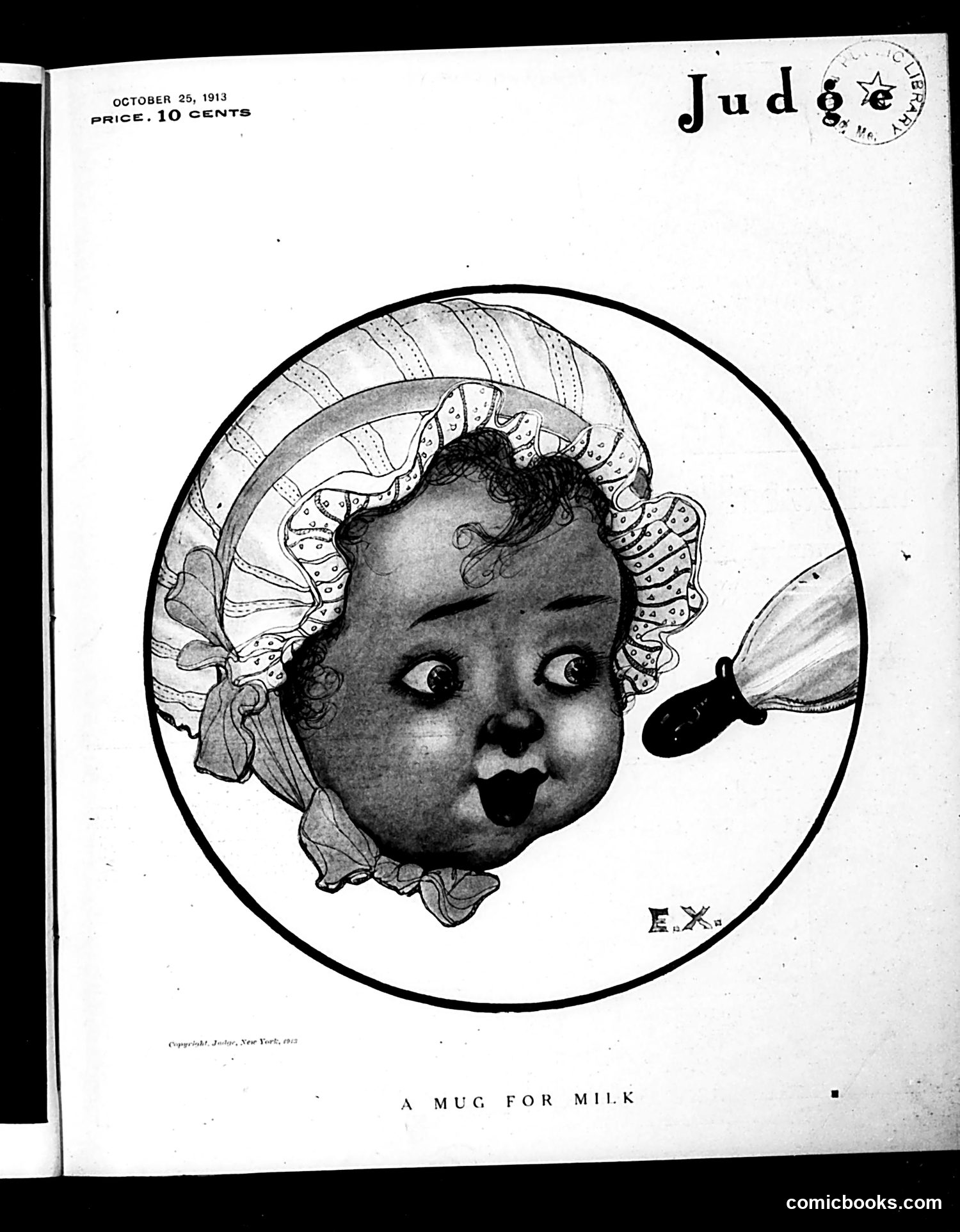
This is a product advertisement disguised as humor. The illustration shows a baby's face designed as a milk mug or drinking vessel, with an ornate bonnet and a surprised expression. A nursing bottle appears to the right. The title "A Mug for Milk" is a pun: "mug" can mean both a drinking cup and a face. The joke plays on the double meaning—the baby's face literally becomes the mug. This was likely advertising novelty dishware or promotional merchandise for dairy products, common in early 20th-century magazines. Judge used humor and visual puns to promote commercial products to its affluent readership. The exaggerated baby imagery and expression were typical of period advertising aesthetics, though such caricatured depictions would be considered crude today.
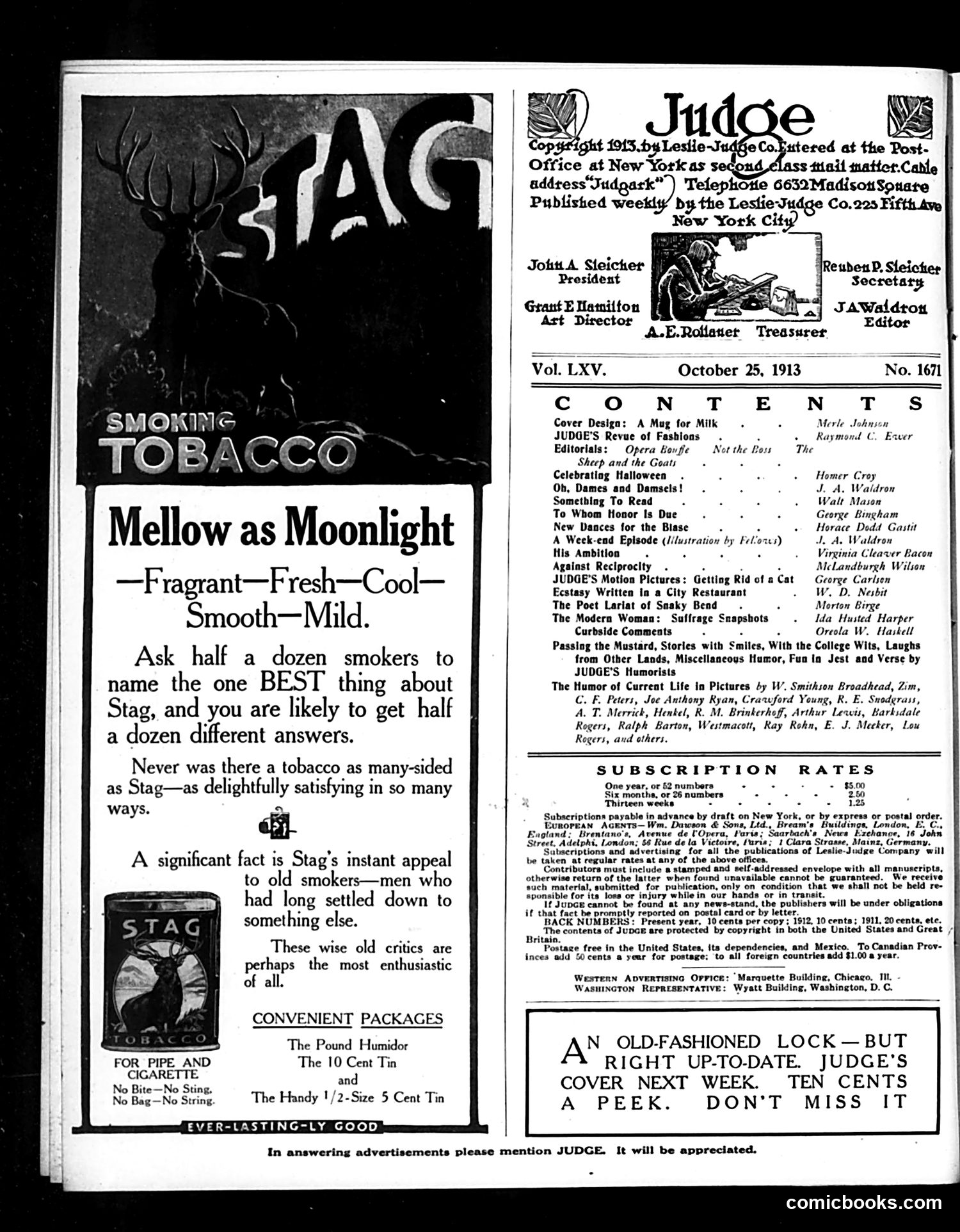
This is primarily an **advertising page** for Stag Smoking Tobacco, with minimal satirical content. The large left advertisement features a silhouetted stag (the animal, serving as the brand mascot) and promotes Stag tobacco as "Mellow as Moonlight" with qualities like "Fragrant—Fresh—Cool—Smooth—Mild." The copy appeals to experienced smokers, claiming Stag's universal appeal across different preferences. The right side contains the magazine's masthead, contents listing, and subscription information typical of 1913 publications. There is **no apparent political cartoon or social satire** on this particular page—it's primarily commercial content interspersed with standard magazine administrative material.
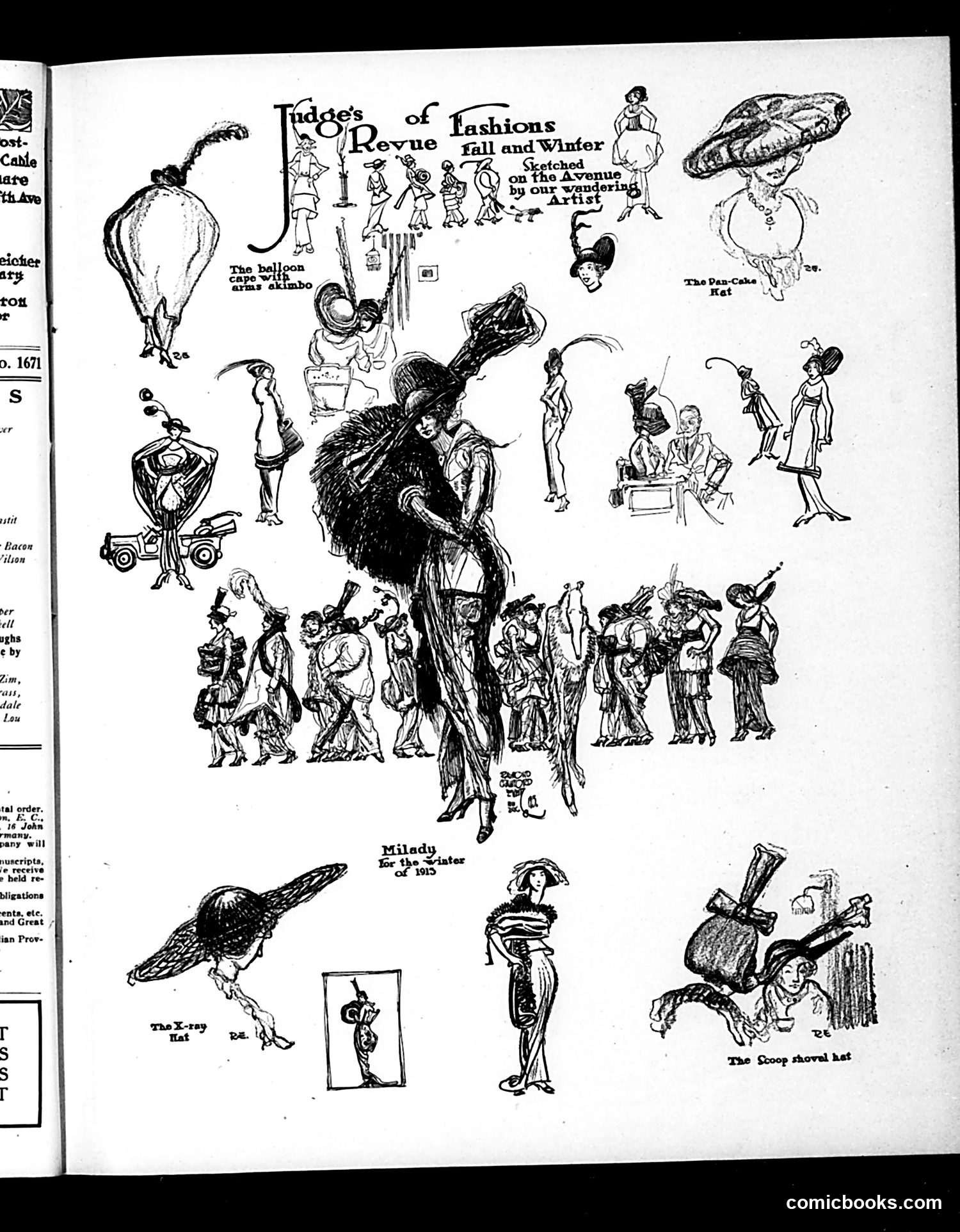
This page presents satirical fashion illustrations titled "Judge's Revue of fashions fall and Winter" centered on "Milady for the Winter of 1915." The central figure is a caricatured woman in elaborate winter clothing, surrounded by smaller vignettes depicting fashionable accessories and absurd hat designs of the era. The satire targets women's fashion trends, particularly the exaggerated, impractical headwear popular in 1915. Named styles like "The Pancake Hat," "The X-ray Hat," and "The Boop Shovel hat" mock the increasingly ridiculous proportions of contemporary millinery. The accompanying figures illustrate how fashion-conscious women adopted these oversized, unwieldy designs. This reflects Judge magazine's recurring critique of women following frivolous fashion trends without regard for practicality.
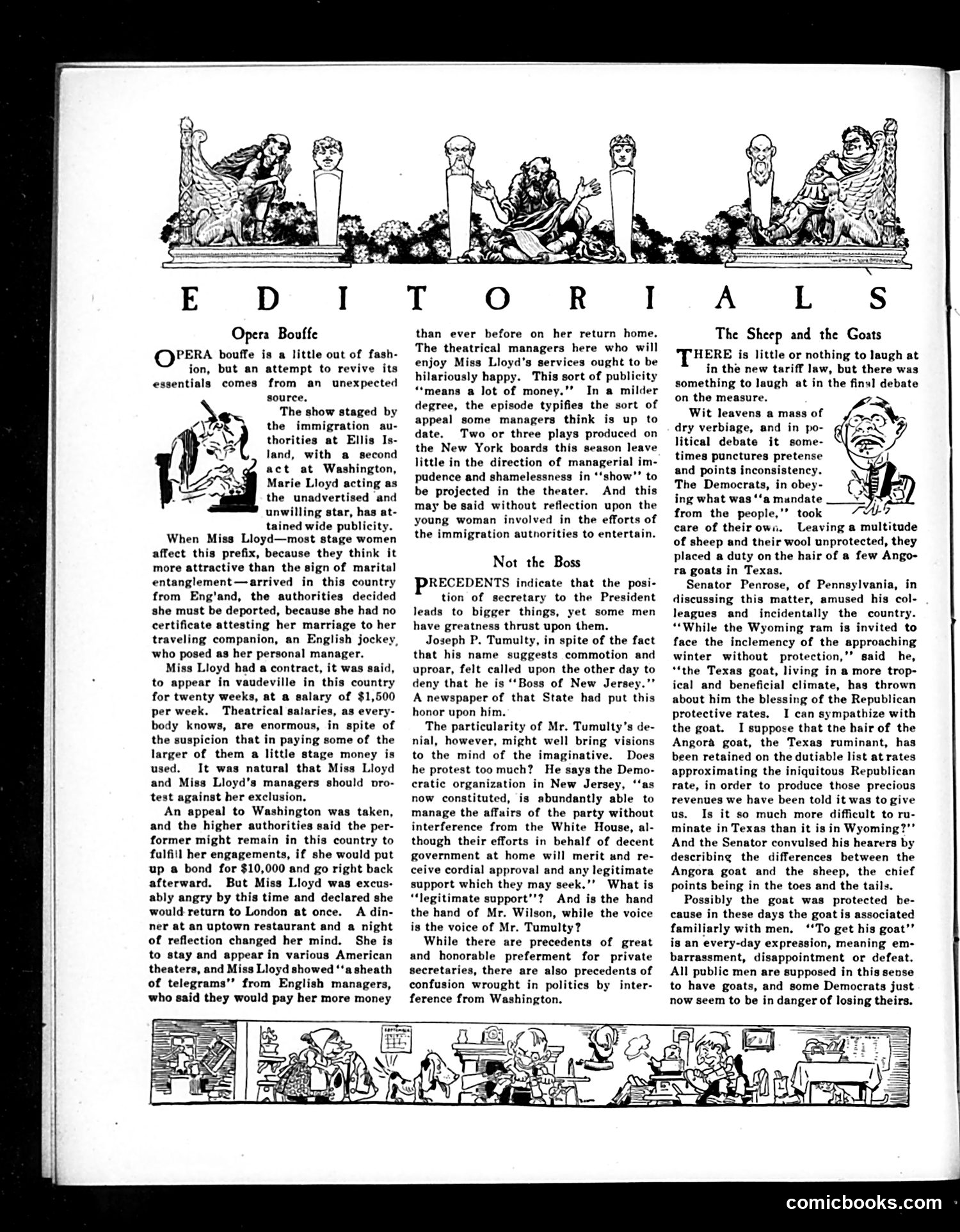
This editorial page from Judge magazine critiques Marie Lloyd, a famous British music hall performer attempting an American comeback. The main article "Open Bouffé" attacks her revival tour as lacking substance—a mere cash grab rather than artistic endeavor. The secondary piece "Not the Boss" satirizes Joseph Tumulty, President Wilson's secretary, for overstepping his authority and wielding excessive influence over Democratic Party politics and government affairs—effectively running things from behind the scenes rather than serving in a proper advisory capacity. "The Sheep and the Goats" mocks Democratic politicians for their inconsistency on tariff protection, particularly regarding wool and Pennsylvania interests, suggesting party hypocrisy on economic policy. The decorative header and bottom comic strip provide satirical framing for these political critiques typical of Judge's style.
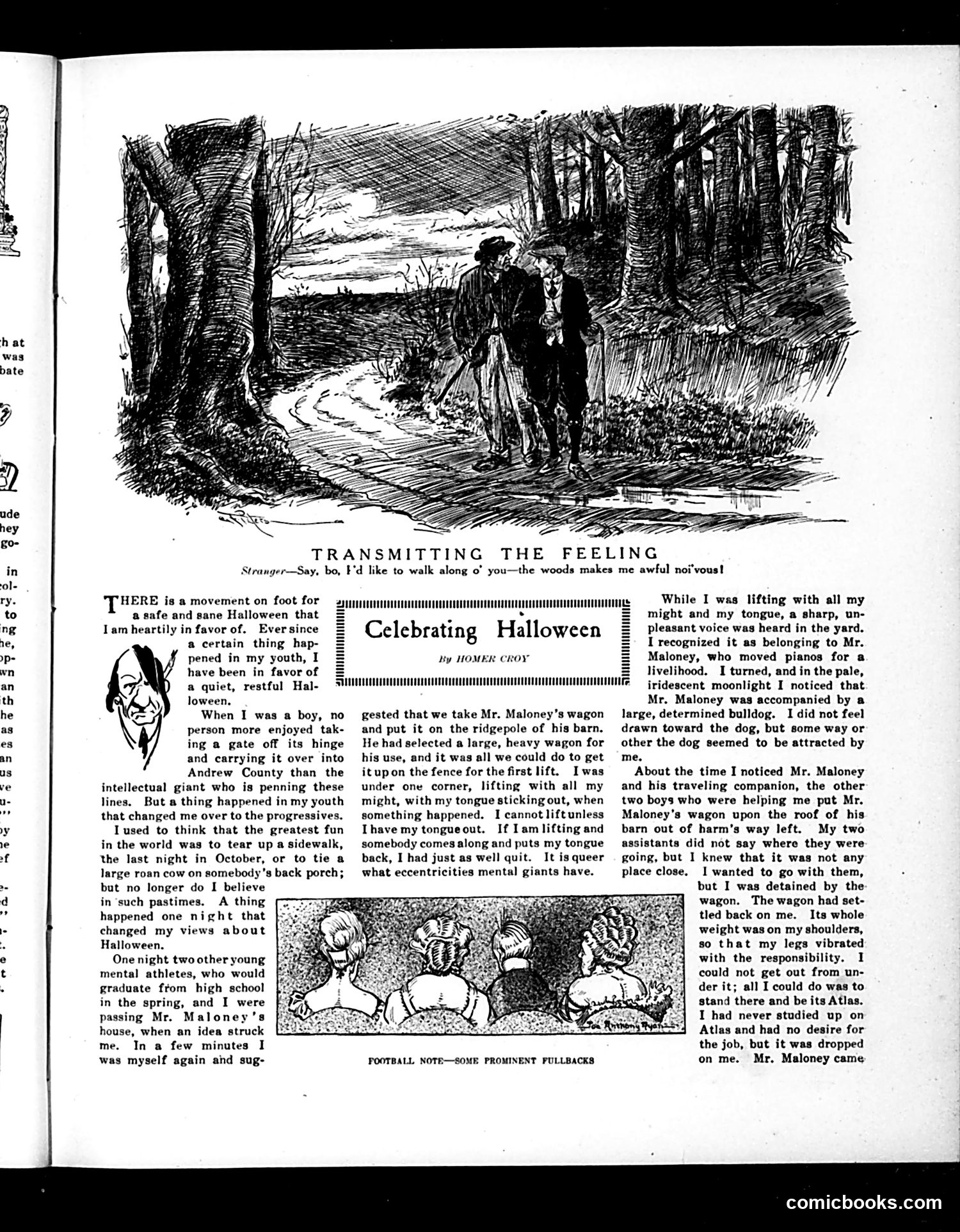
This page from *Judge* presents a Halloween-themed piece by Homer Croy with accompanying illustrations. The main narrative describes the author's youthful Halloween pranks, specifically mentioning tearing up sidewalks and causing mischief at Mr. Maloney's house—suggesting pranks that disrupted a neighbor's property. The top illustration shows two men in a wooded setting; the caption "Transmitting the Feeling" implies one is recounting Halloween memories to another. The lower illustration labeled "Football Note—Some Prominent Fullbacks" appears to show football players in a humorous context, likely connecting Halloween's mischievous spirit to athletic competition or collegiate life. The piece celebrates a "safe and sane Halloween" movement, indicating contemporary concern about dangerous pranks. Overall, it's nostalgic social commentary on Halloween traditions and youth behavior.
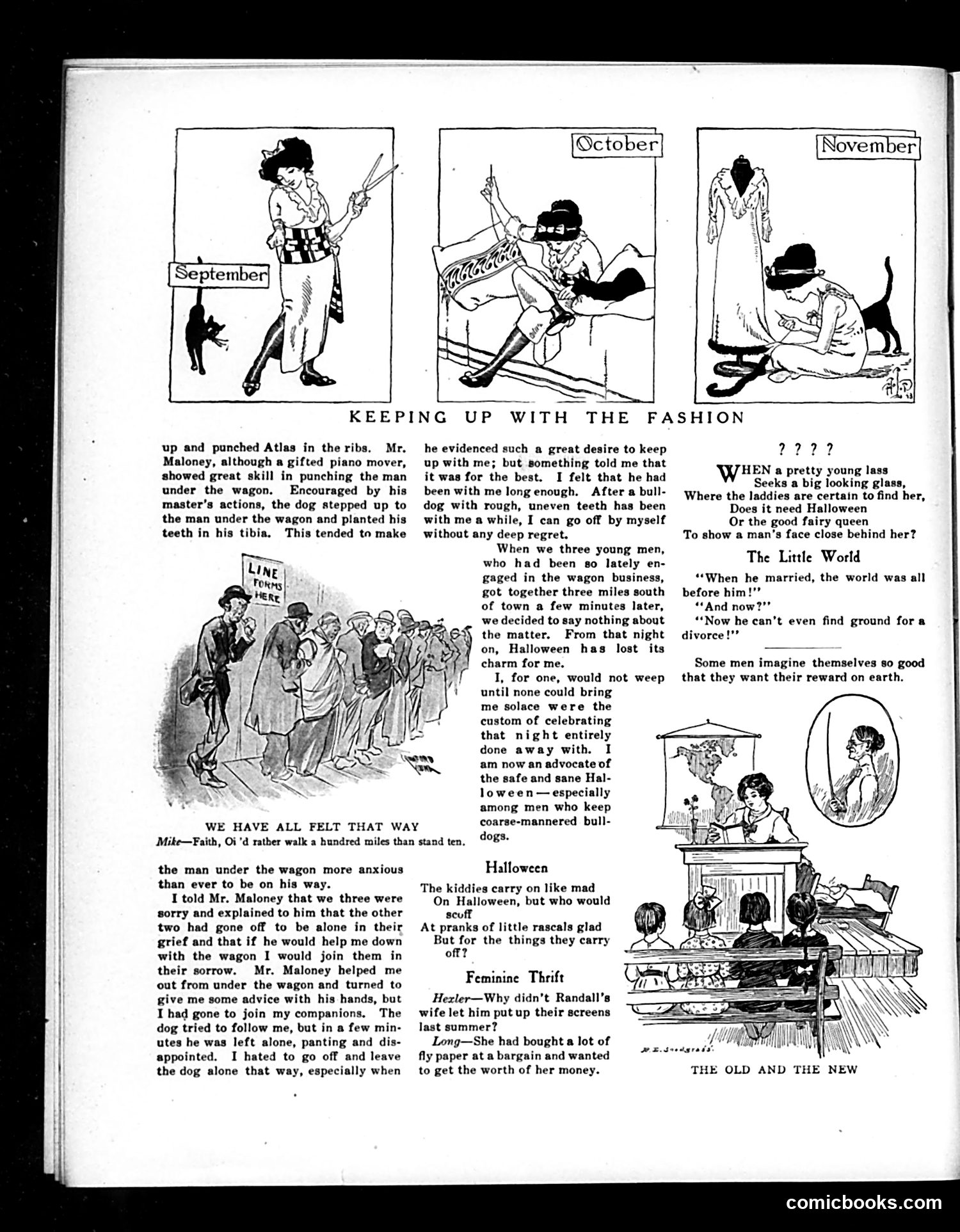
This page satirizes early 20th-century Halloween pranks and their consequences. The top panels illustrate three months (September-November) showing fashionable women engaged in increasingly reckless behavior—suggesting that dangerous "pranks" have become a social trend to follow. The main story describes a violent Halloween encounter: a piano mover named Maloney and his dog brutally attack a man trapped under a wagon, ostensibly for sport. The narrator suggests this experience has soured him permanently on Halloween celebrations. The satire targets the normalization of destructive behavior under the guise of festive tradition. By framing violence as "fashion," Judge critiques how social customs can legitimize cruelty, particularly among working-class men. The accompanying short pieces on Halloween mischief and "Feminine Thrift" maintain the satirical tone, mocking both holiday excess and petty domestic behavior—suggesting Judge viewed contemporary social practices as foolish.
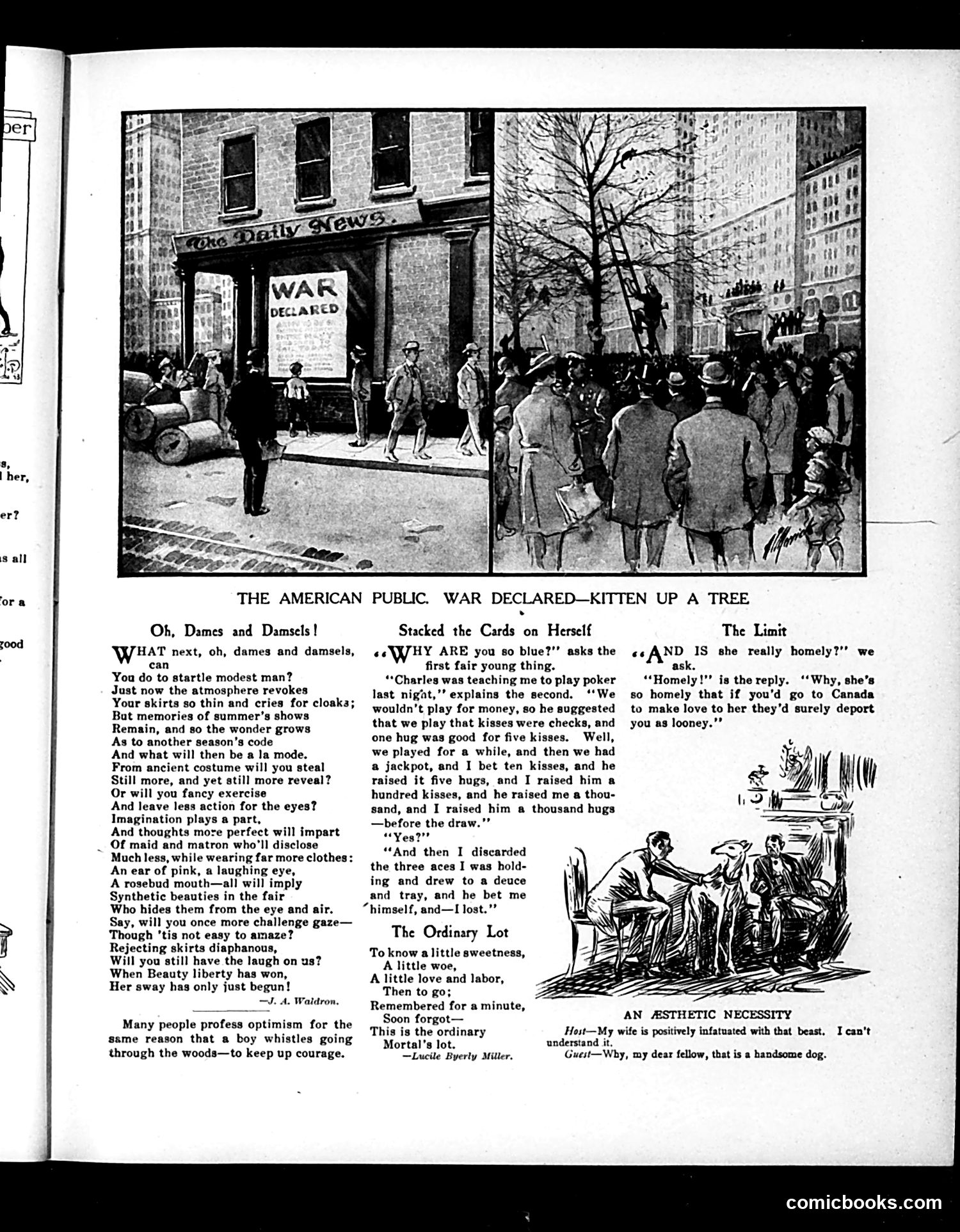
This Judge magazine page satirizes American society at the moment of U.S. entry into World War I. The headline's ironic juxtaposition—placing "WAR DECLARED" alongside a trivial "kitten up a tree" scene—mocks the public's detachment from the gravity of war. The top image shows a Daily News storefront displaying a war declaration poster, surrounded by crowds of ordinary citizens going about their business largely indifferent to the momentous news. Below, multiple humorous pieces—about women's changing fashion, a flirtatious poker game using kisses as currency, and philosophical musings on ordinary life—underscore the satirical point: while the nation enters a devastating conflict, the American public remains preoccupied with trivial personal concerns: clothing trends, romantic games, and shallow social anxieties. The satire suggests both the public's disconnection from war's reality and society's absorption in superficial matters during a historical turning point.
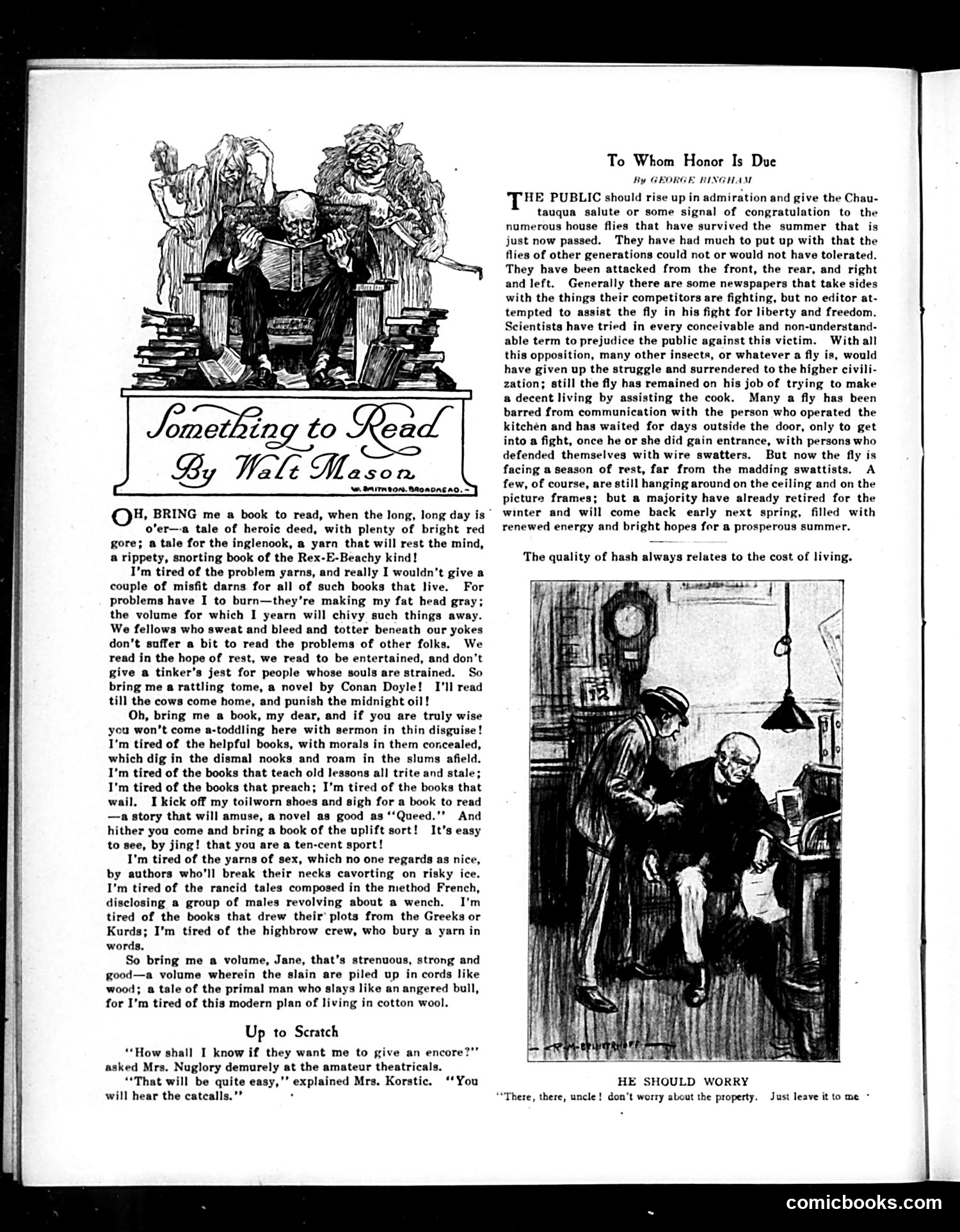
This page contains two pieces of content: **"Something to Read" by Walt Mason** (left): A humorous poem complaining about over-earnest literature. The speaker is tired of "problem yarns," moralistic books, and "uplift" fiction—he wants entertaining adventure stories like Conan Doyle's works instead. The satire targets contemporary literary pretension and didactic fiction that prioritized moral lessons over entertainment. The final cartoon shows an amateur theater performer asking how to know if the audience wants an encore; the response jokes that catcalls (boos) serve as the signal. **"To Whom Honor Is Due" by George Bingham** (right): A satirical piece praising house flies for surviving the summer despite public persecution—they've been swatted, attacked by scientists who've tried to prejudice people against them, and barred from kitchens. The satire appears to mock sensationalist newspaper coverage that takes "sides" with underdogs, here comically applied to common household pests. The accompanying illustration shows someone reassuring an uncle not to worry about property damage.
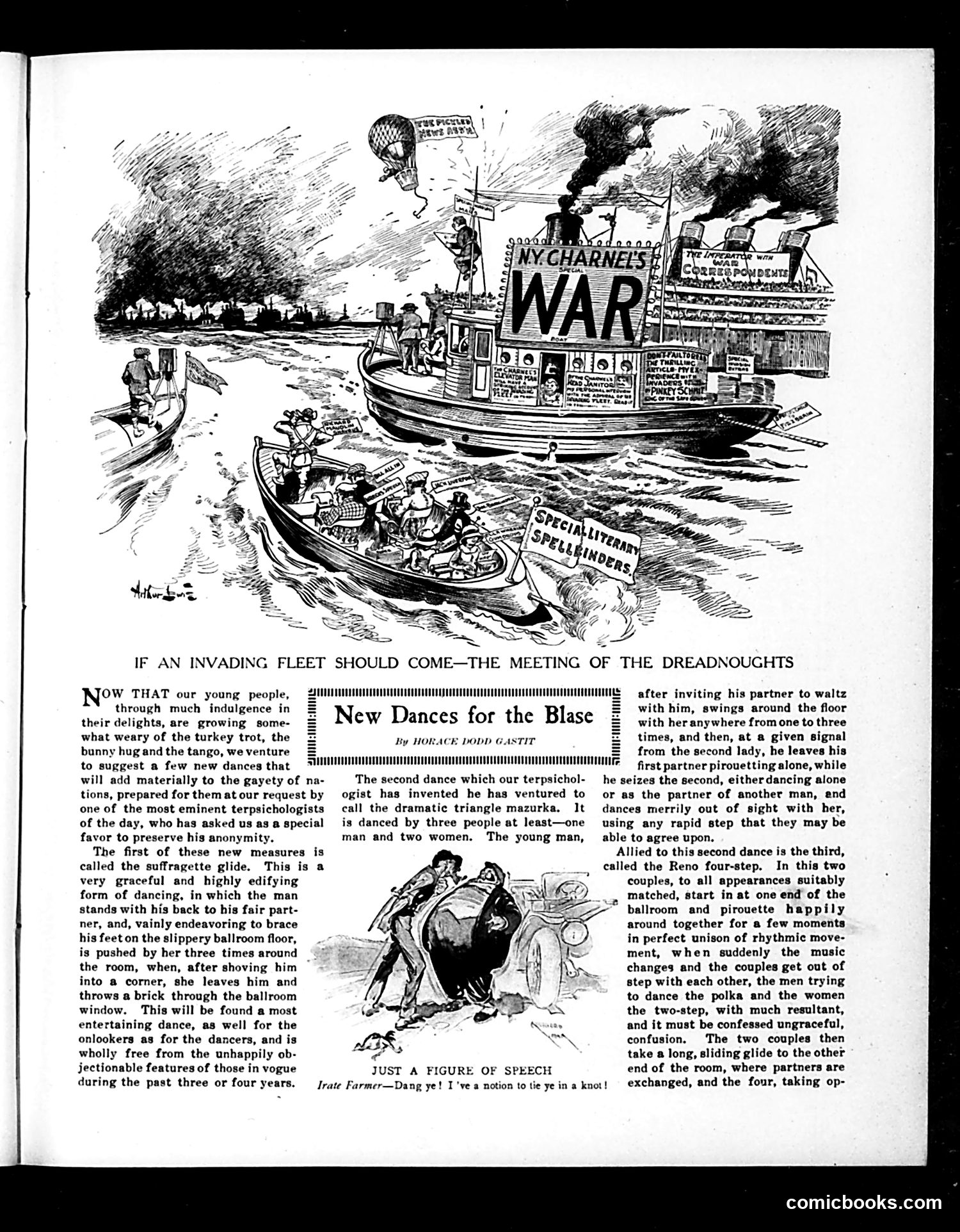
This satirical piece mocks contemporary social movements through dance metaphors. The top cartoon depicts "N.Y. Charnel's War" as a theatrical spectacle on boats, likely referencing sensationalized war coverage during the World War I era. The main article proposes absurd "new dances" that satirize social concerns of the day: 1. **"The Suffragette Glide"** ridicules the women's suffrage movement by depicting a woman pushing a man around and throwing a brick through a window—mocking suffragettes as violent and emasculating. 2. **"The Dramatic Triangle Mazurka"** and **"The Reno Four-step"** lampoon infidelity and divorce, referencing Reno, Nevada (famous for easy divorces). Partners swap mid-dance, suggesting the era's perceived moral decay in relationships. The satire expresses conservative anxiety about women's rights activism, changing gender dynamics, and loose morality—presenting these social changes as ridiculous through the lens of fashionable dances.
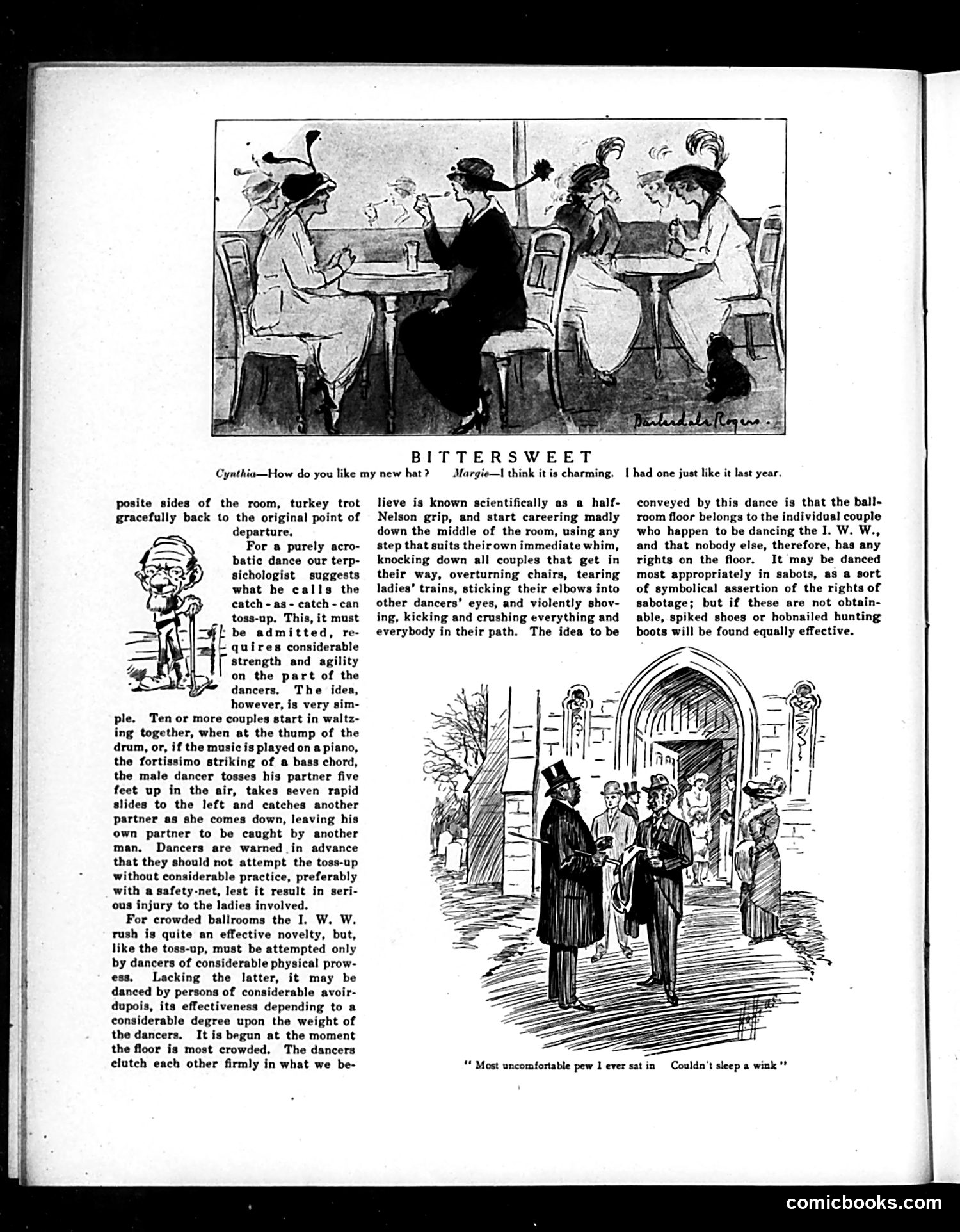
This page satirizes modern dance crazes and labor radicalism circa 1910s. **Top cartoon**: A tea party scene where two women discuss a hat, with the caption joke being the second woman's compliment rings hollow—she owned an identical hat last year, making the "new" hat unremarkable. **Main article**: Describes absurdist "novelty dances"—the "catch-as-catch-can toss-up" (partners literally toss each other mid-dance) and the "I.W.W. rush." The I.W.W. (Industrial Workers of the World) reference is the satire's political bite: the dance mockingly describes anarchist/radical behavior as a ballroom trend, with dancers deliberately crashing into others, destroying property, and asserting "rights of sabotage." It's satirizing both frivolous dance fads and labor radicals by conflating them. **Bottom cartoon**: Churchgoers complaining about an uncomfortable pew—unrelated to the dance content, likely filler. The satire ridicules both fashionable society's embrace of chaotic "modern" dances and the I.W.W.'s destructive tactics by presenting them as equivalent entertainments.
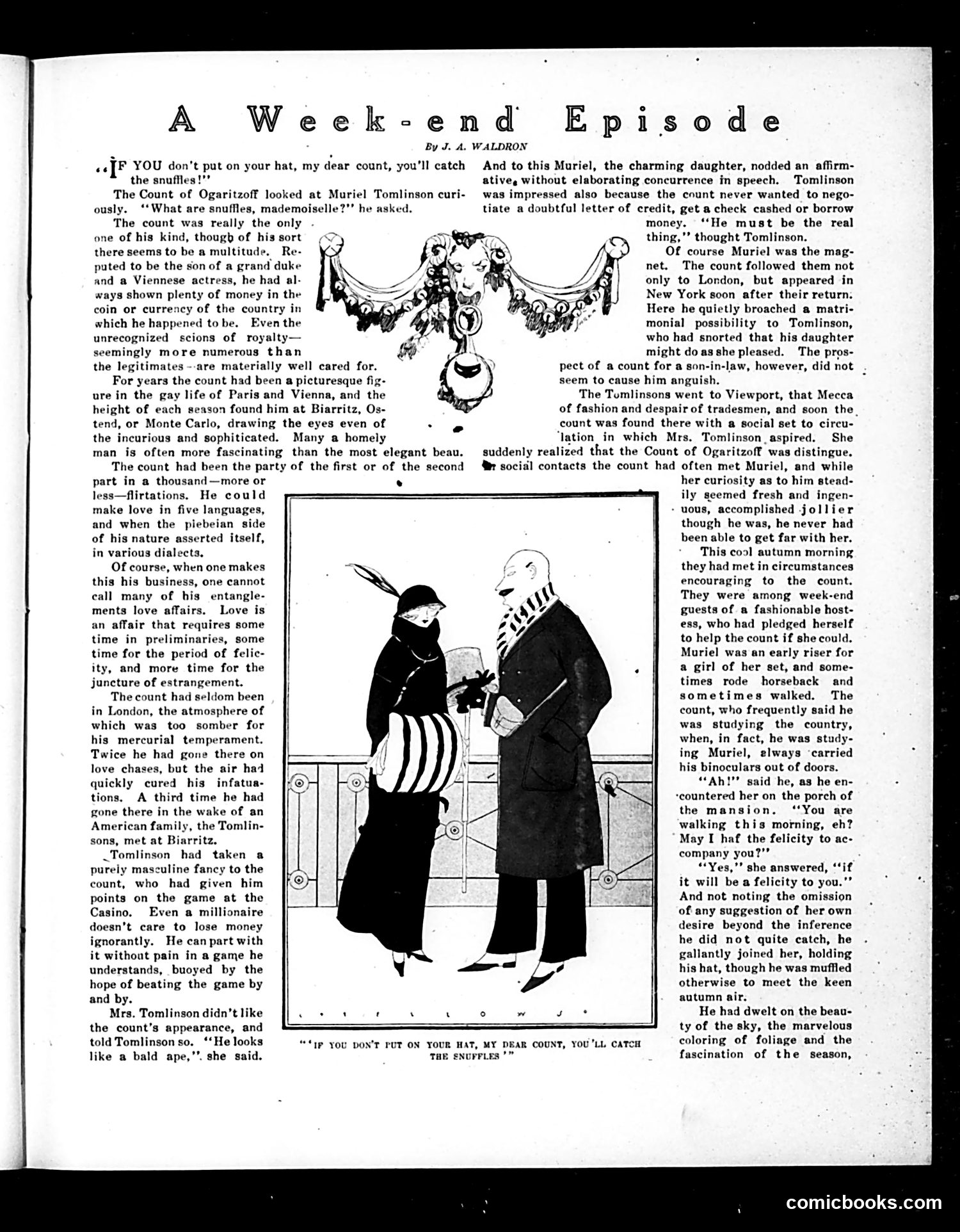
This is a romantic satirical story about a fortune-hunting European nobleman pursuing an American heiress. The Count of Ogaritzoff, a vaguely aristocratic figure with questionable credentials (reputed son of a grand duke and Viennese actress), follows the wealthy Tomlinson family from Paris to London to New York to the fashionable resort of Viewport, ostensibly courting their daughter Muriel. The satire targets the period's social pretense: wealthy Americans eager to legitimize themselves through European titles, and impoverished European "counts" exploiting this hunger for aristocracy. The count charms the family through careful performance—never needing loans, speaking multiple languages, never directly demanding money—while his true mercenary motives remain transparent to the reader. The illustrated scene shows the count encountering Muriel on a morning walk, attempting his romantic pursuit. The caption's hat joke suggests his manipulative gallantry. The story mocks both the phony "count" and the American social-climbing that enables his scheme.
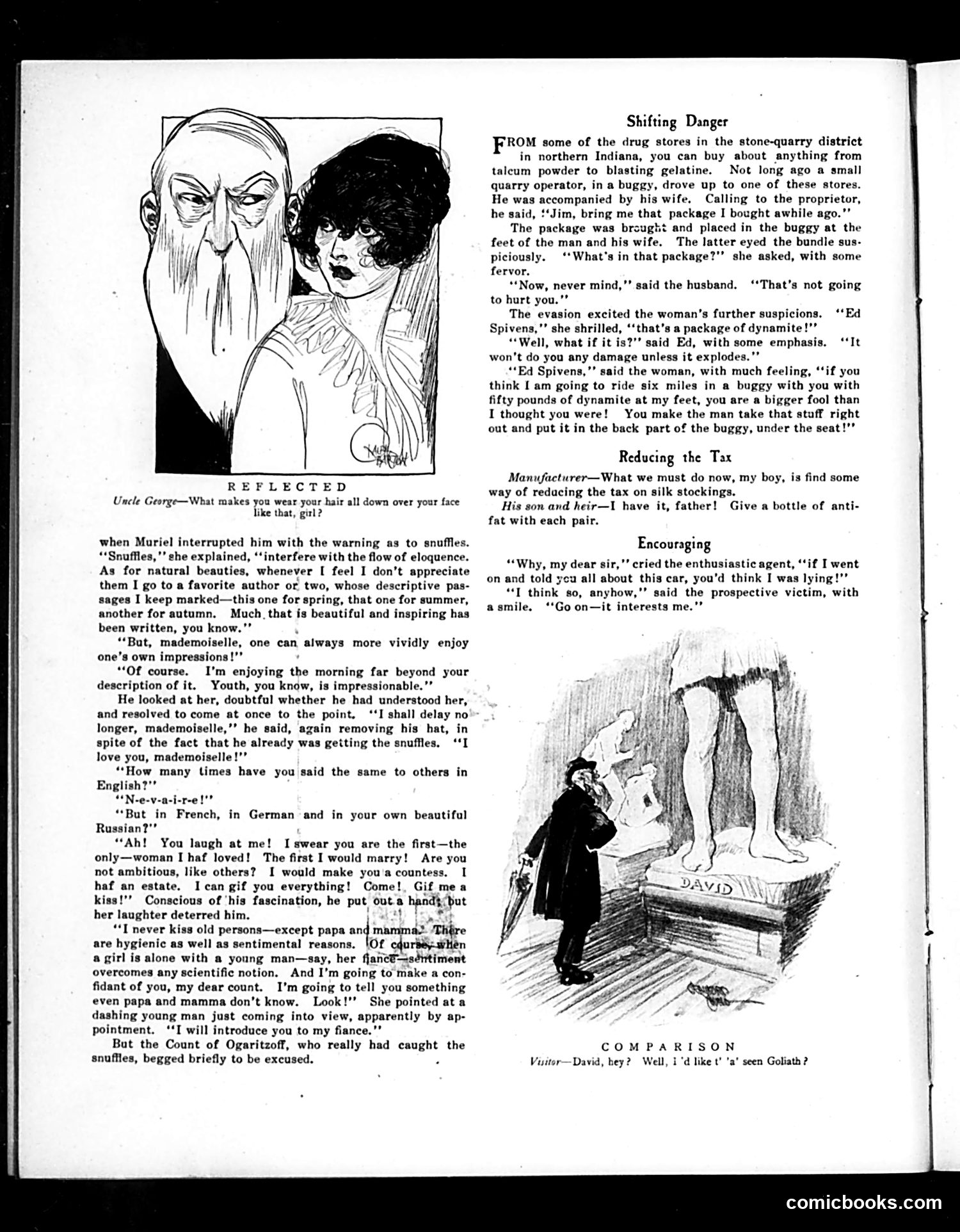
This page contains three satirical pieces typical of early 20th-century humor: **"Reflected"** (top): A romantic comedy where a young foreign count (identifiable by his accent and grandiose manner) attempts to court a clever young woman. The satire mocks both his affected continental manners and her pseudo-intellectual affectations (refusing to kiss "old persons" for hygienic reasons). The joke culminates when she reveals her actual fiancé, embarrassing the count. **"Shifting Danger"** (right): Satire on rural/industrial safety. A quarry operator's wife objects to him transporting dynamite in their buggy—a practical, humorous domestic dispute highlighting industrial hazards in small towns. **"Reducing the Tax"** and **"Encouraging"** (bottom): Brief jokes mocking business practices (reducing silk stockings tax by pairing with diet pills) and deceptive car sales pitches. The illustrations are crude line drawings typical of Judge's visual style. The overall tone targets pretension, faulty logic, and commercial dishonesty—Judge's recurring satirical targets.
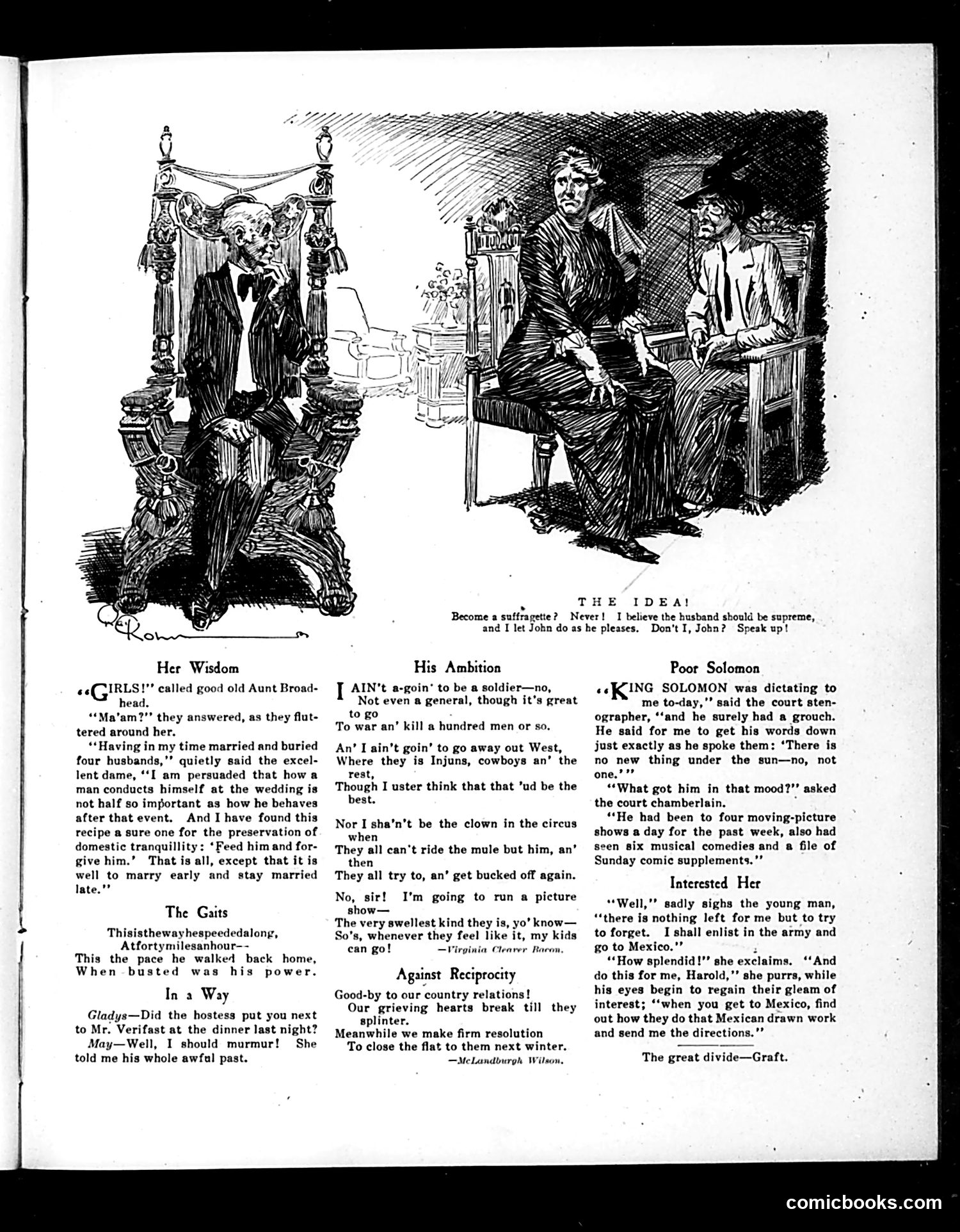
This page contains multiple satirical pieces typical of early 20th-century American humor: **"Her Wisdom"** mocks traditional marriage advice, with Aunt Broadhead counseling young women to marry early and stay married by "feeding" and forgiving their husbands—treating wives as subordinate. **"His Ambition"** ridicules working-class male aspirations, depicting a man rejecting soldiering, Western adventure, and circus work to become a picture-show proprietor so his children can attend movies freely—satirizing how new entertainment mediums distracted from "respectable" ambitions. **"Poor Solomon"** jokes that even King Solomon, despite biblical wisdom, finds modern life repetitive after attending multiple movies and comedies—mocking contemporary mass entertainment's superficiality. **"Interested Her"** presents a young woman unromantically focused on acquiring Mexican craft instructions rather than caring about her suitor's military service—light satire of women's practical materialism. The page satirizes marriage dynamics, class ambitions, entertainment culture, and gender relations through genteel humor typical of Judge's readership.
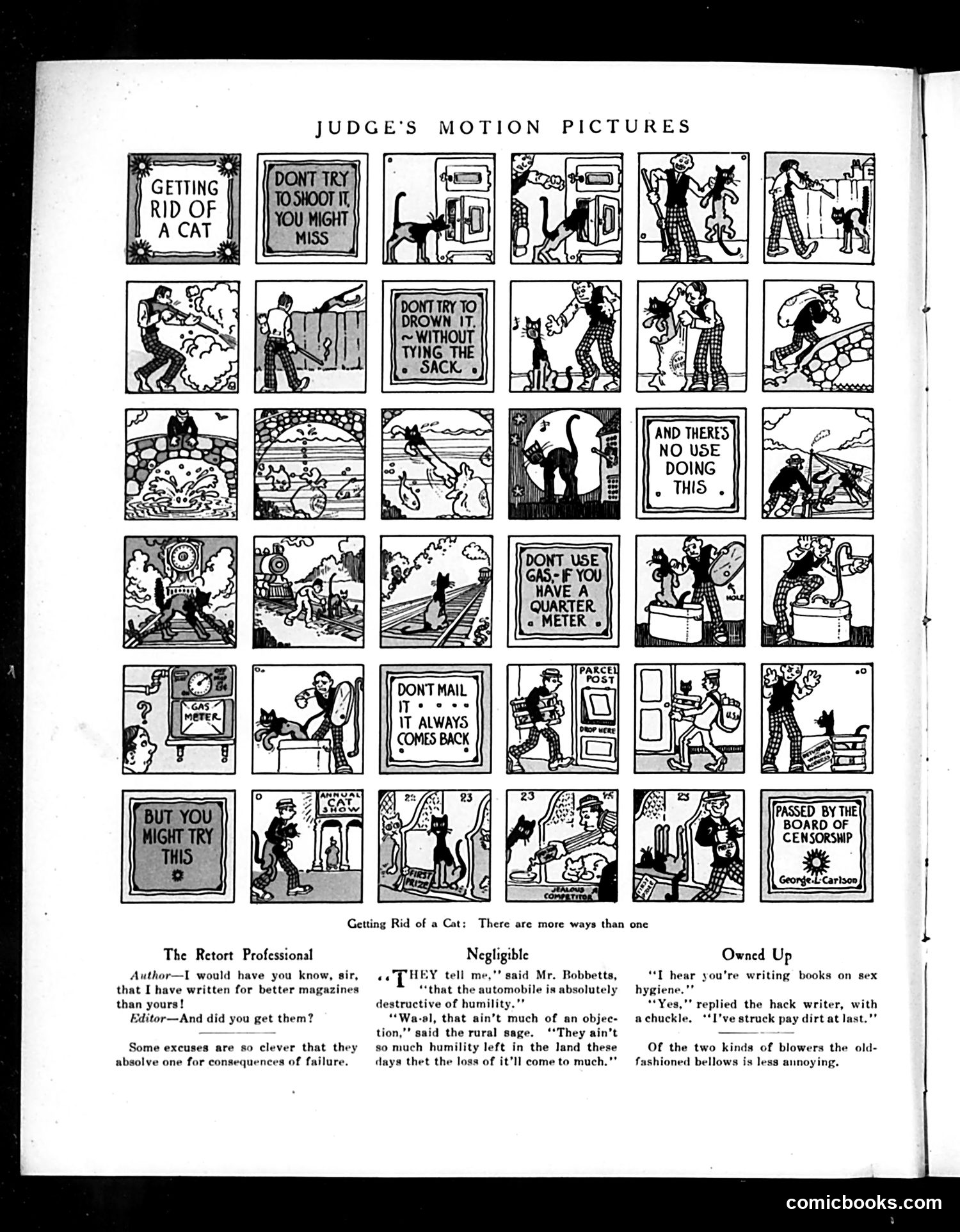
This page presents three separate satirical pieces from Judge magazine's "Motion Pictures" section (early cinema-style illustrated humor): 1. **"Getting Rid of a Cat"** (top): A wordless comic strip showing various failed methods of removing a cat, ending with the caption "there are more ways than one"—satirizing both the cat's resilience and human futility. 2. **"The Retort Professional"**: A dialogue joke mocking pretentious writers. An author boasts of writing for "better magazines," and the editor deflates him by asking if he actually *got* published there—suggesting the author's claim is empty bluster. 3. **"Negligible"** and **"Owned Up"**: Two short jokes about automobiles destroying humility (with a rural character dismissing this concern) and a hack writer profiting from sex-hygiene books. These are typical Judge satire: attacking professional pretension, rural ignorance, and contemporary social anxieties (automobiles, publishing, sexual education). The humor relies on recognizable character types and punchy comedowns of inflated claims.
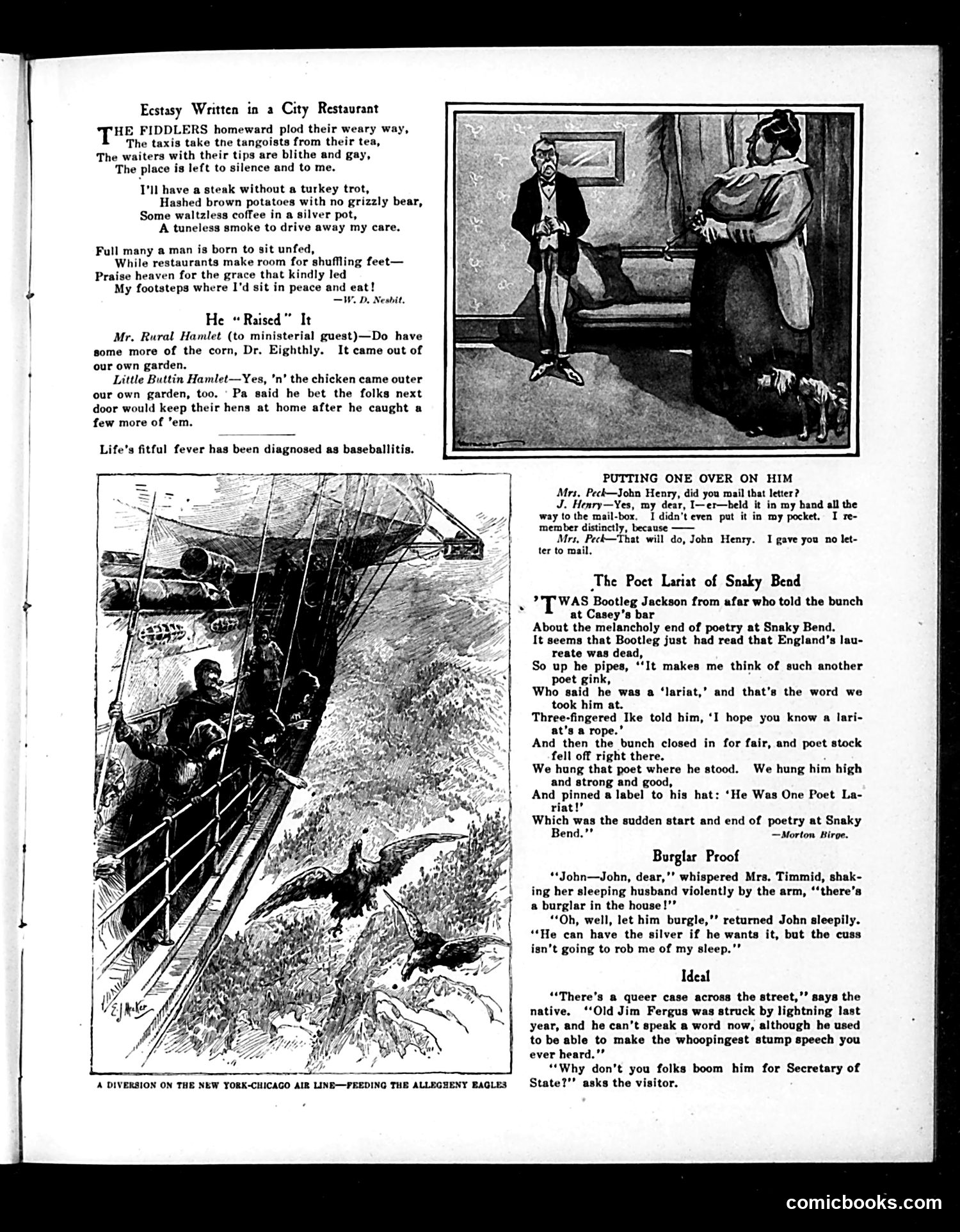
This page contains several humorous pieces satirizing early 20th-century American life: **"Ecstasy Written in a City Restaurant"** parodies romantic poetry, depicting a diner's relief at escaping the noise and crowds of restaurants filled with "tangoists" and dancers—mocking the era's dance crazes (turkey trot, waltz). **"He 'Raised' It"** jokes about rural life: a farmer's son admits his father caught neighbors' chickens in their garden, suggesting he'll catch more—a mild commentary on countryside neighborly disputes. **"The Poet Lariat of Snaky Bend"** is frontier humor about a man claiming to be a "lariat" (rope) poet. The rough bunch, misunderstanding or rejecting his pretension, hangs him—satirizing both artistic pretension and frontier justice. **"Burglar Proof"** and **"Ideal"** are brief domestic and small-town jokes about apathy and ironic political commentary respectively. The illustration shows an aerial mail delivery scene, referencing the then-novel New York-Chicago air mail service.
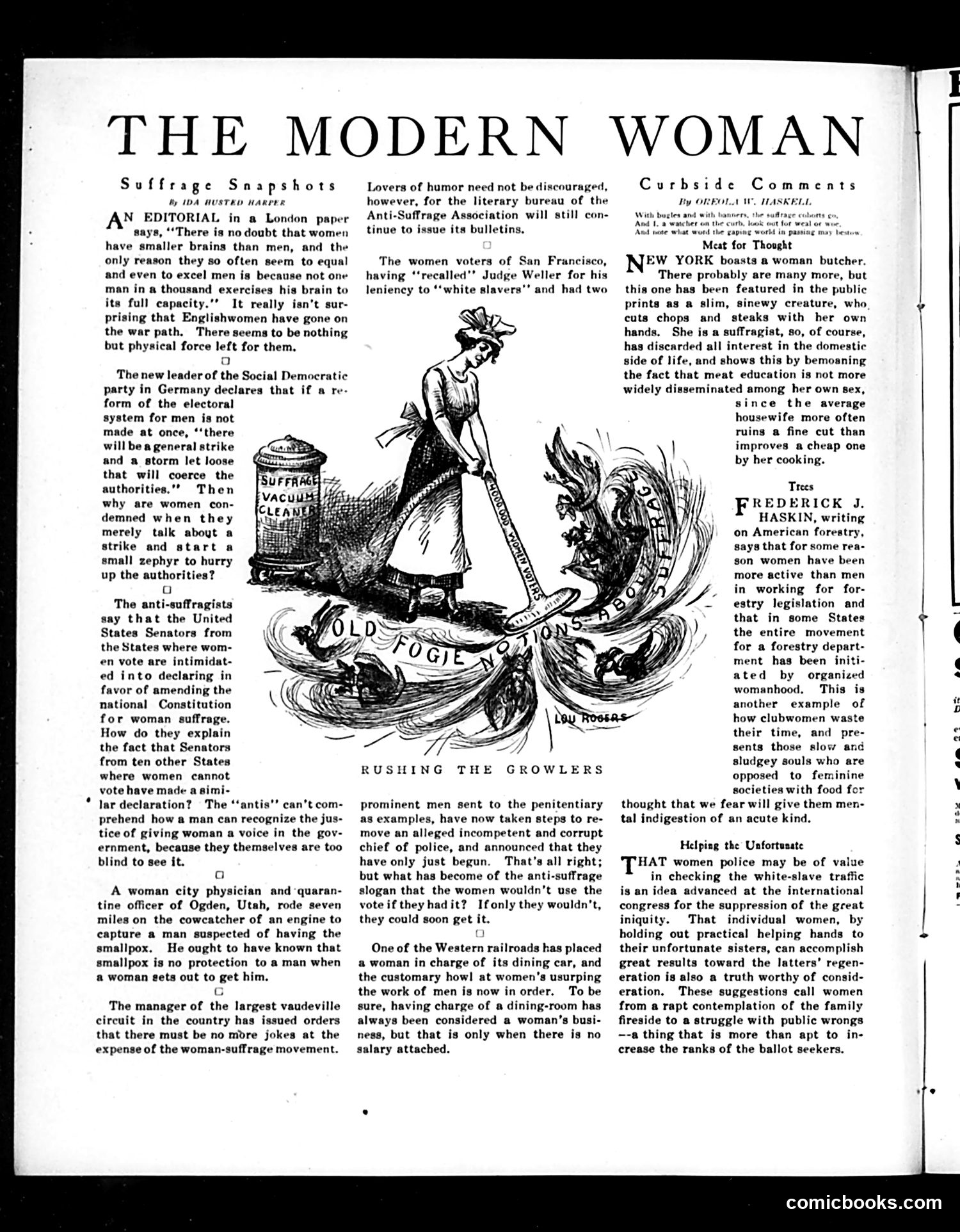
This page satirizes **anti-suffrage arguments** through Ida Husted Harper's "Suffrage Snapshots" column. The central cartoon depicts a woman "rushing the growlers"—aggressively pursuing old obstacles (labeled "Old Fogie" and "Suffrage")—sweeping them away with a broom marked "Suffrage Cleaner." The satire mocks anti-suffragists' contradictions: they claim women won't use voting rights if granted, yet women voters in San Francisco have already successfully recalled a judge and removed a corrupt police chief. Harper highlights the hypocrisy that women are condemned for "strikes" while male politicians threaten far worse. She also exposes how society only objects to women's work when **salary is attached**—revealing that opposition stems from economic rather than moral concerns. The cartoon and accompanying commentary argue anti-suffragists are intellectually dishonest "growlers" resisting inevitable progress.
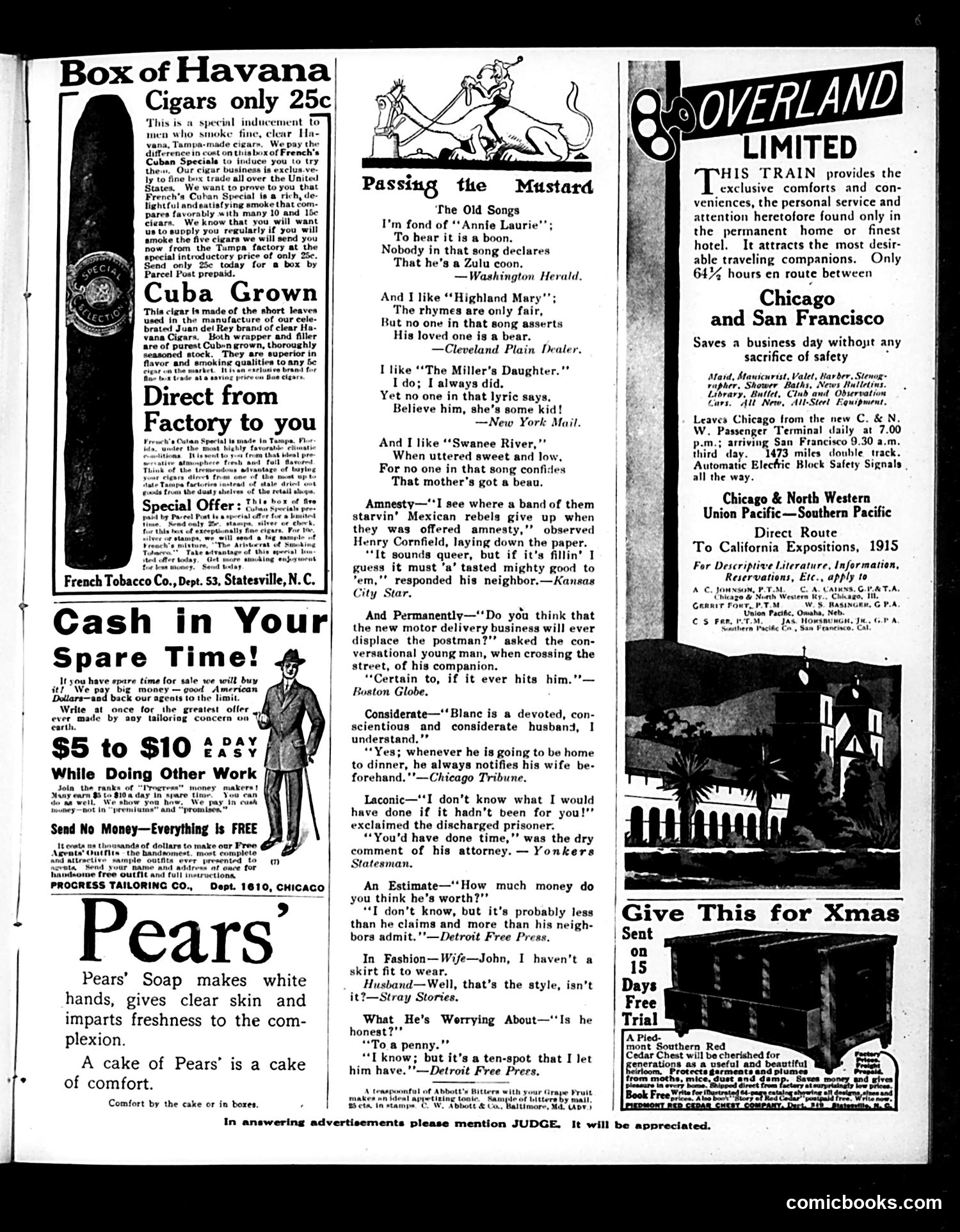
This page is primarily **advertisements and humorous short anecdotes** rather than political cartoons. The content includes: **Advertisements**: Cigars, soap, tailoring services, and a railroad (Overland Limited train service between Chicago and San Francisco). **"Passing the Mustard" section**: A series of brief, genteel comic observations about old sentimental songs. The humor relies on contrasting the romantic idealism of classical songs ("Annie Laurie," "Highland Mary," "Swanee River") with crude modern slang and crude realities—suggesting modern youth have lost refinement. One anecdote references "Zulu coon" (using a racial slur contemporary to the era), mocking lowbrow entertainment preferences. **Short jokes**: Various one-liners about marriage, business, honesty, and fashion—typical "filler" humor for the period, often playing on marital discord and practical cynicism. **Context for modern readers**: The genteel tone contrasting "proper" old songs with vulgar modern speech reflects anxieties about cultural decline and modernization common in early 20th-century satirical magazines. The humor assumes educated, middle-class readers familiar with classical ballads.
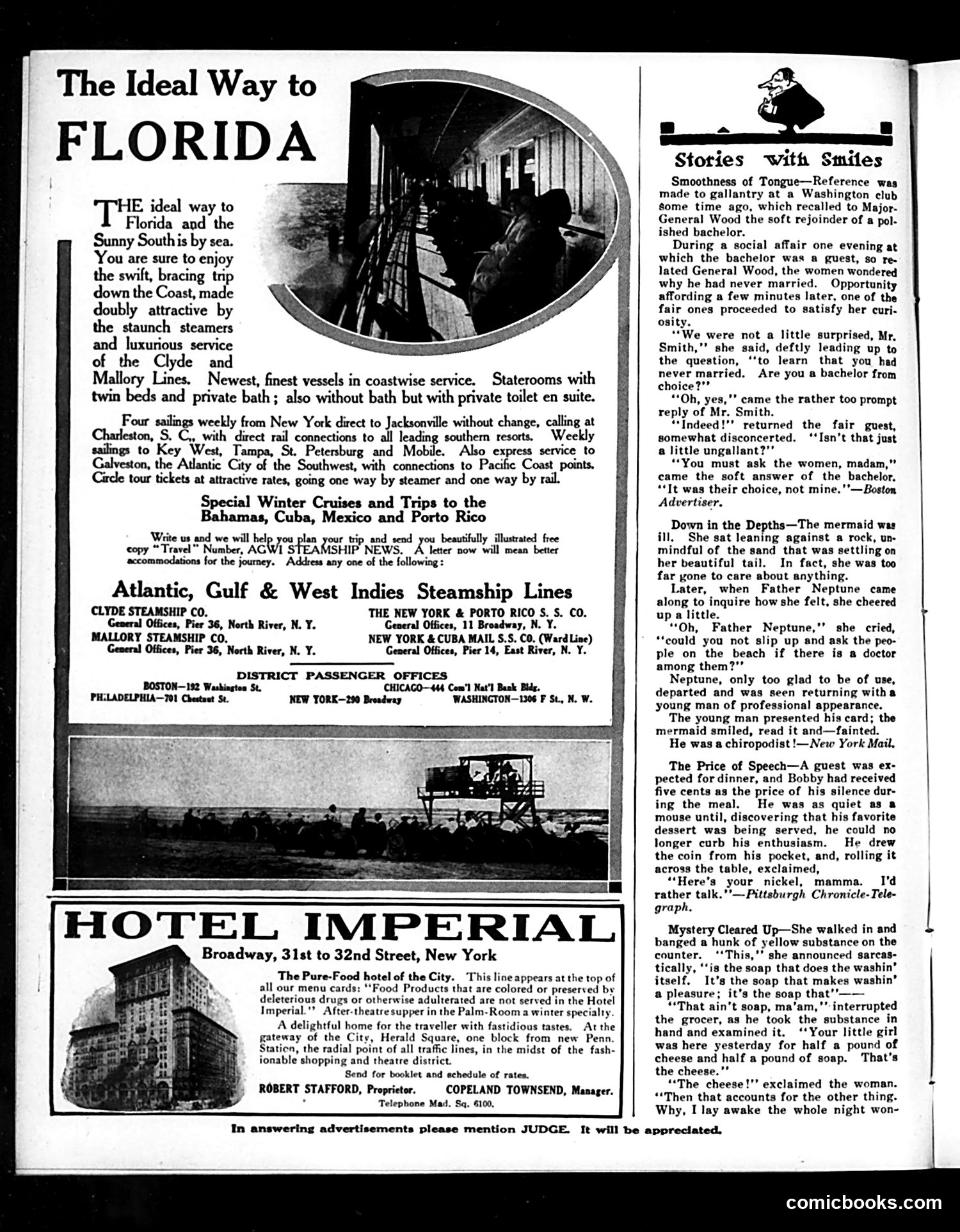
This page is primarily **advertising**, not political satire. It contains travel and hotel advertisements for early 20th-century leisure destinations (Florida steamship lines, Hotel Imperial in New York). The small "Stories with Smiles" section offers light humor anecdotes unrelated to politics or social commentary: 1. **"Smoothness of Tongue"** — A bachelor uses witty deflection when asked why he never married, implying women rejected him rather than him rejecting them. The humor relies on clever wordplay and gallant social banter. 2. **"Down in the Depths"** — A fragmentary mermaid story (text cuts off), likely a whimsical or romantic tale. These brief comedic pieces use gentle, conversational humor typical of *Judge* magazine's lighter content — social observations about courtship and fantasy rather than political satire. The page reflects Gilded Age leisure culture and period attitudes toward romance and bachelor life.
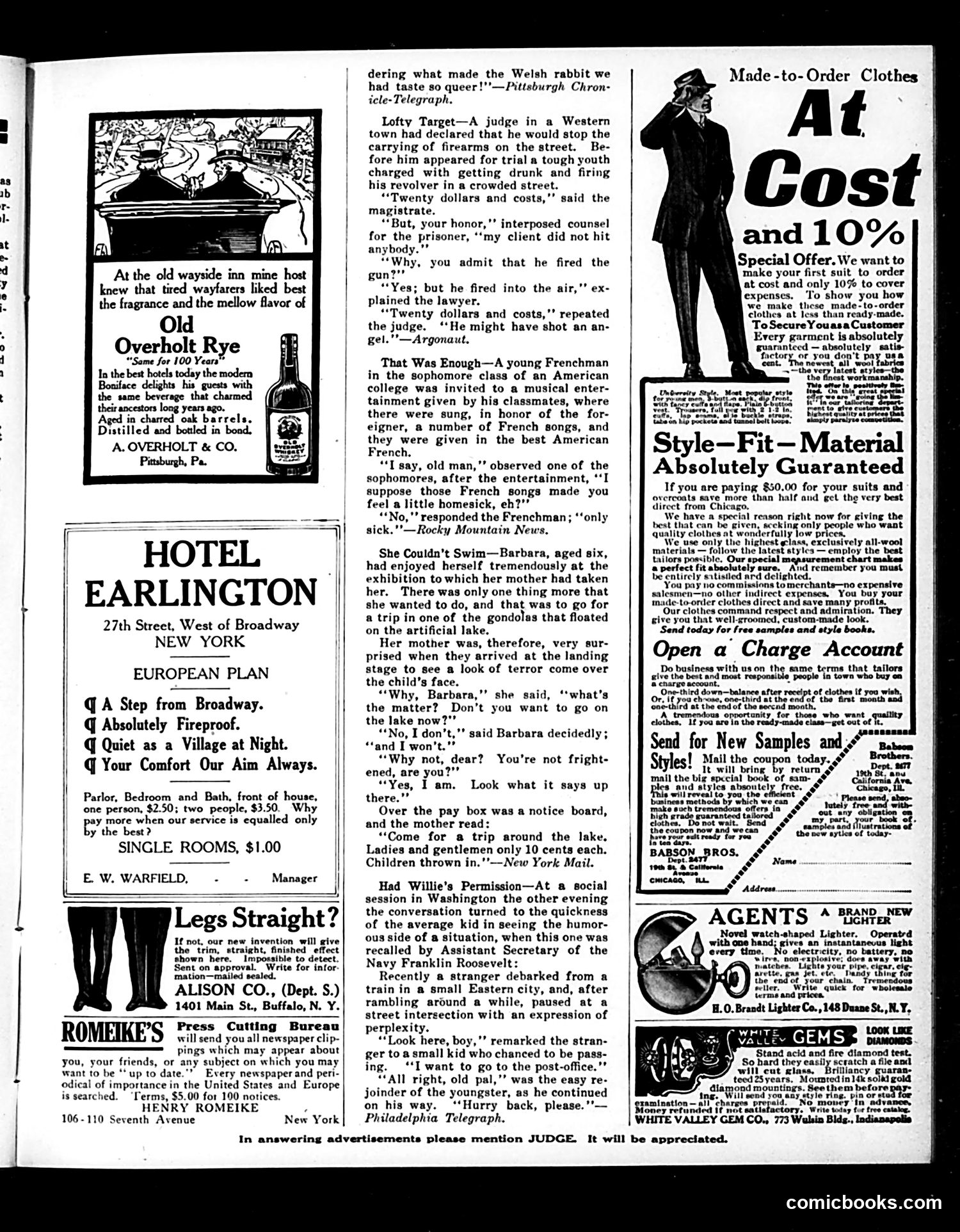
This page is primarily **advertising**, not political satire. The dominant content includes ads for Old Overholt Rye whiskey, Hotel Earlington in New York, a ladies' leg-straightening device, and various services (press clipping bureau, custom tailoring). The page contains several short **humorous anecdotes** rather than political cartoons: a judge imposing identical fines on a revolver-firing youth regardless of aim (satirizing judicial logic); American college students singing French songs badly for a visiting French classmate (mocking American pretension); a child misreading a gondola sign advertising "children thrown in" as literal (wordplay humor); and a reference to Franklin Roosevelt observing children's humor. There is **no clear political message** or caricature. The content reflects early 20th-century American commercial culture and gentle, lighthearted social observation typical of Judge magazine's humor section.
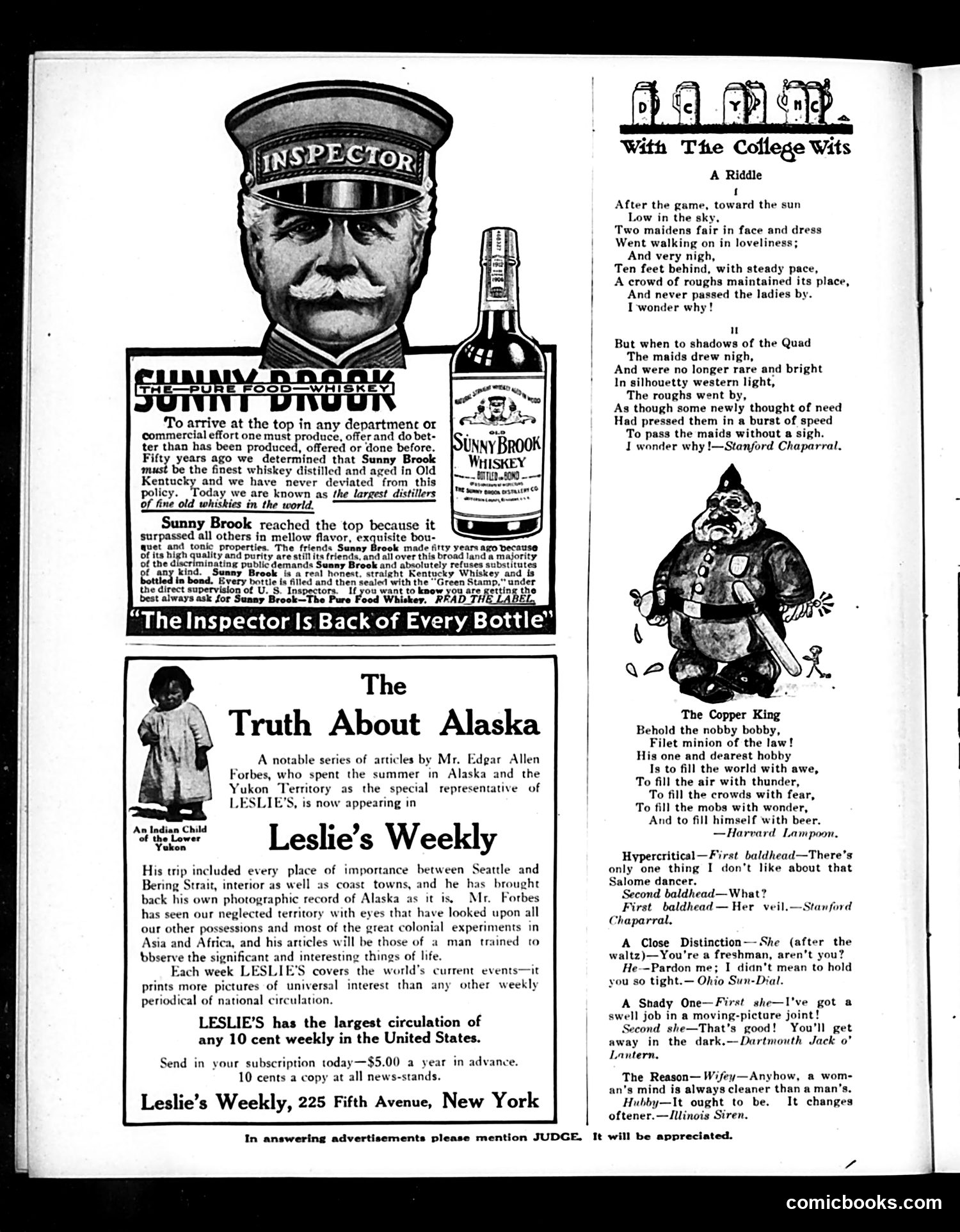
This page mixes a **whiskey advertisement** with **college humor** from various university publications. The top features a **Sunny Brook Whiskey ad** with an "Inspector" character—a reference to Prohibition-era federal alcohol regulation. The ad claims fifty years of quality production and boasts being "the largest distillers of fine old whiskies." The inspector figure ironically represents government oversight, while the ad emphasizes the product's legitimacy under "U.S. Inspectors." Below is a Leslie's Weekly promotion for articles about Alaska by Edgar Allan Forbes. The right side collects humorous riddles and jokes from college newspapers (Stanford Chaparral, Harvard Lampoon, etc.). These include mild, period-appropriate humor: a riddle about men following women until darkness (implying impropriety becomes invisible), jokes about police ("bobbies"), bald men watching dancers, and domestic humor about women's minds. The humor reflects early-20th-century college attitudes—somewhat risqué by era standards but relatively innocent today.
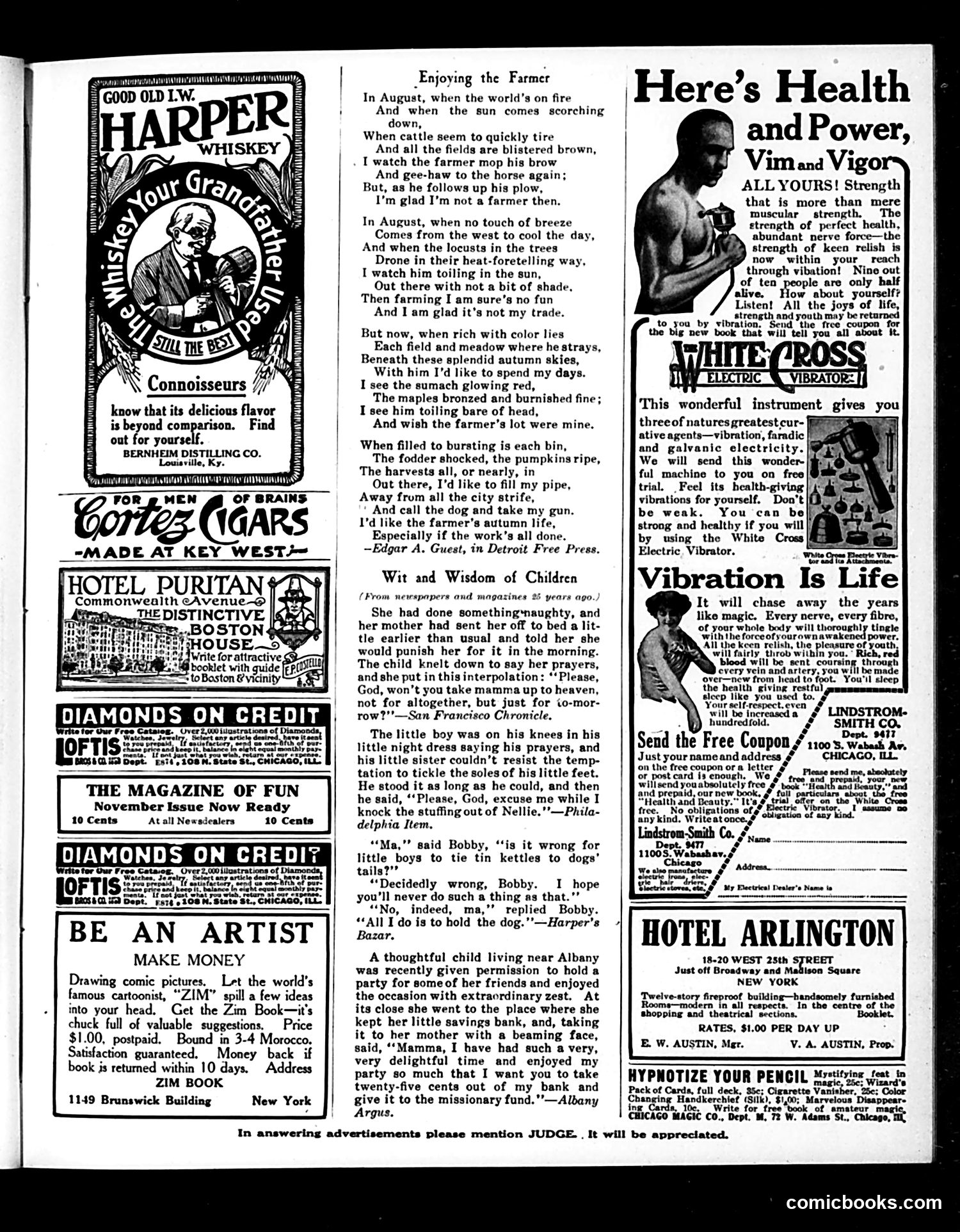
This page is primarily **advertising and light content** rather than political satire. The dominant elements are: **Advertisements** occupy most space: Harper's Whiskey, Cortez Cigars, Hotel Puritan, diamonds-on-credit schemes, and a correspondence course for aspiring cartoonists (the "Zim Book"). **The main editorial content** is a poem, "Enjoying the Farmer," by Edgar A. Guest, expressing nostalgic ambivalence about rural life—appreciating autumn harvests while glad to avoid the hard labor of summer farming. **"Wit and Wisdom of Children"** presents anecdotes about children's innocent but humorous misinterpretations of morality and prayer, typical humor for the era. There is **no identifiable political cartoon or social satire** on this page. Judge here functions as a general-interest humor and advertising magazine rather than delivering pointed political commentary. The content reflects early 20th-century middle-class sensibilities about work, nature, and childhood.
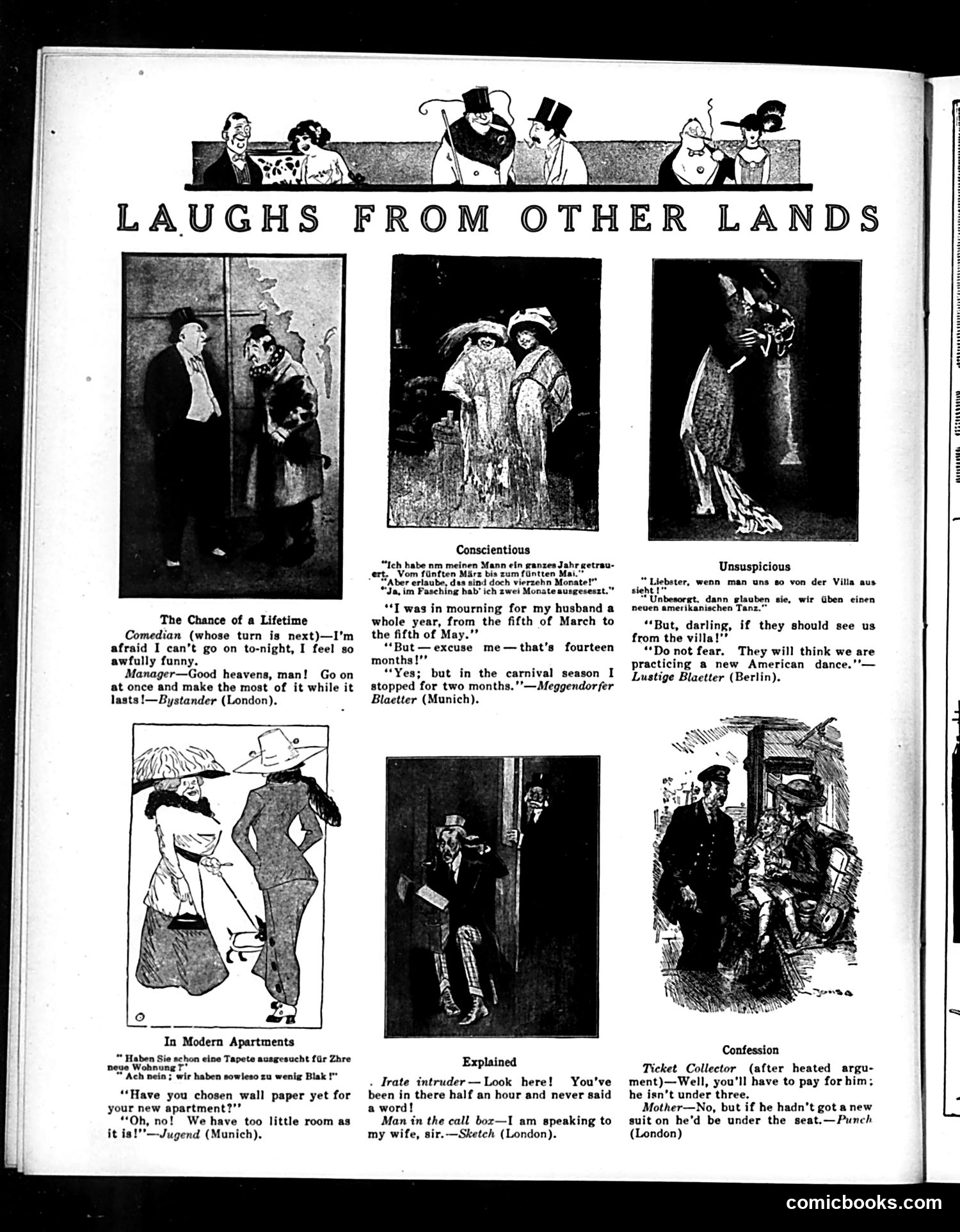
This page collects humorous anecdotes from European satirical magazines (German *Jugend* and *Lustige Blätter*, British *Punch* and *Sketch*, *Bystander*). The humor is largely non-political—domestic and social comedy targeting universal middle-class experiences. Key jokes include: a nervous comedian paradoxically becoming funny when anxious; cramped modern apartment living; a woman's creative accounting of mourning periods to justify carnival absence; a man monopolizing a telephone booth talking to his wife; neighbors dancing, which they claim is practicing American jazz (suggesting Jazz Age novelty); and a child barely fitting under a train seat, allowing a mother to avoid paying his fare. The "Unsuspicious" cartoon references the contemporary fascination with American dance trends. Otherwise, these are timeless observations about domestic life, bureaucracy, and social pretense—designed to amuse through relatable situations rather than topical satire.
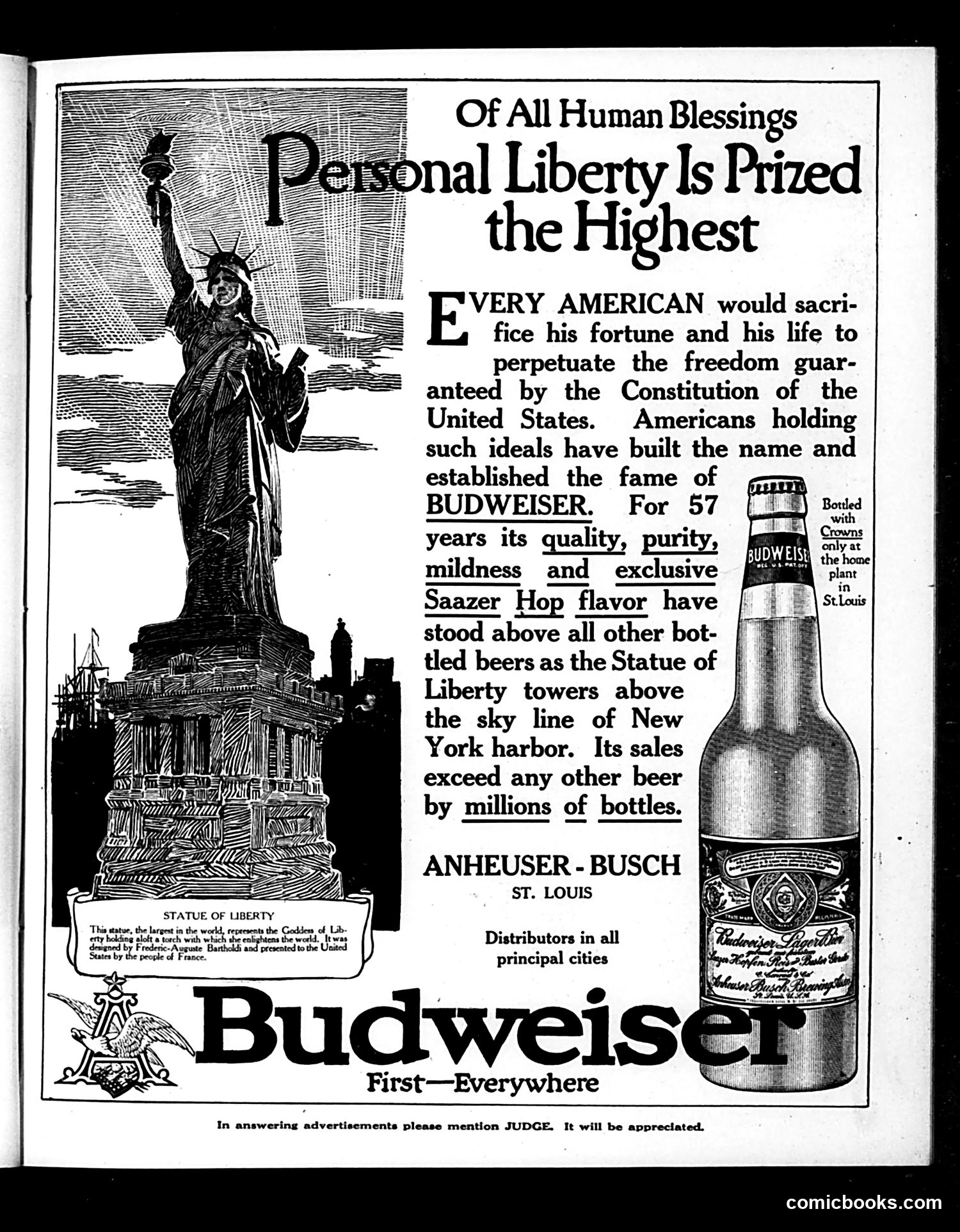
This is primarily a **beer advertisement**, not political satire. Budweiser/Anheuser-Busch uses patriotic imagery to market their product. The ad compares Budweiser to the Statue of Liberty—both American symbols of excellence and freedom. The text claims the beer has dominated the market "for 57 years" through superior "quality, purity, mildness and exclusive Saazer Hop flavor," just as Liberty "towers above the sky line of New York harbor." The patriotic framing—invoking the Constitution, American sacrifice, and national ideals—was common in early-20th-century advertising. By associating beer with liberty and American values, the company appeals to nationalist sentiment. There is **no satire here**. Judge magazine occasionally ran advertisements alongside its satirical content. This page appears to be a straightforward (if manipulative) commercial using patriotic language to sell beer to American consumers.
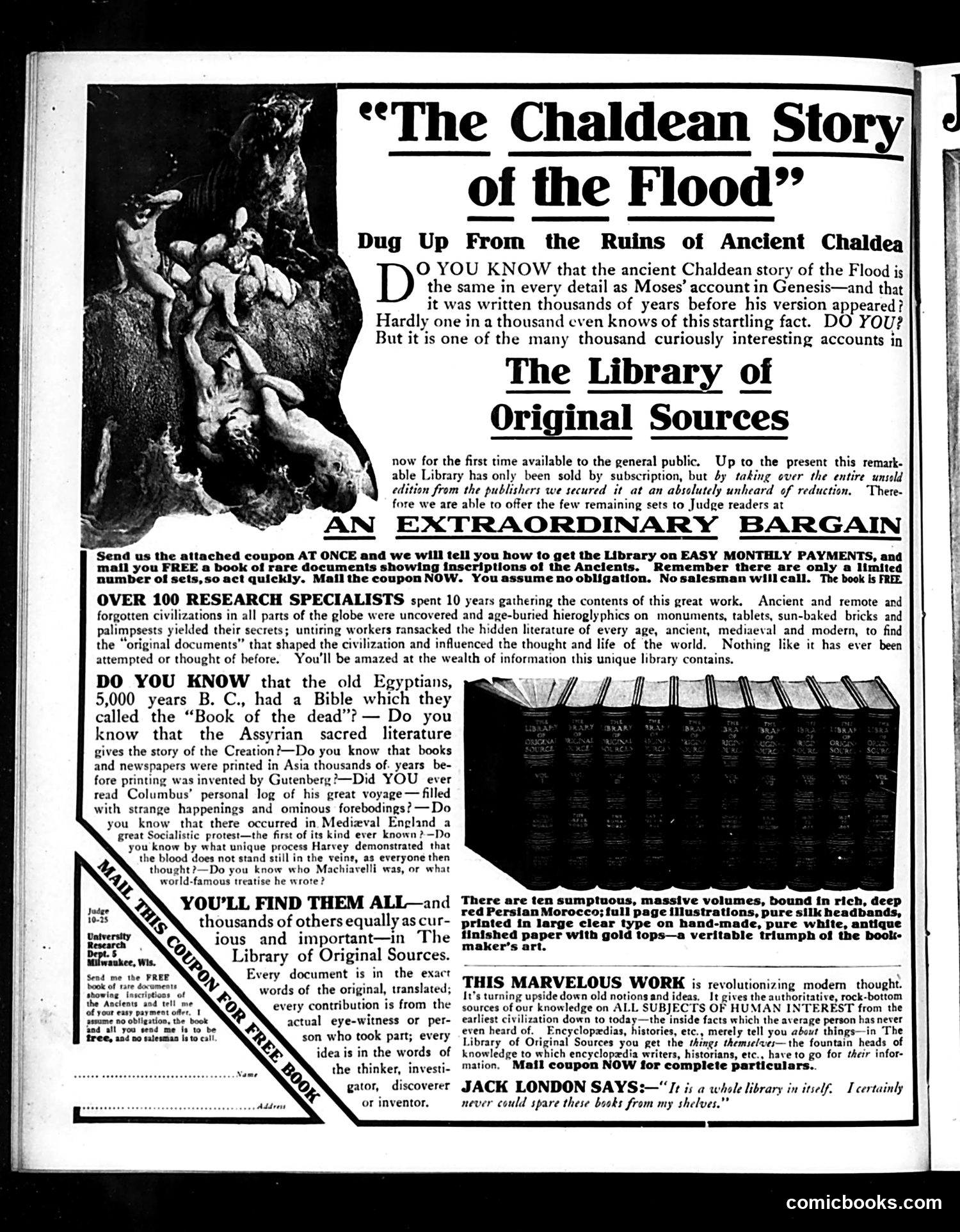
This page is primarily **advertising, not satire or political commentary**. It promotes "The Library of Original Sources," a ten-volume subscription encyclopedia set marketed through Judge magazine. The advertisement uses a rhetorical hook: it opens by claiming the ancient Chaldean flood story predates Moses's Biblical account—a legitimate historical/archaeological claim that would have seemed startling to early 20th-century readers. This "Did You Know?" format aims to intrigue Judge's educated audience. The left image shows classical figures, likely illustrating ancient civilizations discussed in the library. The pitch emphasizes that 100+ researchers spent a decade compiling primary historical documents from ancient Egypt, Assyria, Medieval England, and elsewhere. The advertisement positions the library as democratizing specialized knowledge previously available only through subscription. The appeal targets intellectual curiosity about history, religion, and "original sources"—positioning the product as authoritative and comprehensive. This represents typical early-20th-century direct-mail marketing strategy embedded in magazine advertising.