
Judge, 1913-10-25 · page 4 of 24
Judge — October 25, 1913 — page 4: what you’re looking at
What you’re looking at
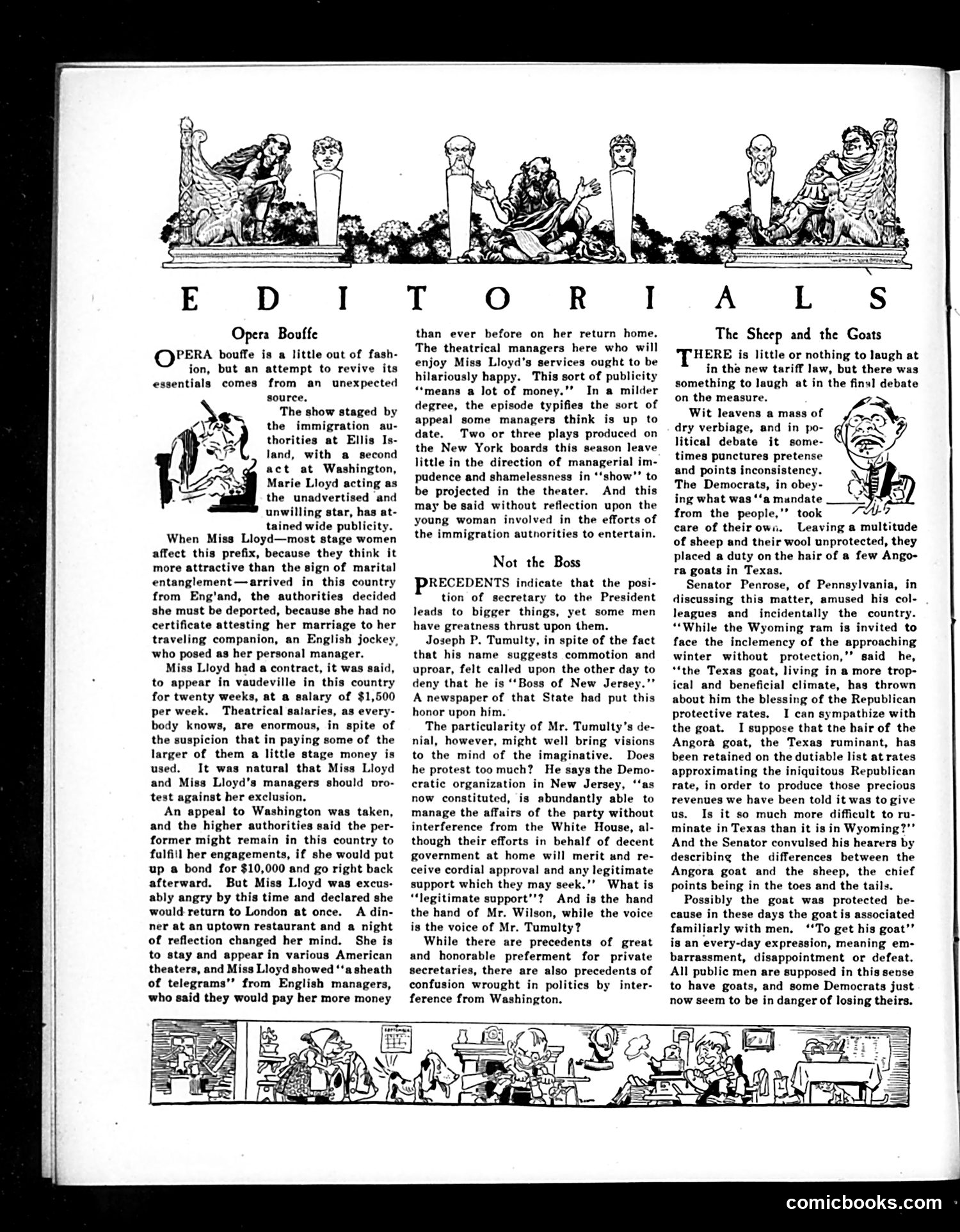
This editorial page from Judge magazine critiques Marie Lloyd, a famous British music hall performer attempting an American comeback. The main article "Open Bouffé" attacks her revival tour as lacking substance—a mere cash grab rather than artistic endeavor. The secondary piece "Not the Boss" satirizes Joseph Tumulty, President Wilson's secretary, for overstepping his authority and wielding excessive influence over Democratic Party politics and government affairs—effectively running things from behind the scenes rather than serving in a proper advisory capacity. "The Sheep and the Goats" mocks Democratic politicians for their inconsistency on tariff protection, particularly regarding wool and Pennsylvania interests, suggesting party hypocrisy on economic policy. The decorative header and bottom comic strip provide satirical framing for these political critiques typical of Judge's style.
📄 Transcribed text from this page (OCR, searchable)
Machine-transcribed from the original scan — historical spelling and the odd misread are preserved.
PERA bouffe is a little out of fash- ion, but an attempt to revive its essentials comes from an unexpected source. The show staged by the immigration au- thorities at Ellis Is- land, with a second act at Washington, Marie Lloyd acting as the unadvertised and unwilling star, has at- tained wide publicity. When Miss Lloyd—most stage women affect this prefix, because they think it more attractive than the sign of marital entanglement—arrived in this country from Eng'and, the authorities decided she must be deported, because she had no certificate attesting her marriage to her traveling companion, an English jockey, who posed as her personal manager. Miss Lloyd had a contract, it was said, to appear in vaudeville in this country for twenty weeks, at a salary of $1,500 per week. Theatrical salaries, as every- body knows, are enormous, in spite of the suspicion that in paying some of the larger of them a little stage money is used. It was natural that Miss Lloyd and Miss Lloyd’s managers should vro- test against her exclusion. An appeal to Washington was taken, and the higher authorities said the per- former might remain in this country to fulfill her engagements, if she would put up a bond for $10,000 and go right back afterward. But Miss Lloyd was excus- ably angry by this time and declared she would return to London at once. A din- ner at an uptown restaurant and a night of reflection changed her mind. She is to stay and appear in various American theaters, and Miss Lloyd showed ‘‘asheath of telegrams’? from English managers, who said they would pay her more money than ever before on her return home. The theatrical managers here who will enjoy Miss Lloyd's services ought to be hilariously happy. This sort of publicity “*means a lot of money.’’ In a milder degree, the episode typifies the sort of appeal some managers think is up to date. Two or three plays produced on the New York boards this season leave little in the direction of managerial im- pudence and shamelessness in ‘‘show’’ to be projected in the theater. And this may be said without reflection upon the young woman involved in the efforts of the immigration autnorities to entertain. Not the Boss PRECEDENTS indicate that the posi- tion of secretary to the President leads to bigger things, yet some men have greatness thrust upon them. Joseph P. Tumulty, in spite of the fact that his name suggests commotion and uproar, felt called upon the other day to deny that he is ‘‘Boss of New Jersey.’’ A newspaper of that State had put this honor upon him. The particularity of Mr. Tumulty’s de- nial, however, might well bring visions to the mind of the imaginative. Does he protest too much? He says the Demo- cratic organization in New Jersey, ‘‘as now constituted, is abundantly able to manage the affairs of the party without interference from the White House, al- though their efforts in behalf of decent government at home will merit and re- ceive cordial approval and any legitimate support which they may seek.’’ What is “legitimate support’? And is the hand the hand of Mr. Wilson, while the voice is the voice of Mr. Tumulty? While there are precedents of great and honorable preferment for private secretaries, there are also precedents of confusion wrought in politics by inter- ference from Washington. The Sheep and the Goats THERE is little or nothing to laugh at in the new tariff law, but there was something to laugh at in the final debate on the measure. Wit leavens a mass of dry verbiage, and in po- litical debate it some- times punctures pretense and points inconsistency. The Democrats, in obey- ing what was ‘‘a mandate from the people,’’ took care of theirowns. ULeaving a multitude of sheep and their wool unprotected, they placed a duty on the hair of a few Ango- ra goats in Texas. Senator Penrose, of Pennsylvania, in discussing this matter, amused his col- leagues and incidentally the country. “While the Wyoming ram is invited to face the inclemency of the approaching winter without protection,’’ said he, “‘the Texas goat, living in a more trop- ical and beneficial climate, has thrown about him the blessing of the Republican protective rates. I can sympathize with the goat. I suppose that the hair of the Angora goat, the Texas ruminant, has been retained on the dutiable list at rates approximating the iniquitous Republican rate, in order to produce those precious revenues we have been told it was to give us. Is it so much more difficult to ru- minate in Texas than it is in Wyoming?"’ And the Senator convulsed his hearers by describing the differences between the Angora goat and the sheep, the chief points being in the toes and the tails. Possibly the goat was protected be- cause in these days the goat is associated familiarly with men. ‘To get his goat’’ is an every-day expreasion, meaning em- barrassment, disappointment or defeat. All public men are supposed in this sense to have goats, and some Democrats just now seem to be in danger of losing theirs. comicbooks.com