
Judge, 1913-10-25 · page 10 of 24
Judge — October 25, 1913 — page 10: what you’re looking at
What you’re looking at
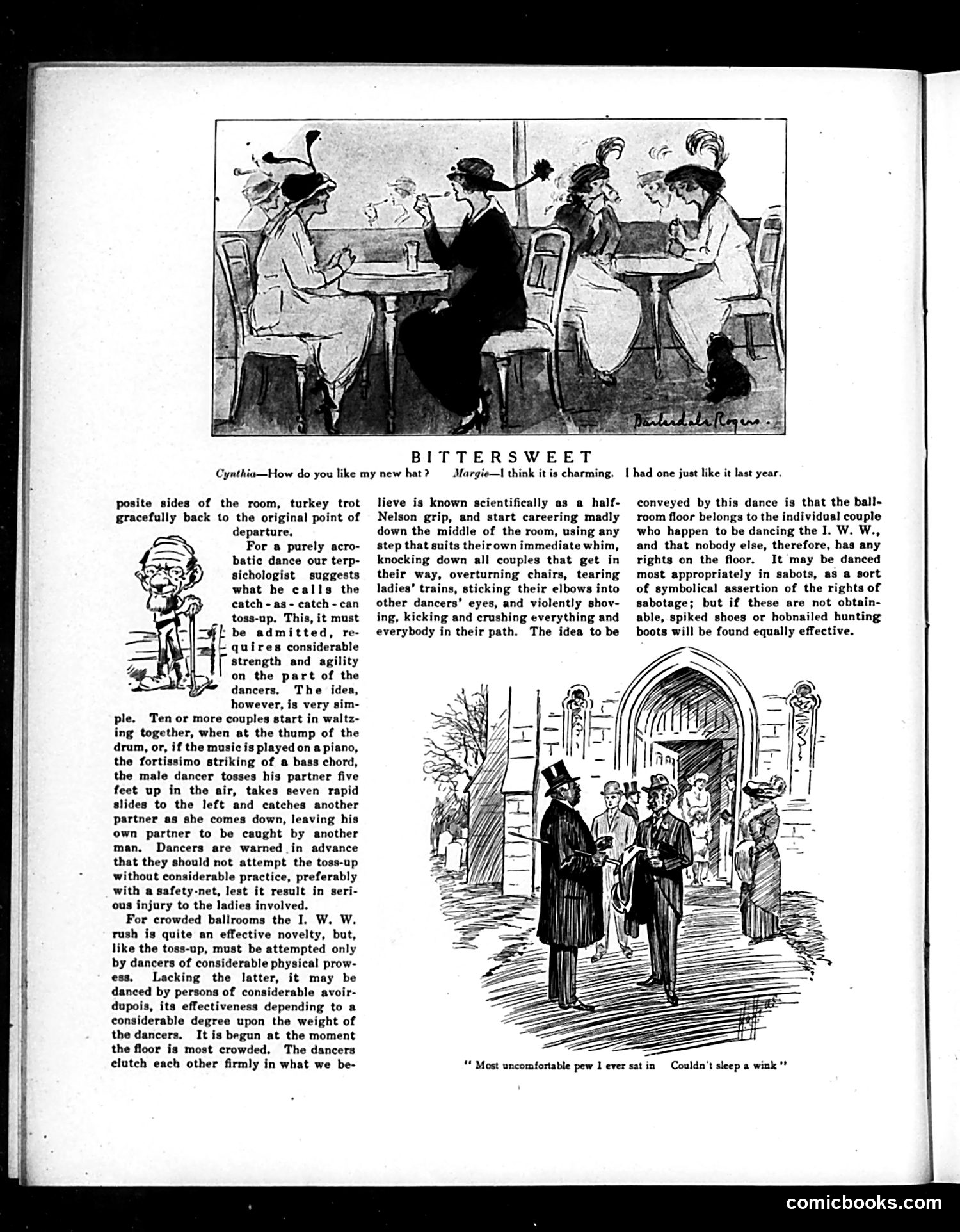
This page satirizes modern dance crazes and labor radicalism circa 1910s. **Top cartoon**: A tea party scene where two women discuss a hat, with the caption joke being the second woman's compliment rings hollow—she owned an identical hat last year, making the "new" hat unremarkable. **Main article**: Describes absurdist "novelty dances"—the "catch-as-catch-can toss-up" (partners literally toss each other mid-dance) and the "I.W.W. rush." The I.W.W. (Industrial Workers of the World) reference is the satire's political bite: the dance mockingly describes anarchist/radical behavior as a ballroom trend, with dancers deliberately crashing into others, destroying property, and asserting "rights of sabotage." It's satirizing both frivolous dance fads and labor radicals by conflating them. **Bottom cartoon**: Churchgoers complaining about an uncomfortable pew—unrelated to the dance content, likely filler. The satire ridicules both fashionable society's embrace of chaotic "modern" dances and the I.W.W.'s destructive tactics by presenting them as equivalent entertainments.
📄 Transcribed text from this page (OCR, searchable)
Machine-transcribed from the original scan — historical spelling and the odd misread are preserved.
posite sides of the room, turkey trot gracefully back to the original point of departure. For a purely acro- ic dance our terp- sichologist suggests what he calls the catch - as - catch - can _, toss-up. This, it must =H: be admitted, re- - quires considerable ( 7 [ seenath and agility on the part of the dancers. The idea, however, is very sim- ple. Ten or more couples start in waltz- ing together, when at the thump of the drum, or, if the music is played on a piano, the fortissimo striking of a bass chord, the male dancer tosses his partner five feet up in the air, takes seven rapid slides to the left and catches another partner as she comes down, leaving his own partner to be caught by another man. Dancers are warned in advance that they should not attempt the toss-up without considerable practice, preferably with a safety-net, lest it result in seri- ous injury to the ladies involved. For crowded ballrooms the I. W. W. rush is quite an effective novelty, but, like the toss-up, must be attempted only by dancers of considerable physical prow- ess. Lacking the latter, it may be danced by persons of considerable avoir- dupois, its effectiveness depending to a considerable degree upon the weight of the dancers. It is begun at the moment the floor is most crowded. The dancers clutch each other firmly in what we be- BITTERSWEET Cynthia—How do you like my new hat ? Margie—\ think it is charming. lieve is known scientifically as a half- Nelson grip, and start careering madly down the middle of the room, using any step that suits theirown immediate whim, knocking down all couples that get in their way, overturning chairs, tearing ladies’ trains, sticking their elbows into other dancers’ eyes, and violently shov- ing, kicking and crushing everything and everybody in their path. The idea to be “* Most uncomfortable pew 1 ever sat in Thad one just like it last year. conveyed by this dance is that the ball- room floor belongs to the individual couple who happen to be dancing the I. W. W., and that nobody else, therefore, has any rights on the floor. It may be danced most appropriately in sabots, as a sort of symbolical assertion of the rights of sabotage; but if these are not obtain- able, spiked shoes or hobnailed hunting boots will be found equally effective. Couldn't sleep a wink comicbooks.com