
Judge, 1913-10-25 · page 11 of 24
Judge — October 25, 1913 — page 11: what you’re looking at
What you’re looking at
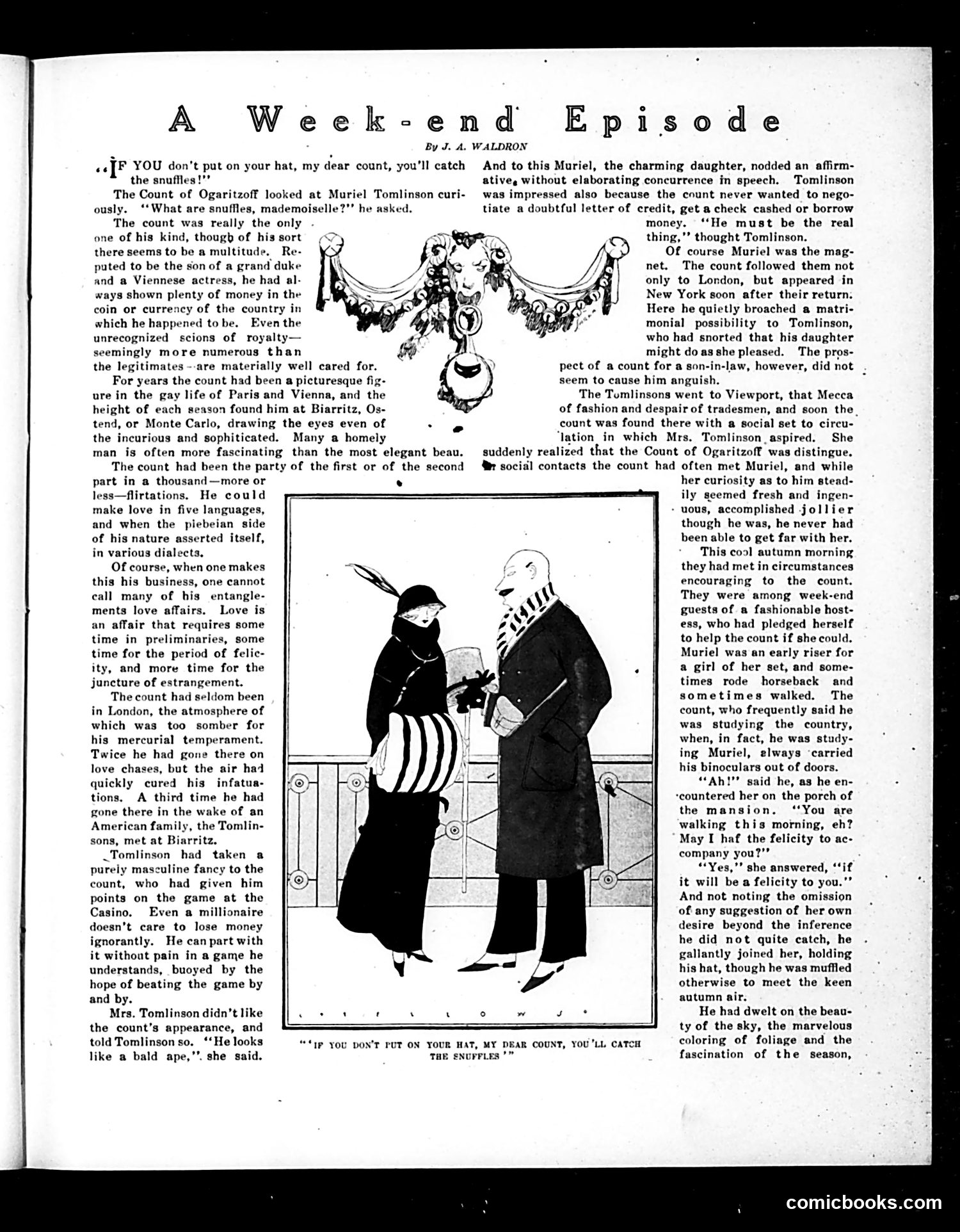
This is a romantic satirical story about a fortune-hunting European nobleman pursuing an American heiress. The Count of Ogaritzoff, a vaguely aristocratic figure with questionable credentials (reputed son of a grand duke and Viennese actress), follows the wealthy Tomlinson family from Paris to London to New York to the fashionable resort of Viewport, ostensibly courting their daughter Muriel. The satire targets the period's social pretense: wealthy Americans eager to legitimize themselves through European titles, and impoverished European "counts" exploiting this hunger for aristocracy. The count charms the family through careful performance—never needing loans, speaking multiple languages, never directly demanding money—while his true mercenary motives remain transparent to the reader. The illustrated scene shows the count encountering Muriel on a morning walk, attempting his romantic pursuit. The caption's hat joke suggests his manipulative gallantry. The story mocks both the phony "count" and the American social-climbing that enables his scheme.
📄 Transcribed text from this page (OCR, searchable)
Machine-transcribed from the original scan — historical spelling and the odd misread are preserved.
A Week-end Episode By J. A. WALDRON And to this Muriel, the charming daughter, nodded an affirm- «JF the snuffles!’’ YOU don’t put on your hat, my dear count, you'll catch The Count of Ogaritzoff looked at Muriel Tomlinson curi- ously. The count was really the only one of his kind, though of his sort there seems to be a multitude. Re- puted to be the son of a grand duke and a Viennese actress, he had al- ways shown plenty of money in the coin or currency of the country in which he happened tobe. Even the unrecognized scions of royalty— seemingly more numerous than the legitimates “What are snuffles, mademoiselle?"’ he asked. are materially well cared for. For years the count had been a picturesque fig- ure in the gay life of Paris and Vienna, and the height of ea tend, or Monte Carlo, drawing the the incurious and sophiticated. h season found him at Biarritz, Os- eyes even of Many a homely o man is often more fascinating than the most elegant beau. The count had been the party of the first or of the second part in a thousand—more or less—flirtations. He could ative, without elaborating concurrence in speech. Tomlinson was impressed also because the count never wanted to nego- tiate a doubtful letter of credit, get a check cashed or borrow pect of @ coun’ money. ‘‘He must be the real thing,’’ thought Tomlinson. Of course Muriel was the mag- net. The count followed them not only to London, but appeared in New York soon after their return. Here he quietly broached a matri- monial possibility to Tomlinson, who had snorted that his daughter might doasshe pleased. The pros- t for a son-in-law, however, did not seem to cause him anguish. The Tumlinsons went to Viewport, that Mecca of fashion and despair of tradesmen, and soon the, count was found there with a social set to circu- ‘lation in which Mrs. Tomlinson aspired. She suddenly realized that the Count of Ogaritzoff was distingue. @& social contacts the count had often met Muriel, and while make love in five languages, and when the piebeian side of his nature asserted itself, in various dialects, Of course, when one makes this his business, one cannot call many of his entangle- ments love affairs. Love is an affair that requires some time in preliminaries, some time for the period of felic- ity, and more time for the juncture of estrangement. The count had seldom been in London, the atmosphere of which was too somber for his mercurial temperament. Twice he had gone there on love chases, but the air had quickly cured his infatua- tions, A third time he had gone there in the wake of an American family, the Tomlin- sons, met at Biarritz. _Tomlinson had taken a purely masculine fancy to the count, who had given him points on the game at the Casino. Even a millionaire doesn’t care to lose money ignorantly. He can part with it without pain in a game he understands, buoyed by the hope of beating the game by and by. Mrs. Tomlinson didn’t like her curiosity as to him stead- ily seemed fresh and ingen- + uous, accomplished jollier though he was, he never had been able to get far with her. This cool autumn morning they had met in circumstances encouraging to the count. They were among week-end guests of a fashionable host- ess, who had pledged herself to help the count if she could. Muriel was an early riser for a girl of her set, and some- times rode horseback and sometimes walked. The count, who frequently said he was studying the country, when, in fact, he was study- ing Muriel, elways ‘carried his binoculars out of doors. “Ah!’’ said he, as he en- countered her on the porch of the mansion. ‘You are walking this morning, eh? May I haf the felicity to ac- company you?”? “‘Yes,’’ she answered, it will be a felicity to you. And not noting the omission of any suggestion of her own desire beyond the inference he did not quite catch, he gallantly joined her, holding his hat, though he was muffled otherwise to meet the keen autumn air. He had dwelt on the beau- ft the count’s appearance, and told Tomlinson so. ‘‘He looks like a bald ape,’’. she said. ““Ip YoU DON'T PUT ON YoU THE HAT, MY DEAR COUNT, YOU'LL CATCH ty of the sky, the marvelous coloring of foliage and the fascination of the season, comicbooks.com