
Judge, 1913-10-25 · page 9 of 24
Judge — October 25, 1913 — page 9: what you’re looking at
What you’re looking at
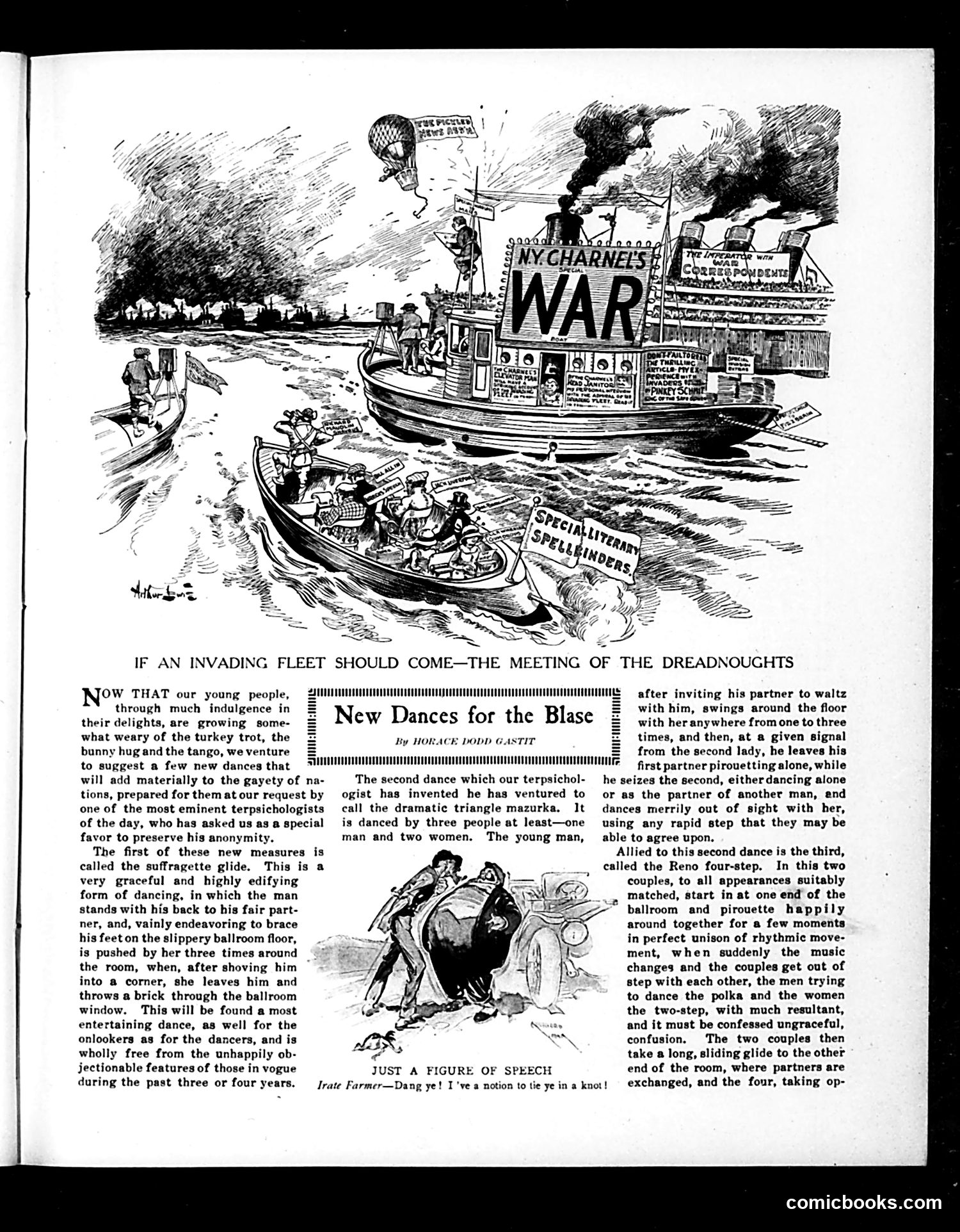
This satirical piece mocks contemporary social movements through dance metaphors. The top cartoon depicts "N.Y. Charnel's War" as a theatrical spectacle on boats, likely referencing sensationalized war coverage during the World War I era. The main article proposes absurd "new dances" that satirize social concerns of the day: 1. **"The Suffragette Glide"** ridicules the women's suffrage movement by depicting a woman pushing a man around and throwing a brick through a window—mocking suffragettes as violent and emasculating. 2. **"The Dramatic Triangle Mazurka"** and **"The Reno Four-step"** lampoon infidelity and divorce, referencing Reno, Nevada (famous for easy divorces). Partners swap mid-dance, suggesting the era's perceived moral decay in relationships. The satire expresses conservative anxiety about women's rights activism, changing gender dynamics, and loose morality—presenting these social changes as ridiculous through the lens of fashionable dances.
📄 Transcribed text from this page (OCR, searchable)
Machine-transcribed from the original scan — historical spelling and the odd misread are preserved.
Now THAT our young people, ua vunUanuennensuaUeeduesuenUenueaseaneneesenssaneaneessesseiesniiNtte = after inviting his partner to waltz through much indulgence in their delights, are growing some- what weary of the turkey trot, the bunny hug and the tango, we venture to suggest a few new dances that will add materially to the gayety of na- tions, prepared for them at our request by one of the most eminent terpsichologists of the day, who has asked us as a special favor to preserve his anonymity. The first of these new measures is called the suffragette glide. This is a very graceful and highly edifying form of dancing, in which the man stands with his back to his fair part- ner, and, vainly endeavoring to brace his feet on the slippery ballroom floor, is pushed by her three times around the room, when, after shoving him into a corner, she leaves him and throws a brick through the ballroom window. This will be found a most entertaining dance, as well for the onlookers as for the dancers, and is wholly free from the unhappily ob- jectionable features of those in vogue during the past three or four years. —Jrate Farmer—Dang ye! I've a notion to tie ye in a knot! New Dances for the Blase By HORACE DODD GASTIT The second dance which our terpsichol- ogist has invented he has ventured to call the dramatic triangle mazurka. It is danced by three people at least—one man and two women. The young man, JUST A FIGURE OF SPEECH with him, swings around the floor with her anywhere from one to three times, and then, at a given signal from the second lady, he leaves his ShaevccenvnccngncuenaancevnscevnanaceevcuconssvucessoueeesycvegsacenntntatNtE first partner pirouetting alone, while he seizes the second, eitherdancing alone or as the partner of another man, and dances merrily out of sight with her, using any rapid step that they may be able to agree upon. Allied to this second dance is the third, called the Reno four-step. In this two couples, to all appearances suitably _» Matched, start in at one end of the " ballroom and pirouette happily around together for a few moments in perfect unison of rhythmic move- ment, when suddenly the music changes and the couples get out of step with each other, the men trying to dance the polka and the women the two-step, with much resultant, and it must be confessed ungraceful, confusion. The two couples then take a long, sliding glide to the other end of the room, where partners are exchanged, and the four, taking op- comicbooks.com