
A complete issue · 24 pages · 1913
Judge — September 6, 1913
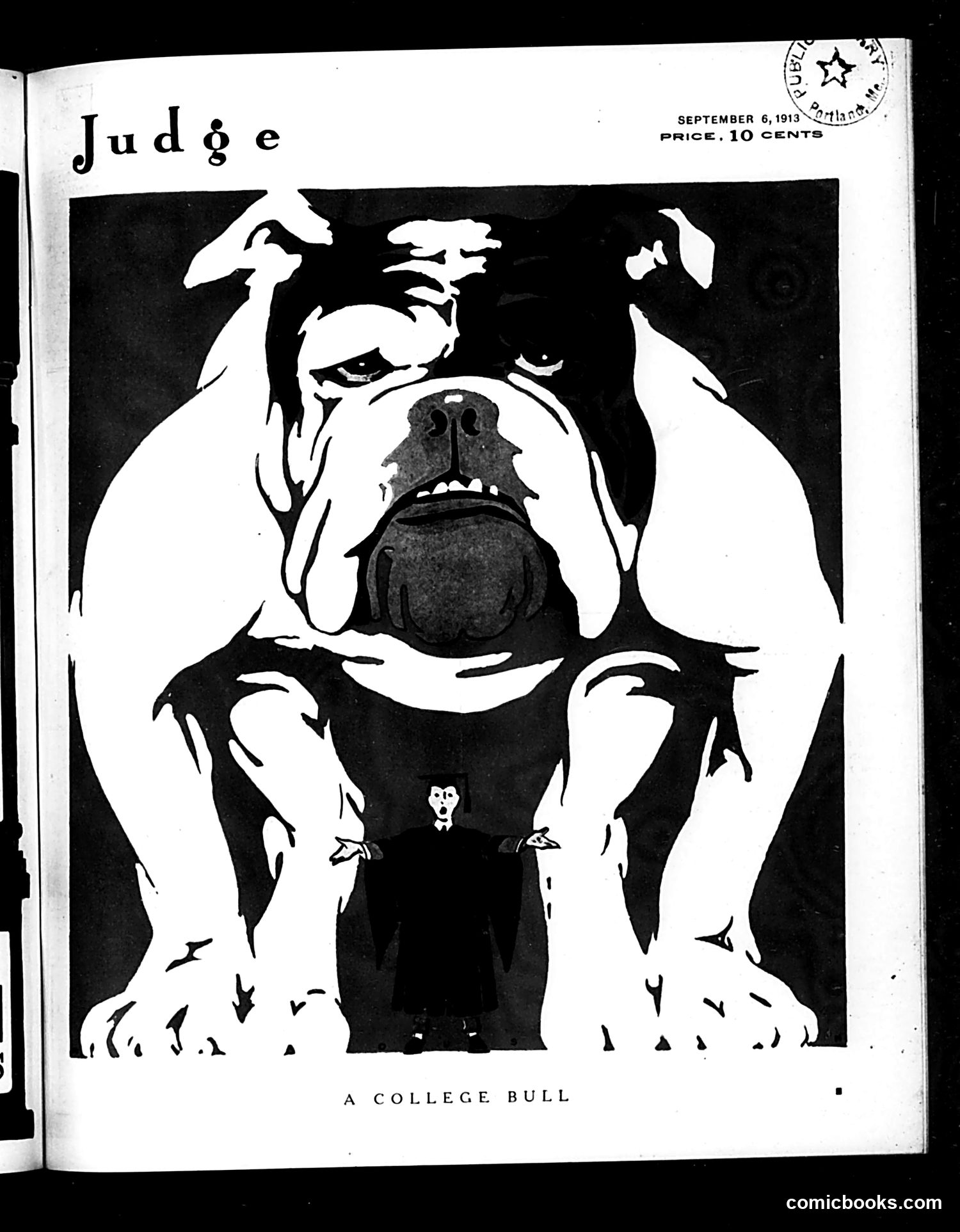
This cartoon depicts a massive bulldog wearing academic regalia (a dark robe with a skull emblem), towering over a small human figure in formal dress. The bulldog's aggressive stance and fierce expression suggest institutional power and intimidation. The satire likely critiques college hazing, excessive institutional authority, or the aggressive traditions of collegiate culture—common targets of Progressive Era satirists. The "college bull" appears to represent the overwhelming, brutish nature of collegiate institutions themselves, or possibly criticizes how colleges steamroll individual students. The tiny human figure emphasizes the power imbalance. Without additional context from the magazine's surrounding articles, the specific target—whether hazing rituals, football culture, or administrative overreach—remains unclear, though the commentary on institutional dominance is unmistakable.
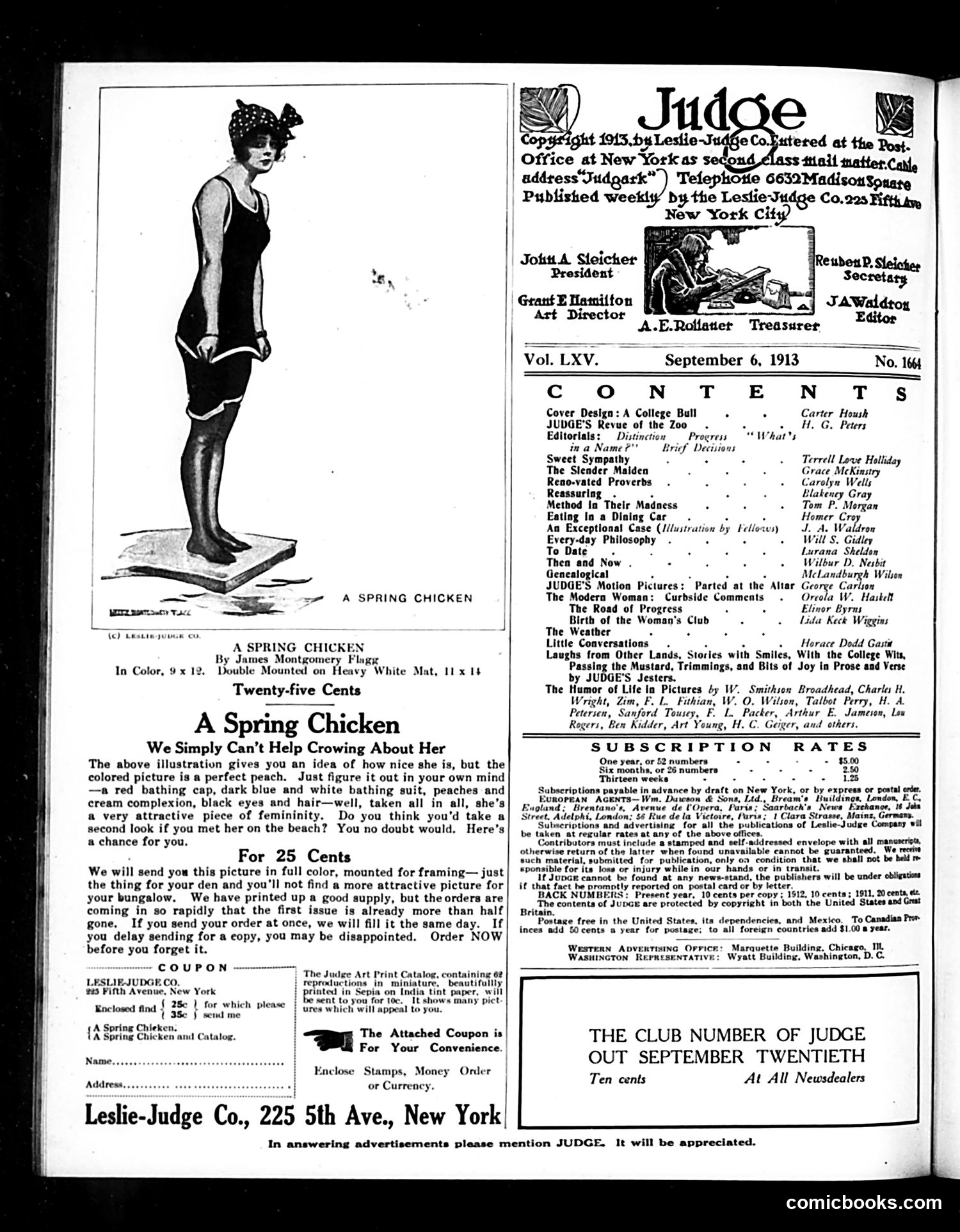
This page is primarily an **advertisement for a colored illustration**, not political satire. The main image shows a young woman in a bathing suit standing on a pedestal, labeled "A Spring Chicken." The accompanying text explains this is a "colored picture" available for 25 cents, mounted and ready for framing. The phrase "spring chicken" was (and remains) slang for an attractive young woman or newcomer. The advertisement emphasizes the illustration's appeal—"peaches and cream complexion, black eyes and hair"—and markets it as suitable home decoration. This reflects early 1900s aesthetic tastes and the commercial illustration industry. The coupon below allows readers to order the print.
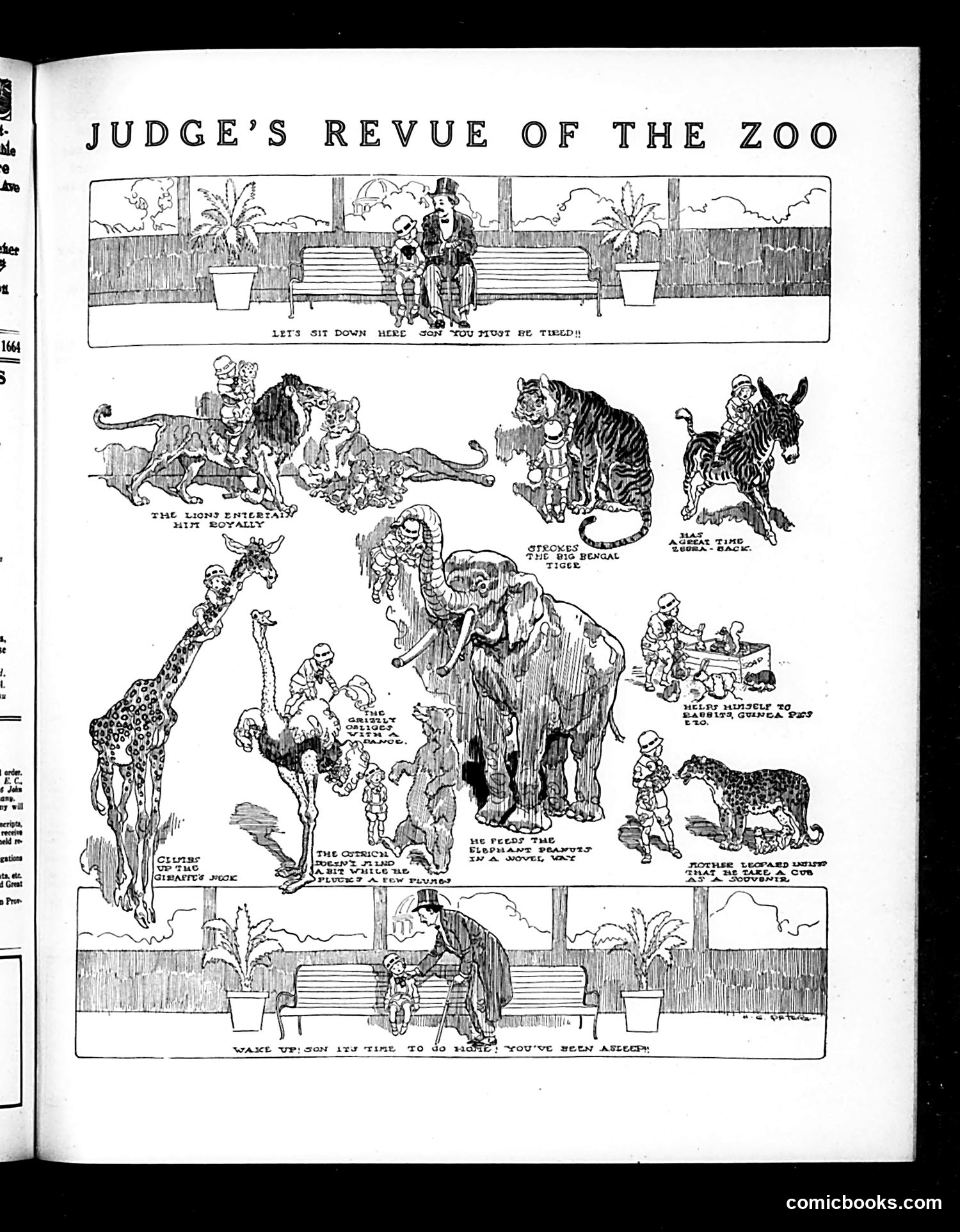
This satirical cartoon uses a zoo setting as a metaphor for society or politics. A well-dressed judge character observes various animals entertaining children, with captions providing commentary on each scene. The humor derives from animal behavior paralleling human conduct: lions "entertain" their "royals," a Bengal tiger is "stroked," a giraffe accommodates a "giant's" perspective, an elephant serves as entertainment, and a donkey is ridden. The framing panels show the judge dozing and waking, suggesting tired observation of human folly. The "zoo" metaphor appears to critique social hierarchies and human behavior by comparing people to animals. However, without clearer identification of specific captions or historical context, the precise political targets remain unclear. This appears to be general social satire rather than commentary on specific events.
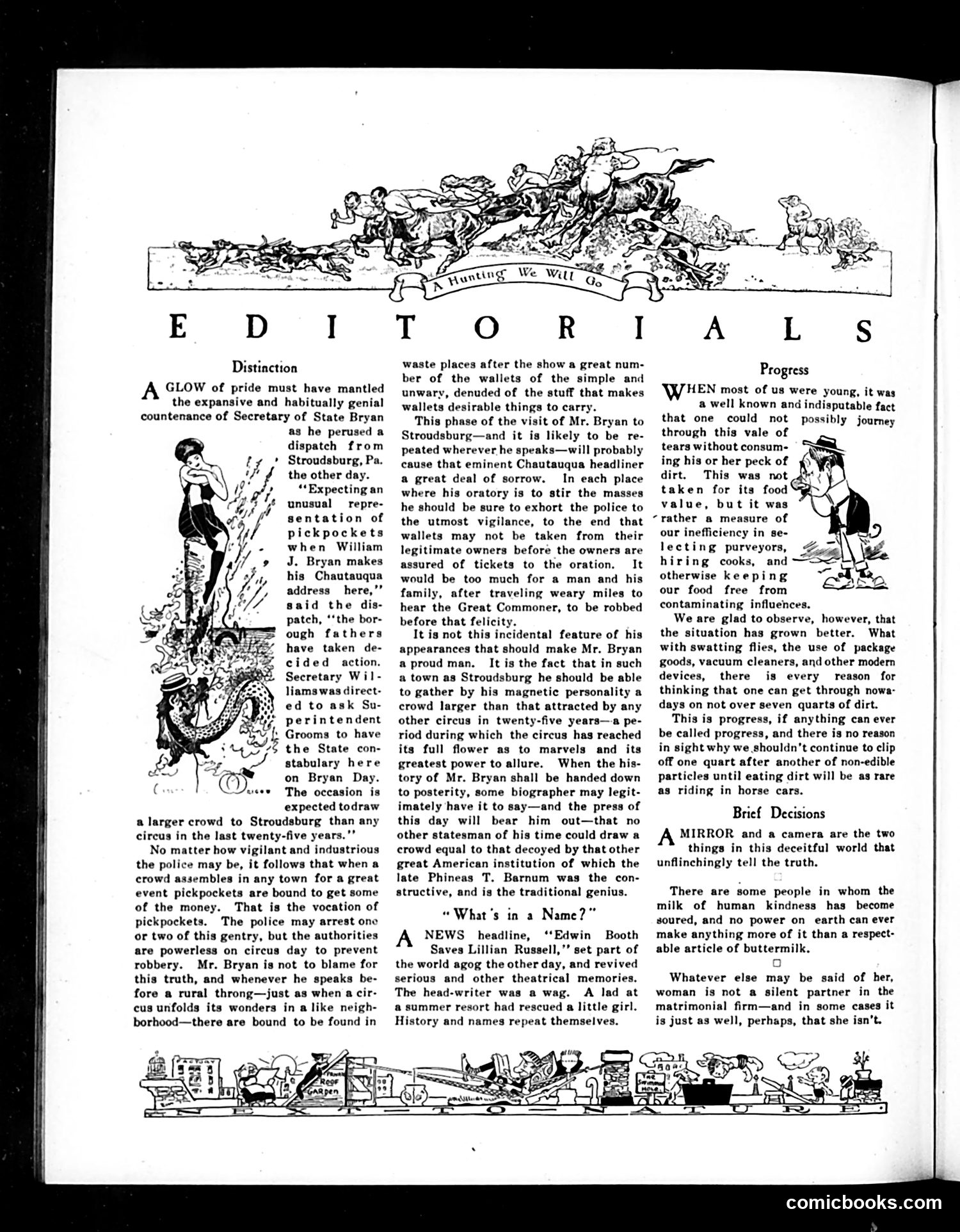
This page contains three distinct editorial pieces from *Judge* magazine, primarily text-based commentary rather than political cartoons. **"Distinction"** mocks J. Bryan's (likely William Jennings Bryan) speaking tour, suggesting his oratory attracts crowds motivated by curiosity rather than genuine support. The satire criticizes how pickpockets exploit these gatherings. **"Progress"** argues that sanitation has improved—fewer flies, better food handling—though housekeeping standards remain inadequate compared to affluent standards. **"What's in a Name?"** and **"Brief Decisions"** are brief commentary pieces on theatrical news and social observations respectively. The decorative header and footer illustrations show hunting/circus scenes typical of *Judge*'s visual style, but the page functions primarily as editorial commentary rather than satirical cartooning.
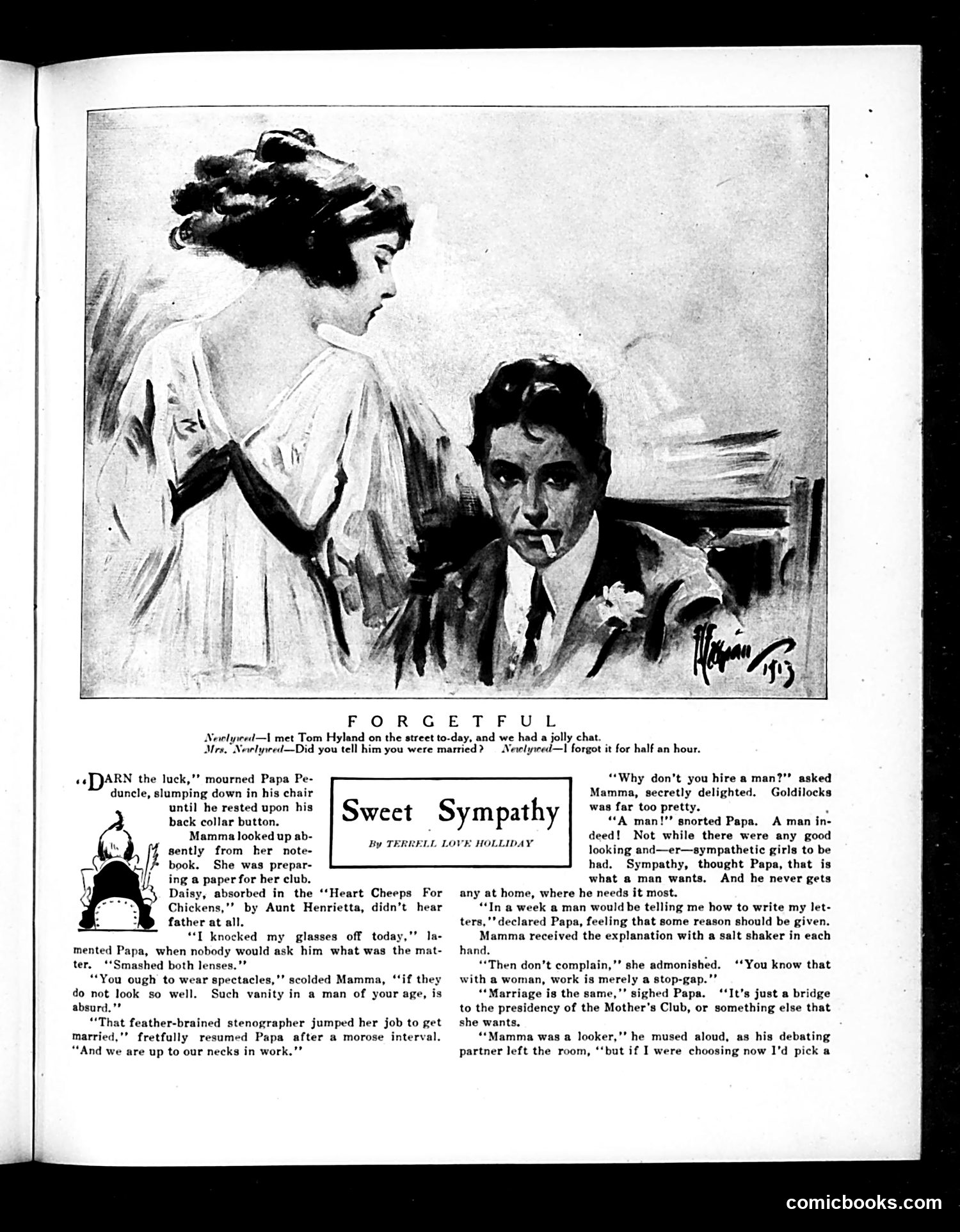
This page from *Judge* magazine presents two satirical pieces about gender relations and marriage. The top illustration, titled "Forgetful," depicts a married couple's awkward reunion. The wife reminds her husband they met on the street, had a chat, and she "forgot" to mention she was married—an ironic reversal of typical gender roles regarding disclosure and honesty in courtship. The story "Sweet Sympathy" by Terrell Love Holliday satirizes Papa's complaints about women. When asked why he won't hire a woman, Papa argues men are superior because they're "sympathetic"—yet the narrative reveals Papa's actual hypocrisy: he resists women's capabilities while simultaneously depending on them. The satire critiques men's contradictory attitudes toward women's work and independence during the early 20th century.
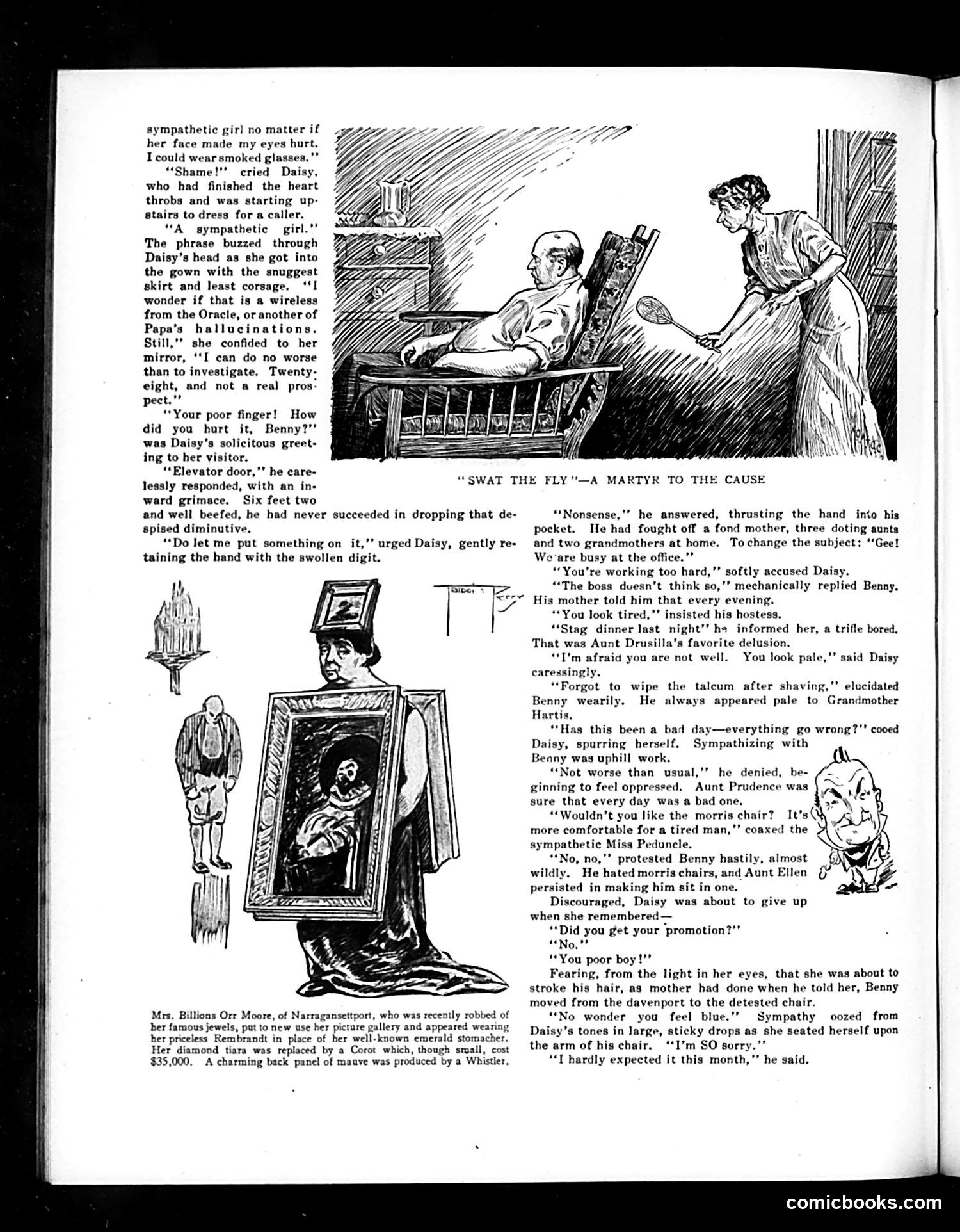
This comic mocks the artificiality of romantic courtship through a young woman named Daisy who adopts exaggerated "sympathy" as a dating strategy. When a young man (Benny) visits, she manufactures concern over his minor finger injury, fatigue, and career disappointment—mimicking tactics she's heard from older female relatives (his mother, grandmothers, aunts). The joke is that Daisy's sympathy is transparently calculated and performative rather than genuine. Benny, exhausted by the routine from his family, repeatedly tries to escape her suffocating concern. The cartoon satirizes both the manipulative use of false empathy as a courtship tool and the tedious social conventions of the era that trapped young men in endless cycles of maternal-style "care" from multiple women. The sidebar about Mrs. Moore wearing artwork instead of jewels extends the satire to the absurdity of wealthy affectation.
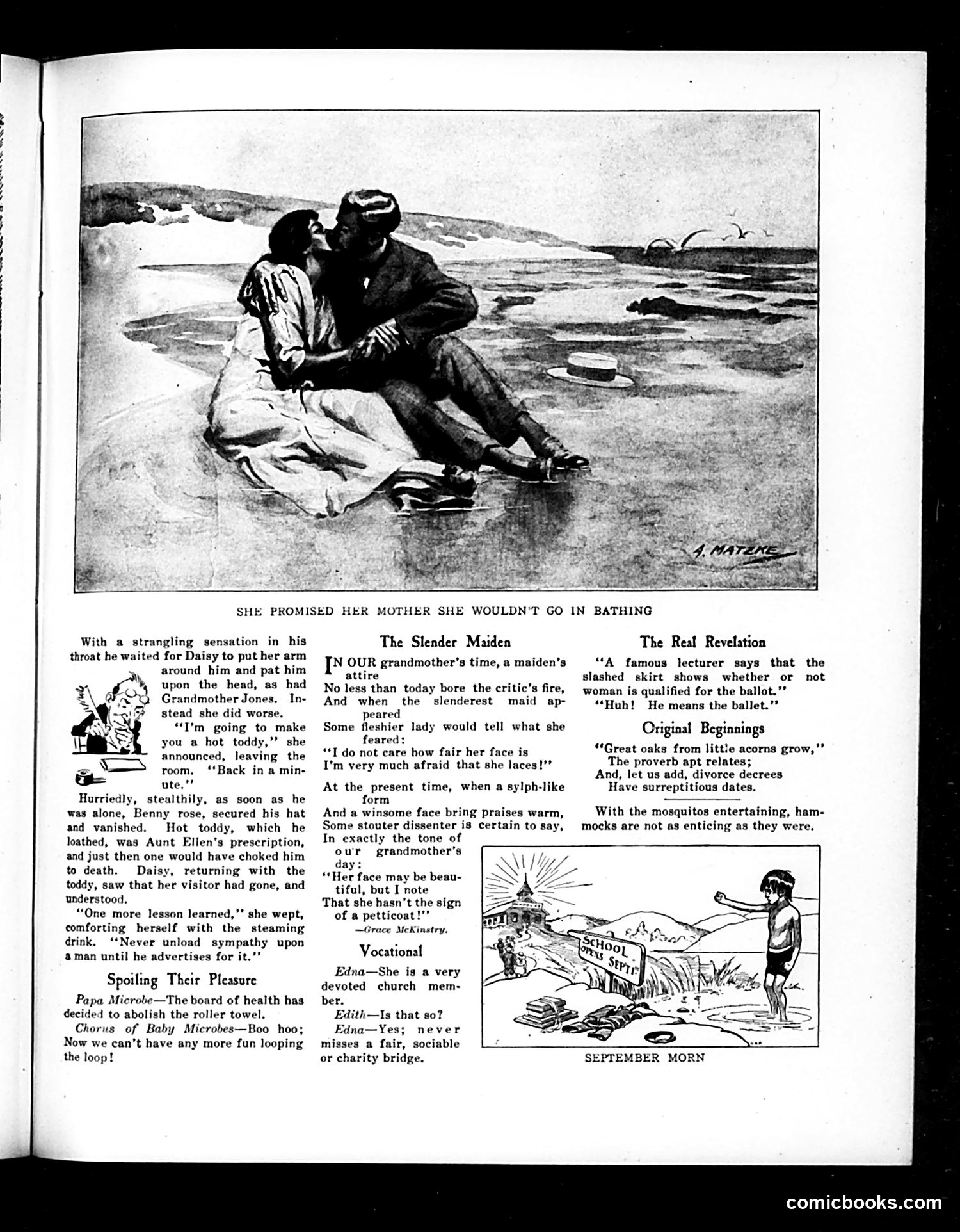
This page contains several satirical pieces targeting early 20th-century social conventions: **"The Slender Maiden"** compares Victorian-era body-shaming (criticizing thin women for corseting) to contemporary criticism of the same thinness, suggesting women can't win regardless of fashion. The joke: fashion standards are arbitrary and hypocritical. **"Spoiling Their Pleasure"** mocks public health efforts to eliminate shared towels (which spread germs). Microbes "mourn" losing this transmission vector—dark humor about resistance to sanitation. **"The Real Revelation"** satirizes a lecturer claiming women's hemlines indicate voting fitness. The correction—he meant "ballet," not "ballot"—ridicules the absurdity of judging women's political capacity by clothing. **"Original Beginnings"** makes a cynical quip: divorce decrees, like mighty oaks, grow from small seeds, implying divorces have secretive origins. The top photograph illustrates a sentimental domestic story about a man avoiding unwanted sympathy. These pieces collectively lampoon social pretension, bodily anxieties, and evolving gender roles of the period.
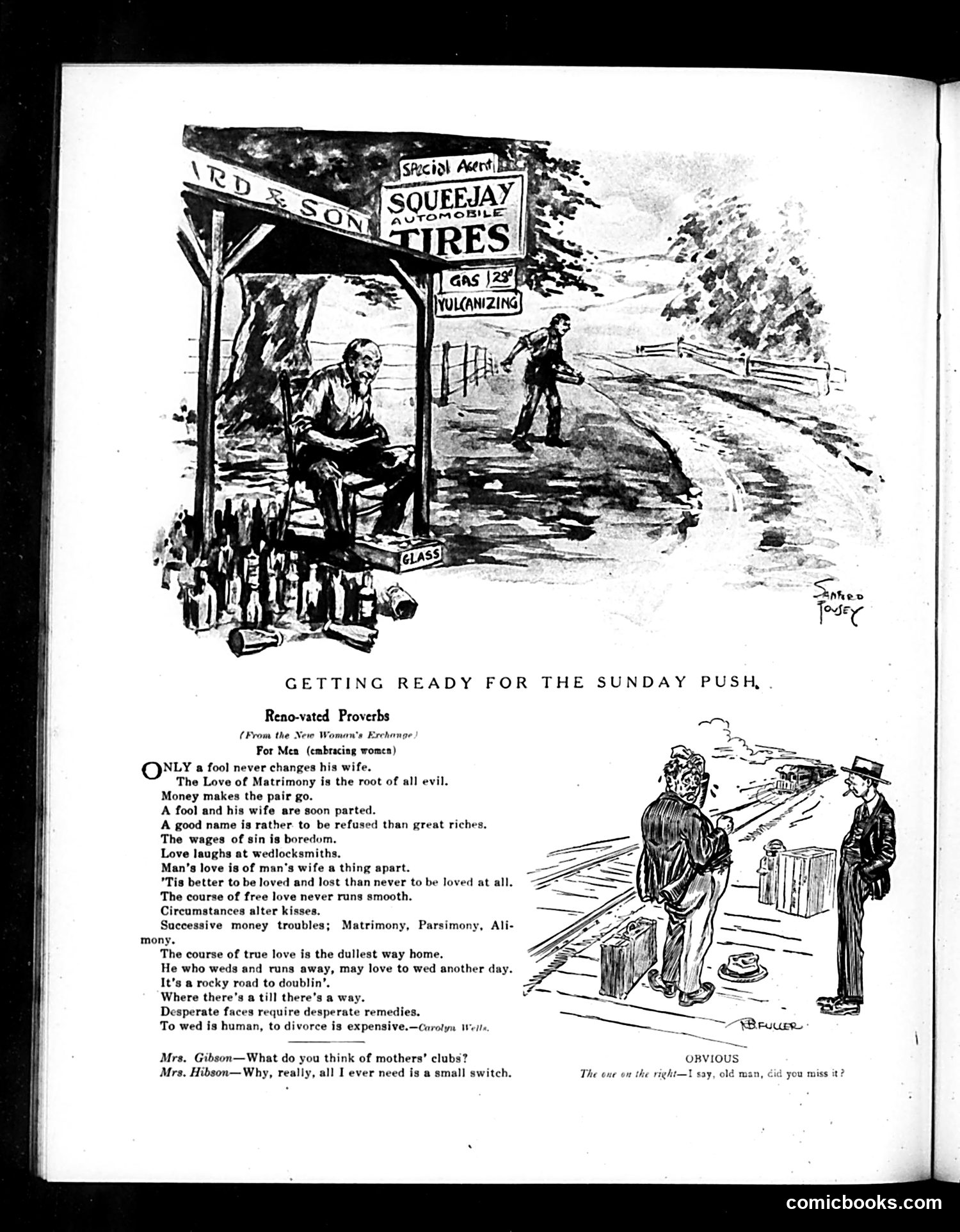
**Top Cartoon ("Getting Ready for the Sunday Push"):** A man sits under a Squeejay Automobile Tires advertisement while another man approaches on a rural road. The title suggests preparation for weekend driving—a commentary on the emerging automobile culture and leisure activities of the early 20th century. **Main Content ("Reno-vated Proverbs"):** This is satirical social commentary on marriage and divorce. The proverbs mock traditional marriage wisdom by inverting or subverting them—replacing "Love of God" with "Love of Matrimony" as evil, adding "Alimony" to financial troubles, and treating divorce as expensive inevitability. The reference to "Reno" (Nevada's divorce capital) and "New Woman's Exchange" suggests criticism of changing gender relations and women's increasing independence. The closing dialogue mocks motherhood and suggests corporal punishment remains acceptable. **Bottom Cartoon ("Obvious"):** Two figures on a platform appear to be discussing missing something on "the right"—possibly a train or vehicle, playing on the era's transportation developments. The overall page satirizes modern marriage instability, women's liberation, and social change.
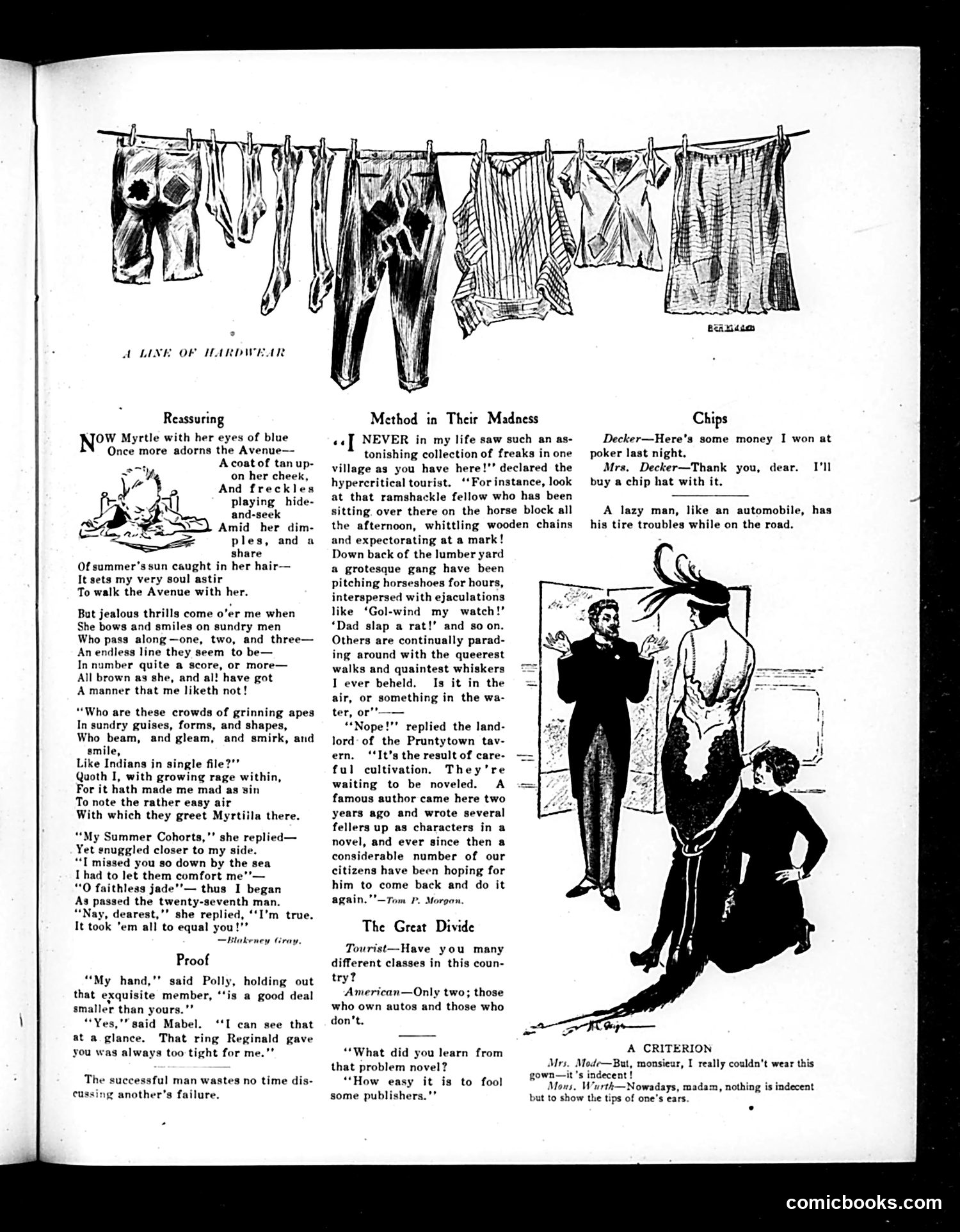
This page contains multiple short satirical pieces typical of early 20th-century American humor magazines: **"A Line of Hardware"** (top): A poem mocking male jealousy. A man grows increasingly angry seeing his girlfriend Myrtle greeting numerous other men on the Avenue, until she assures him they were merely substitutes for his affection while he was away—"It took 'em all to equal you!" **"Method in Their Madness"**: A tourist criticizes the odd behavior of villagers (whittling, peculiar walks, strange whiskers), but the tavern landlord reveals they're deliberately cultivating eccentric personalities, hoping a famous author who previously novelized locals will return to feature them again. **"The Great Divide"**: Social commentary on class division—an American claims there are only two classes: those who own automobiles and those who don't (reflecting early auto culture's status symbol). **Minor pieces** include wordplay about poker winnings ("chip hat"), lazy men's "tire troubles," and fashion satire about fashion designer "Wurth" defending scandalously short hemlines while condemning visible ear-tips as indecent.
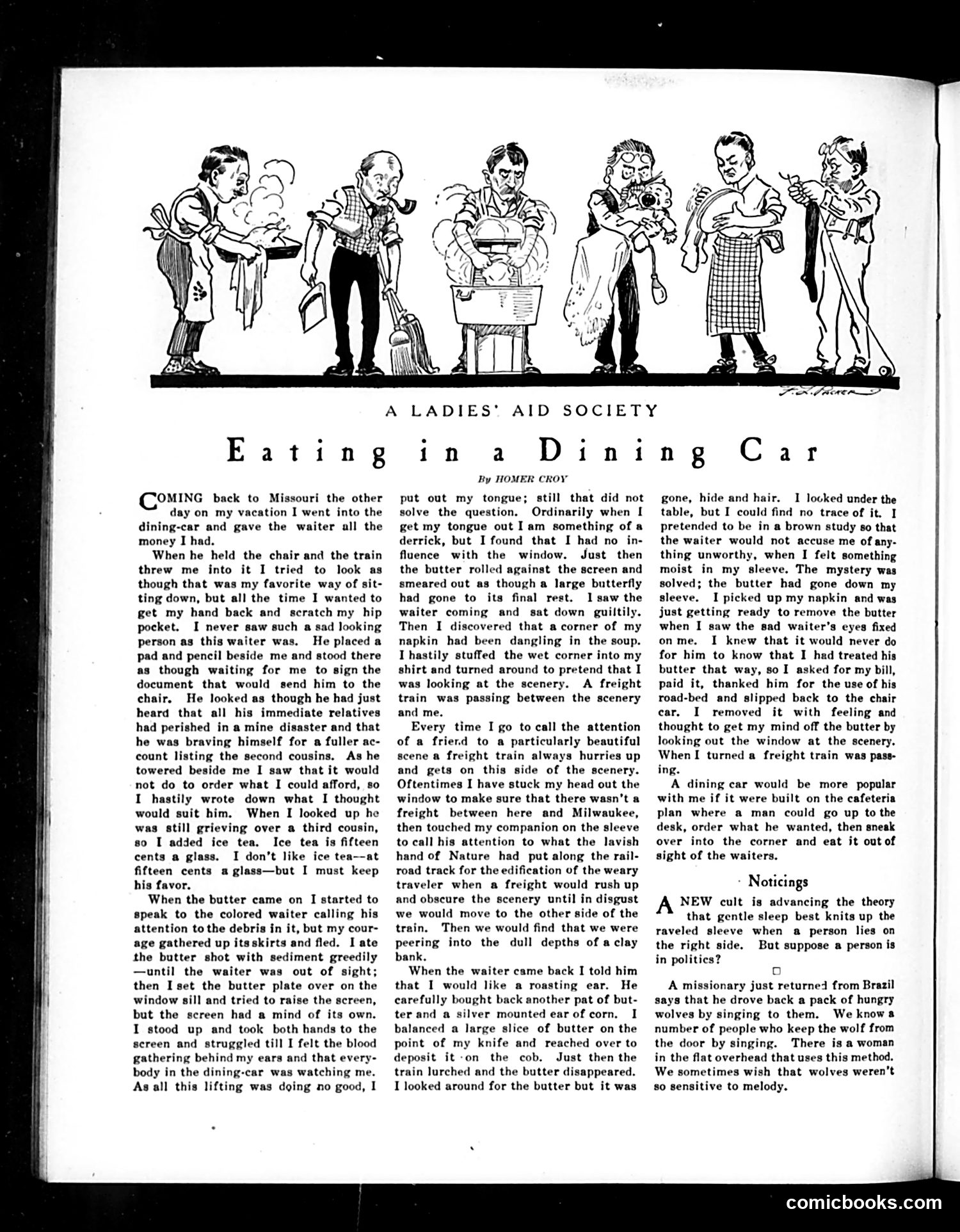
This is a humorous essay-cartoon (the illustration shows various dining-car mishaps) by Homer Croy poking fun at middle-class anxiety in formal settings. The narrator, traveling by train, becomes so intimidated by a sad-faced waiter that he orders expensive food he can't afford and pretends to enjoy buttered corn he clearly doesn't want, fearing judgment. The satire targets the social pretense required of Americans in "refined" spaces: the narrator struggles with a window screen while others watch, hides a soup-soaked napkin, and endures various indignities—ultimately getting butter down his sleeve—rather than lose face before a servant. The cartoon illustration at top ("A Ladies' Aid Society") depicts six characters in domestic chaos, complementing the dining-car theme of people performing respectability while things fall apart around them. The humor lies in exposing the absurdity of maintaining composure under social pressure.
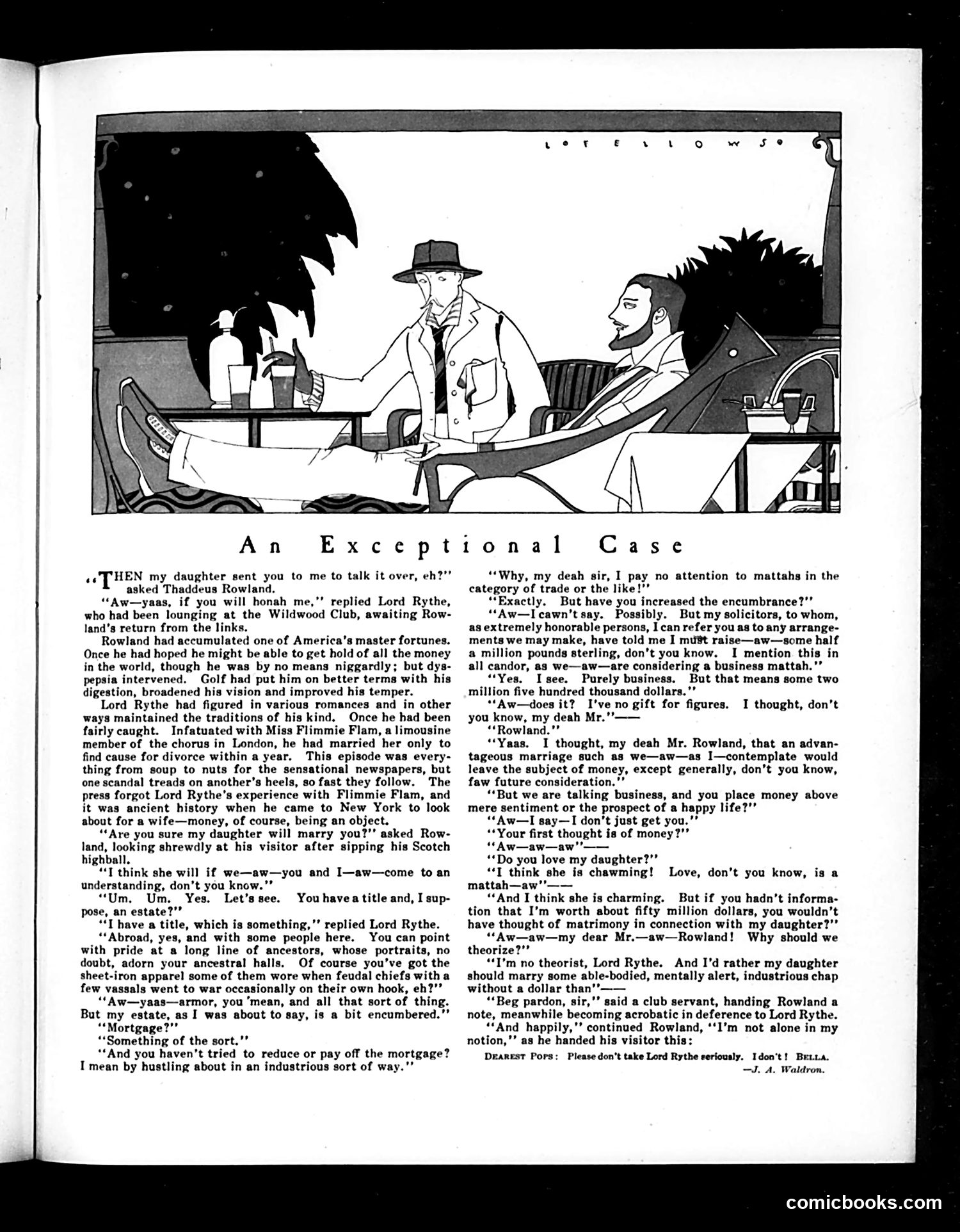
This satirical story mocks the transatlantic marriage market of the Gilded Age, where impoverished European aristocrats sought American heiresses' fortunes. Lord Rythe, a British nobleman with a scandalous past (a failed marriage to a chorus girl), approaches wealthy self-made American Thaddeus Rowland seeking to marry his daughter. The satire targets Rythe's transparent mercenary motives—he needs £500,000 (about $2.5 million) but frames it as "business." Rowland progressively exposes the hypocrisy: Rythe claims indifference to "trade," yet obsesses over money; he professes love for the daughter only after learning of her father's "$50 million" wealth. The joke highlights American anxiety about aristocratic fortune-hunters exploiting wealthy daughters, while also satirizing the daughters' and fathers' willingness to trade wealth for titles and social prestige. Rowland's final preference for a penniless but honest suitor over a titled fortune-seeker represents the idealized "American" values the magazine promoted.
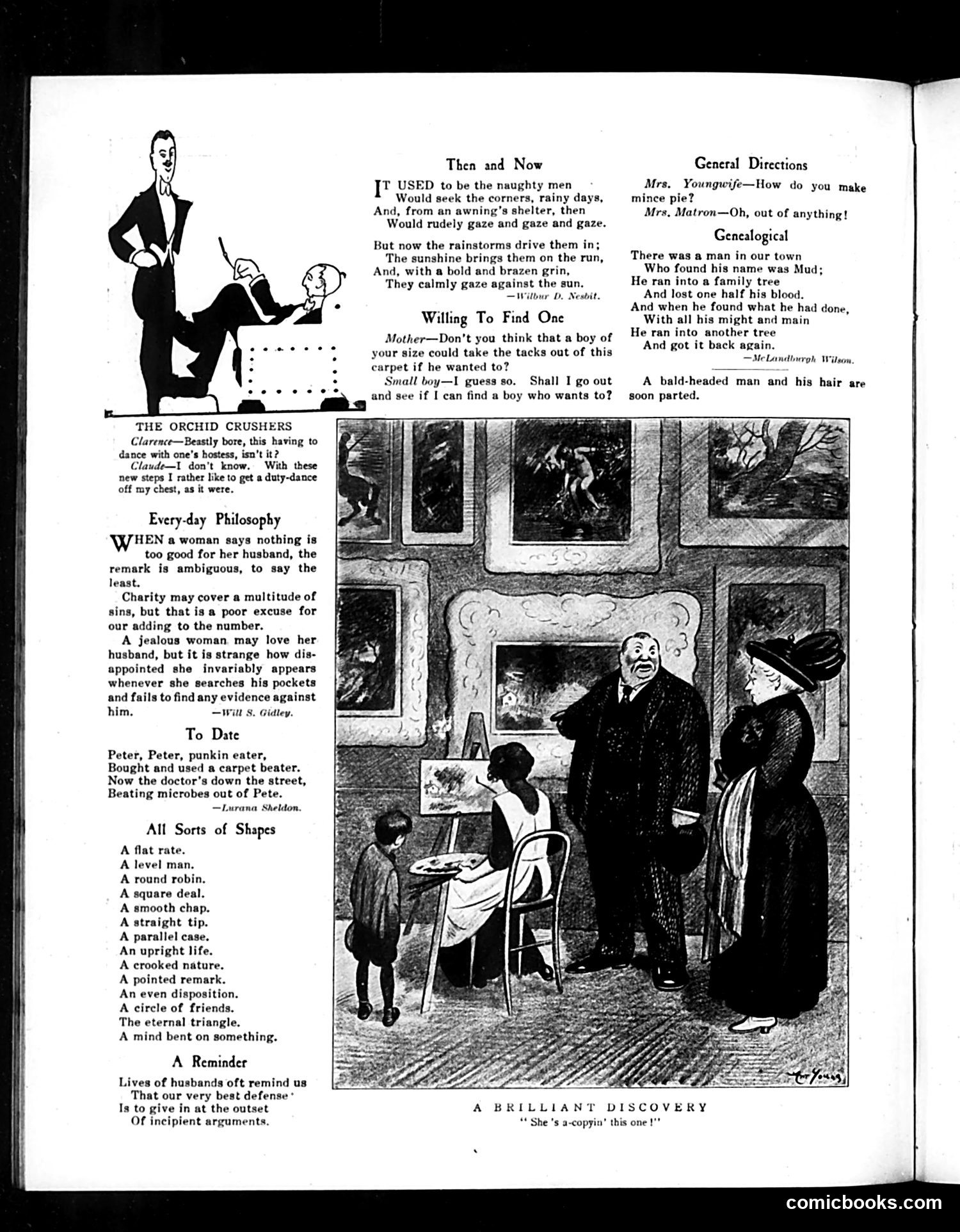
This page contains humorous short pieces typical of early 20th-century American satirical magazines. The main cartoon, "A Brilliant Discovery," depicts a woman copying artwork from a gallery wall while museum attendants watch—the joke being her claim that she's "copying" (reproducing) the painting, a play on artistic theft. The surrounding content includes light social commentary and wordplay: - "Then and Now" contrasts Victorian-era propriety with modern boldness—men once hid to gaze at women; now they stare openly in daylight - "Willing to Find One" is a child's deflection joke about avoiding work - Various puns use homonyms (a "flat rate," "round robin," "crooked nature") to create wordplay - "Genealogical" jokes about a man literally running into family trees The overall tone is genteel humor aimed at upper-middle-class readers—satirizing social pretension, marital dynamics, and modern behavior changes. There's no heavy political content; instead, the satire targets everyday social hypocrisy and linguistic wordplay.
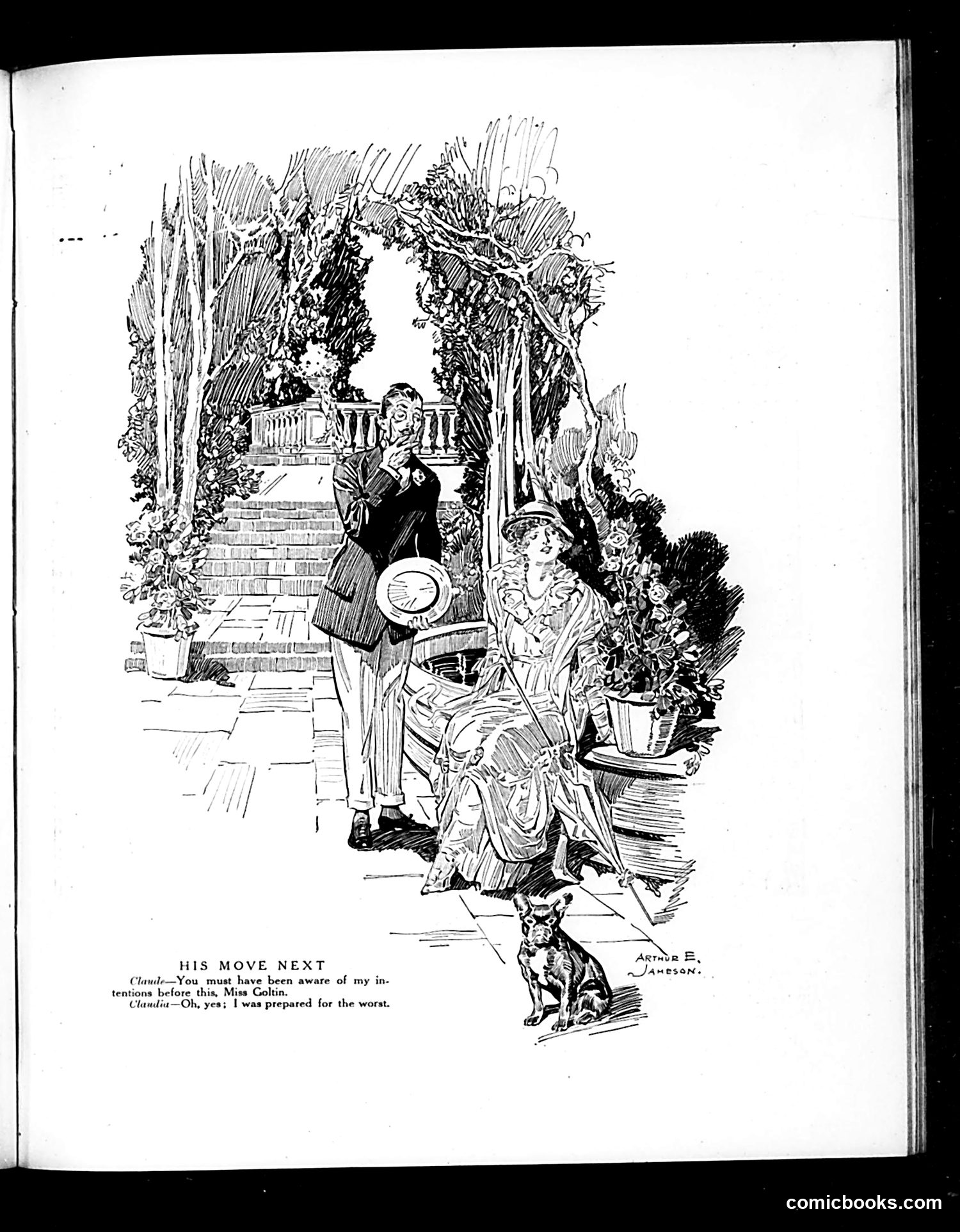
This appears to be a romantic comedy cartoon showing a marriage proposal scene in a garden setting. The male figure "Claude" is making his romantic intentions known to "Miss Goldin," while she responds with comic resignation that she "was prepared for the worst." The satire mocks conventional courtship rituals of the era—the woman's unenthusiastic response suggests she views marriage as an inevitable doom rather than romantic fulfillment. This reflects period humor about matrimony as a trap for women, contrasting the idealized romantic garden setting with her bleak, resigned attitude. The small dog observing the scene adds to the comedic tone. The cartoon is credited to **Arthur E. Jameson**. The joke relies on the ironic gap between romantic expectation and female skepticism about marriage.
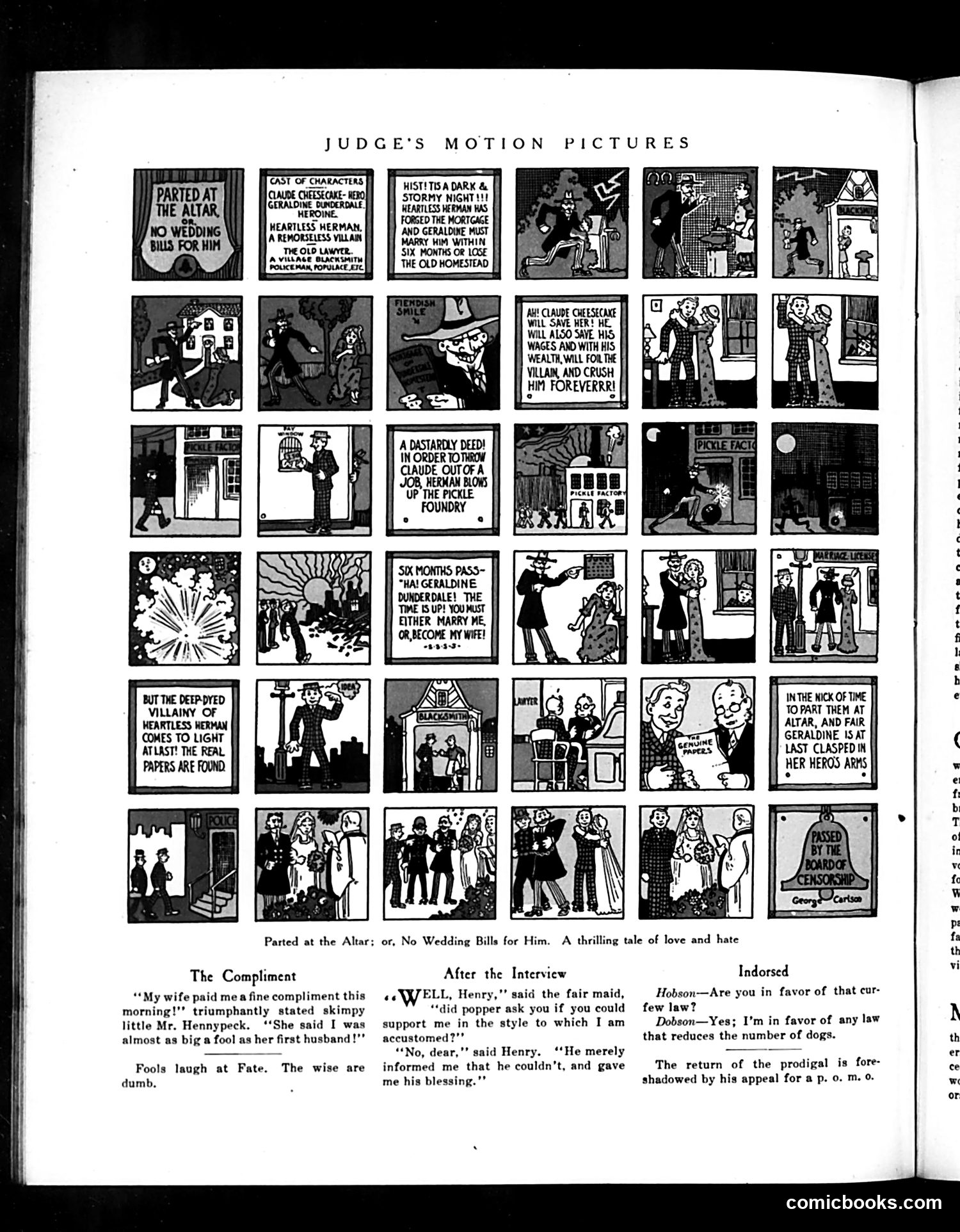
This page presents a serialized melodrama titled "Parted at the Altar" told through sequential comic panels. The story follows classic villain-hero-heroine tropes: Claude Cheesecake (hero) and Geraldine Dunderdale (heroine) are separated at their wedding by Heartless Herman (villain), who schemes to force Geraldine into marriage within six months. The narrative resolves when hidden papers expose Herman's villainy, allowing the hero to rescue the heroine. Below the serial are three brief joke sections mocking domestic life and social conventions. "The Compliment" ridicules henpecked husbands; "After the Interview" satirizes prospective fathers-in-law's financial concerns; "Indorsed" makes a joke about noise ordinances and dogs. The page exemplifies Judge magazine's blend of melodramatic parody and satirical commentary on everyday American social dynamics, particularly marriage and gender relations, typical of early 20th-century American humor publications.
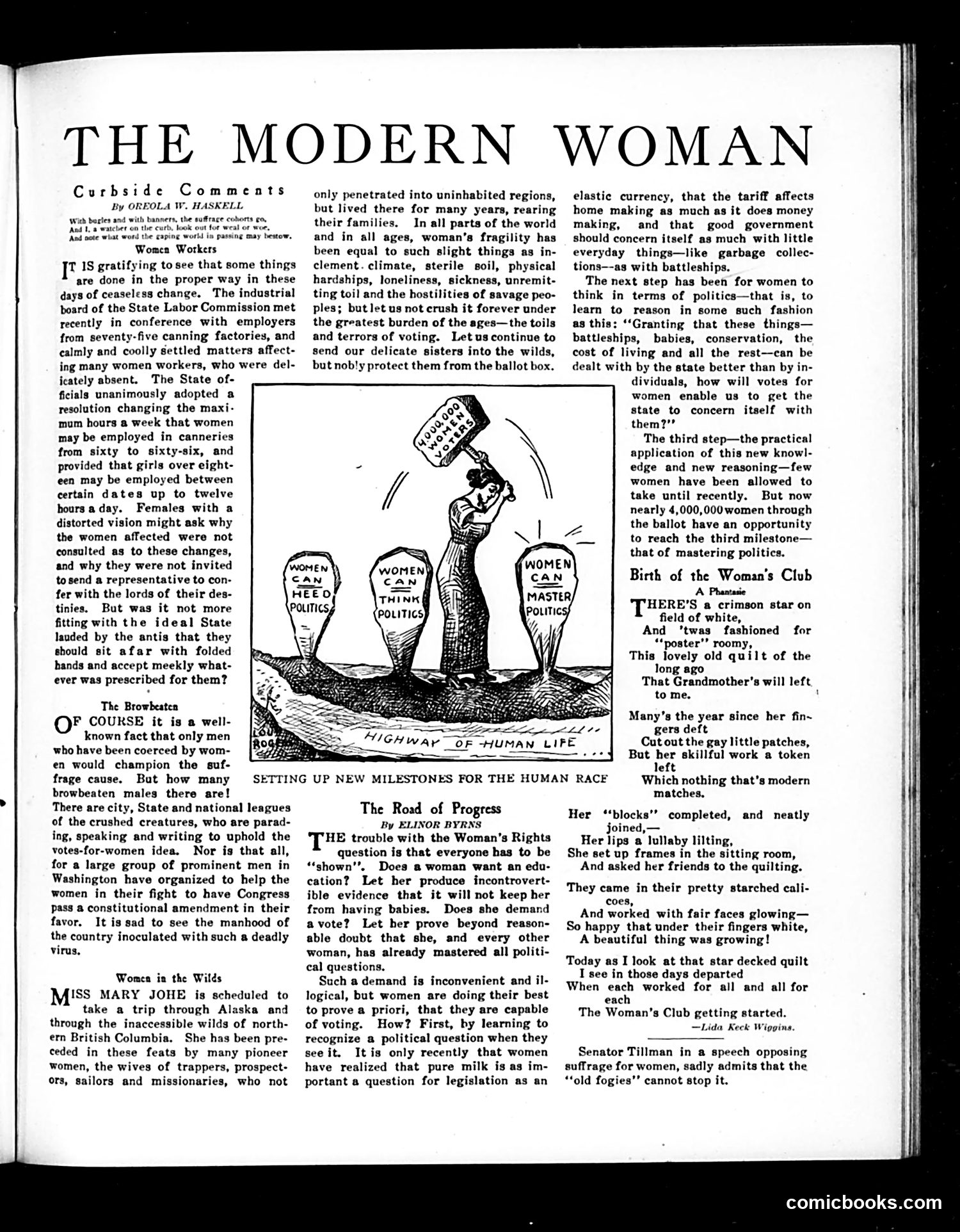
This page uses heavy irony to mock anti-suffrage arguments. The central cartoon shows four female figures labeled "Women Can Heed Politics," "Women Can Think Politics," and "Women Can Master Politics" emerging from soil labeled "Highway of Human Life"—satirizing the notion that women are incapable of political thought. The accompanying text systematically dismantles anti-suffrage logic through sarcasm. It mocks a state labor board that changed women's working hours *without consulting the affected women*, then sarcastically suggests this was "fitting" since women shouldn't participate in decisions affecting them. It ridicules the claim that only "browbeaten" men support suffrage, and highlights the contradiction that women can survive Alaska's wilderness but supposedly can't handle voting. The piece argues women have already demonstrated political competence by recognizing that everyday concerns—garbage collection, milk purity, tariffs—are inherently political issues requiring legislative attention. **The satire's point**: Anti-suffrage arguments are logically absurd and contradict women's demonstrated capabilities.
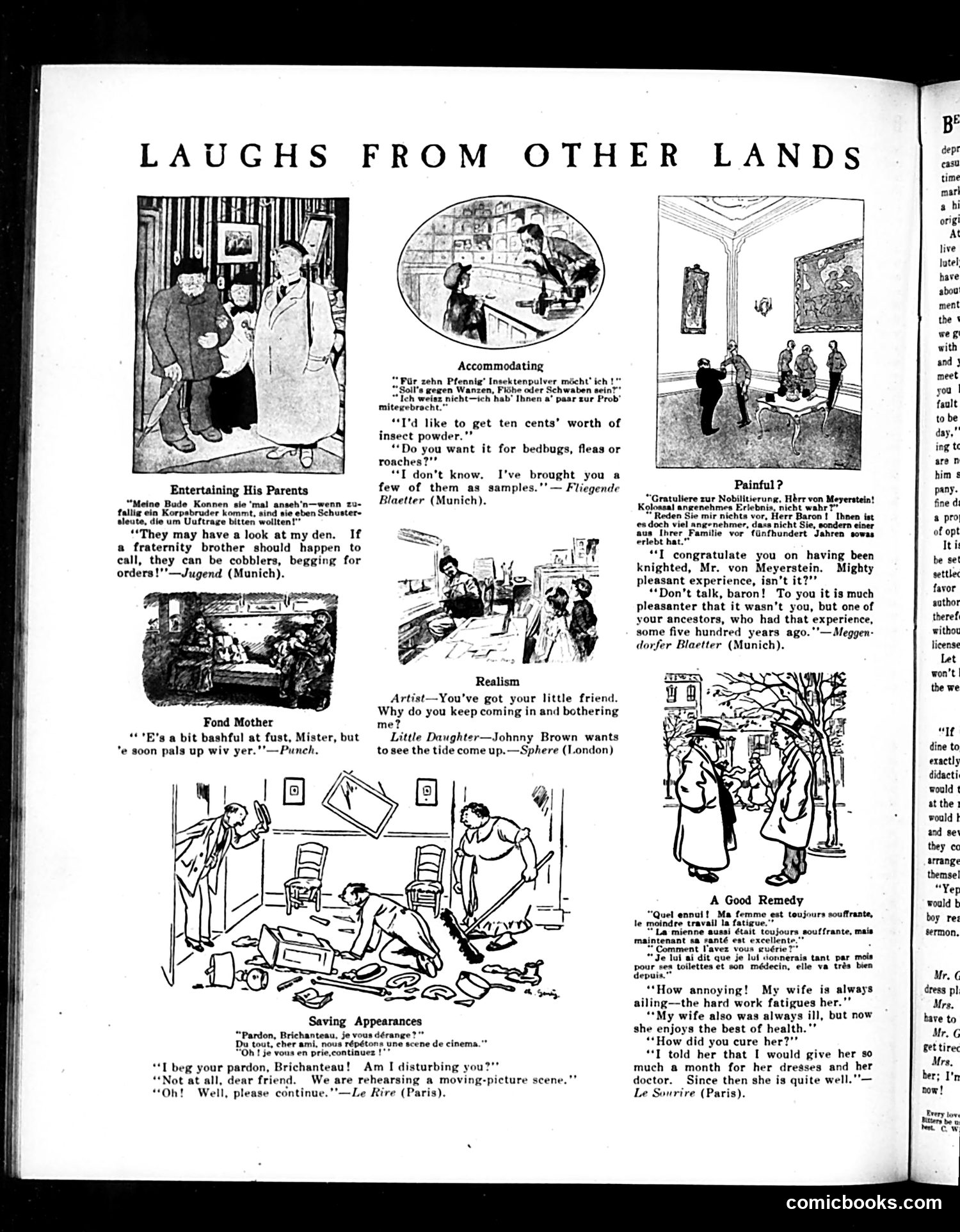
This page collects comic anecdotes translated from European satirical publications (German *Jugend* and *Fliegende Blätter*, French *Le Rire* and *Le Sourire*, British *Punch* and *Sphere*). The humor reflects early 20th-century social attitudes: **Key themes:** - **Class pretense**: A student hides working-class parents as "cobblers" from fraternity brothers - **Marital dynamics**: A husband "cures" his hypochondriac wife by allocating her a clothing/doctor budget—satirizing women's complaints as materially motivated - **Naturalistic comedy**: A child disrupts an artist because her friend wants to watch the real tide - **Social climbing**: A newly knighted man is mocked for enjoying status his ancestors couldn't have achieved The satire targets bourgeois social anxiety, gender stereotypes, and pretentiousness across European cultures, using situation comedy rather than caricature.
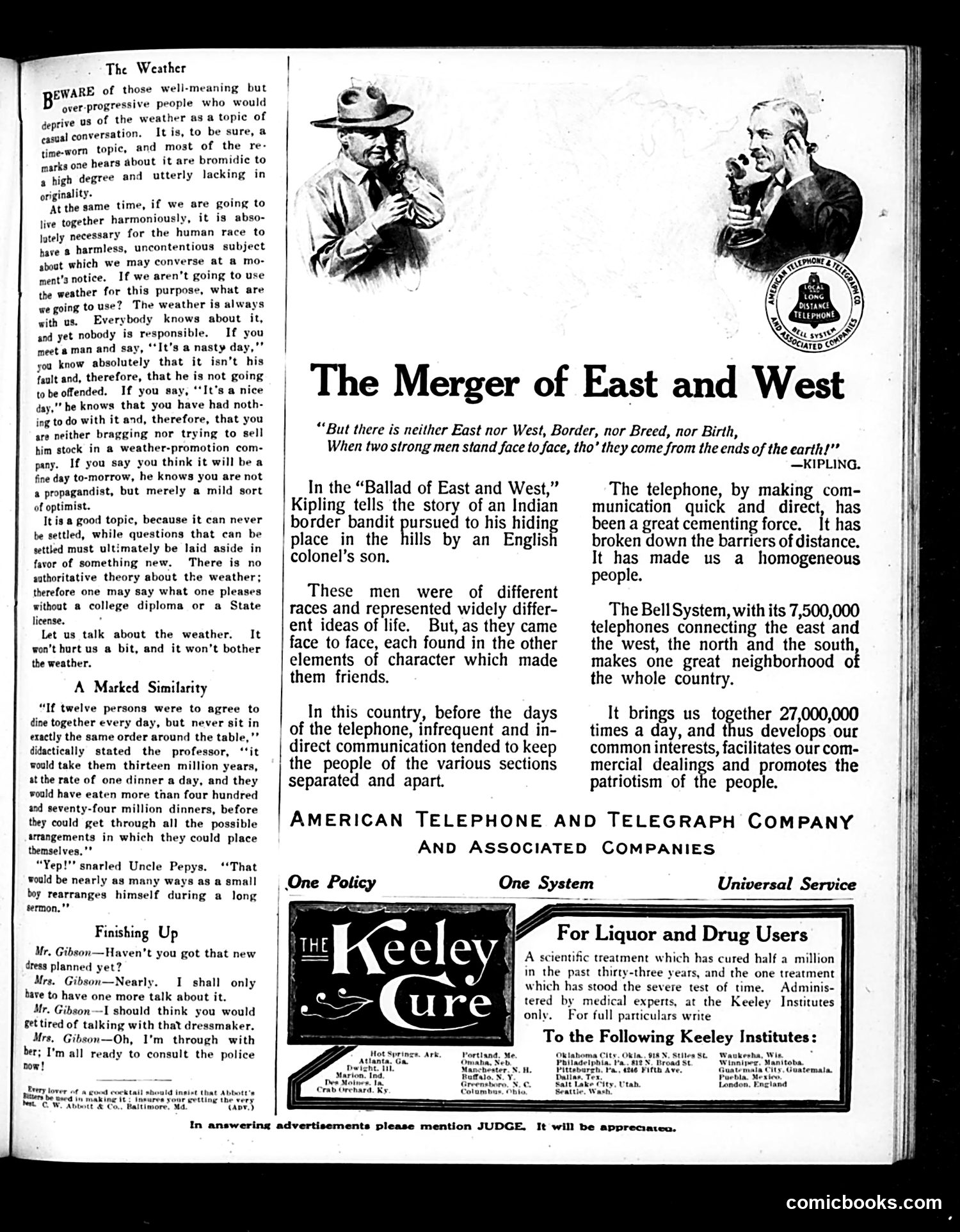
This Judge magazine page contains several satirical pieces and advertisements: **"The Weather"** humorously defends small talk about weather as a necessary, harmless social lubricant—a topic nobody can blame you for since it's nobody's responsibility. **"A Marked Similarity"** is a joke comparing the mathematical improbability of a boy sitting in different positions during a long sermon to the thirteen-million-year calculation about dinner seating arrangements. **"The Merger of East and West"** is the main content: it references Kipling's poem to argue the telephone unites America's geographically and culturally divided regions. The accompanying Bell Telephone advertisement claims their 7.5 million phones connecting east/west and north/south create national unity and patriotism through 27 million daily connections. The cartoon illustrations (two men in conversation) visually represent this East-West connection theme. The page also includes an ad for "The Keeley Cure," a treatment for addiction—a common but now-notorious patent medicine of the era.
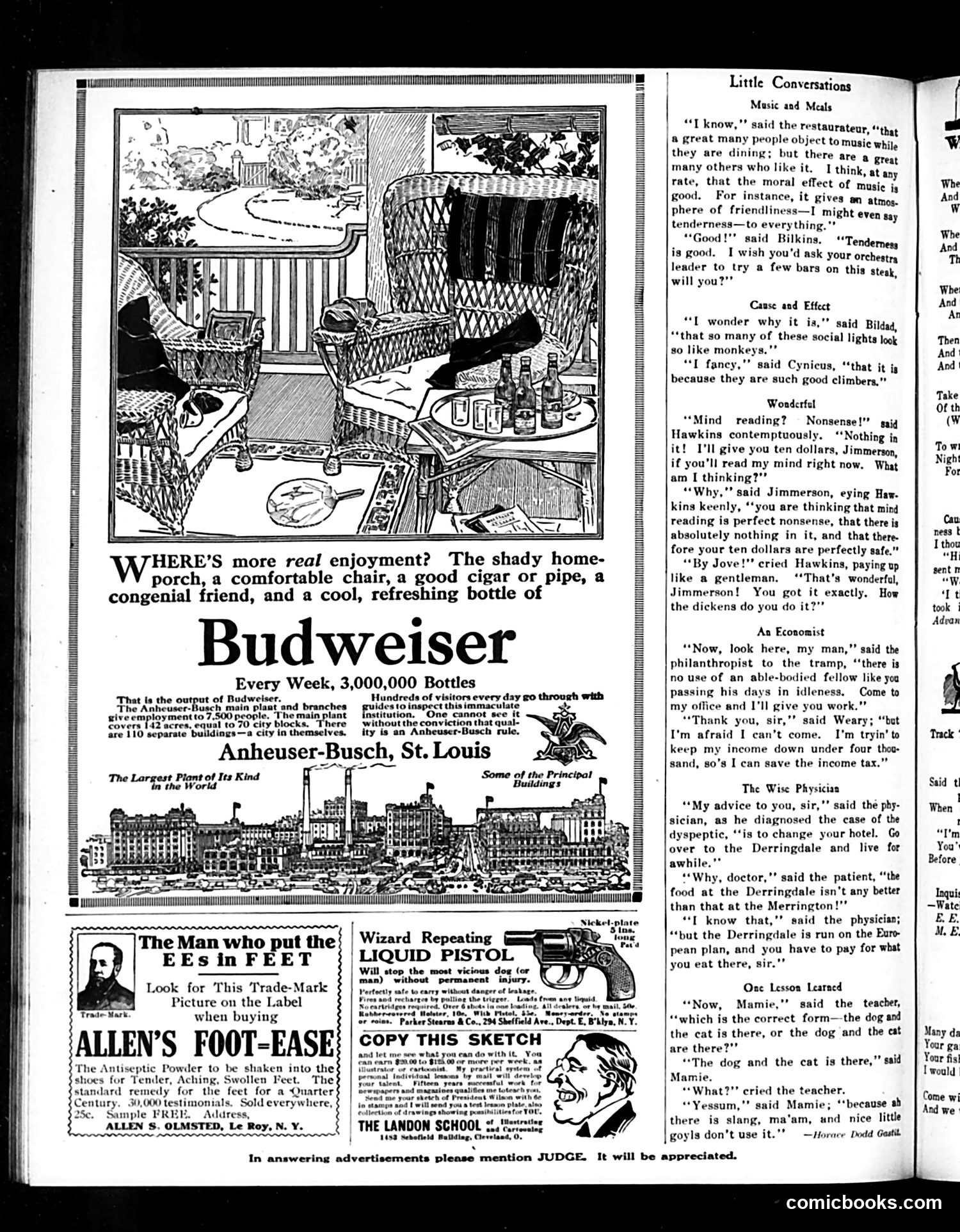
This page contains multiple brief humorous dialogues satirizing early 20th-century social pretensions and absurdities. **"Music and Meals"** mocks restaurateurs' claims that dining music creates "tenderness"—the diner sarcastically suggests the orchestra play on his steak, implying the food needs tenderness, not the atmosphere. **"Cause and Effect"** contains a casual monkey joke about "social lights" being good "climbers"—typical period humor. **"Mind Reading"** satirizes both a con artist's fraud and gullible wealthy patrons willing to pay for pseudoscientific entertainment. **"An Economist"** mocks a tramp's inverted logic: he refuses work to keep his income low enough to avoid taxes—absurd reasoning presented deadpan. **"The Wise Physician"** jokes that European plan hotels (paying per meal) force you to save money by eating less, making them "healthier" than all-inclusive American hotels. The dominant imagery is a large **Budweiser advertisement** featuring factory imagery and production claims—typical early-1900s advertising copy emphasizing industrial scale and quality control.
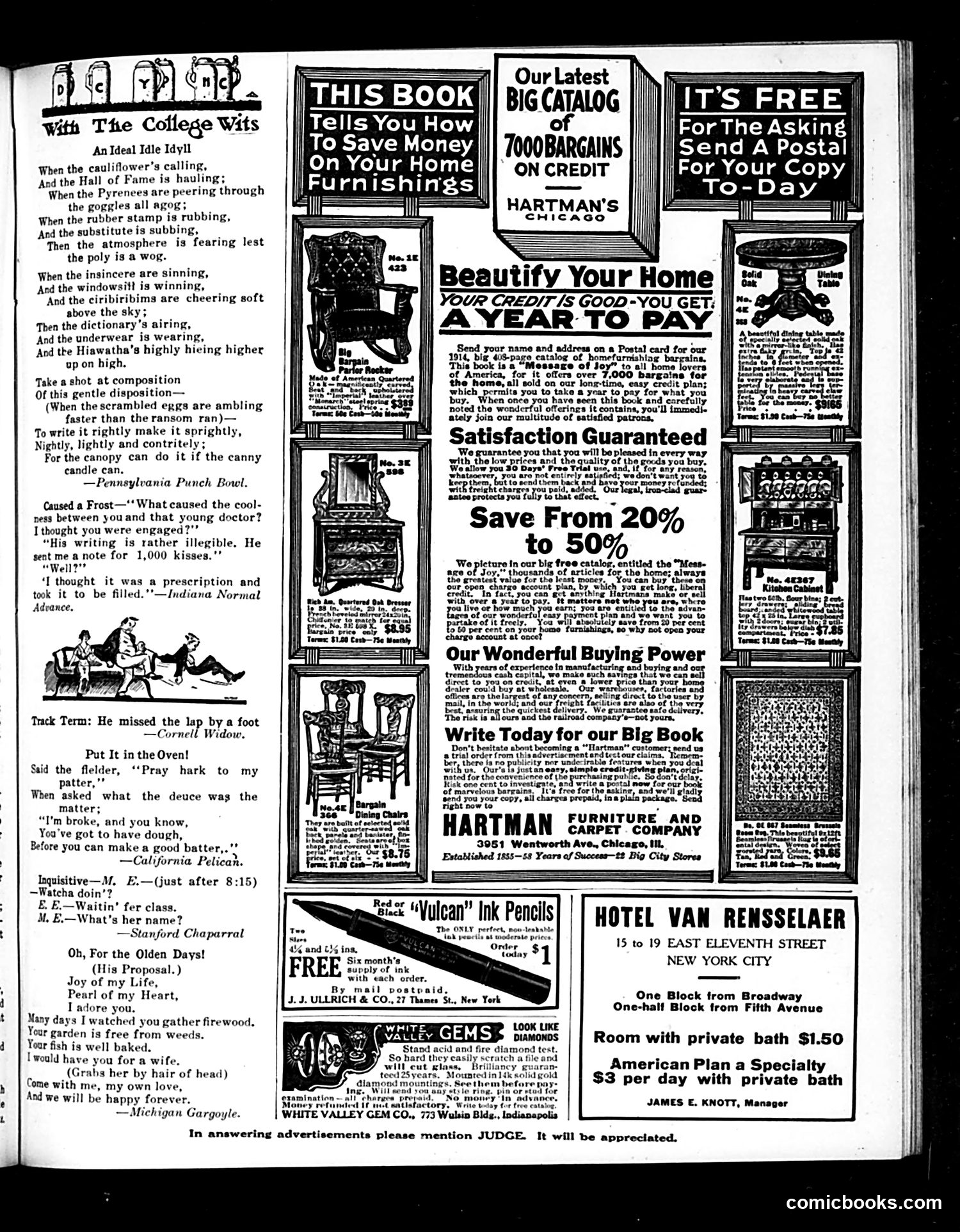
This is primarily an **advertising page** with minimal editorial content. The left column contains brief humorous verses and jokes attributed to college publications ("College Wits"), including puns about campus life ("the poly is a wog," wordplay with "Hiawatha"). The jokes are mild observational humor typical of early 20th-century college humor—a young doctor's illegible handwriting mistaken for a prescription; a baseball player missing "the lap by a foot"; romantic banter about needing "dough" to make a "good batter." The page is dominated by **mail-order furniture and home goods advertisements** from Hartman Furniture and Carpet Company (Chicago), promoting credit purchases with "a year to pay," hotel ads, ink pencil offers, and diamond jewelry. These ads reflect the era's emphasis on consumer credit and mail-order shopping. The page has no discernible political satire or social commentary—it's a typical Judge revenue page mixing lightweight collegiate humor with commercial advertisements.
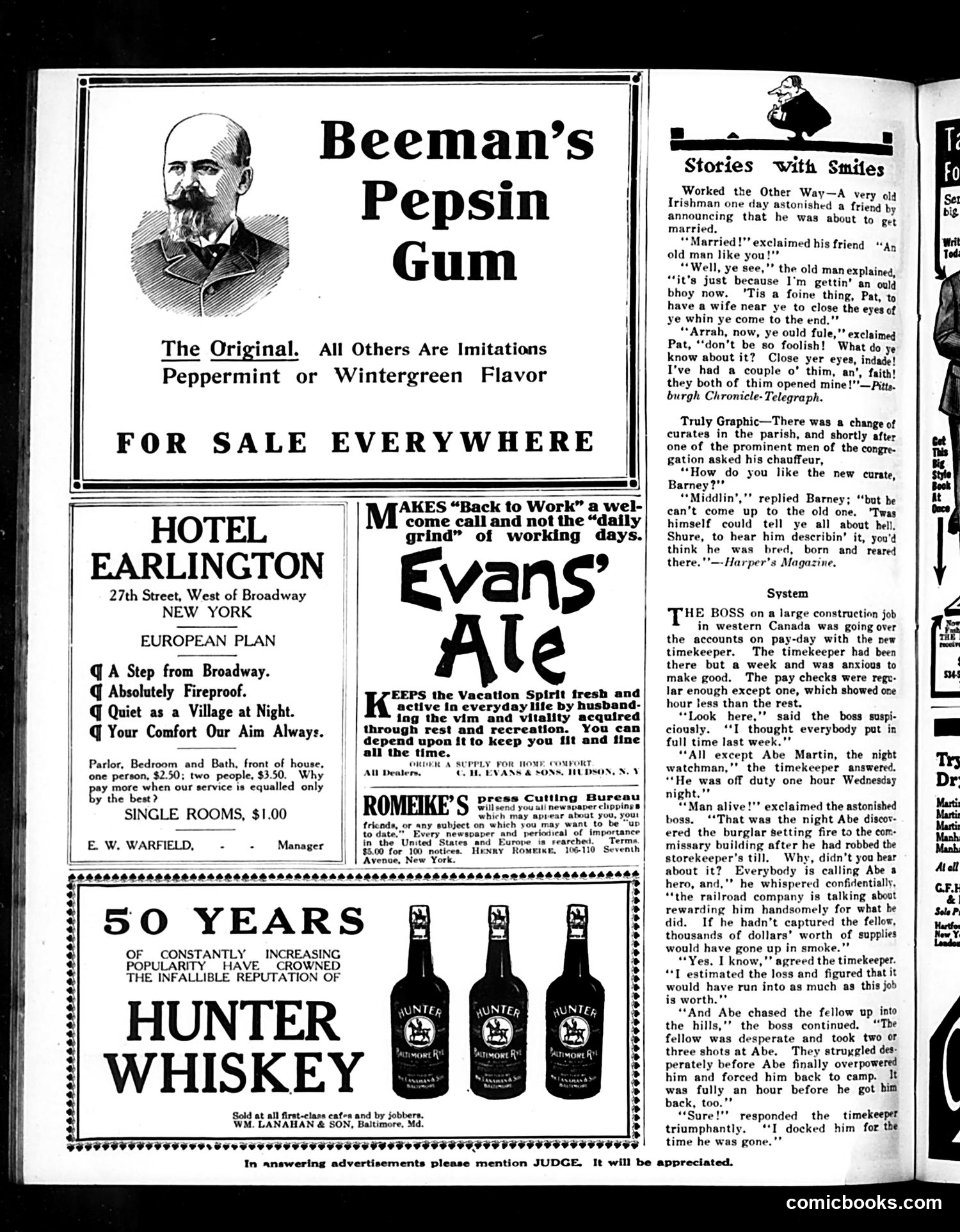
This page is primarily **advertising**, featuring multiple product and service promotions typical of early 20th-century magazines rather than satirical editorial content. The advertisements include Beeman's Pepsin Gum (claiming to be "the original"), the Hotel Earlington in New York, Evans' Ale, Hunter Whiskey (emphasizing 50 years of popularity), and a press clipping bureau service. The only editorial content comprises three brief humorous stories in the "Stories with Smiles" section—lighthearted anecdotes about Irish characters and workplace situations. These are gentle, folksy humor pieces with no apparent political satire. One story satirizes bureaucratic absurdity: a timekeeper deducts an hour's pay from a night watchman who heroically stopped a burglary, demonstrating rigid rule-following at odds with common sense and justice. The page reflects Judge's mixed format of advertising revenue alongside entertainment content rather than focused satirical commentary.
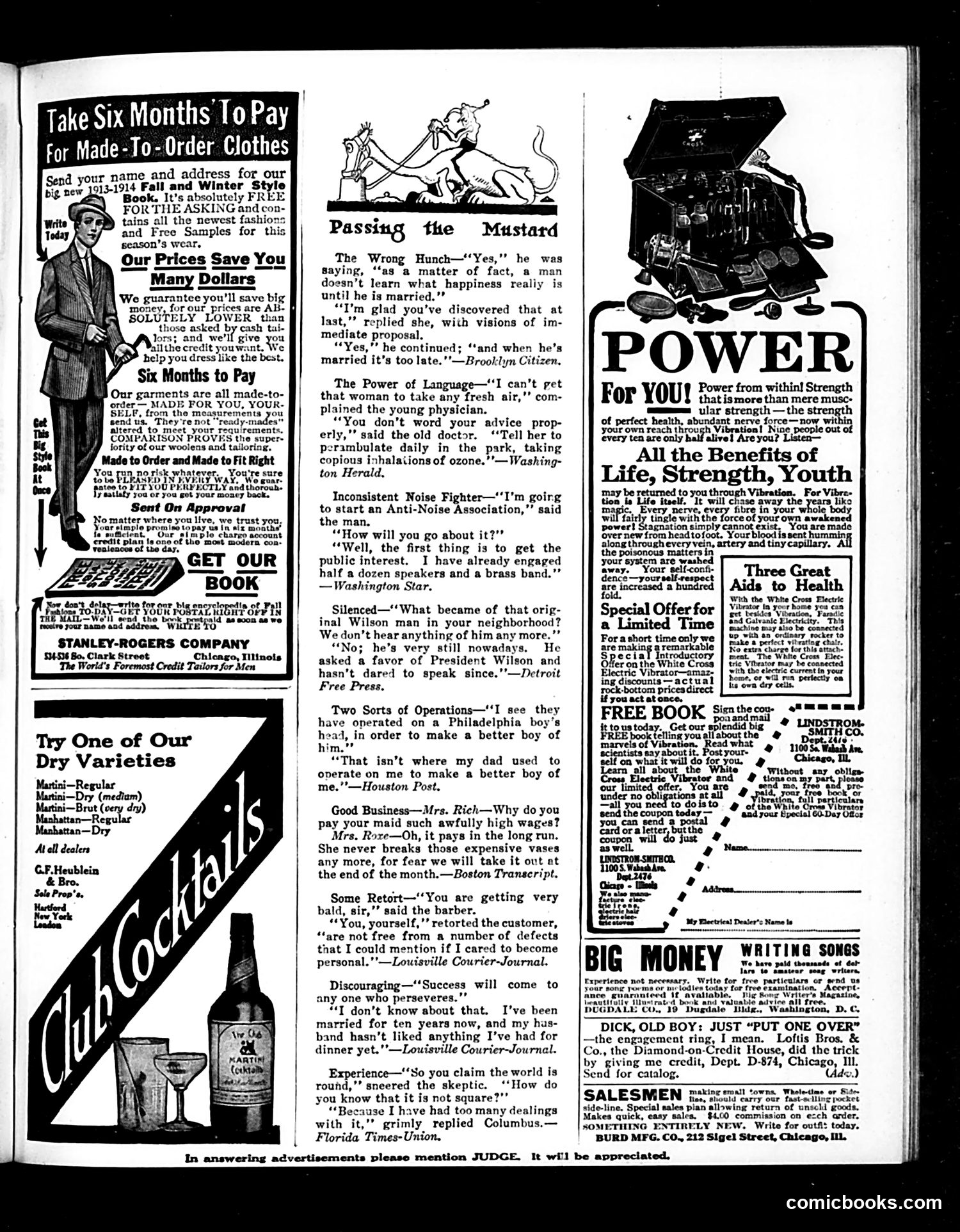
This page from *Judge* (circa 1914) is primarily an **advertising-heavy publication page** with several brief satirical jokes scattered throughout. The main content includes: **Advertisements:** Multiple ads dominate—tailoring services ("Six Months to Pay"), a "Vibration" health device promising strength and vitality, and other mail-order products typical of early 1900s magazines. **Satirical Jokes** ("Passing the Mustard" section): - A cynical joke about marriage: a man tells his wife that men don't learn about happiness until after marriage—"then it's too late" - A doctor's joke about using fancy language ("perambulate," "copious inhalations of ozone") to persuade patients - A joke mocking an "Anti-Noise Association" founder who plans to promote it using—ironically—speakers and a brass band - A "silenced Wilson man" reference, likely mocking a supporter of President Woodrow Wilson who lost his voice after asking Wilson a favor The page reflects early 20th-century advertising culture and satirizes contemporary social attitudes about marriage, class pretension, and politics.
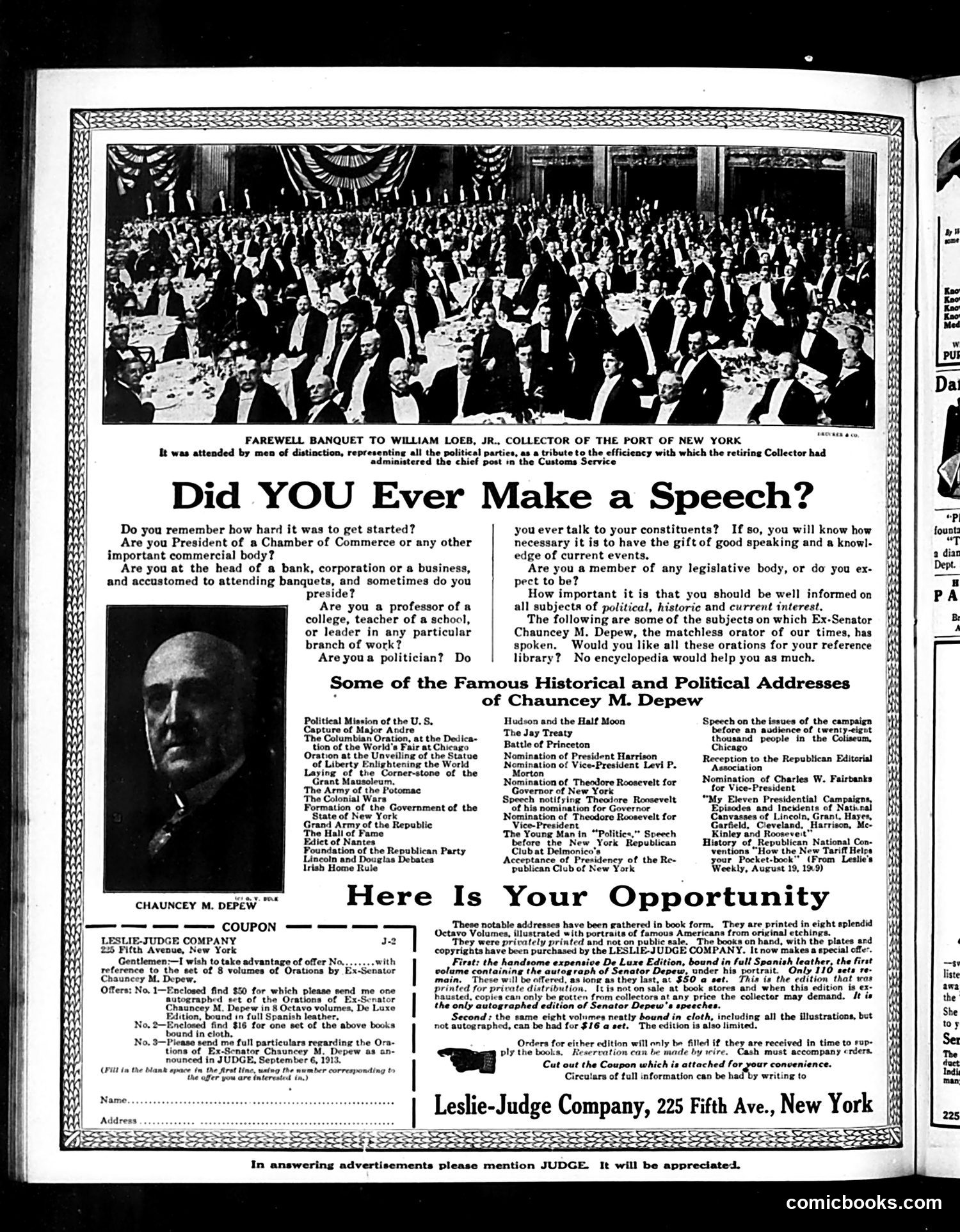
This page is primarily **advertising**, not satire. It promotes a multi-volume collection of speeches by **Chauncey M. Depew**, a prominent Republican politician and orator of the early 20th century. The page includes: 1. **A photograph** of a farewell banquet for William Loeb Jr., Collector of the Port of New York—a ceremonial government event attended by political figures. 2. **"Did YOU Ever Make a Speech?"**—a rhetorical questionnaire designed to convince readers (businesspeople, politicians, educators) that they need Depew's speeches for reference and oratorical inspiration. 3. **A list of Depew's famous addresses** on historical and political topics (Hudson River, Jay Treaty, Theodore Roosevelt nominations, etc.), establishing his credibility as a great speaker. 4. **Mail-in coupons** offering three purchase options for the De Luxe edition (leather-bound, $50) or cloth edition ($16). The implicit message: owning Depew's collected speeches will improve your own public speaking abilities. This is a straightforward sales pitch disguised as civic self-improvement.
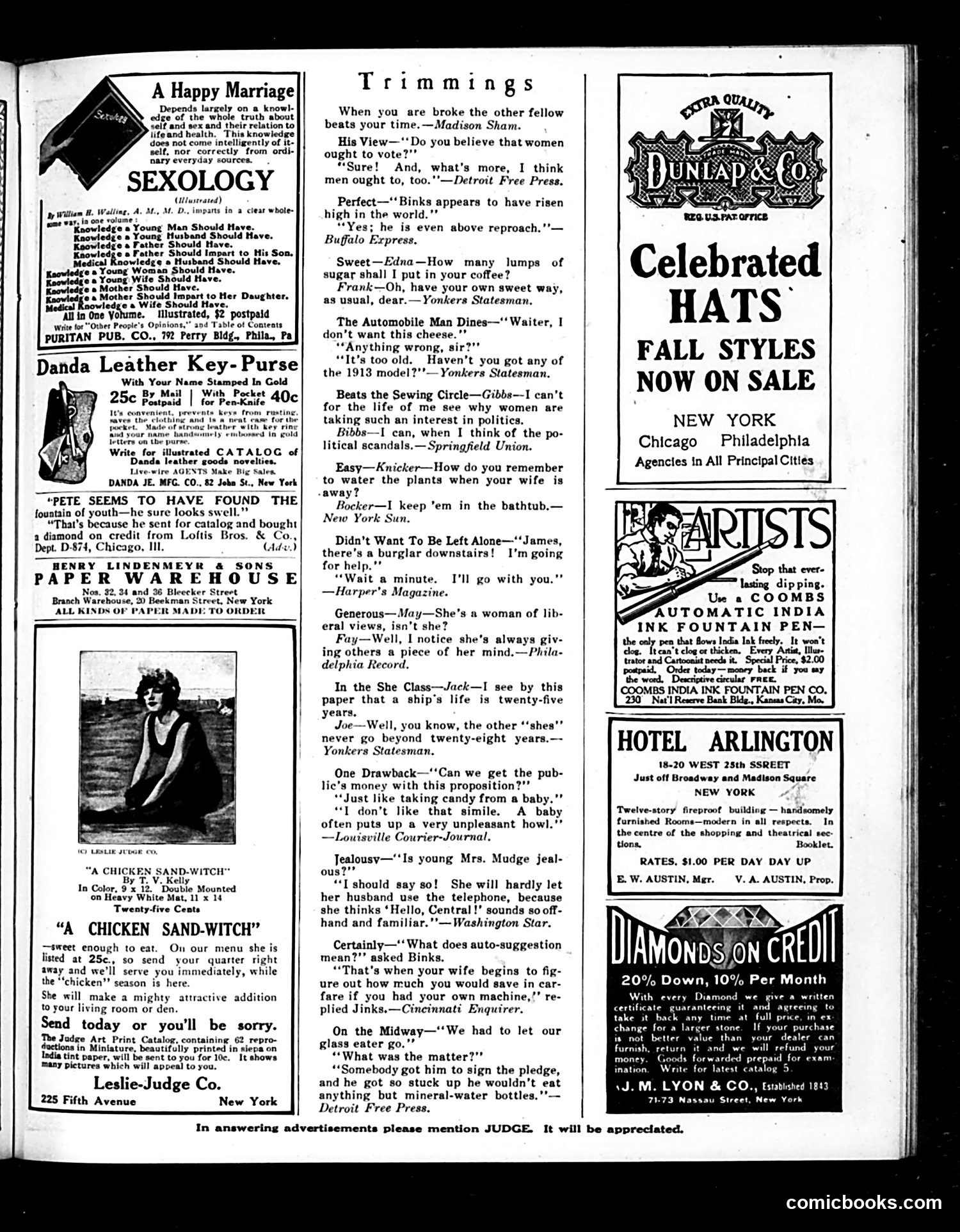
This page is primarily **advertising and short humorous quips** rather than political cartoons requiring historical context. The "Trimmings" section consists of brief jokes about early 1900s domestic life: women's suffrage, romantic relationships, automobiles, and household management. One joke references "1913 model" cheese, suggesting this page dates near that year. Another mentions women's newfound interest in politics, reflecting contemporary debates over women's voting rights. The advertisements promote era-appropriate products: a sexology book (reflecting Progressive-era interest in scientific approaches to marriage), leather goods, a "Chicken Sand-Witch" (apparently a novelty item), and diamonds sold on credit. One small illustration (credited to Leslie-Judge Co.) accompanies an ad but lacks clear satirical content visible here. The page contains **no major political figures or sustained satire**—just light domestic humor typical of Judge magazine's format, with oblique references to women's suffrage and modern conveniences (automobiles, telephones) that were still novel enough to merit jokes.
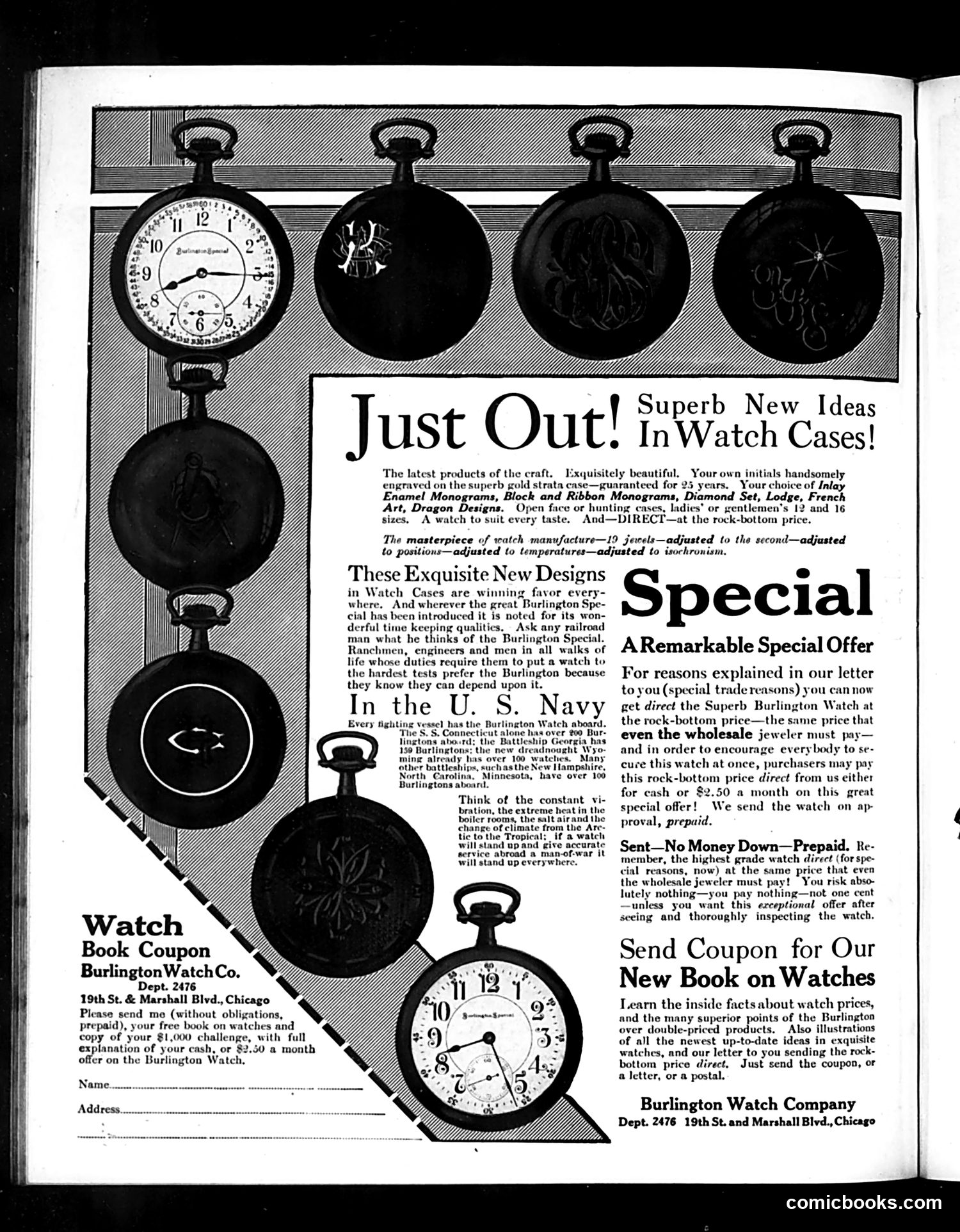
This page is **not a cartoon or satire**—it's a full-page advertisement for the Burlington Watch Company, appearing in Judge magazine. The ad promotes "superb new" watch case designs with various monogram options (enamel, diamond-set, French Art, dragon designs). The central marketing pitch emphasizes the watch's reliability: it's used by the U.S. Navy, railroad workers, and engineers who depend on precision timekeeping under extreme conditions. The advertisement's key selling tactic is a direct-sales offer bypassing jewelers—customers can purchase at "rock-bottom price" with $2.50 monthly payments and a no-money-down trial. A coupon invites readers to request a free catalog. The visual display of multiple pocket watch designs and faces (some showing decorative engravings, one clearly labeled for Navy use) illustrates the product range. This is period marketing copy exploiting contemporary trust in military/industrial endorsements rather than satire or political commentary.