
Judge, 1913-09-06 · page 10 of 24
Judge — September 6, 1913 — page 10: what you’re looking at
What you’re looking at
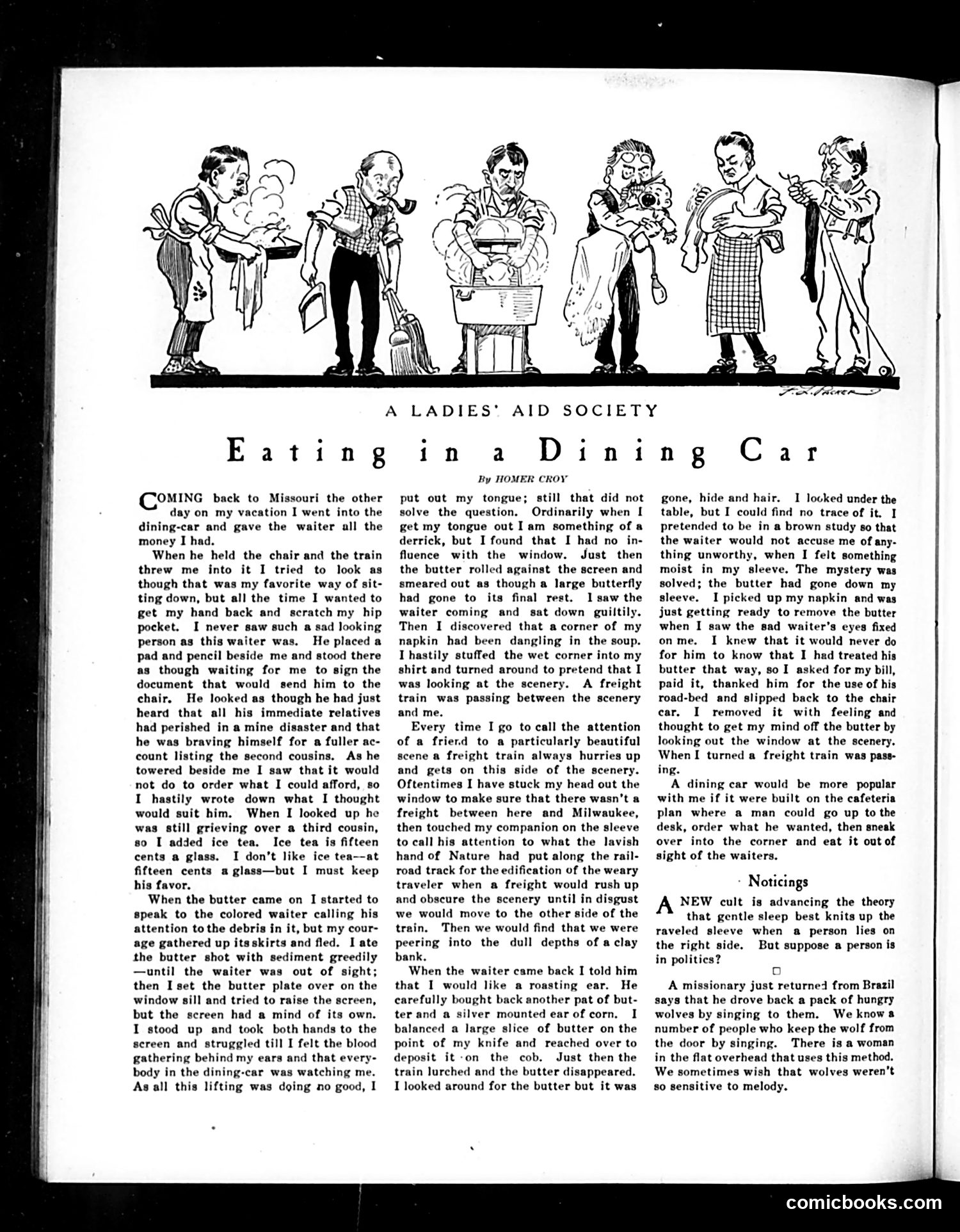
This is a humorous essay-cartoon (the illustration shows various dining-car mishaps) by Homer Croy poking fun at middle-class anxiety in formal settings. The narrator, traveling by train, becomes so intimidated by a sad-faced waiter that he orders expensive food he can't afford and pretends to enjoy buttered corn he clearly doesn't want, fearing judgment. The satire targets the social pretense required of Americans in "refined" spaces: the narrator struggles with a window screen while others watch, hides a soup-soaked napkin, and endures various indignities—ultimately getting butter down his sleeve—rather than lose face before a servant. The cartoon illustration at top ("A Ladies' Aid Society") depicts six characters in domestic chaos, complementing the dining-car theme of people performing respectability while things fall apart around them. The humor lies in exposing the absurdity of maintaining composure under social pressure.
📄 Transcribed text from this page (OCR, searchable)
Machine-transcribed from the original scan — historical spelling and the odd misread are preserved.
Eating COMING back to issouri the other day on my vacation I went into the dining-car and gave the waiter all the money I had. When he held the chair and the train threw me into it I tried to look as though that was my favorite way of sit- ting down, but all the time I wanted to get my hand back and scratch my hip pocket. I never saw such a sad looking person as this waiter was. He placed a pad and pencil beside me and stood there as though waiting for me to sign the document that would send him to the chair. He looked as though he had just heard that all his immediate relatives had perished in a mine disaster and that he was braving himself for a fuller ac- count listing the second cousins. As he towered beside me I saw that it would not do to order what I could afford, so I hastily wrote down what I thought would suit him. When I looked up he was still grieving over a third cousin, so I added ice tea. Ice tea is fifteen cents a glass. I don’t like ice tea—at fifteen cents a glass—but I must keep his favor. When the butter came on I started to speak to the colored waiter calling his attention to the debris in it, but my cour- age gathered up itsskirts and fled. I ate the butter shot with sediment greedily —until the waiter was out of sight; then I set the butter plate over on the window sill and tried to raise the screen, but the screen had a mind of its own. I stood up and took both hands to the screen and struggled till I felt the blood gathering behind my ears and that every- body in the dining-car was watching me. As all this lifting was doing no good, I A LADIES’ AID SOCIETY a Dini Ry HOMER CROY in put out my tongue; still that did not solve the question. Ordinarily when I get my tongue out Iam something of a derrick, but I found that I had no in- fluence with the window. Just then the butter rolled against the screen and smeared out as though a large butterfly had gone to its final rest. 1 saw the waiter coming and sat down guiltily. Then I discovered that a corner of my napkin had been dangling in the soup. Thastily stuffed the wet corner into my shirt and turned around to pretend that I was looking at the scenery. A freight train was passing between the scenery and me. Every time I go to call the attention of a friend to a particularly beautiful scene a freight train always hurries up and gets on this side of the scenery. Oftentimes I have stuck my head out the window to make sure that there wasn’t a freight between here and Milwaukee, then touched my companion on the sleeve to call his attention to what the lavish hand of Nature had put along the rail- road track for the edification of the weary traveler when a freight would rush up and obscure the scenery until in disgust we would move to the other side of the train. Then we would find that we were peering into the dull depths of a clay bank. When the waiter came back I told him that I would like a roasting ear. He carefully bought back another pat of but- ter and a silver mounted ear of corn. I balanced a large slice of butter on the point of my knife and reached over to deposit it-on the cob. Just then the train lurched and the butter disappeared. I looked around for the butter but it was ng Car gone, hide and hair. 1 locked under the table, but I could find no trace of it. I pretended to be in a brown study so that the waiter would not accuse me of any- thing unworthy, when I felt something moist in my sleeve. The mystery was solved; the butter had gone down my sleeve. I picked up my napkin and was just getting ready to remove the butter when I saw the sad waiter’s eyes fixed onme. I knew that it would never do for him to know that I had treated his butter that way, so I asked for my bill, paid it, thanked him for the use of his road-bed and slipped back to the chair car. I removed it with feeling and thought to get my mind off the butter by looking out the window at the scenery. When I turned a freight train was pase- ing. A dining car would be more popular with me if it were built on the cafeteria plan where a man could go up to the desk, order what he wanted, then sneak over into the corner and eat it out of sight of the waiters. » Noticings A NEW cult is advancing the theory that gentle sleep best knits up the raveled sleeve when a person lies on the right side. But suppose a person is in politics? oD A missionary just returned from Brazil says that he drove back a pack of hungry wolves by singing to them. We know a number of people who keep the wolf from the door by singing. There is a woman in the flat overhead that uses this method. We sometimes wish that wolves weren't 80 sensitive to melody. comicbooks.com