
Judge, 1913-09-06 · page 15 of 24
Judge — September 6, 1913 — page 15: what you’re looking at
What you’re looking at
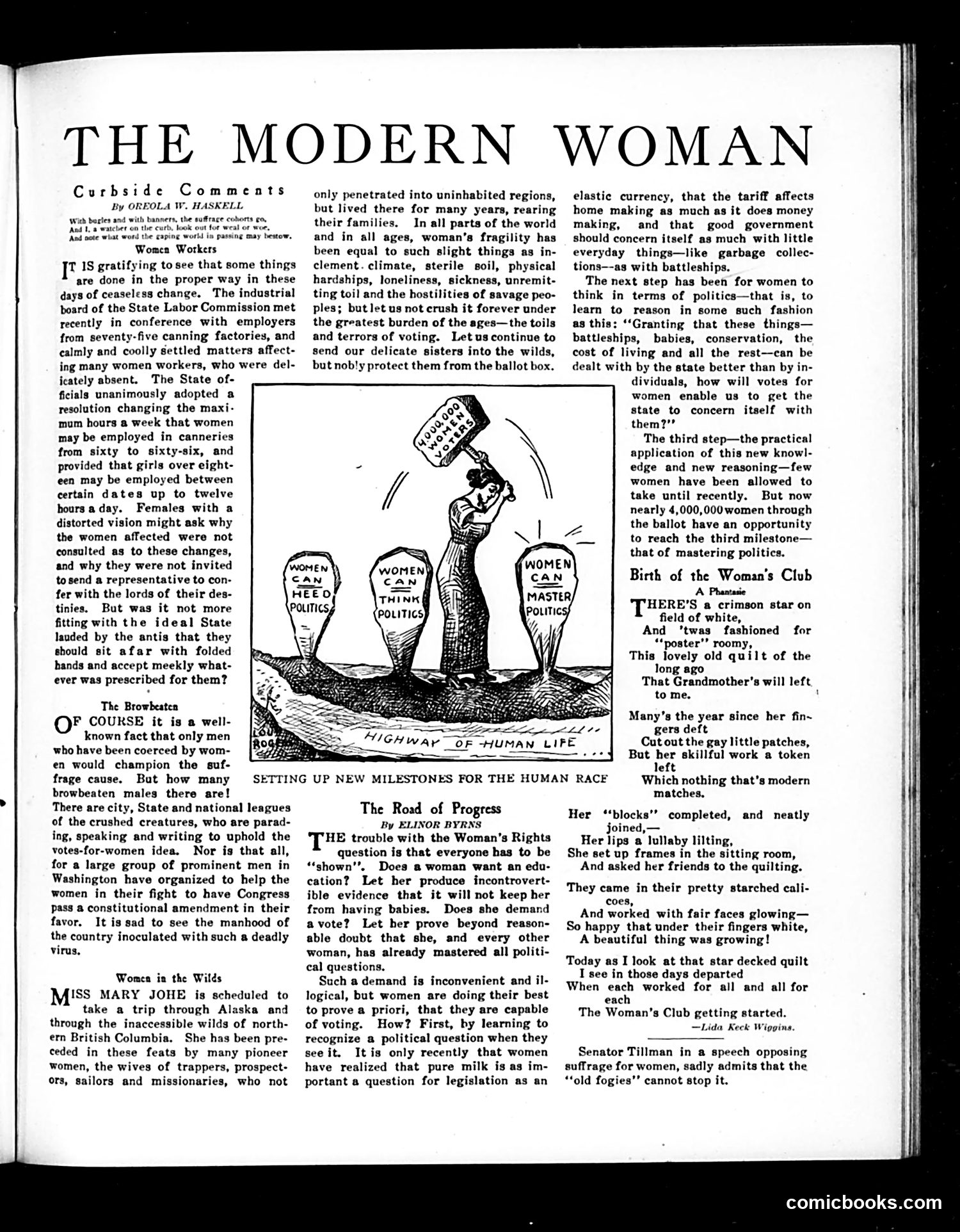
This page uses heavy irony to mock anti-suffrage arguments. The central cartoon shows four female figures labeled "Women Can Heed Politics," "Women Can Think Politics," and "Women Can Master Politics" emerging from soil labeled "Highway of Human Life"—satirizing the notion that women are incapable of political thought. The accompanying text systematically dismantles anti-suffrage logic through sarcasm. It mocks a state labor board that changed women's working hours *without consulting the affected women*, then sarcastically suggests this was "fitting" since women shouldn't participate in decisions affecting them. It ridicules the claim that only "browbeaten" men support suffrage, and highlights the contradiction that women can survive Alaska's wilderness but supposedly can't handle voting. The piece argues women have already demonstrated political competence by recognizing that everyday concerns—garbage collection, milk purity, tariffs—are inherently political issues requiring legislative attention. **The satire's point**: Anti-suffrage arguments are logically absurd and contradict women's demonstrated capabilities.
📄 Transcribed text from this page (OCR, searchable)
Machine-transcribed from the original scan — historical spelling and the odd misread are preserved.
THE MODERN WOMAN Curbside Comments And 1. Ler ‘Asd pote what word the gaping worl! in passing may bestow, Women Workers r 1S gratifying to see that some things are done in the proper way in these days of ceaseless change. The industrial board of the State Labor Commission met recently in conference with employers from seventy-five canning factories, and calmly and coolly settled matters affect- ing many women workers, who were del- icately absent. The State of- ficials unanimously adopted a resolution changing the maxi- mum hours a week that women may be employed in canneries from sixty to sixty-six, and provided that girls over eight- een may be employed between certain dates up to twelve hoursaday. Females with a distorted vision might ask why the women affected were not consulted as to these changes, and why they were not invited tosend a representative to con- fer with the lords of their des- tinies. But was it not more fitting with the ideal State lauded by the antis that they should sit afar with folded hands and accept meekly what- ever was prescribed for them? The Browbeaten F COURSE it is a well- known fact that only men who have been coerced by wom- en would champion the suf- frage cause. But how many browbeaten males there are! There are city, State and national leagues of the crushed creatures, who are parad- ing, speaking and writing to uphold the votes-for-women idea. Nor is that all, for a large group of prominent men in Washington have organized to help the women in their fight to have Congress pass a constitutional amendment in their favor. It is sad to see the manhood of the country inoculated with such a deadly virus, Women in the Wilds M'ss MARY JOHE is scheduled to take a trip through Alaska and through the inaccessible wilds of north- ern British Columbia. She has been pre- ceded in these feats by many pioneer women, the wives of trappers, prospect- ors, sailors and missionaries, who not only penetrated into uninhabited regions, but lived there for many years, rearing their families. In all parts of the world and in all ages, woman's fragility has been equal to such slight things as in- clement. climate, sterile soil, physical hardships, loneliness, sickness, unremit- ting toil and the hostilities of savage peo- ples; butlet us not crush it forever under the greatest burden of the ages—the toils and terrors of voting. Letus continue to send our delicate sisters into the wilds, but nob!y protect them from the ballot box. IOI Se a aad OF -HUMAN LIFE SETTING UP NEW MILESTONES FOR THE HUMAN RACE The Road of Progress By ELINOR BYRNS HE trouble with the Woman's Rights question is that everyone has to be “shown’’. Does a woman want an edu- cation? Let her produce incontrovert- ible evidence that it will not keep her rom having babies. Does she demand avote? Let her prove beyond reason- able doubt that she, and every other woman, has already mastered all politi- cal questions. Such a demand is inconvenient and il- logical, but women are doing their best to prove a priori, that they are capable of voting. How? First, by learning to recognize a political question when they see it. Itis only recently that women have realized that pure milk is as im- portant a question for legislation as an elastic currency, that the tariff affects home making as much as it does money making, and that good government should concern itself as much with little everyday things—like garbage collec- tions—-as with battleships. The next step has been for women to think in terms of politics—that is, to learn to reason in some such fashion as this; ‘‘Granting that these things— battleships, babies, conservation, the cost of living and all the rest—can be dealt with by the state better than by in- dividuals, how will votes for women enable us to get the state to concern itself with them?” The third step—the practical application of this new knowl- edge and new reasoning—few women have been allowed to take until recently. But now nearly 4,000,000 women through the ballot have an opportunity to reach the third milestone— that of mastering politics. Birth of the Woman’s Club A Phantasie HERE'S a crimson star on field of white, And ‘twas fashioned for “‘poster’’ roomy, This lovely old quilt of the long ago That Grandmother's will left to me. i Many’s the year since her fin~ gers deft Cut out the gay little patches, But her skillful work a token left Which nothing that’s modern matches, Her and neatly “‘blocks’’ completed, joined,— Her lips a lullaby lilting, She set up frames in the sitting room, And asked her friends to the quilting. They came in their pretty starched cali- coes, And worked with fair faces glowing— So happy that under their fingers white, A beautiful thing was growing! Today as I look at that star decked quilt I see in those days departed When each worked for all and all for each The Woman’s Club getting started. Lida Keck Wiggins. Senator Tillman in a speech opposing suffrage for women, sadly admits that the “old fogies’’ cannot stop it. comicbooks.com