
Judge, 1913-09-06 · page 11 of 24
Judge — September 6, 1913 — page 11: what you’re looking at
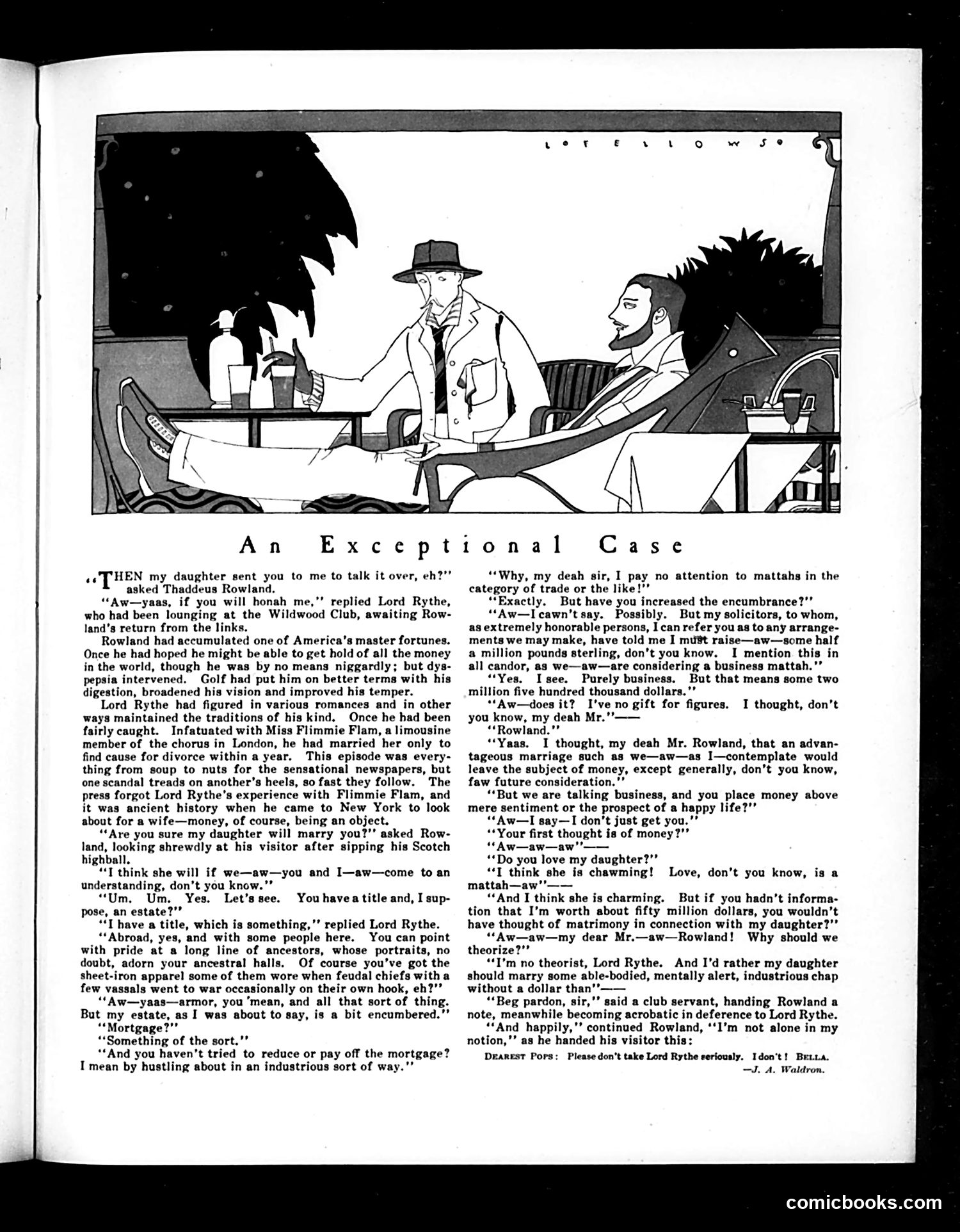
What you’re looking at
This satirical story mocks the transatlantic marriage market of the Gilded Age, where impoverished European aristocrats sought American heiresses' fortunes. Lord Rythe, a British nobleman with a scandalous past (a failed marriage to a chorus girl), approaches wealthy self-made American Thaddeus Rowland seeking to marry his daughter. The satire targets Rythe's transparent mercenary motives—he needs £500,000 (about $2.5 million) but frames it as "business." Rowland progressively exposes the hypocrisy: Rythe claims indifference to "trade," yet obsesses over money; he professes love for the daughter only after learning of her father's "$50 million" wealth. The joke highlights American anxiety about aristocratic fortune-hunters exploiting wealthy daughters, while also satirizing the daughters' and fathers' willingness to trade wealth for titles and social prestige. Rowland's final preference for a penniless but honest suitor over a titled fortune-seeker represents the idealized "American" values the magazine promoted.
📄 Transcribed text from this page (OCR, searchable)
Machine-transcribed from the original scan — historical spelling and the odd misread are preserved.
An oe THEN my daughter sent you to me to talk it over, eh?’’ asked Thaddeus Rowland. “‘Aw—yaas, if you will honah me,"’ replied Lord Rythe, who had been lounging at the Wildwood Club, awaiting Row- land’s return from the links. Rowland had accumulated one of America's master fortunes. Once he had hoped he might be able to get hold of all the money in the world, though he was by no means niggardly; but dys- pepsia intervened. Golf had put him on better terms with his digestion, broadened his vision and improved his temper. Lord Rythe had figured in various romances and in other ways maintained the traditions of his kind. Once he had been fairly caught. Infatuated with Miss Flimmie Flam, a limousine member of the chorus in London, he had married her only to find cause for divorce within a year. This episode was every- thing from soup to nuts for the sensational newspapers, but one scandal treads on another's heels, so fast they follow. The press forgot Lord Rythe’s experience with Flimmie Flam, and it was ancient history when he came to New York to look about for a wife—money, of course, being an object. “Are you sure my daughter will marry you?’’ asked Row- land, looking shrewdly at his visitor after sipping his Scotch highball. “T think she will if we— understanding, don’t you know. “Um, Um. Yes. Let's see. pose, an estate?’” “T have a title, which is something,"’ replied Lord Rythe. “Abroad, yes, and with some people here. You can point with pride at a long line of ancestors, whose portraits, no doubt, adorn your ancestral halls. Of course you’ve got the sheet-iron apparel some of them wore when feudal chiefs witha few vassals went to war occasionally on their own hook, eh?” “‘Aw—yaas—armor, you ’mean, and all that sort of thing. But my estate, as I was about to say, is a bit encumbered.’’ “Mortgage?” “‘Something of the sort.’’ “And you haven't tried to reduce or pay off the mortgage? I mean by hustling about in an industrious sort of way.'’ —you and I—aw—come to an You havea title and, I sup- Exceptional Case “Why, my deah sir, I pay no attention to mattahs in the category of trade or the like!"” “‘Exactly. But have you increased the encumbrance?”’ “‘Aw—I cawn’t say. Possibly. But my solicitors, to whom, as extremely honorable persons, I can refer you as to any arrange- ments we may make, have told me I mu8t raise—aw—some half a million pounds sterling, don’t you know. I mention this in all candor, as we—aw—are considering a business mattah."’ “Yes. Isee. Purely business. But that means some two million five hundred thousand dollars.'’ “*Aw—does it? I've no gift for figures. you know, my deah Mr."’-—— “‘Rowland.”” “Yaas. I thought, my deah Mr. Rowland, that an advan- tageous marriage such as we—aw—as I—contemplate would leave the subject of money, except generally, don’t you know, faw future consideration.” “‘But we are talking business, and you place money above mere sentiment or the prospect of a happy life?’’ “‘Aw—I say—I don’t just get you.’’ “Your first thought is of money?” “Aw—aw—aw’’—— “Do you love my daughter?’’ “I think she is chawming! mattah—aw’’—— “(And I think she is charming. But if you hadn’t informa- tion that I’m worth about fifty million dollars, you wouldn’t have thought of matrimony in connection with my daughter?”’ “‘Aw—aw—my dear Mr.—aw—Rowland! Why should we theorize? “I’m no theorist, Lord Rythe. And I'd rather my daughter should marry some able-bodied, mentally alert, industrious chap without a dollar than’’—— “‘Beg pardon, sir,’’ said a club servant, handing Rowland a note, meanwhile becoming acrobatic in deference to Lord Rythe. “And happily,’ continued Rowland, ‘‘l’m not alone in my notion,’’ as he handed his visitor this: Dearest Pors: Please don’t take Lord Rythe seriously. I thought, don’t Love, don’t you know, is a Idon't! Bria. —J. A, Waldron. comicbooks.com