
A complete issue · 24 pages · 1912
Judge — November 16, 1912
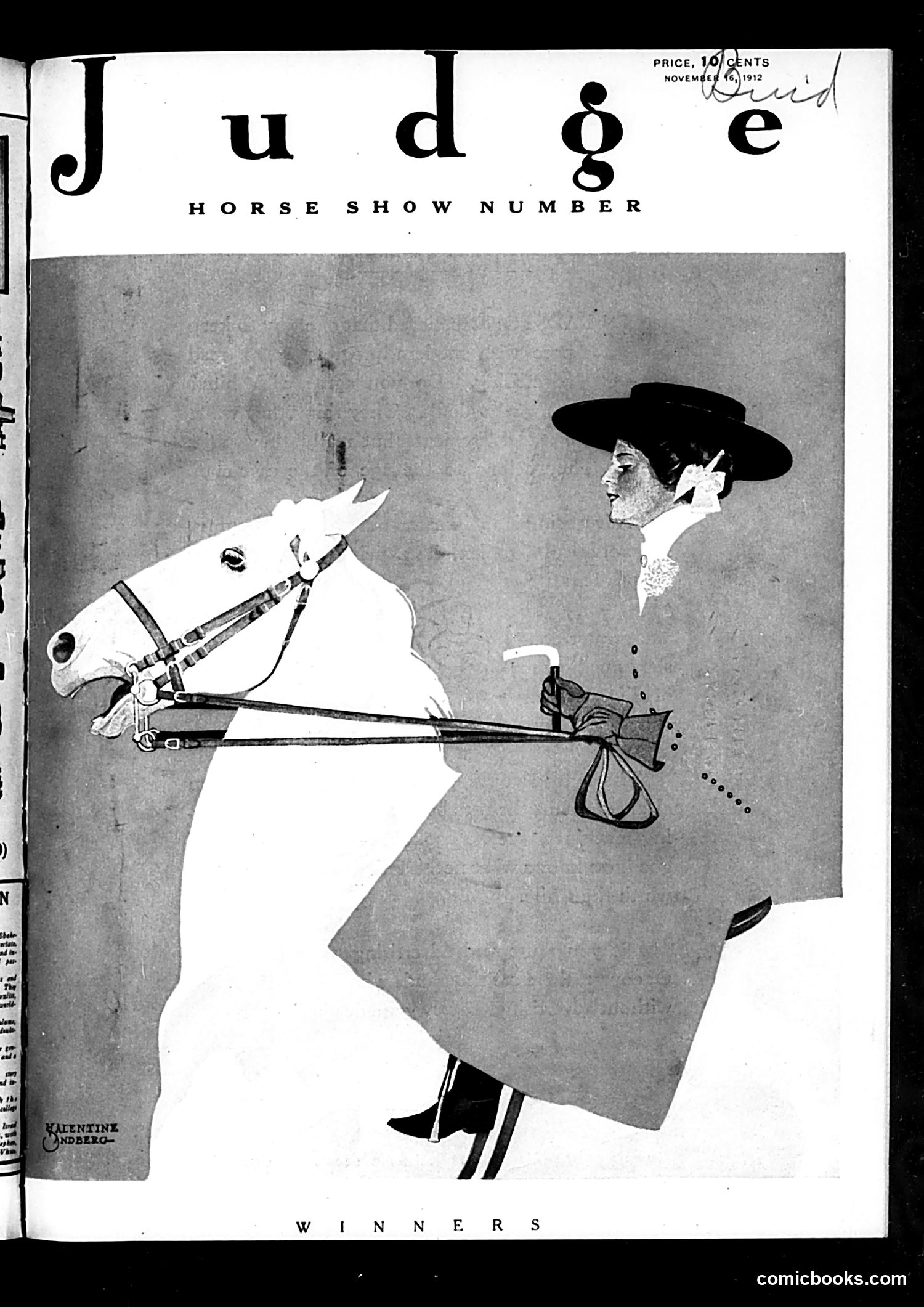
## "Horse Show Number" - Winners This is the cover of Judge's "Horse Show Number" from November 1912. The illustration depicts a stylized figure in riding attire (top hat, coat) mounted on an elegant white horse, presented in the magazine's characteristic minimalist Art Deco style. The caption "Winners" suggests this celebrates successful participants in horse shows—a fashionable sport among America's wealthy elite during the Gilded Age and Progressive Era. Horse shows were major social events where the upper class displayed both their animals and themselves. The artwork's elegant, somewhat exaggerated style is typical of Judge's satirical approach to high society. Without additional context on specific individuals or events referenced, the image primarily celebrates equestrian sport as a marker of social status and refinement.
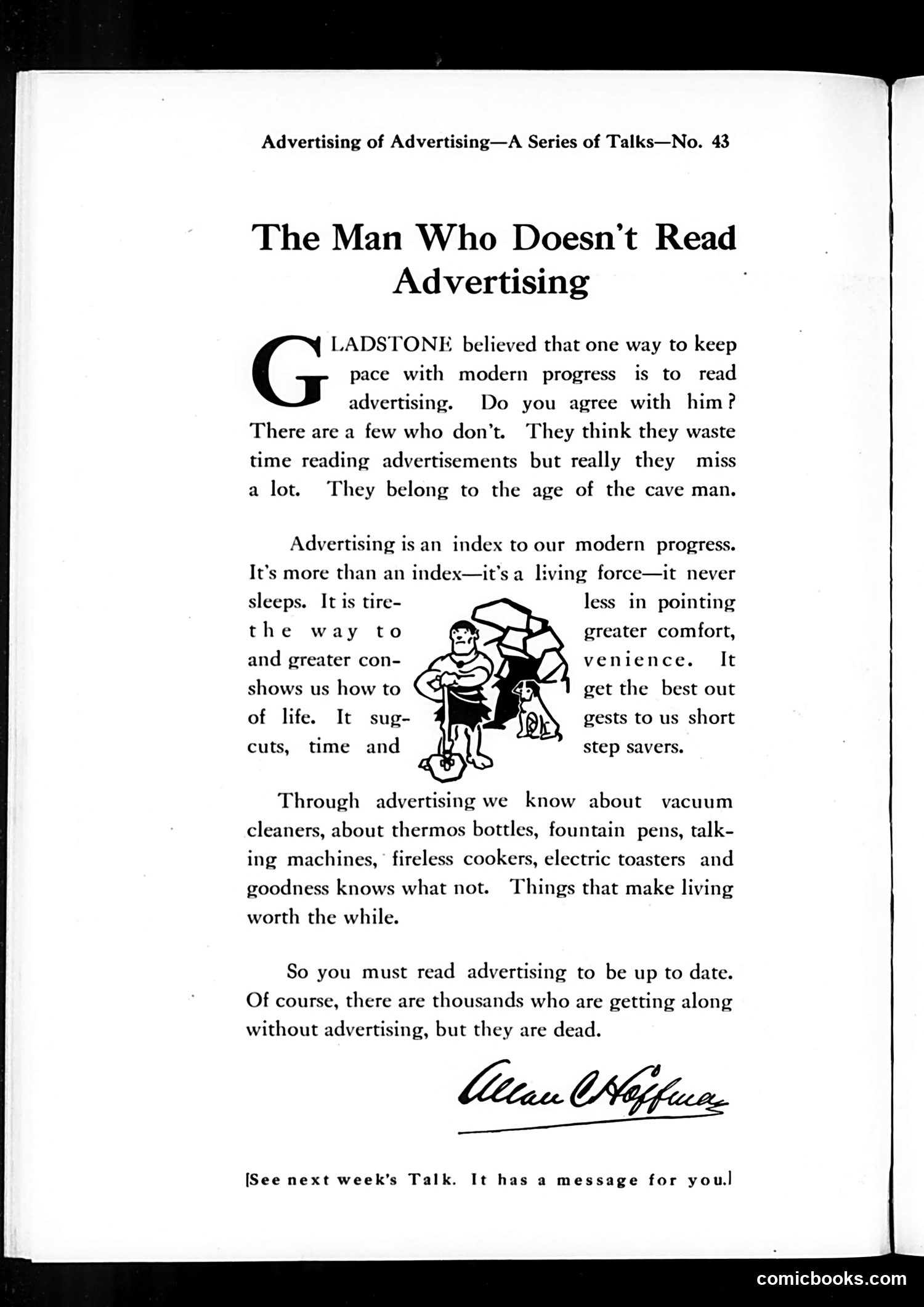
This is a satirical talk by Gilman Ostrander promoting advertising's cultural value. The piece argues that reading advertisements is essential to modern progress and staying informed about consumer innovations (vacuum cleaners, thermoses, etc.). The small cartoon shows a primitive "cave man" figure, illustrating the article's central conceit: those who ignore advertising are intellectually backward, "dead" to modern civilization. The satire is tongue-in-cheek—Ostrander makes exaggerated claims that advertising is "a living force" and essential to quality living, gently mocking both advertising's self-importance and consumers' susceptibility to its messaging. This reflects early 20th-century optimism about consumer culture and technological progress as markers of civilization itself.
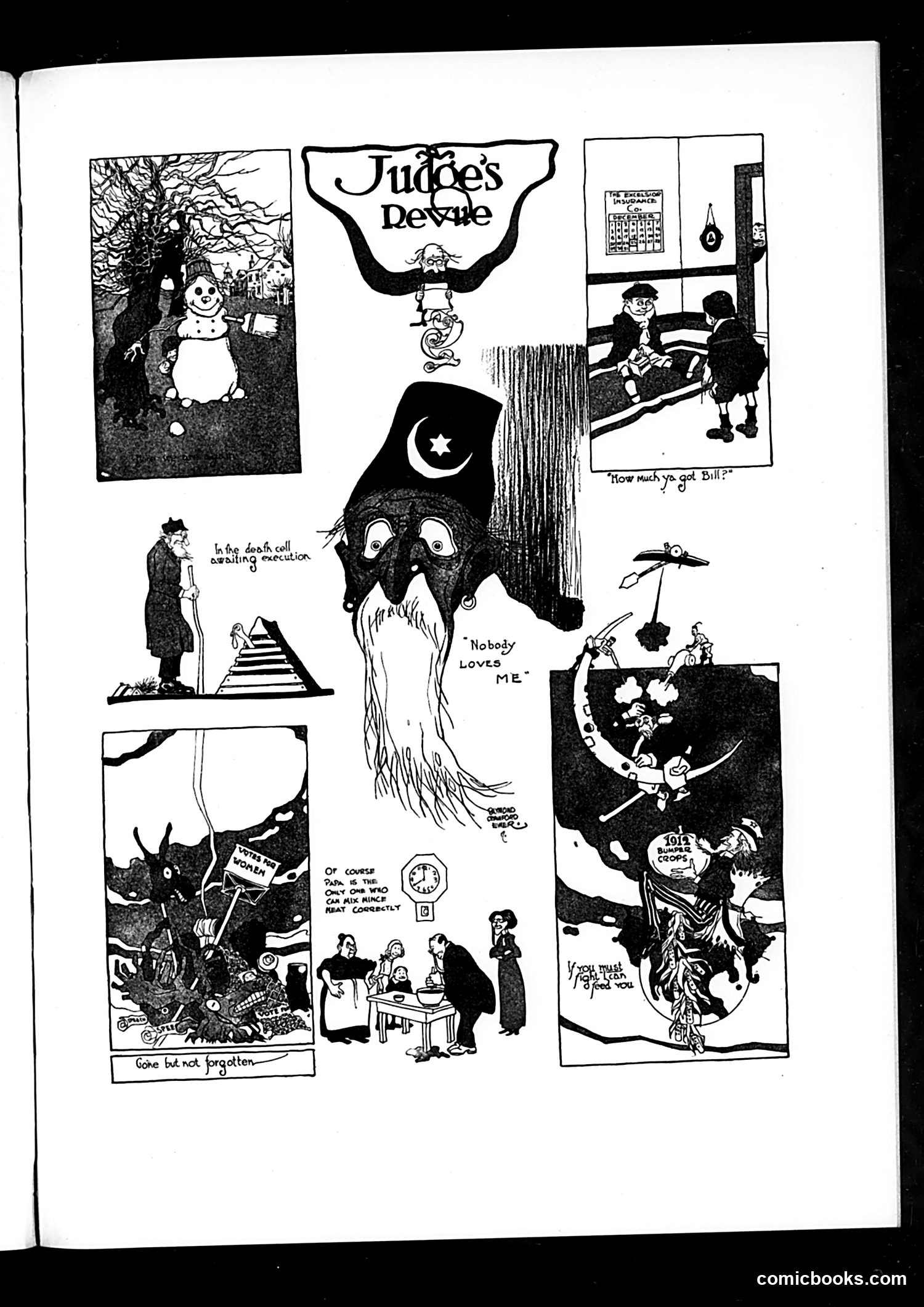
This satirical page from *Judge* magazine presents a dark fantasy titled "Judges Deville," combining multiple grotesque scenes critiquing American society and institutions. The central demonic figure with a crescent moon suggests references to Middle Eastern or "foreign" anxieties. Surrounding panels depict disturbing scenarios: executions ("In big dark cell awaiting execution"), forgotten graves, and institutional corruption. Text fragments like "Nobody loves ME" and "Gone but not forgotten" suggest commentary on social injustice and forgotten victims—possibly referencing capital punishment or wrongful convictions. The bottom scene shows what appears to be judicial proceedings, implying critique of the legal system's failures or corruption. The overall tone satirizes American courts and justice as hellish and indifferent to human suffering, though specific historical context remains unclear without publication date.
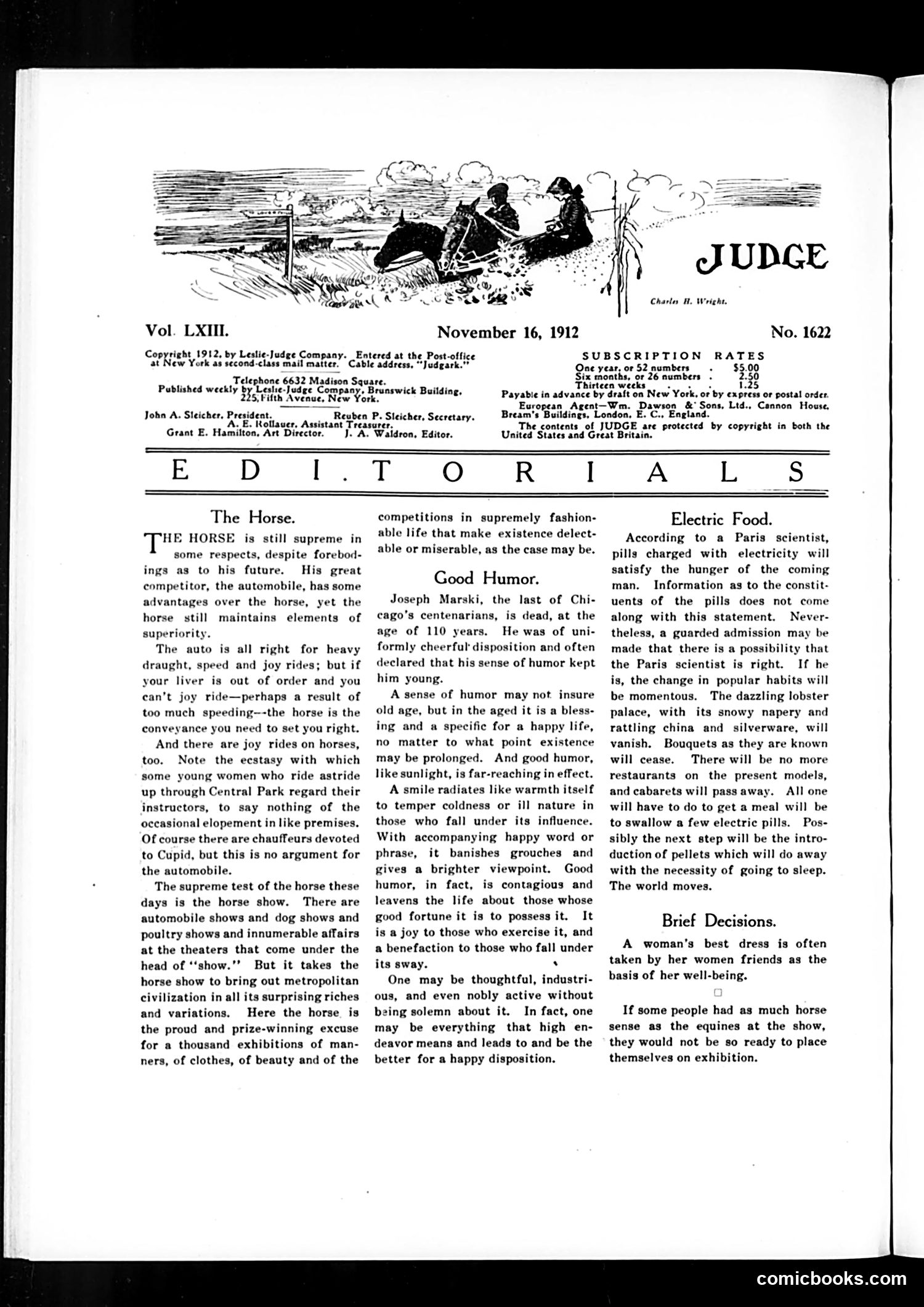
This page features editorial columns rather than political cartoons. The header illustration shows figures on horseback in a rural landscape—decorative rather than satirical. The three editorials address: 1. **"The Horse"** — argues horses remain superior to automobiles for certain purposes, defending traditional transportation against modern innovation. 2. **"Good Humor"** — celebrates Joseph Marski, Chicago's last centenarian (died at 110), crediting his longevity to cheerfulness and humor. This reflects period interest in "secrets" to long life. 3. **"Electric Food"** and **"Brief Decisions"** — brief items about a Paris scientist's electricity-based pills and women's fashion choices. The tone is nostalgic and conservative, typical of Judge's editorial stance during the automobile era's emergence.
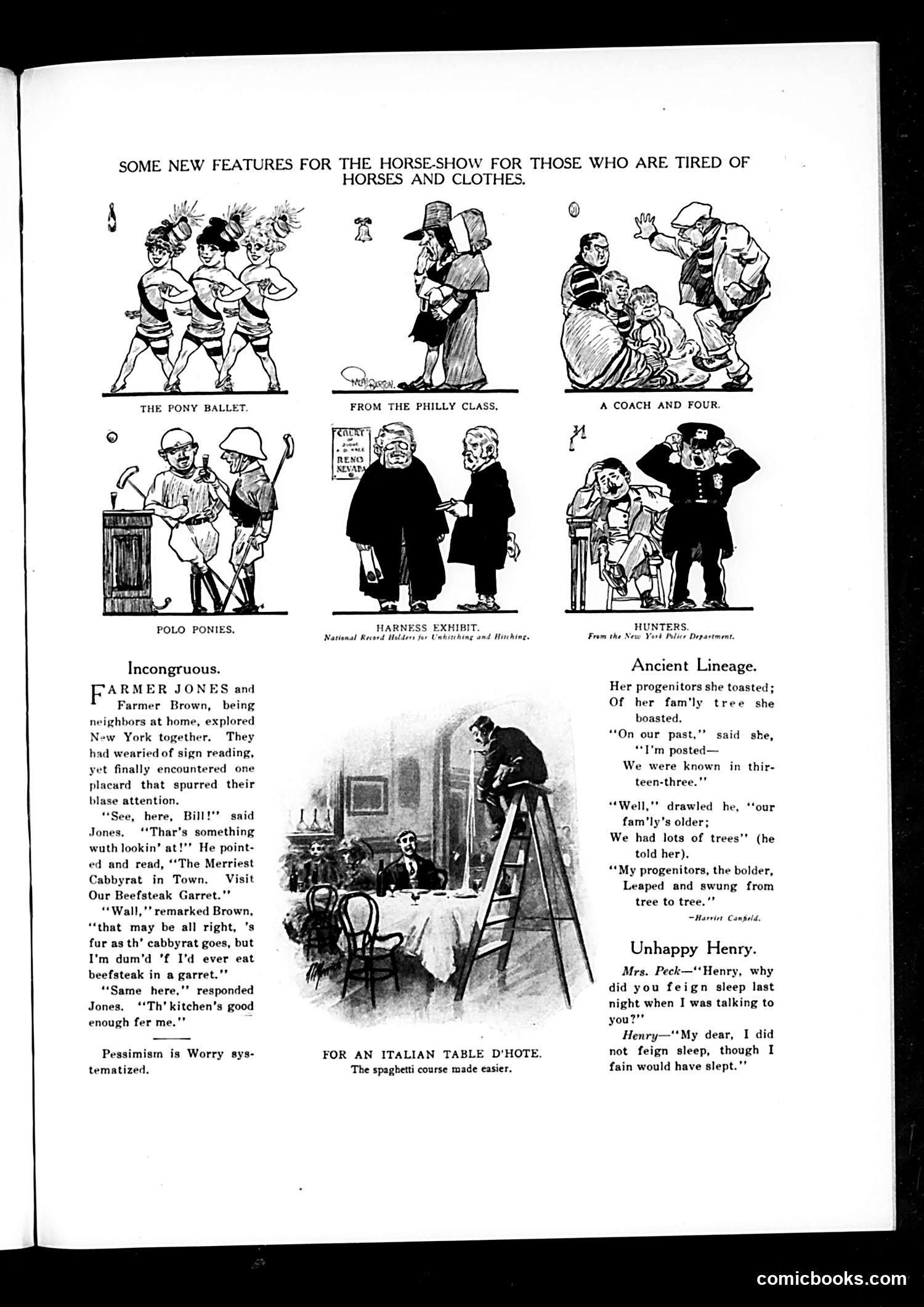
This page contains satirical cartoons mocking horse-show culture and society figures of the era. The top section shows six proposed "new features" for horse shows, including "The Pony Ballet," "From the Philly Class," and "Polo Ponies"—these ridicule the pretentious, increasingly theatrical nature of wealthy society's equestrian competitions. The middle section includes two brief comedic anecdotes: "Incongruous" depicts farmers discussing a cabaret visit (mocking rural-urban class differences), while "Pessimism is Worry systematized" offers wordplay humor. The illustrated sketch "For an Italian Table D'Hote" appears to satirize dining experiences or Italian cuisine. The right column presents two short dialogue pieces—"Ancient Lineage" and "Unhappy Henry"—using conversation to mock aristocratic pretension and marital relationships respectively. Overall, the page targets wealthy society's affectations and class consciousness.
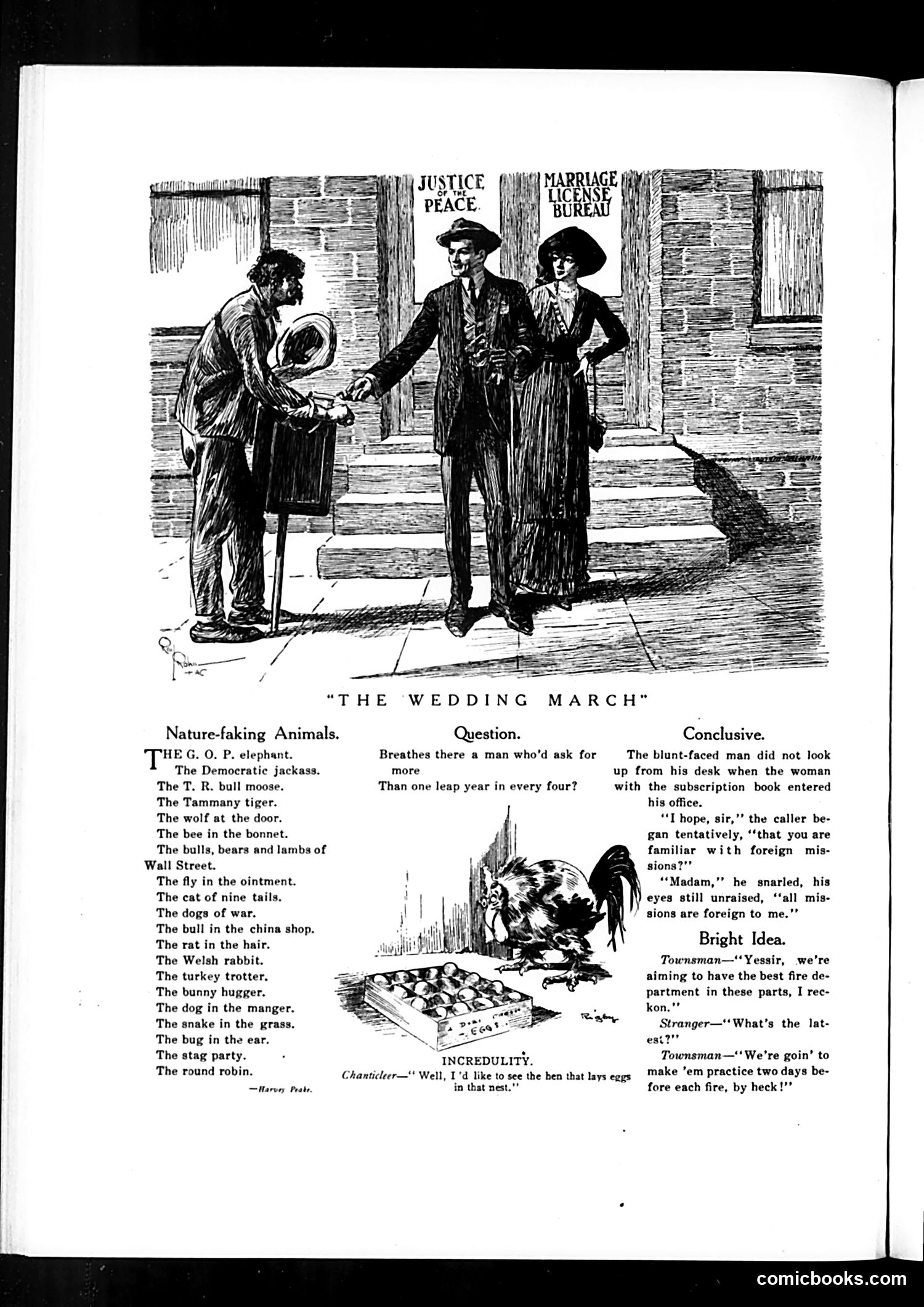
The main cartoon depicts a marriage between the Republican elephant and Democratic donkey, symbolizing a political alliance. The "Justice of the Peace" and "Marriage License Bureau" signs indicate a formal union between these traditional party mascots. The "Nature-faking Animals" list is a satirical reference to a contemporary literary trend—likely mocking popular "nature-faking" books that anthropomorphized animals. Here, the list humorously equates famous political figures and Wall Street players with animal characteristics: the G.O.P. elephant, Democratic jackass, Theodore Roosevelt's bull moose (referencing his Progressive "Bull Moose" Party split from Republicans), and Tammany Hall's political machine tiger. The surrounding comic vignettes offer unrelated satirical humor about everyday absurdities—a woman's complaint about male indifference to foreign missions, and a town's misguided fire department strategy. The overall effect mocks both political realignments and contemporary cultural pretensions through animal metaphors and deadpan humor typical of Judge's satirical style.
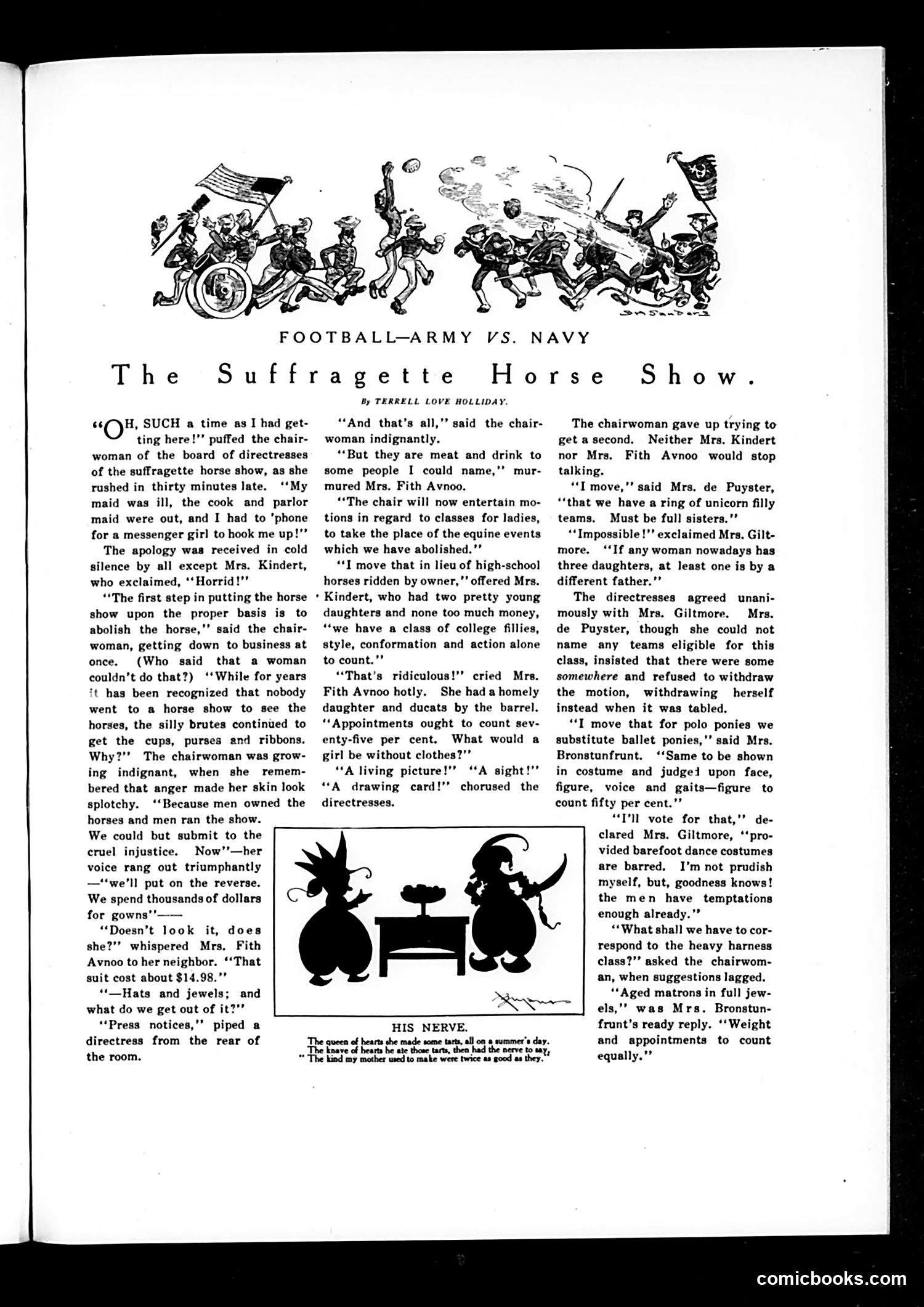
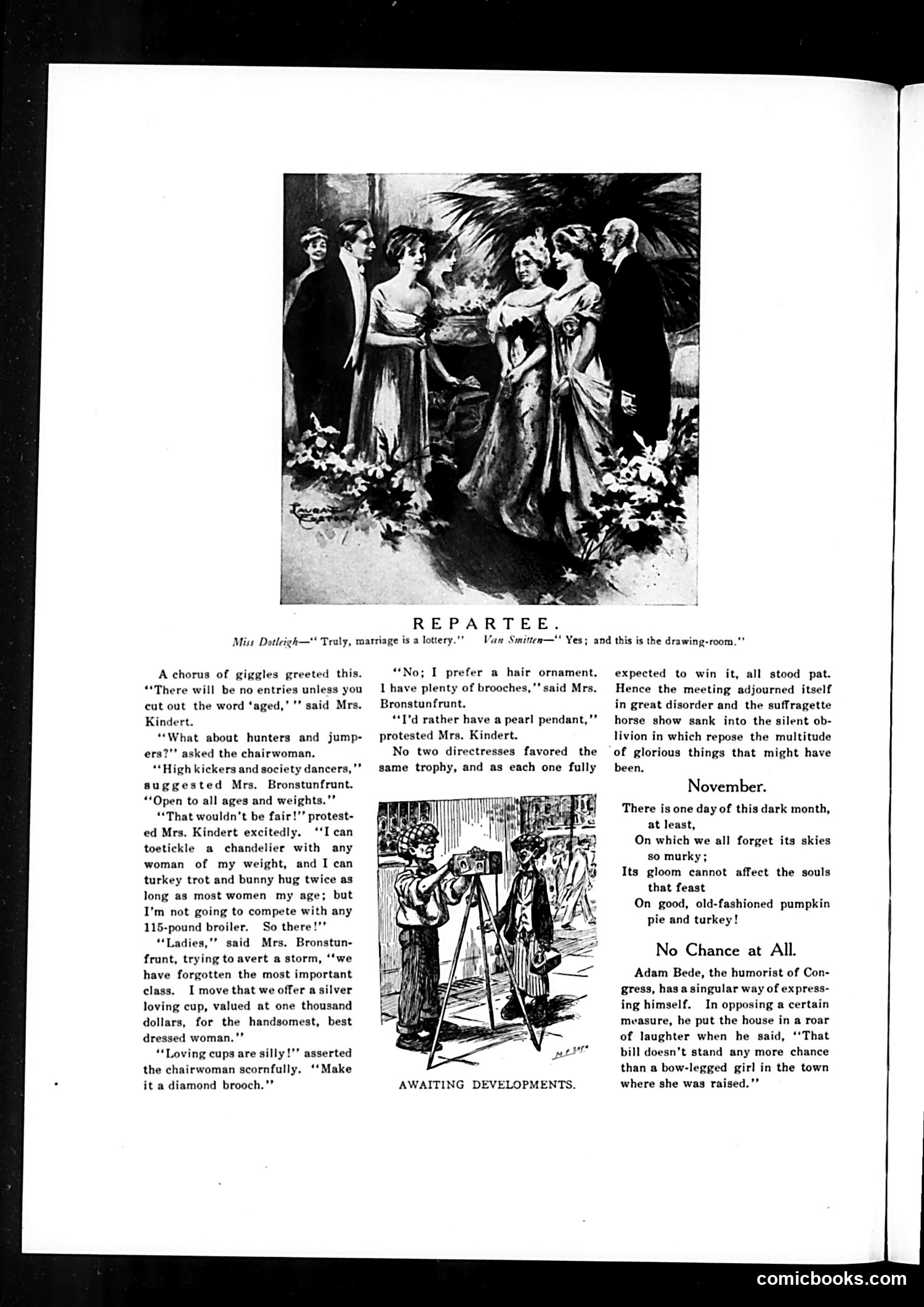
This satire ridicules women suffragists by depicting their proposed "improvements" to a horse show as absurd and self-serving. The premise: a chairwoman and board of wealthy society women vote to eliminate horses entirely—the actual purpose of the event—replacing them with classes showcasing women instead. The joke targets the apparent hypocrisy: these women claim to champion equality and practicality, yet their "reforms" are transparently narcissistic (showcasing their gowns, jewels, and figures). The characters' cattiness—mocking each other's clothing costs and daughters' appearances—undercuts their reformist rhetoric. The satire also mocks class pretension: Mrs. Kindert's practical suggestion (judging on merit) is rejected by wealthier women favoring "appointments" (expensive accessories). The closing joke about "aged matrons" suggests these socialites are ridiculous regardless of the cause they champion. The cartoon represents anti-suffrage propaganda: portraying women activists as vain, petty, and unsuited for serious civic participation.
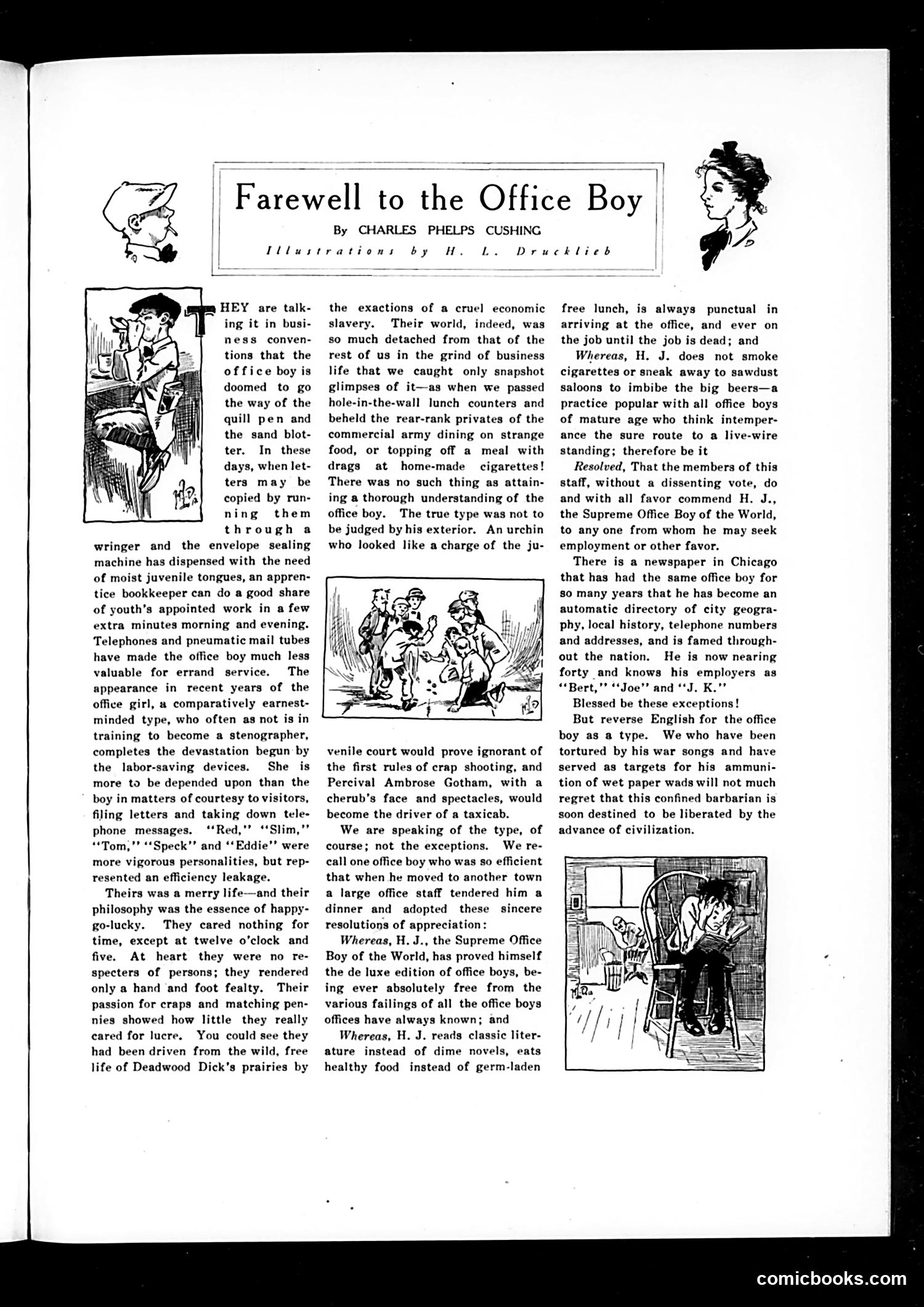
This article by Charles Phelps Cushing is an elegy for a vanishing workplace figure. Cushing argues that the office boy—a stock character in early 20th-century business—is being made obsolete by technological and social changes: mechanical mail systems, pneumatic tubes, typewriters, and crucially, the rise of the office girl (stenographer). The piece characterizes traditional office boys as colorfully undisciplined ("Red," "Slim," "Tom")—carefree, gambling types indifferent to advancement, representing a dying free-range spirit being crushed by industrial capitalism. Cushing notes this with nostalgic ambivalence: they were inefficient but possessed personality. The article then offers an exception: H.J., "Supreme Office Boy of the World," who is everything an office boy *should* be—literate, punctual, abstemious—yet precisely the type being replaced by more serious, competent office girls. The satire cuts both ways: lamenting lost character while acknowledging economic progress makes sentimentality obsolete. It's social commentary on modernization's human costs.
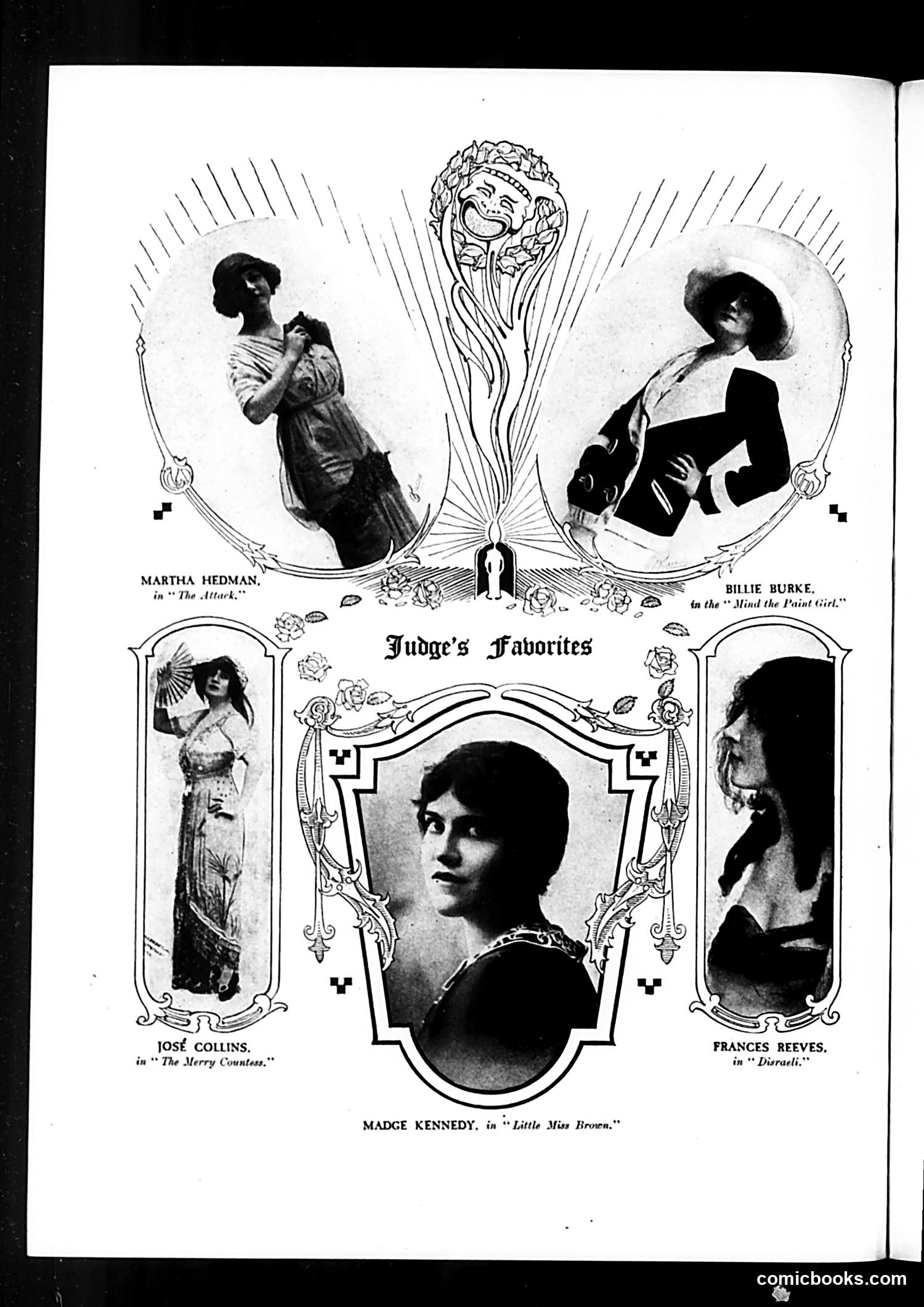
This page from Judge magazine presents "Judge's Favorites"—a collection of theatrical headshots featuring actresses from early 20th-century stage productions. The layout includes five photographs: Martha Hedman and Billie Burke at top, José Collins and Frances Reeves in the middle row, and Madge Kennedy centrally positioned below. Each actress is identified with the theatrical production she appeared in, such as "The Attack," "Mind the Paint Girl," "The Merry Countess," "Disraeli," and "Little Miss Brown." This appears to be entertainment coverage rather than political satire—essentially a fan feature celebrating popular stage actresses of the era. The decorative art nouveau styling with floral motifs and the ornamental framing reflect the magazine's design sensibilities of that period.
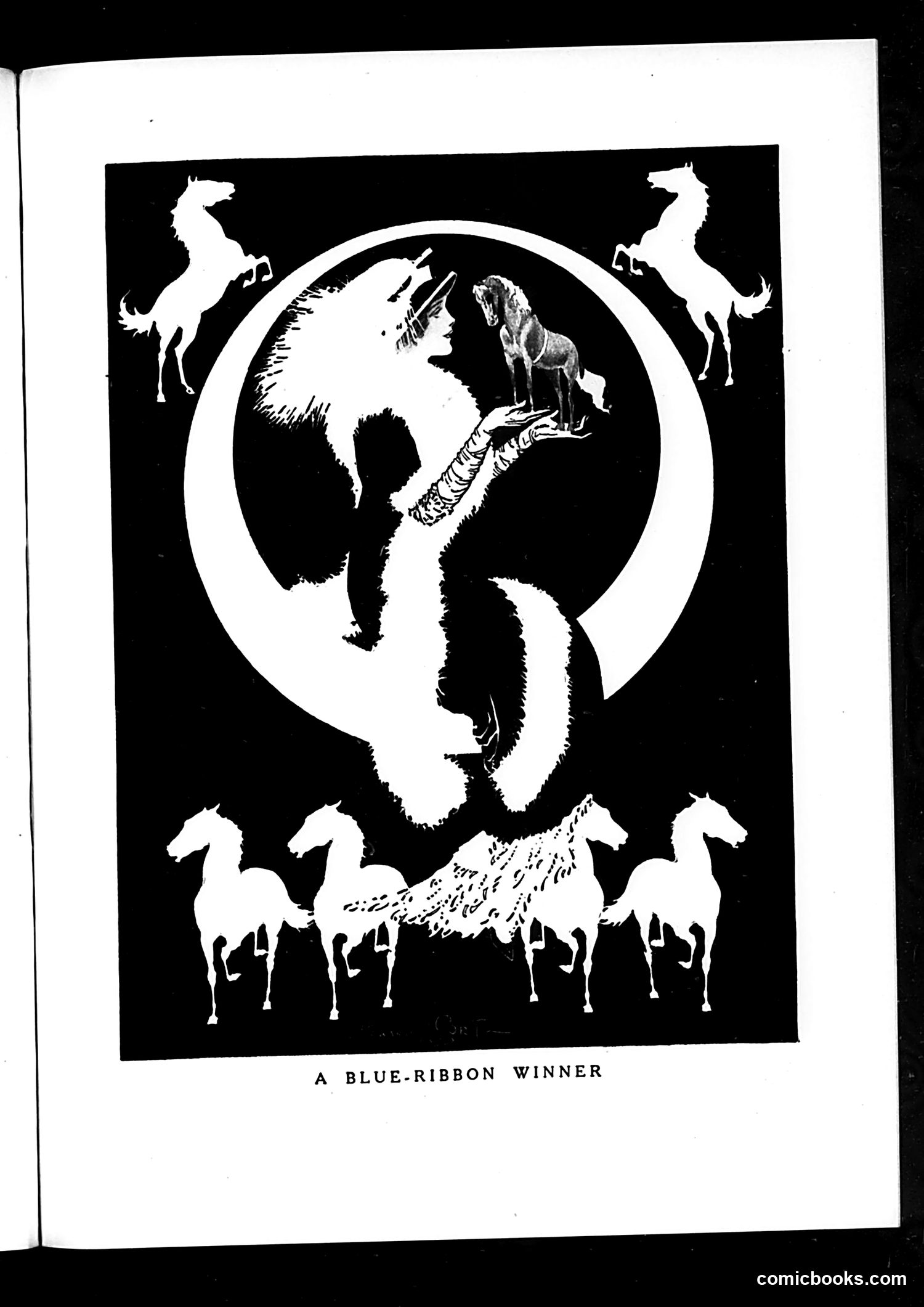
This political cartoon depicts a large dog or canine figure standing upright in a circular frame, holding a smaller dog or animal on its arm. The central figure is surrounded by six horse silhouettes at the bottom and two rearing horses at the top. The title "A Blue-Ribbon Winner" references prize competitions, likely agricultural shows or dog shows popular in the era. The cartoon appears to satirize a successful competitor or public figure by caricaturing them as an animal handler exhibiting prizes. The specific identity of the "winner" remains unclear without additional context, though the composition suggests commentary on pretension or the commodification of accomplishment through competitive display. The anthropomorphized animals emphasize the satirical nature of the critique.
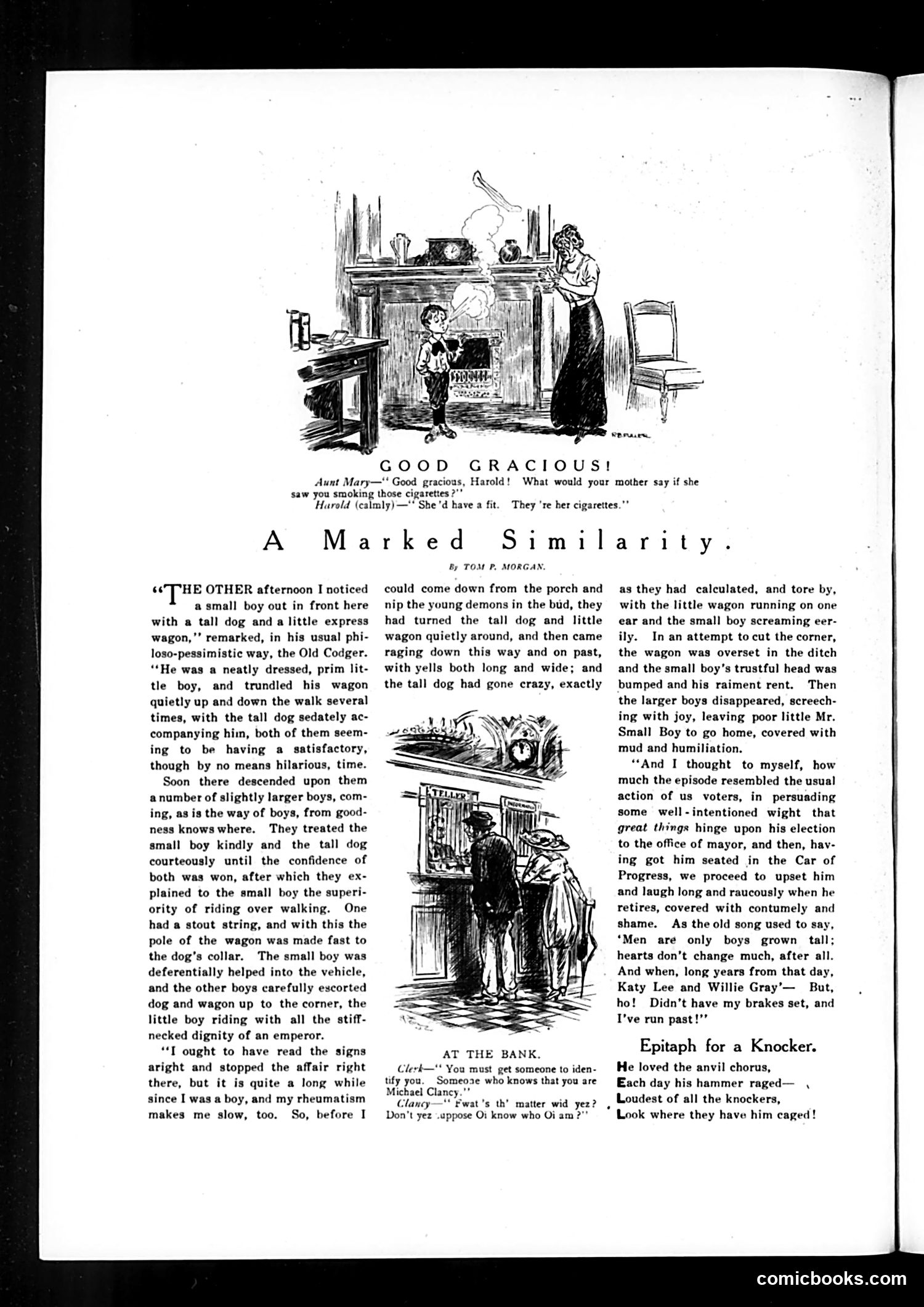
This page contains three distinct satirical pieces from Judge magazine: **"Good Gracious!" (top cartoon):** A domestic joke about a boy smoking cigarettes. His aunt threatens to tell his mother; he calmly responds his mother wouldn't mind because they're her cigarettes. The humor plays on unexpected role reversals and class commentary about women smoking—then a scandalous behavior. **"A Marked Similarity" (main story):** An extended political allegory by Tom P. Morgan. An older narrator recounts boys convincing a well-dressed small boy to ride in a wagon pulled by a tall dog, then deliberately causing a chaotic, humiliating crash. He explicitly compares this to voters persuading naive candidates to run for mayor, only to ridicule them when they fail. The satire critiques voter behavior in municipal politics—how the electorate manipulates candidates for entertainment, then abandons them to shame. **"Epitaph for a Knocker" (bottom right):** A brief poem mocking someone ("the anvil chorus," a loud complainer) who is now "caged"—imprisoned or silenced, presumably for his constant criticism.
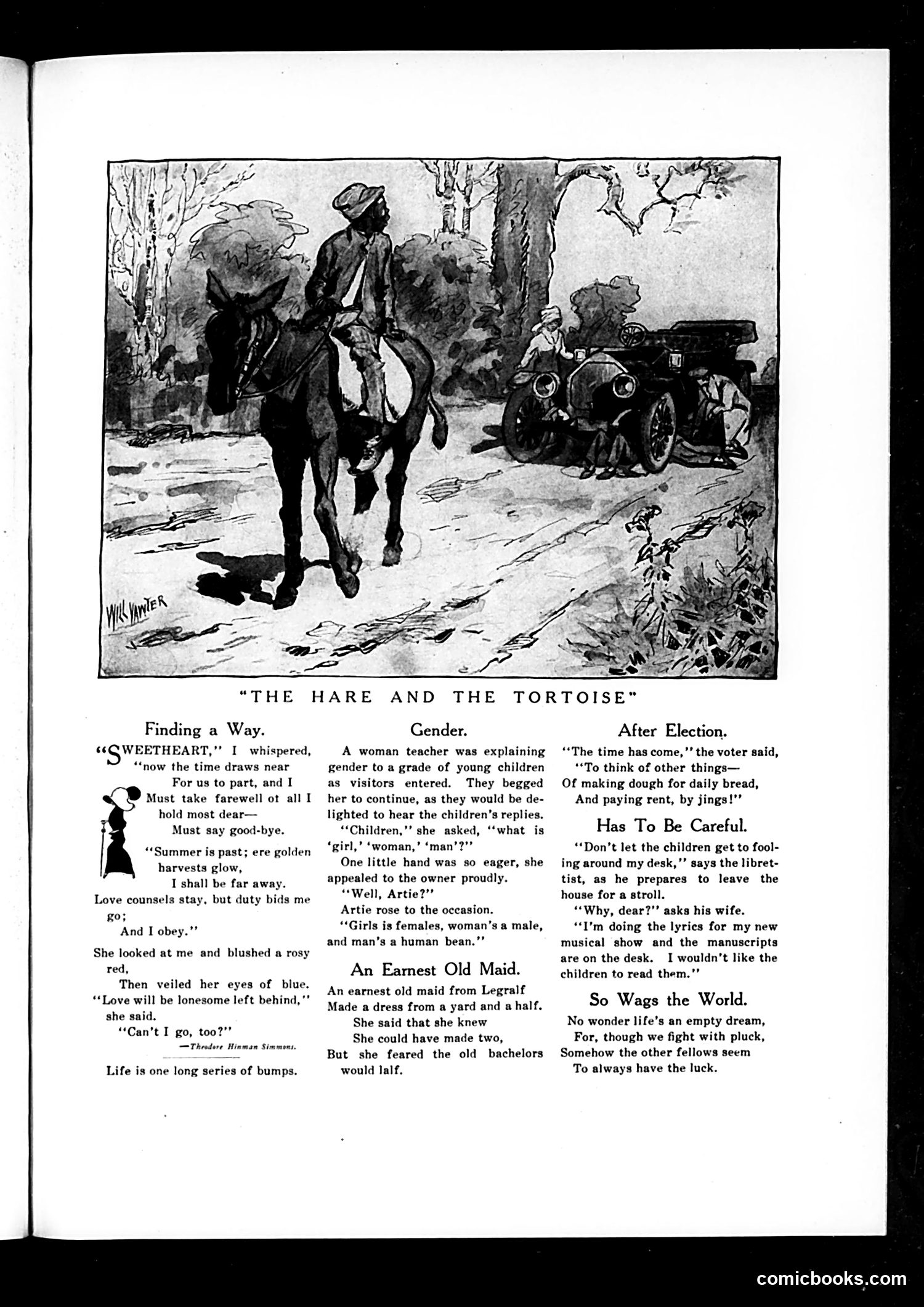
This page from *Judge* collects six short humorous pieces, each with accompanying illustrations or decorative elements. The title references Aesop's fable but appears decorative rather than thematic to the content below. The pieces include: - **"Finding a Way"**: A sentimental poem about a man leaving his sweetheart, likely for military service or work. - **"Gender"**: A joke about a child's confused definition of gendered terms ("woman's a male, man's a human bean"). - **"An Earnest Old Maid"**: A limerick mocking an unmarried woman's modest dress-making. - **"After Election"**: Social commentary—once voting is over, citizens must return to earning bread and paying rent. - **"Has To Be Careful"**: A brief joke about a librettist protecting song manuscripts from children. - **"So Wags the World"**: Philosophical verse about luck favoring others. The main illustration depicts a horseman meeting an automobile on a country road—likely representing the era's technological transition. The overall tone blends sentiment, gentle mockery of social conventions, and period-specific humor.
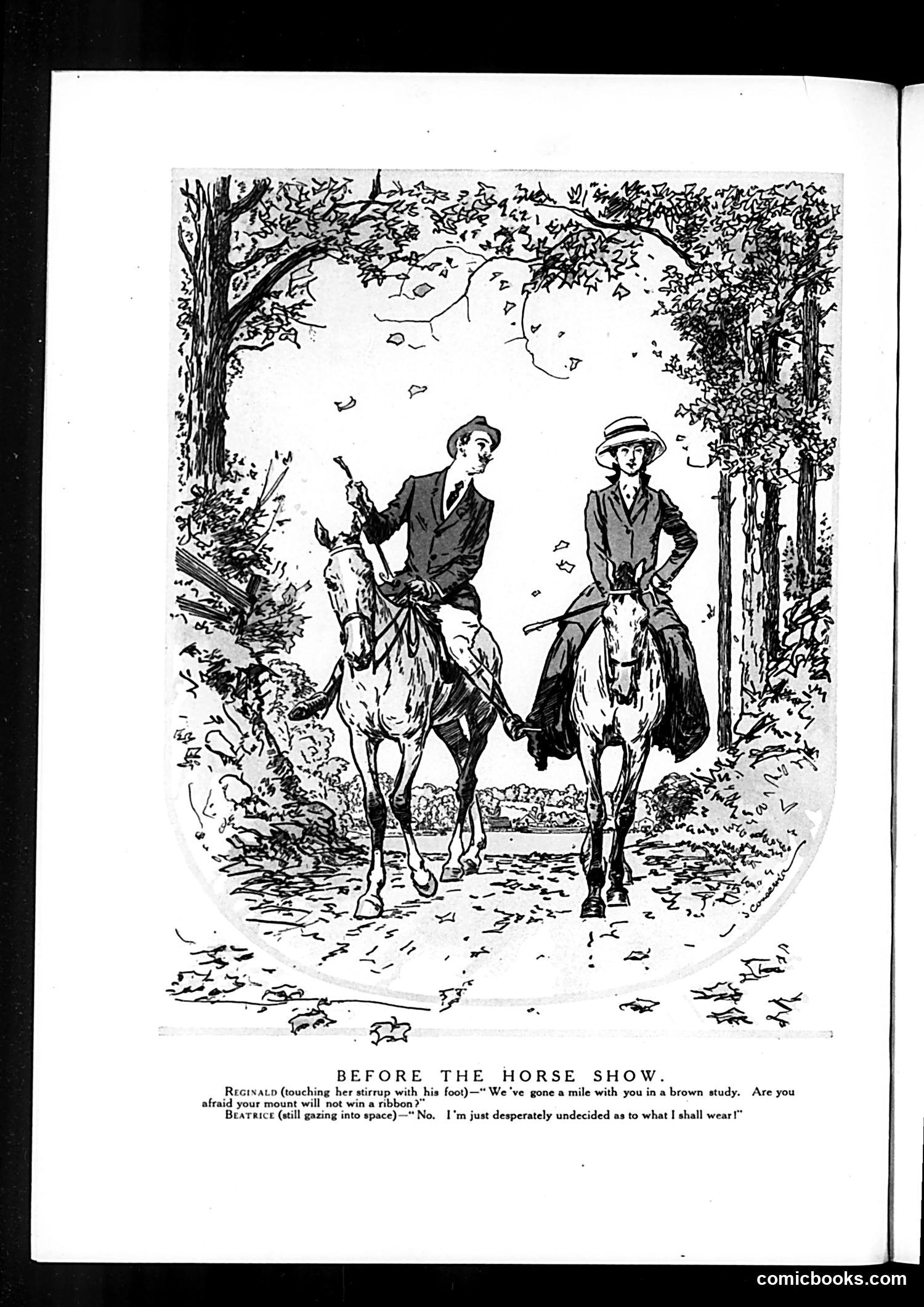
This is a satirical cartoon about upper-class social priorities. Two people on horseback are shown before a horse show competition. The male character (Reginald) expresses concern that his companion seems distracted and worried about her horse's performance—a reasonable concern before a competition. However, the female character (Beatrice) reveals she's actually preoccupied with something trivial: what outfit to wear. The satire mocks the superficiality of wealthy women, suggesting they care more about fashion and appearance than the actual event or competition itself. The joke reflects early 20th-century gender stereotypes about women's supposed vanity and obsession with clothing, presenting this as absurdly misplaced priorities when preparing for a serious equestrian competition.
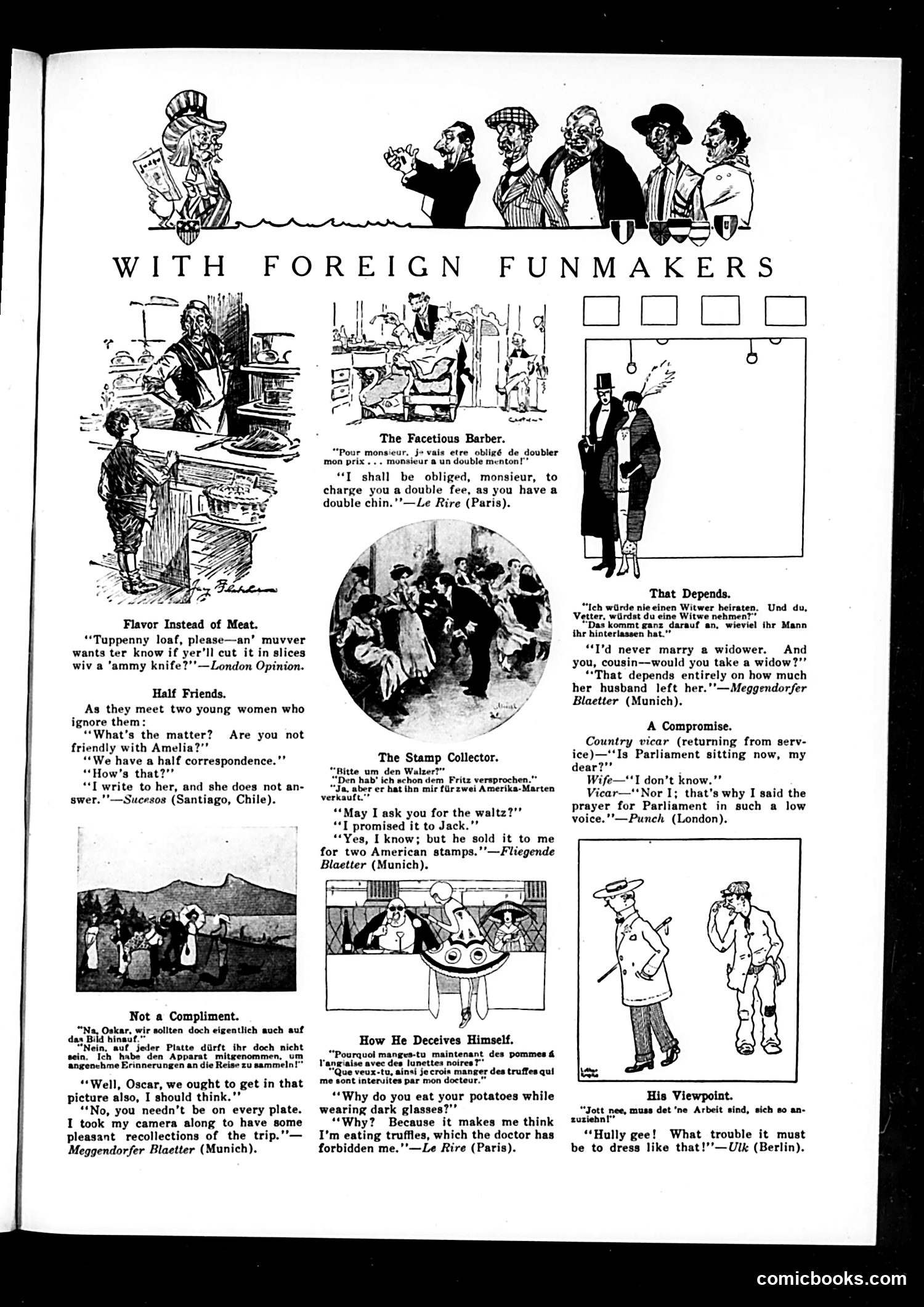
This page collects international humorous anecdotes translated from European satirical publications, reflecting early 20th-century middle-class anxieties and social observations. The cartoons mock: a working-class London boy's grammar ("'ammy knife" for "ham knife"), failed romantic correspondence, a photographer prioritizing souvenirs over including himself in memories, and a barber's witty threat to charge double for a double chin. Later pieces satirize materialism (trading dance partners for stamps, marrying widowers for inheritance), self-deception (eating potatoes in dark glasses to imagine them as truffles), and absent-mindedness (a clergyman unsure if Parliament meets). The unifying theme: ordinary people's social pretensions, poor communication, and transparent self-interest. These are gentle, domestic satires—no political figures or events—aimed at readers amused by European foibles and everyday human foolishness. The translations suggest *Judge*'s cosmopolitan appeal to educated audiences.
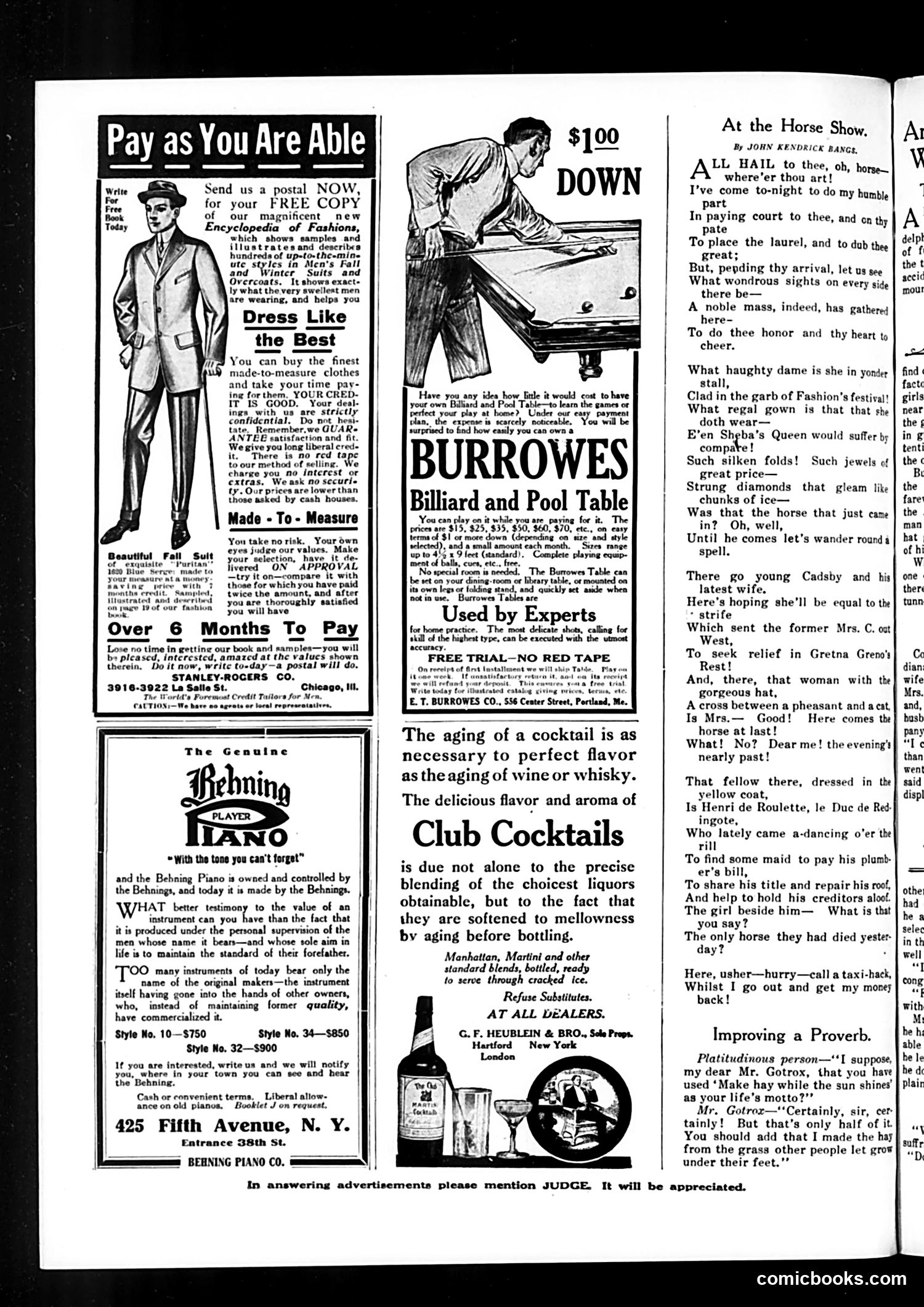
This page is primarily **advertising**, with one short poem titled "At the Horse Show" by John Kendrick Bangs visible on the right side. The advertisements feature typical early 20th-century consumer goods: made-to-measure suits (Stanley-Rogers Co.), billiard tables (Burrowes), pianos (Behning), and cocktails (Club Cocktails by Heublein). The ads emphasize **easy payment plans**—a significant selling point of the era. Phrases like "Pay as You Are Able," "Over 6 Months to Pay," and "FREE TRIAL—NO RED TAPE" suggest these were novel, reassuring concepts for working-class consumers considering major purchases. The brief Bangs poem satirizes **high society horse shows**, poking gentle fun at wealthy socialites and their fashionable pretensions. There are **no political cartoons** on this page—it's a standard magazine advertisement section typical of Judge's revenue model.
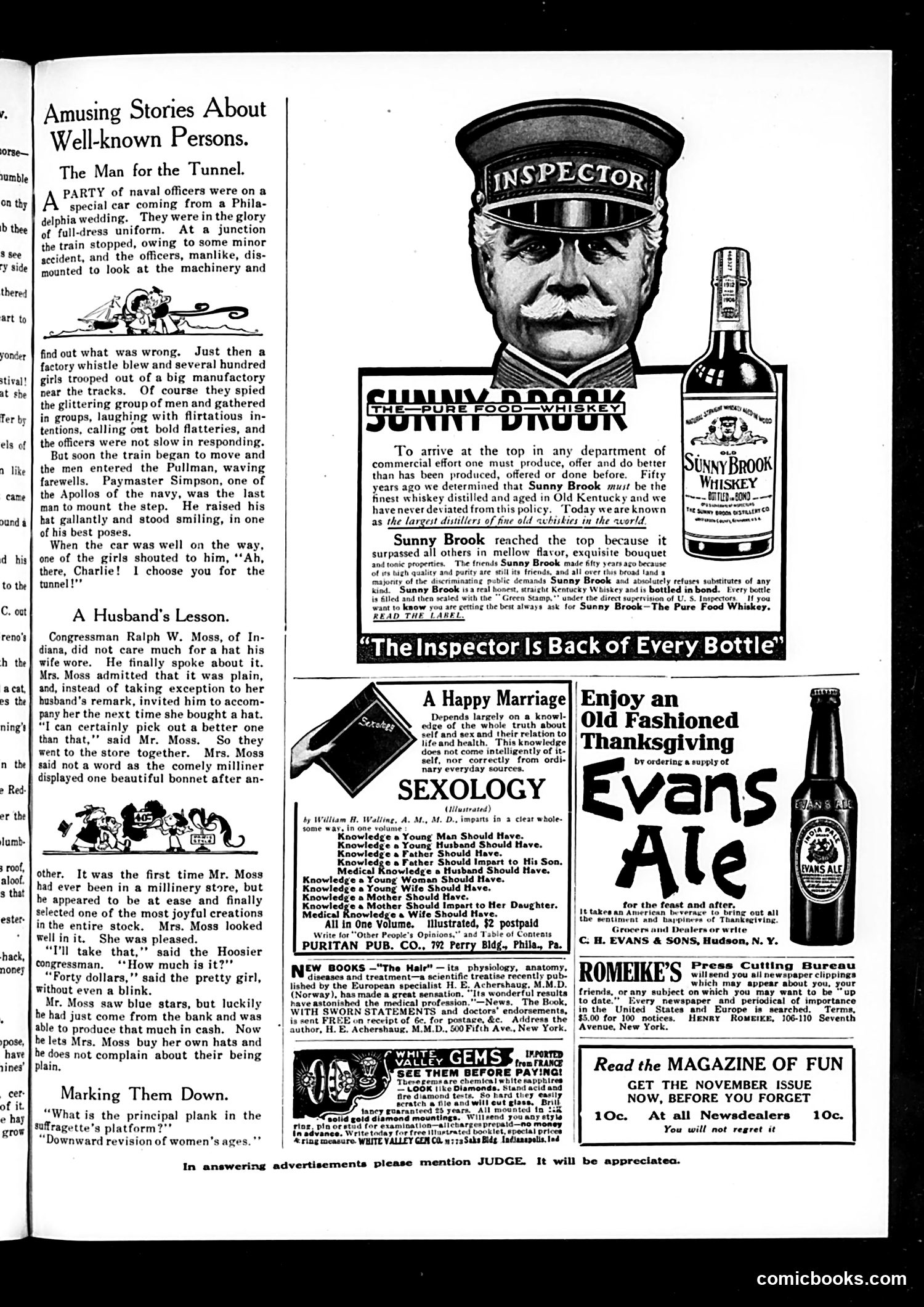
This page from *Judge* contains several short humorous anecdotes and advertisements typical of early 20th-century satirical magazines. **"The Man for the Tunnel"** jokes about naval officers in dress uniforms flirting with factory girls near train tracks. When one girl shouts "I choose you for the tunnel!" to Paymaster Simpson, the humor relies on the double meaning—she's referring to the train entering a tunnel (a moment of darkness), but the officers interpret it as a flirtatious advance. The joke plays on the officers' vanity and the girls' boldness. **"A Husband's Lesson"** tells of Congressman Moss complaining about his wife's plain hat. When he accompanies her to select one himself, he chooses an expensive hat ($40—substantial money then) and learns never to criticize her purchases again. The satire mocks male presumption about women's fashion judgment. **"Marking Them Down"** is a brief suffragette joke playing on "plank" (political position) and women's "ages"—a common anti-feminist taunt. The page is mostly advertisements for *Sunny Brook* whiskey, *Evans Ale*, and other products, with modest editorial content.
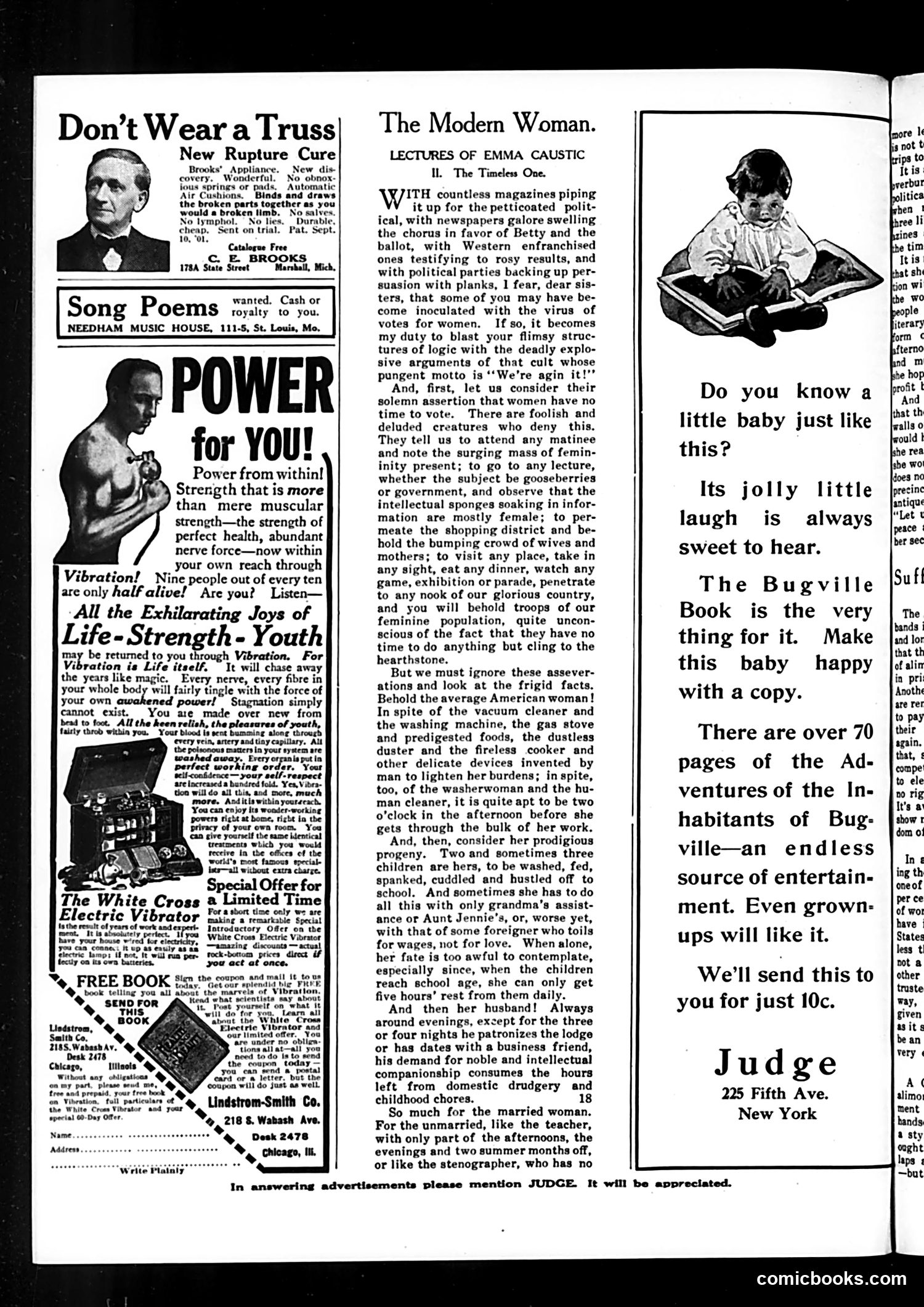
This page features a satirical lecture opposing women's suffrage, disguised as concern for women's welfare. "Emma Caustic" (likely a pseudonym for a male humorist) uses mock-sympathy to argue women lack *time* to vote because they're occupied with housework and childcare—a common anti-suffrage argument of the era. The satire works through exaggeration: the author pretends to acknowledge women's actual busy schedules (vacuum cleaners, washing machines, children to manage) while simultaneously claiming these devices prove women have *no* time for voting. The absurdity is intentional—the piece ridicules anti-suffrage logic by pushing it to obvious contradiction. The accompanying advertisement for "The Bugville Book" (offering entertainment about babies) sits ironically below, reinforcing the stereotype of women's limited concerns. This reflects the early-20th-century suffrage debate, mocking opponents' paternalistic arguments that women were too domestically bound for political participation.
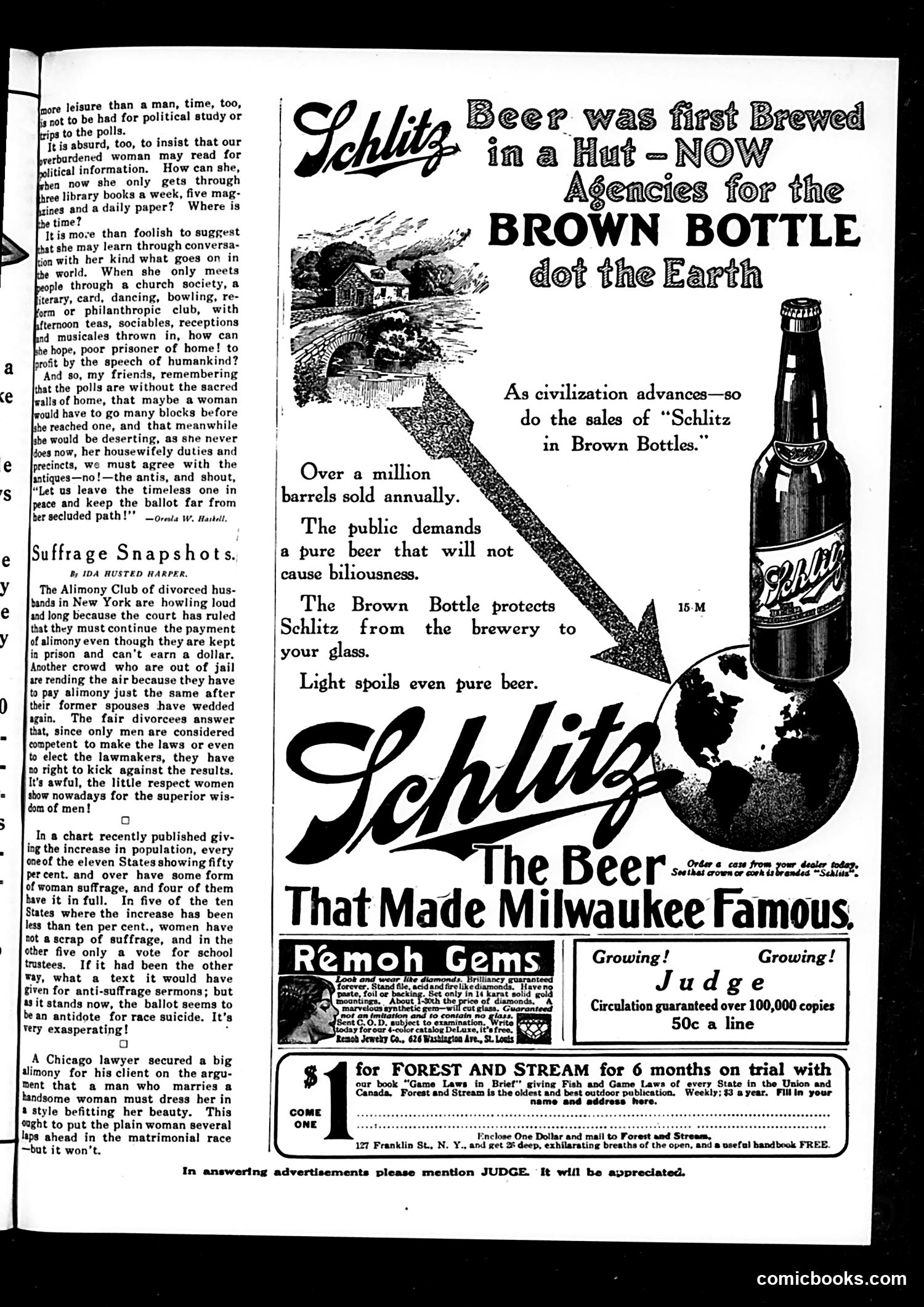
This page combines **political satire with advertising**, typical of Judge magazine's format. ## Political Content: "Suffrage Snapshots" The left column contains anti-women's suffrage arguments presented sarcastically by writer Ida Husted Harper. The satire mocks opponents of female voting by: - Exaggerating claims that women lack time for political information (too busy with social clubs and teas) - Ridiculing fears that voting requires women to leave home - Highlighting the hypocrisy: divorced men must pay alimony regardless of circumstances, yet only men make laws - Presenting statistical evidence: states with women's suffrage show higher population growth than those without The satire's point: **If women's suffrage causes "race suicide" (population decline), why do suffrage states show the *opposite* trend?** ## Advertising The bulk of the page advertises **Schlitz beer in brown bottles**, claiming protection from light spoilage. Minor ads include Remoh Gems (jewelry) and Forest and Stream magazine. The content reflects the pre-1920 suffrage debate, when such arguments against women voting were seriously advanced—now presented as obviously absurd.
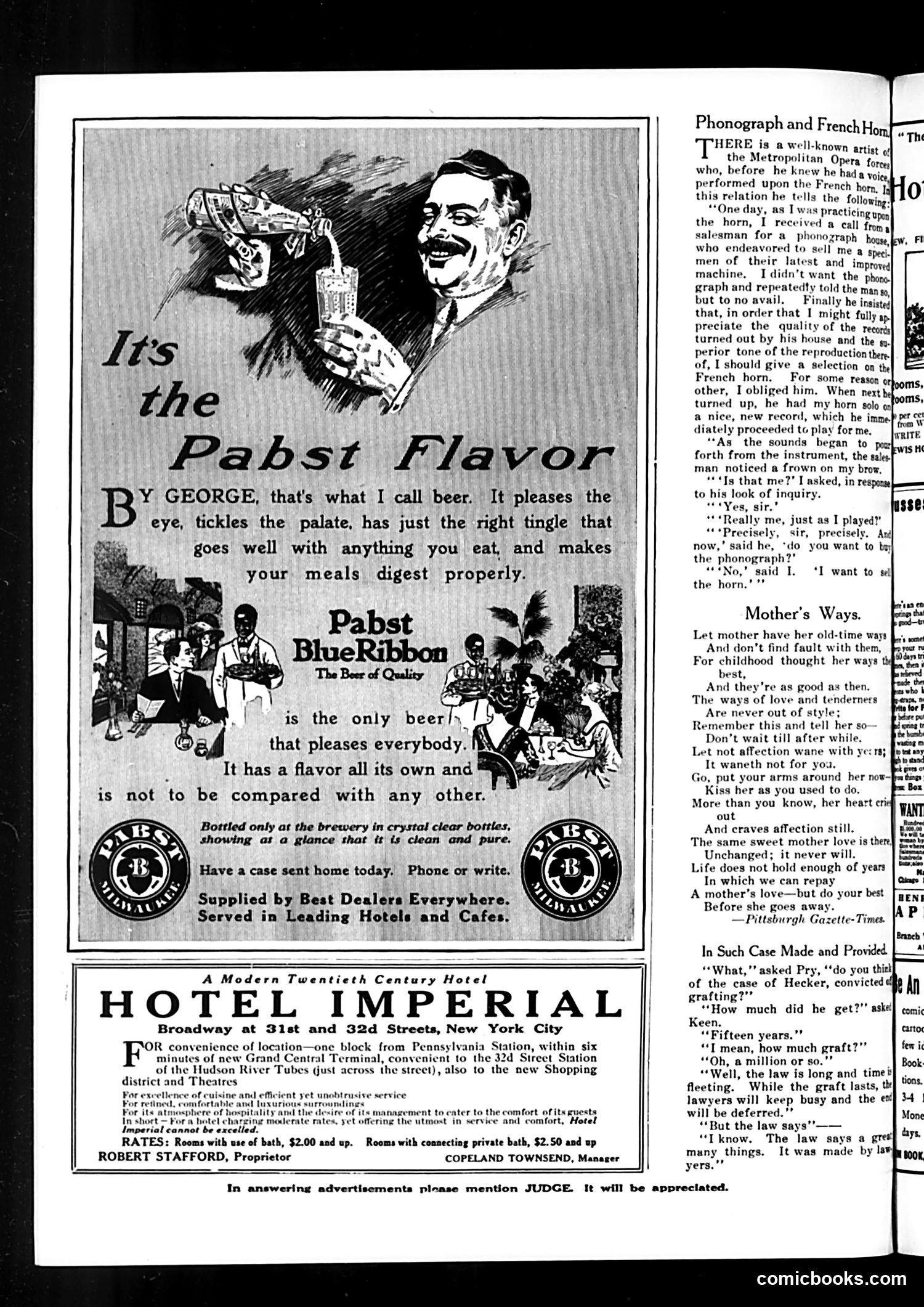
This page is primarily a **Pabst Blue Ribbon beer advertisement** featuring a man enthusiastically endorsing the product's flavor and digestive qualities. The ad uses typical early 20th-century marketing imagery—a well-dressed gentleman and scenes of social consumption—to promote beer as a beverage that "pleases everybody." The surrounding text includes unrelated content: a hotel advertisement and two brief humorous pieces. One involves a phonograph salesman who records someone playing French horn, apparently poorly. The other, titled "In Such Case Made and Provided," is satirical commentary on legal corruption—discussing a grafting conviction where lawyers deliberately delay justice to maximize fees, with the punchline that laws themselves "were made by lawyers." This juxtaposition reflects *Judge* magazine's typical mix of advertising revenue and satirical social commentary critiquing greed and institutional hypocrisy.
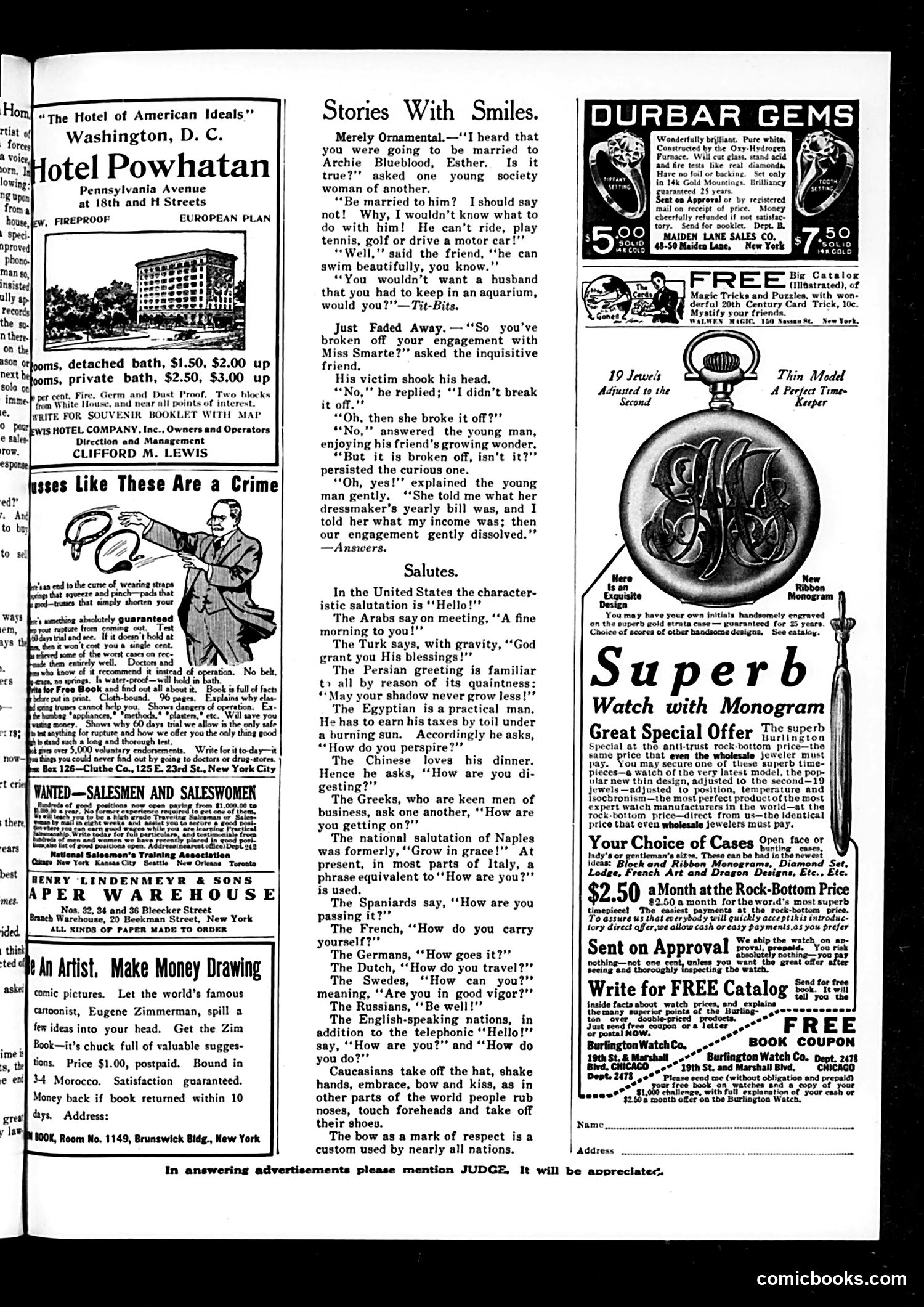
This page is primarily **advertising and filler content**, not political satire. The main content consists of: 1. **Hotel Powhatan advertisement** (Washington D.C.) - standard promotional copy 2. **"Stories With Smiles"** - three light humor anecdotes about engagements and relationships with no political content 3. **"Salutes"** - a cultural comparison piece explaining greeting customs across different nations (Arabs, Turks, Persians, Egyptians, Chinese, Greeks, Italians, Spanish, French, Germans, Dutch, Swedes, Russians, English). This appears educational rather than satirical—simply noting how different cultures greet each other. 4. **Multiple advertisements** for watches, gems, salesman training, paper warehouse, and drawing instruction There are **no identifiable political cartoons or caricatures** on this page. The single illustration shows a figure in what appears to be a "wringing stress" advertisement, but lacks political commentary. This is a typical early 20th-century magazine page mixing light entertainment with commercial content.
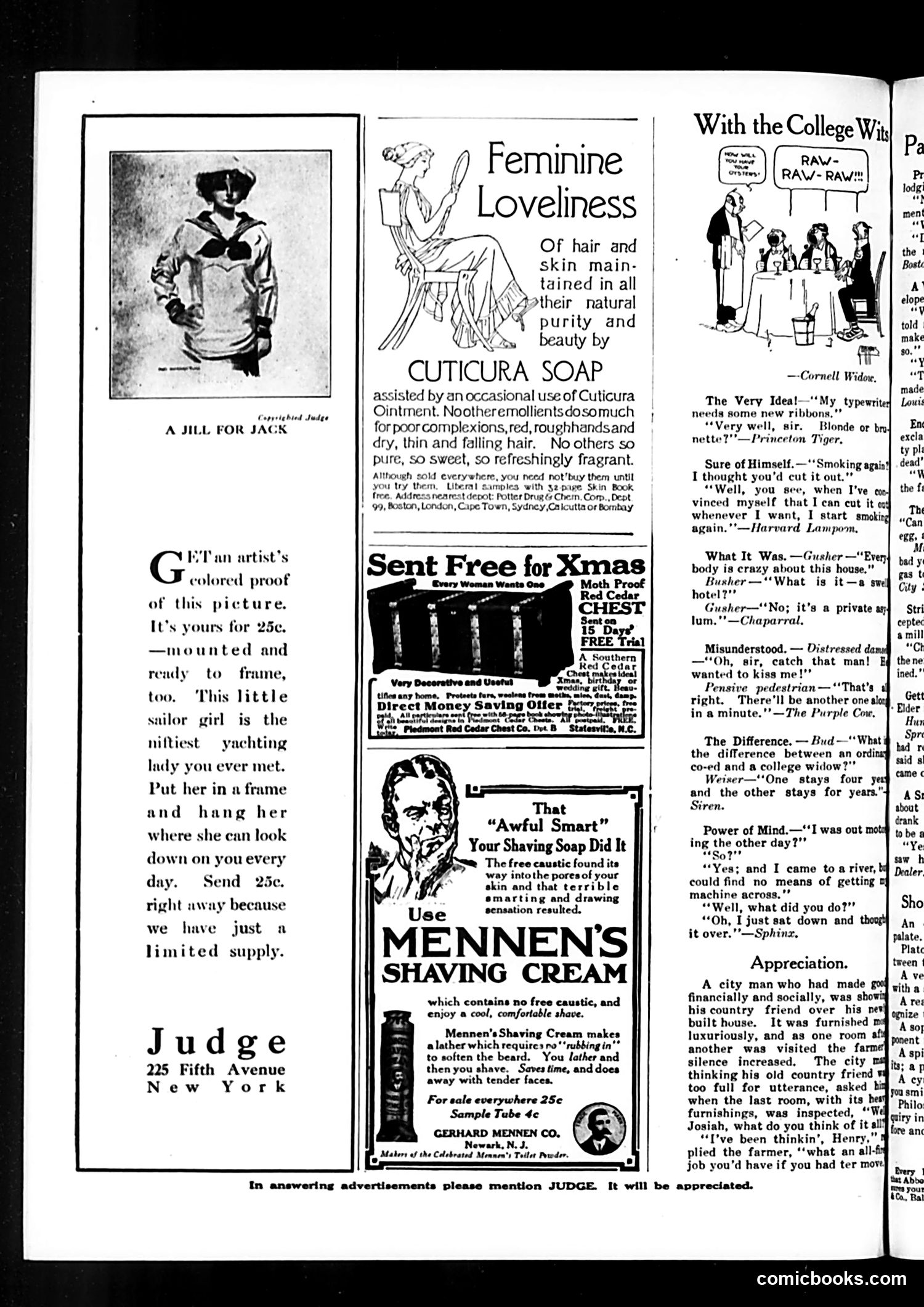
This page is primarily **advertisements interspersed with brief humor columns**, typical of Judge's format. The main advertised products—Cuticura Soap, Mennen's Shaving Cream, and a Red Cedar Chest—use common early-20th-century marketing tactics: appeals to beauty, comfort, and domestic value. The "Feminine Loveliness" ad emphasizes women's appearance maintenance; the shaving cream ad humorously depicts men's sensitive skin reactions. The humor columns ("With the College Wits") feature jokes from university publications (Cornell Widow, Princeton Tiger, Harvard Lampoon). These are mild, genteel jokes about college life—romantic misunderstandings, smoking habits, differences between co-eds and "college widows" (older unmarried women). The "Appreciation" column presents a rural/urban contrast: a country farmer touring a wealthy city man's mansion remains unimpressed, asking what job the man would need if forced to move such possessions. The artwork—a framed illustration of a "sailor girl" offered for 25 cents—advertises Judge's art prints as affordable home decoration. **Context for modern readers:** This reflects pre-1920s consumer culture, gender attitudes, and college humor traditions now largely extinct.
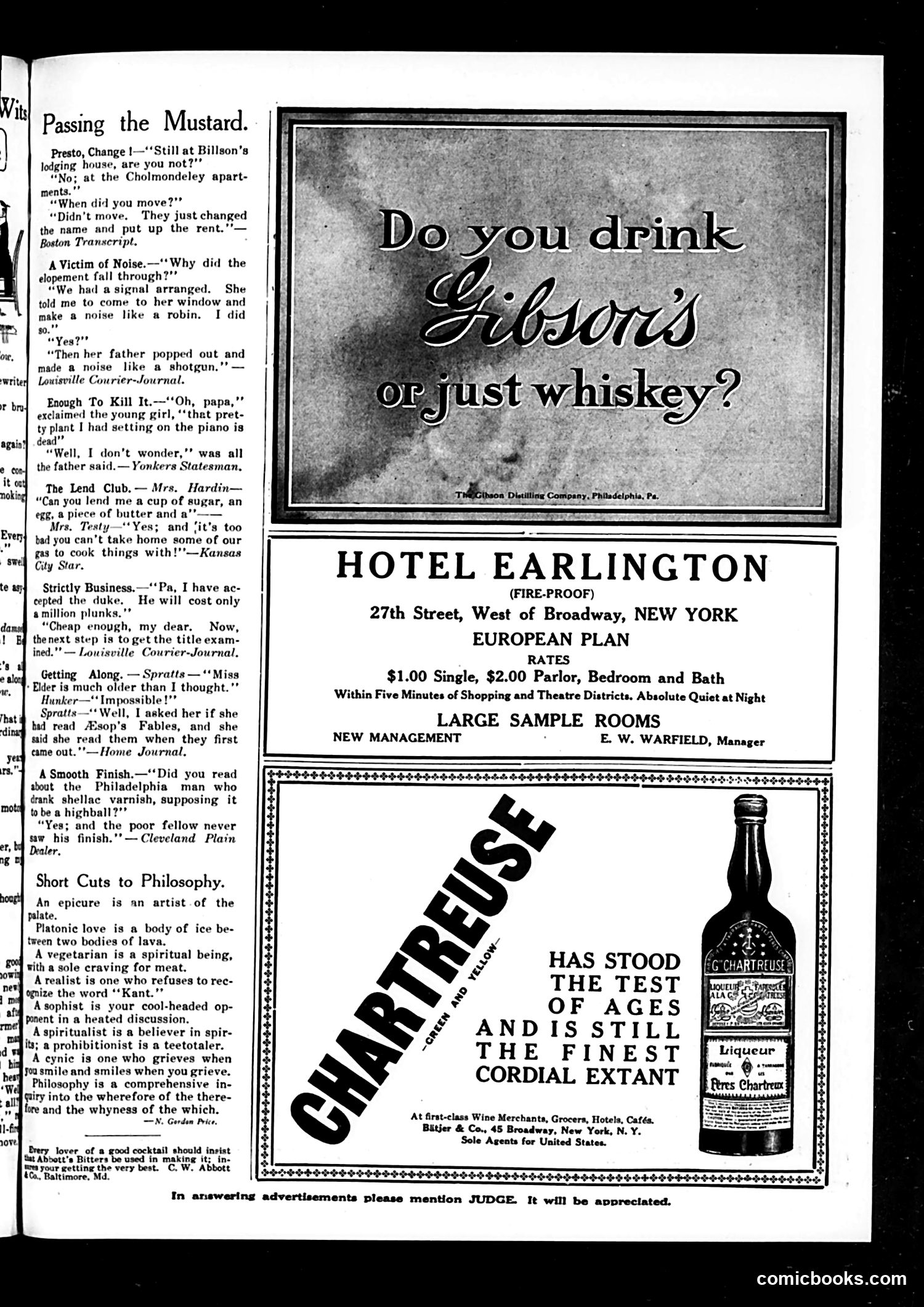
This page consists primarily of **short humorous anecdotes** rather than political cartoons. The jokes satirize everyday social situations and human nature: - **Housing scam**: A landlord renames an apartment building and raises rent without tenants actually moving - **Elopement mishap**: A father mistakes his daughter's signal (robin noise) for an intruder and fires a shotgun - **Over-lending**: A woman borrows so many ingredients from a neighbor that the neighbor sarcastically offers to lend cooking gas - **Shellac mishap**: A Philadelphia man drinks shellac varnish thinking it's whiskey, dying without "finishing" The page also includes **"Short Cuts to Philosophy,"** witty definitions mocking pretentiousness (e.g., "A realist is one who refuses to recognize the word 'Kant'"). The **advertisements** promote liquor, a hotel, and Abbott's Bitters—typical of the era. These reflect Judge's audience: educated, urban, middle-to-upper-class men who appreciated wordplay and social commentary delivered through brief, punchy scenarios.
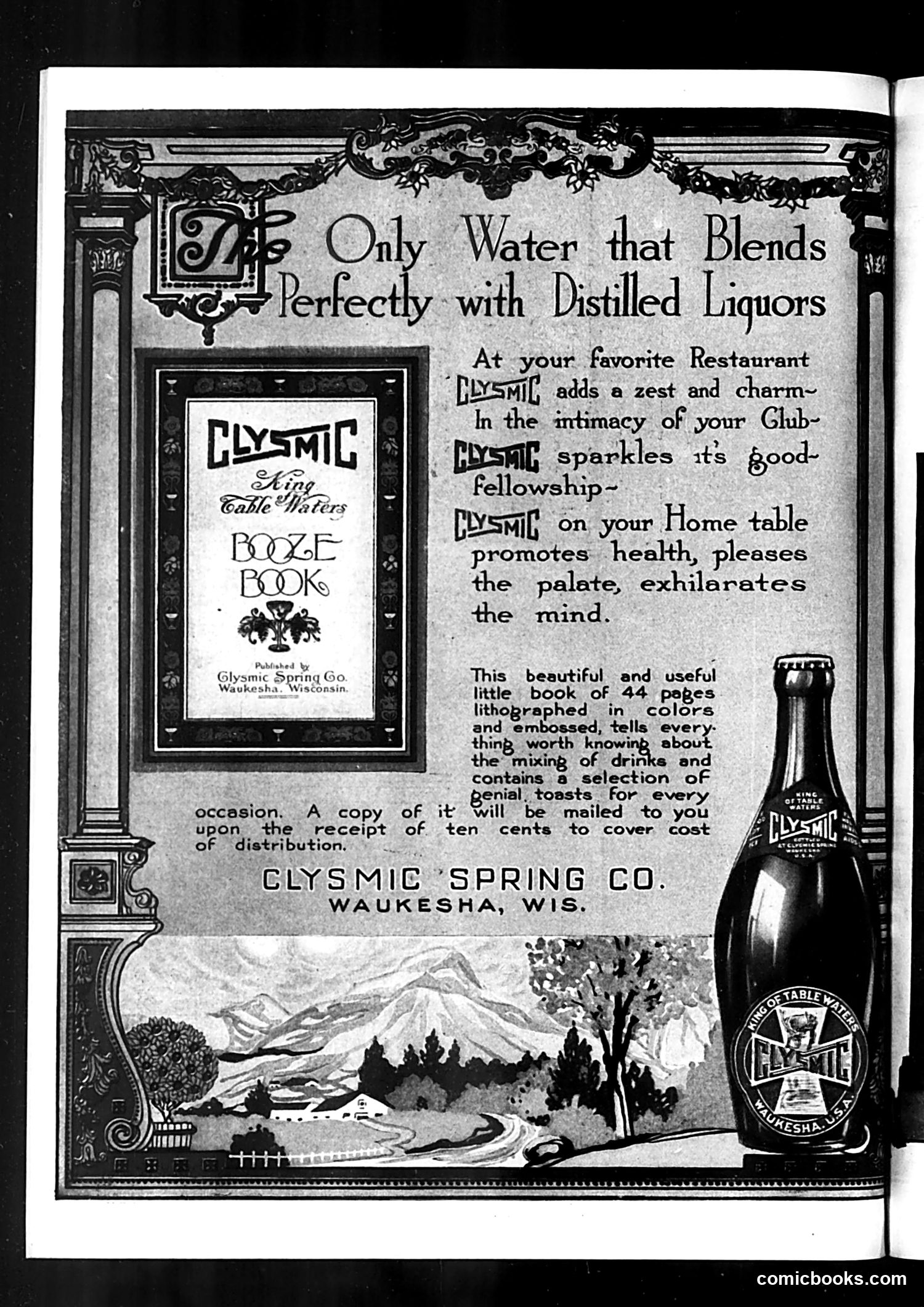
This is a straightforward advertisement, not satire or political commentary. Glysmic Spring Company of Waukesha, Wisconsin promotes their bottled water as the ideal mixer for distilled liquors (hard alcohol). The ad emphasizes Glysmic's usefulness in three settings: restaurants, clubs, and home tables—claiming it "promotes health, pleases the palate, exhilarates the mind." The company offers a free 44-page "King of Table Waters" recipe book for ten cents (shipping cost) containing drink-mixing instructions and toasts. The ornate Art Deco design and mountain landscape imagery convey quality and purity. This appears in *Judge* magazine, likely during Prohibition or the immediate post-Prohibition era when marketed "medicinal" waters and mixers were common. The ad targets affluent consumers who could afford bottled water and alcohol.