
Judge, 1912-11-16 · page 12 of 24
Judge — November 16, 1912 — page 12: what you’re looking at
What you’re looking at
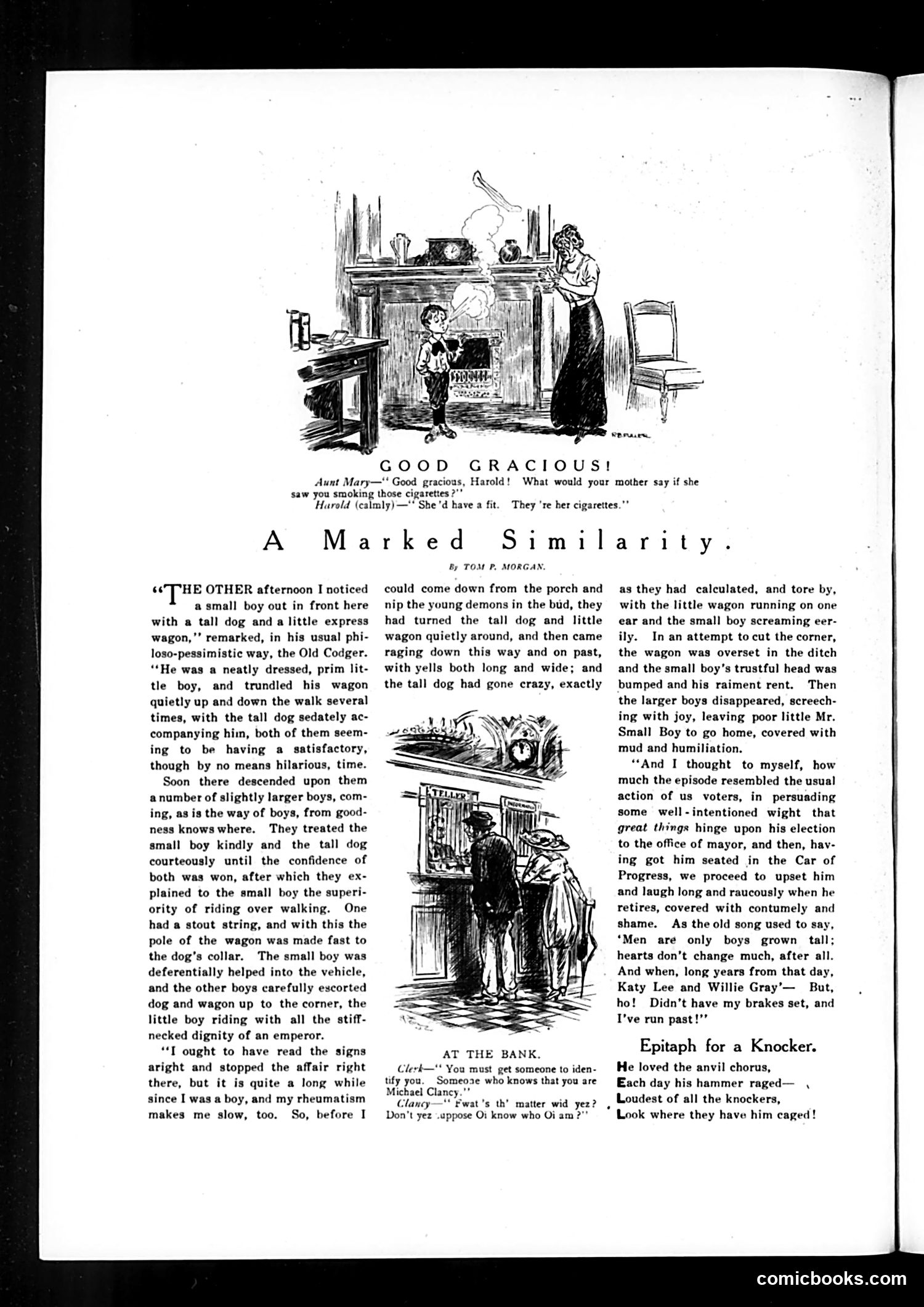
This page contains three distinct satirical pieces from Judge magazine: **"Good Gracious!" (top cartoon):** A domestic joke about a boy smoking cigarettes. His aunt threatens to tell his mother; he calmly responds his mother wouldn't mind because they're her cigarettes. The humor plays on unexpected role reversals and class commentary about women smoking—then a scandalous behavior. **"A Marked Similarity" (main story):** An extended political allegory by Tom P. Morgan. An older narrator recounts boys convincing a well-dressed small boy to ride in a wagon pulled by a tall dog, then deliberately causing a chaotic, humiliating crash. He explicitly compares this to voters persuading naive candidates to run for mayor, only to ridicule them when they fail. The satire critiques voter behavior in municipal politics—how the electorate manipulates candidates for entertainment, then abandons them to shame. **"Epitaph for a Knocker" (bottom right):** A brief poem mocking someone ("the anvil chorus," a loud complainer) who is now "caged"—imprisoned or silenced, presumably for his constant criticism.
📄 Transcribed text from this page (OCR, searchable)
Machine-transcribed from the original scan — historical spelling and the odd misread are preserved.
Aunt Mary—‘‘ Good gracious, Harold! GOOD GRACIOUS! What would your saw you smoking those cigarettes ?"” Harold (calmly) —‘* She'd have a fit. A Ma 66° HE OTHER afternoon I noticed a small boy out in front here with a tall dog and a little express wagon,’ remarked, in his usual phi- loso-pessimistic way, the Old Codger. ‘*He was a neatly dressed, prim lit- tle boy, and trundled his wagon quietly up and down the walk several times, with the tall dog sedately ac- companying him, both of them seem- ing to be having a satisfactory, though by no means hilarious, time. Soon there descended upon them anumber of slightly larger boys, com- ing, as is the way of boys, from good- ness knows where. They treated the small boy kindly and the tall dog courteously until the confidence of both was won, after which they ex- plained to the small boy the superi- ority of riding over walking. One had a stout string, and with this the pole of the wagon was made fast to the dog's collar. The small boy was deferentially helped into the vehicle, and the other boys carefully escorted dog and wagon up to the corner, the little boy riding with all the stiff- necked dignity of an emperor. “T ought to have read the signs aright and stopped the affair right there, but it is quite a long while since I was a boy, and my rheumatism makes me slow, too. So, before I rked Simil By TOM P, MORGAN. could come down from the porch and nip the young demons in the bud, they had turned the tall dog and little wagon quietly around, and then came raging down this way and on past, with yells both long and wide; and the tall dog had gone crazy, exactly AT THE BANK. Clerk—"* You must get someone to iden- tify you. Someose who knows that you are Michael Clancy." Clancy —"* Fwat's th’ matter wid yez? Don’t yez .appose Oi know who Oi am?" mother say if she They ‘re her cigarettes."" arity. as they had calculated, and tore by, with the little wagon running on one ear and the small boy screaming eer- ily. In an attempt to cut the corner, the wagon was overset in the ditch and the small boy’s trustful head was bumped and his raiment rent. Then the larger boys disappeared, screech- ing with joy, leaving poor little Mr. Small Boy to go home, covered with mud and humiliation. “And I thought to myself, how much the episode resembled the usual action of us voters, in persuading some well-intentioned wight that great things hinge upon his election to the office of mayor, and then, hav- ing got him seated in the Car of Progress, we proceed to upset him and laugh long and raucously when he retires, covered with contumely and shame. As the old song used to say, ‘Men are only boys grown tall; hearts don’t change much, after all. And when, long years from that day, Katy Lee and Willie Gray’— But, ho! Didn't have my brakes set, and I’ve run past!’” Epitaph for a Knocker. He loved the anvil chorus, Each day his hammer raged— , Loudest of all the knockers, * Look where they have him caged! comicbooks.com