
A complete issue · 24 pages · 1912
Judge — August 10, 1912
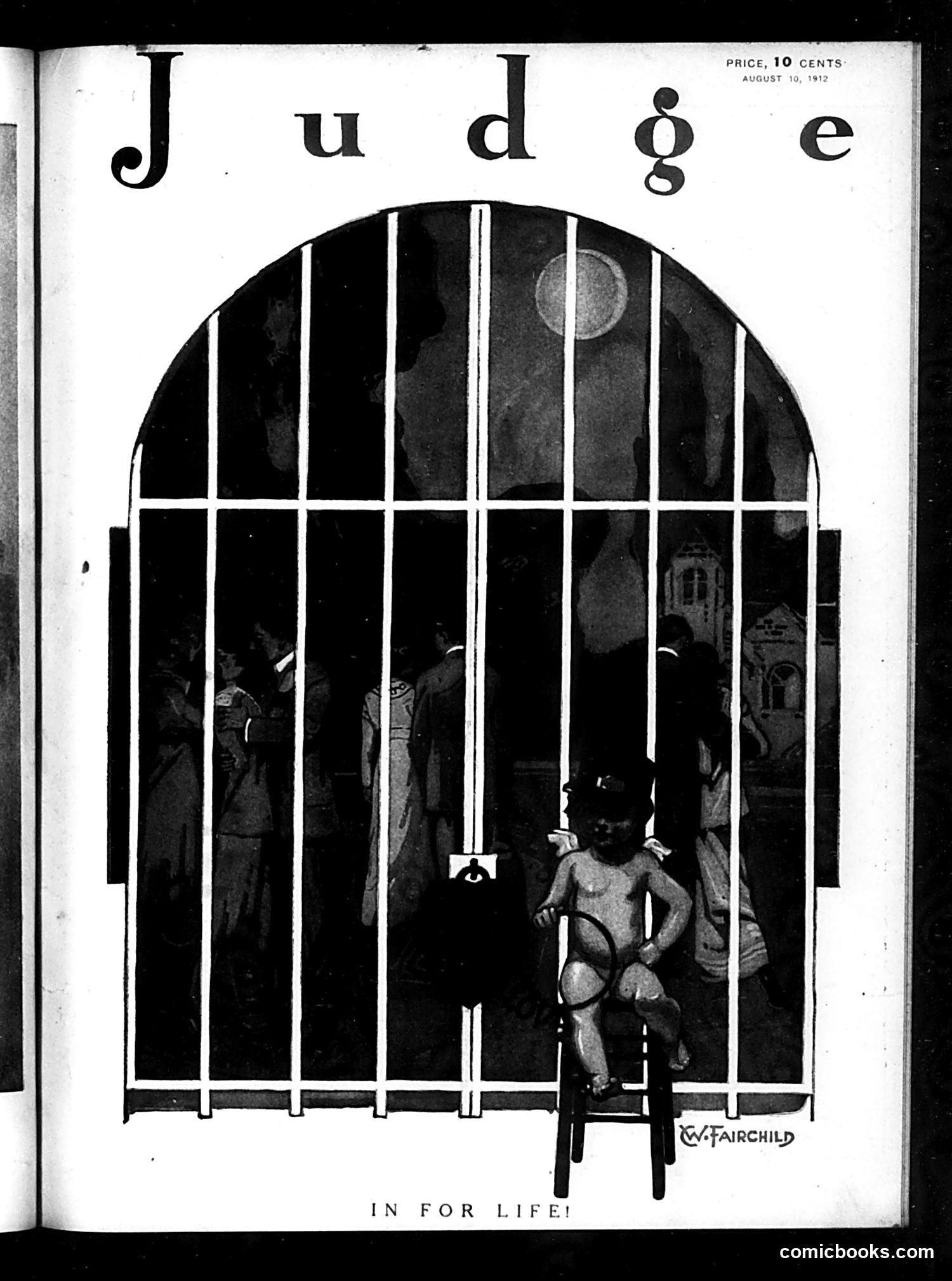
This cover depicts a baby in a high chair facing a barred window/cage, with shadowy figures visible behind the bars. The caption reads "IN FOR LIFE!" **What it means:** This is political satire about the 1912 U.S. presidential election. The baby likely represents the American voter or public, trapped by their choice of presidential candidate—suggesting whoever wins will be "in for life" (a term meaning imprisoned long-term). The figures behind bars appear to be the competing candidates. The satire critiques the election as offering voters a false or imprisoning choice between unsatisfactory options. The image's dark, prison-like framing emphasizes the bleakness of the electoral outcome for the public. **Artist credit:** Signed by W. Fairchild.
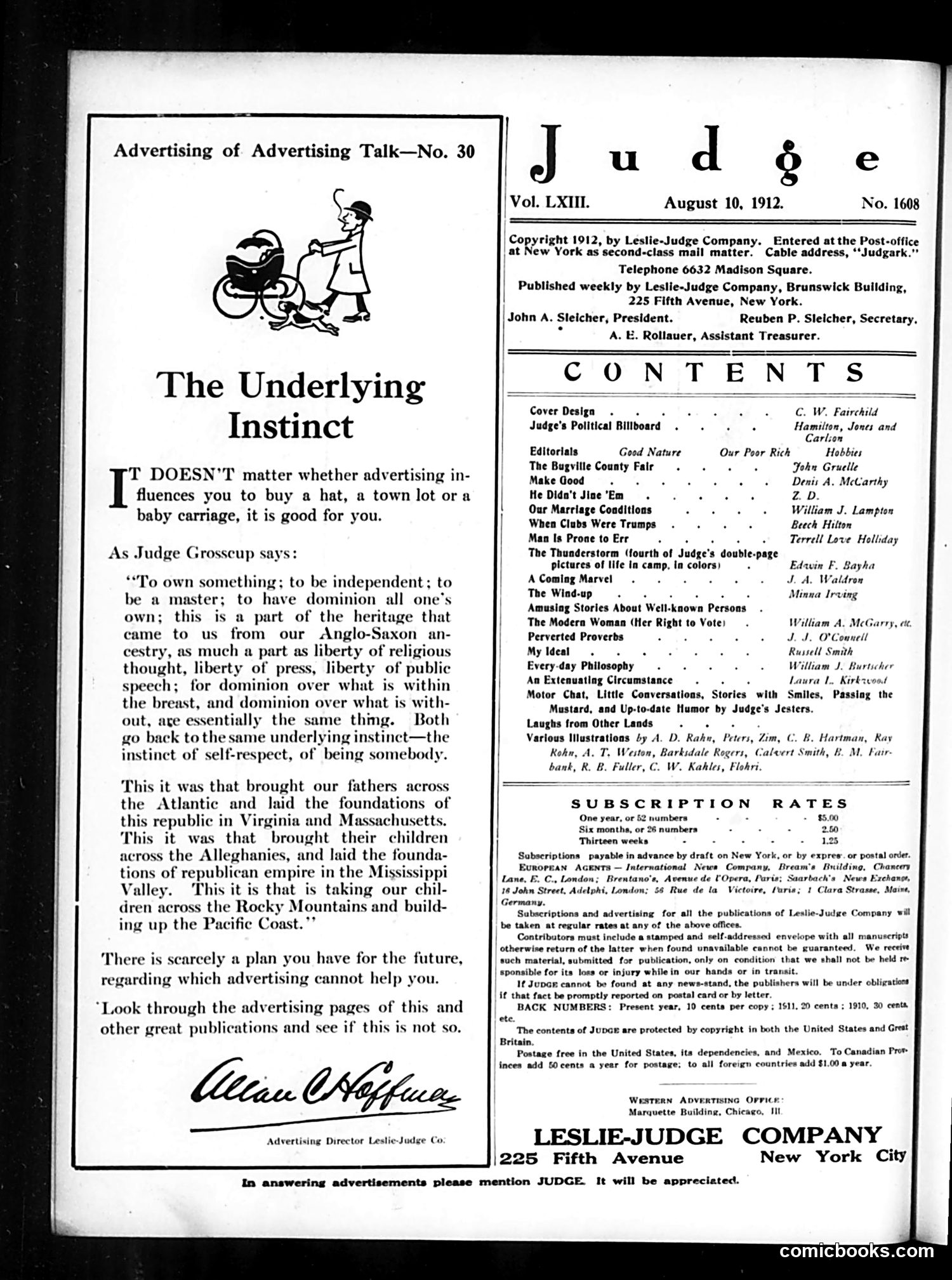
This page is primarily an **advertising feature** rather than political satire. The left side contains "The Underlining Instinct," an ad copy by Leslie-Judge Company's Advertising Director Allan Hoffmann, quoting Judge Grosceup on ownership and independence as fundamental American values. The quote links acquisitiveness to the nation's founding and westward expansion—suggesting that wanting to own things (and thus buy advertised products) is patriotic and natural. The right side shows the magazine's contents page and subscription rates ($5 yearly). This appears standard editorial/business matter rather than satirical commentary, typical of Judge's format blending humor with commercial messaging.
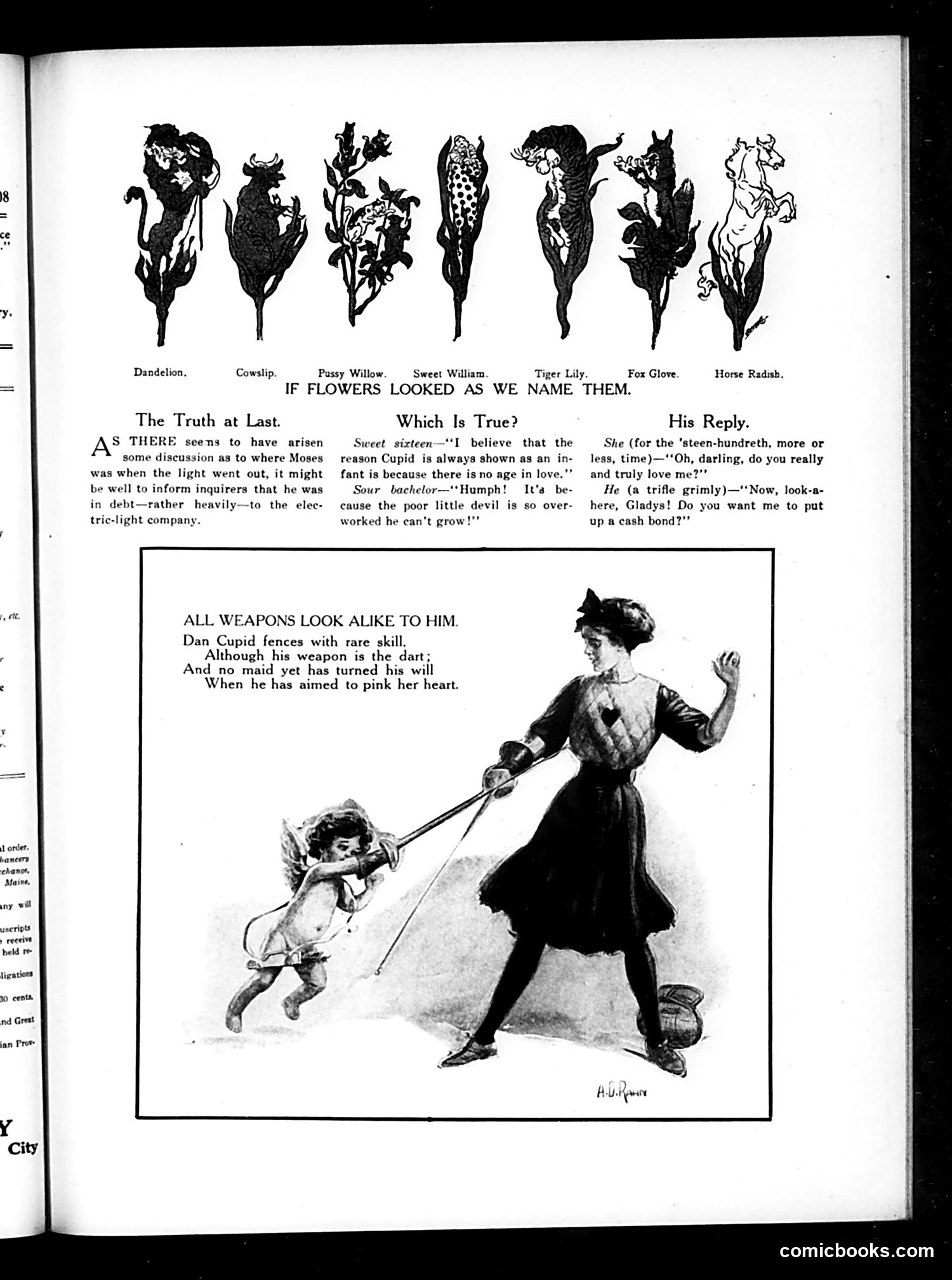
This page contains two distinct elements: **Top Section:** A humorous debate about flower nomenclature. The illustrated flowers are named after romantic or rural concepts (Dandelion, Cowslip, Pussy Willow, etc.). Three characters—Sweet Sixteen, Sour Bachelor, and He—debate whether Cupid is "shown as an infant" because love has "no age" or because the devil is "overworked." The joke plays on conventional romantic sentiment versus cynical observations about love and marriage. **Main Cartoon:** Titled "All Weapons Look Alike to Him," it depicts a woman wielding Cupid (the cherub) as a weapon or tool on a leash. The accompanying verse suggests Cupid's dart is an effective romantic weapon. The satire appears to mock romantic love as a form of control or manipulation, portraying Cupid as weaponized for conquering hearts—a commentary on courtship dynamics of the era.
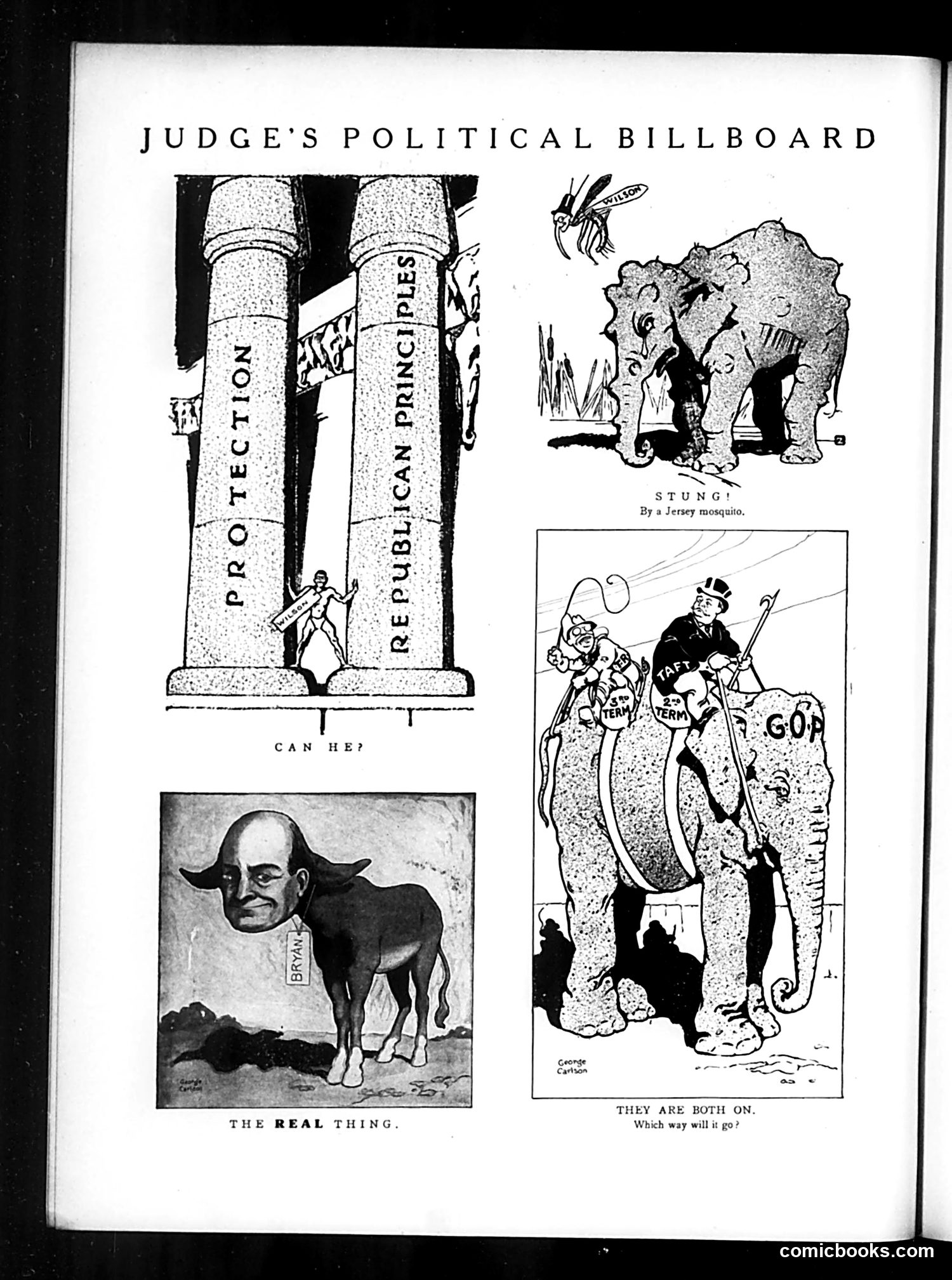
This page presents four satirical cartoons commenting on early 20th-century American politics: 1. **"Can He?"** depicts a small figure attempting to support two massive pillars labeled "Protection" and "Republican Principles"—questioning whether a political leader can uphold these Republican ideals. 2. **"The Real Thing"** shows a goat-headed caricature labeled "Bryan," likely William Jennings Bryan, the populist Democratic politician—a derisive portrayal suggesting his ideas were absurd or destructive. 3. **"Stung!"** depicts an elephant (the Republican symbol) stung by a Jersey mosquito, commenting on electoral setbacks. 4. **"They Are Both On"** shows Republicans and Democrats (labeled "Dem" and "Rep") riding an elephant together, asking "Which way will it go?"—satirizing political uncertainty and shared responsibility.
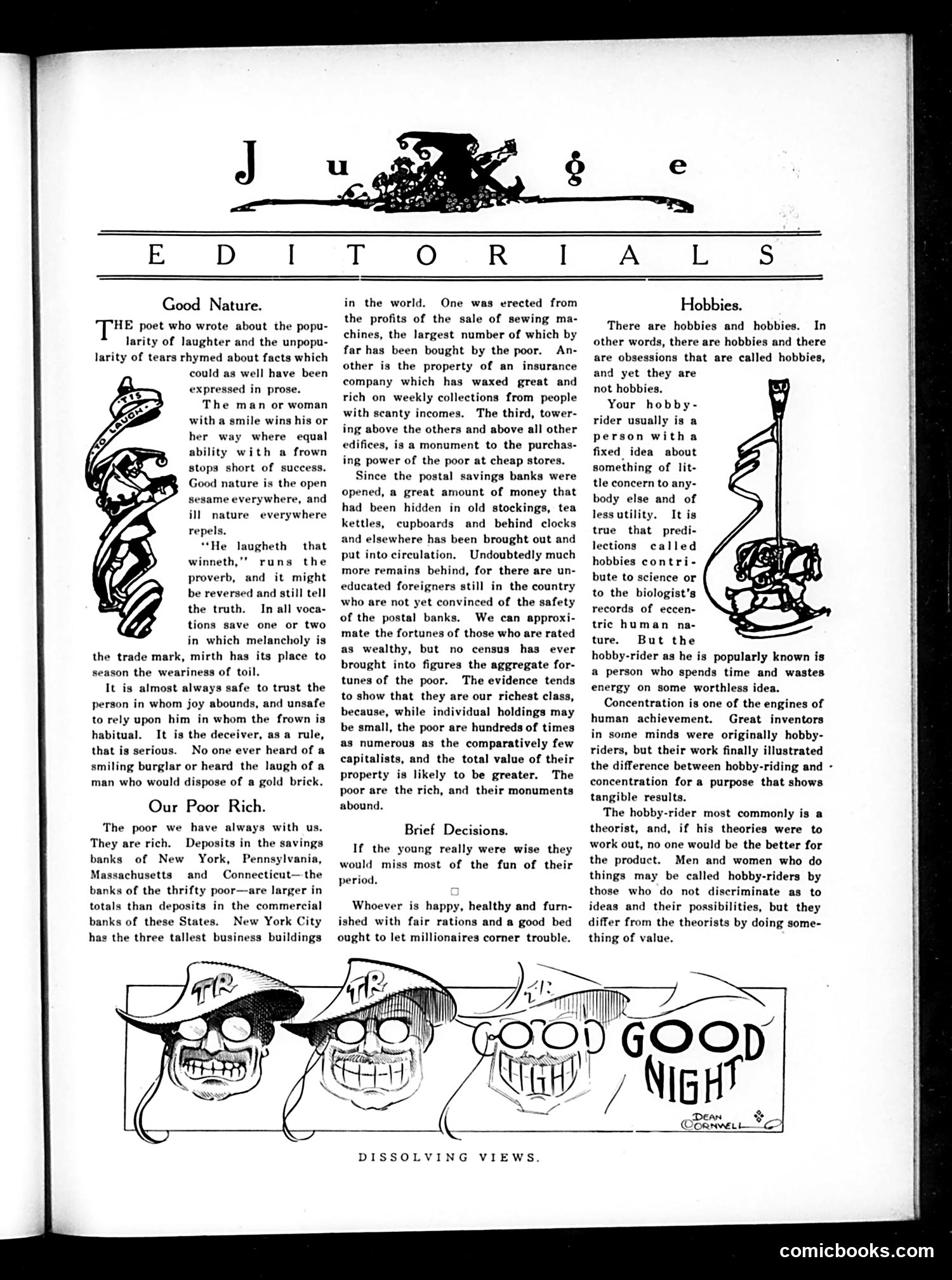
This page combines three distinct editorial pieces on wealth and social class: 1. **"Good Nature"** (left column): Argues that laughter and tears about poverty are better expressed in prose than poetry, using a decorative initial letter. 2. **"Of Poor Rich"** (center): Satirizes wealthy people's ignorance of their own poverty levels. It notes that postal savings banks hold more deposits than commercial banks—evidence that poor Americans are wealthier collectively than the rich realize. 3. **"Hobbies"** (right): Distinguishes between hobbyists (serious practitioners) and "hobby-riders" (dilettantes who waste energy on worthless pursuits). The bottom cartoon, **"Dissolving Views,"** shows three nearly-identical faces progressively losing detail, labeled "GOOD NIGHT"—likely satirizing people whose ideas or convictions gradually fade away. The overall theme critiques both class misconceptions and intellectual superficiality.
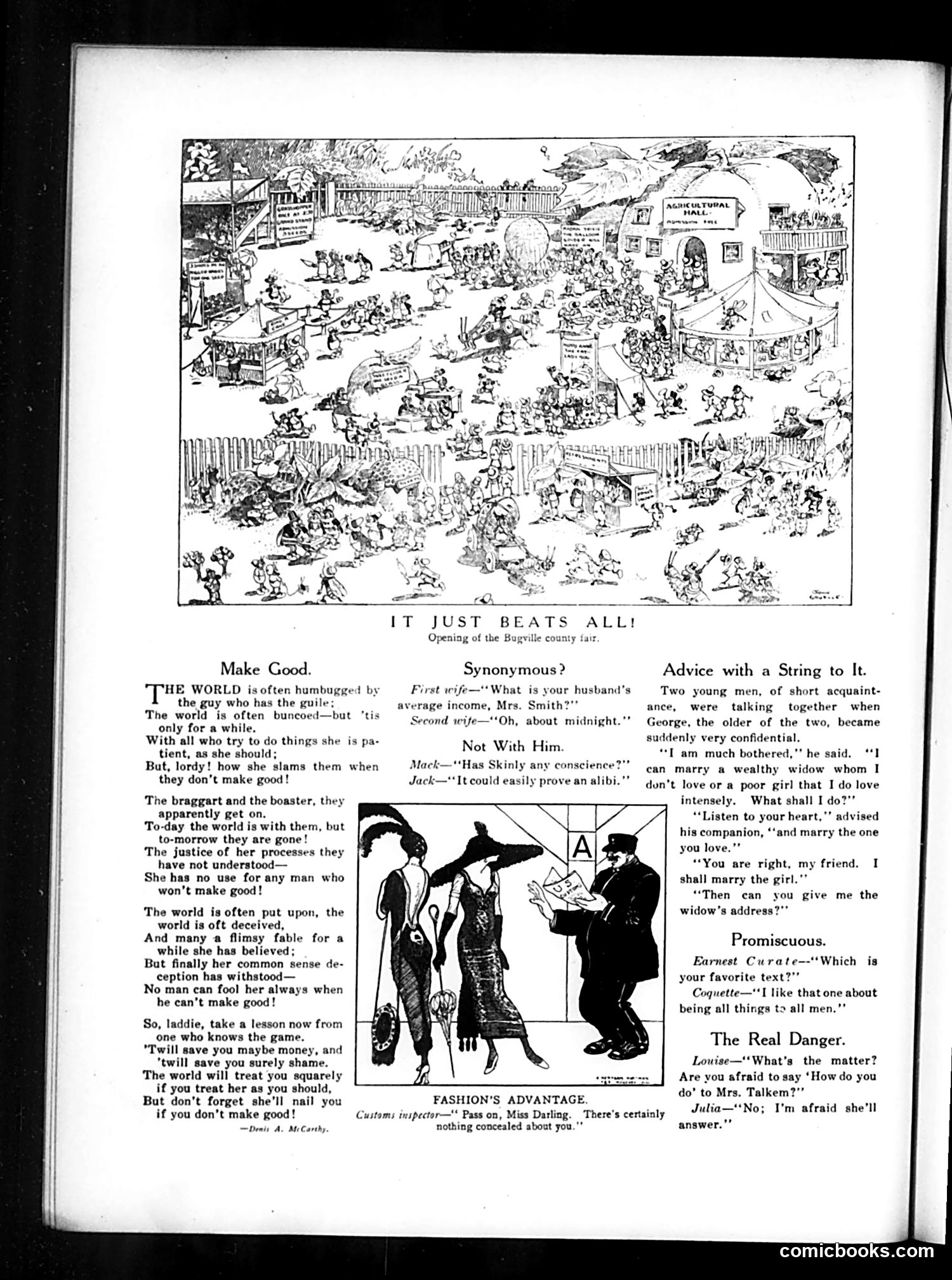
This page from Judge contains **satirical commentary and humor pieces** rather than political cartoons. The top features a large illustration titled "It Just Beats All!" depicting the opening of a county fair—a busy scene with numerous activities and attractions. Below are several **short humorous pieces**: - **"Make Good"** is a poem about how the world eventually catches up with fraudsters and charlatans; success requires genuine effort. - **Brief joke exchanges** mock various character types: husbands, conscience-lacking men, boasters. - **"Fashion's Advantage"** jokes about customs inspection and concealment. - **"Advice with a String to It"** depicts a cynical friend advising another to marry for love while secretly seeking the wealthy widow's contact information. - **"The Real Danger"** is a quip about an overly talkative woman. The satire targets **human hypocrisy, social pretense, and character flaws** rather than specific political figures. The humor is gentle, domestic, and moralistic—typical of early 20th-century American magazine fare emphasizing that dishonesty and phoniness eventually fail.
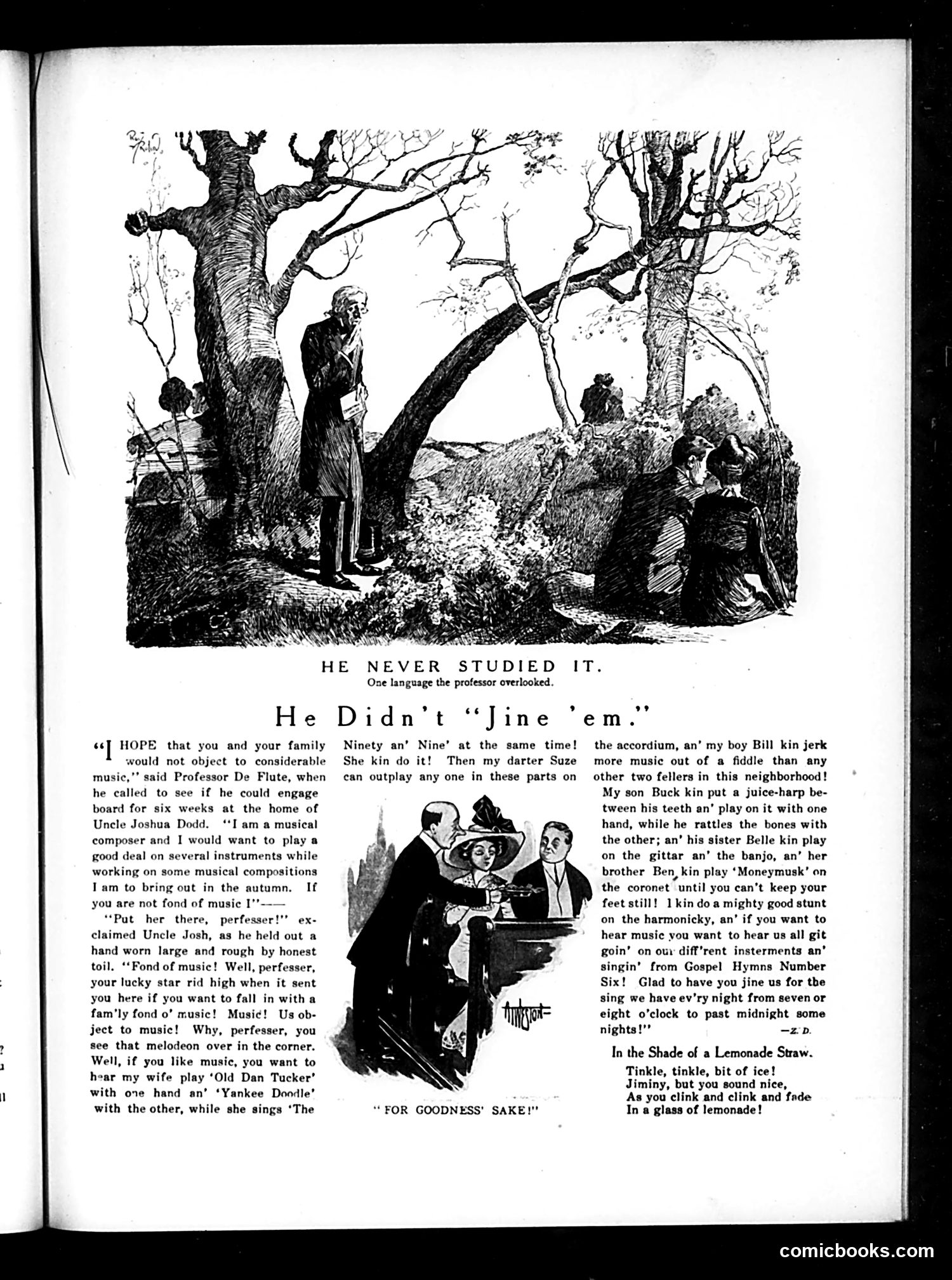
This page contains two separate satirical pieces from *Judge* magazine: **Top cartoon ("He Never Studied It"):** A professor visits a rural home, overlooking that the family speaks only in dialect—a "language" of colloquial speech he failed to anticipate. The satire mocks educated urbanites encountering working-class rural Americans whose speech patterns they find incomprehensible. **"He Didn't 'Jine 'em'" story:** A music professor seeks lodging, expecting quiet to compose. Uncle Joshua Dodd enthusiastically describes his entire family's musical abilities—each family member playing different loud instruments *simultaneously* every night until midnight. The humor lies in the professor's horror at this cacophony, and the family's obliviousness to how unbearable constant amateur musicmaking would be. The heavy dialect reinforces the rural/urban class divide—the professor clearly regrets his boarding choice. Both pieces exploit period stereotypes of rural Americans as crude, unsophisticated, and socially unaware, while portraying educated city folk as out-of-touch and pretentious.
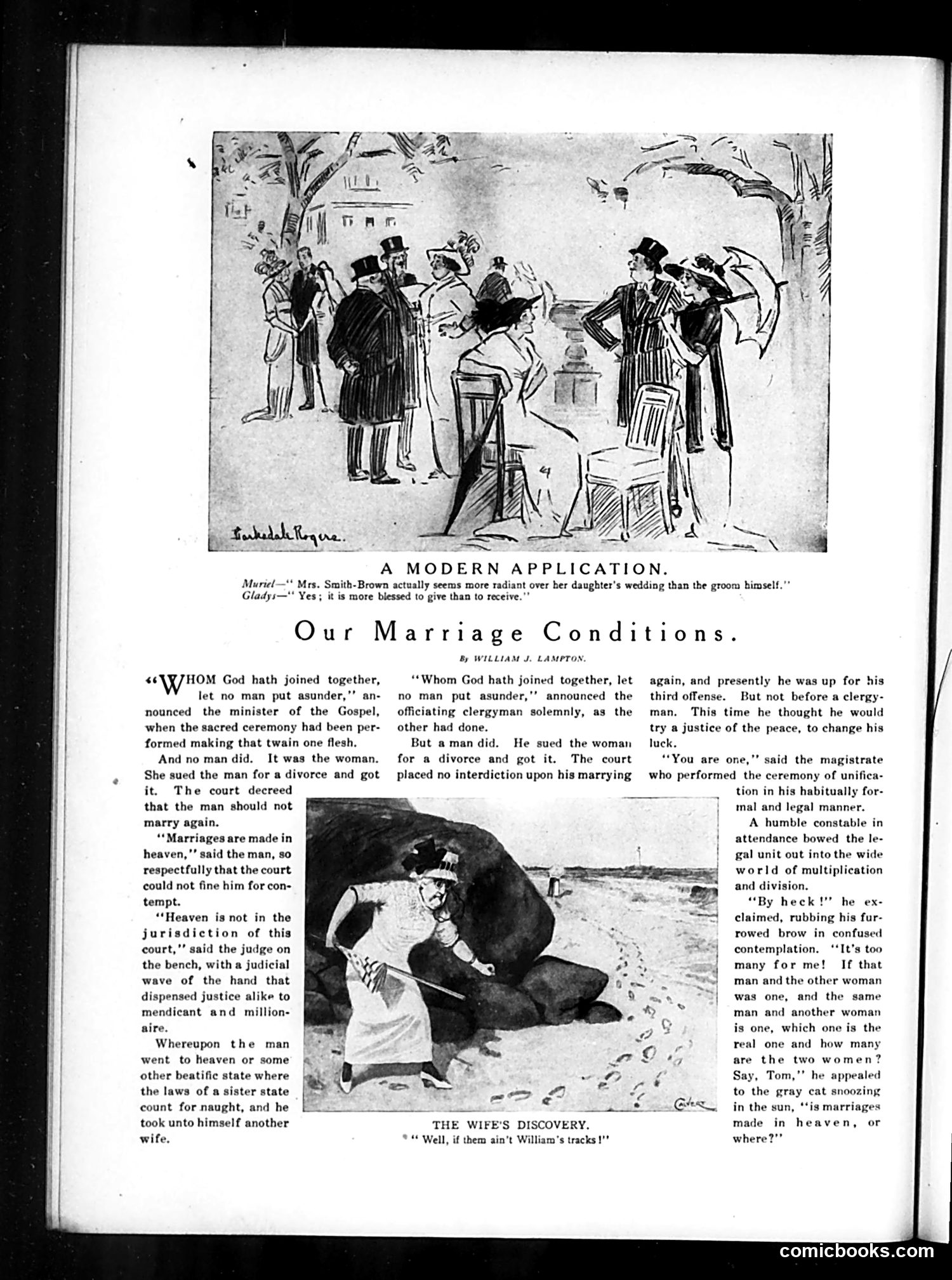
This piece by William J. Lampton satirizes the inconsistency of divorce laws across American states and the absurdity of repeated marriages. The narrative describes a man who divorces his wife. A court forbids him from remarrying—but he escapes to another state with laxer laws and marries again. He divorces a second time, then attempts a third marriage via justice of the peace instead of church, hoping to "change his luck." The satire's punch: the constable witnessing this third ceremony struggles with the theological/legal contradiction: if each marriage makes two people "one," which woman is the *real* one? How many are actually two women? The cartoon at top shows a mother proudly presiding over her daughter's wedding, suggesting women benefit materially from marriages (gifts, status) more than grooms do—a cynical commentary on marriage as transaction. The joke exposes how easily men exploited jurisdictional gaps in marriage and divorce law, and mocks the gap between religious doctrine ("what God hath joined") and legal reality.
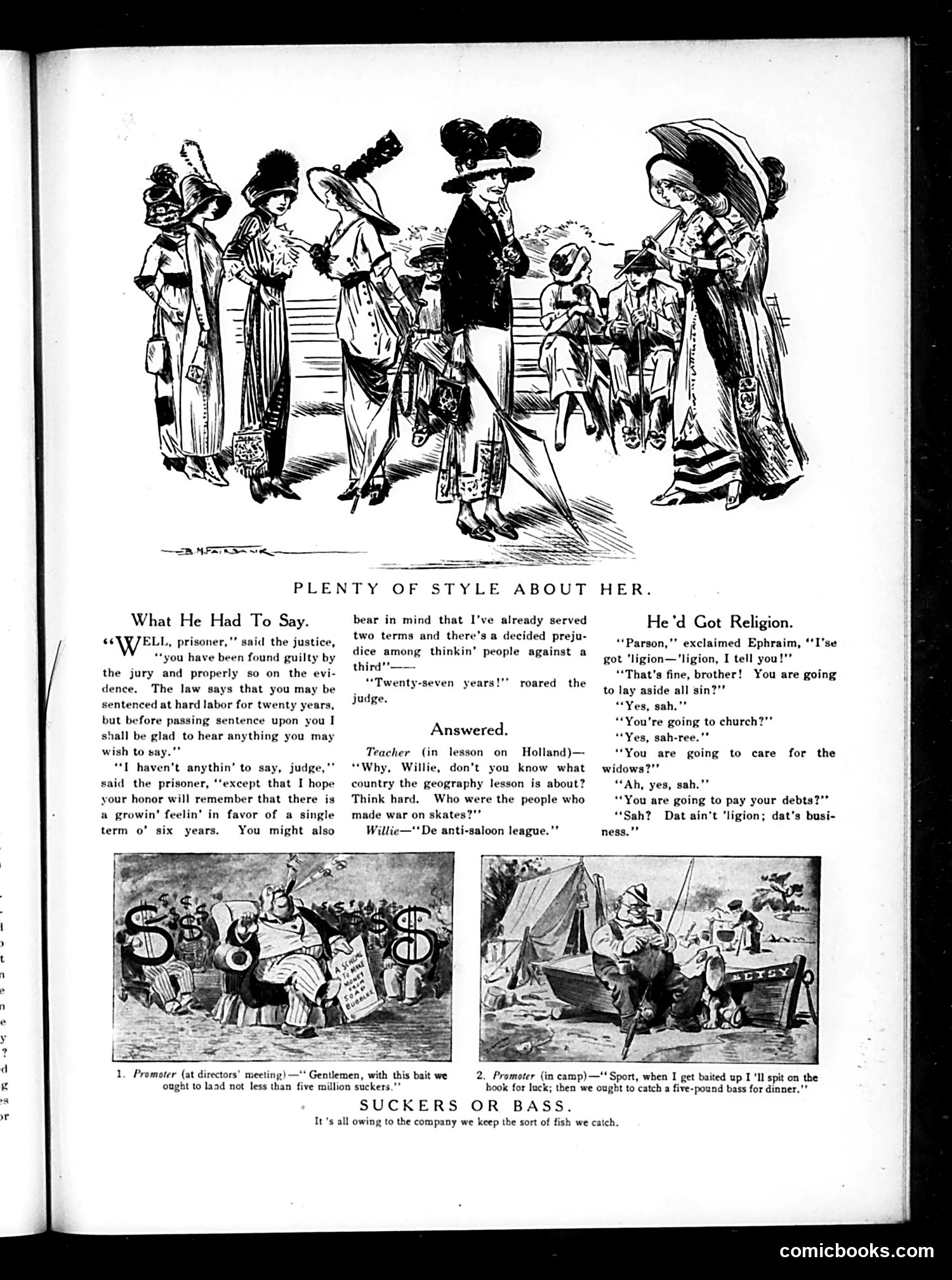
This Judge magazine page contains three satirical pieces: **Top cartoon**: Shows fashionably dressed women and men in elaborate Edwardian attire. The title mocks superficial fashion consciousness—"style" substitutes for substance. **Text jokes**: 1. A prisoner facing sentencing uses "modern" arguments (public opinion, prior sentences) to avoid responsibility—satirizing how criminals manipulate sentiment instead of facing consequences. 2. A teacher's joke: when asked about Holland's geography, a student answers "anti-saloon league," mocking Prohibition advocates as obsessed and present everywhere. 3. "He'd Got Religion": An African American character claims newfound religiosity but admits he won't pay debts—satirizing insincere conversion that abandons moral obligations. The dialect humor reflects the era's offensive racial stereotyping. **Bottom cartoons** ("Suckers or Bass"): Promoters use bait to catch "suckers" (gullible investors), with wordplay suggesting we become what we associate with—a commentary on investment fraud and bad company.
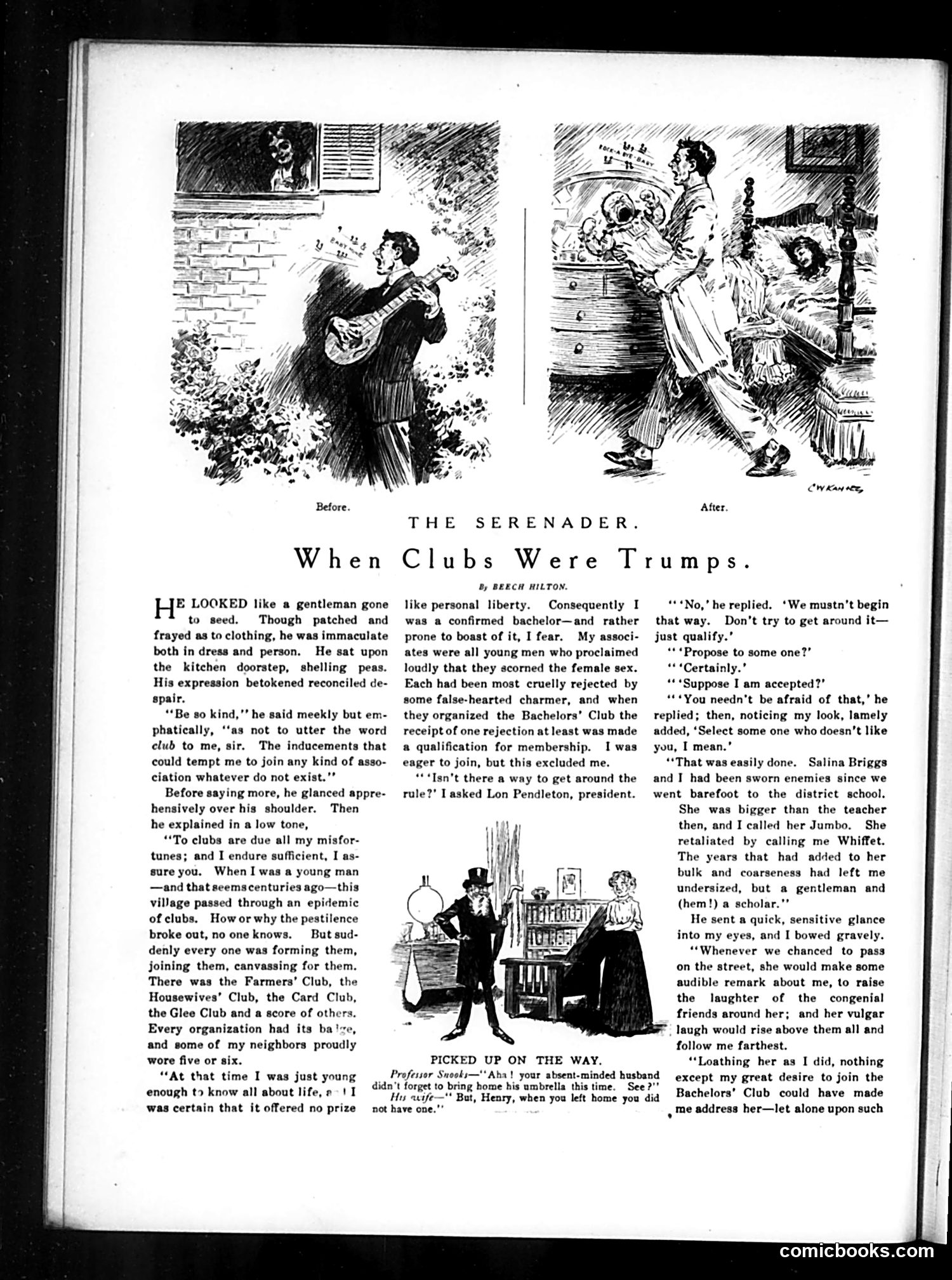
This humorous story satirizes the late 19th-century American epidemic of social clubs. The unnamed protagonist recounts how village social life became dominated by clubs—Farmers' Club, Housewives' Club, Glee Club, and notably the "Bachelors' Club" for rejected men. The joke centers on the Bachelors' Club's cruel irony: to join, one must be rejected by a woman. To qualify, our hero must propose to Salina Briggs, his childhood nemesis, confident she'll refuse. The satire mocks both the pretentiousness of exclusionary club culture and the narrator's misguided strategy based on mutual contempt. The two accompanying illustrations show "Before" and "After" scenarios involving a serenader—likely depicting the romantic complications that ensue, suggesting his plan backfires when the woman accepts his proposal. The page critiques how clubs had become social obsessions that dominated small-town life and drove absurd, consequence-filled behavior.
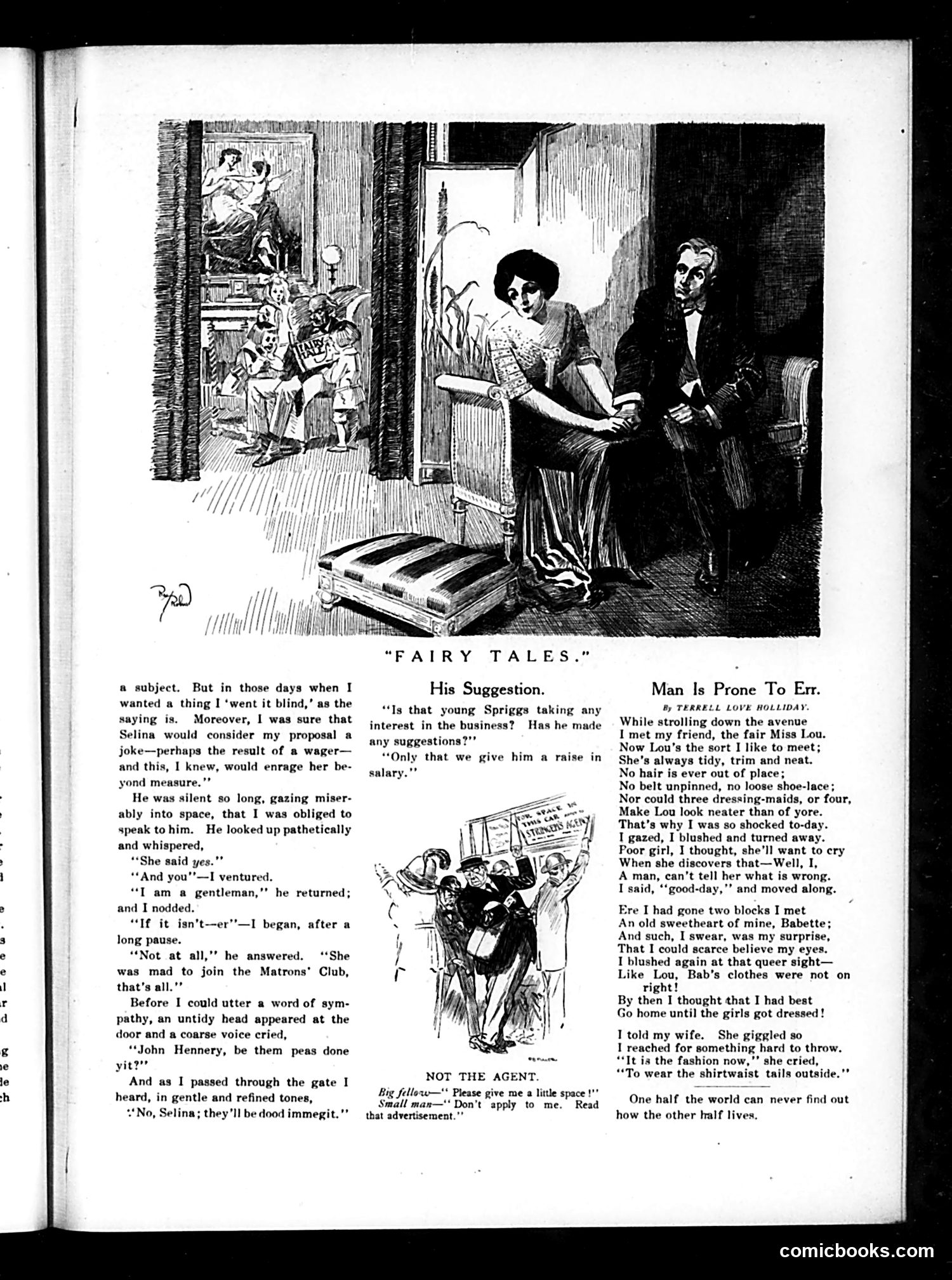
This page contains three separate humorous pieces satirizing early 20th-century social life. **Top cartoon** depicts a domestic scene where a man reluctantly proposes to a woman named Selina—not for love, but because she wanted to join a "Matrons' Club" and marriage was the price of admission. The joke mocks both her mercenary motivation and his resigned acceptance of matrimony as social obligation rather than romance. **"His Suggestion"** jokes about workplace dynamics: a young employee's only contribution is requesting a raise—satirizing useless workers. **"Man Is Prone To Err"** by Terrell Love Holliday pokes fun at the narrator's embarrassment upon seeing two well-dressed women with their shirtwaist tails worn *outside* their skirts—apparently a new fashion trend he doesn't recognize. His wife's explanation reveals he's simply ignorant of current women's fashion, making the piece a gentle jab at male obliviousness to style changes. The closing line cynically suggests the classes live in entirely separate worlds.
This appears to be a dramatic illustration from *Judge* magazine titled "The Thunderstorm." The black and white image depicts a turbulent natural scene with dark, stormy conditions—bare branches visible at the top, swirling atmospheric effects, and what seems to be rough terrain or landscape below. Without additional context from surrounding text or caption, the specific satirical meaning is unclear. This could be either a literal illustration accompanying a story or editorial commentary, or potentially political allegory using weather/natural imagery. The theatrical, dramatic style suggests it may comment on contemporary tumultuous events, but the exact reference remains uncertain from the image alone.
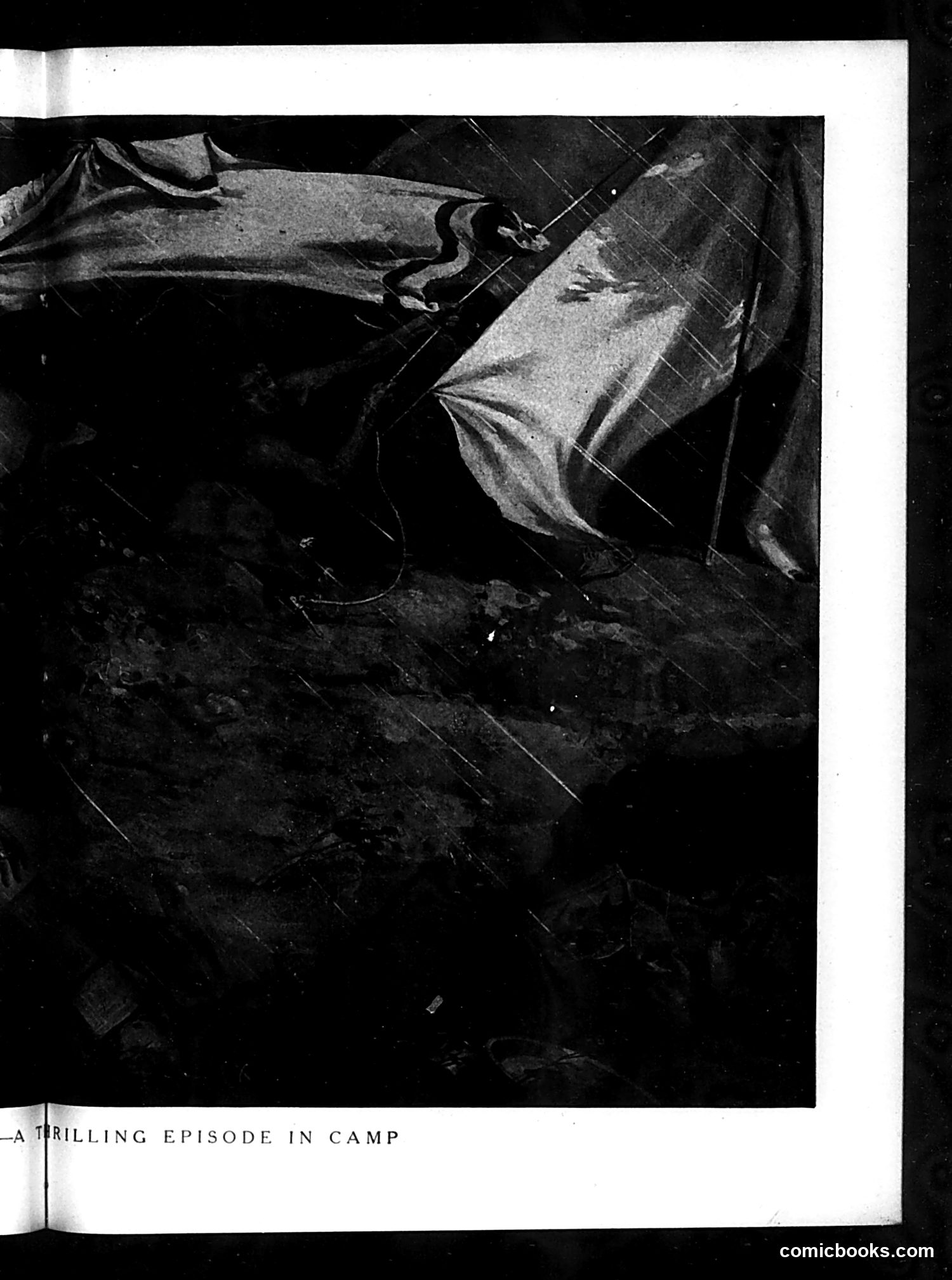
This appears to be a dramatic illustration captioned "A Thrilling Episode in Camp," though the specific context and historical moment are unclear from the image alone. The black-and-white photograph shows figures in what appears to be an outdoor or military camp setting, with people in period clothing positioned dramatically on the ground. Without additional context about which issue of *Judge* this is from or what contemporary events it references, I cannot confidently identify the specific figures, political situation, or satirical point being made. The composition suggests either a military or political scenario being depicted humorously, but the exact subject matter requires more information to explain accurately to a modern reader.
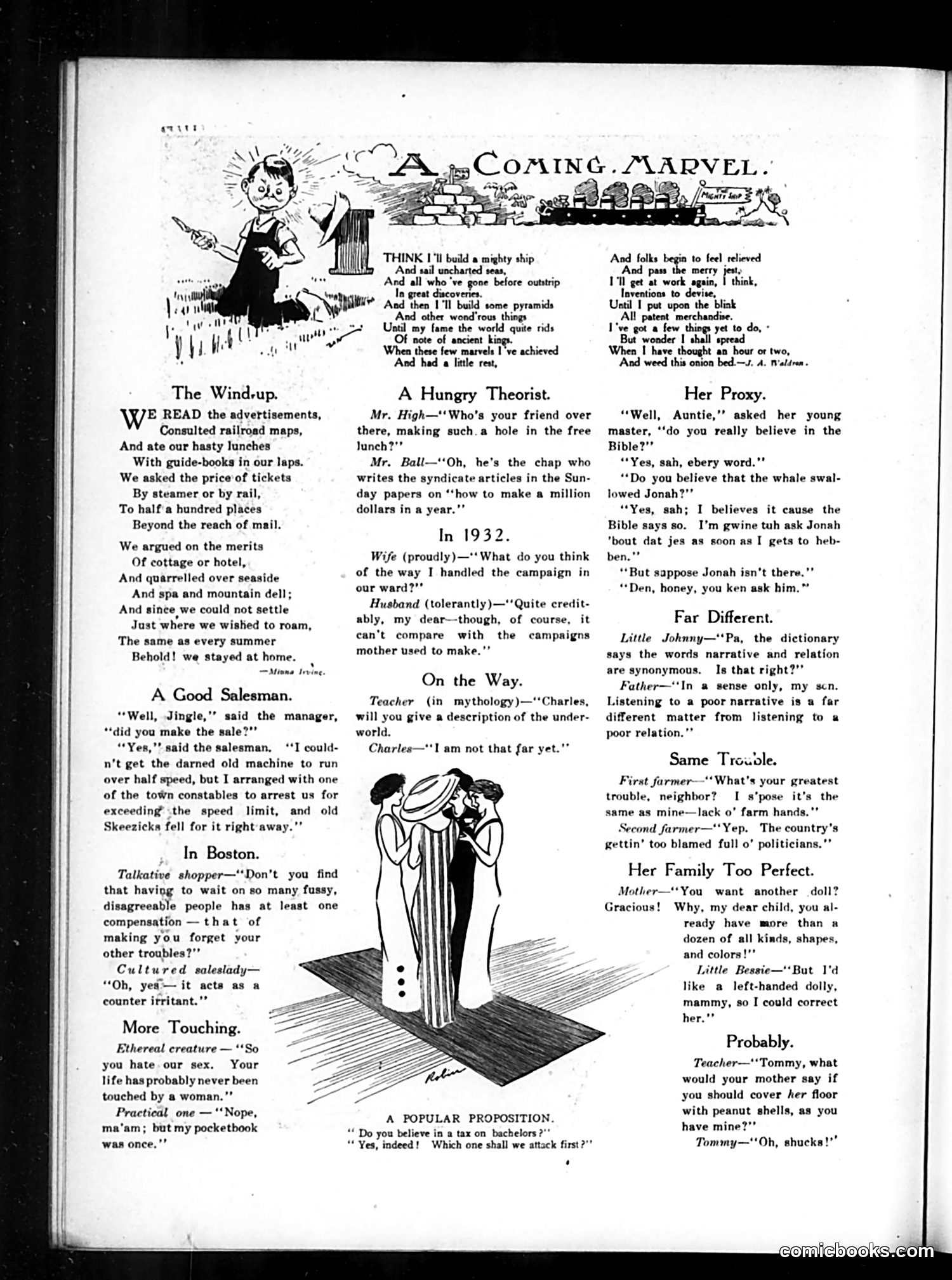
This page from Judge magazine (appears to be early 1930s based on the "In 1932" section) contains multiple short humorous pieces reflecting American middle-class anxieties and social observations: **"The Wind-up"** satirizes vacation indecision—families endlessly plan trips but ultimately stay home, a relatable Depression-era predicament. **"A Good Salesman"** mocks dubious sales tactics: a salesman can't get a car to work properly, so he arranges his own arrest for speeding to convince the customer it's fast. **"A Hungry Theorist"** jokes about self-help culture: a man writing articles on "how to make a million dollars yearly" apparently freeloads at lunches. **"In 1932"** humorously suggests a wife's campaign management couldn't compare to her mother-in-law's—typical domestic satire. The remaining pieces are brief observational gags about human nature, family dynamics, and social pretension. The overall tone captures middle-class American humor during economically uncertain times, focusing on everyday absurdities rather than overtly political commentary.
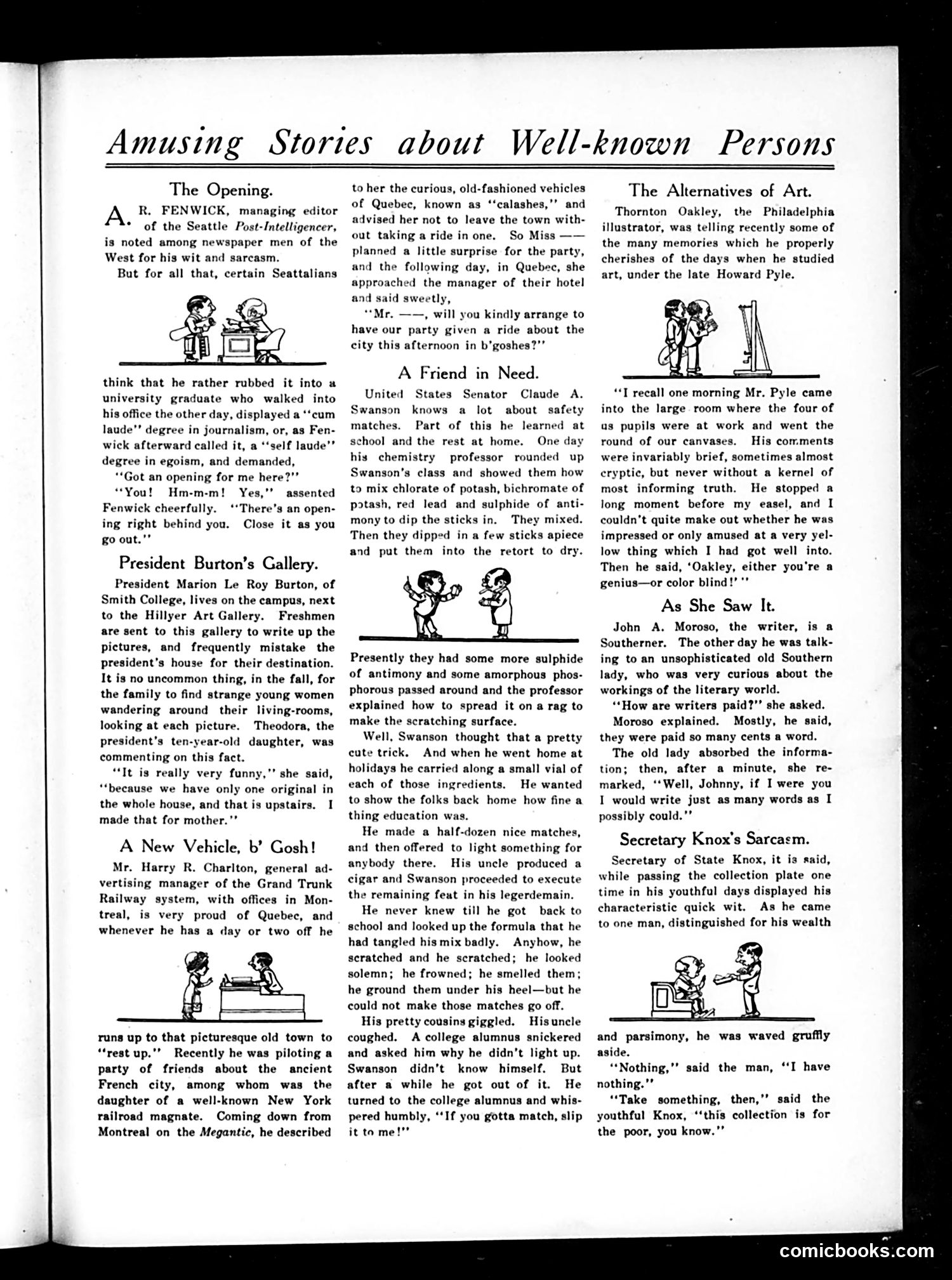
This page collects four anecdotes about prominent early-20th-century figures, presented as humorous "amusing stories": 1. **A.R. Fenwick** (Seattle Post-Intelligencer editor): Dismisses a presumptuous journalism graduate with a cutting remark about an "opening" behind him—a joke on his arrogance. 2. **President Marion Le Roy Burton** (Smith College): His ten-year-old daughter notes the family's only original artwork is her own—gentle satire of academic pretension. 3. **Harry R. Charlton** (Grand Trunk Railway): A woman mishears "calashes" (Quebec carriages) as "b'goshes"—wordplay humor on regional dialect. 4. **Senator Claude A. Swanson**: His homemade safety matches (made from chemistry-class formulas) fail spectacularly in front of family—humorous incompetence despite education. The satire targets professional vanity, academic stuffiness, and the gap between theoretical knowledge and practical competence. The illustrations are small comic vignettes accompanying each story.
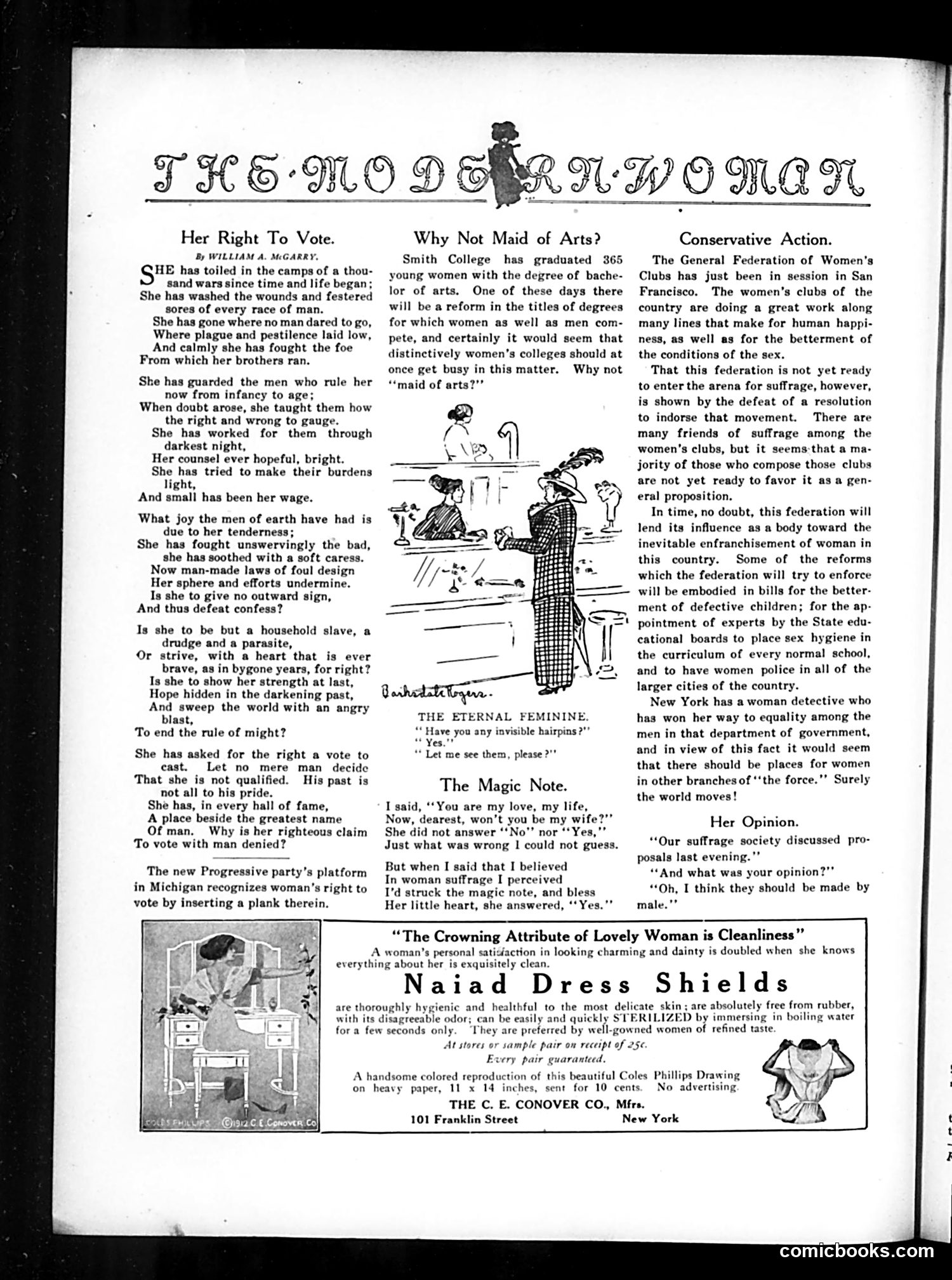
This page presents competing perspectives on women's rights, centered on **women's suffrage**—the right to vote, which women didn't have federally until 1920. **"Her Right to Vote"** (left column) is a pro-suffrage poem arguing women deserve voting rights based on their historical contributions to society—nursing, caregiving, moral guidance. The rhetoric emphasizes women's sacrifices and competence. **"Why Not Maid of Arts?"** notes Smith College graduates women with "bachelor of arts" degrees, questioning why women's colleges don't use distinctively feminine titles like "maid of arts"—a tongue-in-cheek jab at gender discrimination in academia. **"The Magic Note"** is a humorous sketch: a man's marriage proposal fails until he mentions supporting **women's suffrage**, which magically wins the woman's heart—satirizing how suffrage had become a passionate political issue. **"Conservative Action"** reports that the General Federation of Women's Clubs defeated a pro-suffrage resolution, showing even organized women weren't unanimously supporting voting rights. The advertisements below (dress shields, hairpins) reinforce period assumptions about women's domestic roles, contrasting sharply with the political arguments above.
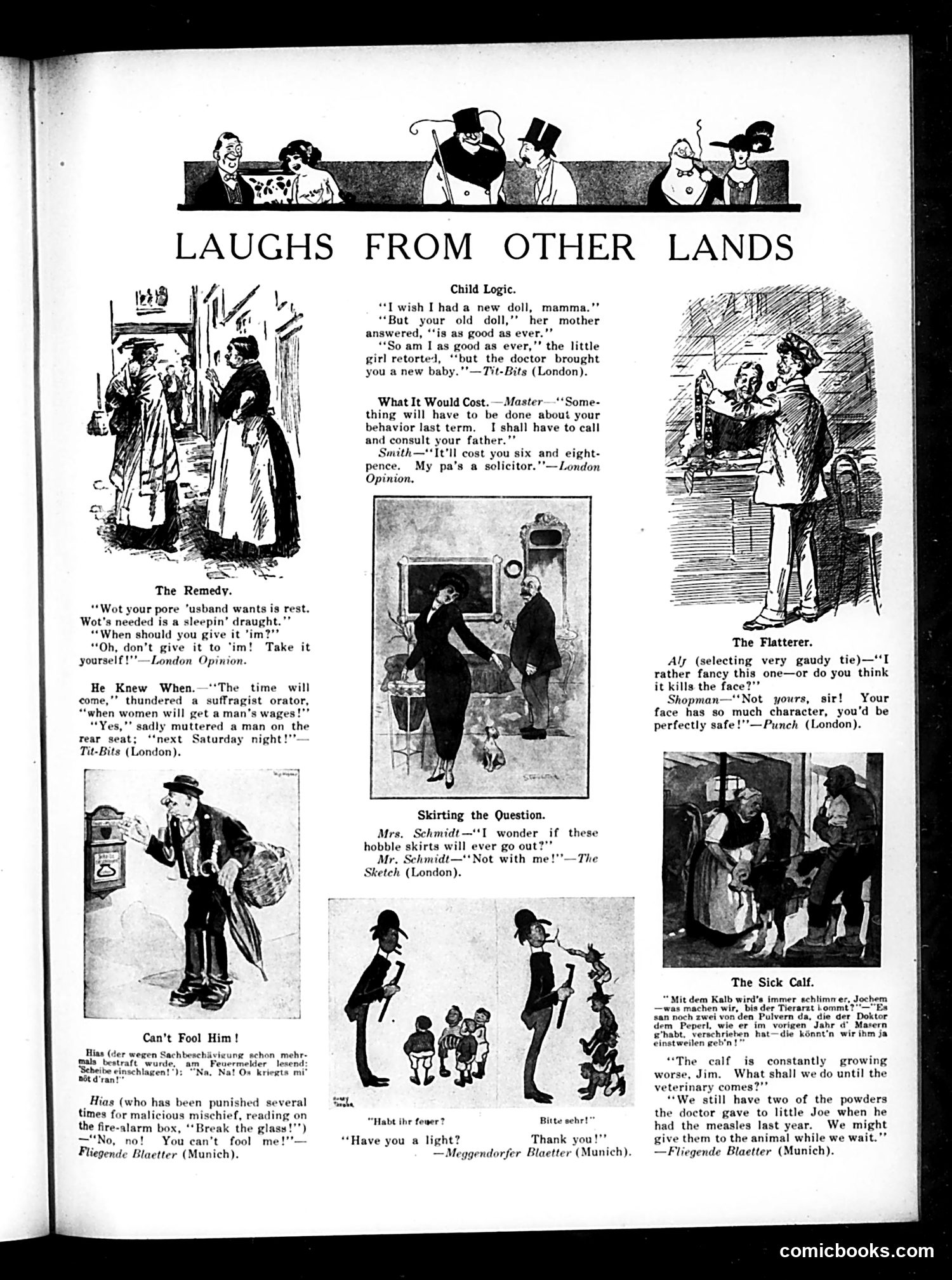
This page collects brief humorous anecdotes from international publications, reflecting early 20th-century social attitudes. The jokes target recognizable figures and situations: **Key themes:** - **Child logic**: A girl's innocent comparison of herself to a new baby exposes parental hypocrisy - **Class satire**: A schoolboy threatens to charge his father (a solicitor) consultation fees—mocking both legal profession costs and entitled youth - **Gender roles**: A suffragist orator's prediction about equal wages is undercut by a man's joke about Saturday night payday—suggesting wives expect spending money - **Marriage mockery**: A wife is told to take her husband's sleeping draught herself, implying nagging wives cause his exhaustion - **Fashion**: A pun about women's skirts never going "out" (becoming unfashionable) The contributions come from British (*Punch*, *Tit-Bits*), German (*Fliegende Blaetter*), and other European humor magazines, showing Judge's international scope. Humor relies on domestic situations, class consciousness, and contemporary anxieties about suffrage and marital discord.
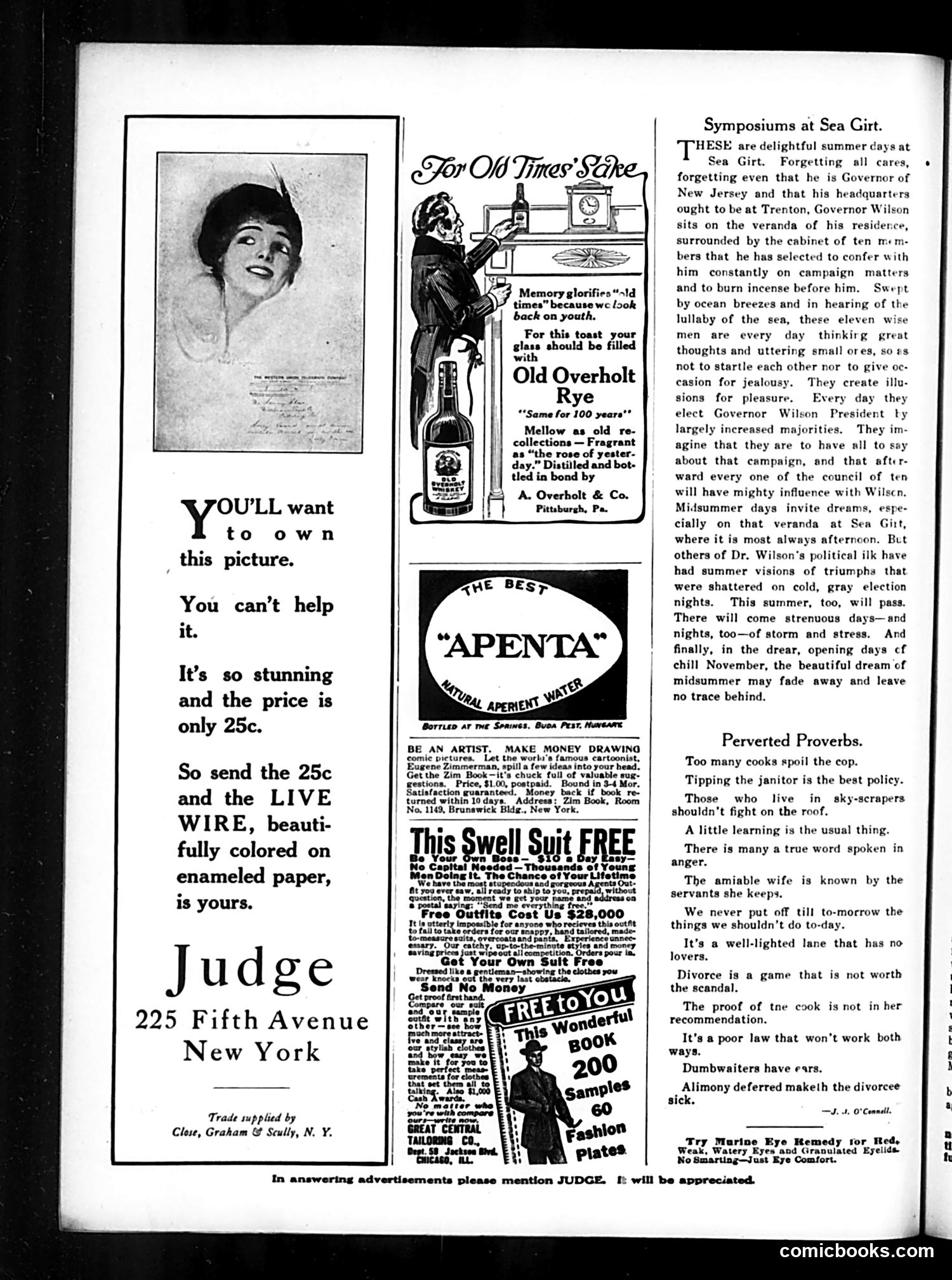
This article satirizes Governor Woodrow Wilson of New Jersey, who is spending summer at Sea Girt surrounded by ten advisors. The piece mocks the self-delusional "symposiums" occurring on his veranda—where these men imagine they'll have tremendous influence over Wilson's political campaign and presidency. The satire is cutting: these advisors create "illusions for pleasure," imagining "largely increased majorities" and future power, oblivious that their summer dreams will likely shatter like those of previous politicians on cold election nights. The author suggests November will bring harsh reality, and their influence will prove ephemeral. This appears to reference Wilson's 1912 presidential campaign, lampooning both his advisory circle's inflated self-importance and the gap between political ambition and electoral outcome.
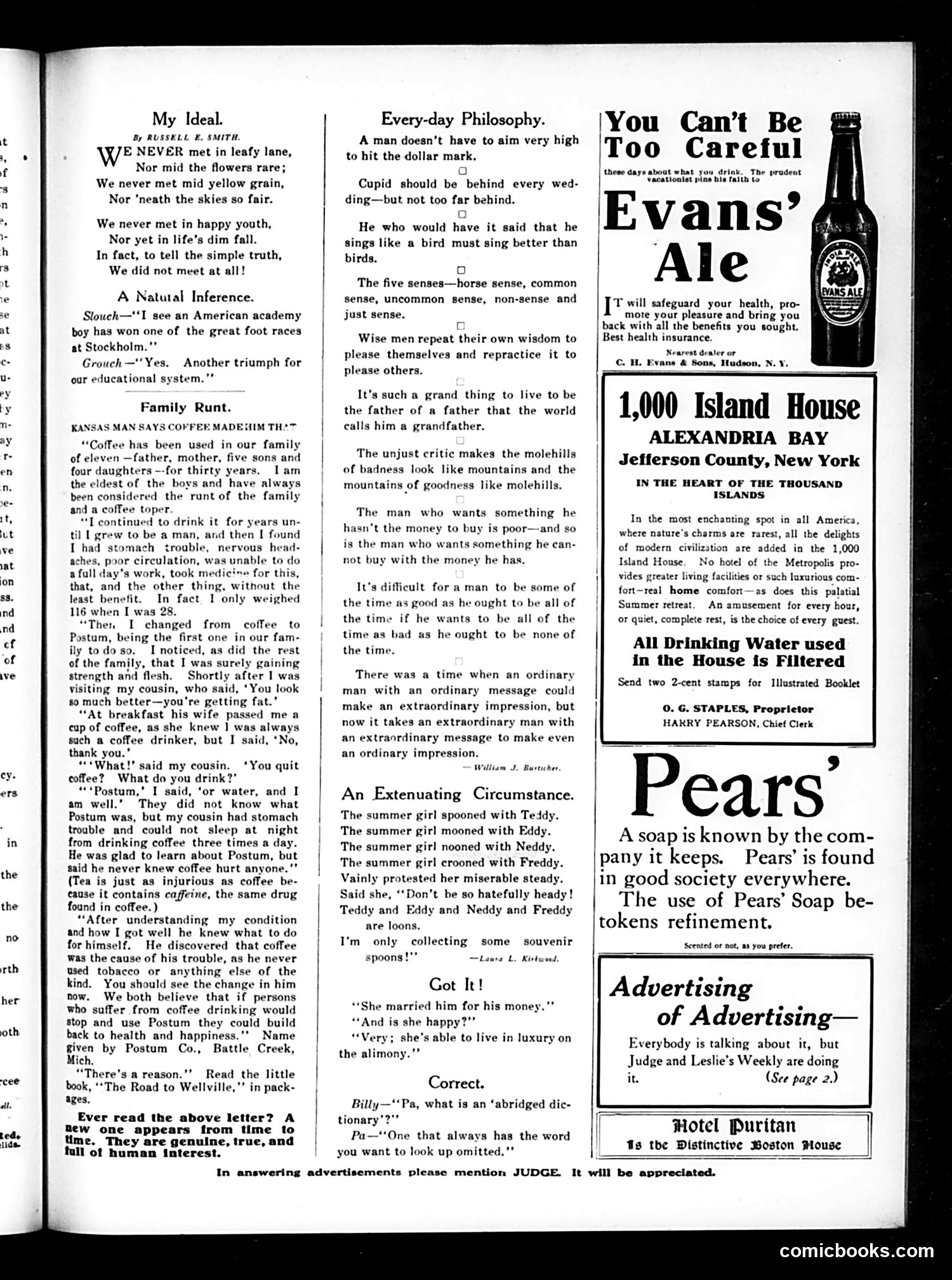
This page is primarily **advertisements and light humor columns** rather than political cartoons. The content includes: 1. **Poetry/Humor sections** ("My Ideal," "A Natural Inference," "Family Runt") — gentle, non-political jokes about everyday life and relationships 2. **A Postum coffee advertisement** disguised as a testimonial letter from a Kansas man claiming coffee caused him health problems (stomach trouble, nervousness, poor circulation) until he switched to Postum, a caffeine-free coffee substitute. This reflects early 1900s marketing tactics using pseudo-scientific health claims. 3. **"Every-day Philosophy"** — pithy aphorisms about human nature and morality 4. **Product advertisements** for Evans' Ale, Island House resort, Pears' Soap, and Hotel Puritan The page contains **no significant political satire or caricature**. It represents typical Judge magazine filler: light entertainment mixed with period advertisements making dubious health and lifestyle claims now recognizable as early 20th-century marketing hokum.
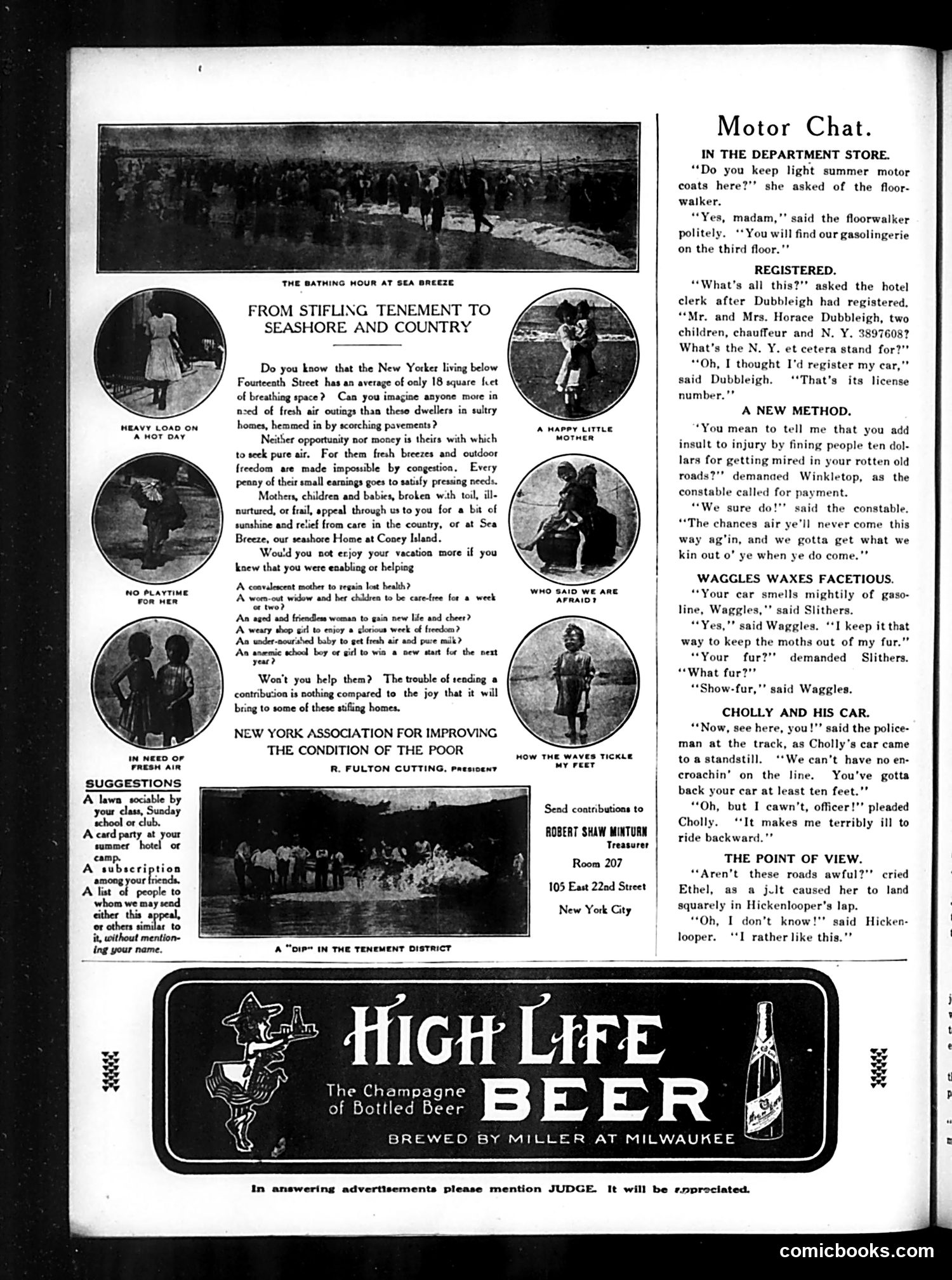
This page from *Judge* magazine contains two distinct sections: **Upper half:** A serious charitable appeal by the New York Association for Improving the Condition of the Poor. The photographs document tenement dwellers—mothers, children, and the elderly—living in overcrowded, poorly ventilated housing on Manhattan's Lower East Side (below Fourteenth Street). The text emphasizes their 18 square feet of breathing space per person and appeals for donations to send them to Sea Breeze, a seaside relief home at Coney Island. This reflects Progressive Era concerns about urban poverty. **Lower half:** A series of humorous automobile vignettes mocking early motorcar culture—newly wealthy drivers registering their cars like children, paying "road fines" to rural officials, the smell of gasoline, and backwards-driving discomfort. The satire targets affluent motorists as absurd and self-important. **Notably:** The juxtaposition is jarring—serious poverty advocacy adjacent to jokes about wealthy car owners' frivolities, reflecting class tensions in 1910s America.
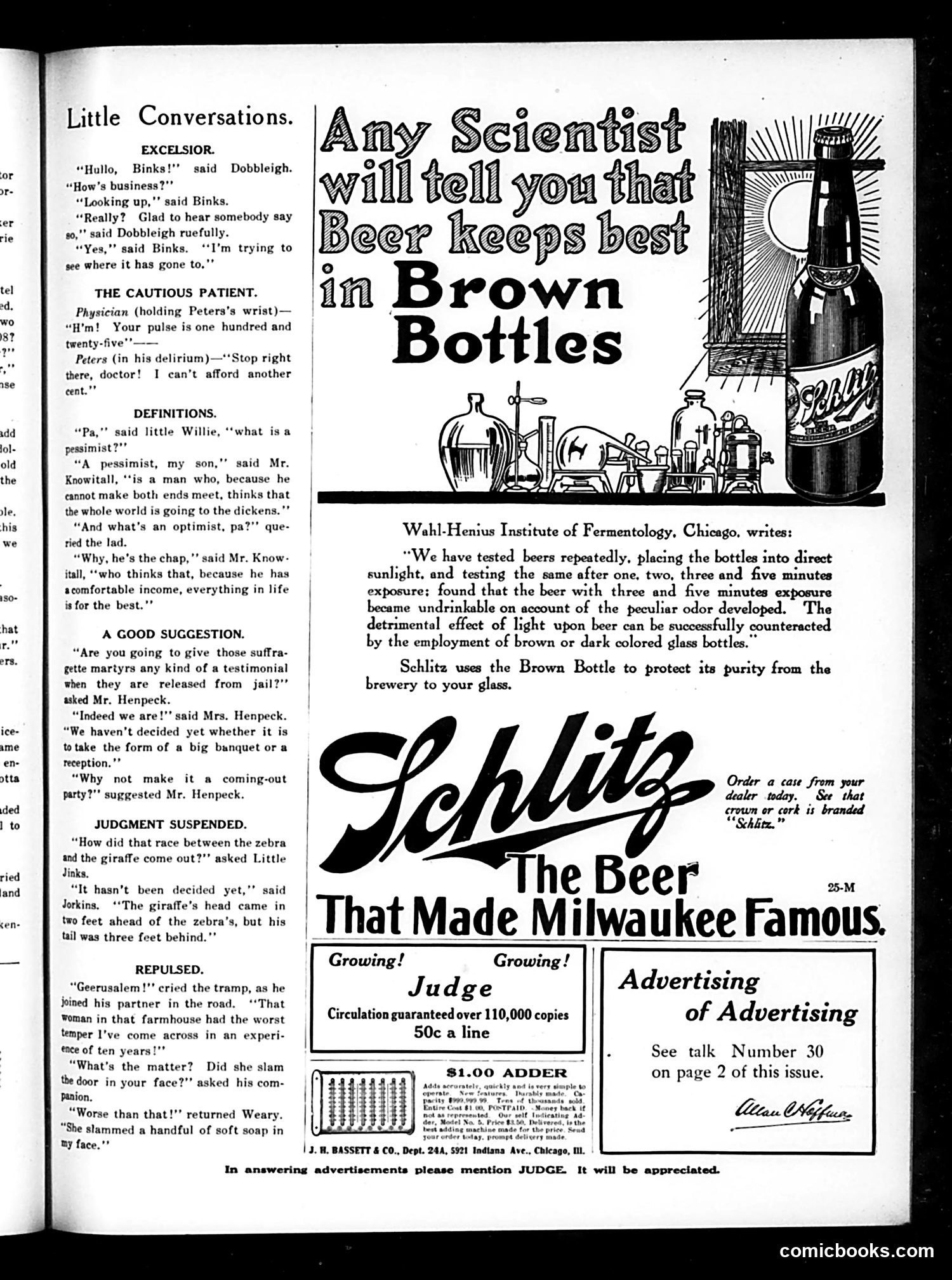
This page is primarily **advertising**, dominated by a large Schlitz beer advertisement claiming brown bottles protect beer from light damage. The ad cites the "Wahl-Henius Institute of Fermentology" asserting that direct sunlight makes beer undrinkable within minutes, positioning brown bottles as the solution. The left column contains brief satirical humor pieces typical of Judge magazine: - "Little Conversations" offering mild social jokes about optimists vs. pessimists - "The Cautious Patient" about medical costs - "A Good Suggestion" about suffragette martyrs (referencing early 20th-century women's voting rights activists) - Various short gags **The satire is gentle**: jokes about domestic life, a tramp's misadventures, and wordplay. Nothing here appears sharply political—it's general domestic humor. The beer advertisement dominates the page, using pseudoscientific authority to market product superiority. For modern readers: this reflects early 1900s advertising's heavy reliance on claimed "scientific" backing, however dubious.
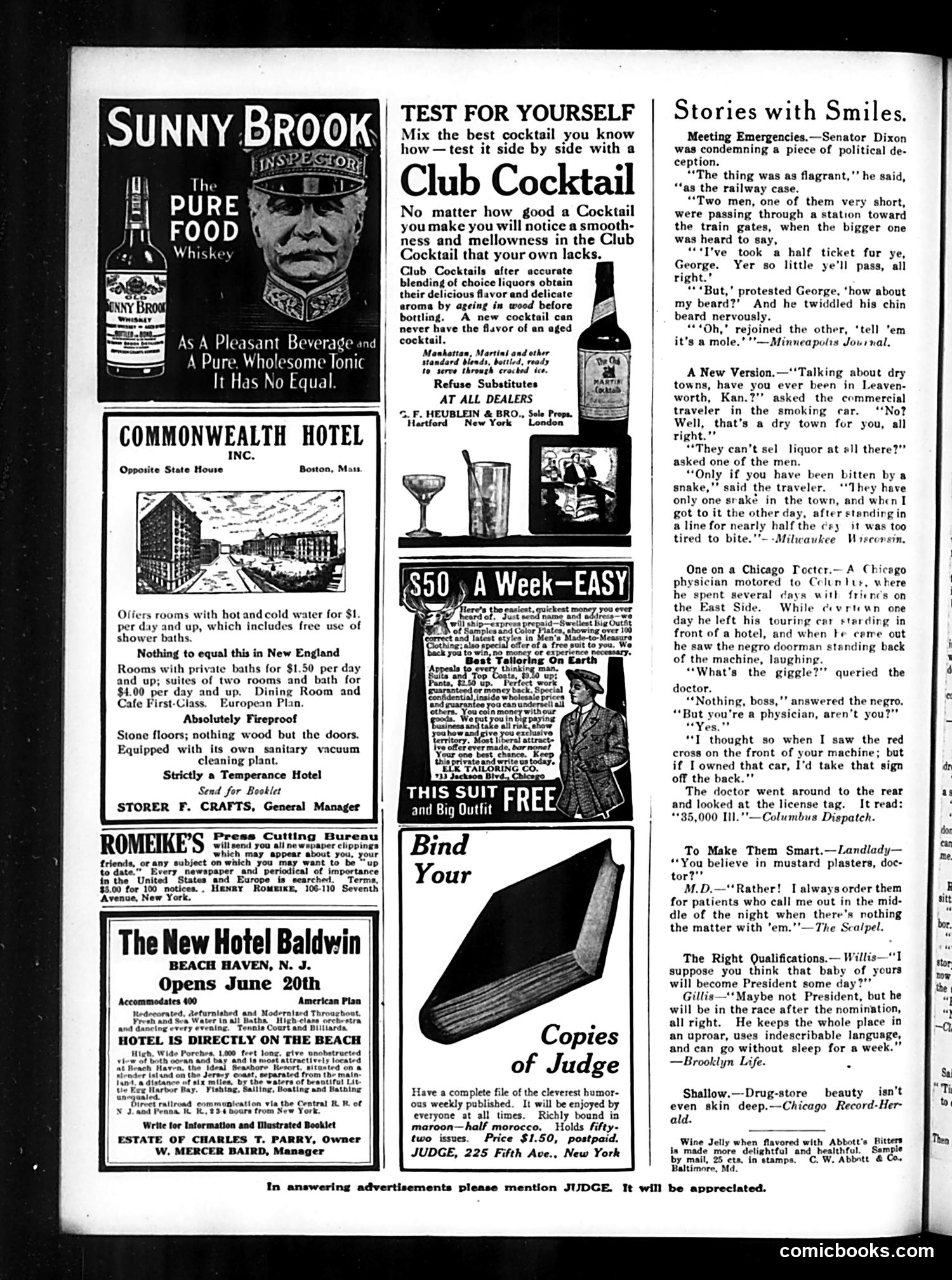
This page is primarily **advertisements and humor vignettes** from Judge magazine, not a political cartoon. The "Stories with Smiles" section contains three brief anecdotes meant to amuse readers: 1. **"Meeting Emergencies"**: A joke about a short man trying to pass as a child on a train ticket, claiming his beard is a "mole"—absurdist humor based on deception. 2. **"A New Version"**: A tall tale about an extremely dry Kansas town where liquor is only dispensable if you've been bitten by a snake—the town's single snake becomes so exhausted from people seeking bites that it can't perform. 3. **"One on a Chicago Doctor"**: Appears incomplete but suggests a physician's car mishap while visiting Columbus. The rest of the page consists of hotel and beverage advertisements typical of 1920s Judge. The humor relies on wordplay, exaggeration, and absurdist scenarios rather than political satire, reflecting the magazine's lighter content alongside its satirical cartoons.
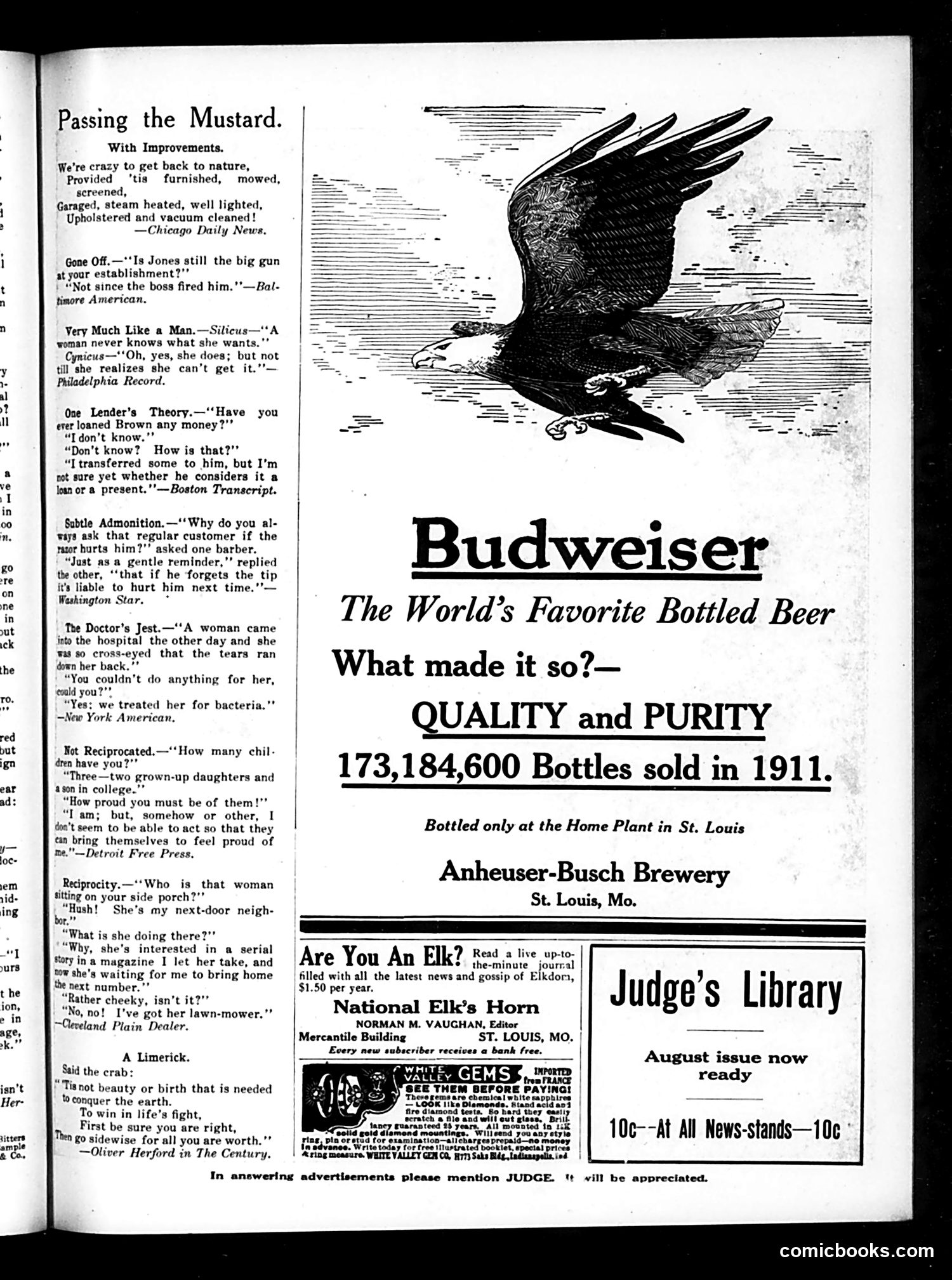
This page from *Judge* magazine consists primarily of **short humorous anecdotes** and **advertisements** rather than political cartoons. The left column contains brief jokes satirizing early 20th-century American life: a quip about returning to "nature" with modern conveniences (poking fun at the "back-to-nature" movement); workplace dynamics; gender relations ("A woman never knows what she wants"); lending practices; and barber-shop etiquette. These represent mild social observations typical of *Judge's* humor—gentle ribbing of everyday absurdities rather than sharp political critique. The dominant image is a **bald eagle**, accompanying a large **Budweiser beer advertisement** claiming 173,184,600 bottles sold in 1911—using patriotic symbolism to market the product. The page also advertises *Judge's* August issue, the *National Elk's Horn* publication, and *White Valley Gems* jewelry. The overall content reflects *Judge's* mix of light satirical commentary on American manners and commercial advertising, aimed at middle-class readers.
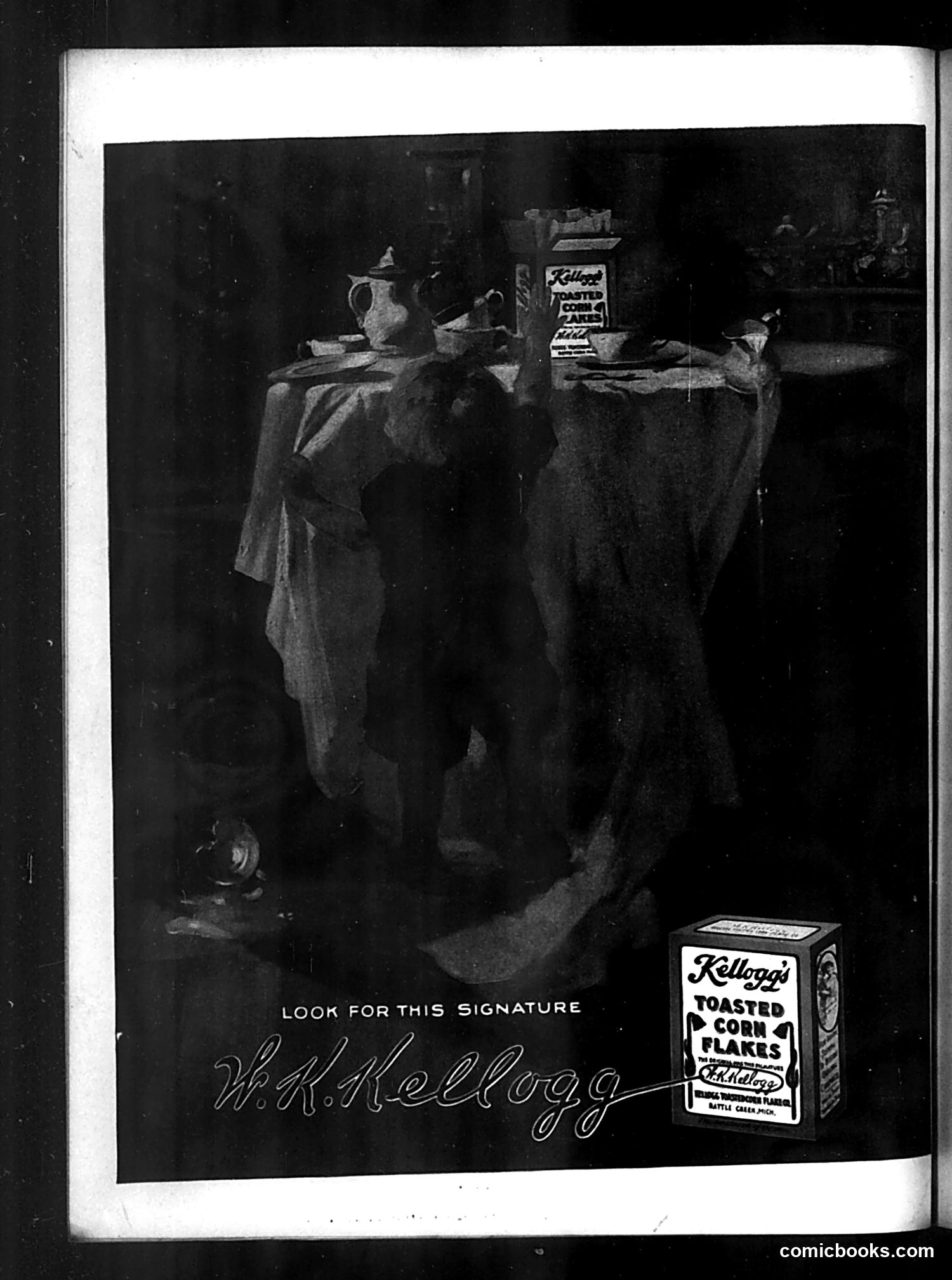
This page is primarily a **Kellogg's advertisement** for Toasted Corn Flakes, not a political cartoon. The image shows a still life with a pitcher, bowl, and other tableware arranged on draped cloth, with a Kellogg's cereal box prominently displayed in the lower right. The advertisement's message is straightforward product promotion: consumers should identify genuine Kellogg's cereal by looking for W.K. Kellogg's signature on the box packaging. This serves as a brand authentication device—assuring buyers they're purchasing the legitimate product rather than an imitation. The theatrical lighting and formal composition suggest this was meant as a prestige advertisement aimed at middle-class households, emphasizing quality and authenticity as selling points for the relatively new commercial breakfast cereal market.