
Judge, 1912-08-10 · page 15 of 24
Judge — August 10, 1912 — page 15: what you’re looking at
What you’re looking at
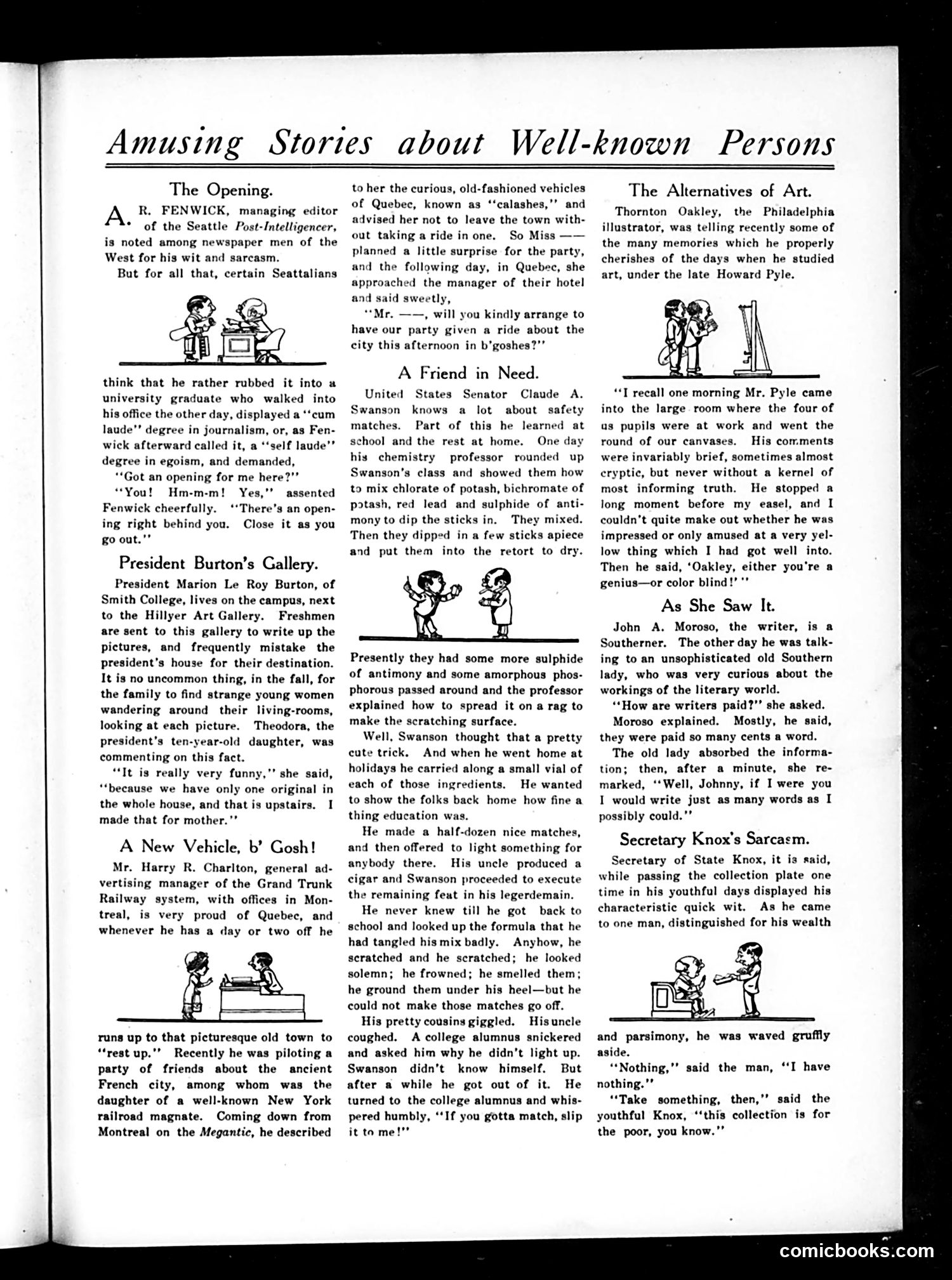
This page collects four anecdotes about prominent early-20th-century figures, presented as humorous "amusing stories": 1. **A.R. Fenwick** (Seattle Post-Intelligencer editor): Dismisses a presumptuous journalism graduate with a cutting remark about an "opening" behind him—a joke on his arrogance. 2. **President Marion Le Roy Burton** (Smith College): His ten-year-old daughter notes the family's only original artwork is her own—gentle satire of academic pretension. 3. **Harry R. Charlton** (Grand Trunk Railway): A woman mishears "calashes" (Quebec carriages) as "b'goshes"—wordplay humor on regional dialect. 4. **Senator Claude A. Swanson**: His homemade safety matches (made from chemistry-class formulas) fail spectacularly in front of family—humorous incompetence despite education. The satire targets professional vanity, academic stuffiness, and the gap between theoretical knowledge and practical competence. The illustrations are small comic vignettes accompanying each story.
📄 Transcribed text from this page (OCR, searchable)
Machine-transcribed from the original scan — historical spelling and the odd misread are preserved.
Amusing Stories about Well-known Persons The Opening. A, ® FENWICK, managing editor * of the Seattle Post-Intelligencer, is noted among newspaper men of the West for his wit and sarcasm, But for all that, certain Seattalians think that he rather rubbed it into a university graduate who walked into his office the other day, displayed a ‘‘cum laude’’ degree in journalism, or, as Fen- wick afterward called it, a ‘‘self laude’’ degree in egoism, and demanded, ‘‘Got an opening for me here?” “You! Hm-m-m! Yes,’ assented Fenwick cheerfully. ‘There's an open- ing right behind you. Close it as you go out."” President Burton’s Gallery. President Marion Le Roy Burton, of Smith College, lives on the campus, next to the Hillyer Art Gallery. Freshmen are sent to this gallery to write up the pictures, and frequently mistake the president's house for their destination. It is no uncommon thing, in the fall, for the family to find strange young women wandering around their living-rooms, looking at each picture. Theodora, the president's ten-year-old daughter, was commenting on this fact. “It is really very funny,’’ she said, ‘because we have only one original in the whole house, and that is upstairs. I made that for mother."’ A New Vehicle, b’ Gosh! Mr. Harry R. Charlton, general ad- vertising manager of the Grand Trunk Railway system, with offices in Mon- treal, is very proud of Quebec, and whenever he has a day or two off he runs up to that picturesque old town to “rest up.’ Recently he was piloting a party of friends about the ancient French city, among whom was the daughter of a well-known New York railroad magnate. Coming down from Montreal on the Megantic, he described to her the curious, old-fashioned vehicles of Quebec, known as ‘‘calashes,’’ and advised her not to leave the town with- out taking a ride in one. So Miss —— planned a little surprise for the party, and the following day, in Quebec, she approached the manager of their hotel and said sweetly, **Mr. ——, will you kindly arrange to have our party given a ride about the city this afternoon in b’goshes?’’ A Friend in Need. United States Senator Claude A. Swanson knows a lot about safety matches. Part of this he learned at school and the rest at home. One day his chemistry professor rounded up Swanson’s class and showed them how to mix chlorate of potash, bichromate of potash, red lead and sulphide of anti- mony to dip the sticks in. They mixed. Then they dipped in a few sticks apiece and put them into the retort to dry. Presently they had some more sulphide of antimony and some amorphous phos- phorous passed around and the professor explained how to spread it on a rag to make the scratching surface. Well, Swanson thought that a pretty cute trick. And when he went home at holidays he carried along a small vial of each of those ingredients. He wanted to show the folks back home how fine a thing education was. He made a half-dozen nice matches, and then offered to light something for anybody there. His uncle produced a cigar and Swanson proceeded to execute the remaining feat in his legerdemain. He never knew till he got back to school and looked up the formula that he had tangled his mix badly. Anyhow, he scratched and he scratched; he looked solemn; he frowned; he smelled them; he ground them under his heel—but he could not make those matches go off. His pretty cousins giggled. Hisuncle coughed. A college alumnus snickered and asked him why he didn’t light up. Swanson didn’t know himself. But after a while he got out of it. He turned to the college alumnus and whis- pered humbly, “If you gotta match, slip it tome!” The Alternatives of Art. Thornton Oakley, the Philadelphia illustrator, was telling recently some of the many memories which he properly cherishes of the days when he studied art, under the late Howard Pyle. “T recall one morning Mr. Pyle came into the large room where the four of as pupils were at work and went the round of our canvases. His comments were invariably brief, sometimes almost cryptic, but never without a kernel of most informing truth. He stopped a long moment before my easel, and I couldn’t quite make out whether he was impressed or only amused at a very yel- low thing which I had got well into. Then he said, ‘Oakley, either you're a genius—or color blind!’ "* As She Saw It. John A. Moroso, the writer, is a Southerner. The other day he was talk- ing to an unsophisticated old Southern lady, who was very curious about the workings of the literary world. “How are writers paid?”’ she asked. Moroso explained. Mostly, he sai they were paid so many cents a word. The old lady absorbed the informa- tion; then, after a minute, she re- marked, ‘*Well, Johnny, if I were you I would write just as many words as I possibly could.’” Secretary Knox's Sarcasm. Secretary of State Knox, it is said, while passing the collection plate one time in his youthful days displayed his characteristic quick wit. As he came to one man, distinguished for his wealth and parsimony, he was waved gruffly aside. “*Nothing,’’ said the man, ‘I have nothing.’” “Take something, then,’’ said the youthful Knox, ‘‘this collection is for the poor, you know.’” comicbooks:com