
Judge, 1912-08-10 · page 5 of 24
Judge — August 10, 1912 — page 5: what you’re looking at
What you’re looking at
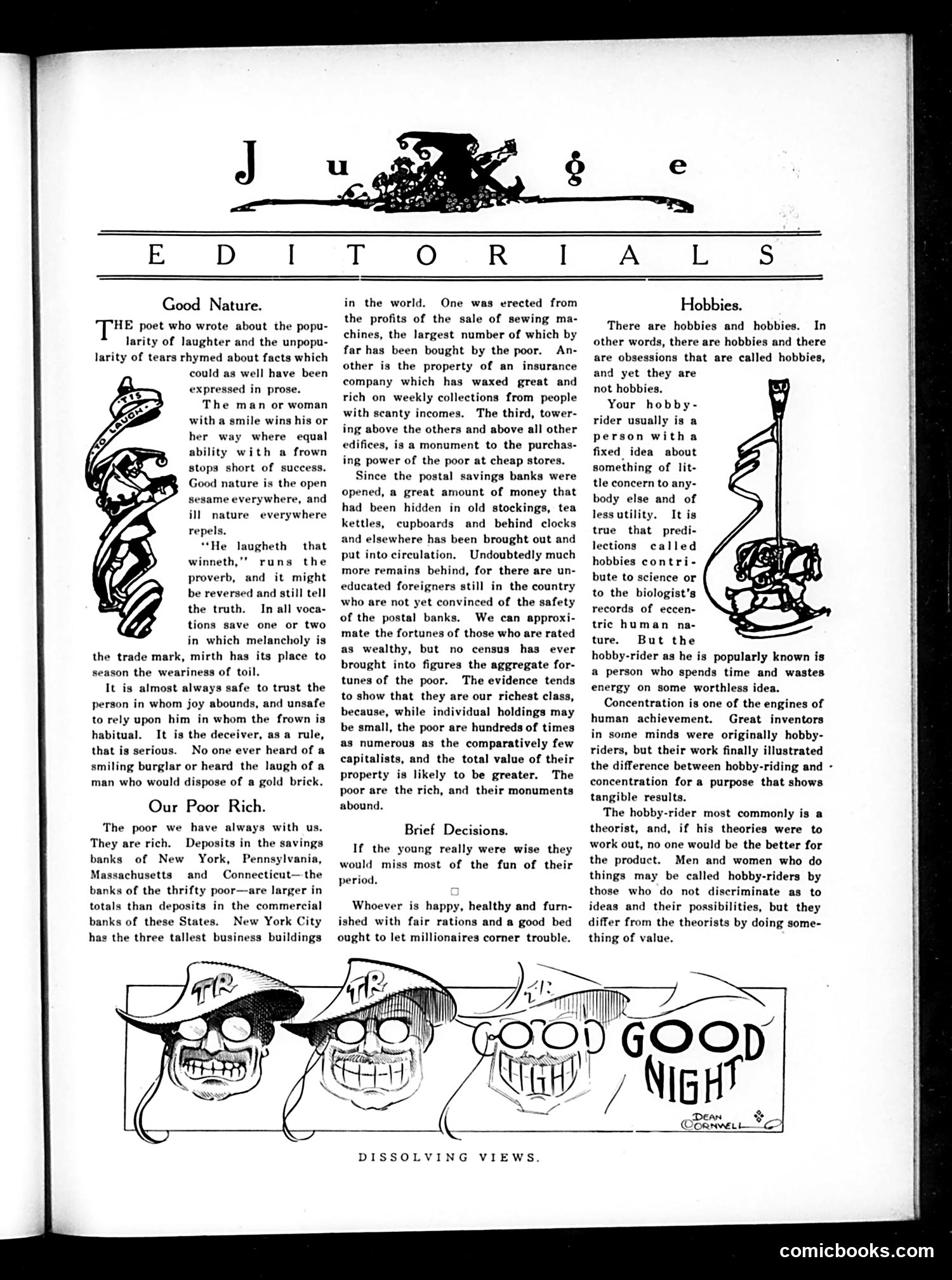
This page combines three distinct editorial pieces on wealth and social class: 1. **"Good Nature"** (left column): Argues that laughter and tears about poverty are better expressed in prose than poetry, using a decorative initial letter. 2. **"Of Poor Rich"** (center): Satirizes wealthy people's ignorance of their own poverty levels. It notes that postal savings banks hold more deposits than commercial banks—evidence that poor Americans are wealthier collectively than the rich realize. 3. **"Hobbies"** (right): Distinguishes between hobbyists (serious practitioners) and "hobby-riders" (dilettantes who waste energy on worthless pursuits). The bottom cartoon, **"Dissolving Views,"** shows three nearly-identical faces progressively losing detail, labeled "GOOD NIGHT"—likely satirizing people whose ideas or convictions gradually fade away. The overall theme critiques both class misconceptions and intellectual superficiality.
📄 Transcribed text from this page (OCR, searchable)
Machine-transcribed from the original scan — historical spelling and the odd misread are preserved.
E D Good Nature. THe poet who wrote about the popu- larity of laughter and the unpopu- larity of tears rhymed about facts which could as well have been expressed in prose. The man or woman with a smile wins his or her way where equal ability with a frown stops short of success. Good nature is the open sesame everywhere, and ill nature repels. “*He laugheth that winneth,"” runs the proverb, and it might be reversed and still tell the truth. In all voca- tions save one or two in which melancholy is the trade mark, mirth has its place to season the weariness of toil. It is almost always safe to trust the person in whom joy abounds, and unsafe to rely upon him in whom the frown is habitual. It is the deceiver, as a rule, that is serious. No one ever heard of a smiling burglar or heard the laugh of a man who would dispose of a gold brick. Our Poor Rich. The poor we have always with us. They are rich. Deposits in the savings banks of New York, Pennsylvania, Massachusetts and Connecticut—the banks of the thrifty poor—are larger in totals than deposits in the commercial banks of these States. New York City has the three tallest business buildings everywhere in the world. One was erected from the profits of the sale of sewing ma- chines, the largest number of which by far has been bought by the poor. An- other is the property of an insurance company which has waxed great and rich on weekly collections from people with scanty incomes. The third, tower- ing above the others and above all other edifices, is a monument to the purchas- ing power of the poor at cheap stores. Since the postal savings banks were opened, a great amount of money that had been hidden in old stockings, tea kettles, cupboards and behind clocks and elsewhere has been brought out and put into circulation. Undoubtedly much more remains behind, for there are un- educated foreigners still in the country who are not yet convinced of the safety of the postal banks. We can approxi- mate the fortunes of those who are rated as wealthy, but no census has ever brought into figures the aggregate for- tunes of the poor. The evidence tends to show that they are our richest class, because, while individual holdings may be small, the poor are hundreds of times as numerous as the comparatively few capitalists, and the total value of their property is likely to be greater. The poor are the rich, and their monuments abound. Brief Decisions. If the young really were wise they would miss most of the fun of their period. Whoever is happy, healthy and furn- ished with fair rations and a good bed ought to let millionaires corner trouble. Hobbies. There are hobbies and hobbies. In other words, there are hobbies and there are obsessions that are called hobbies, and yet they are not hobbies. Your hobby- rider usually is a person witha fixed idea about something of lit- tle concern to any- body else and of less utility. It is true that predi- lections called hobbies contri- bute to science or to the biologist’s records of eccen- tric human na- ture. But the hobby-rider as he is popularly known is a person who spends time and wastes energy on some worthless idea. Concentration is one of the engines of human achievement. Great inventors in some minds were originally hobby- riders, but their work finally illustrated the difference between hobby-riding and concentration for a purpose that shows tangible results. The hobby-rider most commonly is a theorist, and, if his theories were to work out, no one would be the better for the product. Men and women who do things may be called hobby-riders by those who do not discriminate as to ideas and their possibilities, but they differ from the theorists by doing some- thing of value. La Uy Oop NigH? Dean 2. Cornwerr 6 DISSOLVING VIEWS. comicbooks.com