
A complete issue · 26 pages · 1912
Judge — August 3, 1912
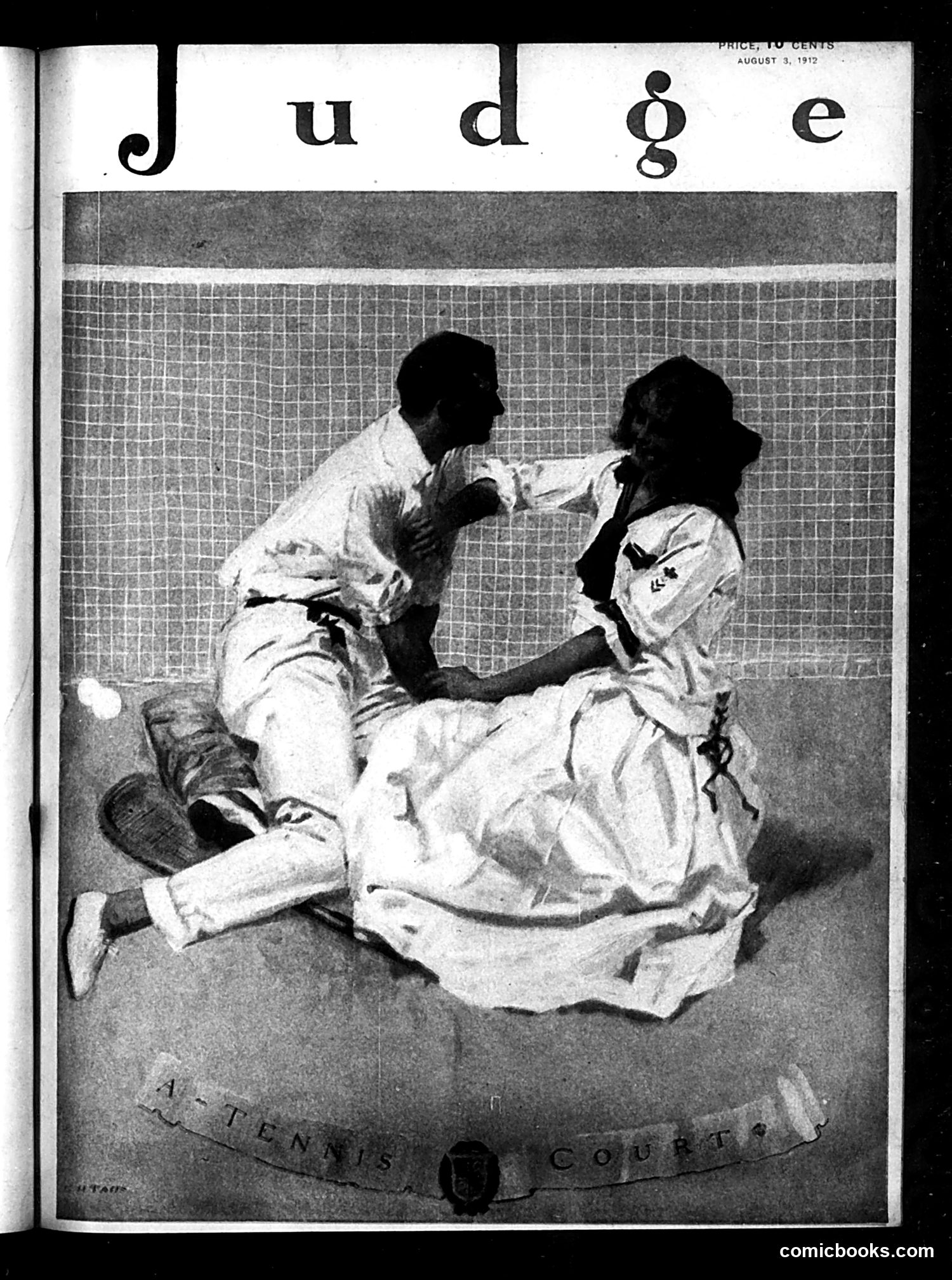
This is the cover of **Judge magazine** from August 3, 1912, priced at 10 cents. The image shows two figures in light clothing engaged in what appears to be a playful or flirtatious interaction on a tennis court (indicated by the net visible behind them and "TENNIS COURT" text at bottom). The satirical point likely comments on **social behavior or romance** in the context of early 1900s leisure activities. Tennis was a popular sport among the upper classes where men and women mingled socially—a somewhat progressive activity for the era. The intimate pose and casual setting may be satirizing evolving courtship customs or "modern" mixed-gender socializing that conservative readers might have found noteworthy or amusing. Without clearer identification of specific figures or accompanying article text, the precise political or social target remains unclear.
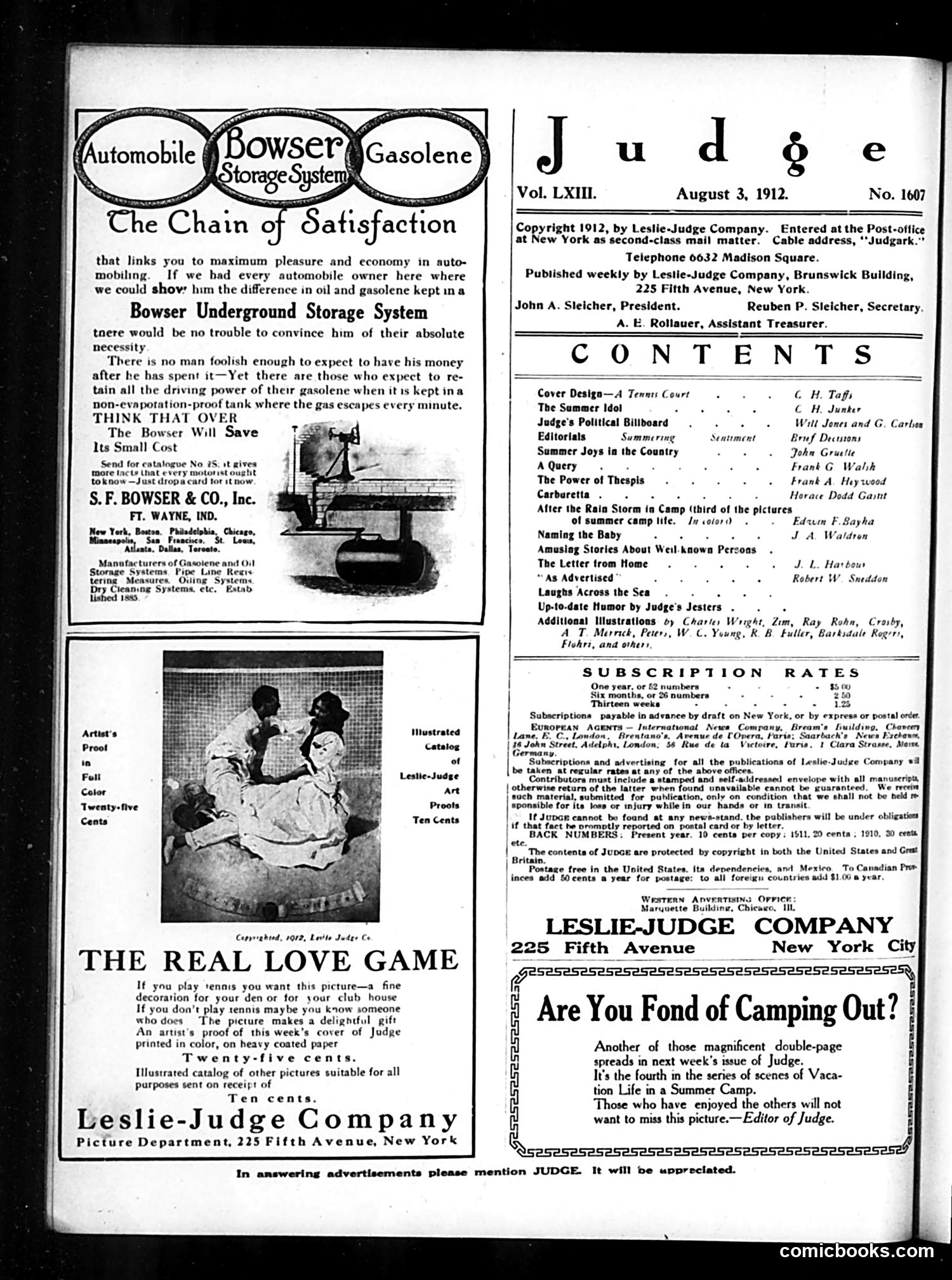
This page is primarily **advertising and table of contents**, not political satire. The main content includes: **Bowser Gasoline Storage System** ad: A commercial pitch claiming their underground storage prevents gasoline evaporation and maintains fuel quality—a practical concern for early automobiles. **"The Real Love Game"** section: Advertises a colored illustration of tennis players suitable for home decoration, sold by Leslie-Judge Company for ten cents. **Contents listing**: Features articles on summer activities, camping, and various illustrations by period artists. The page reflects **1912 consumer culture**: automobiles were still relatively new, camping was emerging as recreation, and illustrated magazines served as both entertainment and shopping catalogs. No clear political satire is evident on this particular page.
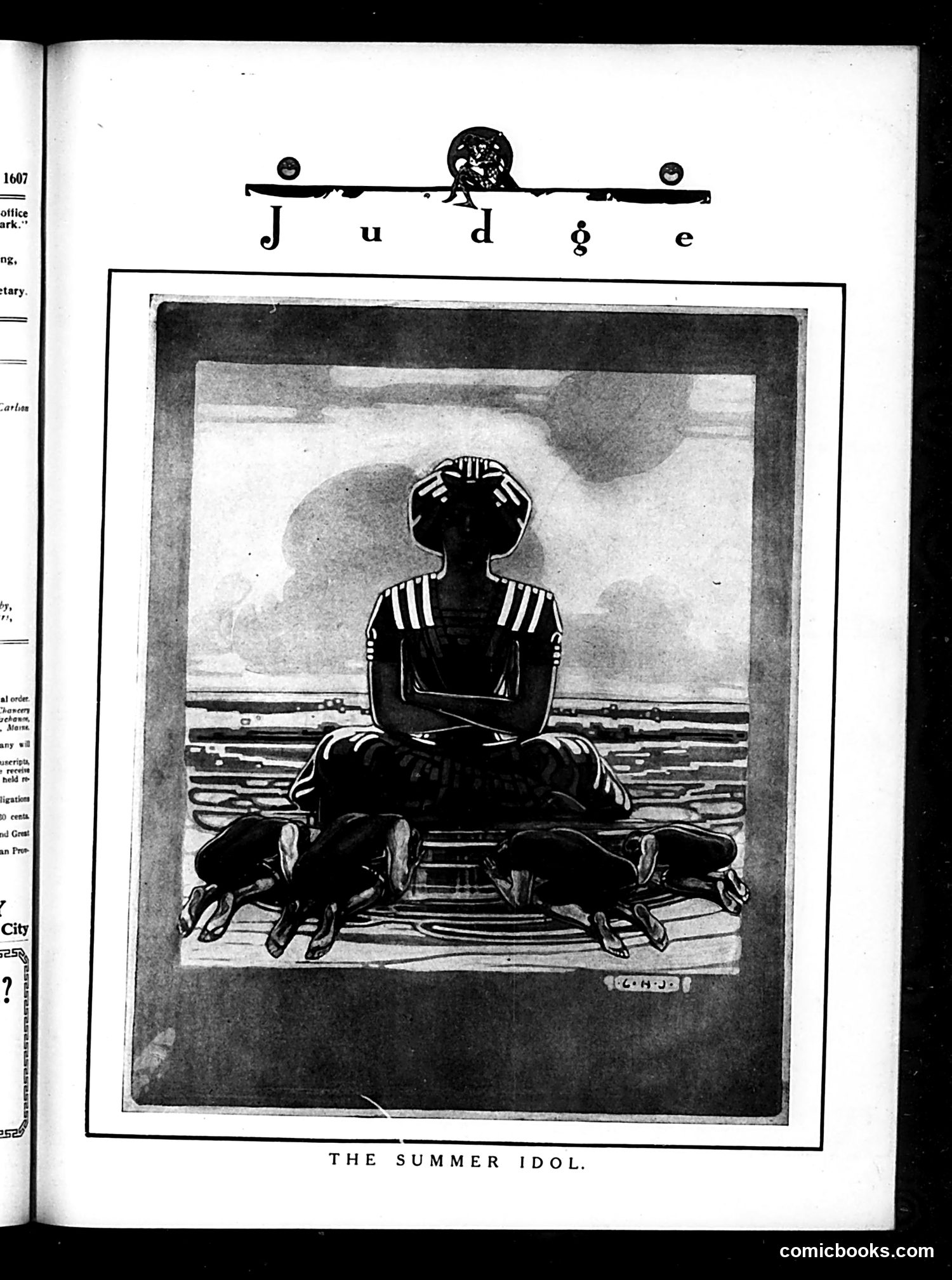
This cartoon satirizes the objectification of women during summer leisure season. The illustration depicts a fashionable woman in a sailor-themed outfit, seated and displayed prominently—literally positioned as an "idol" for public consumption. The three dogs at her feet appear to represent admirers or suitors fawning over her. The satire likely critiques how women, particularly in upper-class summer social settings, were treated as decorative objects of attraction rather than substantive individuals. The sailor outfit references fashionable seaside resort wear of the era. The title's use of "idol" suggests the shallow, superficial nature of summer social dynamics where appearance and display took precedence over character or intellect—a common target of Judge magazine's social commentary.
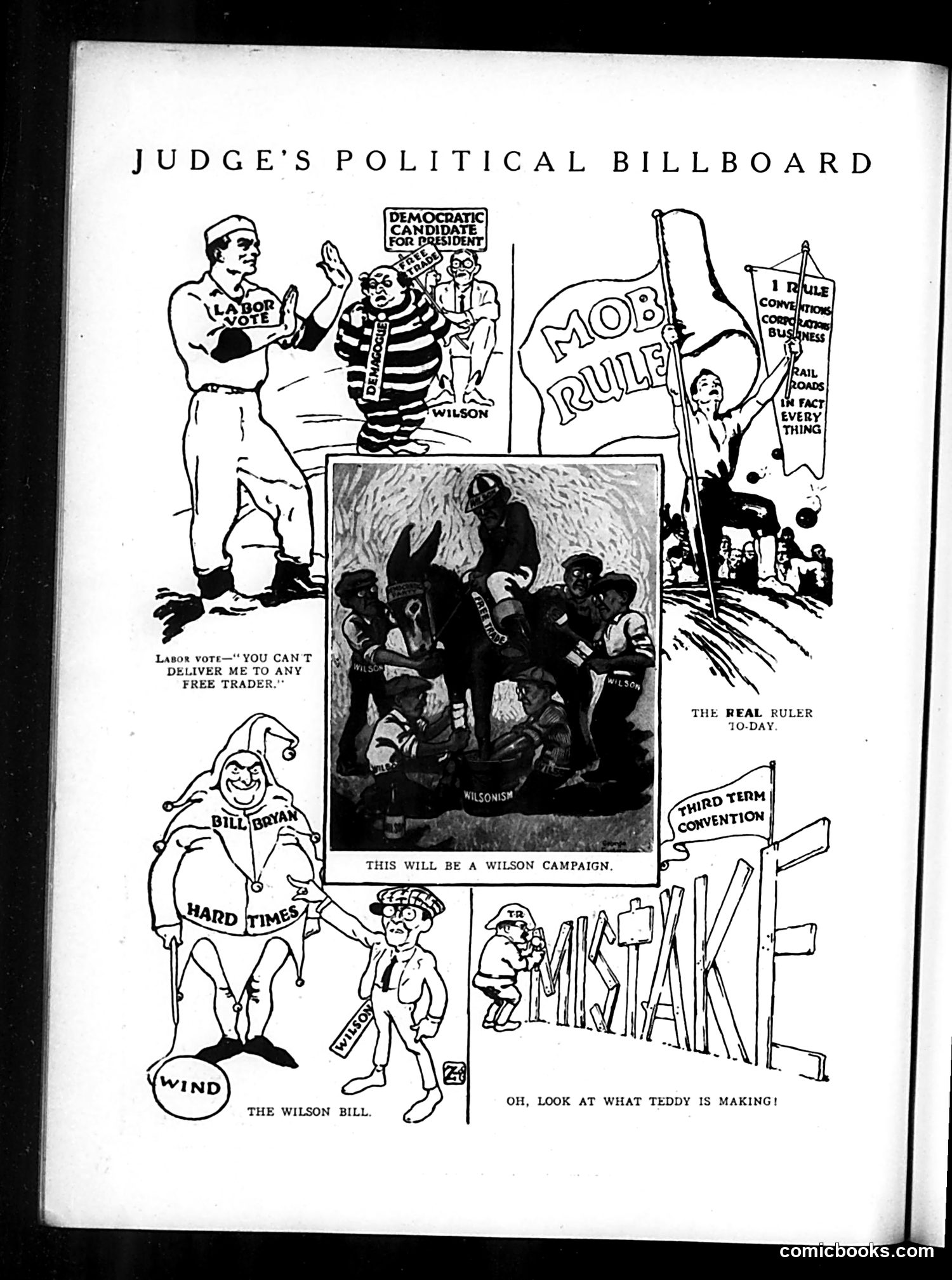
This 1912 political cartoon satirizes the U.S. presidential election, likely the three-way race between Wilson (Democrat), Taft (Republican incumbent), and Theodore Roosevelt (Progressive/"Bull Moose" candidate). **Key elements:** - **Top left**: Labor depicted as unable to be "delivered" to any candidate, suggesting worker skepticism - **Center**: "This will be a Wilson campaign" with crowds gathered - **"Mob Rule" billboard**: Critiques Roosevelt's populist appeal as dangerous mob control - **"Bill Bryan" figure with "Hard Times" and "Wind"**: References William Jennings Bryan, associating Democratic politics with economic hardship - **Bottom right**: "Oh, look at what Teddy is making!" suggests Roosevelt's influence destabilizing politics The cartoon expresses conservative skepticism toward progressive politics and Roosevelt's "bull moose" movement.
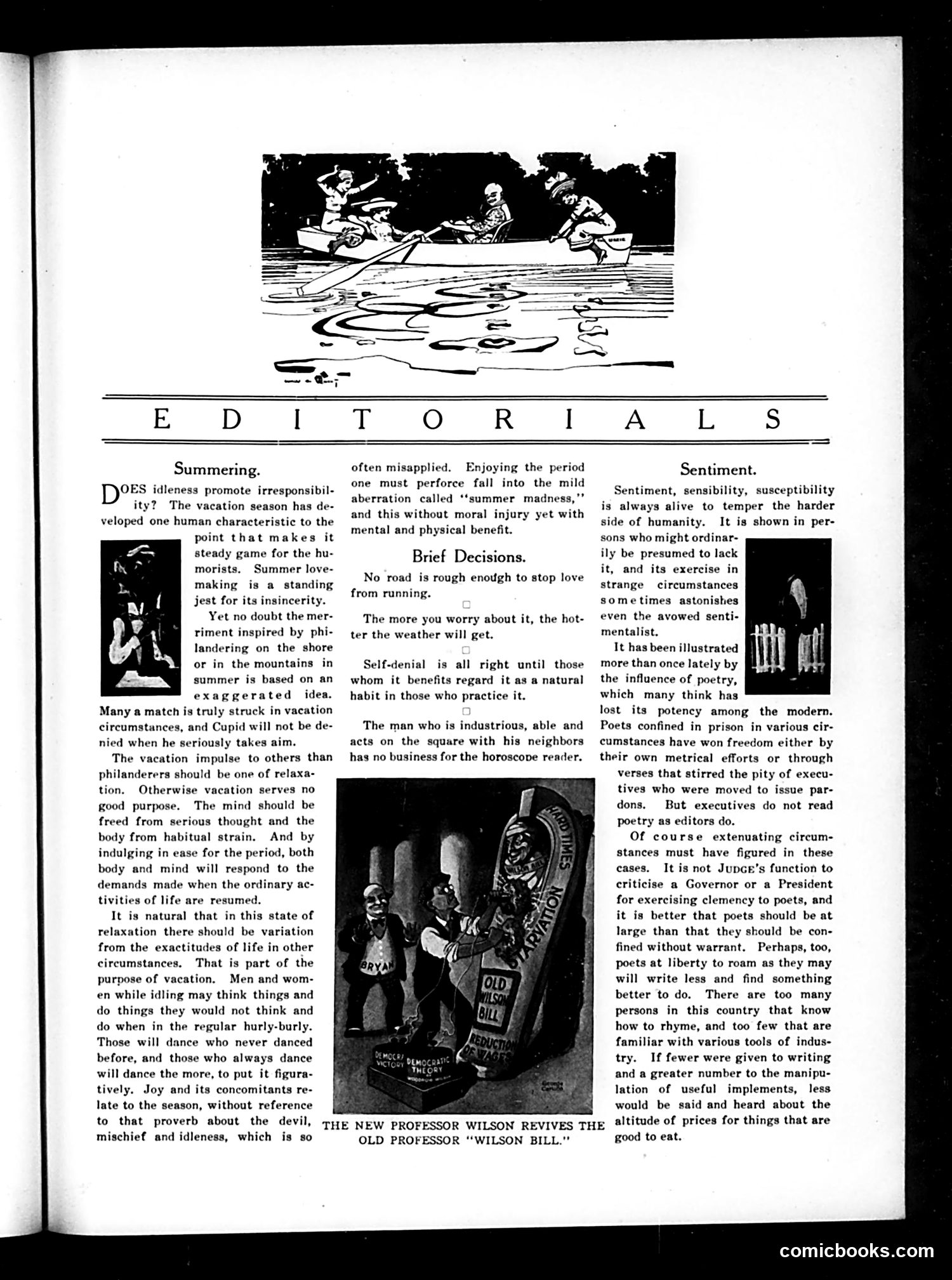
This editorial page contains three distinct sections: **Top illustration**: Shows people in boats on water, likely depicting summer leisure activities. **Left column ("Summering")**: Discusses vacation idleness and its moral implications, advocating for purposeful rest rather than mindless relaxation. **Center ("Brief Decisions")**: Short aphorisms about weather, self-interest, and industriousness. **Right column ("Sentiment")**: Critiques poets and poetry's declining influence in modern culture, arguing that too few people understand literary tools and that poets should have more freedom to write without institutional constraints. **Bottom illustration**: Labeled "The New Professor Wilson Revives the Old Professor 'Wilson Bill,'" depicting what appears to be a figure in period costume, likely a historical or political reference to someone named Wilson, though the specific context remains unclear without additional dating or historical context.
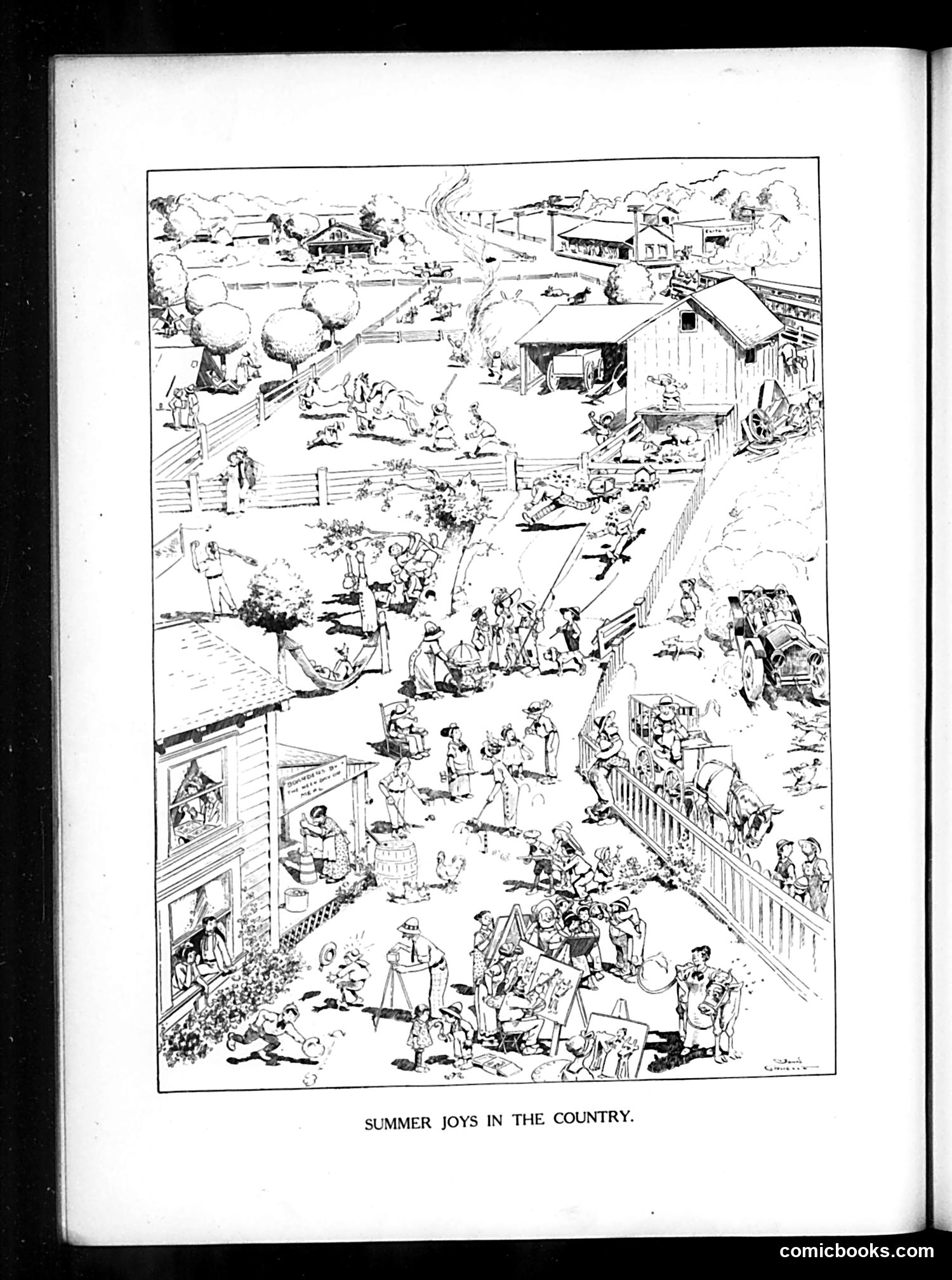
This Judge cartoon depicts a bustling rural farm scene during summer, showing various leisure and work activities. The detailed illustration captures multiple vignettes: children playing, families gathered around a table outdoors, people swimming or bathing, farm workers, and domestic animals. The satire appears gentle rather than sharp—it seems to present an idealized vision of country life with both its genuine pleasures (swimming, picnicking, family time) and its realities (chores, manual labor). The crowded composition emphasizes abundance of activity and community. Given Judge's typically satirical nature, this may gently mock urban readers' romanticized notions of rural simplicity, or celebrate authentic country pleasures as contrast to city life. Without additional context, the specific target of satire remains unclear, though the overall tone appears affectionately observational rather than mocking.
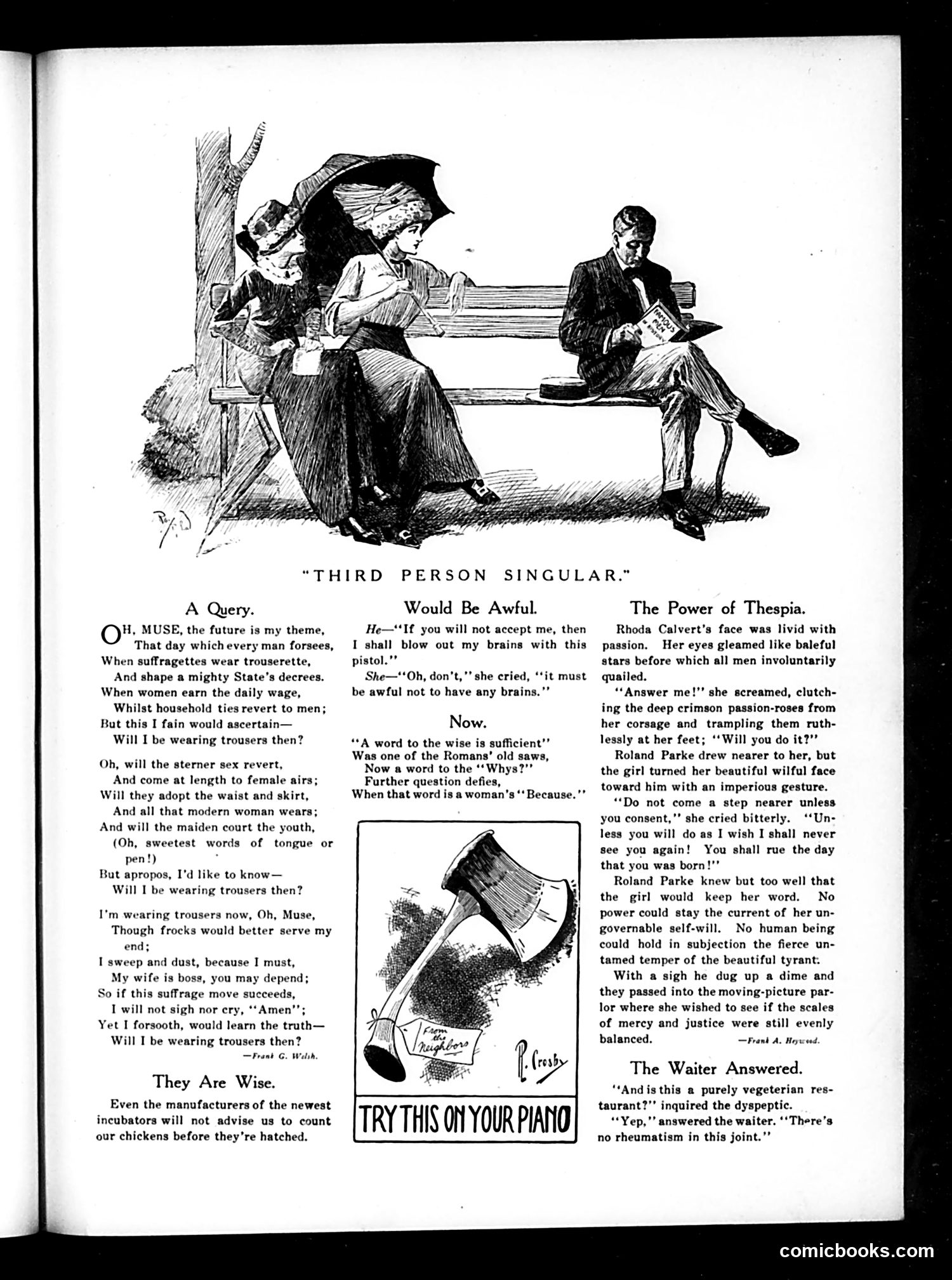
This page satirizes anxieties about the women's suffrage movement. The main cartoon depicts a man and woman on a bench—she reads while he sits separately, illustrating role-reversal fears. The poem "A Query" expresses a common anti-suffrage anxiety: if women gain equality and enter the workforce, will men be forced into traditionally "feminine" domestic roles, including wearing women's clothing? The speaker worries that granting women "the daily wage" and political power will invert gender norms entirely. The humor relies on exaggerating suffragists' actual goals into absurd predictions. Other brief jokes mock women's logic ("Because"), romantic manipulation, and vegetarianism—popular among progressive movements of the era. The tone is condescending, treating women's equality as inherently ridiculous rather than a serious political position. This reflects Judge magazine's conservative stance on women's rights during the suffrage debates of the early 20th century.
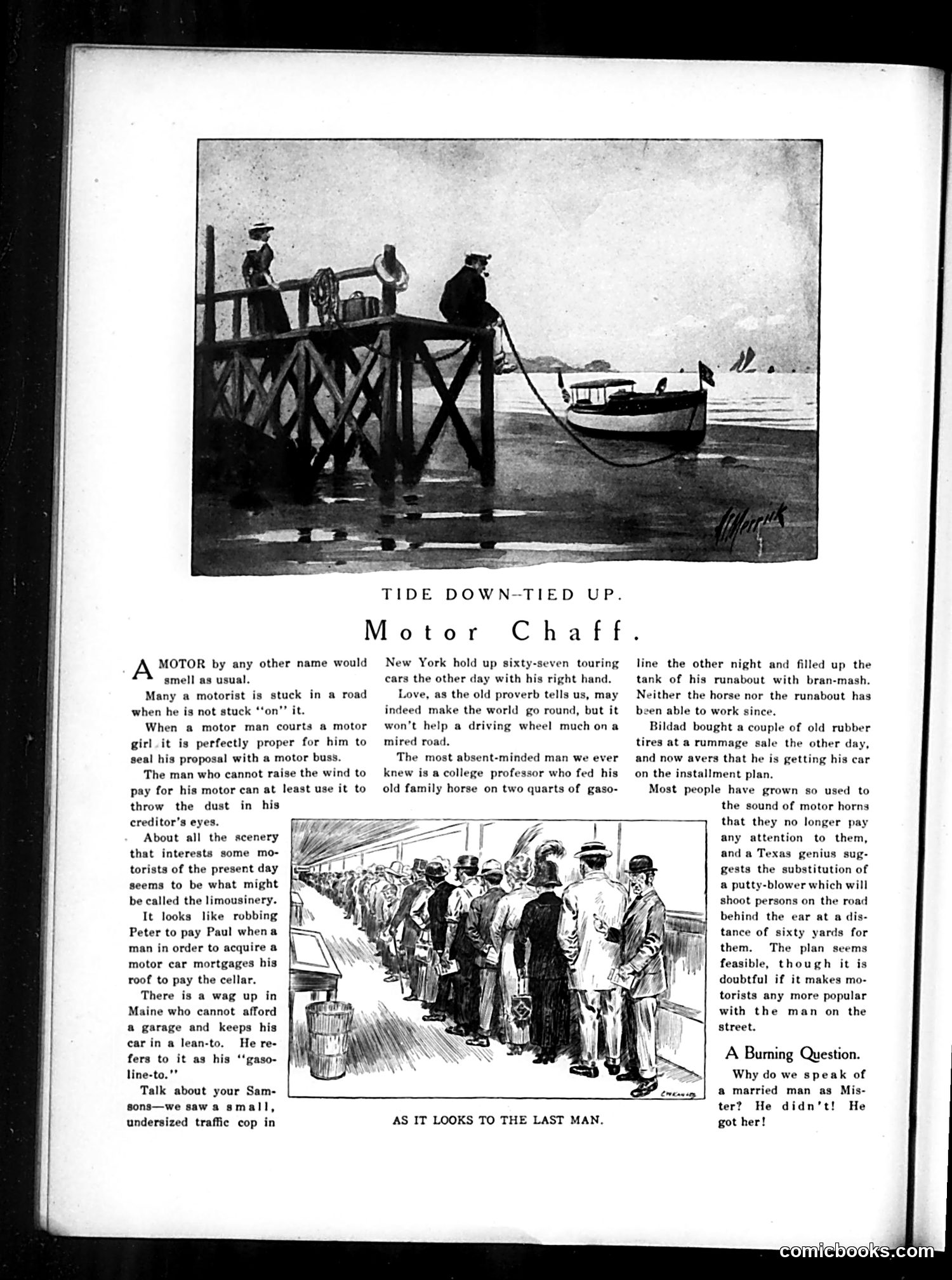
This page from *Judge* magazine contains humorous short pieces about early automobiles and motorists. The top illustration shows people at a seaside pier with boats—captioned "Tide Down-Tied Up"—using nautical language to joke about motor vehicles. The "Motor Chaff" section consists of witty one-liners mocking motorists and cars. Key jokes include: a professor accidentally feeding gasoline to his horse instead of grain; wordplay on "motor buss" (kiss); and complaints about dust kicked up by cars. One piece references a New York traffic cop who supposedly stopped 67 cars single-handedly. The satirical point: automobiles were still novel enough to inspire ridicule about their unreliability, the pretentiousness of owners, noise pollution, and danger to pedestrians. The "Burning Question" at bottom is unrelated humor about marriage. The central illustration, "As It Looks to the Last Man," appears to show a crowded vehicle, presumably satirizing the chaotic experience of early motoring.
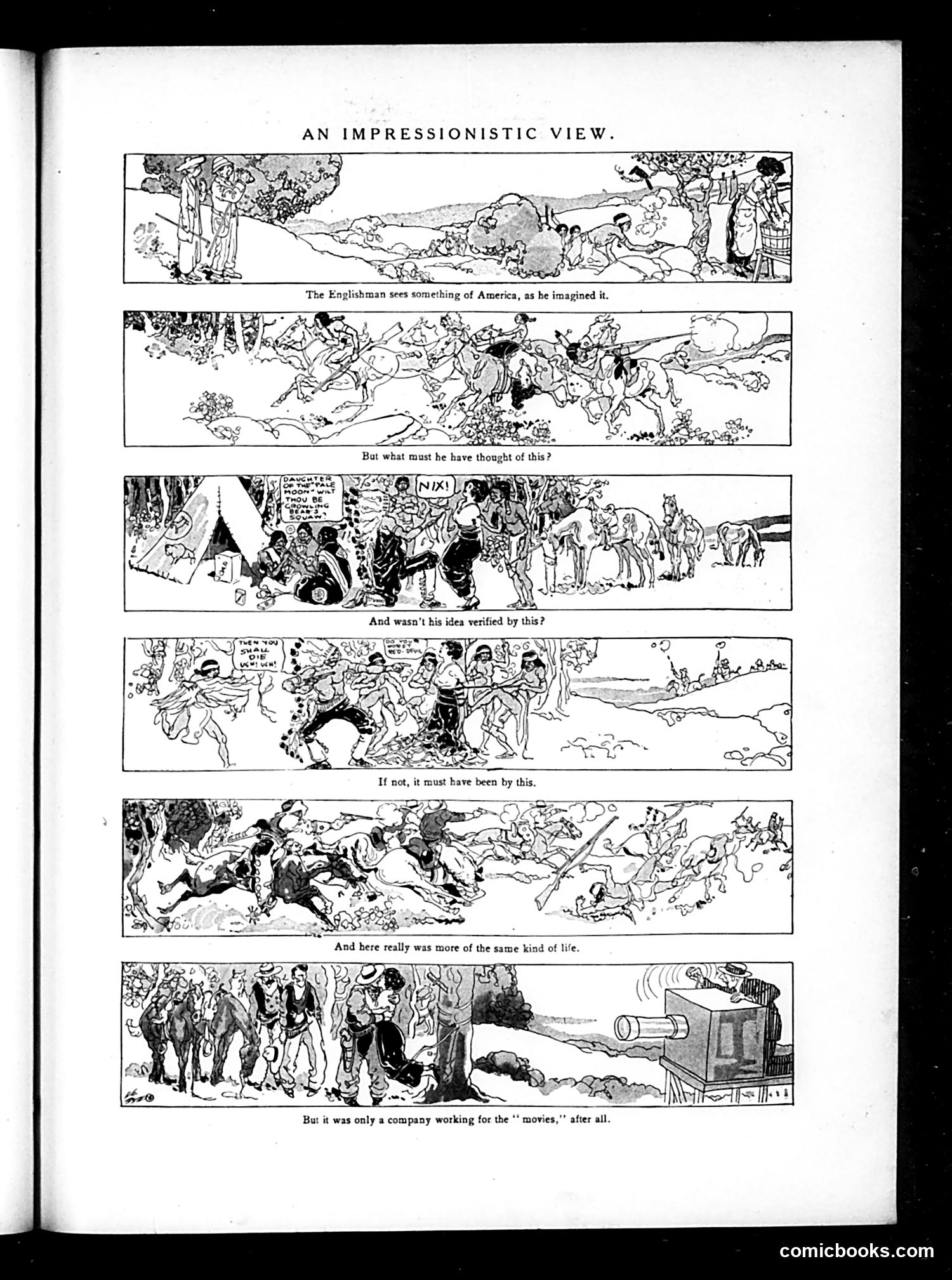
This satirical cartoon sequence mocks the gap between European (specifically English) imaginings of America and reality. The top panel shows an idealized, pastoral American landscape. Subsequent panels progressively reveal chaotic, violent scenes—wild cowboys, gunfights, and mayhem—depicting what the Englishman "thought" America must be like based on popular culture. The punchline reveals the joke: all this wild action wasn't authentic American frontier life but rather a movie production company filming Western scenes. The satire targets both European misconceptions fed by sensationalized cinema and the film industry's exaggerated portrayal of the American West. It's a commentary on how early motion pictures distorted international perceptions of American culture, showing the gap between cinema's dramatized fantasies and actual reality.
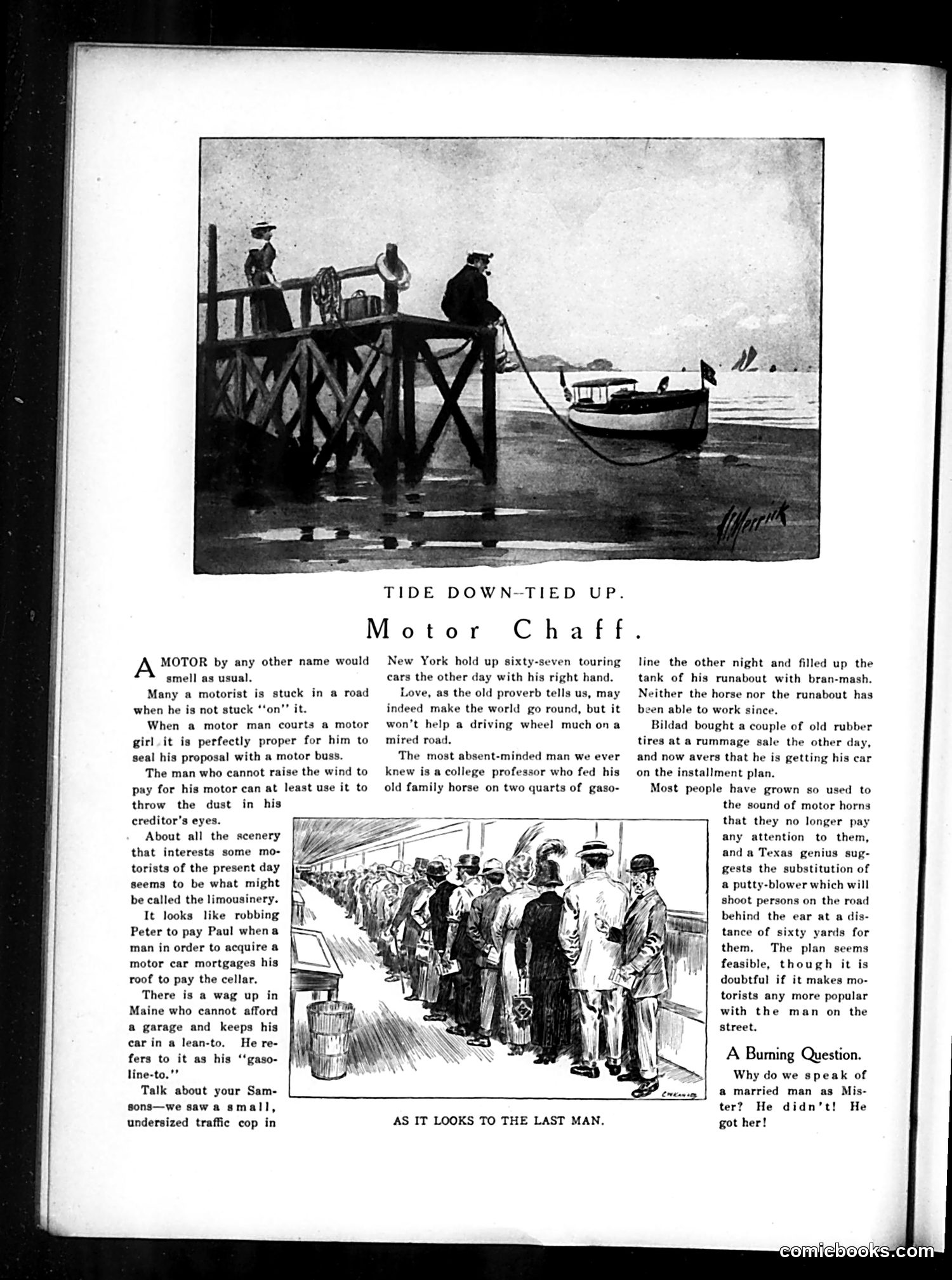
This page from *Judge* magazine contains humorous short quips about automobiles and early motoring culture. The satirical comments mock motorists' absent-mindedness, financial desperation to own cars, and dangerous driving habits. The top photograph shows people at a dock with a boat during low tide—a literal visual pun on "Tide Down-Tied Up," playing on the idea of being stuck (a common motorist problem). The middle illustration depicts a crowded street scene labeled "As It Looks to the Last Man," suggesting non-motorists' perspective of being overwhelmed by increasing automobile traffic. The jokes target motorists' poor behavior (throwing dust at others), the financial burden of car ownership (mortgaging homes), and social absurdities (feeding a horse gasoline by mistake). The final item is an unrelated joke about why married men are called "Mister" when they didn't choose marriage—typical period humor about marital entrapment, unrelated to cars. The piece reflects early-20th-century skepticism about automobiles as a status symbol and social menace.
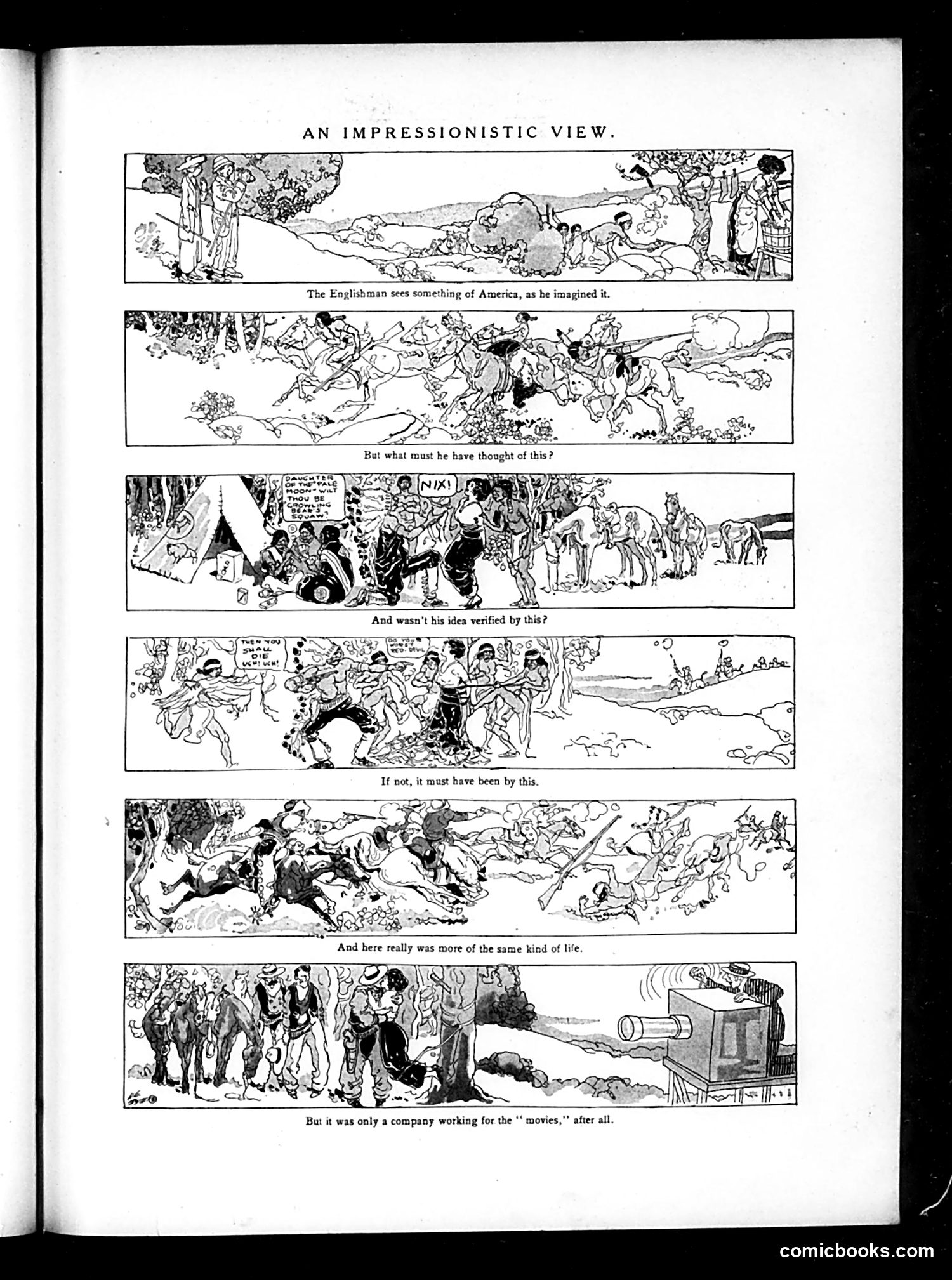
This satirical cartoon sequence mocks early cinema's depiction of American history and frontier life. The progression shows: 1. **An idealized vision**: An Englishman's romanticized imagination of America as pastoral and peaceful 2. **Reality check**: Violent scenes of Native Americans and conflict 3. **The explanation**: These aren't actual historical events—merely a movie company filming a western The satire targets how silent film studios (the "movies") created sensationalized, violent spectacles masquerading as authentic American history. By revealing that audiences were watching actors performing for cameras rather than genuine history, Judge criticizes both filmmakers' dishonesty and the public's gullibility in accepting cinematic fantasies as truth. The cartoon reflects early-1900s anxieties about cinema's power to shape perception and spread misinformation about national history and Indigenous peoples.
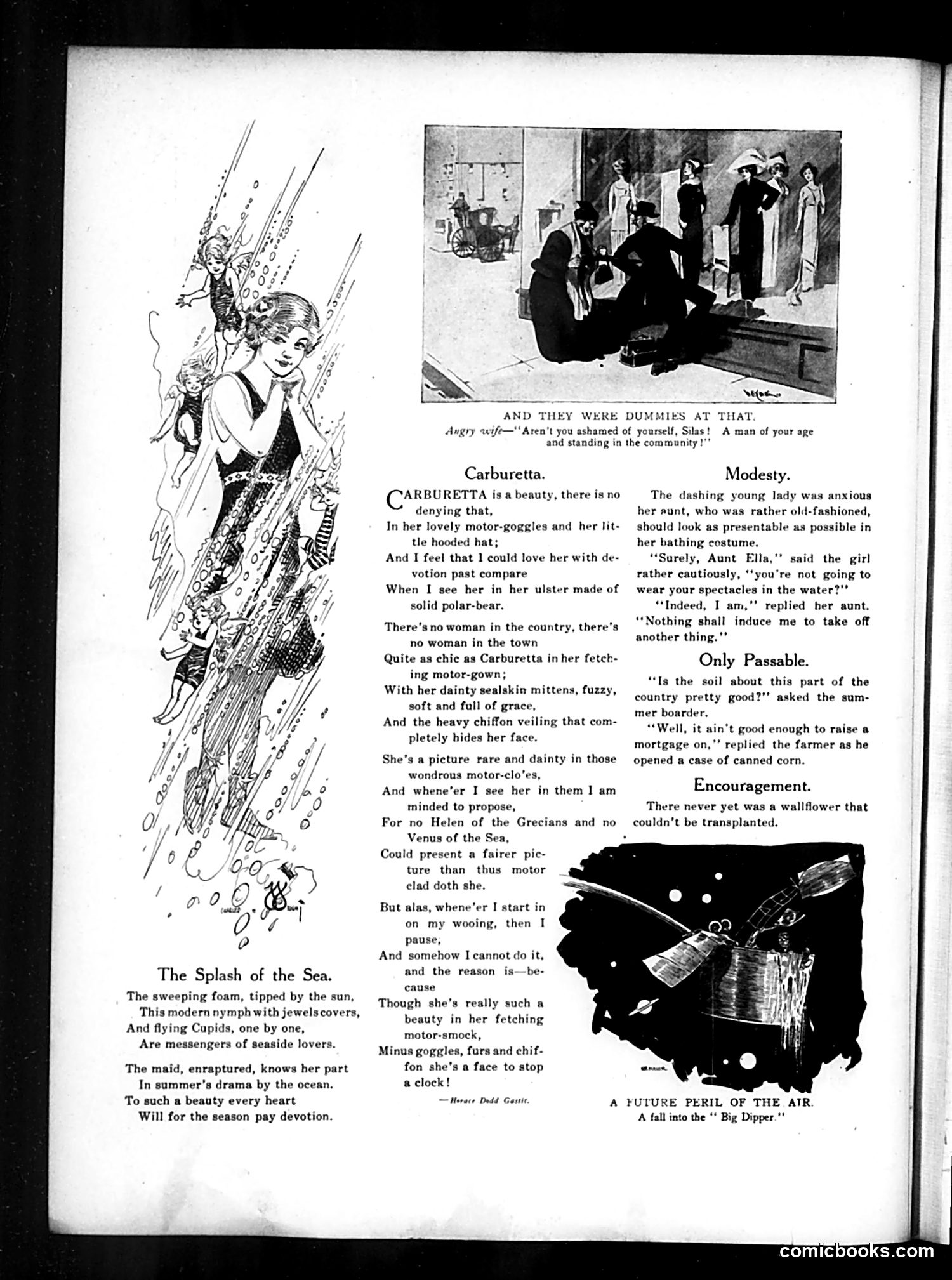
This page from *Judge* contains several satirical pieces mocking early 1900s social conventions and modern trends: **"Carburetta"**: A poem mocking women in early automobiles. The satire targets the contradiction between fashionable motor-car aesthetics (goggles, furs, veiling) and the wearer's actual appearance—the joke being that elaborate driving costumes completely obscure the woman's face, which the poem suggests is intentionally necessary ("a face to stop a clock"). **"Modesty"**: A brief joke about generational differences, where a young woman worries her old-fashioned aunt will wear spectacles while swimming, but the aunt refuses to remove anything else, satirizing Victorian modesty standards. **"Only Passable"**: A rural comedy about a farmer's poor soil, played for laughs through the punchline that he can't even mortgage it—yet relies on canned goods rather than fresh crops. **Top photograph**: Captioned "And They Were Dummies at That," showing what appears to be domestic conflict, satirizing marital discord. The overall theme mocks new technology (automobiles), outdated social norms, and rural-urban divides.
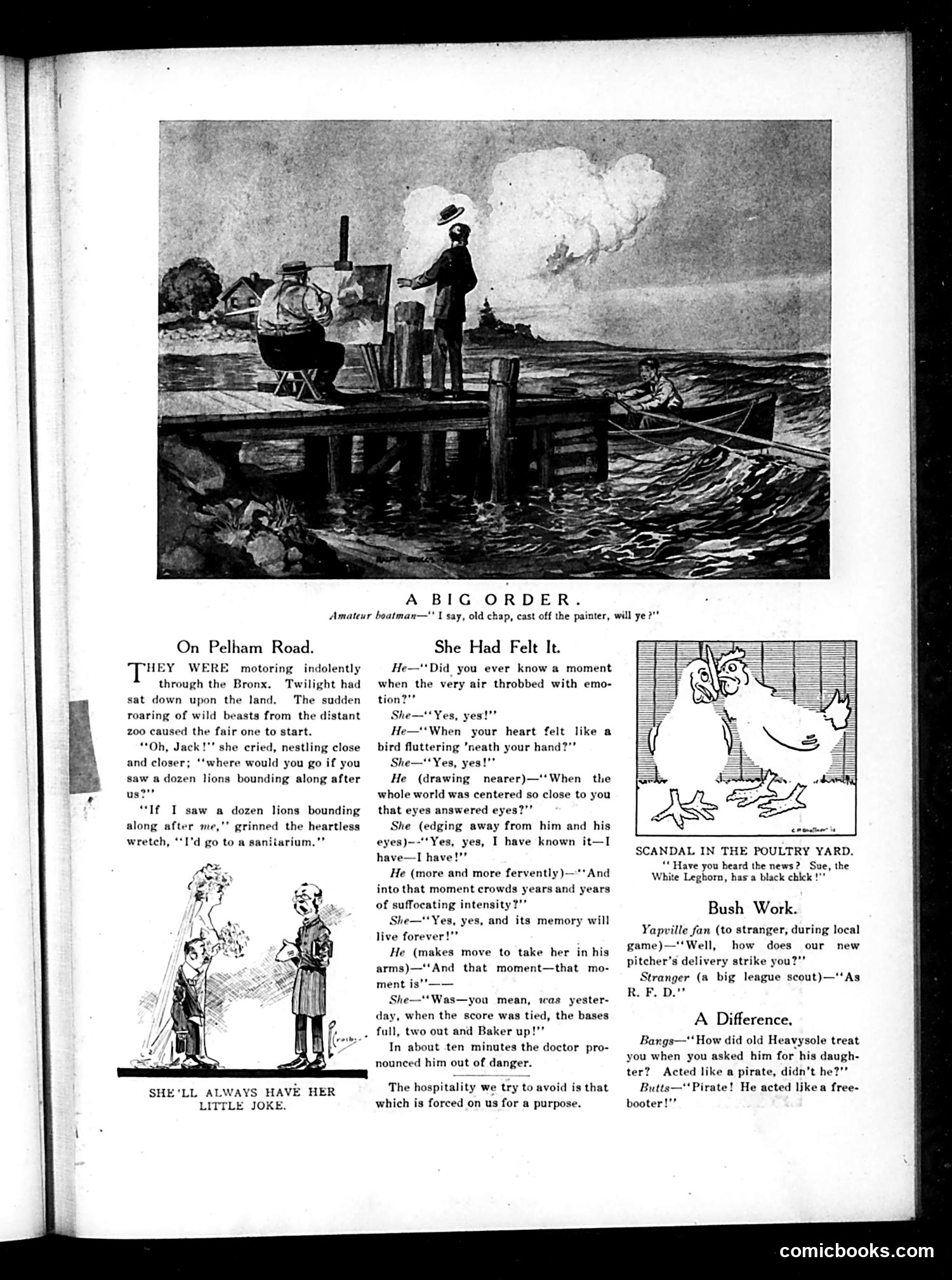
This page contains several brief humorous sketches typical of early 20th-century American satirical magazines. **"A Big Order"** (top illustration): A boatman on a dock instructs someone to "cast off the painter" (nautical term for untie the rope). The humor is visual wordplay—the amateur mistakes this for an art instruction. **"On Pelham Road"**: A couple in a car near the Bronx Zoo hear lions roaring. When the woman asks where he'd go if lions chased them, the man replies he'd go to a sanitarium—joking that he'd need psychiatric care from the terror. **"She'll Always Have Her Little Joke"**: A romantic moment is interrupted when the woman reveals she was actually thinking about a baseball game (bases loaded, two outs, "Baker up"), not the man's romantic advances. The humor plays on feminine obliviousness or deflation of male sentimentality. The remaining items are brief joke exchanges playing on puns and misunderstandings, typical of period humor magazines.
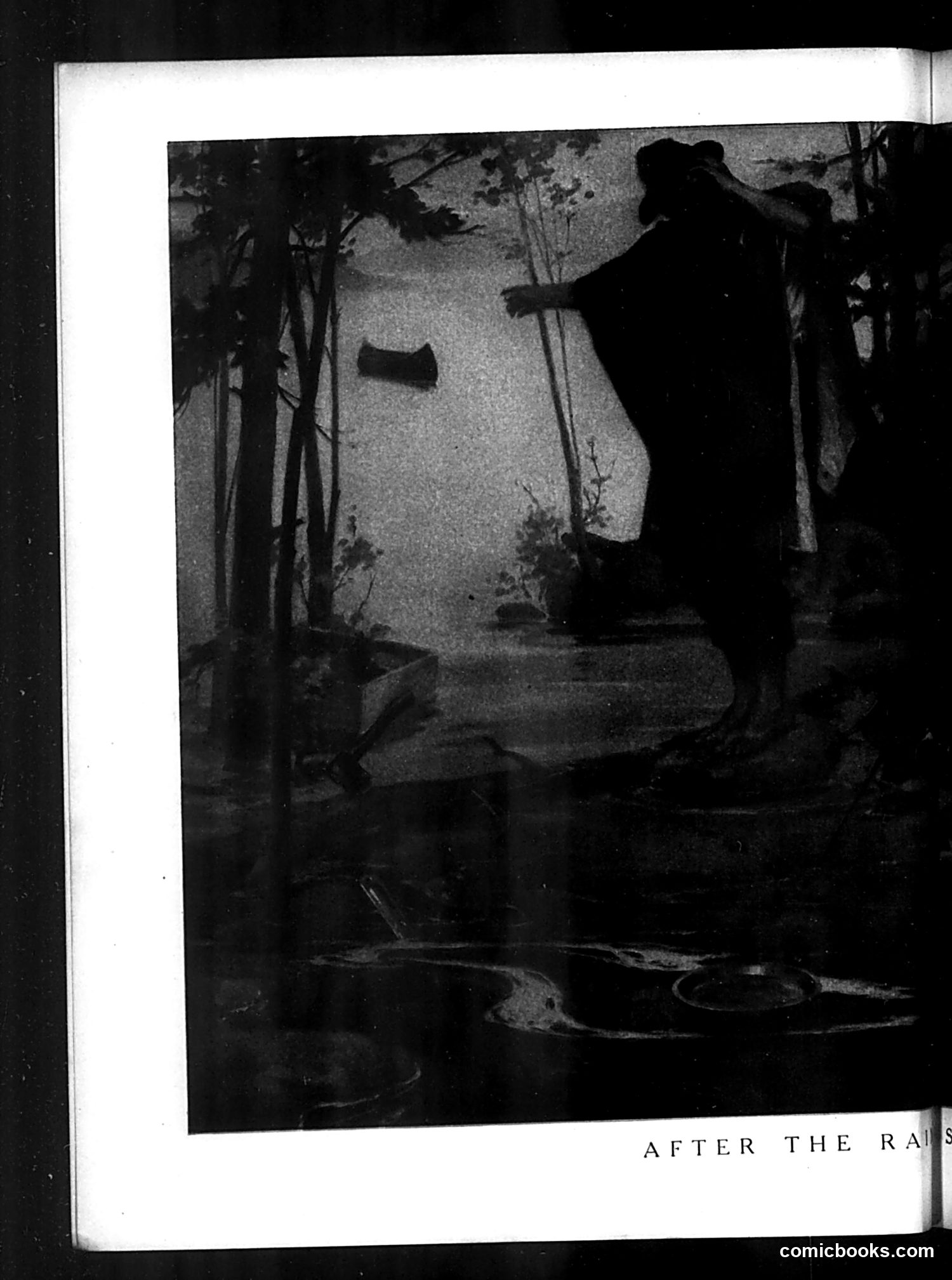
This page from *Judge* magazine shows a silhouetted figure in what appears to be an interior domestic scene with furniture and potted plants. The partial caption reads "AFTER THE RAI[N]" (text is cut off). The image is primarily silhouetted, making specific identification of figures difficult. The scene depicts someone in an interior space, possibly suggesting a domestic or social situation. Without the complete caption or additional context visible on the page, the precise satirical point is unclear. The image quality and heavy silhouetting obscure details that would help identify specific political figures or social commentary that *Judge* magazine typically targeted in this era. More of the page's text or caption would be needed to explain the intended satire to modern readers.
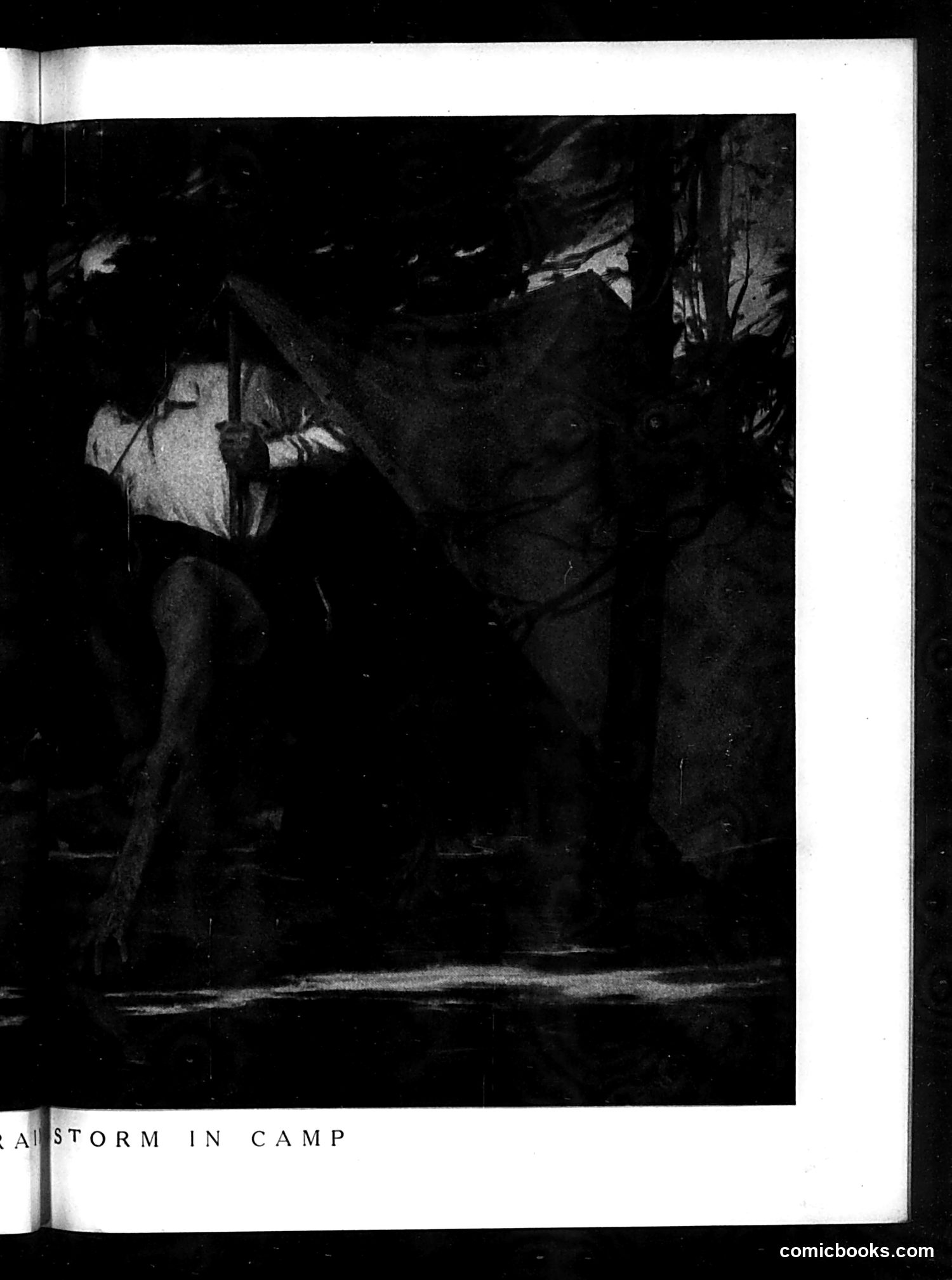
The page shows a dark, dramatic illustration titled "A Storm in Camp" but the image quality and high contrast make specific details difficult to discern clearly. The scene appears to depict figures in what looks like a military or outdoor camp setting during turbulent weather, with dynamic movement suggested by the composition. Without clearer visibility of facial features or additional context clues, I cannot confidently identify the specific figures or the particular political/social reference this satirizes. The dramatic staging suggests this critiques some aspect of military life, camp conditions, or leadership, typical of Judge magazine's satirical approach, but the exact target of the satire remains unclear from this reproduction.
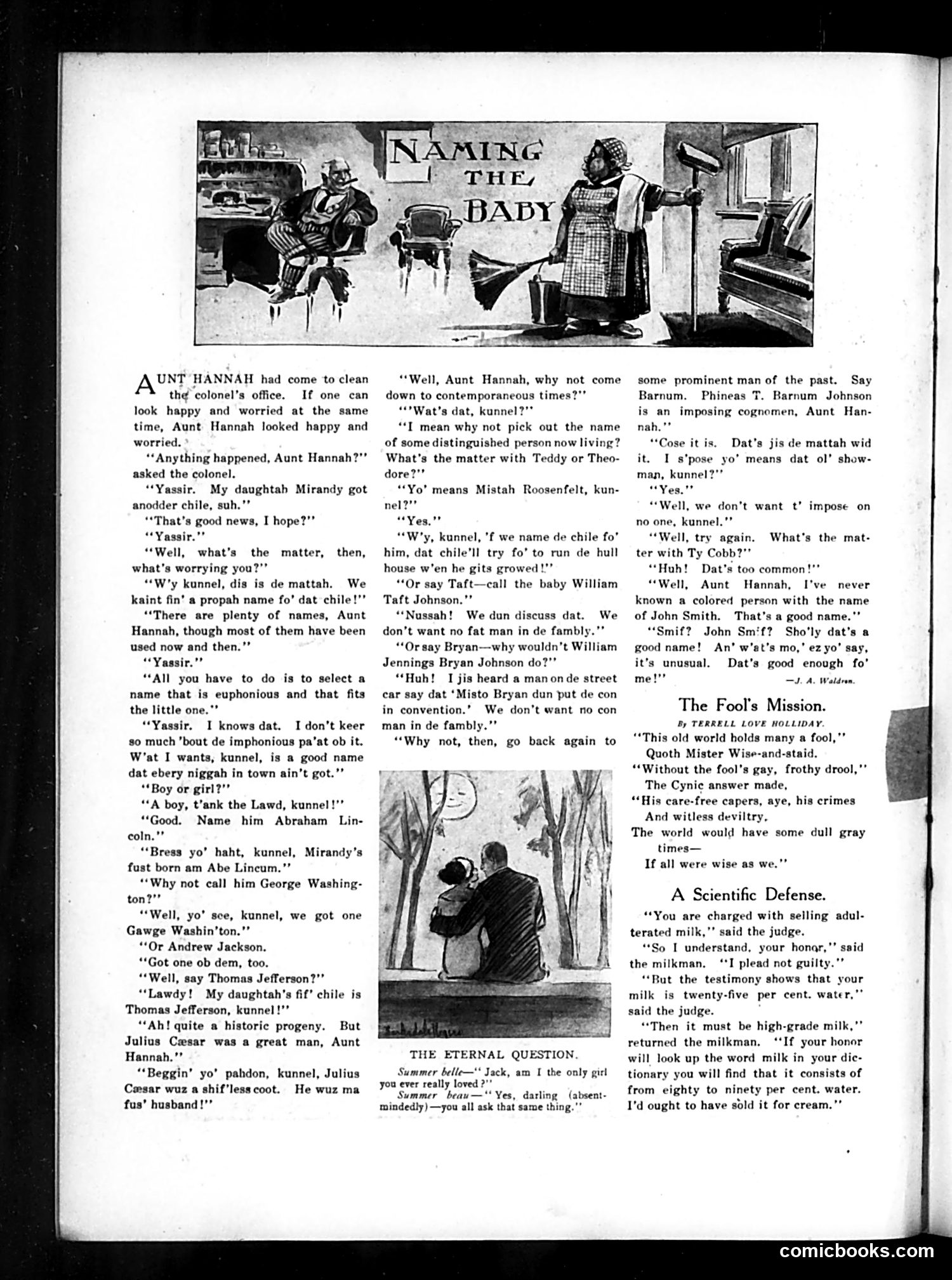
The main cartoon depicts a dialogue between a white colonel and "Aunt Hannah," an enslaved or formerly enslaved Black woman seeking a name for her grandson. The satire mocks the practice of naming Black children after prominent white American figures—Lincoln, Washington, Jefferson, Teddy Roosevelt, Taft, Bryan, Barnum—suggesting both aspiration and the absurdity of adopting these names indiscriminately. The humor relies on dialect stereotypes and Hannah's practical objections (e.g., Bryan would make the child "run de hull house"). The surrounding content includes "The Eternal Question" (a man's tired response to a woman's repetitive question), "The Fool's Mission" (verse about society's need for foolishness), and "A Scientific Defense" (a milkman's clever rebuttal about adulterated milk containing water, which technically matches the dictionary definition). The page reflects early 20th-century *Judge* magazine's mix of racial caricature, domestic humor, and social commentary targeting various targets—Black aspirations, courtship rituals, and commercial dishonesty.
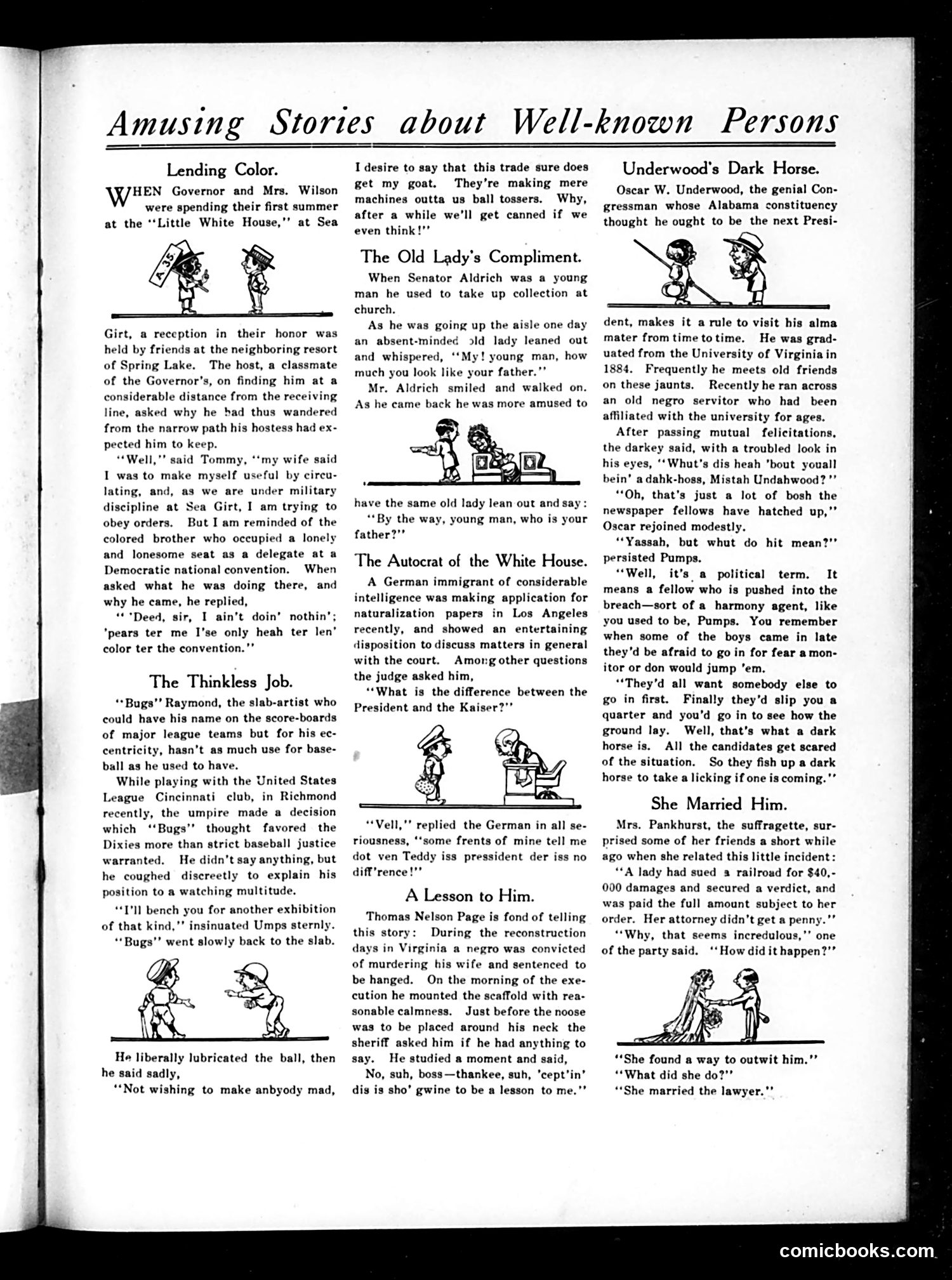
This page contains six brief satirical anecdotes mocking prominent political figures and social attitudes of the era (circa 1912, based on Wilson and Underwood references). **Key targets:** - **Governor Wilson** (future President): Satirized for rigid military discipline - **Senator Aldrich**: Mocked for vanity via a forgetful old lady's comment - **President Theodore Roosevelt**: A German immigrant's joke suggests Roosevelt acts like an autocrat/kaiser - **Oscar Underwood**: A "dark horse" presidential candidate - **Baseball pitcher "Bugs" Raymond**: Criticized for thinking independently rather than obeying umpires mechanically The anecdotes use **racist dialect** (the "colored brother," the freed Black man) as punchlines—reflecting period prejudices. The humor relies on exaggeration and wordplay rather than visual wit. The Roosevelt joke is the sharpest political critique, equating American presidential power with European autocracy.
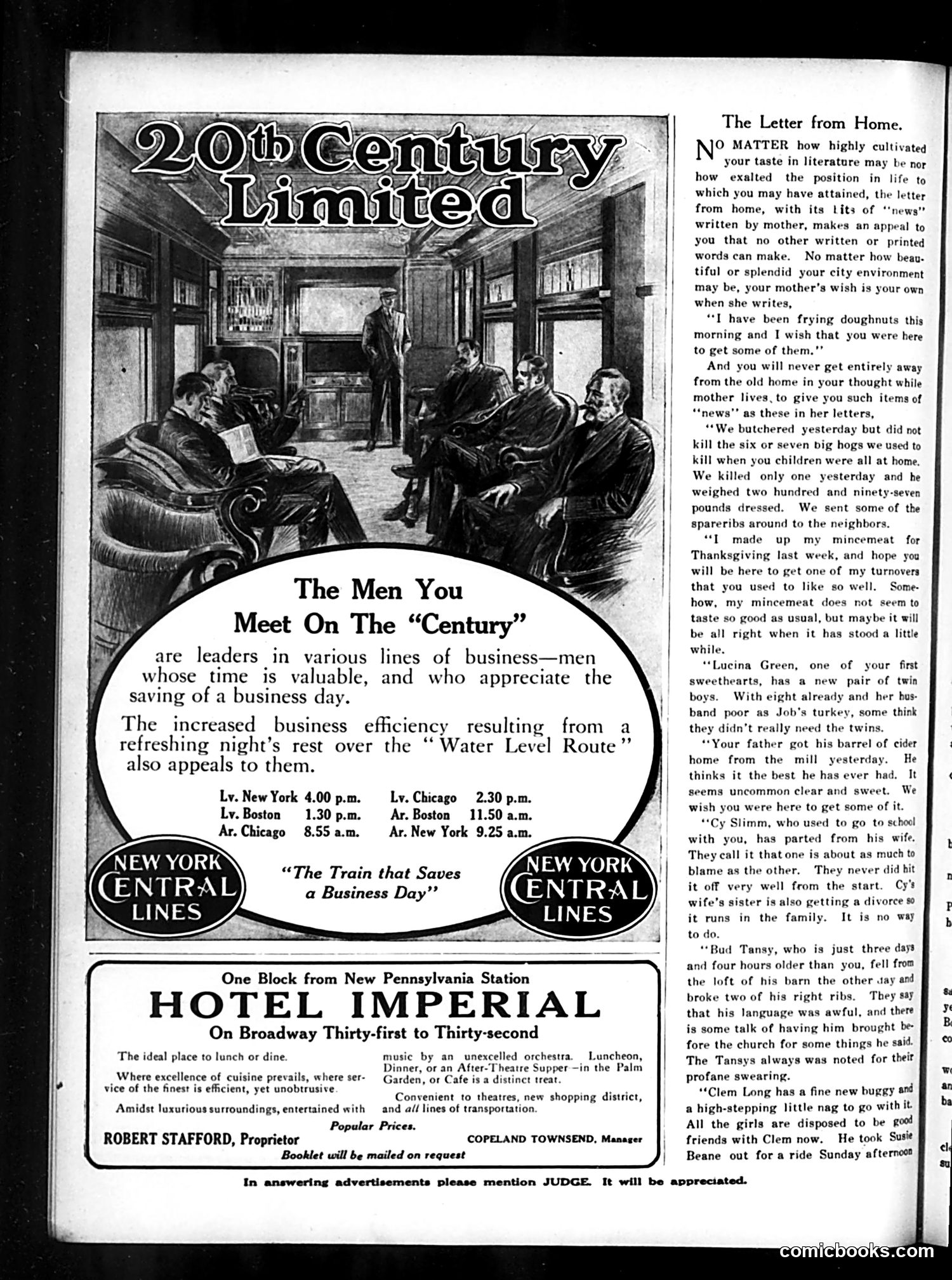
This page is primarily **advertising**, not political satire. It contains two main advertisements: 1. **New York Central Lines railroad ad**: Promotes the "Century" train as efficient for busy businessmen, emphasizing time-saving travel between major cities (New York, Boston, Chicago). 2. **Hotel Imperial ad**: Features upscale dining and accommodations on Broadway. The right column contains **"The Letter from Home,"** a sentimental short story (not satire) about a mother's letter to her absent son, filled with small-town gossip: butchering livestock, mincemeat recipes, neighbors' divorces, and local scandals. The humor here is gentle and nostalgic rather than satirical—it contrasts humble rural life with the sophisticated urban world the son presumably inhabits. There are no political cartoons or caricatures on this page. The content reflects early 20th-century American attitudes valuing family correspondence and rural simplicity amid urban modernity.
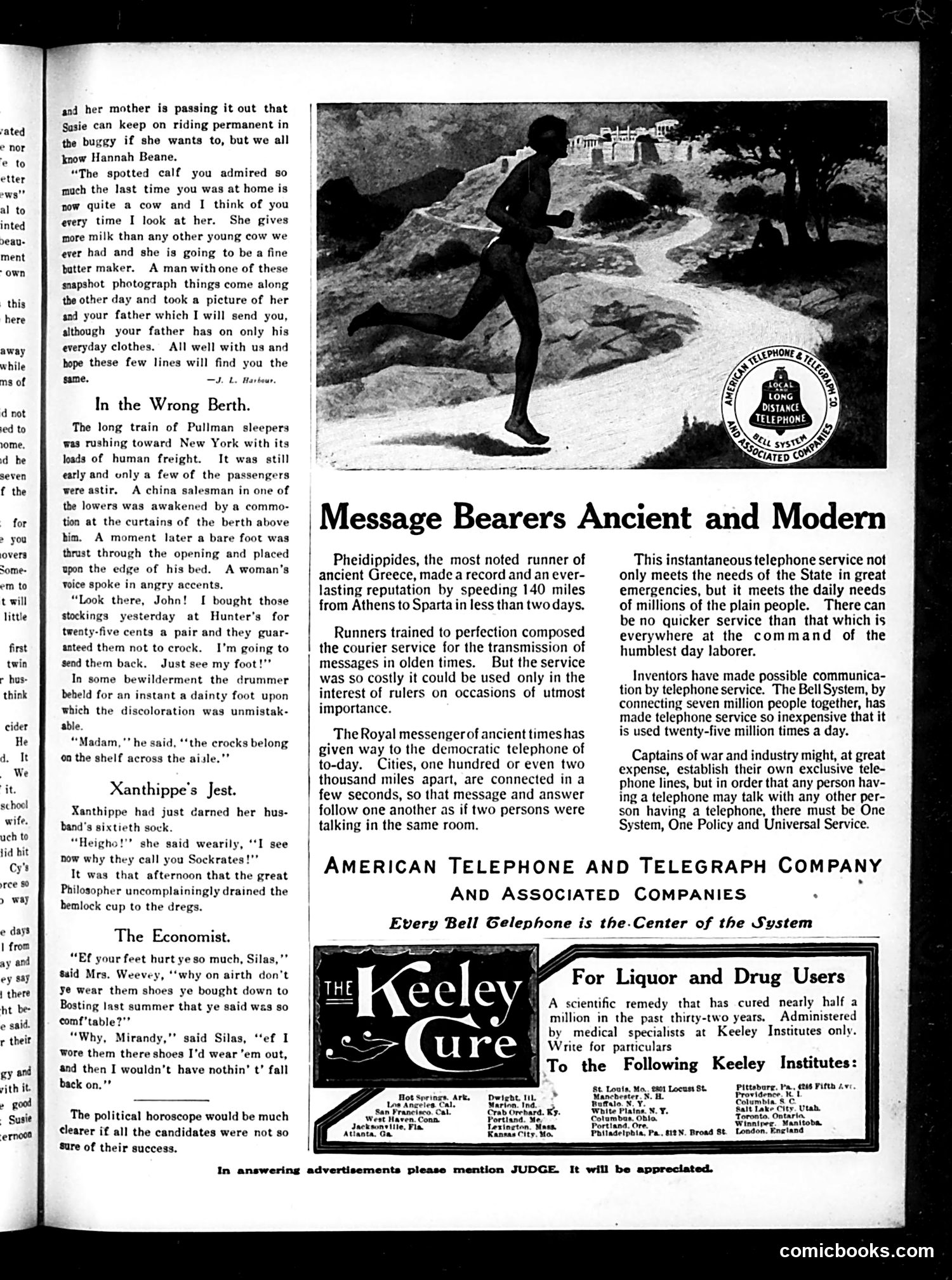
This page contains several short humorous stories (common in Judge) followed by a substantial advertisement for the American Telephone and Telegraph Company. The stories—"In the Wrong Berth," "Xanthippe's Jest," and "The Economist"—are domestic humor pieces with no political content. They joke about marital discord, defective stockings, and penny-pinching, relying on wordplay and situation comedy familiar to the era. The AT&T advertisement is the page's significant content. Titled "Message Bearers Ancient and Modern," it compares ancient Greek runners (Pheidippides) and royal messengers to the modern telephone system. The advertisement argues that the telephone democratizes rapid communication—once available only to rulers for urgent matters, now accessible to "the humblest day laborer" at affordable rates. The Bell System's reach of seven million connected users and twenty-five million daily calls is presented as evidence of progress and social benefit. This is essentially corporate propaganda dressed as historical commentary, celebrating American technological advancement and capitalist expansion during the telephone system's growth period.
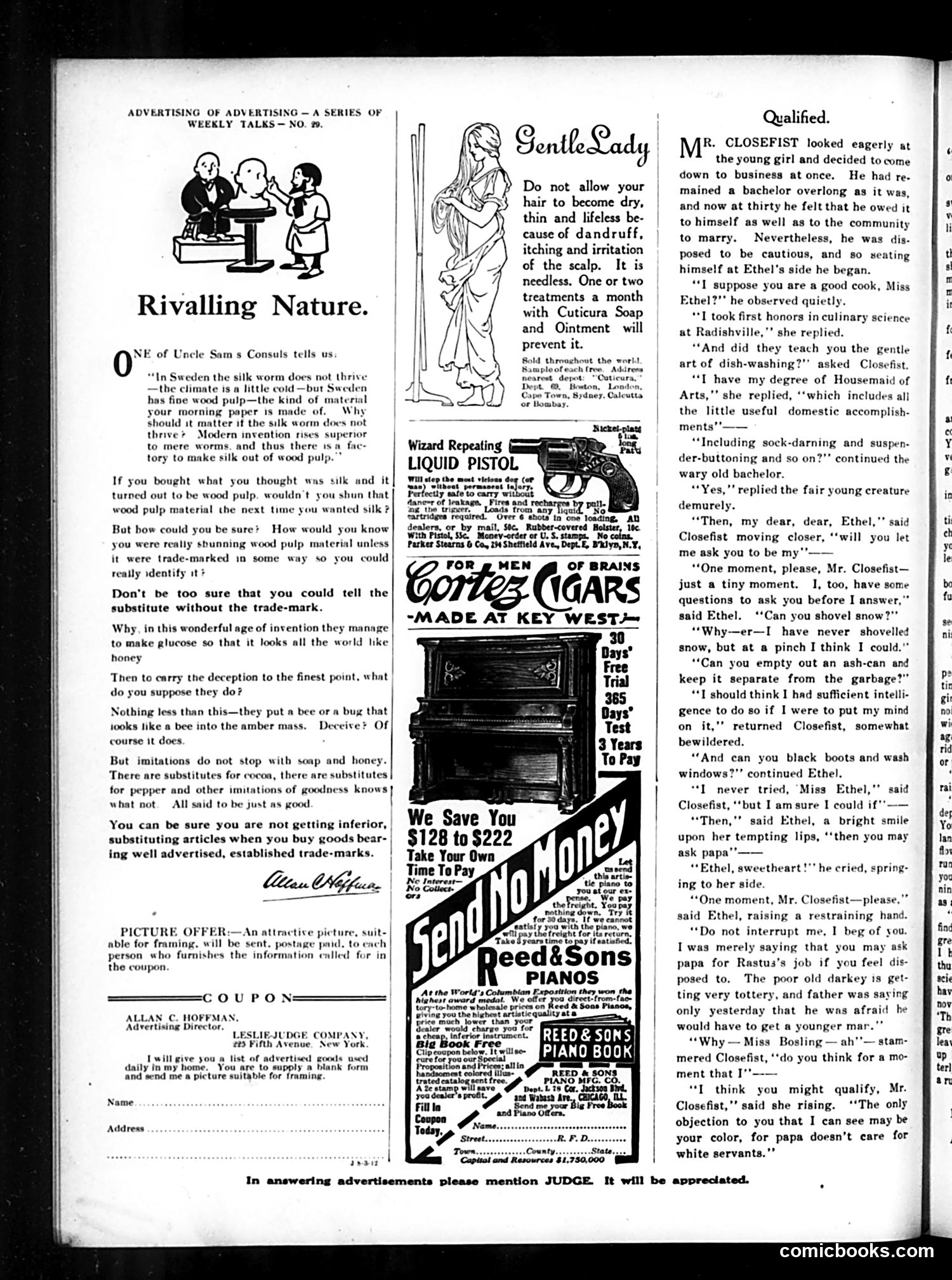
This page satirizes a miserly bachelor ("Mr. Closefist") interviewing a young woman for marriage. The joke is that he treats matrimony like hiring domestic help, asking if she can cook and wash dishes rather than courting her romantically. Her responses—claiming honors in "culinary science" and a "degree of Housemaid of Arts"—mock his utilitarian approach by matching his cold pragmatism with overly formal academic language. The satire targets the era's transactional view of marriage, where a husband evaluated a wife primarily on household labor rather than companionship. Closefist's name itself signals his character: stingy and unromantic. The page's other content comprises advertisements (cigars, pianos, hair treatment, toy pistols) and an essay on trade-marks as consumer protection—standard Judge magazine fare of the period.
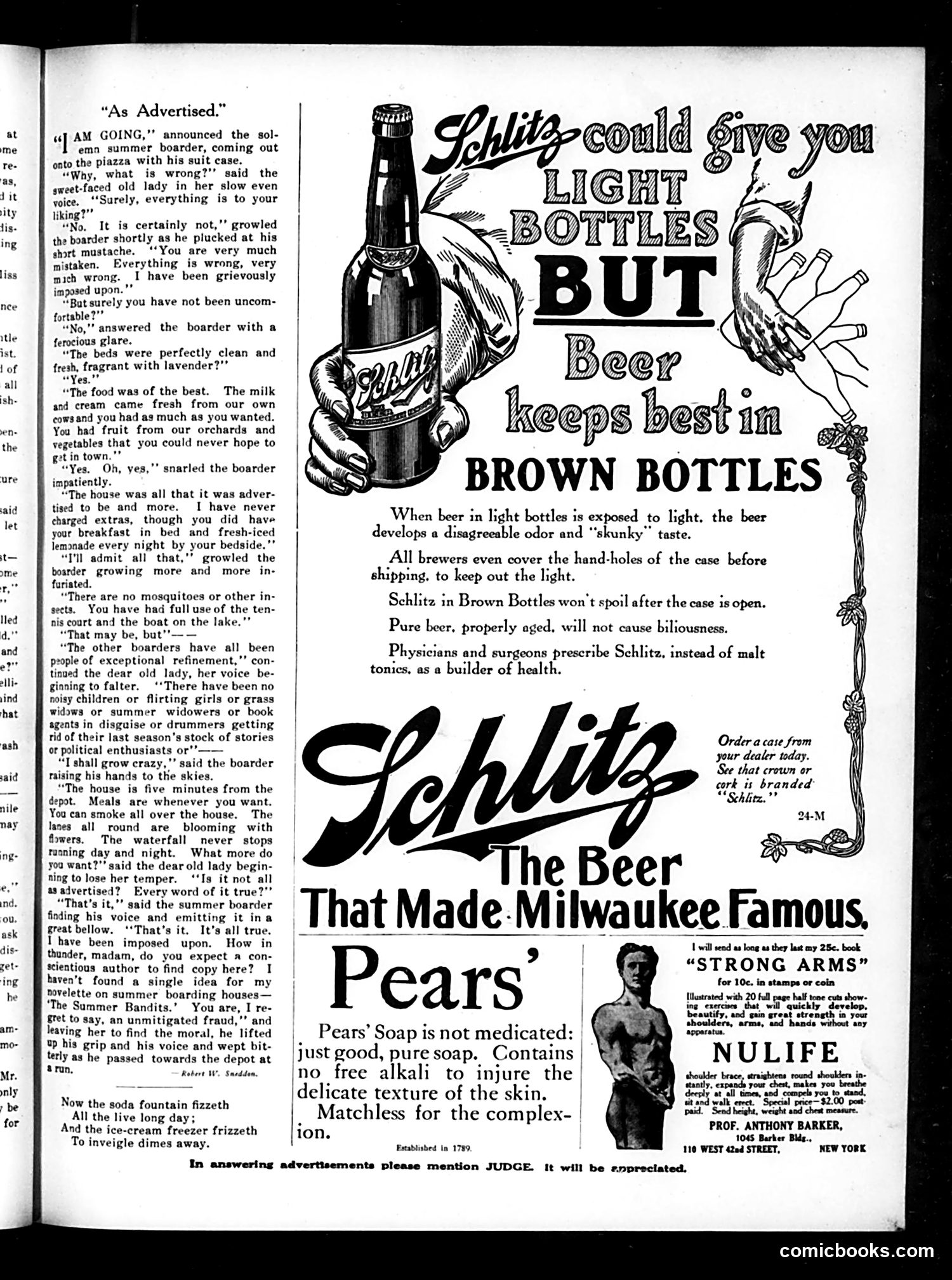
This page contains a satirical short story ("As Advertised") by Robert W. Sneddon, accompanied by period advertisements. **The Story's Satire:** A summer boarder announces he's leaving a boarding house despite perfect conditions—clean beds, excellent food, pleasant guests, beautiful surroundings, and low cost. The frustrated landlady lists every amenity, until the boarder finally reveals the truth: there's *nothing wrong*. He's a writer seeking material for a story called "The Summer Bandits," and an *actually perfect* boarding house provides no scandalous copy. The satire mocks both self-absorbed writers who exploit real life for fiction and the impossible expectations of social commentary—even paradise disappoints those seeking conflict. **The Advertisements:** Schlitz beer (emphasizing brown bottles prevent "skunky" taste from light exposure), Pears' soap (pure, non-medicated), "Strong Arms" bodybuilding manual, and "Nulife" health product for baldness and strength. The juxtaposition is typical of *Judge*: lighthearted social commentary paired with commercial appeals to readers' vanities and anxieties.
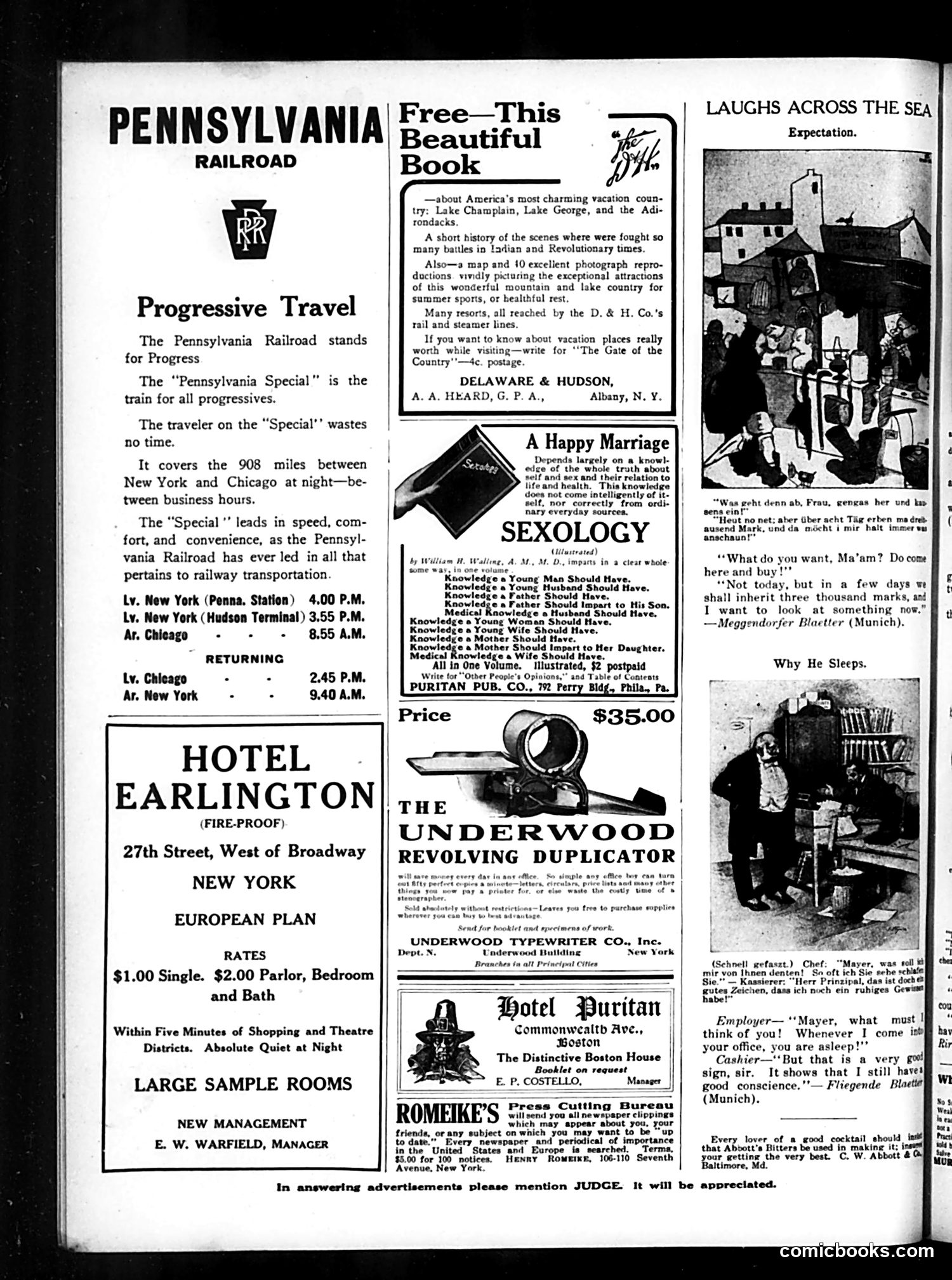
This is primarily an **advertising page** from Judge magazine with minimal editorial content. The advertisements showcase products and services aimed at progressive early-20th-century Americans: the Pennsylvania Railroad's "Special" train (marketed as modern and efficient), hotels, and books on "sexology" and marriage. The only satirical cartoon content appears in the bottom right section titled "Laughs Across the Sea"—reprinted humor from German publications (*Meggendorfer Blaetter* and *Fliegende Blaetter*). These cartoons mock German characters: one depicts a woman obsessing over inherited money she hasn't yet received, another shows an employer who interprets his cashier's sleeping on the job as evidence of a clean conscience. The German humor reflects Judge's tendency to feature ethnic/national stereotypes common to the era. The page otherwise serves as a commercial vehicle rather than political satire.
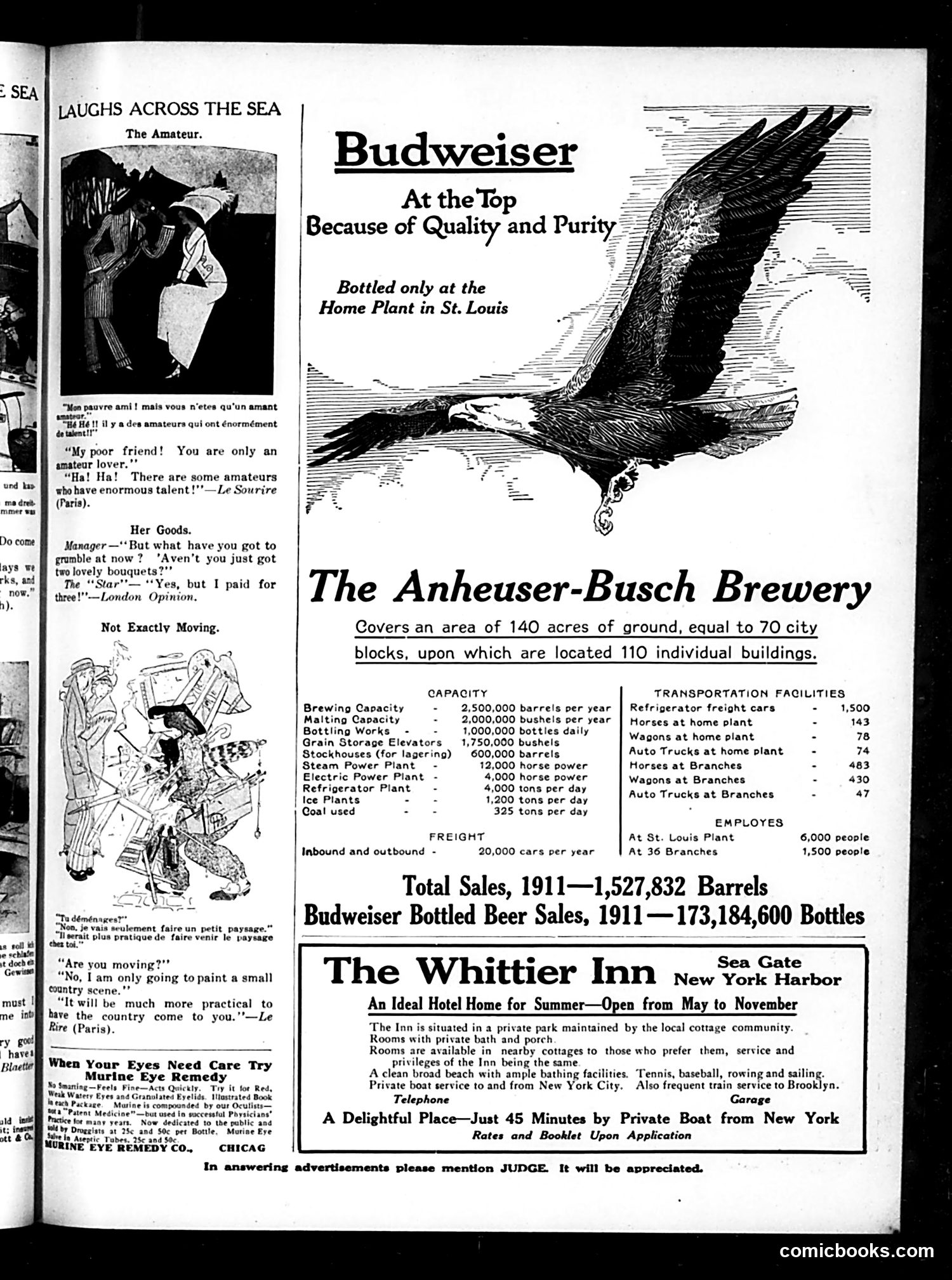
This page mixes satirical cartoons with period advertisements. The three small cartoons at left are reprints of European humor from French publications (*Le Sourire*, *Le Rire*), a common Judge feature showcasing international jokes: 1. **"The Amateur"**: A Parisian joke mocking a lover's romantic incompetence—others do it better. 2. **"Her Goods"**: A theatrical joke where a demanding actress complains about gift bouquets she had to pay for herself. 3. **"Not Exactly Moving"**: A painter refuses to relocate, joking it's easier to have the countryside come to him than move. The page's bulk comprises **Budweiser and Anheuser-Busch brewery advertisements** showcasing massive 1911 production capacity (1.5+ million barrels annually), facilities, and workforce—corporate boasting typical of the era. A smaller ad promotes The Whittier Inn resort in New York Harbor. The page reflects Judge's mix of European satirical humor with prominent American corporate advertising, targeting educated readers with disposable income.
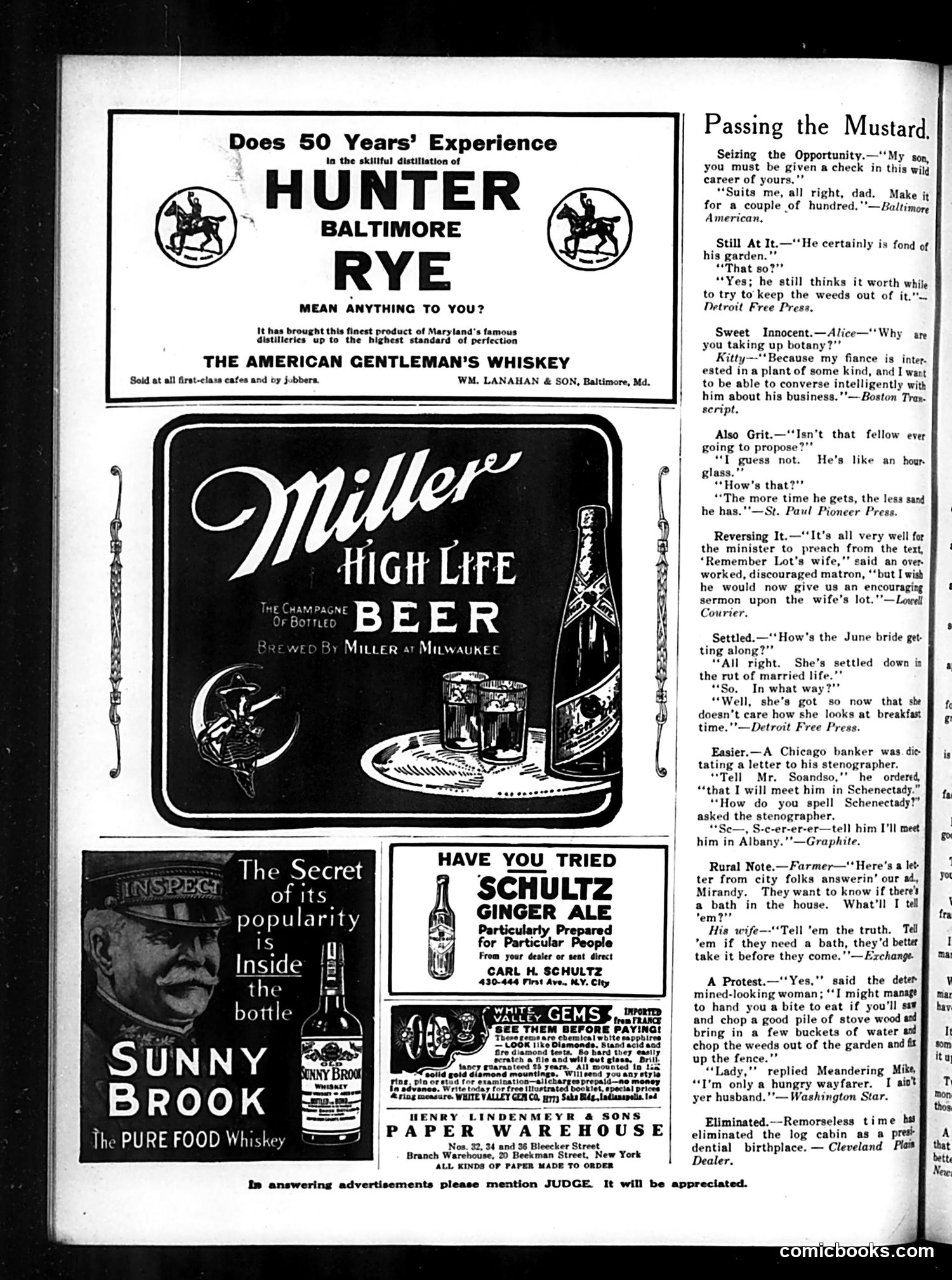
This is primarily an **advertising page** from Judge magazine, featuring liquor and beer advertisements (Hunter Baltimore Rye, Miller High Life Beer, Schultz Ginger Ale, Sunny Brook Whiskey, and paper warehouse ads). The page includes a series of brief **humorous anecdotes** in the margins—typical Judge filler content—covering domestic and social situations: a son requesting money from his father, a husband still tending his garden, a woman studying botany to impress her fiancé, jokes about marriage and proposals, a banker mispronouncing "Schenectady," rural folks inquiring about bathing facilities, and a protest about household chores. These vignettes reflect **early 20th-century American middle-class concerns**: courtship rituals, marriage's mundane realities, city-versus-rural differences, and workplace dynamics. The humor is gentle observational comedy rather than biting satire—typical of Judge's lighter editorial content. The page has no identified political cartoons or caricatures of public figures.
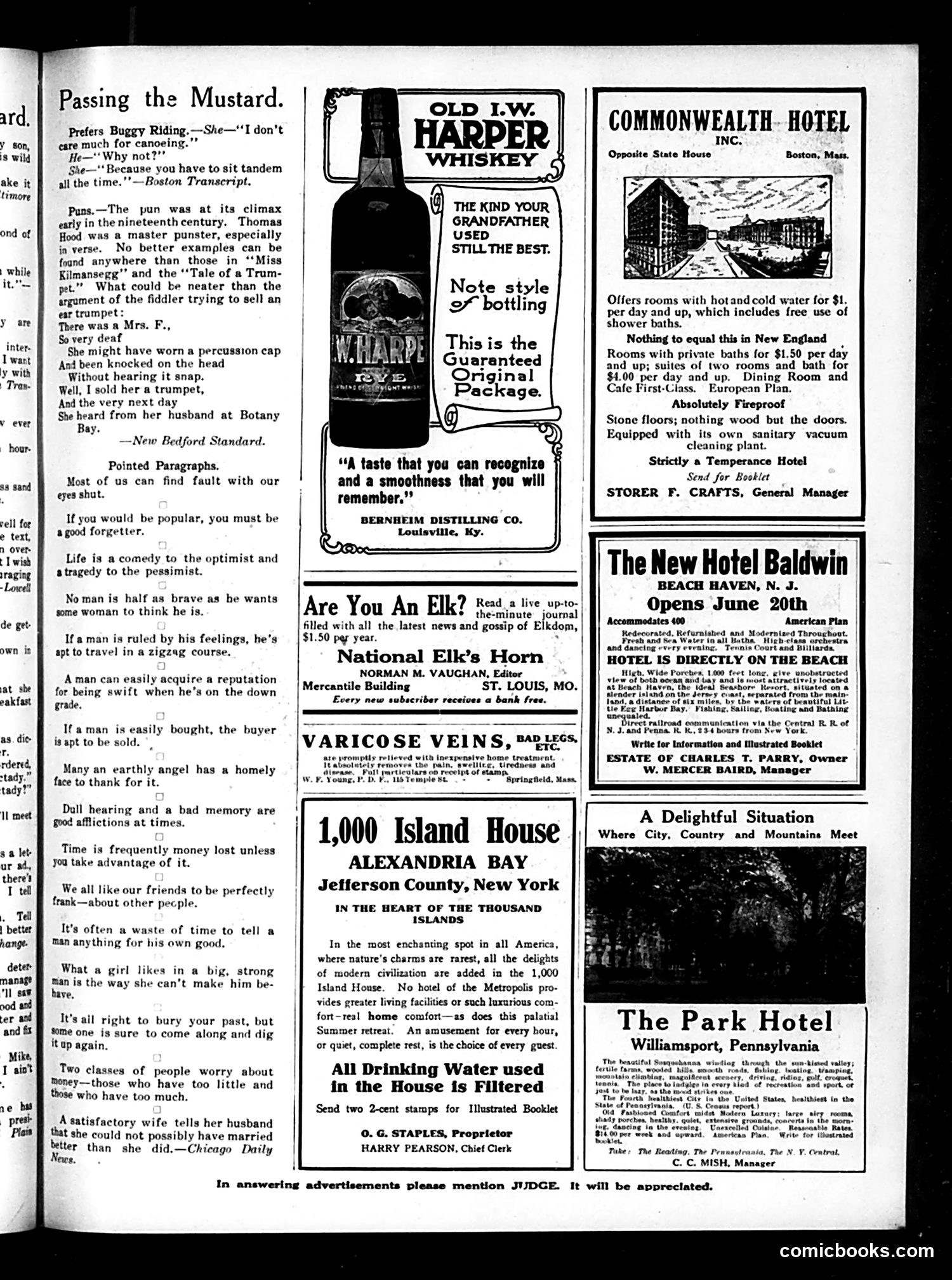
This page is primarily **advertising and filler content** rather than political satire. It consists of: **"Passing the Mustard"** — A column of light humor pieces and puns, including anecdotes about punsters and wordplay from 19th-century literature. **"Pointed Paragraphs"** — Aphoristic observations about human nature (pessimism vs. optimism, courage, relationships, memory). These are generic wisdom-style quips with no specific political target. **Hotel and Product Advertisements** — The bulk of the page advertises hotels (Commonwealth Hotel, New Hotel Baldwin, The Park Hotel, 1,000 Island House) and Old I.W. Harper Whiskey. One ad promotes the "National Elk's Horn" publication for members of the fraternal Elks organization. **No identifiable political cartoons or caricatures appear on this page.** It's representative of how satirical magazines like *Judge* filled space with genteel humor, advertising, and lifestyle content alongside their editorial cartoons (which appear elsewhere in the issue).
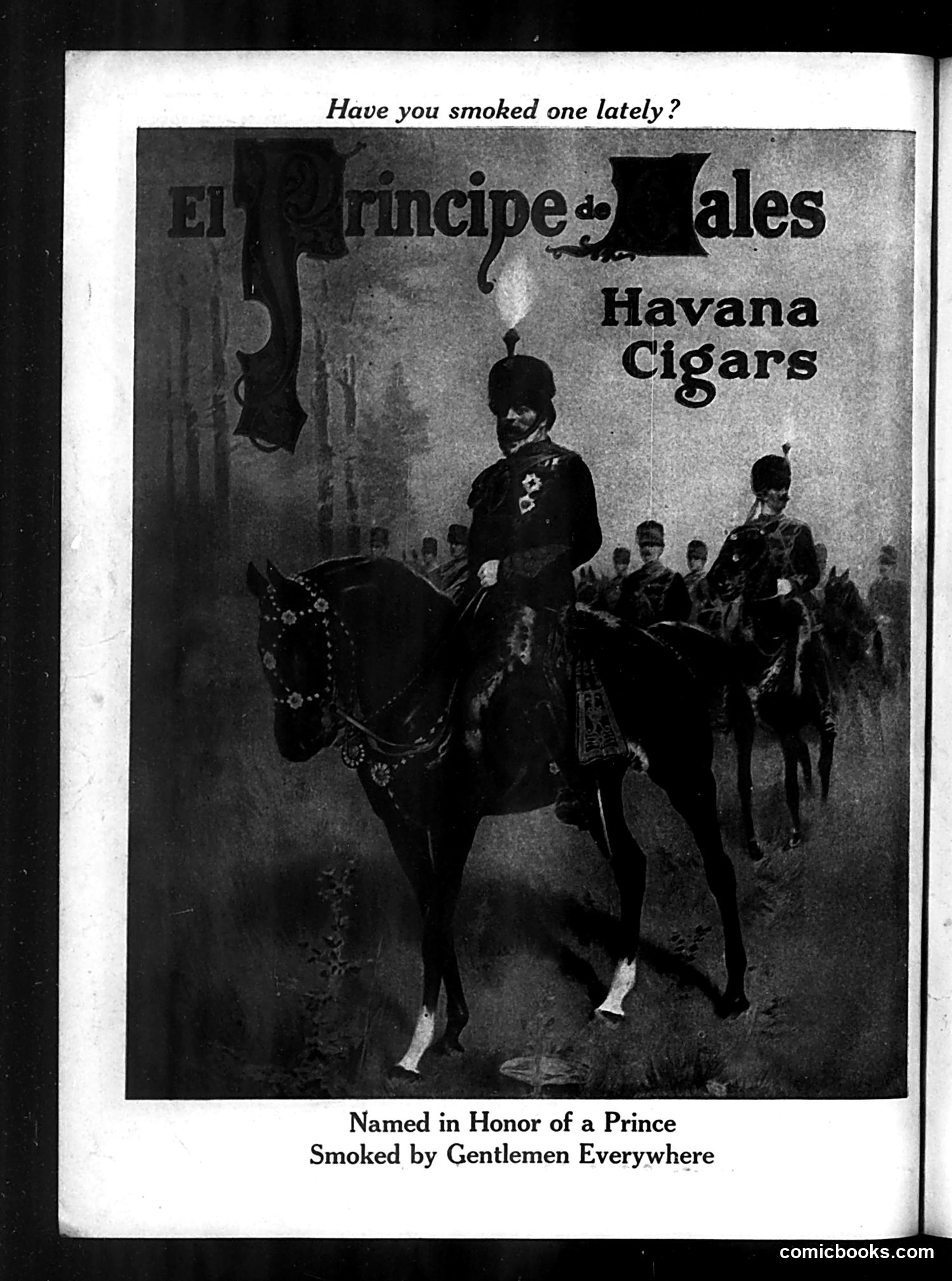
This is a commercial advertisement for Cuban cigars, not political satire. The image depicts a mounted military or royal figure in formal dress uniform leading a procession of uniformed soldiers on horseback through a street. The ad references "El Príncipe de Gales" (The Prince of Wales) in the product name, capitalizing on royal prestige to market luxury cigars. The tagline "Smoked by Gentlemen Everywhere" targets affluent male consumers by associating the product with aristocratic status and refinement. The opening question "Have you smoked one lately?" uses casual language to encourage repeat purchases. Without knowing the specific publication date, the Prince of Wales reference likely invoked a contemporary royal figure to enhance the product's cachet among American consumers.