
Judge, 1912-08-03 · page 17 of 26
Judge — August 3, 1912 — page 17: what you’re looking at
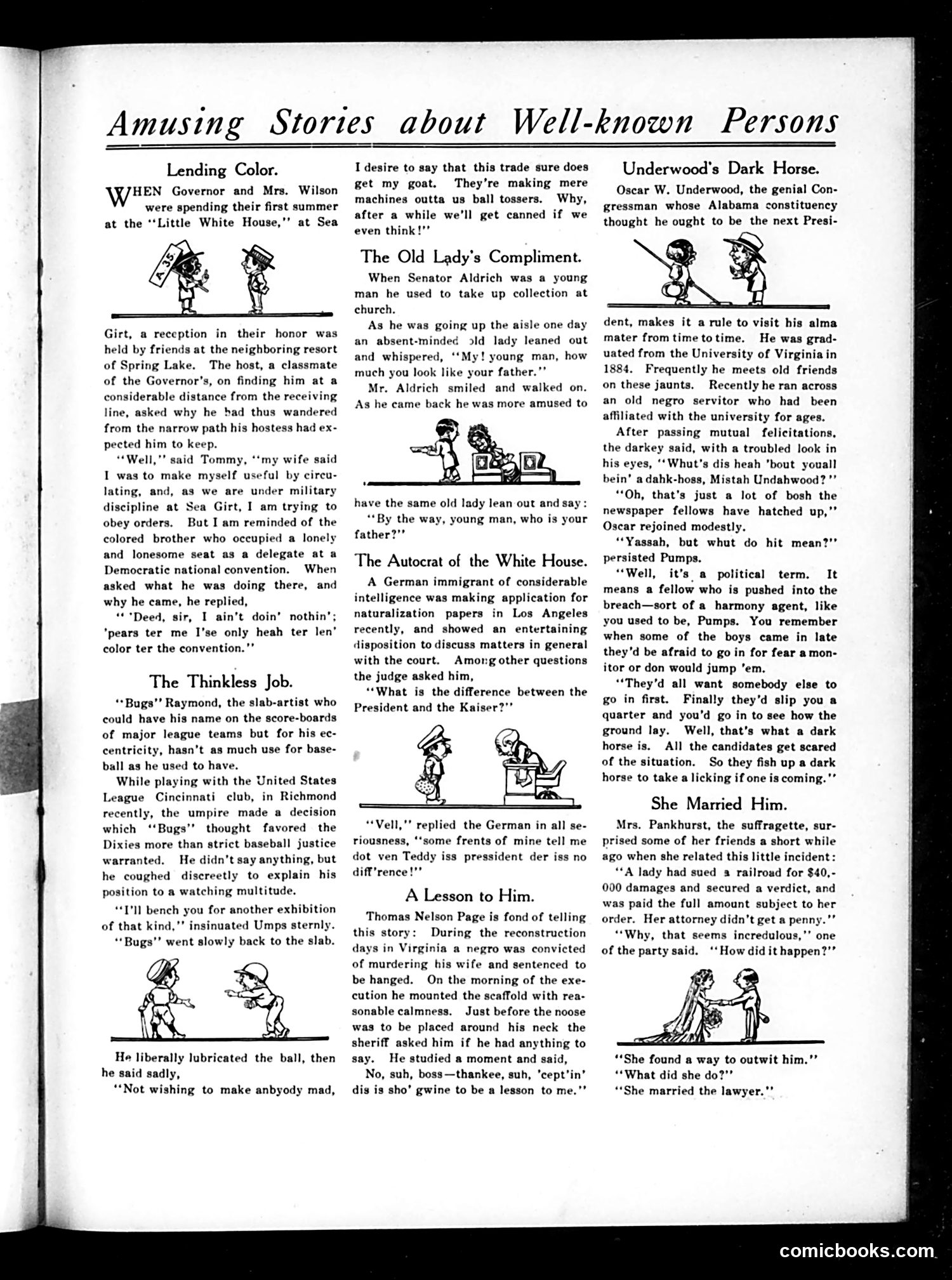
What you’re looking at
This page contains six brief satirical anecdotes mocking prominent political figures and social attitudes of the era (circa 1912, based on Wilson and Underwood references). **Key targets:** - **Governor Wilson** (future President): Satirized for rigid military discipline - **Senator Aldrich**: Mocked for vanity via a forgetful old lady's comment - **President Theodore Roosevelt**: A German immigrant's joke suggests Roosevelt acts like an autocrat/kaiser - **Oscar Underwood**: A "dark horse" presidential candidate - **Baseball pitcher "Bugs" Raymond**: Criticized for thinking independently rather than obeying umpires mechanically The anecdotes use **racist dialect** (the "colored brother," the freed Black man) as punchlines—reflecting period prejudices. The humor relies on exaggeration and wordplay rather than visual wit. The Roosevelt joke is the sharpest political critique, equating American presidential power with European autocracy.
📄 Transcribed text from this page (OCR, searchable)
Machine-transcribed from the original scan — historical spelling and the odd misread are preserved.
Lending Color. HEN Governor and Mrs. Wilson were spending their first summer at the ‘Little White House,’’ at Sea Girt, a reception in their honor was held by friends at the neighboring resort of Spring Lake. The host, a classmate of the Governor's, on finding him at a considerable distance from the receiving line, asked why he had thus wandered from the narrow path his hostess had ex- pected him to keep. “Well,’’ said Tommy, ‘‘my wife I was to make myself useful by circu- lating, and, as we are under military discipline at Sea Girt, I am trying to obey orders. But I am reminded of the colored brother who occupied a lonely and lonesome seat as a delegate at a Democratic national convention. When asked what he was doing there, and why he came, he replied, “Deed, sir, I ain't doin’ nothin’; ‘pears ter me I'se only heah ter len’ color ter the convention." The Thinkless Job. **Bugs’’ Raymond, the slab-artist who could have his name on the score-boards of major league teams but for his ec- centricity, hasn’t as much use for base- ball as he used to have. While playing with the United States League Cincinnati club, in Richmond recently, the umpire made a decision which ‘‘Bugs’’ thought favored the Dixies more than strict baseball justice warranted. He didn’t say anything, but he coughed discreetly to explain his position to a watching multitude. “I'll bench you for another exhibition of that kind,’’ insinuated Umps sternly. **Bugs’’ went slowly back to the slab. said He liberally lubricated the ball, then he said sadly, “Not wishing to make anbyody mad, I desire to say that this trade sure does get my goat. They’re making mere machines outta us ball tossers. Why, after a while we'll get canned if we even think!"" The Old Lady's Compliment. When Senator Aldrich was a young man he used to take up collection at church. As he was going up the aisle one day an absent-minded ld lady leaned out and whispered, ‘*My! young man, how much you look like your father.’" Mr. Aldrich smiled and walked on. As he came back he was more amused to have the same old lady lean out and say: “*By the way, young man, who is your father?” The Autocrat of the White House. A German immigrant of considerable intelligence was making application for naturalization papers in Los Angeles recently, and showed an entertaining disposition to discuss matters in general with the court. Among other questions the judge asked him, “What is the difference between the President and the Kaiser?"’ “Vell,” replied the German in all se- riousness, ‘some frents of mine tell me dot ven Teddy iss pressident der iss no diff’rence!"" A Lesson to Him. Thomas Nelson Page is fond of telling this story: During the reconstruction days in Virginia a negro was convicted of murdering his wife and sentenced to be hanged. On the morning of the exe- cution he mounted the scaffold with rea- sonable calmness. Just before the noose was to be placed around his neck the sheriff asked him if he had anything to say. He studied a moment and said, No, suh, boss—thankee, suh, ‘cept’in’ dis is sho’ gwine to be a lesson to me."’ Amusing Stories about Well-known Persons Underwood's Dark Horse. Oscar W. Underwood, the genial Con- gressman whose Alabama constituency thought he ought to be the next Presi- dent, makes it a rule to visit his alma mater fromtimetotime. He was grad- uated from the University of Virginiain 1884. Frequently he meets old friends on these jaunts. Recently he ran across an old negro servitor who had been affiliated with the university for ages. After passing mutual felicitations, the darkey said, with a troubled look in his eyes, ‘‘Whut’s dis heah "bout youall bein’ adahk-hoss, Mistah Undahwood?"’ “Oh, that's just a lot of bosh the newspaper fellows have hatched up,” Oscar rejoined modestly. “‘Yassah, but whut do hit mean?” persisted Pumps. ‘‘Well, it’s a political term. It means a fellow who is pushed into the breach—sort of a harmony agent, like you used to be, Pumps. You remember when some of the boys came in late they'd be afraid to go in for fear amon- itor or don would jump ‘em. “They'd all want somebody else to go in first. Finally they’d slip you a quarter and you'd go in to see how the ground lay. Well, that’s what a dark horse is. All the candidates get scared of the situation. So they fish up a dark horse to take a licking if one is coming."’ She Married Him. Mrs. Pankhurst, the suffragette, sur- prised some of her friends a short while ago when she related this little incident: “A lady had sued a railroad for $40,- 000 damages and secured a verdict, and was paid the full amount subject to her order. Her attorney didn’t get a penny.” “Why, that seems incredulous,’’ one of the party said. ‘‘How did it happen?’’ “She found a way to outwit him.”” “What did she do?”” “She married the lawyer."’ comicbooks.com.