
A complete issue · 24 pages · 1912
Judge — July 27, 1912
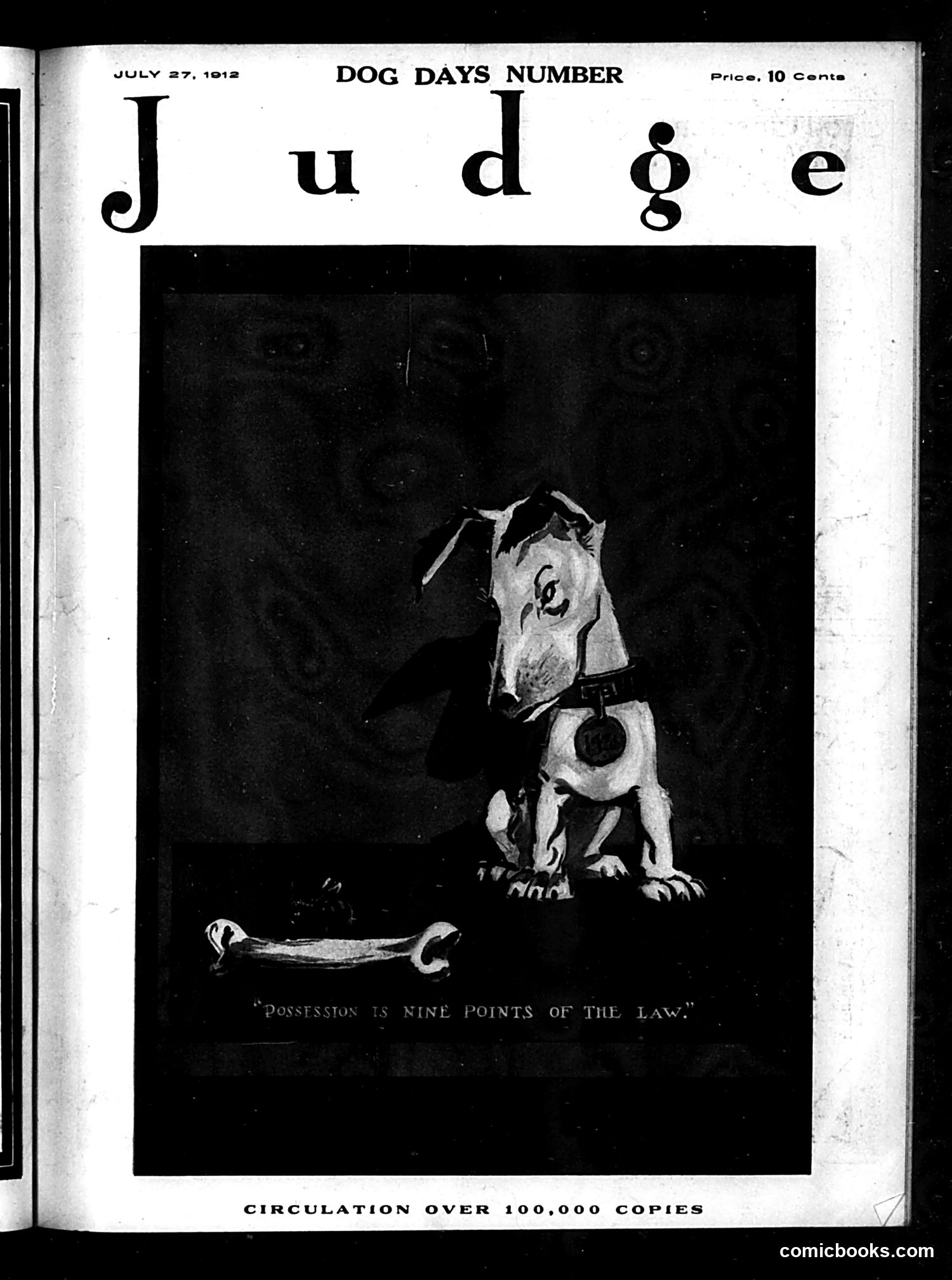
This is the "Dog Days Number" cover featuring a dog with a collar and tag, sitting beside a bone. The caption reads: "Possession is nine points of the law." The cartoon likely references a legal principle common in 1912 jurisprudence—that actual possession of property provides strong claim to ownership. The dog humorously illustrates this concept: it currently possesses the bone, therefore asserting legal ownership despite potentially not being the original owner. The satirical point may also relate to contemporary political or legal disputes where possession determined rights—possibly referencing property disputes, business conflicts, or political claims of the 1912 era. Without additional context about specific 1912 events, the core joke remains the straightforward legal pun applied to the dog's bone.
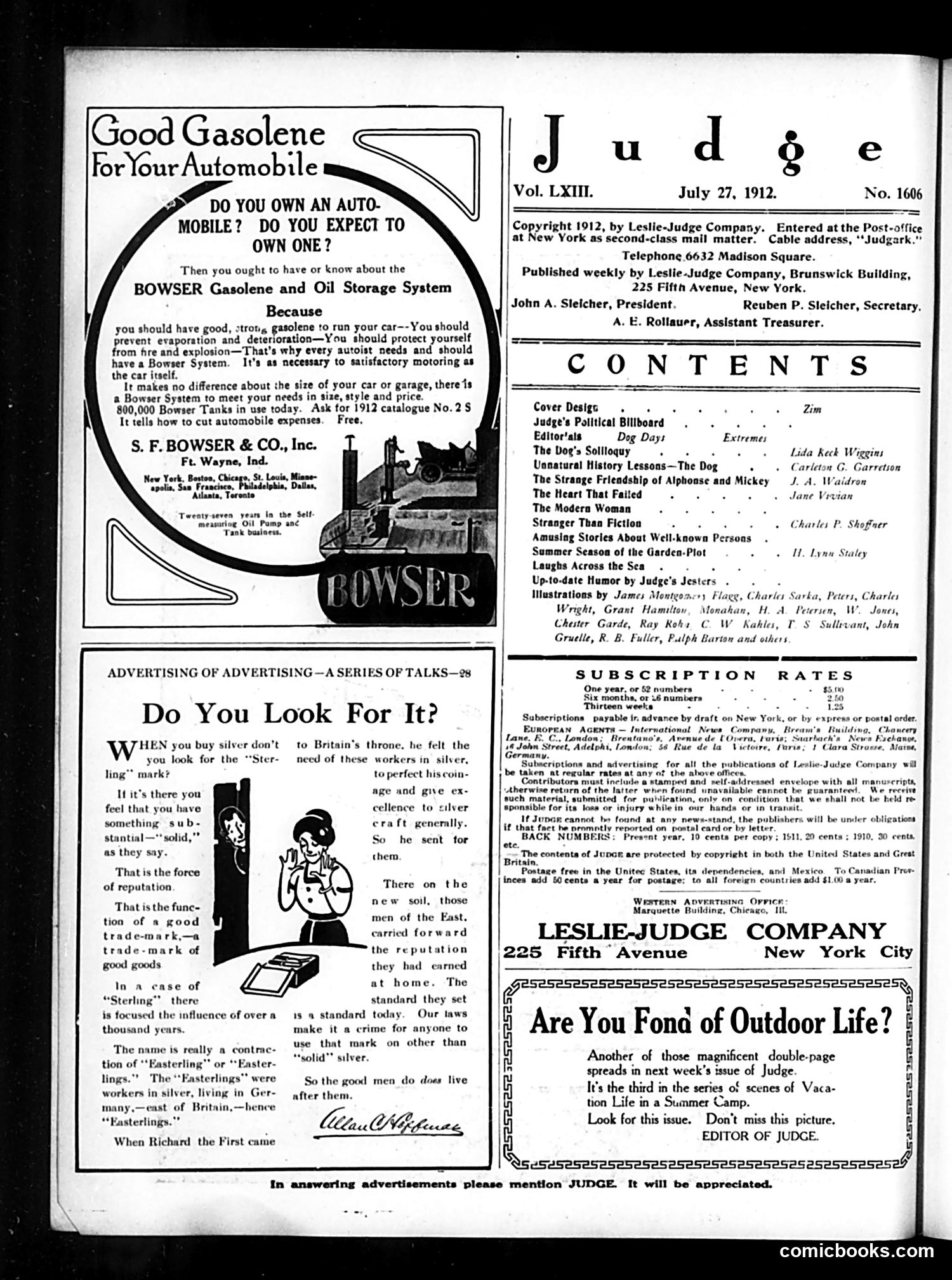
The main cartoon titled "Do You Look For It?" discusses trademark recognition and consumer behavior. It uses the metaphor of seeking "sterling" quality in goods—comparing it to British silversmiths' marks that guaranteed authenticity. The figure shown appears to represent a tradesman or craftsperson. The satire argues that consumers should seek recognized brand marks on products, just as people trust hallmarked silver. The cartoonist suggests brand reputation functions like a craftsman's seal—a guarantee of quality earned over time. The page is primarily advertising, with a prominent Bowser gasoline storage system ad and subscription information for Judge magazine. The cartoon exemplifies early 20th-century marketing rhetoric emphasizing brand trust and standardization.
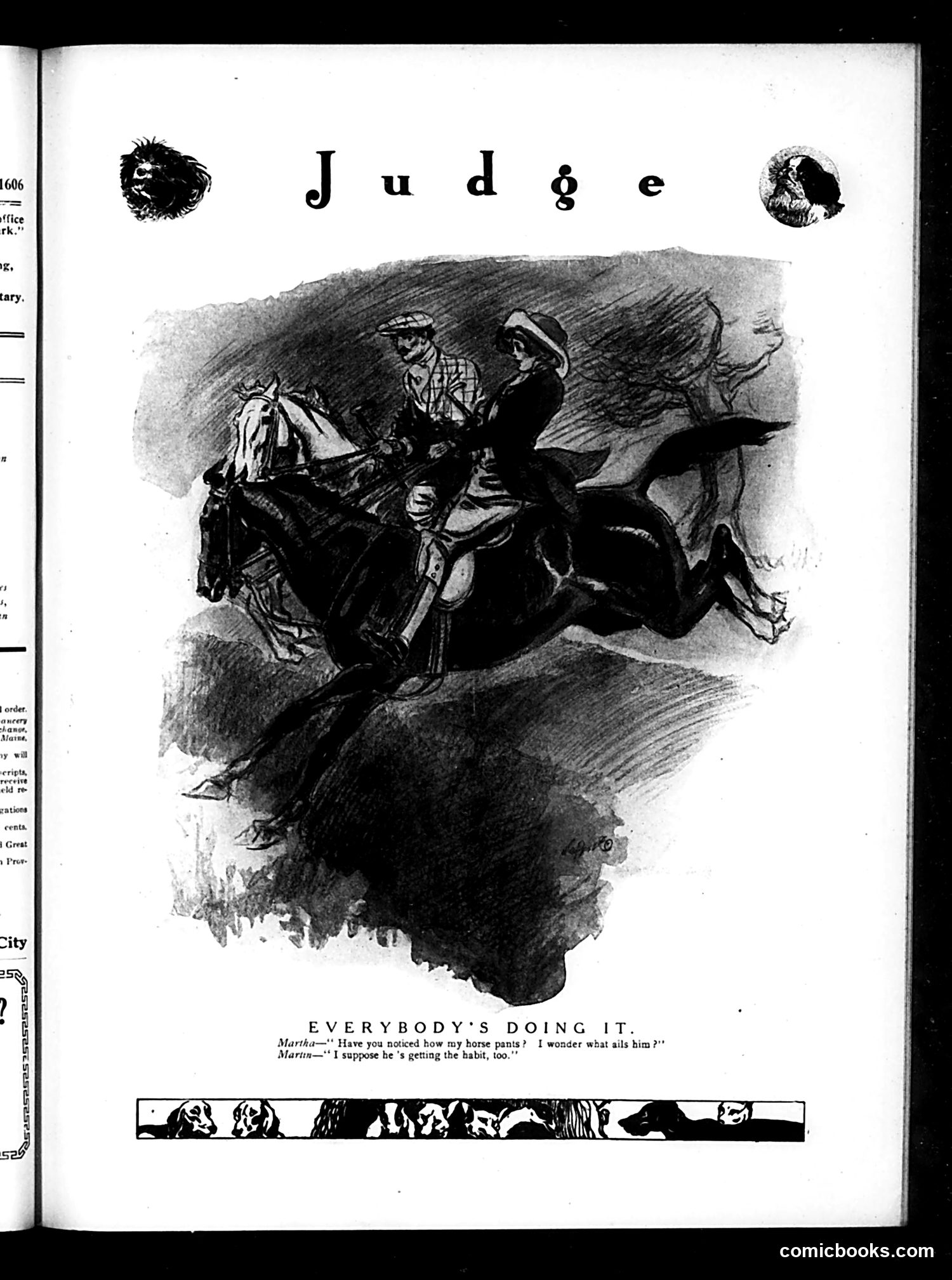
The page shows a satirical cartoon titled "Judge" with the caption "EVERYBODY'S DOING IT." Below, dialogue between two characters named Martha and Maria discusses a horse developing a habit, with Maria suggesting the horse is "getting the habit, too." The cartoon depicts two figures on horseback riding energetically. The "habit" referenced appears to be a drug addiction, likely cocaine or opium use—which was a significant social concern in early 20th-century America. The satire suggests that substance abuse had become so widespread that even animals were supposedly succumbing to it, mocking both the epidemic's prevalence and society's casual acceptance of the problem. This reflects Judge magazine's typical approach of using exaggeration and dark humor to critique social vices.
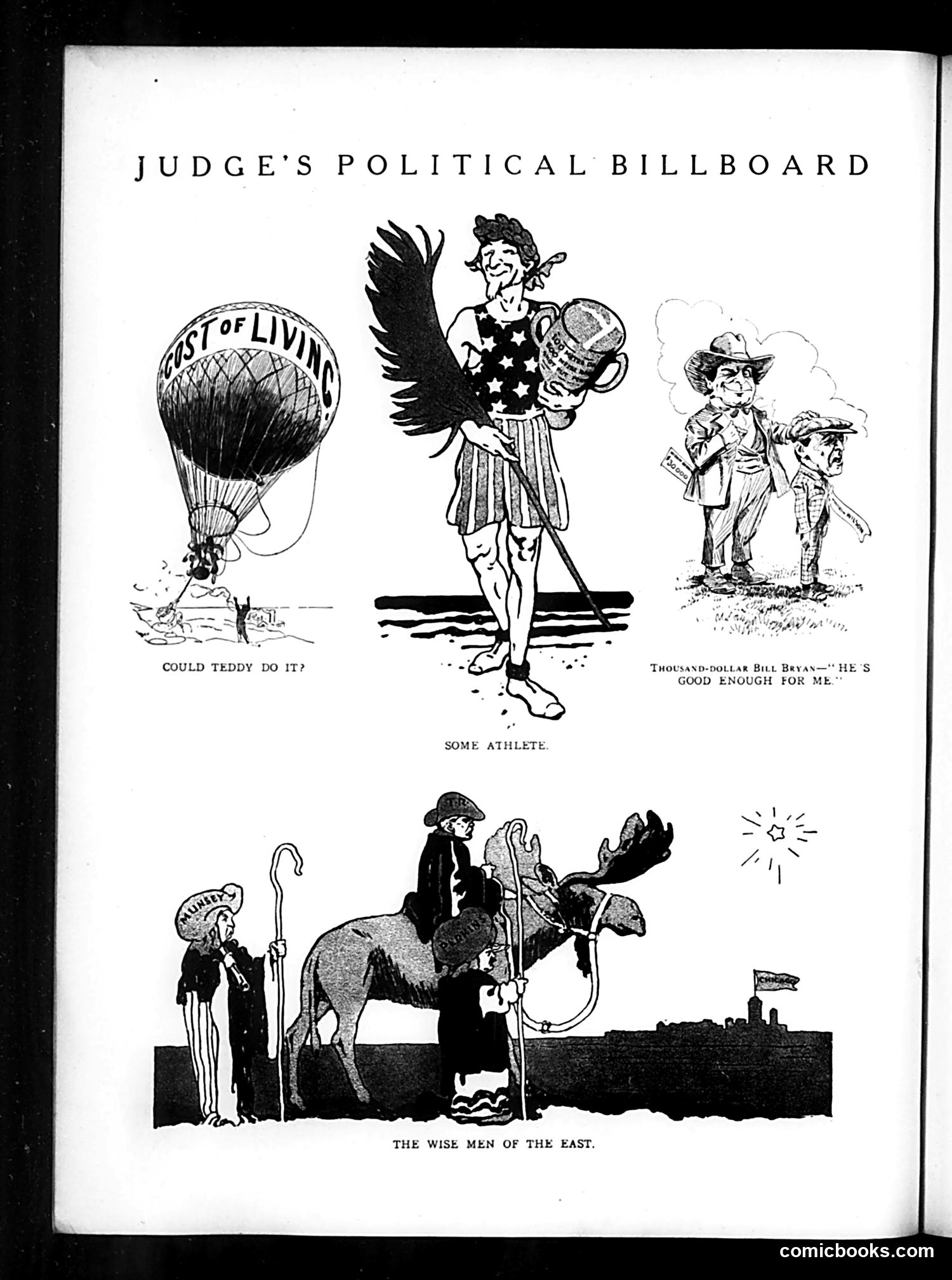
This page satirizes prominent early 20th-century political figures through caricature. **Top section:** Features three panels mocking athletic/physical prowess metaphors in politics. "Could Teddy Do It?" references Theodore Roosevelt and his famous vigor. The central "athlete" figure represents political capability. The right panel's "Thousand-Dollar Bill Bryan" likely references William Jennings Bryan, the three-time presidential candidate, with the caption suggesting he's adequate but not exceptional. **Bottom section:** "The Wise Men of the East" depicts figures arriving by camel—a biblical reference to the Magi. The silhouetted cityscape suggests political figures entering American politics from abroad or from established power centers, likely critiquing foreign policy influence or establishment politics. The overall theme mocks political leaders' claims of strength and wisdom during an era of heated electoral debate.
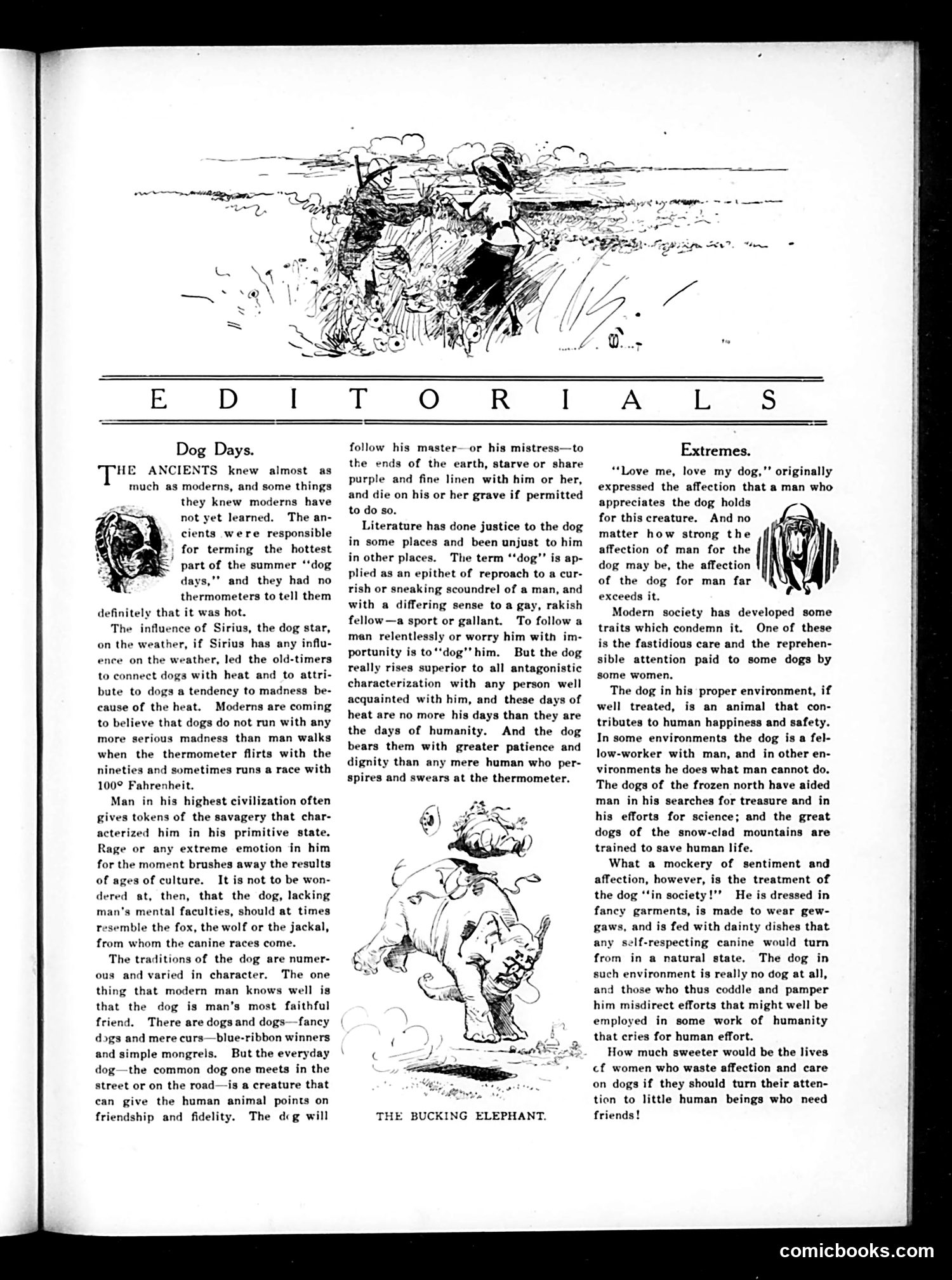
This Judge magazine page contains two editorial pieces about dogs, illustrated with satirical drawings. The left column "Dog Days" discusses how ancient and modern societies have treated dogs, noting that the dog remains humanity's most faithful friend despite occasional mistreatment. The right column "Extremes" critiques how modern "society" mishandles dogs—dressing them in fancy garments and feeding them unsuitable food while ignoring their natural needs. The cartoon titled "THE BUCKING ELEPHANT" depicts a dog riding an elephant, likely satirizing fashionable or absurd pet-keeping practices among the wealthy. Overall, the page mocks both excessive sentimentality toward pets and the disconnect between how dogs are treated versus their actual welfare needs.
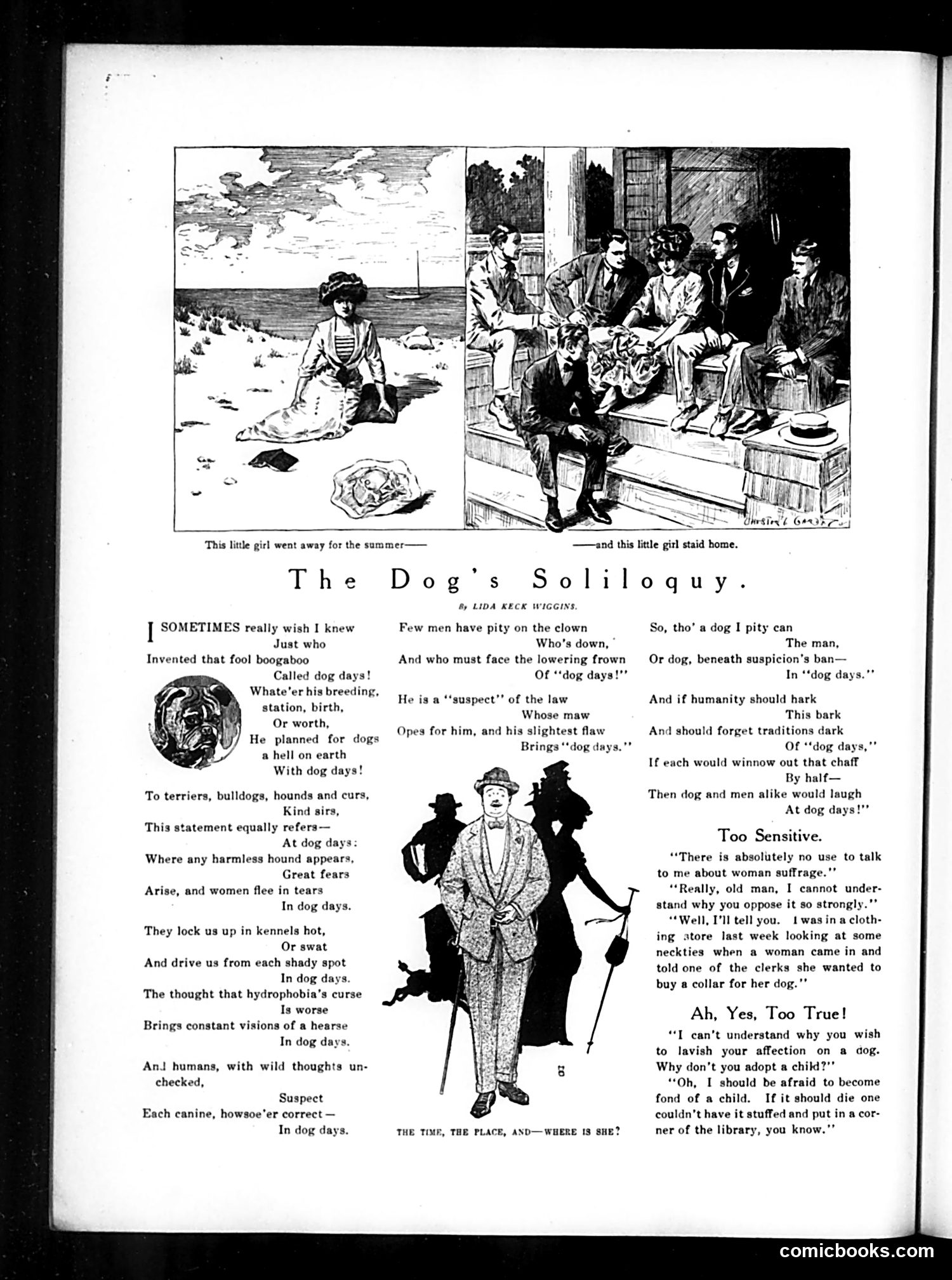
This page satirizes "dog days"—the hot summer period (July-August) when, in era folklore, dogs supposedly went mad and rabies spread. The main poem, written from a dog's perspective, mocks the panic this caused: dogs faced confinement, abuse, and societal suspicion simply because of the season, not actual behavior. The satire works on two levels: it ridicules the *irrational* fear of dogs during summer, and uses the dog's mistreatment as social commentary—comparing how baseless suspicion treats both animals and marginalized people unfairly. The accompanying jokes about women and suffrage feel disconnected, suggesting multiple satirical pieces on one page. The top panels show a girl leaving home (suggesting a plot development, perhaps unrelated to the dog material).
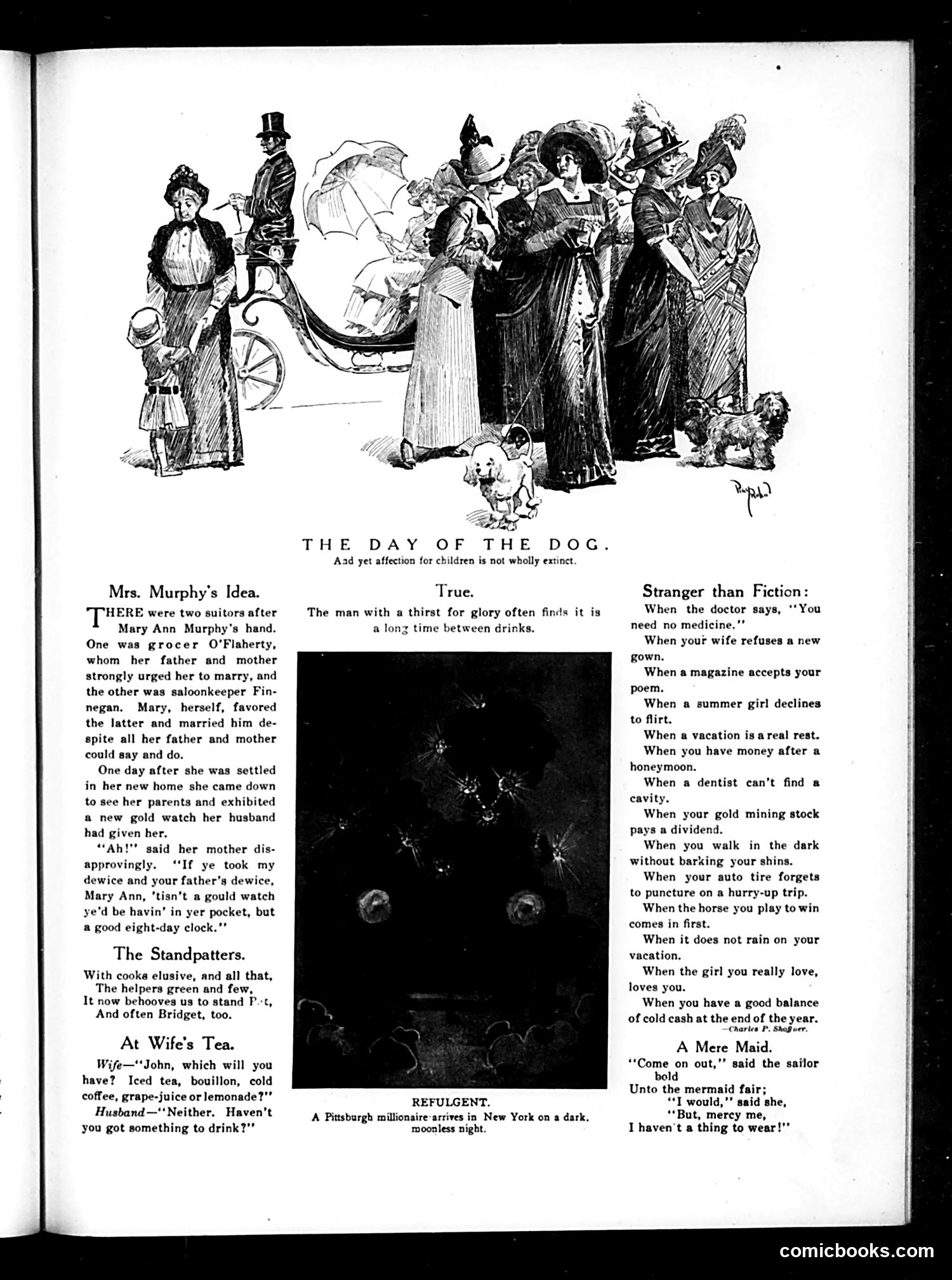
This page from *Judge* magazine contains several brief satirical pieces targeting early 1900s American social life. **"Mrs. Murphy's Idea"** mocks Irish immigrant class aspiration: Mary Ann chooses a saloonkeeper over a grocer (both working-class), disappointing her parents. When she proudly displays a gold watch from her husband, her mother dismissively notes they could have bought a better clock with combined savings—satirizing how modest immigrant wealth produces modest results. **"The Standpatters"** appears to reference domestic labor shortages and the difficulty of maintaining households without reliable servants ("helpers green and few"). **"True"** and **"Stranger than Fiction"** are humorous observations about unlikely or rare occurrences in modern life—the latter listing improbable scenarios (doctors recommending no medicine, wives refusing new gowns) as absurdities. The remaining pieces are light comic vignettes about marital dynamics and romantic situations, typical of *Judge*'s entertainment-focused humor rather than hard political satire.
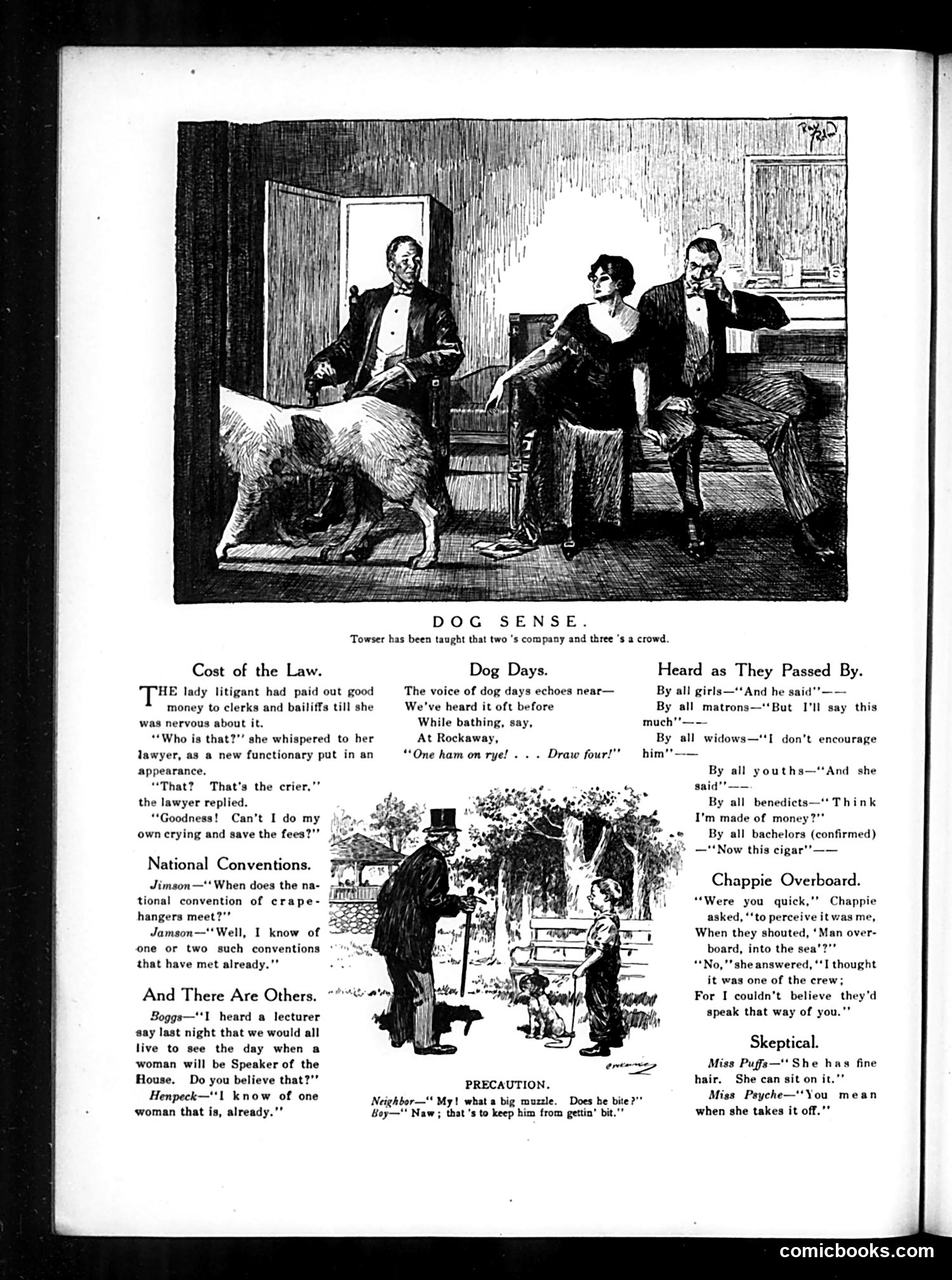
This Judge magazine page contains multiple brief satirical jokes typical of early 20th-century American humor. **Top illustration**: Shows a well-dressed woman with her lawyer and a man in formal dress, with a dog present. The caption "Towser has been taught that two's company and three's a crowd" appears to be a double-entendre joke about propriety and social awkwardness. **Text sections** include several short gags: - "Cost of the Law" mocks litigation expenses, with a woman shocked to learn the "crier" is a court officer (not someone paid for emotional support) - "Dog Days" references summer bathing season with a joke about hot-dog vendors at Rockaway - "National Conventions" puns on convention delegates as "crape-hangers" (mourners) - Various observations about how different groups (matrons, widows, youths) speak - "Skeptical" contains jokes about women's hair The humor relies on wordplay, gender stereotypes, and social observation typical of the era—much would seem dated or offensive to modern readers.
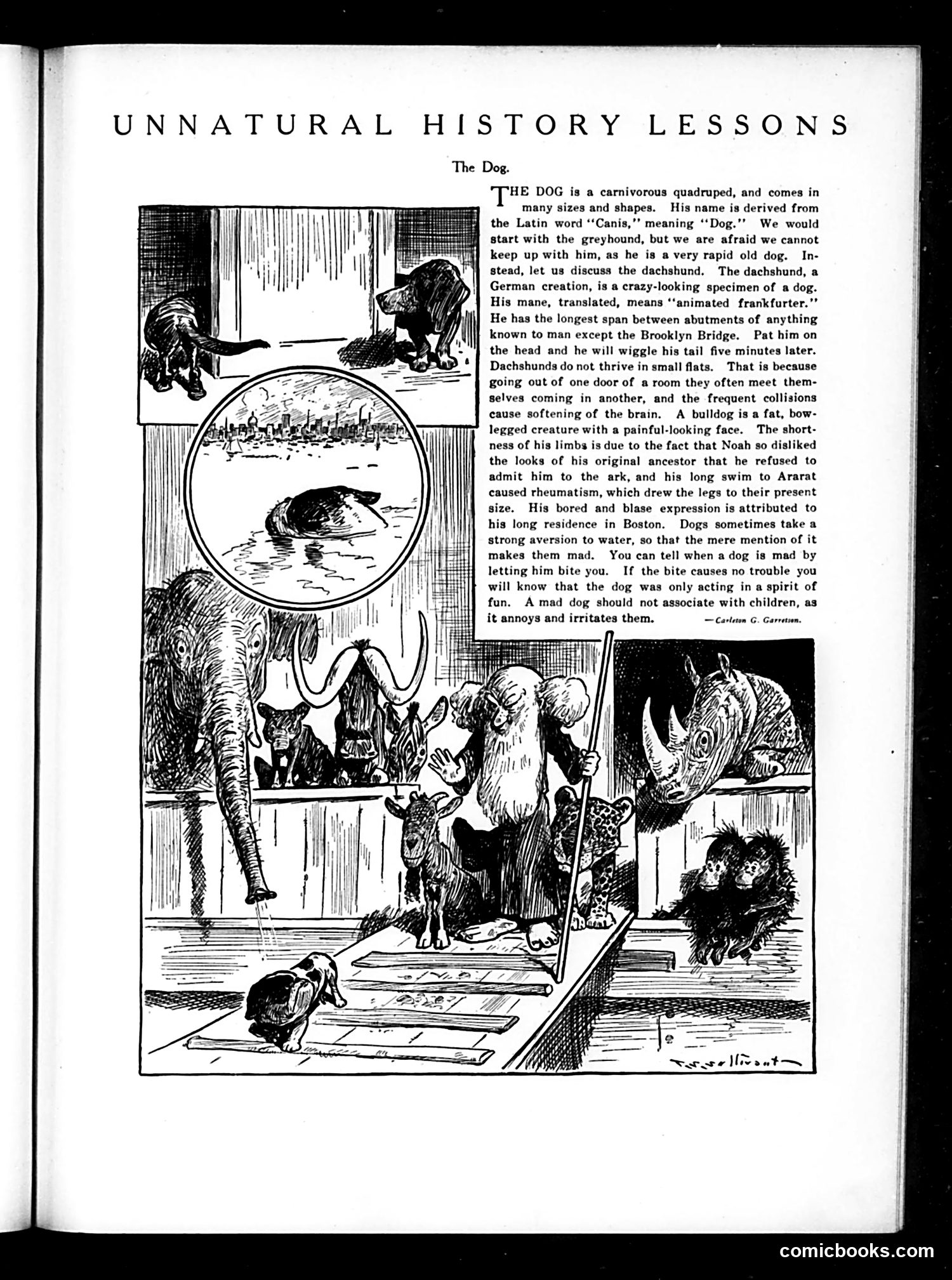
This is a humorous faux-educational essay mocking the earnest, pseudo-scientific tone of natural history textbooks. The author (credited as Carleton G. Garreton) uses absurdist logic to "explain" dog breeds through ridiculous pseudo-etymology and fabricated origin stories. Key satirical points: - The dachshund's elongated body is jokingly compared to the Brooklyn Bridge (a contemporary marvel) - Its name supposedly means "animated frankfurter" - Bulldogs' short legs allegedly resulted from Noah disliking their ancestor and refusing them ark passage, causing a long swim that gave them rheumatism - Bulldogs' bored expressions are attributed to "long residence in Boston" - The closing joke about distinguishing mad dogs by letting them bite you exemplifies the absurdist humor throughout The accompanying illustrations show various dogs and exotic animals in museum/display settings. The satire targets the pretentious scientific certainty of educational materials while poking fun at dog breed characteristics and Boston society.
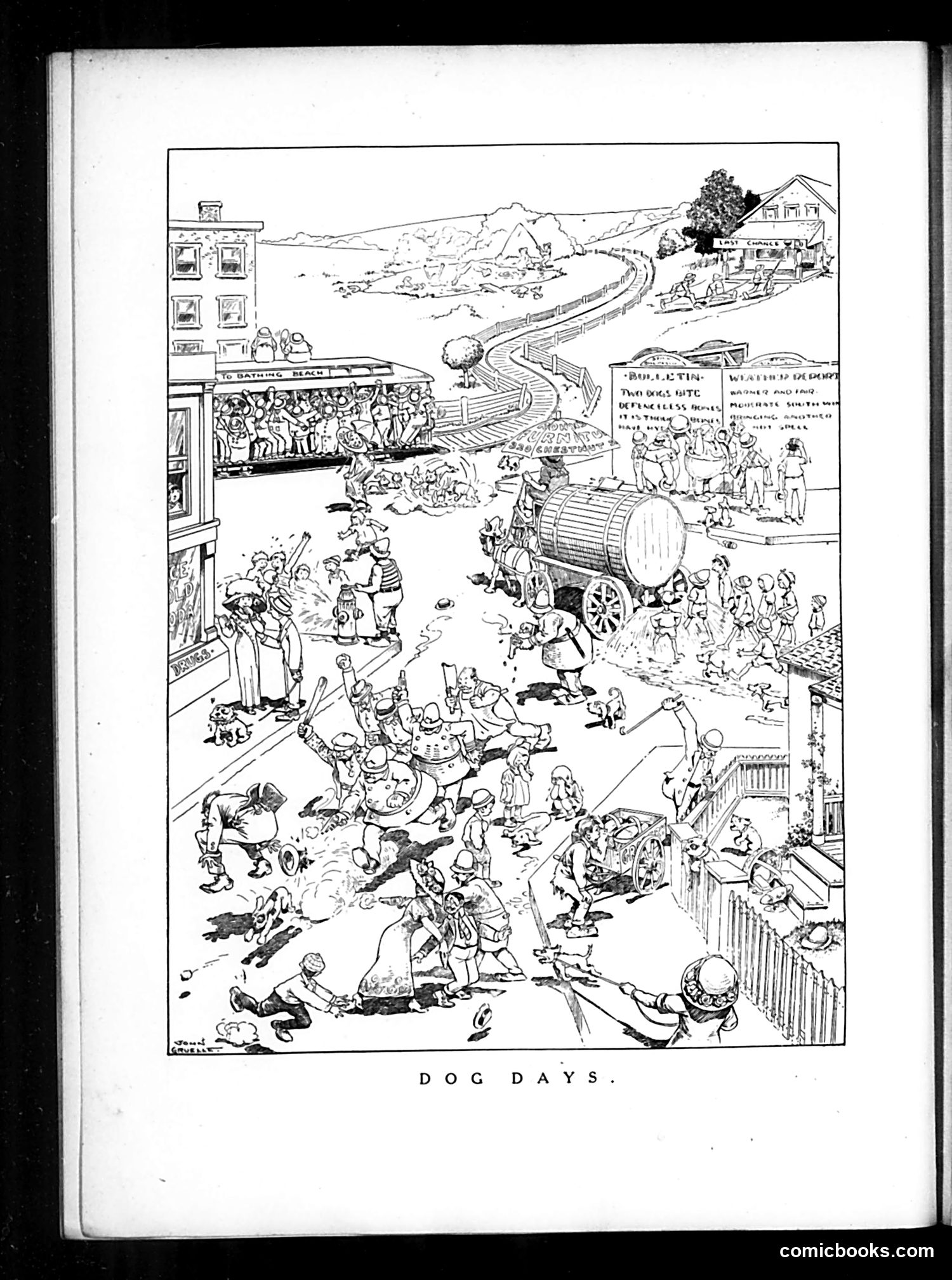
This is a satirical illustration titled "Dog Days," depicting a chaotic seaside amusement park or resort scene. The cartoon shows numerous figures engaged in various summer activities and mishaps—swimming, boating, riding in a water barrel contraption, playing games, and general pandemonium. The satire appears to mock the crowded, hectic nature of popular vacation destinations during hot summer months. The abundance of people, the absurd contraptions, and the general disorder suggest commentary on how summer resorts devolve into scenes of comic chaos and undignified behavior when masses of people gather. A bulletin board visible in the scene likely contains additional satirical text or notices relevant to the scene's theme. The "Dog Days" title references both the summer season and the behavior depicted—people behaving like dogs in their frantic, unruly conduct.
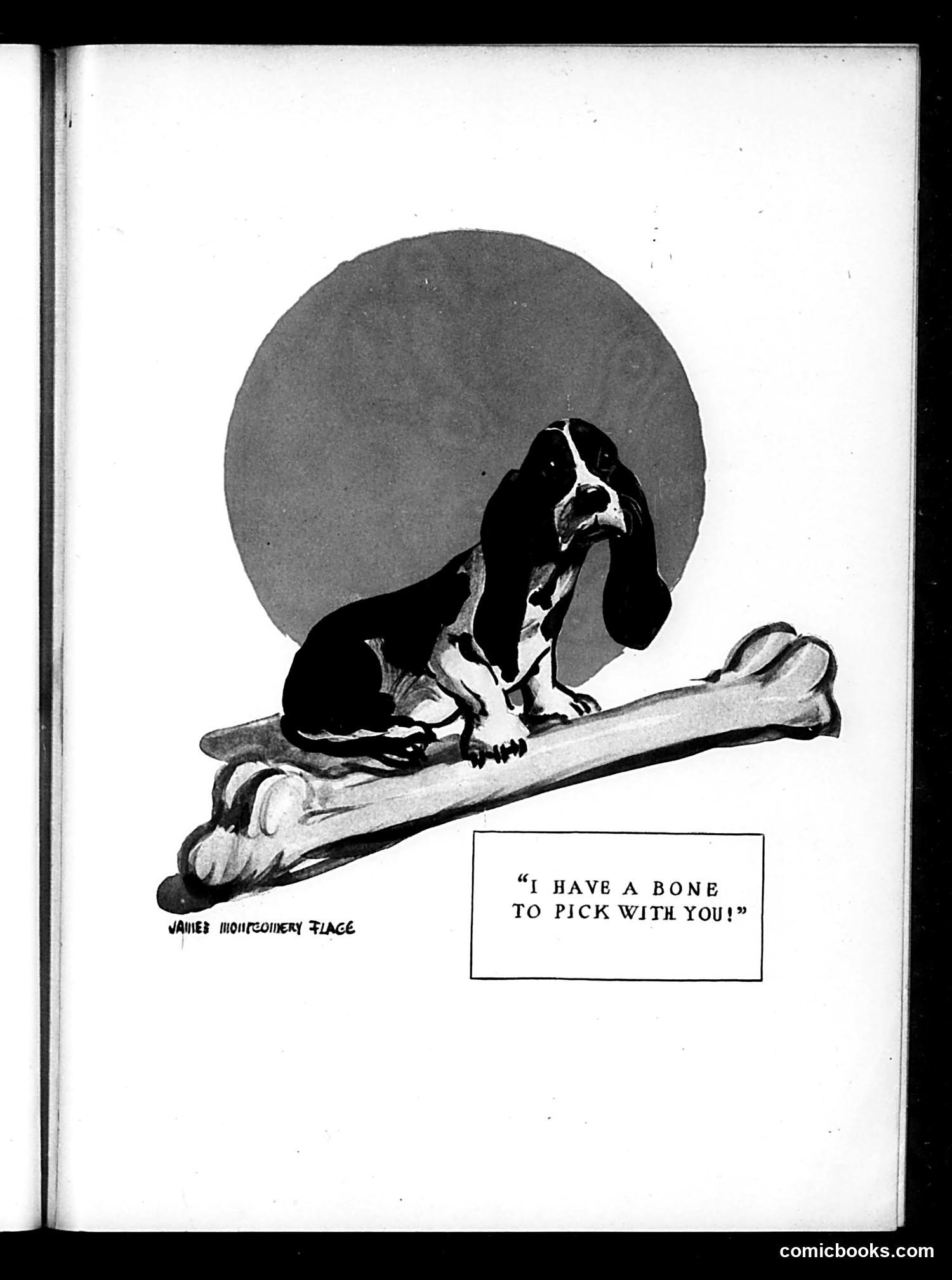
This is a single-panel cartoon by James Montgomery Flagg showing a basset hound lying on a large bone, looking up with an expression of complaint or confrontation. The caption reads "I have a bone to pick with you!" The humor is a visual pun: the dog literally has a bone (the object it's lying on) while using the common idiom "to have a bone to pick with someone," which means to have a grievance or complaint to discuss. The cartoon plays on this double meaning for comedic effect. There's no apparent political or social satire here—it's simply a wordplay-based joke typical of Judge magazine's lighter humor content. The basset hound's droopy expression adds to the comedic effect, suggesting mock indignation.
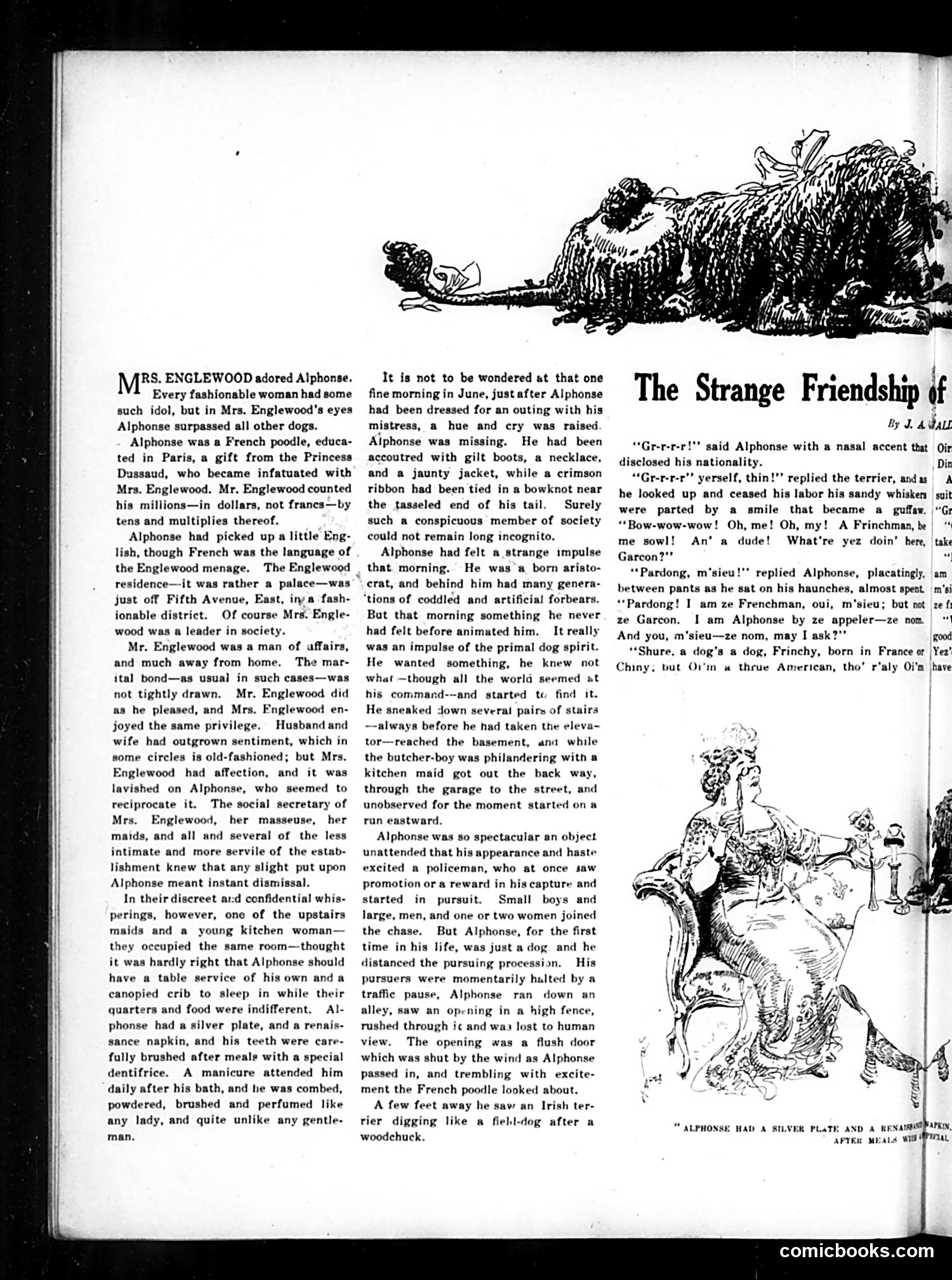
This is the opening of a satirical short story about **Alphonse, a pampered French poodle** owned by a wealthy Fifth Avenue society woman, Mrs. Englewood. The satire targets **conspicuous consumption and class absurdity**: Alphonse receives more care and consideration than the household servants—he has a silver plate, Renaissance napkins, daily manicures, gilt boots, and a canopied crib, while the upstairs maids and kitchen staff live in poor conditions. The story's setup mocks both **nouveau-riche American wealth** (Mr. Englewood's millions) and the sentimental excess of fashionable society women who lavish affection on pets rather than people. When Alphonse escapes one morning—having felt "the primal dog spirit"—he becomes momentarily just a dog rather than a status symbol, sparking a comic chase through the city. The illustrations show Alphonse as an absurdly overdressed creature, emphasizing the ridiculousness of his treatment.
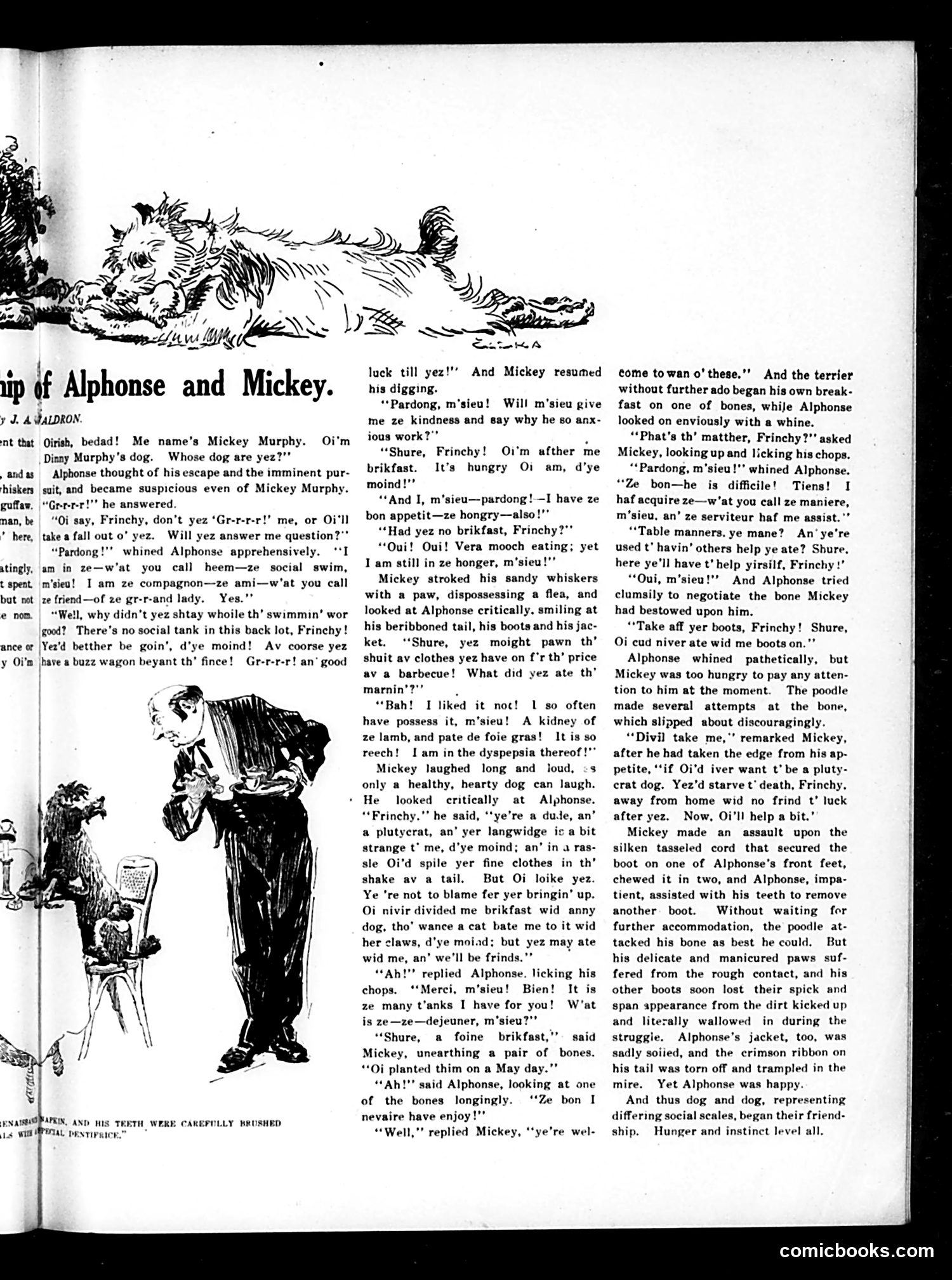
This is a humorous story illustrated with sketches, not primarily a political cartoon. It depicts two dogs of contrasting social classes: **The Characters:** Mickey Murphy is an Irish working-class terrier; Alphonse is a French poodle of aristocratic pretension—evidenced by his fancy boots, ribboned tail, refined vocabulary, and references to "pate de foie gras" and table manners. **The Satire:** The story mocks class pretension and social hierarchy. Alphonse, despite his wealth and refinement, is reduced to envying Mickey's simple bone. The humor derives from Alphonse's exaggerated politeness ("m'sieu," "Merci") and his struggle with basic dog behavior—he needs a servant to help him eat, yet is desperate and hungry. **The Point:** This appears to be gentle satire on European class distinctions and the absurdity of maintaining artificial dignity in practical situations. Hunger and instinct override social pretense—a common Judge magazine theme about the folly of excessive formality.
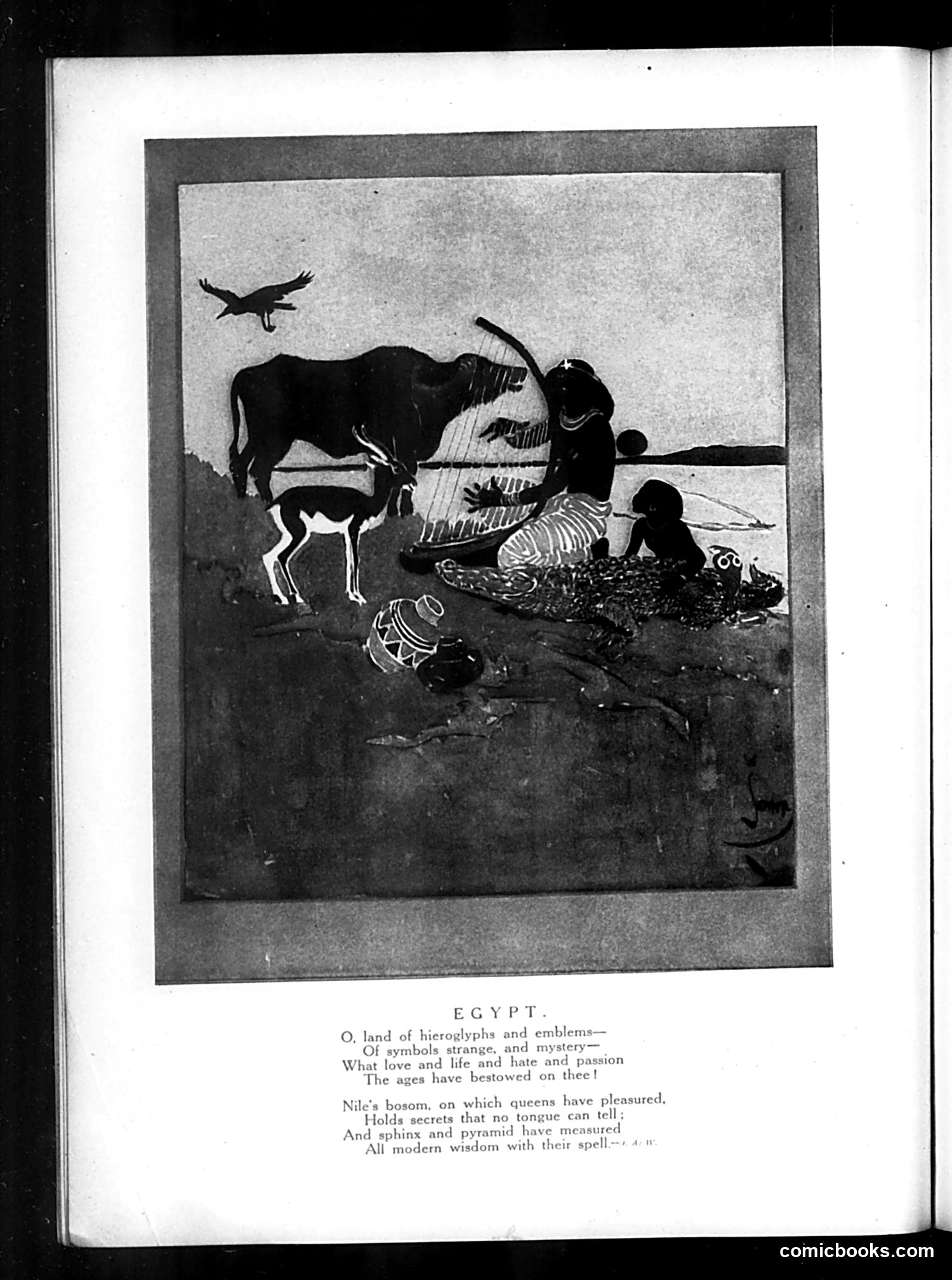
This is a romantic/poetic illustration titled "EGYPT" rather than political satire. The image depicts silhouetted figures in an Egyptian landscape—including a cow, people, and a flying bird—rendered in an artistic, mysterious style. The accompanying verse romanticizes Egypt as an ancient land of secrets, hieroglyphs, and enigmas. It references the Nile River, queens, sphinxes, and pyramids—standard Orientalist tropes common in early 20th-century Western art. The poem suggests Egypt's monuments hold wisdom lost to modernity. This reflects contemporary fascination with Egyptology (King Tut's tomb was discovered in 1922). Rather than satirizing specific politics or figures, this page indulges aesthetic nostalgia for "exotic" ancient civilizations—a common Judge magazine feature blending art, poetry, and cultural commentary for educated readers.
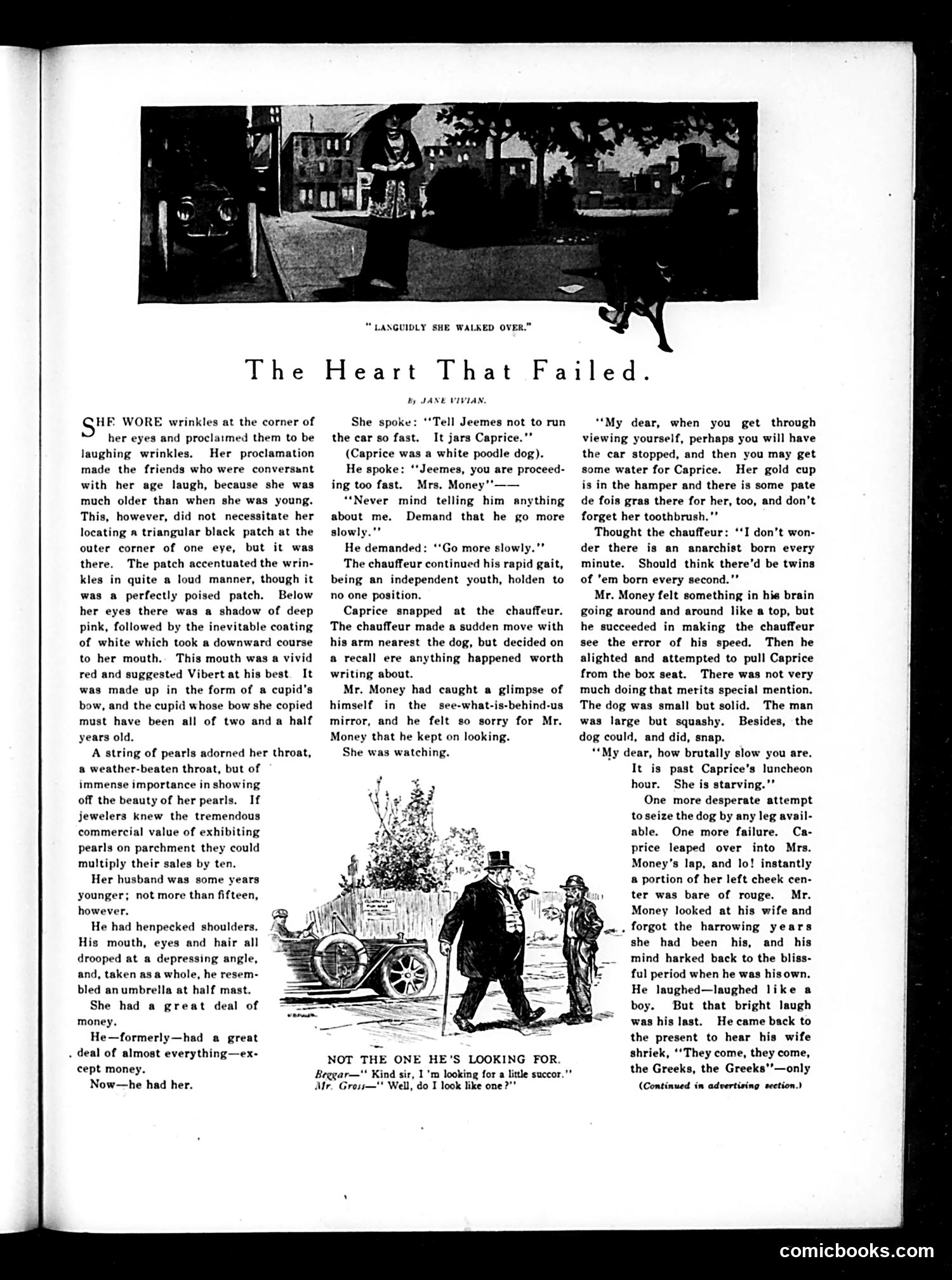
This story satirizes a common turn-of-the-century social type: the wealthy, aging woman married to a younger, henpecked man. The wife is caricatured through exaggerated makeup (cupid's bow lips, heavy rouge, beauty patches) and imperious behavior—she dominates her submissive husband through financial control ("She had a great deal of money. He...had her"). The satire's target is materialistic marriage and the inversion of traditional gender roles. The husband, described as drooping "like an umbrella at half mast," has surrendered his independence. The accompanying cartoon shows a beggar and wealthy man—illustrating class commentary about economic desperation. The story's title suggests emotional hollowness: beneath the wife's beauty rituals and domineering behavior, and the husband's financial dependence, neither has genuine feeling. The humor derives from detailed observations of superficial, transactional marriage among the wealthy.
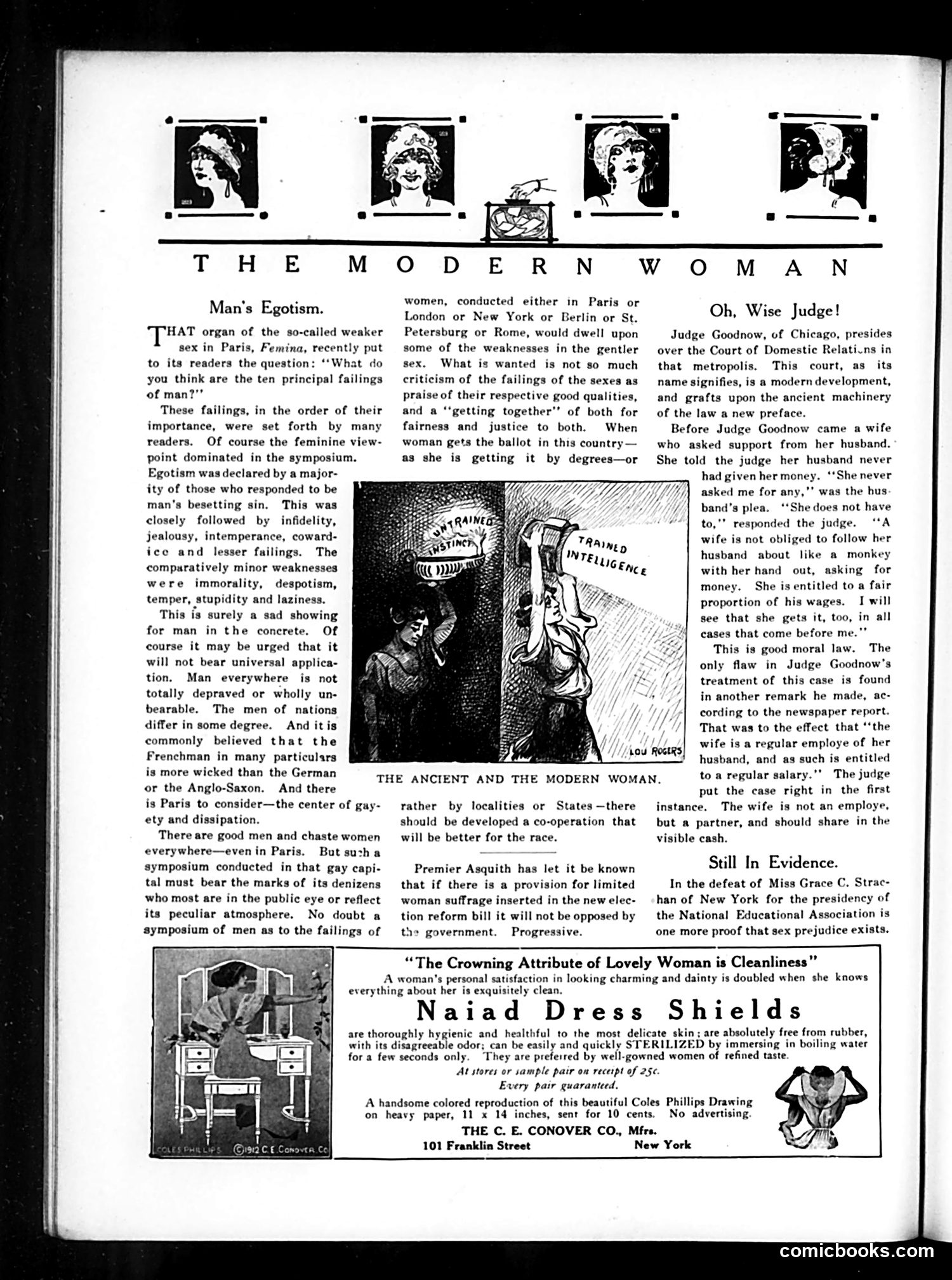
This page satirizes **gender relations and hypocrisy** in early 20th-century attitudes toward women's rights. **Main cartoon ("The Ancient and the Modern Woman"):** Depicts two female figures labeled "Trained Instinct" (traditional woman) and "Trained Intelligence" (modern woman), illustrating the debate about women's evolving roles. **"Man's Egotism" article:** References a French magazine's survey asking women to list men's greatest faults. The piece critiques male-dominated discourse while calling for mutual respect between sexes as women gain voting rights (suffrage was being debated internationally). **"Oh, Wise Judge!"** Praises Judge Goodnow's ruling that wives deserve financial support from husbands—but ironically critiques his framing: he correctly calls wives "partners" (not employees), yet previously described them as "regular employees," revealing the logical inconsistency in how men conceptualized women's legal status. **"Still In Evidence":** Notes Grace Strachan's loss in a National Educational Association election, attributing it to sex prejudice. The page's underlying message: despite progressive legal developments, deep gender bias persists.
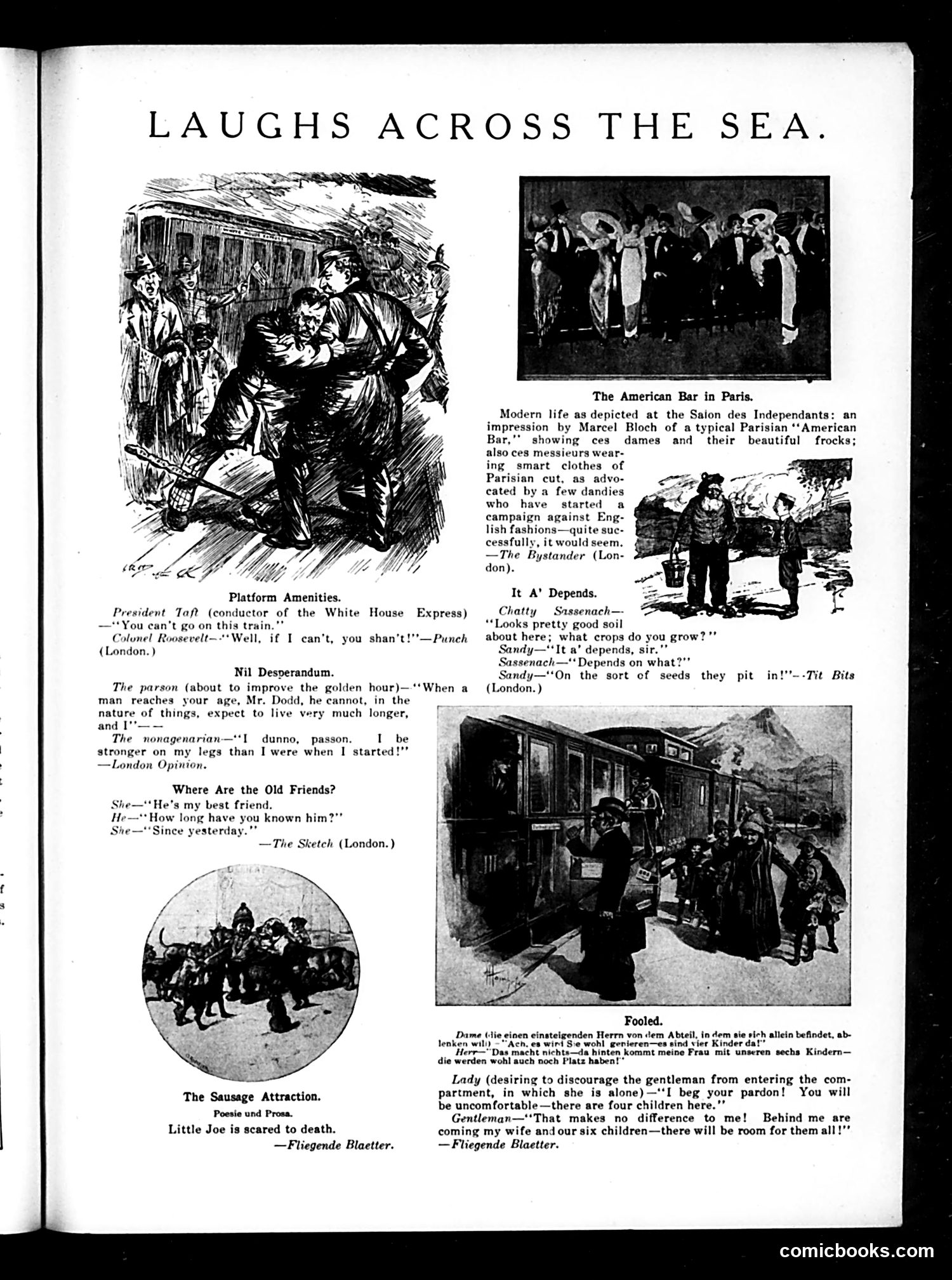
This page collects comic anecdotes and cartoons from British and European sources, arranged thematically around transatlantic observations and everyday life. The opening cartoon references President Taft and Colonel Roosevelt—likely alluding to their political split, with Taft (as "conductor") refusing Roosevelt passage, and Roosevelt retaliating ("if I can't, you shan't!"). This reflects their rivalry following Roosevelt's presidency. Other jokes satirize class anxieties (a nonagenarian defying death expectations), rapid modern friendships, and cross-cultural misunderstandings (a Scottish farmer's cryptic dependence on seed quality; English and German passengers miscommunicating about train compartment space). "The American Bar in Paris" critiques wealthy Americans abroad and French dandies adopting English fashion—capturing period anxieties about cultural influence and authenticity. The page's title suggests Judge was positioning itself as cosmopolitan, sharing refined humor "across the sea" with international audiences.
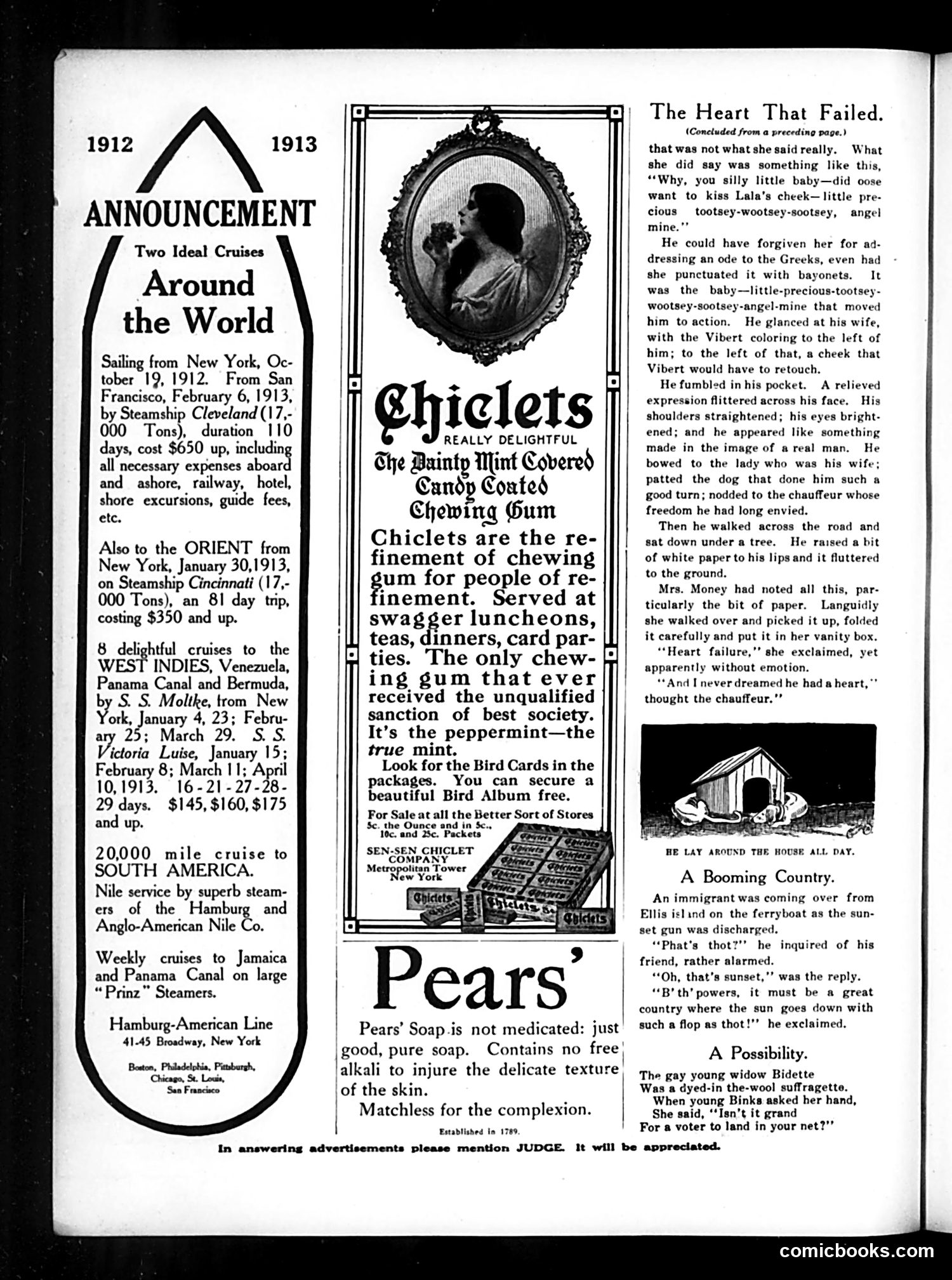
This page is primarily **advertising**, featuring cruise ship announcements and product ads (Chiclets chewing gum, Pears' Soap, Hamburg-American Line). The small satirical content includes three brief humorous stories: 1. **"The Heart That Failed"** - A domestic drama where a man discovers his wife's infidelity but finds peace through an unstated action (likely suicide, given the "heart failure" conclusion). Social commentary on marriage and propriety. 2. **"A Booming Country"** - An ethnic humor piece mocking an Irish immigrant's amazement at America's prosperity, using stereotypical dialect ("B' th' powers"). 3. **"A Possibility"** - A brief joke about a widow suffragette asking a suitor if voting rights are "grand"—satirizing women's suffrage activism as mercenary or absurd. The page reflects early-1900s Judge magazine's blend of travel advertising with light satirical content targeting contemporary social issues (suffrage, immigration, marriage).
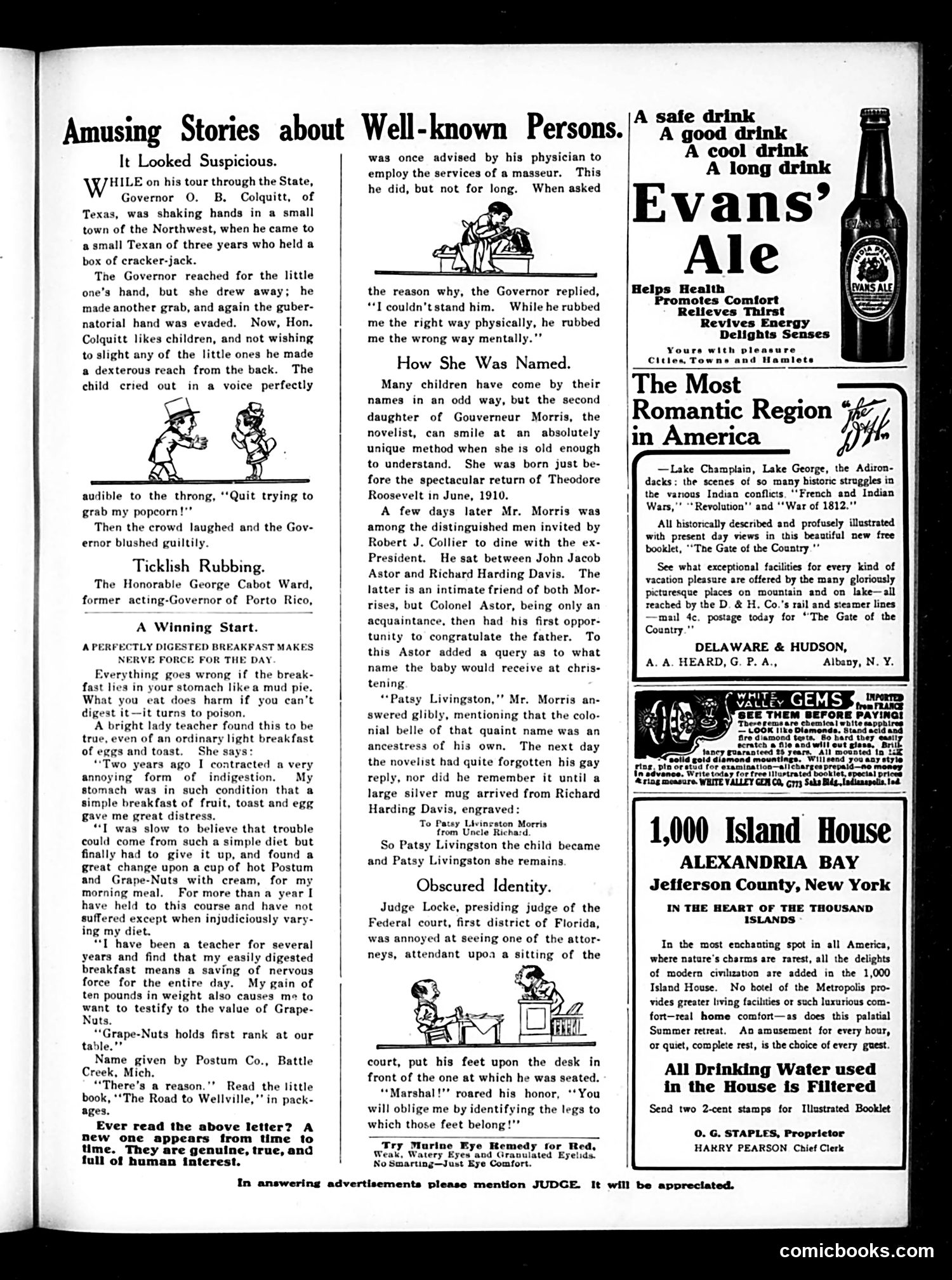
This page contains three humorous anecdotes about prominent American figures, typical of Judge magazine's "Amusing Stories about Well-known Persons" section. **"It Looked Suspicious"** mocks Texas Governor O. B. Colquitt's awkward attempt to shake a child's hand—she misinterprets his reaches as grabs for her cracker-jack snack, loudly accusing him of trying to steal her popcorn. The joke plays on the governor's embarrassment and the child's innocent misreading of his intentions. **"Ticklish Rubbing"** features former Puerto Rico governor George Cabot Ward rejecting a masseur because, while the physical rubbing helped, the masseur's personality bothered him—a play on the phrase "rubbed the wrong way." **"How She Was Named"** describes novelist Gouverneur Morris casually naming his newborn daughter "Patsy Livingston" during dinner conversation with John Jacob Astor and Richard Harding Davis (1910). When Davis takes him seriously and sends an engraved silver mug, the joke becomes that the offhand remark becomes the child's permanent name. These are gentle social satires targeting wealthy, prominent men of the era.
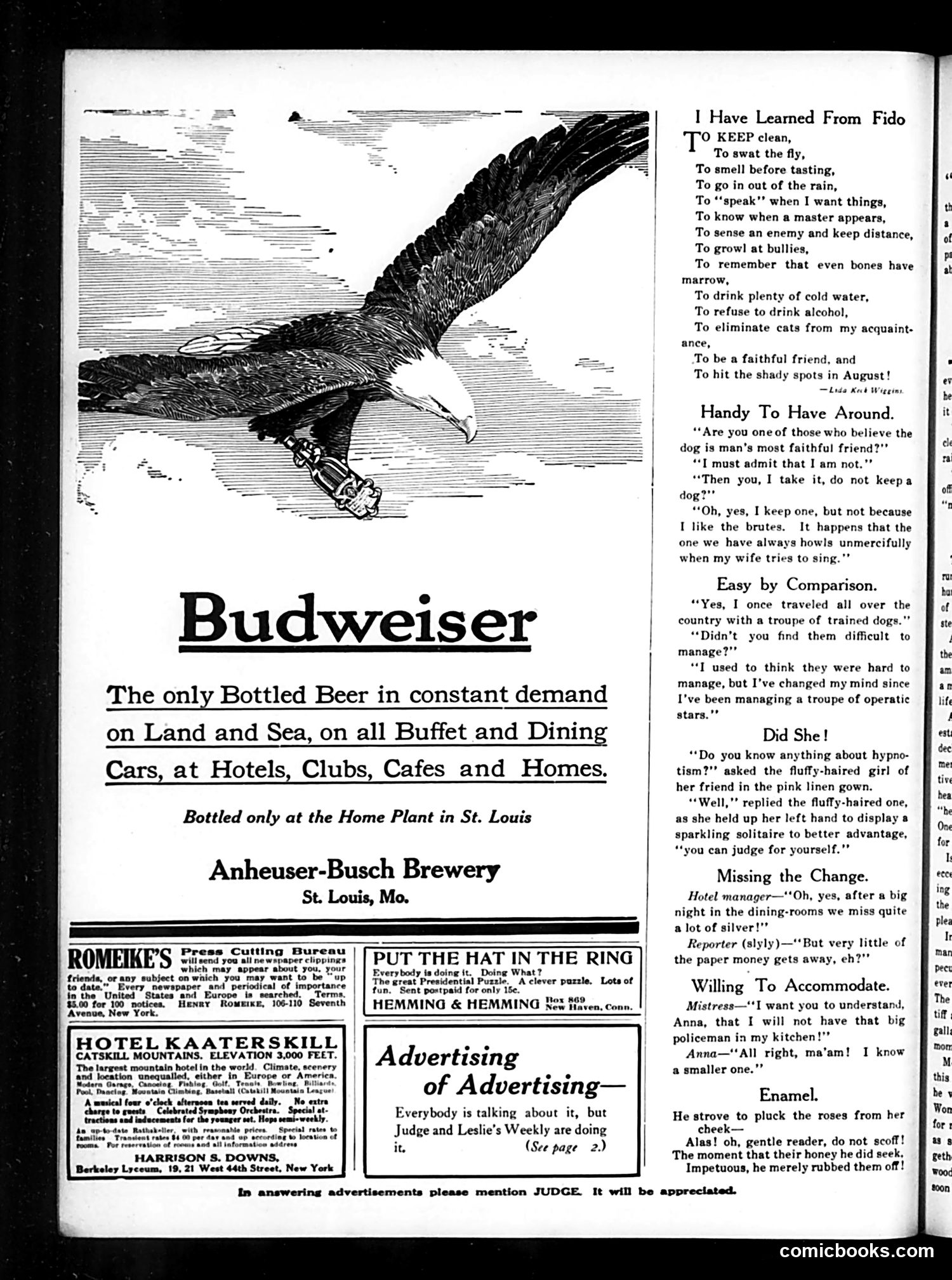
This page comprises mostly **advertisements and humorous short anecdotes** rather than political cartoons. The eagle illustration is Budweiser's logo, not a political caricature. The content reflects early 20th-century American humor: anecdotes about dogs being more obedient than opera singers, hypnosis jokes about engagement rings, and domestic servant humor. Several pieces mock contemporary absurdities—a hotel manager's concern about missing silver (implying theft), complaints about policemen in kitchens, and romantic comedy about a man clumsily picking roses from a woman's dress. The "Put the Hat in the Ring" puzzle references Theodore Roosevelt's 1912 presidential campaign slogan, suggesting this is from around that era. The page's satire is gentle and domestic rather than sharp political commentary—typical of Judge's lighter fare, focusing on everyday social situations and mild social observation rather than partisan critique or caricatured figures.
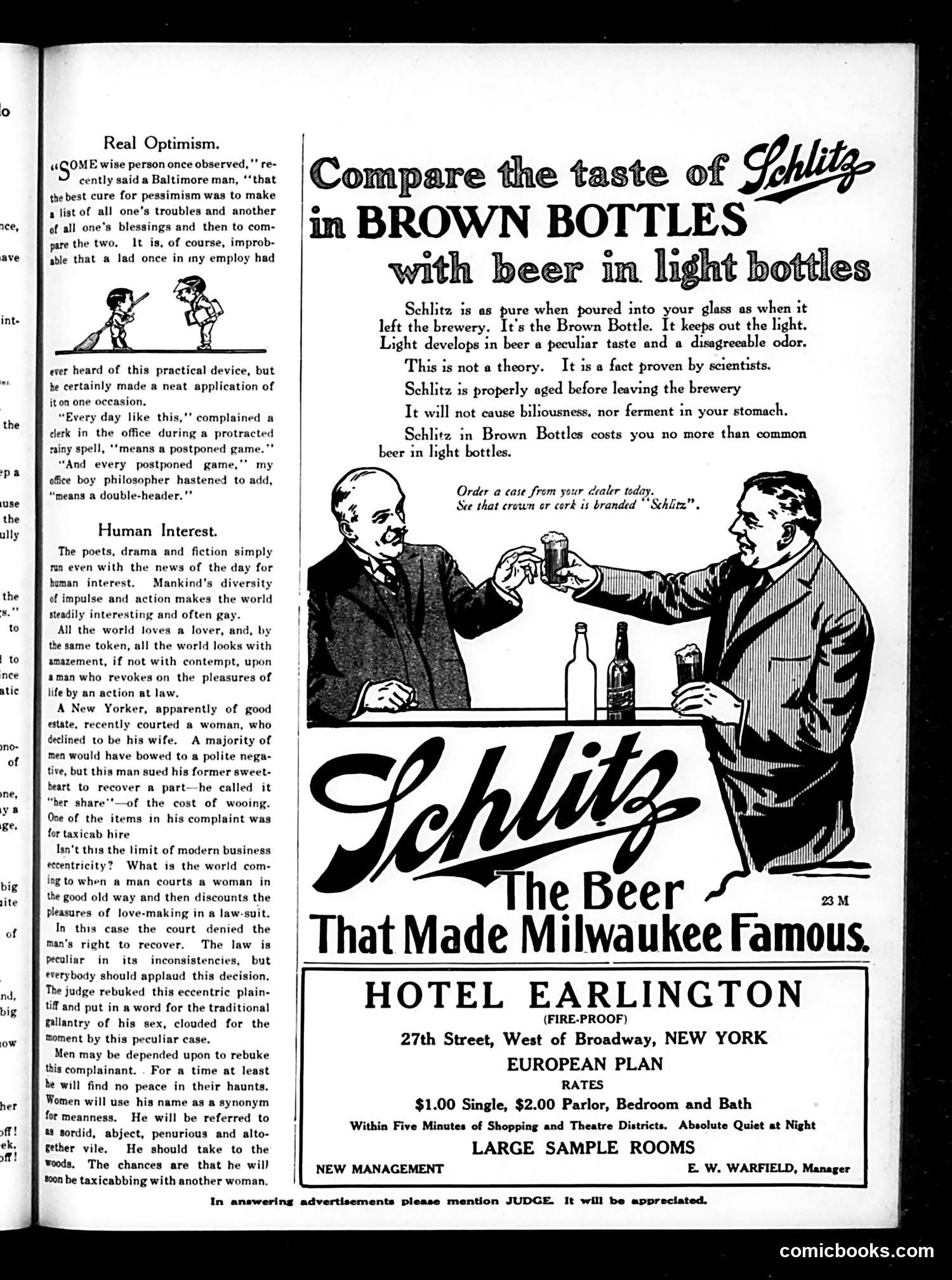
This page combines three distinct elements: **Left Column - Humorous Anecdotes:** Two brief satirical pieces on optimism and human interest. The second story mocks a wealthy New Yorker who sued his former girlfriend to recover expenses he'd spent courting her—including taxicab fares. The satire targets his greed and violation of gentlemanly conduct; the court sided against him, and the author gleefully predicts social ostracism and that he'll eventually court another woman (repeating the cycle). **Right Column - Schlitz Beer Advertisement:** A major commercial ad comparing Schlitz beer in brown bottles versus competitors' light bottles. The copy argues brown bottles protect beer from light exposure, which causes off-flavors. Two men clink glasses in the illustration. This represents early 20th-century beer marketing emphasizing scientific/chemical superiority. **Bottom - Hotel Earlington Ad:** A small hotel advertisement for a New York establishment offering budget rates ($1-2) and "large sample rooms." The page is primarily advertising-driven, with the satirical content serving as editorial filler typical of Judge's format.
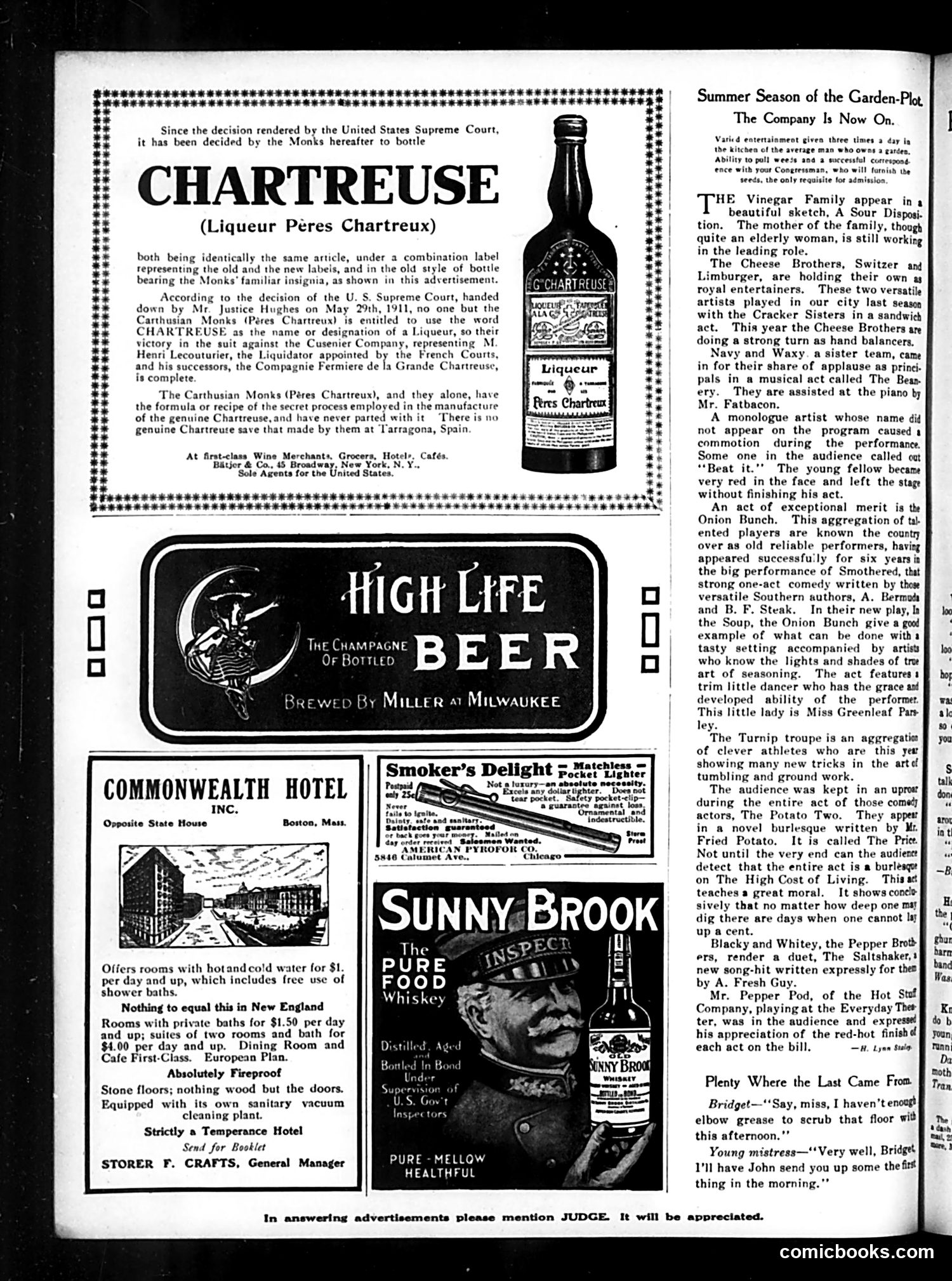
This page is primarily **advertisements and theater/entertainment notices** rather than political satire. The main content describes a humorous "Garden-Plot" theater season where vegetables are anthropomorphized as performers—the "Vinegar Family," "Cheese Brothers," "Onion Bunch," and "Turnip troupe" all perform in acts with punning titles like "A Sour Disposition" and "The High Cost of Living." The satire is lighthearted domestic humor: vegetables performing in a "garden theater" parodies vaudeville acts while creating puns on their food properties. The "Potato Two" burlesques inflation and living costs—likely referencing post-WWI economic concerns. The page also features prominent liquor and hotel advertisements (Chartreuse, High Life Beer, Sunny Brook Whiskey), typical of Judge's commercial content from this era. The small dialogue exchange at bottom about floor cleaning is a conventional joke format. This is **not political commentary** but rather **entertainment-focused satire with commercial advertising**.
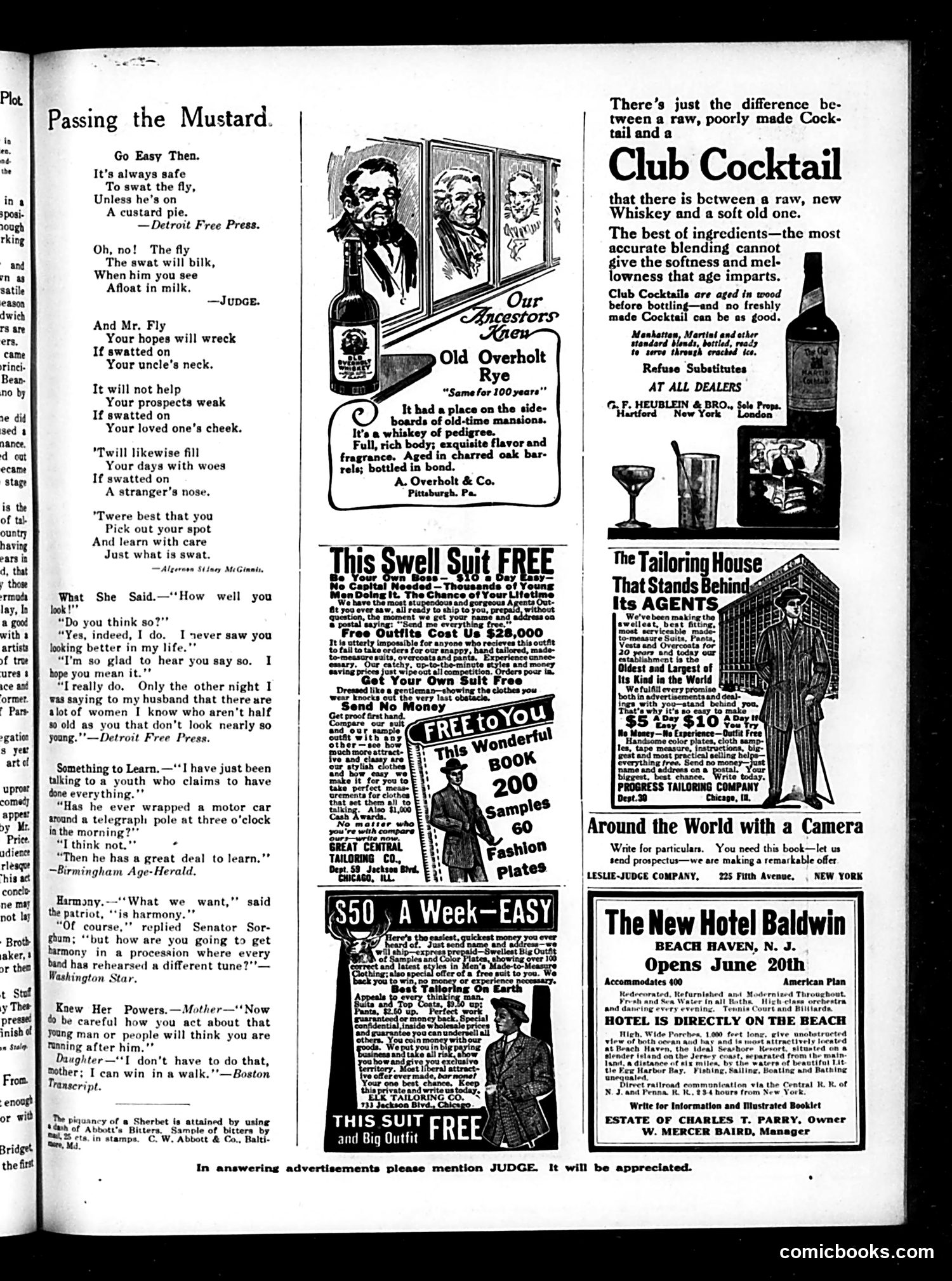
This page is primarily **advertising and humorous filler content** rather than political cartoons. The left column contains brief comic verses about swatting flies in inconvenient places—a lighthearted domestic humor piece with no political significance. The page's main content consists of **period advertisements** (circa 1910s-1920s based on styling): whiskey ads for Old Overholt Rye and Club Cocktail, a "free suit" tailoring scheme, fashion samples, and hotel promotions. These ads reflect common commercial practices of the era, including the "free outfit" scam model. The few short humorous anecdotes scattered throughout are gentle social commentary: one jokes about a woman's attractiveness compared to younger women; another satirizes political "harmony." These are mild observations about courtship and political discord, not serious satire. **No identifiable political figures or caricatures appear**. This is representative of Judge's lighter content—domestic humor, commercial ads, and gentle social observation rather than biting political satire.
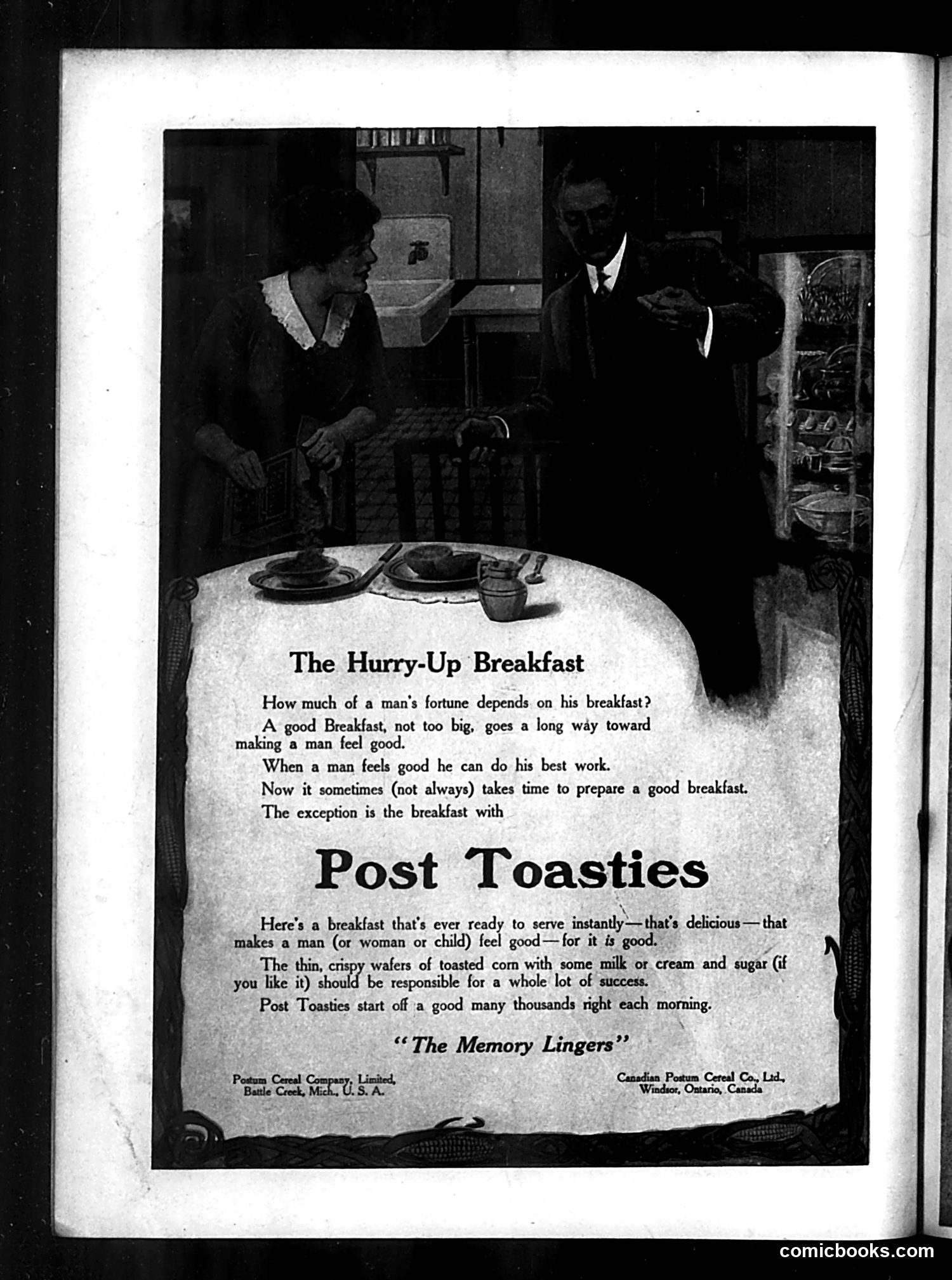
This is primarily a **cereal advertisement**, not satire or political commentary. The page depicts two figures (a woman and man) examining a breakfast table set with Post Toasties cereal. The "joke" or selling point targets early 20th-century anxieties about **time efficiency and male productivity**. The ad argues that a man's business success depends on proper breakfast nutrition—but traditional cooking takes time. Post Toasties solves this: instant, ready-to-serve corn flakes requiring only milk and sugar. The tagline **"The Memory Lingers"** suggests the cereal's appeal persists throughout the workday. This reflects Progressive-era messaging linking convenient foods to modern success and masculine vigor. The text's rhetorical structure—posing breakfast as foundational to fortune—demonstrates period advertising's pseudo-philosophical approach to selling packaged goods as solutions to modern life's demands.