
Judge, 1912-07-27 · page 12 of 24
Judge — July 27, 1912 — page 12: what you’re looking at
What you’re looking at
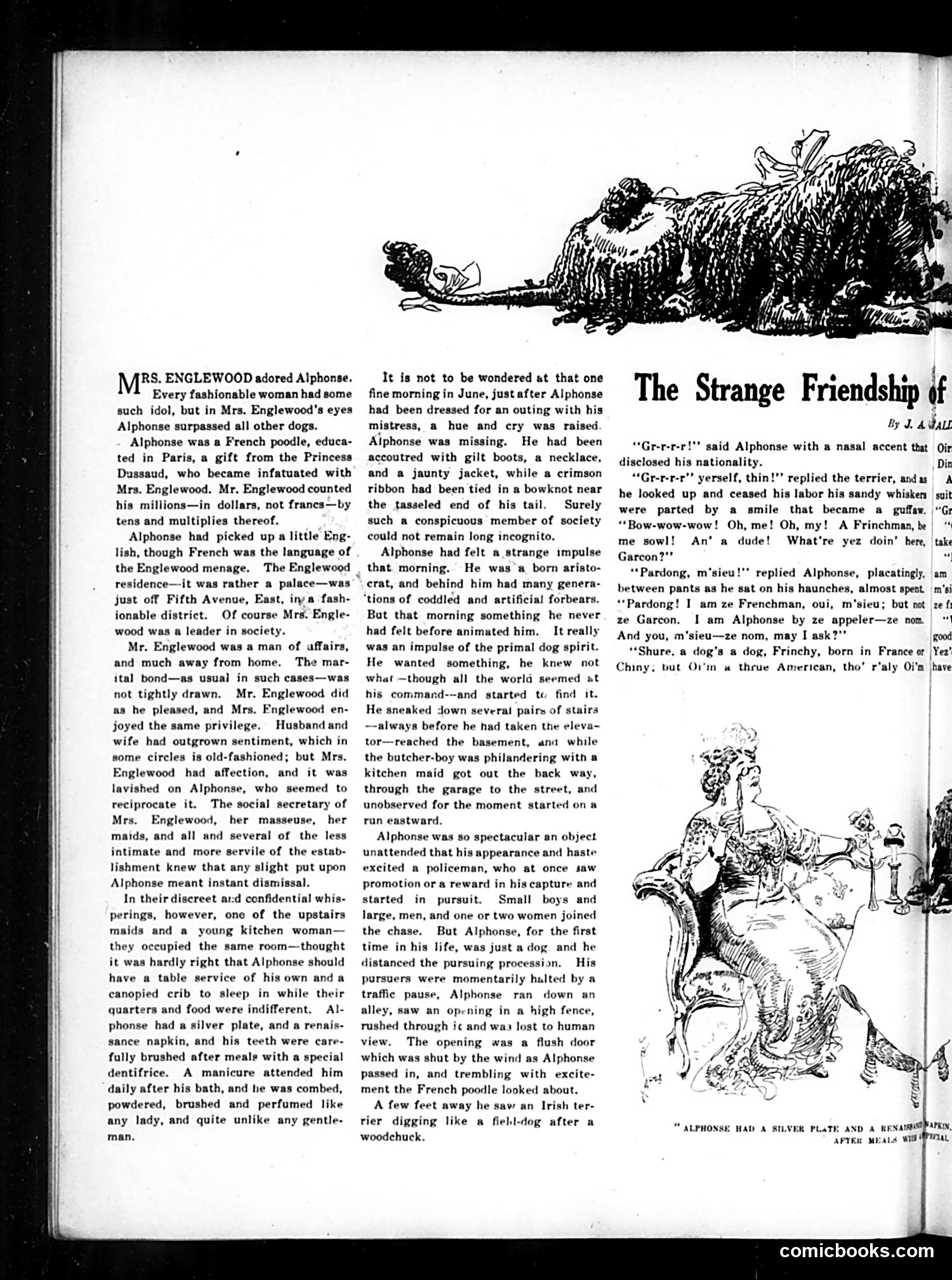
This is the opening of a satirical short story about **Alphonse, a pampered French poodle** owned by a wealthy Fifth Avenue society woman, Mrs. Englewood. The satire targets **conspicuous consumption and class absurdity**: Alphonse receives more care and consideration than the household servants—he has a silver plate, Renaissance napkins, daily manicures, gilt boots, and a canopied crib, while the upstairs maids and kitchen staff live in poor conditions. The story's setup mocks both **nouveau-riche American wealth** (Mr. Englewood's millions) and the sentimental excess of fashionable society women who lavish affection on pets rather than people. When Alphonse escapes one morning—having felt "the primal dog spirit"—he becomes momentarily just a dog rather than a status symbol, sparking a comic chase through the city. The illustrations show Alphonse as an absurdly overdressed creature, emphasizing the ridiculousness of his treatment.
📄 Transcribed text from this page (OCR, searchable)
Machine-transcribed from the original scan — historical spelling and the odd misread are preserved.
RS. ENGLEWOOD adored Alphonse. Every fashionable woman had some such idol, but in Mrs. Englewood’s eyes | Alphonse surpassed all other dogs. | Alphonse was a French poodle, educa- | ted in Paris, a gift from the Princess | Dussaud, who became infatuated with | Mrs. Englewood. Mr. Englewood counted his millions—in dollars, not francs—by | tens and multiplies thereof. Alphonse had picked up a little Eng- lish, though French was the language of the Englewood menage. residence—it was rather a palace—was just off Fifth Avenue, East, inya fash- ionable district. Of course Mrs. Engle- wood was a leader in society. Mr. Englewood was a man of affairs, and much away from home. The mar- ital bond—as usual in such cases—was not tightly drawn. Mr. Englewood did as he pleased, and Mrs. Englewood en- joyed the same privilege. Husband and wife had outgrown sentiment, which in some circles is old-fashioned; but Mrs. Englewood had affection, and it was lavished on Alphonse, who seemed to reciprocate it. The social secretary of Mrs. Englewood, her masseuse, her maids, and all and several of the less intimate and more servile of the estab- lishment knew that any slight put upon Alphonse meant instant dismissal. In their discreet ar:d confidential whis- perings, however, one of the upstairs maids and a young kitchen woman— i they occupied the same room—thought it was hardly right that Alphonse should have a table service of his own anda canopied crib to sleep in while their i} quarters and food were indifferent. Al- phonse had a silver plate, and a renais- sance napkin, and his teeth were care. fully brushed after meals with a special dentifrice. A manicure attended him daily after his bath, and he was combed, | powdered, brushed and perfumed like any lady, and quite unlike any gentle- man. The Englewood | It is not to be wondered at that one fine morning in June, just after Alphonse had been dressed for an outing with his mistress, a hue and cry was raised Alphonse was missing. He had been accoutred with gilt boots, a necklace, and a jaunty jacket, while a crimson ribbon had been tied in a bowknot near the tasseled end of his tail. Surely such a conspicuous member of society could not remain long incognito. Alphonse had felt a strange impulse that morning. He was a born aristo- erat, and behind him had many genera- ‘tions of coddled and artificial forbears. But that morning something he never had felt before animated him. It really was an impulse of the primal dog spirit. He wanted something, he knew not what —though all the world seemed at his command-~and started to find it. He sneaked down several pairs of stairs --always before he had taken the eleva- tor—reached the basement, ana while the butcher-boy was philandering with a kitchen maid got out the back way, through the garage to the street, and unobserved for the moment started on a run eastward, Alphonse was so spectacular an object unattended that his appearance and haste excited a policeman, who at once saw promotion or a reward in his capture and started in pursuit. Small boys and large, men, and one or two women joined the chase. But Alphonse, for the first time in his life, was just a dog. and he distanced the pursuing procession. His pursuers were momentarily hulted by a traffic pause, Alphonse alley, saw an opening in a high fence, rushed through ic and waa lost to human view. The opening was a flush door which was shut by the wind as Alphonse passed in, and trembling with excite- ment the French poodle looked about. A few feet away he saw an Irish ter- rier digging like a fiell-dog after a woodchuck. ran down an The Strange Friendship of By J. Ada “Gr-r-r-r!"’ said Alphonse with a nasal accent that ir disclosed his nationality. Dir “Gr-r-r-r’’ yerself, thin!’’ replied the terrier, andas A he looked up and ceased his labor his sandy whiskers suit were parted by a smile that became a guffaw. “Gr “*Bow-wow-wow! Oh, me! Oh, my! A Frinchman, be | “ me sowl! An’ a dude! What're yez doin’ here, take Garcon?” a “*Pardong, m'sieu!"’ replied Alphonse, placatingly, am between pants as he sat on his haunches, almost spent. m’si **Pardong! I am ze Frenchman, oui, m'sieu; but not ze f: ze Garcon. I am Alphonse by ze appeler—ze nom “1 And you, m’sieu—ze nom, may I ask?"’ good ‘Shure, a dog’s a dog, Frinchy, born in France or | Yer’ Chiny, but Oi'm « thrue American, tho’ r'aly Oi'm jhave “ALPHONSE HAD A SILVER PLATE AND A RENAISUOPAPED, comicbooks.com