
Judge, 1912-07-27 · page 13 of 24
Judge — July 27, 1912 — page 13: what you’re looking at
What you’re looking at
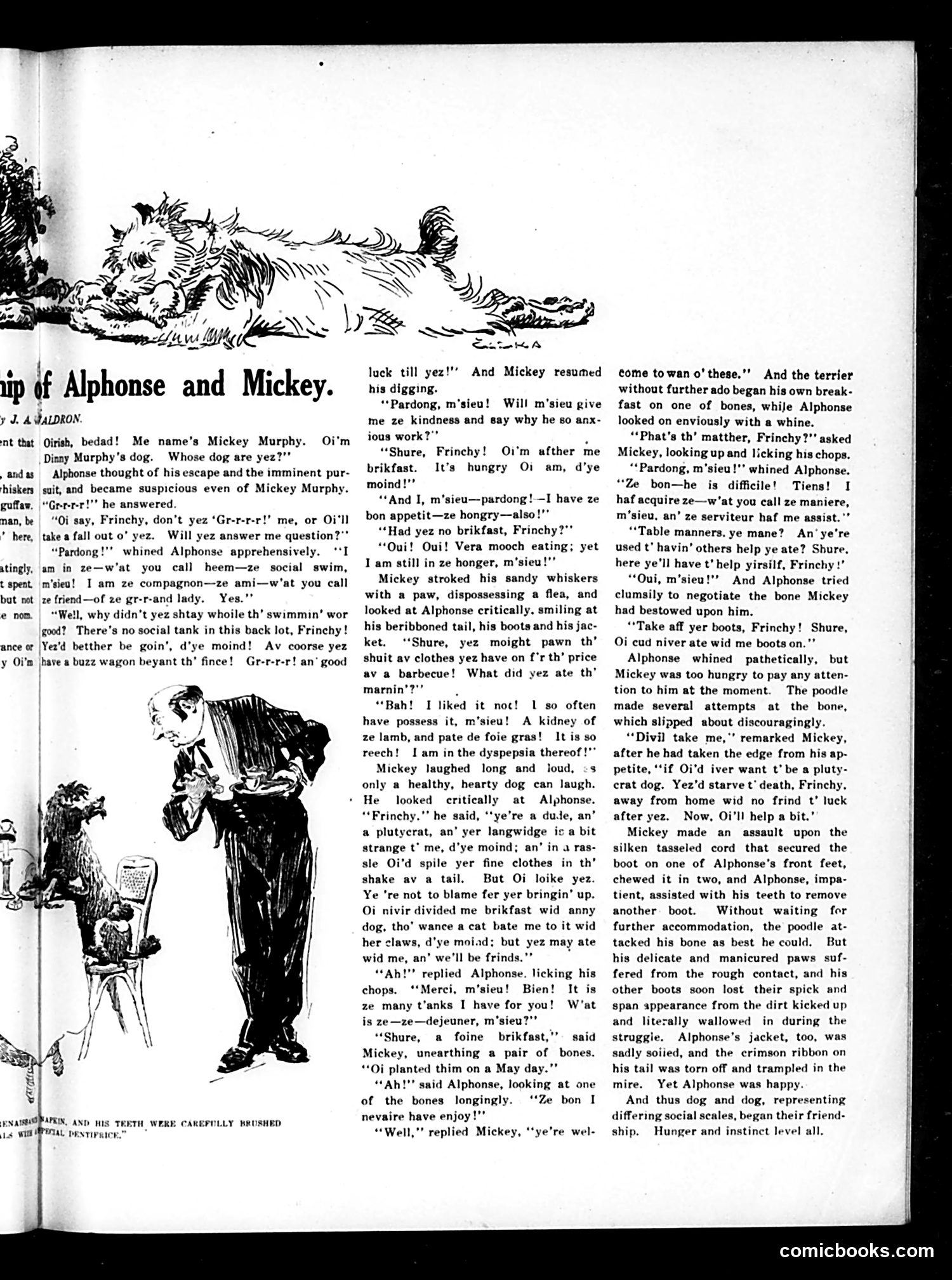
This is a humorous story illustrated with sketches, not primarily a political cartoon. It depicts two dogs of contrasting social classes: **The Characters:** Mickey Murphy is an Irish working-class terrier; Alphonse is a French poodle of aristocratic pretension—evidenced by his fancy boots, ribboned tail, refined vocabulary, and references to "pate de foie gras" and table manners. **The Satire:** The story mocks class pretension and social hierarchy. Alphonse, despite his wealth and refinement, is reduced to envying Mickey's simple bone. The humor derives from Alphonse's exaggerated politeness ("m'sieu," "Merci") and his struggle with basic dog behavior—he needs a servant to help him eat, yet is desperate and hungry. **The Point:** This appears to be gentle satire on European class distinctions and the absurdity of maintaining artificial dignity in practical situations. Hunger and instinct override social pretense—a common Judge magazine theme about the folly of excessive formality.
📄 Transcribed text from this page (OCR, searchable)
Machine-transcribed from the original scan — historical spelling and the odd misread are preserved.
up if Alphonse and Mickey. y J. AVALDRON. nt that irish, bedad! Me name's Mickey Murphy. Dinny Murphy's dog. Whose dog are yez?"’ Alphonse thought of his escape and the imminent pur- and became suspicious even of Mickey Murphy. guffaw. “Grr-r-r!’’ he answered. man, be “Oi Frinchy, don’t yez ‘Gr-r-r-r!’ me, or Oi'll ’ here, take a fall out o’ yez. Will yez answer me question?’ “Pardong!'’ whined Alphonse apprehensively. ‘‘I am in ze—w’at you call heem—ze social swim, m'sieu! I am ze compagnon—ze ami—w'at you call ze friend—of ze gr-r-and lady. Yes.’" “Well, why didn't yez shtay whoile th’ swimmin’ wor good? There's no social tank in this back lot, Frinchy! ance or Yez'd betther be goin’, d'ye moind! Av coorse yez y Oi'm have a buzz wagon beyant th’ fince! Gr-r-r-r! an’ good Oi'm , and as hiskers sui atingly, t spent. but not e nom. CAREFULLY BRUSHED ENAEOPAPEIN AND HIS TRETH WERE is WIPO pesTiPKicE.” * > Gate KA luck till yez!'"’ And Mickey resumed his digging. “*Pardong, m’sieu! Will m'sieu give me ze kindness and say why he so anx- ious work?" ‘ “Shure, Frinchy! Oi'm afther me brikfast. It’s hungry Oi am, d’ye moind “And I, m’sieu—pardong!—I have ze bon appetit—ze hongry—also!’" “*Had yez no brikfast, Frinchy?"’ “Oui! Oui! Vera mooch eating; yet I am still in ze honger, m’sieu!"" Mickey stroked his sandy whiskers with a paw, dispossessing a flea, and looked at Alphonse critically, smiling at his beribboned tail, his boots and his jac- ket. ‘‘Shure, yez moight pawn th’ shuit av clothes yez have on f'r th’ price av a barbecue! What did yez ate th’ marnin ' “Bah! I liked it noc! 1 so often have possess it, m'sieu! A kidney of ze lamb, and pate de foie gras! It is so reech! I am in the dyspepsia thereof !"" Mickey laughed long and loud, <3 only a healthy, hearty dog can laugh. He looked critically at Alphonse. ‘*Frinchy.’’ he said, ‘‘ye’re a dude, an’ a plutycrat, an’ yer langwidge ic a bit strange t' me, d’ye moind; an’ in a ra sle 'd spile yer fine clothes in th’ shake av a tail. But Oi loike yez. Ye ‘re not to blame fer yer bringin’ up. Oi nivir divided me brikfast wid anny dog, tho’ wance a cat bate me to it wid her claws, d’ye moiad; but yez may ate wid me, an’ we'll be frinds."” i “‘Ab!’’ replied Alphonse. licking his chops. ‘Merci, m’sieu! Bien! It is ze many t’anks I have for you! W'at is ze—ze—dejeuner, m'sieu?"’ ‘Shure, a foine brikfast,’’ said Mickey, unearthing a pair of bones. ‘Oi planted thim on a May day.’" “*Ah!"' said Alphonse, looking at one of the bones longingly. ‘‘Ze bon I nevaire have enjoy !’" ‘Well,’ replied Mickey, ‘‘ye’re wel- Come to wan o' these.’ And the terrier without further ado began his own break- fast on one of bones, whiJe Alphonse looked on enviously with a whine. “‘Phat's th’ matther, Frinchy?"’ asked Mickey, looking up and licking his chops. “*Pardong, m'sieu!'’ whined Alphonse. “Ze bon—he is difficile! Tiens! I haf acquire ze—w'at you call ze maniere, m’sieu, an’ ze serviteur haf me assist."’ ‘Table manners, ye mane? An‘ ye're used t' havin’ others help ye ate? Shure, here ye'll have t’ help yirsilf, Frinchy!’ “Oui, m’sieu!"’ And Alphonse tried clumsily to negotiate the bone Mickey had bestowed upon him. “Take aff yer boots, Frinchy! Shure, Oi cud niver ate wid me boots on."’ Alphonse whined pathetically, but Mickey was too hungry to pay any atten- tion to him at the moment. The poodle made several attempts at the bone, which slipped about discouragingly. “Divil take me,’ remarked Mickey, after he had taken the edge from his ap- petite, ‘‘if Oi'd iver want t’ be a pluty- crat dog. Yez’d starve t' death, Frinchy, away from home wid no frind t’ luck after yez. Now, Oi'll help a bit.’ Mickey made an assault upon the silken tasseled cord that secured the boot on one of Alphonse’s front feet, chewed it in two, and Alphonse, impa- tient, assisted with his teeth to remove another boot. Without waiting for further accommodation, the poodle at- tacked his bone as best he could. But his delicate and manicured paws suf- fered from the rough contact, and his other boots soon lost their spick and span appearance from the dirt kicked up and literally wallowed in during the struggle. Alphonse’s jacket, too, was sadly soiied, and the crimson ribbon on his tail was torn off and trampled in the mire. Yet Alphonse was happy. And thus dog and dog, representing differing social scales, began their friend- Hunger and instinct level all. ship. comicbooks.com