
Judge, 1912-07-27 · page 5 of 24
Judge — July 27, 1912 — page 5: what you’re looking at
What you’re looking at
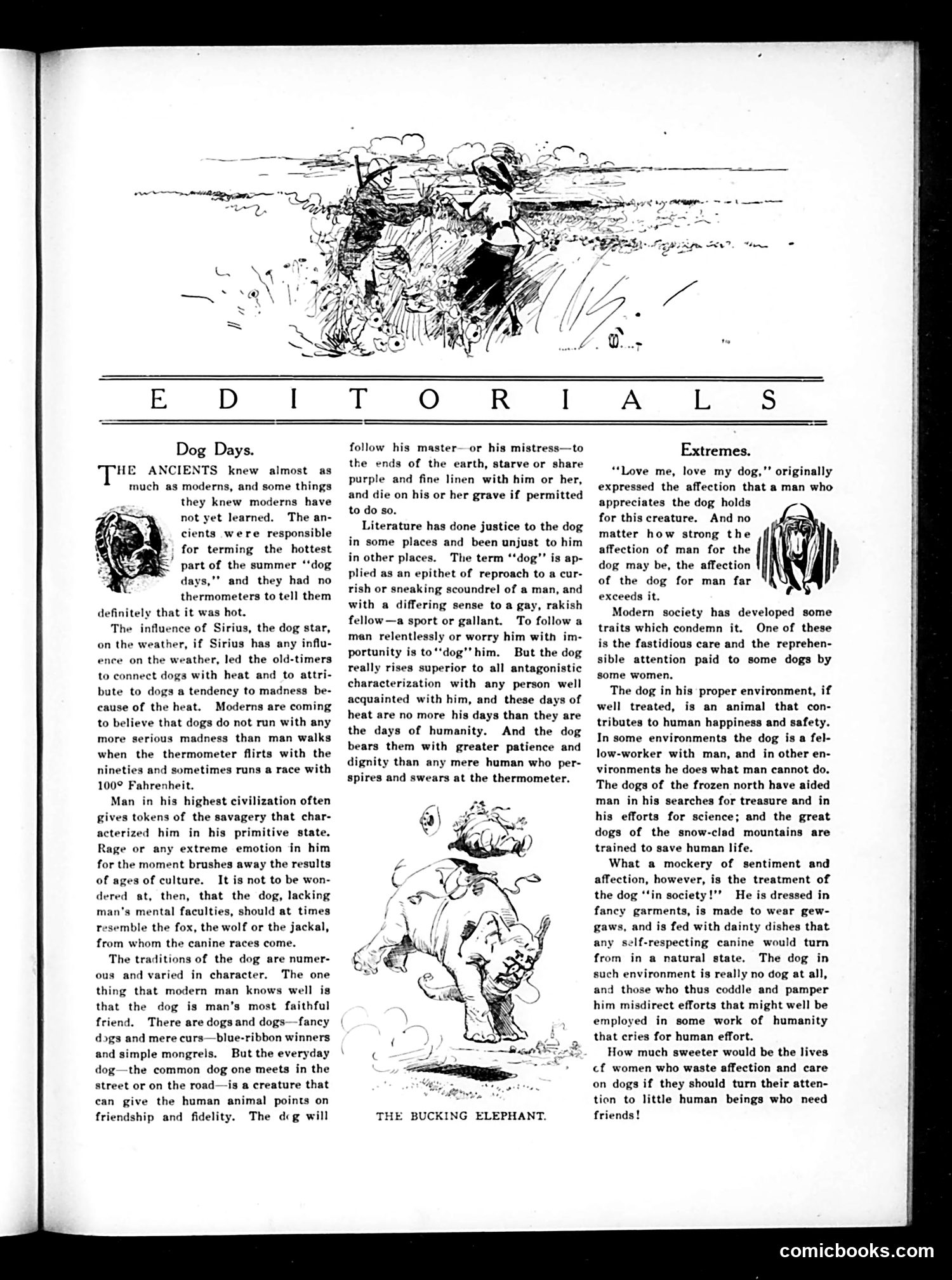
This Judge magazine page contains two editorial pieces about dogs, illustrated with satirical drawings. The left column "Dog Days" discusses how ancient and modern societies have treated dogs, noting that the dog remains humanity's most faithful friend despite occasional mistreatment. The right column "Extremes" critiques how modern "society" mishandles dogs—dressing them in fancy garments and feeding them unsuitable food while ignoring their natural needs. The cartoon titled "THE BUCKING ELEPHANT" depicts a dog riding an elephant, likely satirizing fashionable or absurd pet-keeping practices among the wealthy. Overall, the page mocks both excessive sentimentality toward pets and the disconnect between how dogs are treated versus their actual welfare needs.
📄 Transcribed text from this page (OCR, searchable)
Machine-transcribed from the original scan — historical spelling and the odd misread are preserved.
Dog Days. HE ANCIENTS knew almost as much as moderns, and some things they knew moderns have not yet learned. The an- cients were responsible for terming the hottest part of the summer ‘‘dog days," and they had no thermometers to tell them definitely that it was hot. The influence of Sirius, the dog star, on the weather, if Sirius has any influ- ence on the weather, led the old-timers to connect dogs with heat and to attri- bute to dogs a tendency to madness be- cause of the heat. Moderns are coming to believe that dogs do not run with any more serious madness than man walks when the thermometer flirts with the nineties and sometimes runs a race with 100° Fahrenheit. Man in his highest civilization often gives tokens of the savagery that char- acterized him in his primitive state. Rage or any extreme emotion in him for the moment brushes away the results of ages of culture. It is not to be won- dered at, then, that the dog, lacking man's mental faculties, should at times resemble the fox, the wolf or the jackal, from whom the canine races come. The traditions of the dog are numer- ous and varied in character. The one thing that modern man knows well is that the dog is man’s most faithful friend. There are dogs and dogs—fancy dogs and mere curs—blue-ribbon winners and simple mongrels. But the everyday dog—the common dog one meets in the street or on the road—is a creature that can give the human animal points on friendship and fidelity. The deg will follow his master—or his mistress—to the ends of the earth, starve or share purple and fine linen with him or her, and die on his or her grave if permitted to do so. Literature has done justice to the dog in some places and been unjust to him in other places. The term ‘‘dog’’ is ap- plied as an epithet of reproach to a cur- rish or sneaking scoundrel of a man, and with a differing sense to a gay, rakish fellow—a sport or gallant. To follow a man relentlessly or worry him with im- portunity is to‘‘dog’*him. But the dog really rises superior to all antagonistic characterization with any person well acquainted with him, and these days of heat are no more his days than they are the days of humanity. And the dog bears them with greater patience and dignity than any mere human who per- spires and swears at the thermometer. THE BUCKING ELEPHANT. Extremes. “Love me, love my dog,” originally expressed the affection that a man who appreciates the dog holds for this creature. And no matter how strong the fi affection of man for the ( dog may be, the affection of the dog for man far exceeds it. Modern society has developed some traits which condemn it. One of these is the fastidious care and the reprehen- sible attention paid to some dogs by some women. The dog in his proper environment, if well treated, is an animal that con- tributes to human happiness and safety. In some environments the dog is a fel- low-worker with man, and in other en- vironments he does what man cannot do. The dogs of the frozen north have aided man in his searches for treasure and in his efforts for science; and the great dogs of the snow-clad mountains are trained to save human life. What a mockery of sentiment and affection, however, is the treatment of the dog ‘‘in society!’’ He is dressed in fancy garments, is made to wear gew- gaws, and is fed with dainty dishes that any self-respecting canine would turn from in a natural state. The dog in such environment is really no dog at all, and those who thus coddle and pamper him misdirect efforts that might well be employed in some work of humanity that cries for human effort. How much sweeter would be the lives cf women who waste affection and care on dogs if they should turn their atten- tion to little human beings who need friends! comicbooks.com