
Judge, 1912-07-27 · page 15 of 24
Judge — July 27, 1912 — page 15: what you’re looking at
What you’re looking at
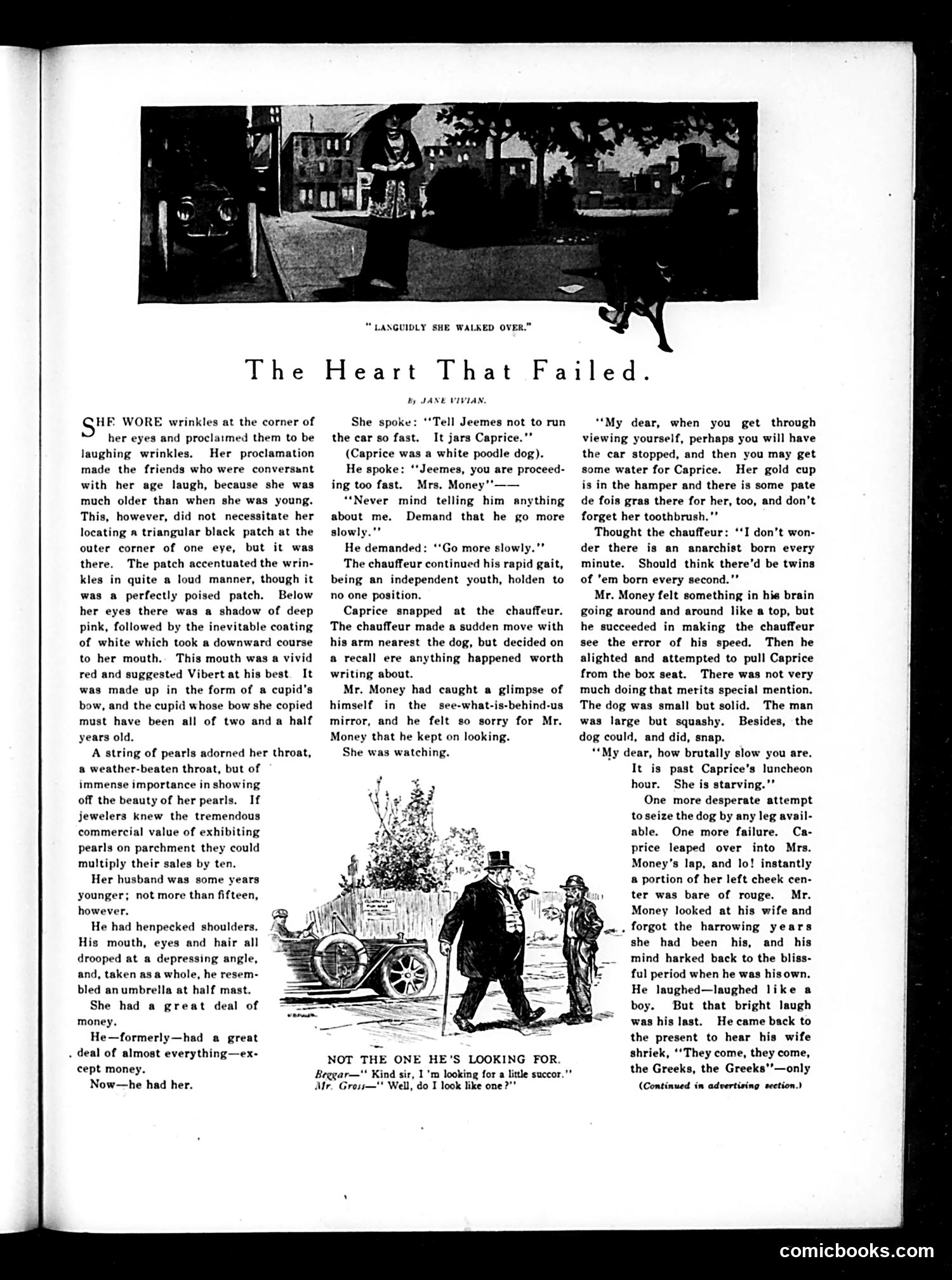
This story satirizes a common turn-of-the-century social type: the wealthy, aging woman married to a younger, henpecked man. The wife is caricatured through exaggerated makeup (cupid's bow lips, heavy rouge, beauty patches) and imperious behavior—she dominates her submissive husband through financial control ("She had a great deal of money. He...had her"). The satire's target is materialistic marriage and the inversion of traditional gender roles. The husband, described as drooping "like an umbrella at half mast," has surrendered his independence. The accompanying cartoon shows a beggar and wealthy man—illustrating class commentary about economic desperation. The story's title suggests emotional hollowness: beneath the wife's beauty rituals and domineering behavior, and the husband's financial dependence, neither has genuine feeling. The humor derives from detailed observations of superficial, transactional marriage among the wealthy.
📄 Transcribed text from this page (OCR, searchable)
Machine-transcribed from the original scan — historical spelling and the odd misread are preserved.
The HE WORE wrinkles at the corner of her eyes and proclaimed them to be laughing wrinkles. Her proclamation made the friends who were conversant with her age laugh, because she was much older than when she was young. This, however, did not necessitate her locating a triangular black patch at the outer corner of one eye, but it was there. The patch accentuated the wrin- kles in quite a loud manner, though it was a perfectly poised patch. Below her eyes there was a shadow of deep pink, followed by the inevitable coating of white which took a downward course to her mouth. This mouth was a vivid red and suggested Vibert at his best. It was made up in the form of a cupid’s bow, and the cupid whose bow she copied must have been all of two anda half years old. A string of pearls adorned her throat, a weather-beaten throat, but of immense importance in showing off the beauty of her pearls. If jewelers knew the tremendous commercial value of exhibiting pearls on parchment they could multiply their sales by ten. Her husband was some years younger; not more than fifteen, however. He had henpecked shoulders. His mouth, eyes and hair all drooped at a depressing angle, and, taken as a whole, he resem- bled anumbrella at half mast. She had a great deal of money. He—formerly—had a great . deal of almost everything—ex- cept money. Now—he had her. “ LANGUIDLY SHE WALKED OVER.” Heart That By JANE VIVIAN, She spoke: ‘‘Tell Jeemes not to run the car so fast. It jars Caprice.’’ (Caprice was a white poodle dog). He spoke: ‘‘Jeemes, you are proceed- ing too fast. Mrs. Money”*—— “Never mind telling him anything about me. Demand that he go more slowly."’ He demanded: ‘‘Go more slowly." The chauffeur continued his rapid gait, being an independent youth, holden to no one position. Caprice snapped at the chauffeur. The chauffeur made a sudden move with his arm nearest the dog, but decided on a recall ere anything happened worth writing about. Mr. Money had caught a glimpse of himself in the see-what-is-behind-us mirror, and he felt so sorry for Mr. Money that he kept on looking. She was watching. NOT THE ONE HE'S LOOKING FOR Beggar: Mr. Gross—"* Well, do I look like one ?"” Kind sir, I 'm looking for a little succor.’ Failed. ‘“‘My dear, when you get through viewing yourself, perhaps you will have the car stopped, and then you may get some water for Caprice. Her gold cup is in the hamper and there is some pate de fois gras there for her, too, and don’t forget her toothbrush.”” Thought the chauffeur: ‘‘I don’t won- der there is an anarchist born every minute. Should think there’d be twins of 'em born every second." Mr. Money felt something in hie brain going around and around like a top, but he succeeded in making the chauffeur see the error of his speed. Then he alighted and attempted to pull Caprice from the box seat. There was not very much doing that merits special mention. The dog was small but solid. The man was large but squashy. Besides, the dog could, and did, snap. ‘*My dear, how brutally slow you are. It is past Caprice’s luncheon hour. She is starving.”’ One more desperate attempt to seize the dog by any leg avail- able. One more failure. Ca- price leaped over into Mrs. Money’s lap, and lo! instantly 8 portion of her left cheek cen- ter was bare of rouge. Mr. Money looked at his wife and forgot the harrowing years she had been his, and his mind harked back to the bliss- ful period when he was his own. He laughed—laughed like a boy. But that bright laugh was his last. He came back to the present to hear his wife shriek, ‘‘They come, they come, the Greeks, the Greeks’’—only (Continued in advertising section.) comicbooks.com