
A complete issue · 24 pages · 1912
Judge — July 13, 1912
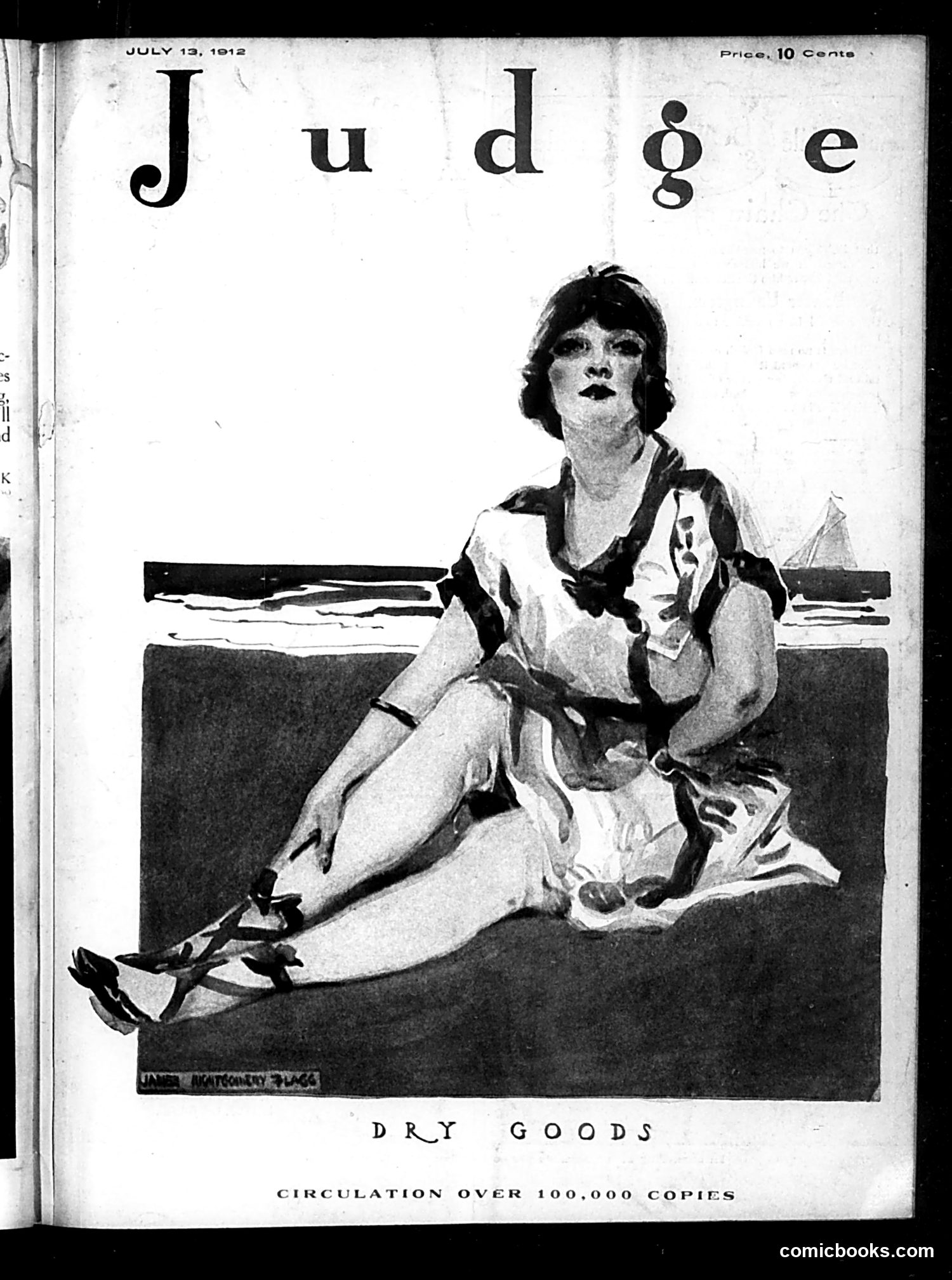
This appears to be a magazine cover featuring an illustration of a woman in early 1900s attire (sailor-style blouse, boots) posed on a couch with a nautical backdrop. The title "DRY GOODS" is a pun—likely referring both to textile merchandise and to the "dry goods" movement (Prohibition/temperance activism gaining momentum in 1912). The woman's somewhat provocative pose and knowing expression suggest satire aimed at either the temperance movement itself or contemporary attitudes toward women's sexuality and social propriety. The large circulation figure (over 100,000 copies) indicates this was a popular, mass-market satirical publication. Without additional context clues, the specific target of the satire remains somewhat unclear, though it likely comments on early Progressive Era debates about morality and women's public roles.
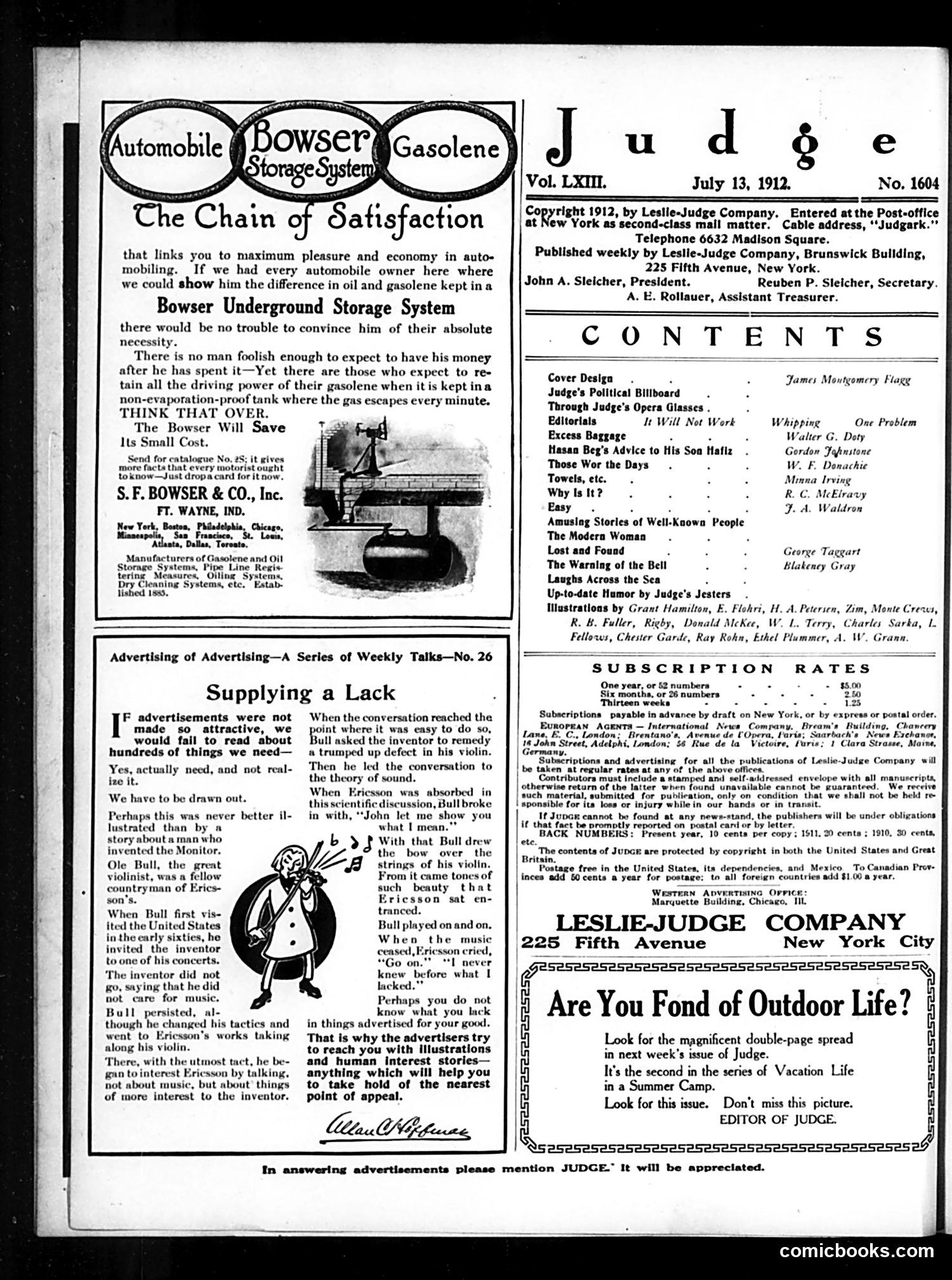
This page is primarily **advertising and magazine contents**, not political satire. The main visual element is an advertisement for the "Bowser Underground Storage System" for automobile gasoline—a practical piece of early automotive infrastructure. The only cartoon present illustrates an article titled "Advertising of Advertising—A Series of Weekly Talks—No. 26," discussing how effective advertisements must be visually striking and compelling. The cartoon depicts a man (appearing to be a musician or public figure, labeled "Bull") who initially resisted advertising but eventually became persuaded of its value. The page lacks the satirical political content typical of Judge's masthead, instead focusing on commercial messaging and magazine housekeeping for this 1912 issue.
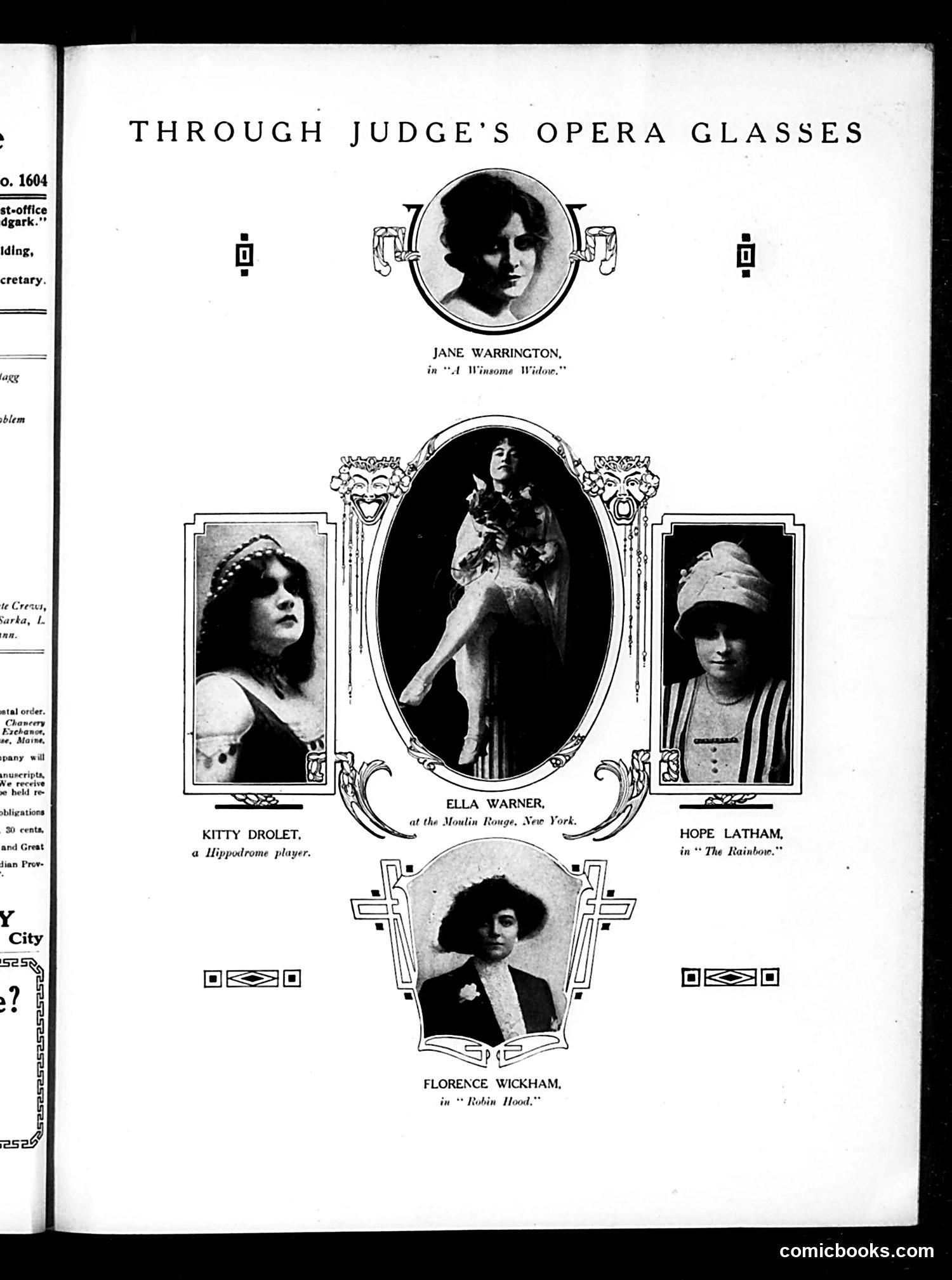
This page showcases five theatrical performers viewed through the metaphorical lens of opera glasses—a visual pun on the title. The subjects are: - **Jane Warrington** in "A Winsome Widow" - **Kitty Drolet**, a Hippodrome player - **Ella Warner** at the Moulin Rouge, New York - **Hope Latham** in "The Rainbow" - **Florence Wickham** in "Robin Hood" Rather than political satire, this appears to be entertainment coverage—essentially a celebrity photo feature highlighting Broadway and theatrical performers of the era. Judge magazine used such features to report on popular stage productions and actors. The ornamental frames and "opera glasses" conceit simply present these performers as objects of theatrical interest, typical of how magazines covered the theater industry in this period.
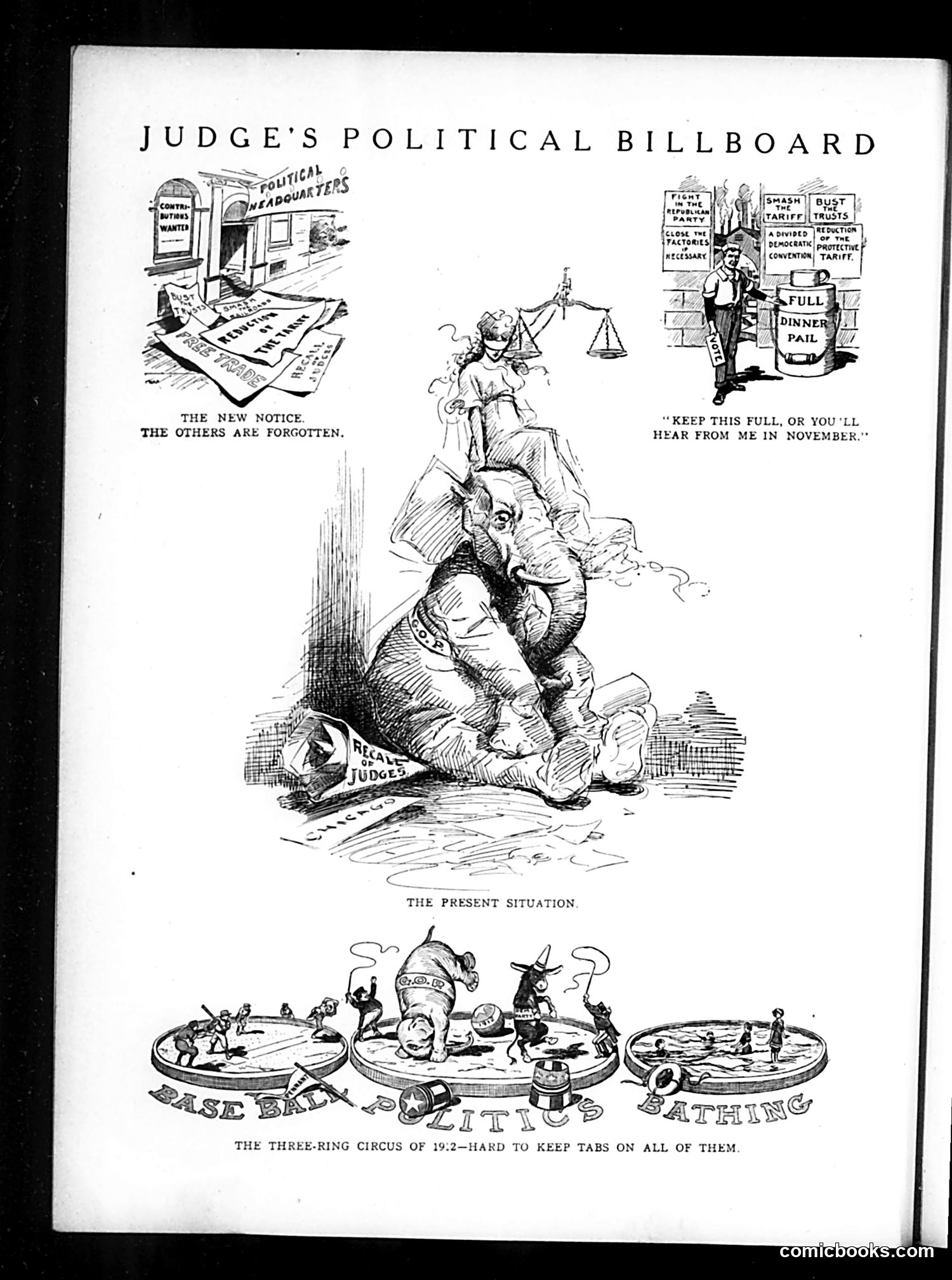
This page satirizes late 19th-century American politics during what appears to be an election year (the "November" reference suggests an upcoming presidential election). **"The Present Situation"** depicts Lady Justice perched atop an elephant labeled "Republican Judge," struggling to maintain balance—suggesting judicial impartiality is compromised by partisan politics. **"The Three-Ring Circus of 1892"** shows competing political spheres (Base Block, Politics, Bathing), implying the political landscape fragments into competing interests that are difficult to monitor simultaneously. The top panels reference political headquarters posting new notices while older positions are forgotten, criticizing inconsistent party platforms. The "Full Dinner Pail" reference likely alludes to Republican economic promises. Overall, the cartoons mock the chaotic, dishonest nature of 1892 American politics and judicial independence under partisan pressure.
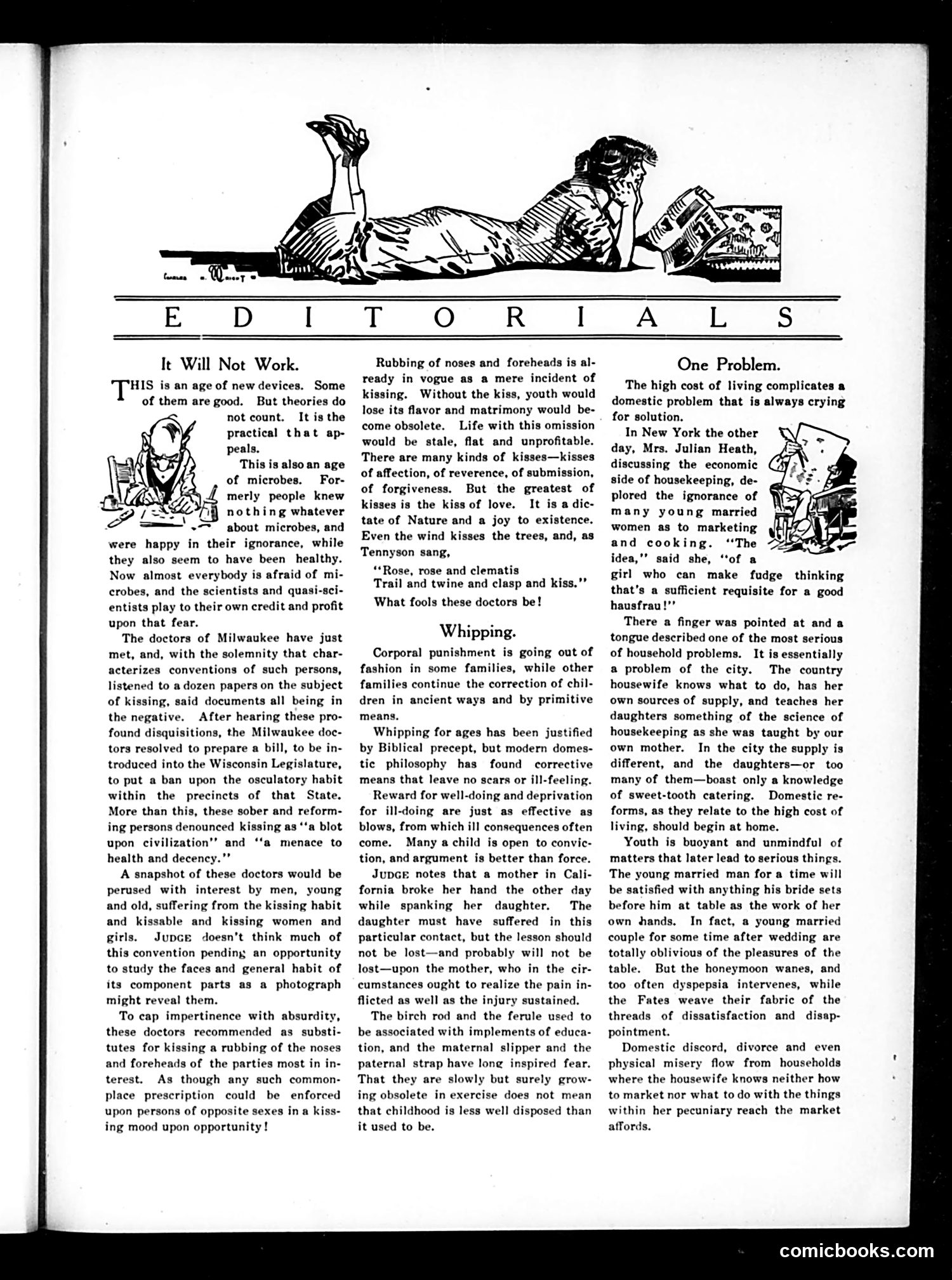
The page contains three opinion pieces with accompanying illustrations, typical of Judge's satirical format: 1. **"It Will Not Work"** mocks doctors who petitioned the Wisconsin Legislature against kissing, arguing the practice spreads microbes. The illustration shows a grotesque figure, likely representing the medical establishment. Judge ridicules the doctors' "sober and reforming" campaign as absurdly prudish and out of touch with human nature. 2. **"Whipping"** debates corporal punishment, discussing whether it's outdated or still justified for child discipline. The text presents both traditional and modern perspectives without clear satire. 3. **"One Problem"** critiques young wives' ignorance of housekeeping, arguing that domestic discord stems from poor household management skills rather than inadequate husband participation. The page reflects early 20th-century debates about modernity, science, and domestic roles.
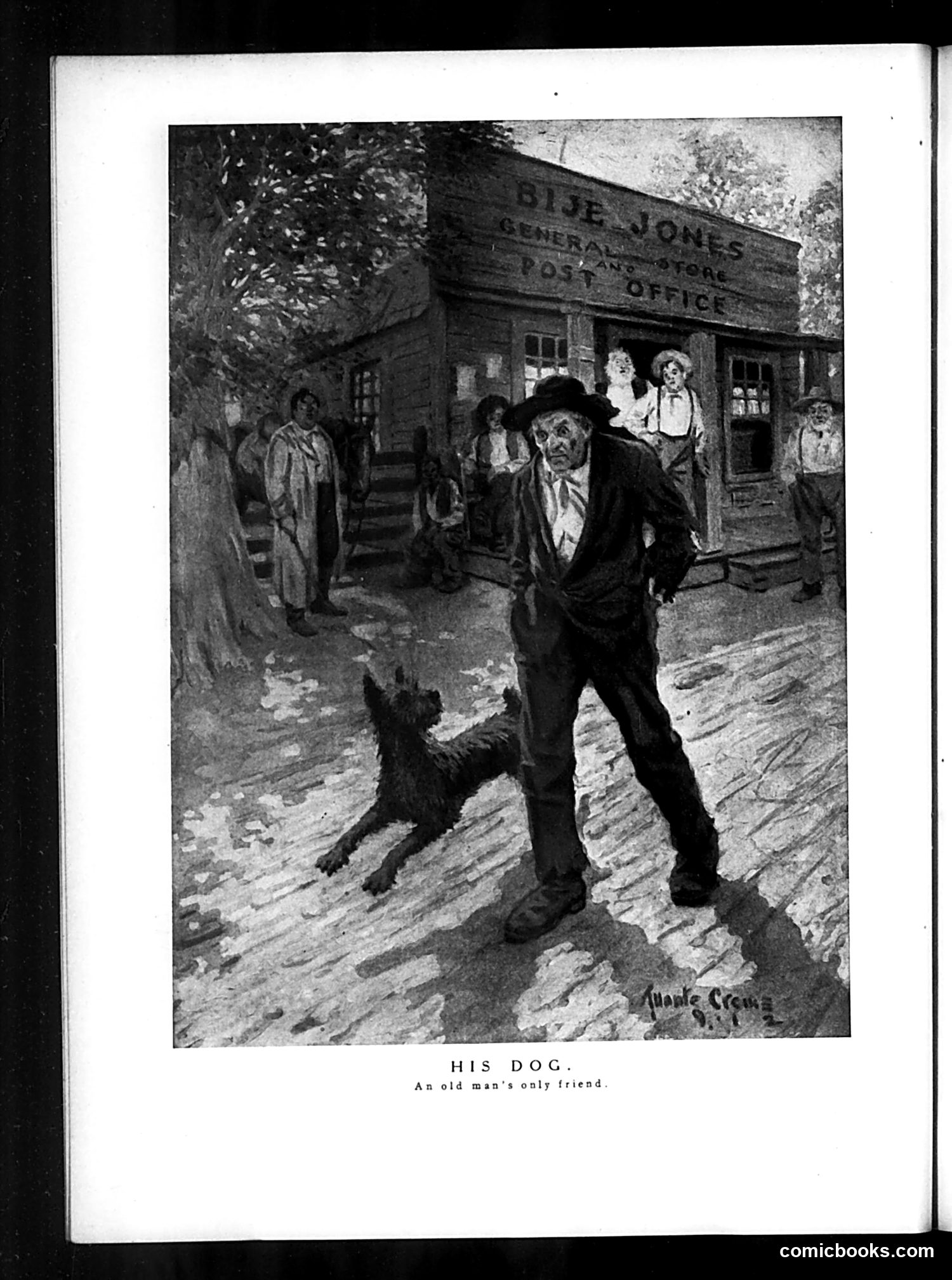
This illustration depicts an elderly man in a rural setting outside "Side Jones General Store and Post Office," accompanied by a small dog. The caption—"An old man's only friend"—employs sentimental humor about aging and social isolation. The satire likely comments on rural American life and the loneliness of elderly individuals in small communities. The juxtaposition of the bustling store with various townspeople visible in the background contrasts against the old man's apparent solitude, suggesting social marginalization or abandonment. His dog becomes his sole companion—a common theme in late 19th/early 20th-century American humor. The scene reflects contemporary anxieties about aging, rural poverty, and community bonds during a period of rapid urbanization.
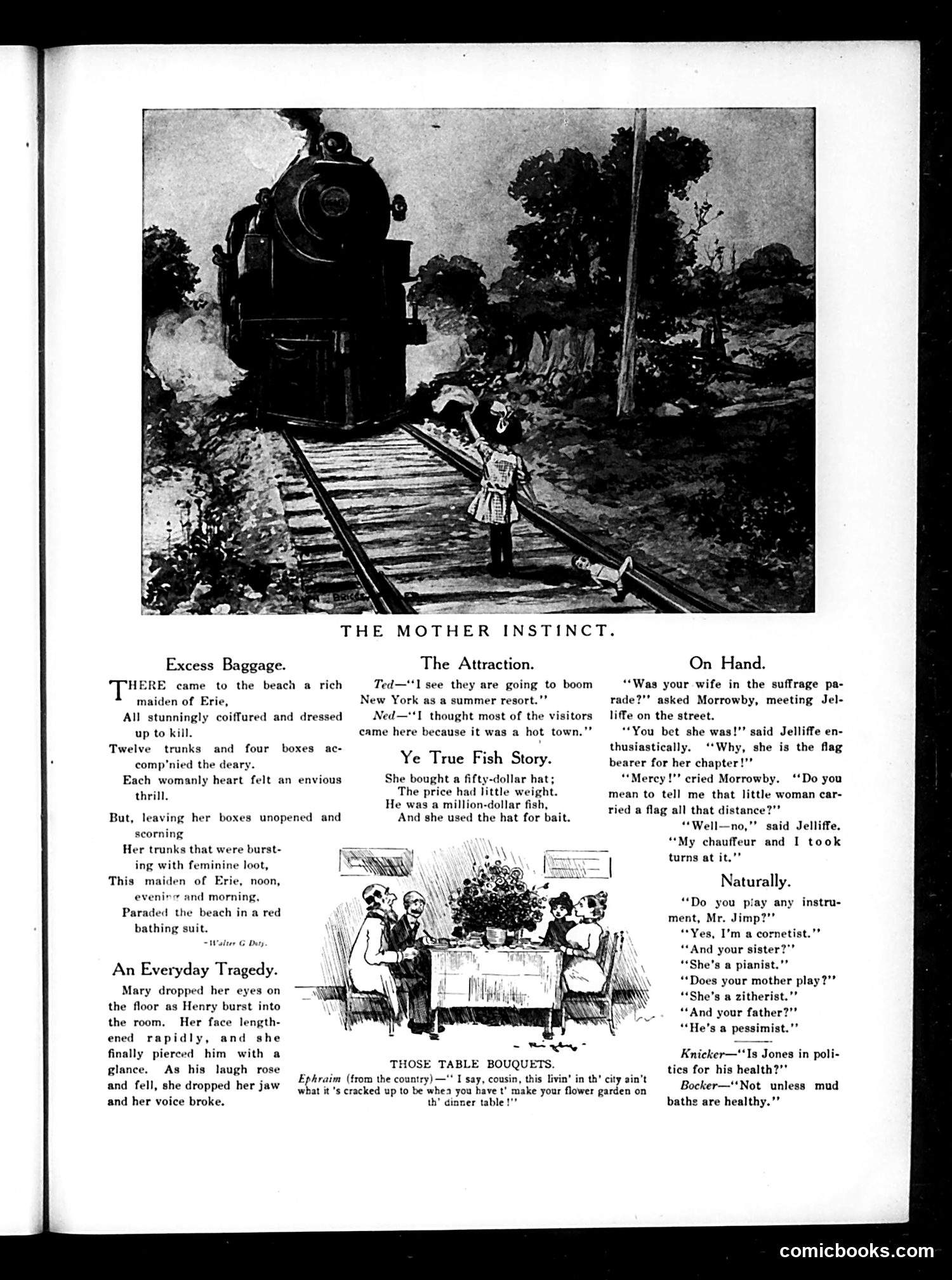
This page contains multiple brief satirical pieces mocking early 20th-century social conventions and gender roles: **"The Mother Instinct"** uses humorous poems and jokes to ridicule women's behavior. "Excess Baggage" mocks a wealthy woman who brings twelve trunks but wears only a red bathing suit—satirizing female vanity and excess. "An Everyday Tragedy" depicts a domestic quarrel ending in reconciliation, suggesting women's emotional volatility. **"Ye True Fish Story"** is a mild joke about a woman using an expensive hat as fishing bait, implying women's frivolous spending. **"Those Table Bouquets"** jokes about urban living's inconveniences, with a country visitor confused by city dwellers growing flowers on dinner tables. The remaining dialogue jokes target women's suffrage activism ("On Hand"), musical pretension ("Naturally"), and politics/corruption ("Knicker-Bocker"). Overall, the page reflects era-typical misogynistic humor dismissing women as vain, emotional, and impractical.
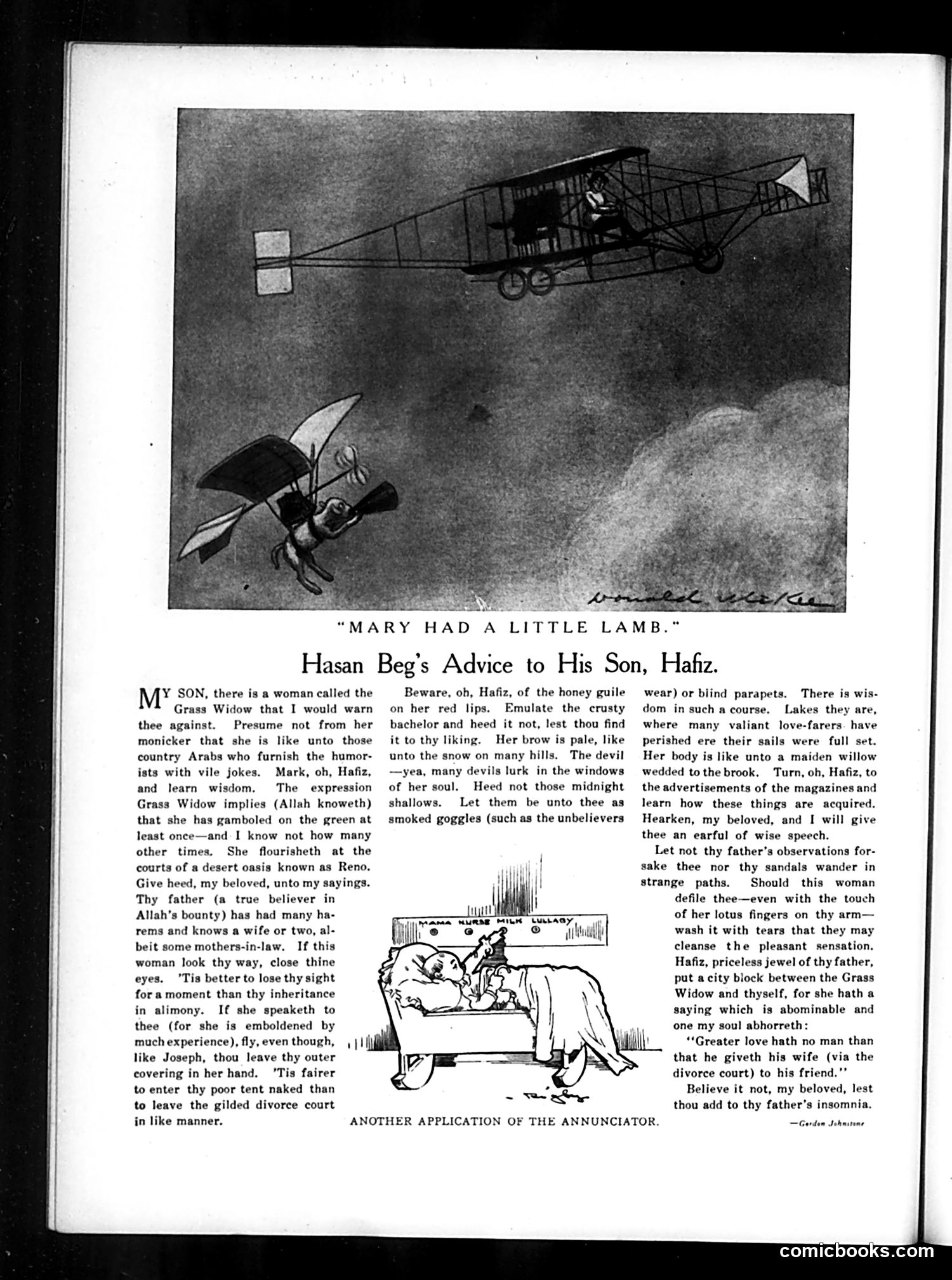
This page satirizes the "grass widow"—a divorced or separated woman, particularly those frequenting Reno, Nevada, which was known for easy divorce proceedings. The satirical advice from "Hasan Beg" to his son uses orientalist framing (mock-Arabian rhetoric) to warn against such women as marriage threats and gold-diggers. The humor targets multiple subjects: the proliferation of divorces enabled by Reno's lax laws, wealthy men's vulnerability to alimony claims, and the perceived danger of sophisticated divorced women. The top cartoon shows an early airplane alongside fantastical imagery, likely satirizing modern technology or progress—possibly suggesting the absurdity of the advice itself. The "Grass Widow" reference implies promiscuity through the crude pun on "grass"—suggesting she's been "rolling" around. This represents period anxieties about female independence and divorce in early 20th-century America, mocking both the women and the men who feared them.
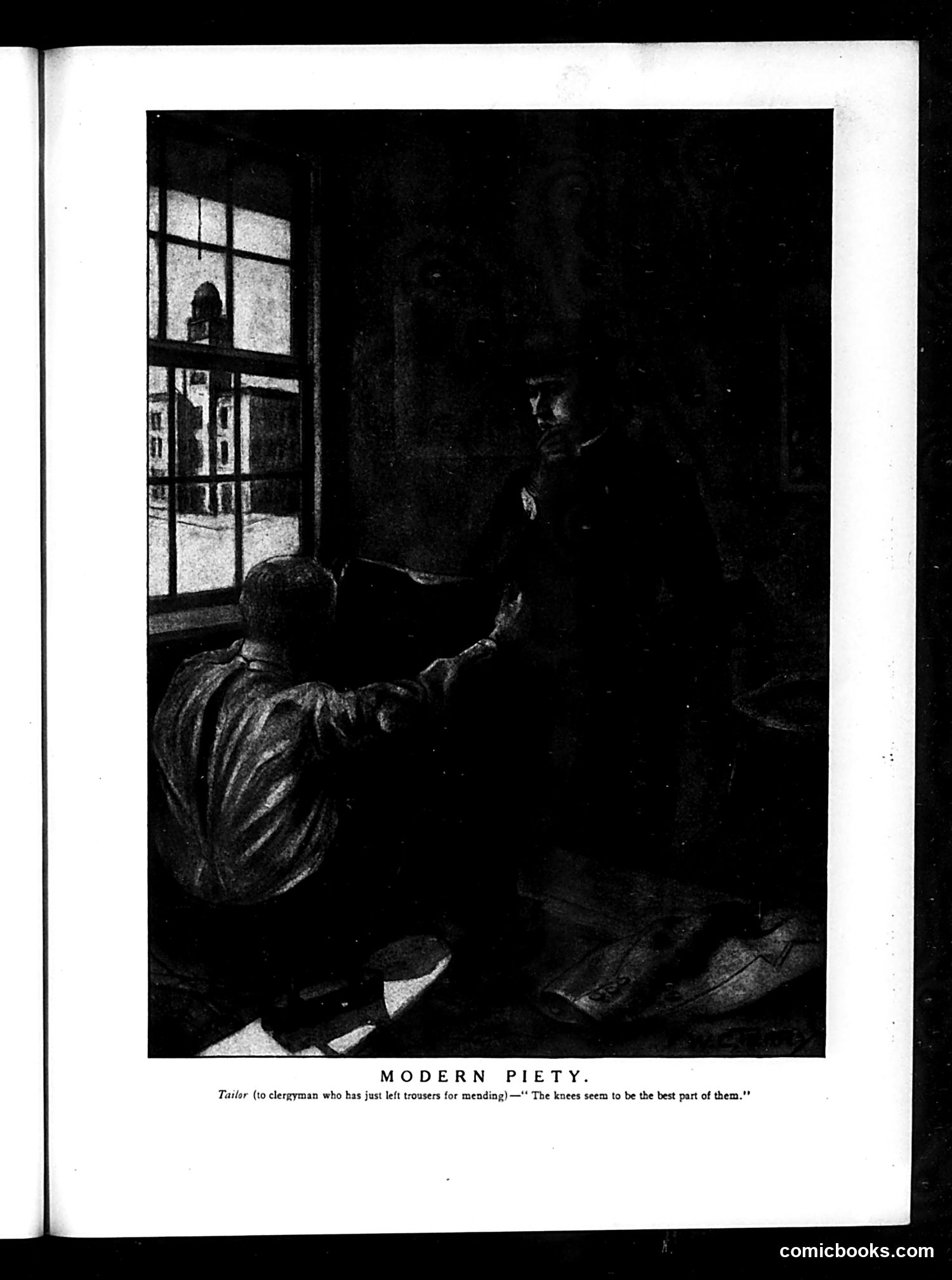
This cartoon satirizes religious hypocrisy through a visual pun. A tailor examines a clergyman's trousers left for mending and remarks that "the knees seem to be the best part of them" — implying the knees are worn through from kneeling in prayer. The humor lies in the double meaning: the tailor's comment appears practical (assessing fabric quality) but actually mocks the clergyman's piety. The worn knees supposedly evidence devout prayer, yet the overall garment's poor condition suggests either the clergyman is not truly wealthy or his apparent piety masks negligence in other areas. The cartoon's title, "Modern Piety," implies that contemporary religious devotion is superficial or performed rather than genuine — the worn knees are mere appearance, not substance.
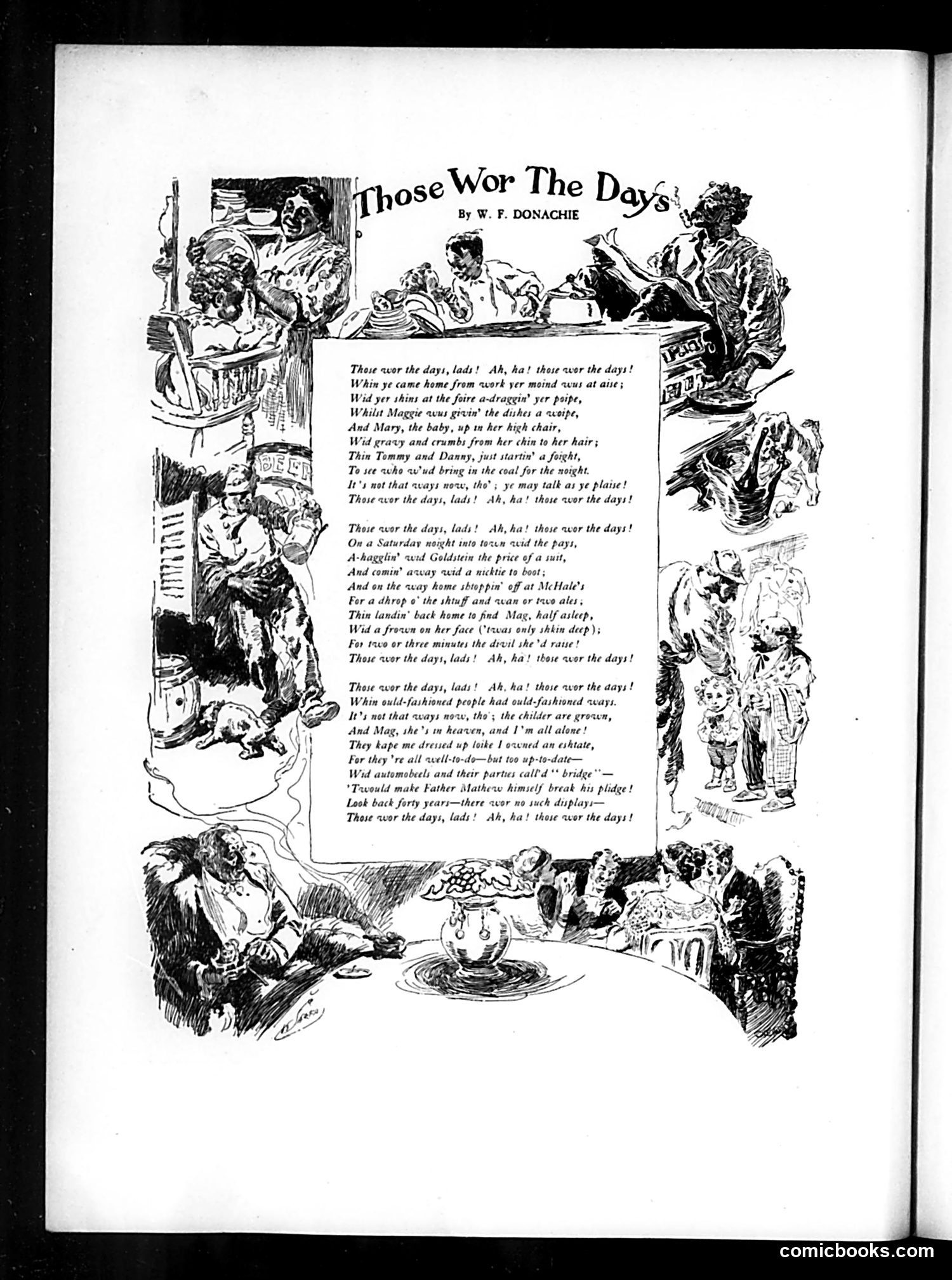
This nostalgic poem, illustrated with domestic scenes, presents an Irish immigrant's lament for working-class life. The speaker recalls earlier, simpler times: coming home from work to a warm hearth, wife doing dishes, children playing, Saturday nights haggling with "Goldstein" (a Jewish merchant) for clothes and stopping at "McHale's" (Irish bar) for drinks. The satire targets modern life's pretensions: his now-grown, wealthy children have become too refined—driving automobiles, playing bridge, dressing him formally—behaviors the speaker considers excessive and morally questionable (he invokes Father Mathew, a temperance advocate, sarcastically). The cartoon mocks both old-fashioned working-class authenticity and new-money affectation, while the ethnic references (Jewish shopkeeper, Irish family names) reflect period immigrant demographics and stereotypes.
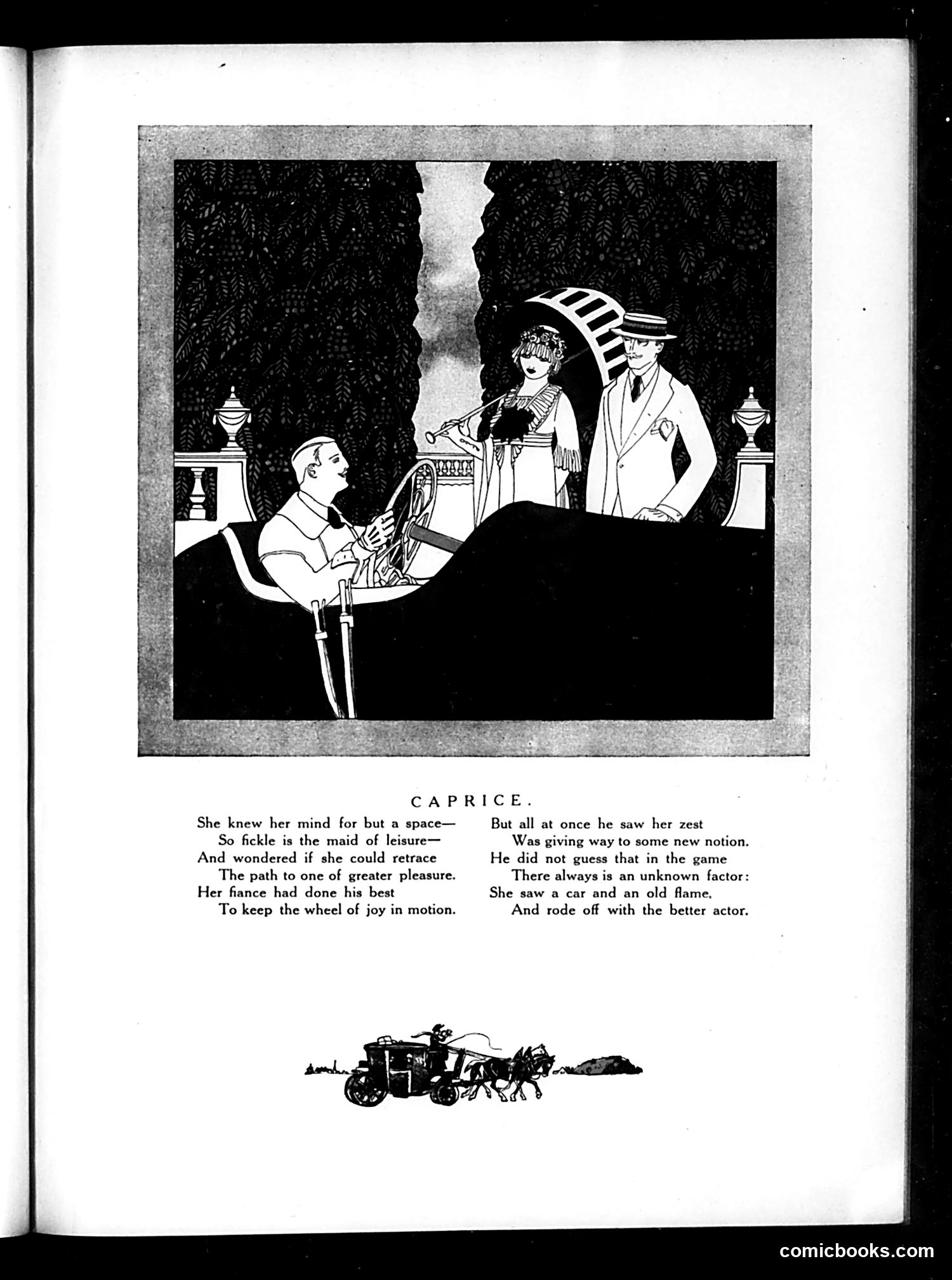
This illustration satirizes female fickleness and the emerging automobile culture of the early 20th century. A wealthy woman of leisure abandons her fiancé (seated left, playing saxophone) when she spots an old romantic interest arriving by motorcar. The poem's moral: even a devoted suitor keeping "the wheel of joy in motion" cannot compete against a woman's capricious nature—particularly when an automobile and a more appealing man appear. The satire targets both gender stereotypes (women as inherently fickle) and the era's fascination with automobiles as symbols of modernity and seduction. The "better actor" likely refers simply to the more charming rival, though Judge's readership would recognize the class-conscious irony: a woman of leisure choosing romance over stability, and a car over commitment.
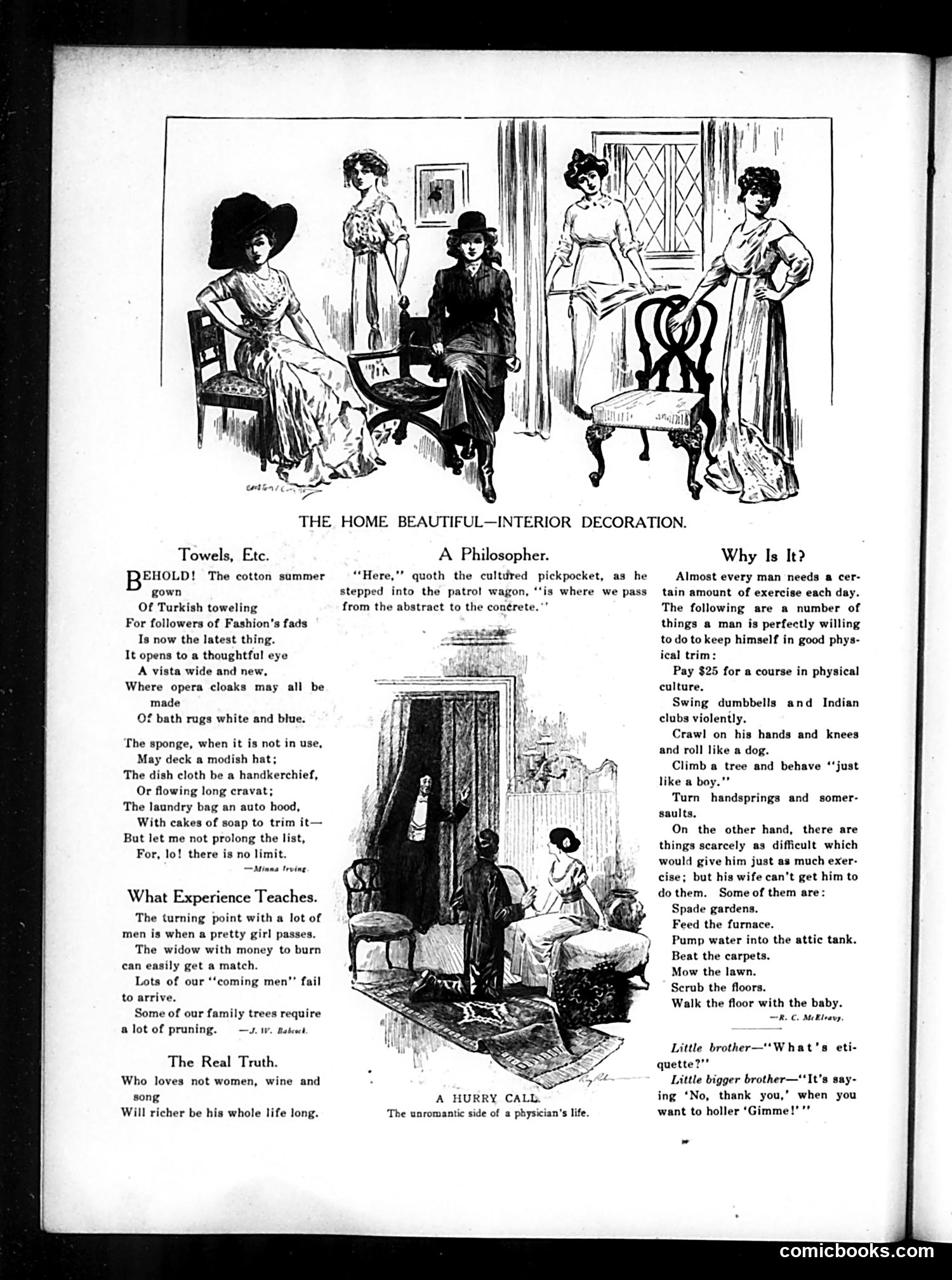
This page satirizes early 1900s domestic fashion and gender roles through interconnected humor pieces: **"The Home Beautiful"** mocks excessive fashion trends by suggesting ordinary household items—bath rugs, dish cloths, laundry bags, soap cakes—could become fashionable clothing. The satire targets followers of high fashion who adopt impractical trends uncritically. **"A Philosopher"** contains a small joke about a pickpocket arrested for theft, pretending his arrest represents moving "from the abstract to the concrete"—philosophical wordplay from someone who steals tangible goods. **"Why Is It?"** contrasts men's willingness to pay for gym memberships and perform gymnastics with their reluctance to do household work—gardening, stoking furnaces, beating carpets, caring for babies—that provides equal exercise. This exposes male hypocrisy about physical fitness while dodging unpaid domestic labor. **"A Hurry Call"** depicts the unglamorous reality of a physician's work (shown as a nighttime emergency visit). **"Little brother/bigger brother"** humorously defines etiquette as polite refusal when one actually wants something. The overall theme critiques both fashion absurdity and gender dynamics of the era.
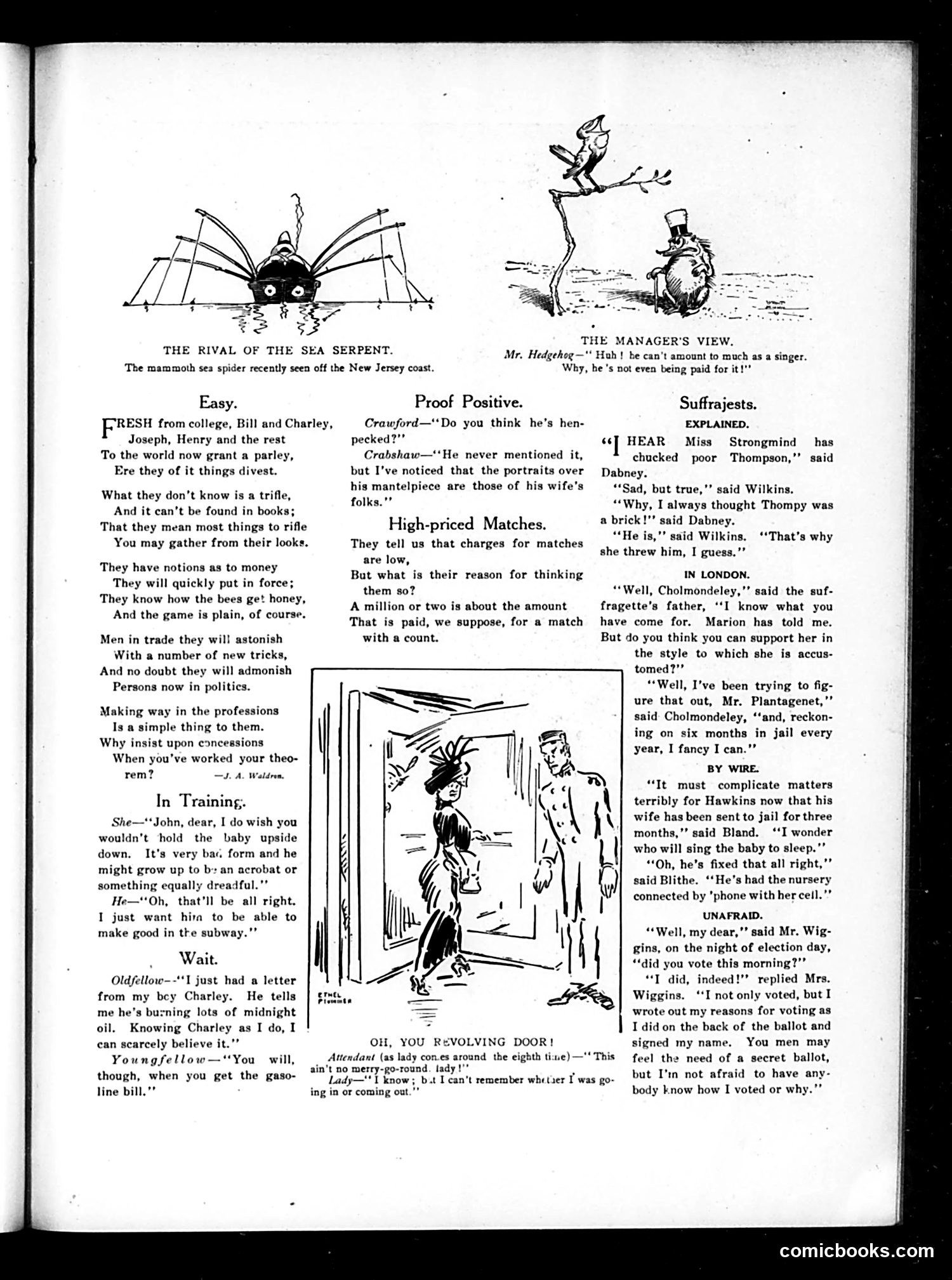
This page from *Judge* contains several satirical pieces mocking contemporary social trends: **Top cartoons:** "The Rival of the Sea Serpent" jokes about a sensational sea spider sighting off New Jersey—typical yellow-journalism fodder. "The Manager's View" mocks unpaid performers. **Poetry sections** ("Easy," "In Training," "Wait") satirize overconfident recent college graduates and young men entering trades, suggesting they lack actual knowledge despite their presumption. **"High-priced Matches"** ridicules wealthy marriages, implying fortunes are spent acquiring aristocratic spouses. **"Suffragists Explained"** contains anti-suffrage humor: a woman dumps her fiancé; another suffragette jailed regularly; a wife publicly announces her voting reasons—all presented as absurd female behavior. The satire assumes women's political participation is inherently ridiculous and threatens domestic stability. **"Unafraid"** ironically praises Mrs. Wiggins for proudly disclosing her vote, contrasting with men's supposed need for ballot secrecy—mocking women's supposed naïveté about politics. The page reflects early 20th-century anti-suffrage sentiment common in *Judge*.
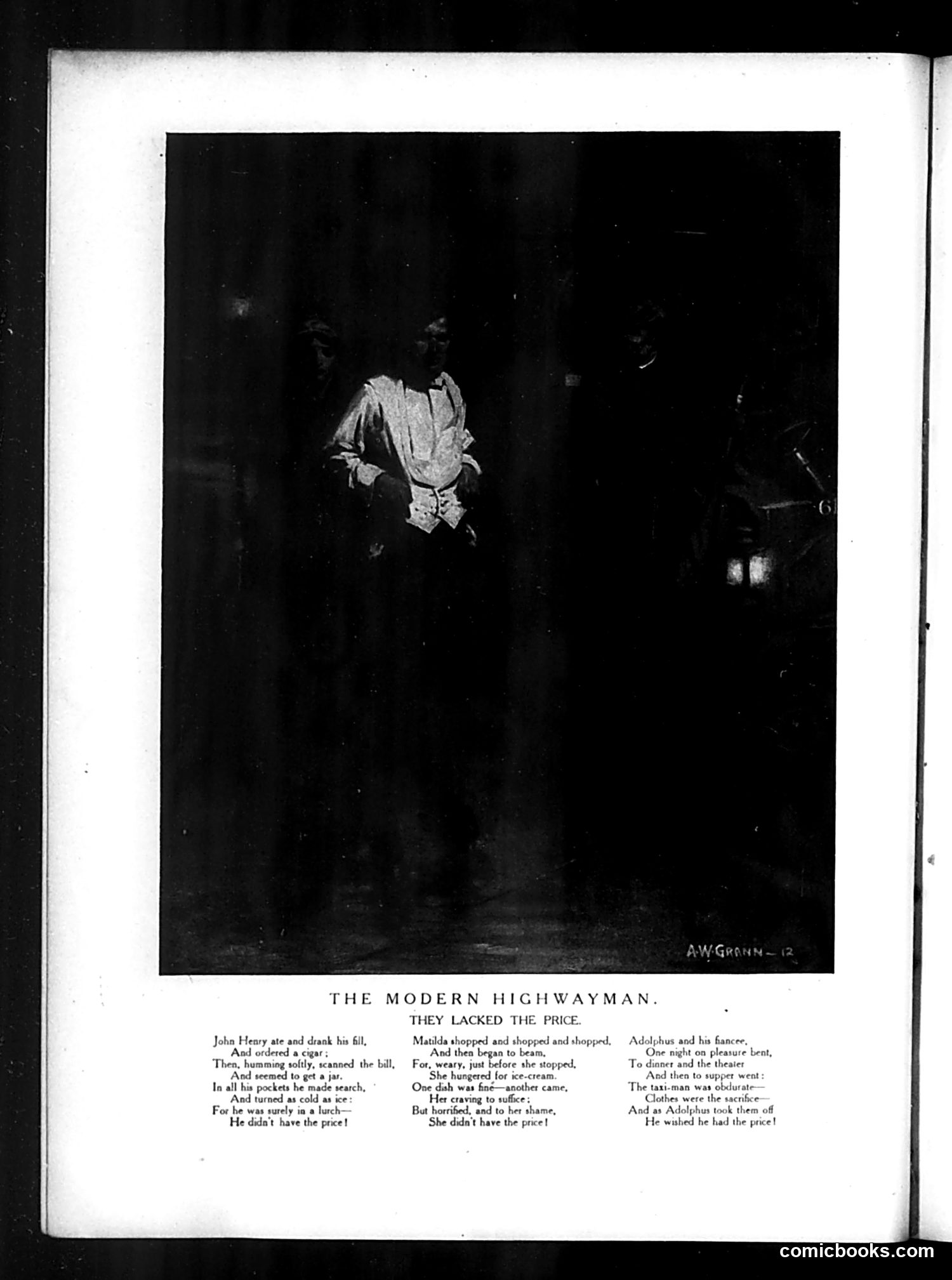
This Judge satirical poem mocks three scenarios where young people on dates discover they cannot afford to pay their bills. Each vignette follows the same pattern: a person indulges (eating, ordering cigarettes, shopping, buying ice cream), then faces embarrassment upon realizing they lack funds. The title "Modern Highwayman" sarcastically compares these situations to highway robbery—suggesting that restaurants and shops effectively steal from patrons who overspend. The repeated refrain "He didn't have the price" emphasizes the social humiliation of being unable to settle debts. The satire targets early-20th-century consumer culture and young people's irresponsible spending habits. It suggests that modern commercial establishments are predatory, luring customers into purchases they cannot afford, leaving them stranded and ashamed. The joke relies on the audience recognizing the anxiety of public embarrassment over unpaid bills.
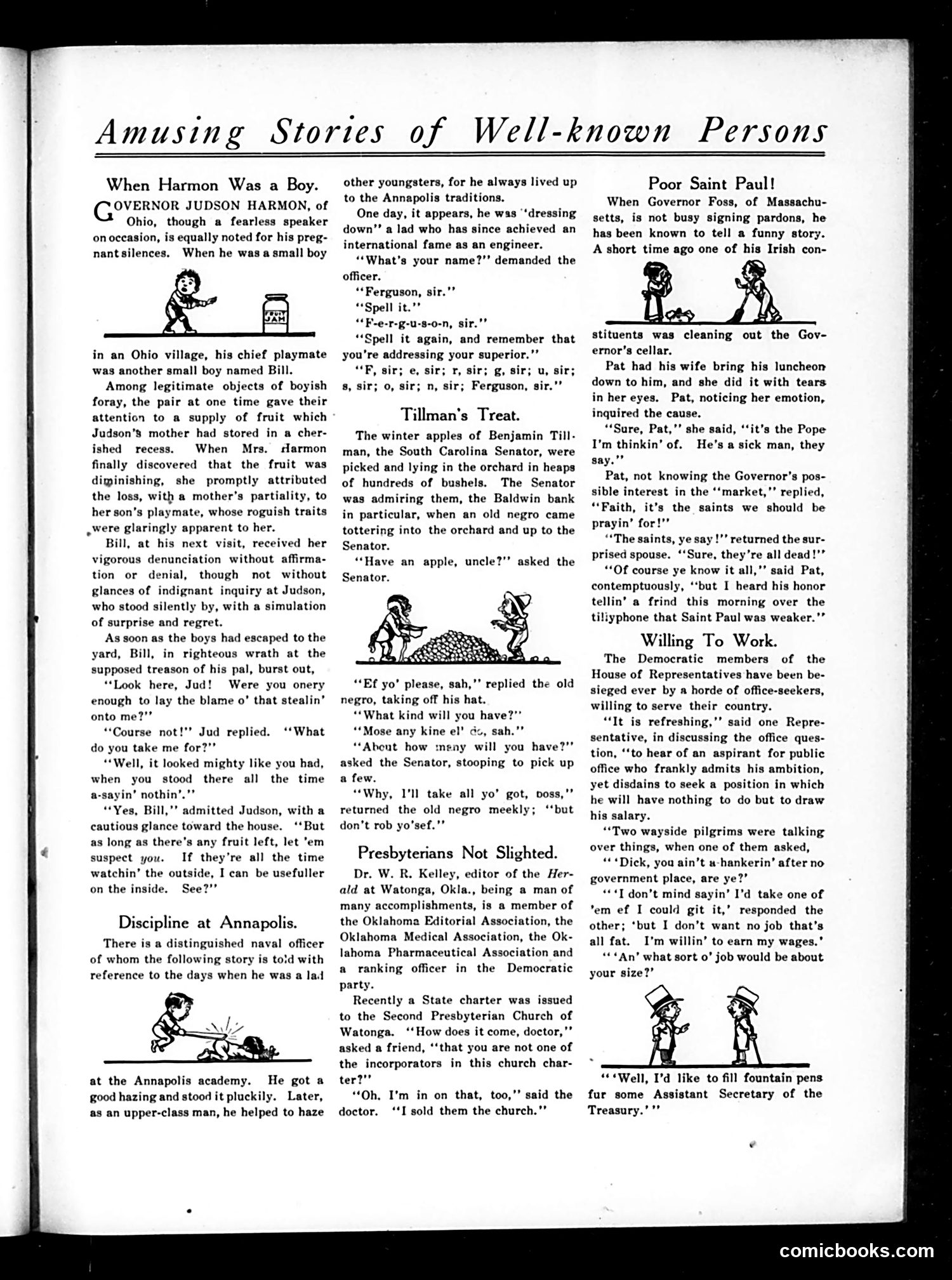
This page from the satirical magazine **Judge** contains humorous anecdotes about prominent American figures, likely from the early 1900s based on references to Governor Judson Harmon of Ohio and Senator Benjamin Tillman of South Carolina. The stories mock these well-known persons through unflattering childhood or professional anecdotes: 1. **Harmon story**: Young Judson stays silent while his friend Bill takes blame for stolen fruit, revealing cunning dishonesty disguised as innocence. 2. **Annapolis naval officer**: A cadet's elaborate, pedantic spelling of his own name to a superior officer, satirizing military hazing traditions. 3. **Tillman's generosity**: A poor Black man shrewdly asks for all the Senator's apples while feigning modesty—a joke at Tillman's expense. 4. **Dr. Kelley**: A man so omnipresent in Oklahoma institutions that he even "sold" the church to its incorporators. The humor targets authority figures' pretensions and inconsistencies, typical of Judge's satirical approach.
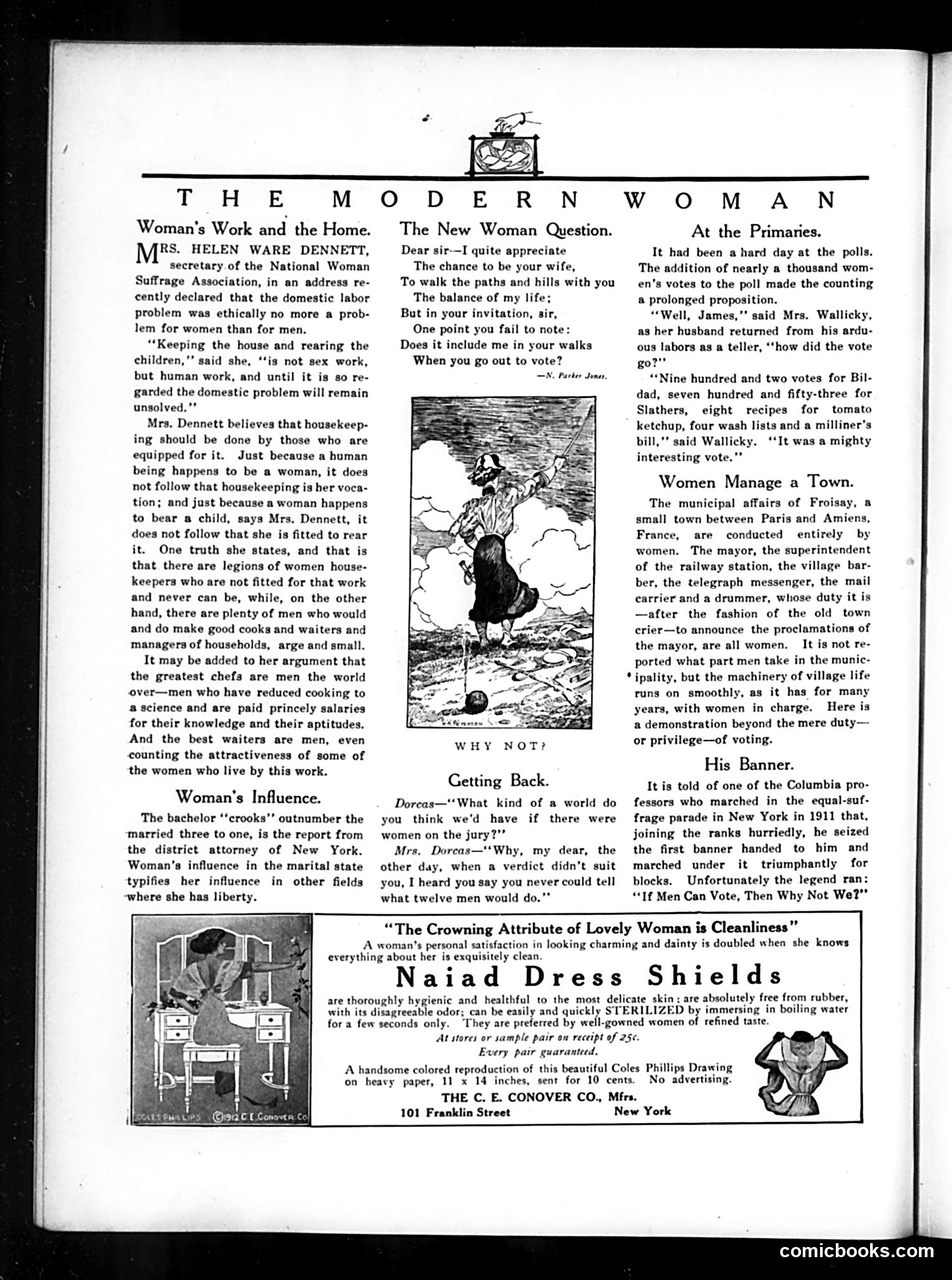
This page from Judge presents satirical commentary on women's suffrage and gender roles, circa 1911 (based on the suffrage parade reference). **Main Arguments:** - Helen Ware Dennett argues housekeeping is "human work," not inherently women's work, and should be performed by those equipped for it - A poem questions whether voting rights are truly inclusive of women - Humor targets both women and men: a husband's voting tally comically includes "eight recipes for tomato ketchup" and "wash lists" alongside actual votes, mocking the distraction women voters cause - A French town (Froisay) is presented as functioning well under female municipal leadership **The Satire:** Judge ridicules the chaos of women voting while simultaneously—through the Dennett piece and the French example—acknowledging women's actual competence. The magazine appears to mock *both* suffrage opponents (through the French success story) and suffragists (through the voting-day confusion). The Columbia professor who unknowingly carries a suffrage banner represents male obtuseness about women's rights. The page reflects pre-1920 suffrage debate's central tension: demonstrating women's capability while satirizing the disruption their political participation supposedly caused.
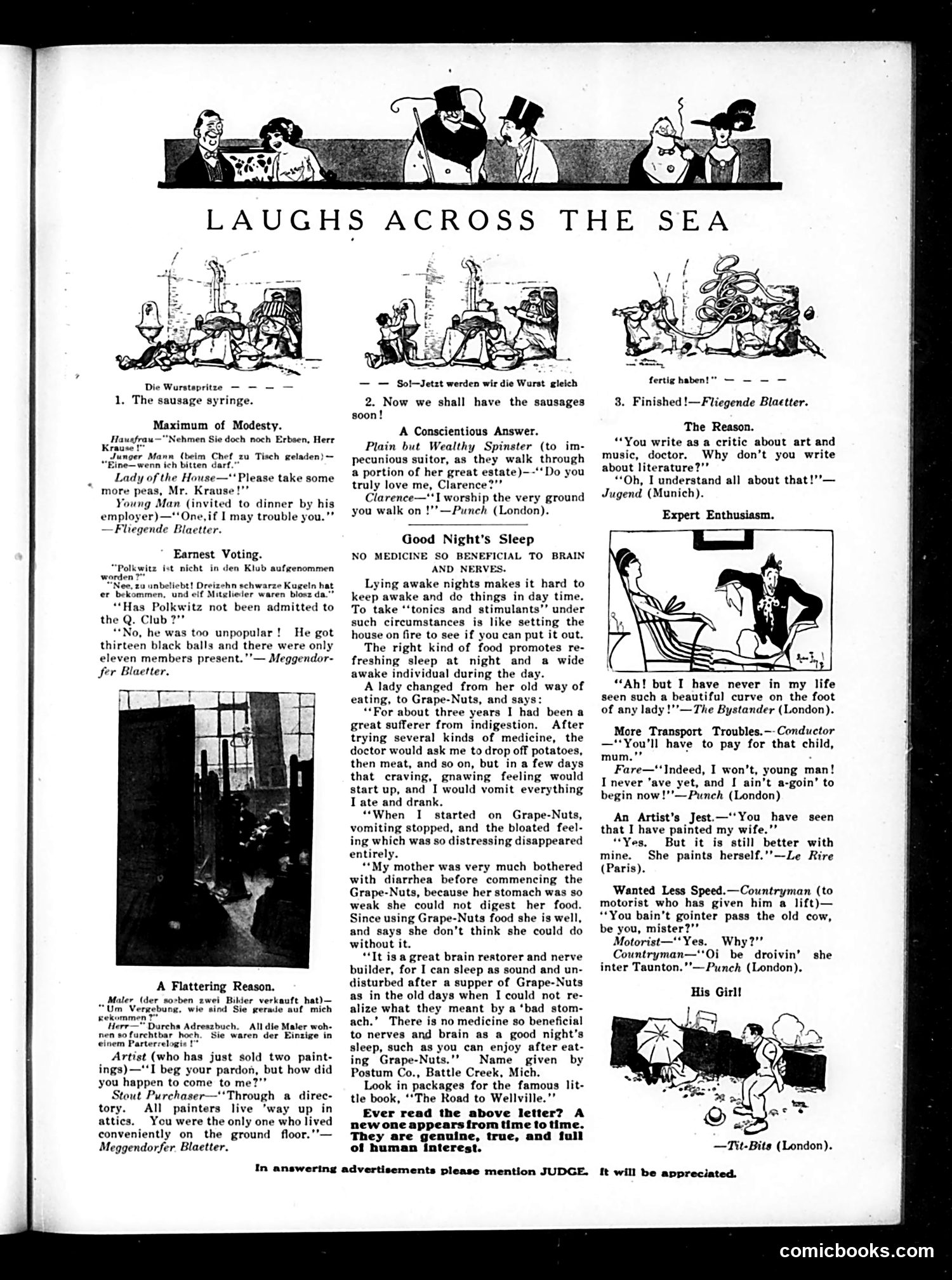
This page collects humorous anecdotes translated from European satirical magazines (primarily German *Fliegende Blätter* and *Meggendorfer Blätter*, plus British *Punch*). The cartoons mock everyday social situations: **Panel 1** mocks false modesty—a young dinner guest accepts only one pea when offered more, performing excessive politeness. **Panel 2** satirizes club voting procedures: a man is rejected for membership despite only eleven members present to cast thirteen blackballs, highlighting absurd club politics. **Panel 3** jokes about an artist's low social status—a purchaser found him through a directory because "all painters live way up in attics," making him unusual for living on the ground floor. Additional jokes target pretentious romance, snobby criticism, and social hypocrisy. The page concludes with **Grape-Nuts advertising**, using a testimonial about digestive health and improved sleep—common early-20th-century health claims for the cereal product.
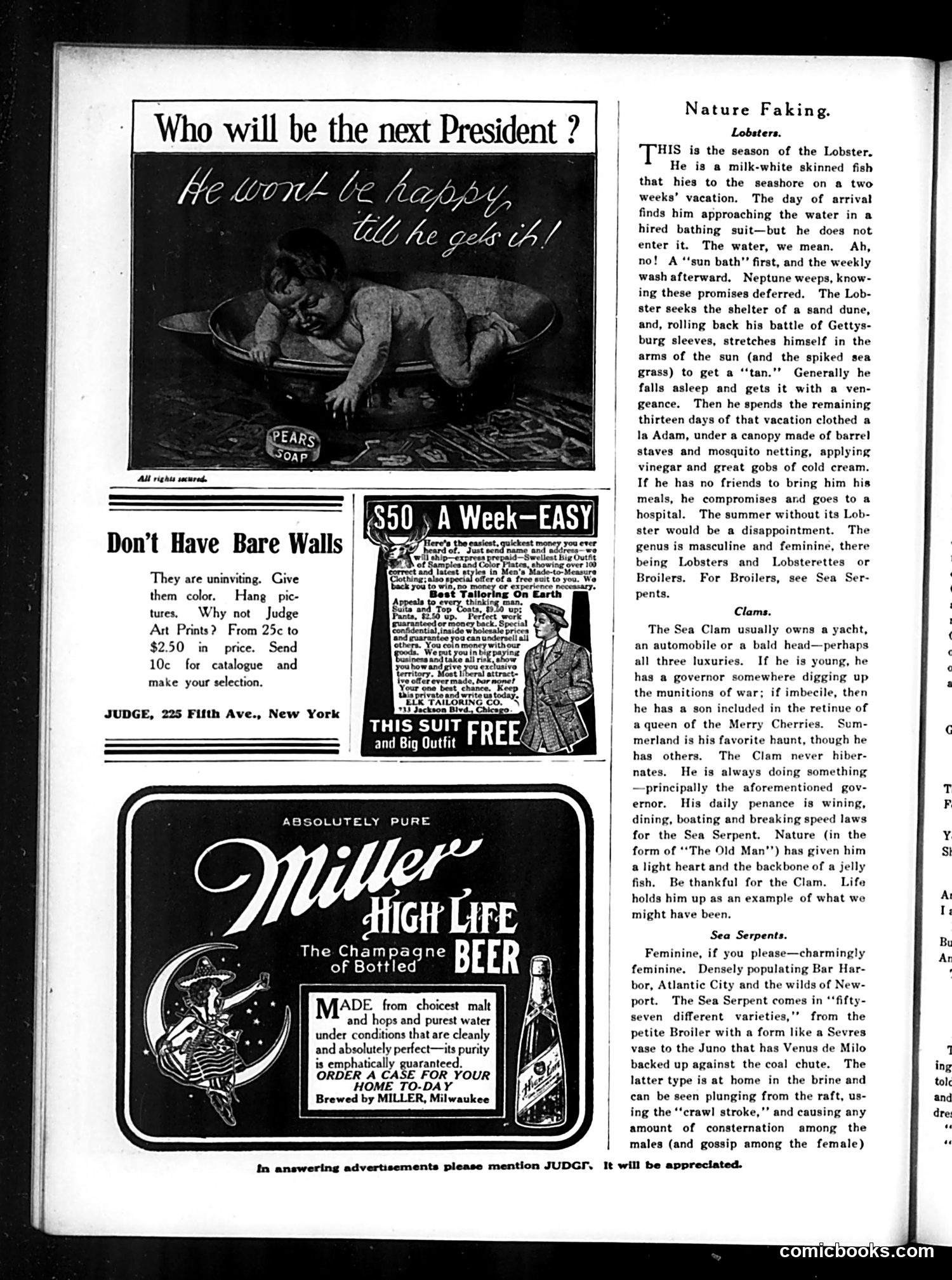
The top cartoon depicts an disheveled man (presumably a political figure, though identity is unclear from the image alone) sprawled on the ground with the caption "He won't be happy till he gets it!" This is a satirical commentary on presidential ambition—likely mocking a specific politician's relentless pursuit of the presidency. The Pears Soap branding suggests this may be a parody or commentary on vanity and ambition intertwined with consumerism. The page is primarily **advertising-heavy**, featuring Judge Art Prints, tailoring services, and Miller High Life beer, interspersed with a humorous article titled "Nature Faking" that uses anthropomorphized sea creatures (Lobsters, Clams, Sea Serpents) as thinly-veiled social satire about wealthy vacationers and their pretentious summer behaviors at beach destinations like Bar Harbor and Newport. The actual political point of the presidential cartoon remains unclear without additional historical context about the specific election or candidate referenced.
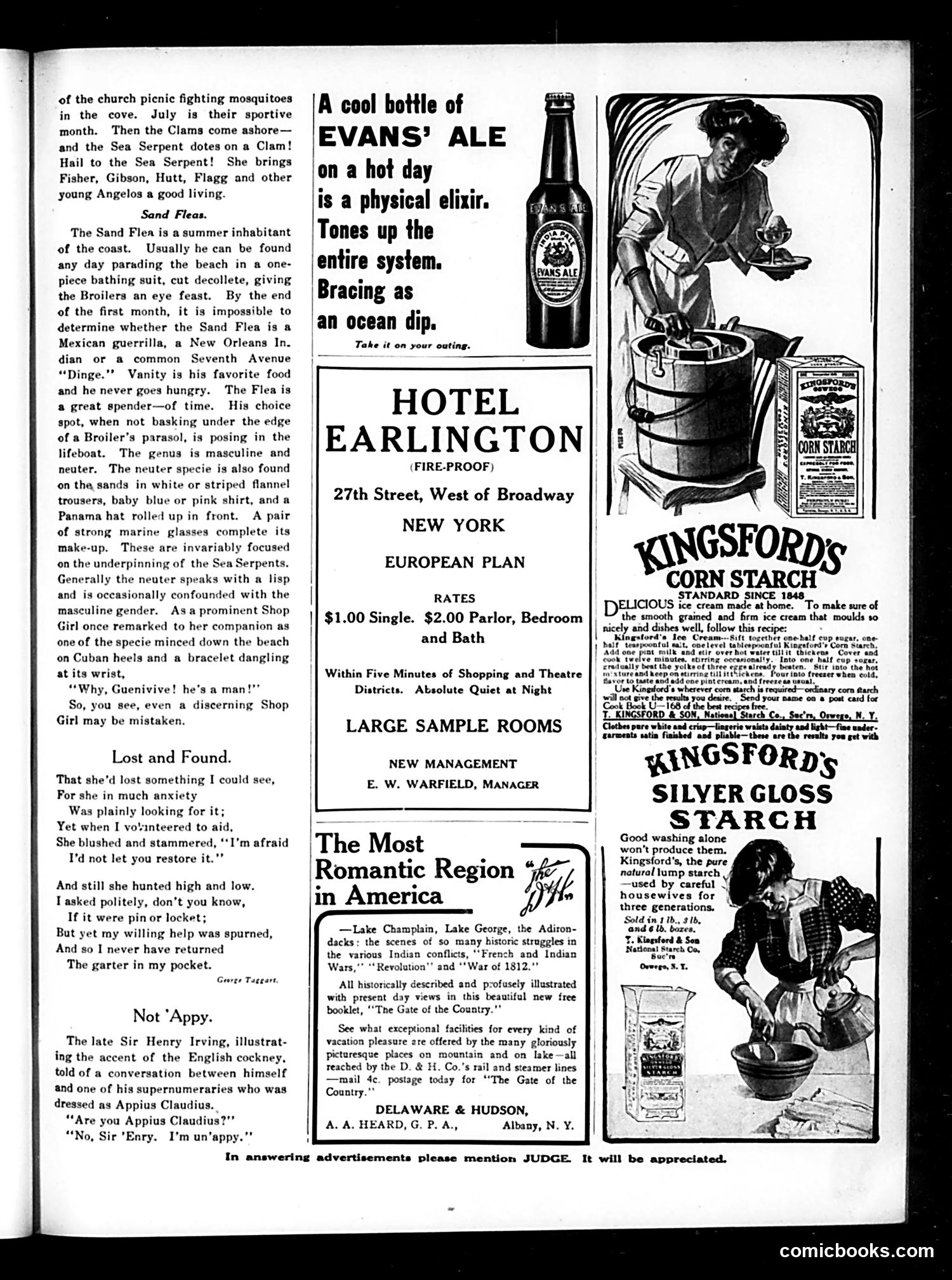
This page is primarily **advertising and filler content** from Judge magazine, with several distinct sections: **Main Content:** - Humorous prose sketches about beach life: "Sand Fleas" (mocking vain beachgoers), "Lost and Found" (a suggestive joke about a lost garter), and "Not 'Appy" (a pun on Henry Irving's accent—"un'appy" sounds like "unhappy"). **Advertisements:** - Evans' Ale and Kingsford's Corn Starch ads (with product illustrations) - Hotel Earlington (NYC lodging) - Delaware & Hudson railway promoting Adirondack tourism **Social Context:** The "Sand Flea" sketch uses period slurs ("Dinge") and mocks working-class beachgoers and cross-dressing individuals. The "Lost and Found" poem relies on risqué innuendo typical of Judge's humor. These reflect early 20th-century attitudes toward class, gender, and sexuality that would be considered offensive today. The page reflects Judge's mix of satirical content, light humor, and commercial advertising aimed at upper-middle-class readers.
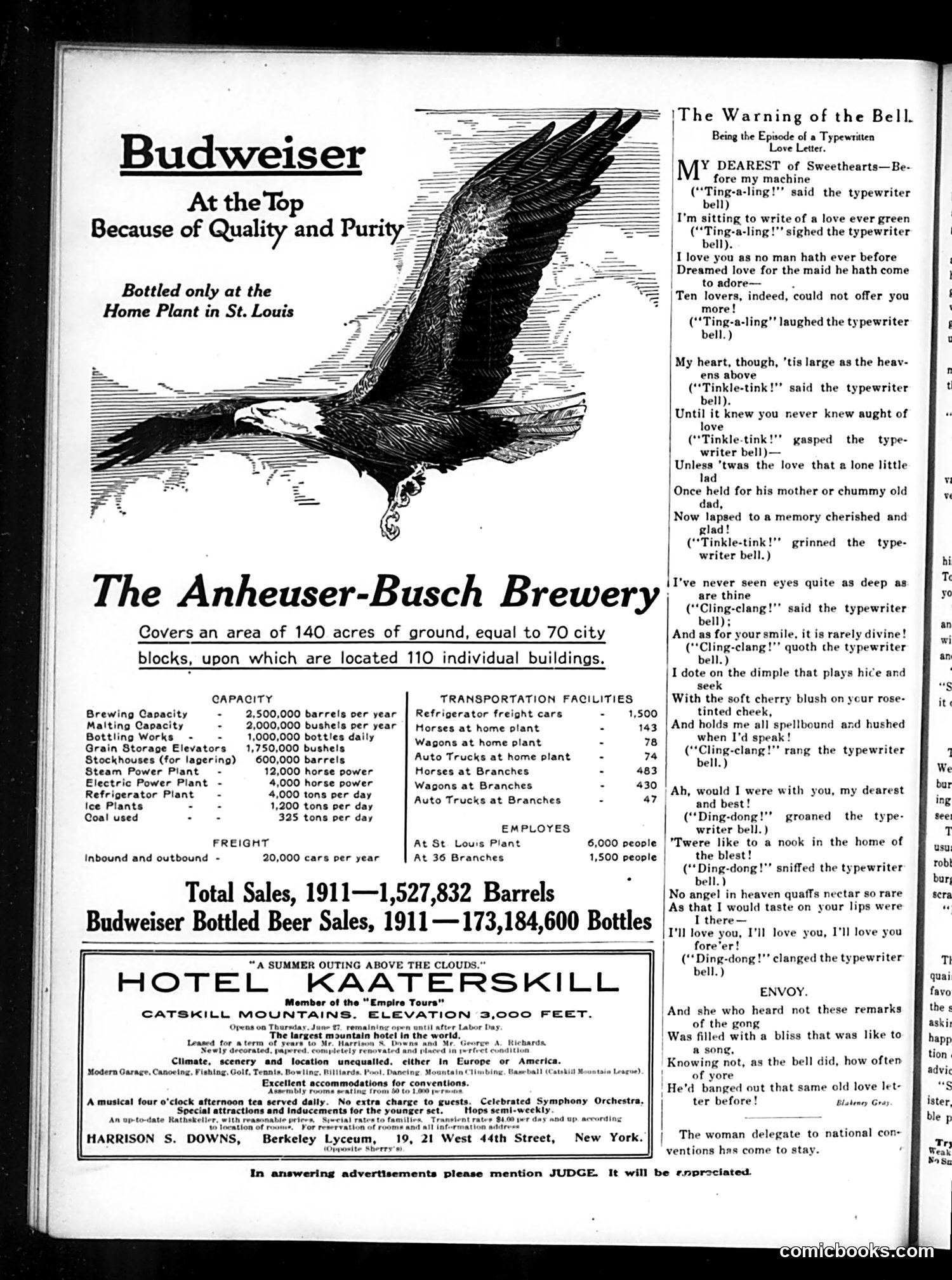
This page is primarily **advertisements and promotional content**, not political satire. The main elements are: **Left side:** A large Budweiser/Anheuser-Busch brewery advertisement showcasing the company's massive 1911 production capacity (1.5 billion bottles annually) across 140 acres in St. Louis. This reflects early 20th-century American corporate pride in industrial scale and efficiency. **Bottom:** An advertisement for Hotel Kaaterskill in the Catskill Mountains—a luxury resort destination. **Right side:** A sentimental romantic poem titled "The Warning of the Bell," about a man typing a love letter on a typewriter. The typewriter's bell punctuates each stanza with onomatopoeia ("Ting-a-ling," "Cling-clang," "Ding-dong"), creating comedic contrast between the heartfelt romantic language and mechanical sounds. **The humor:** The typewriter bell's interruptions mock the overwrought sentimentality of romantic correspondence—a gentle, non-political joke about courtship and modern technology.
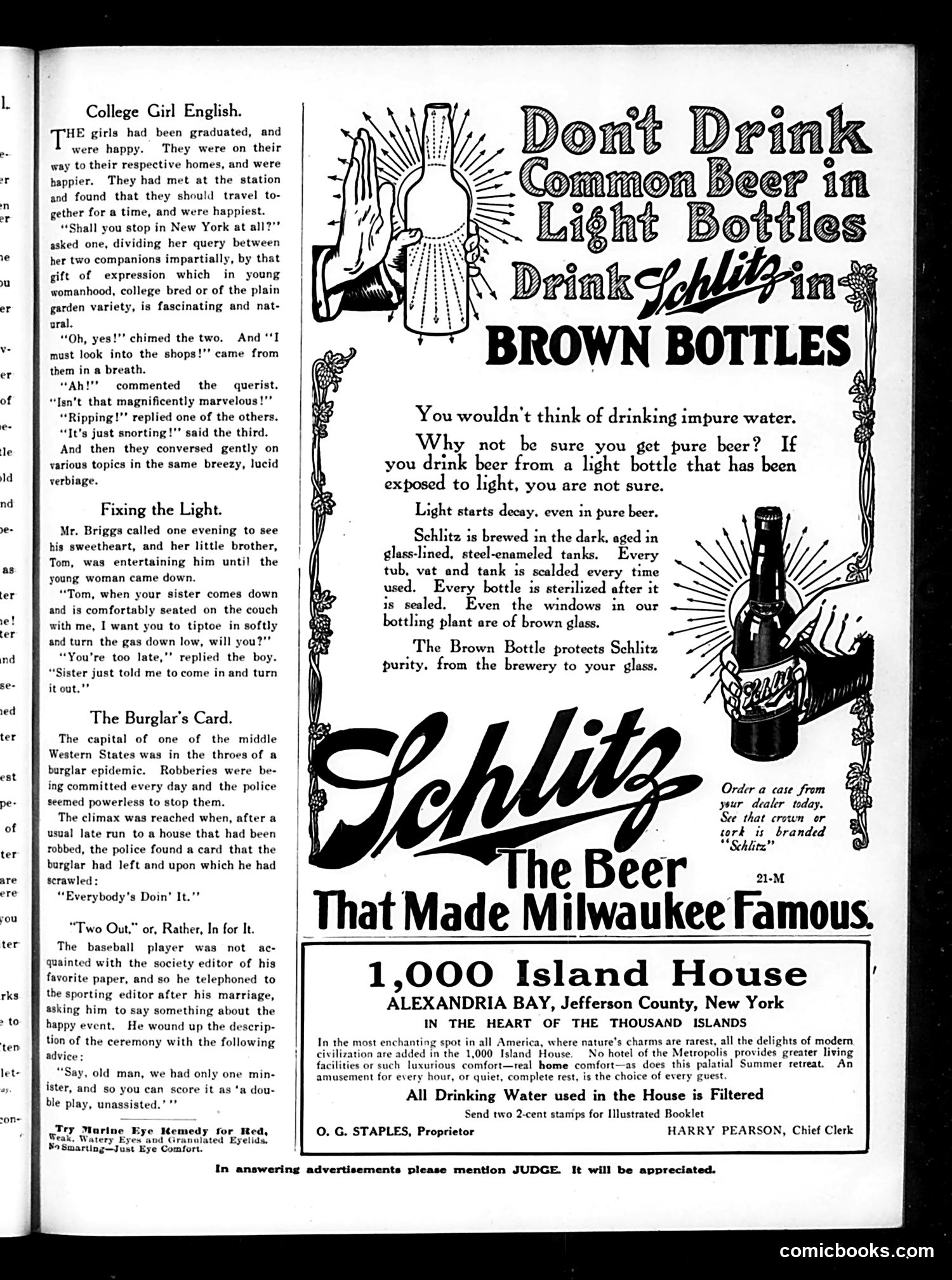
This page contains three short humorous pieces and advertisements rather than political cartoons. **"College Girl English"** satirizes how newly graduated college women adopt affected speech patterns—using phrases like "magnificently marvelous" and "ripping"—to signal their education and sophistication, which the author finds both amusing and somewhat pretentious. **"Fixing the Light"** is a brief romantic joke: a suitor asks the girl's brother to dim the gas lamp during his visit, but the sister has already instructed the boy to turn it *off* entirely, indicating she's more eager to be alone with him than he realizes. **"The Burglar's Card"** references the contemporary fad phrase "Everybody's Doin' It" (a 1909 popular song), sardonically suggesting that even burglars are participating in the trend by leaving calling cards at crime scenes. The page is primarily advertising real estate and Schlitz beer, emphasizing brown bottles to protect beer from light exposure.
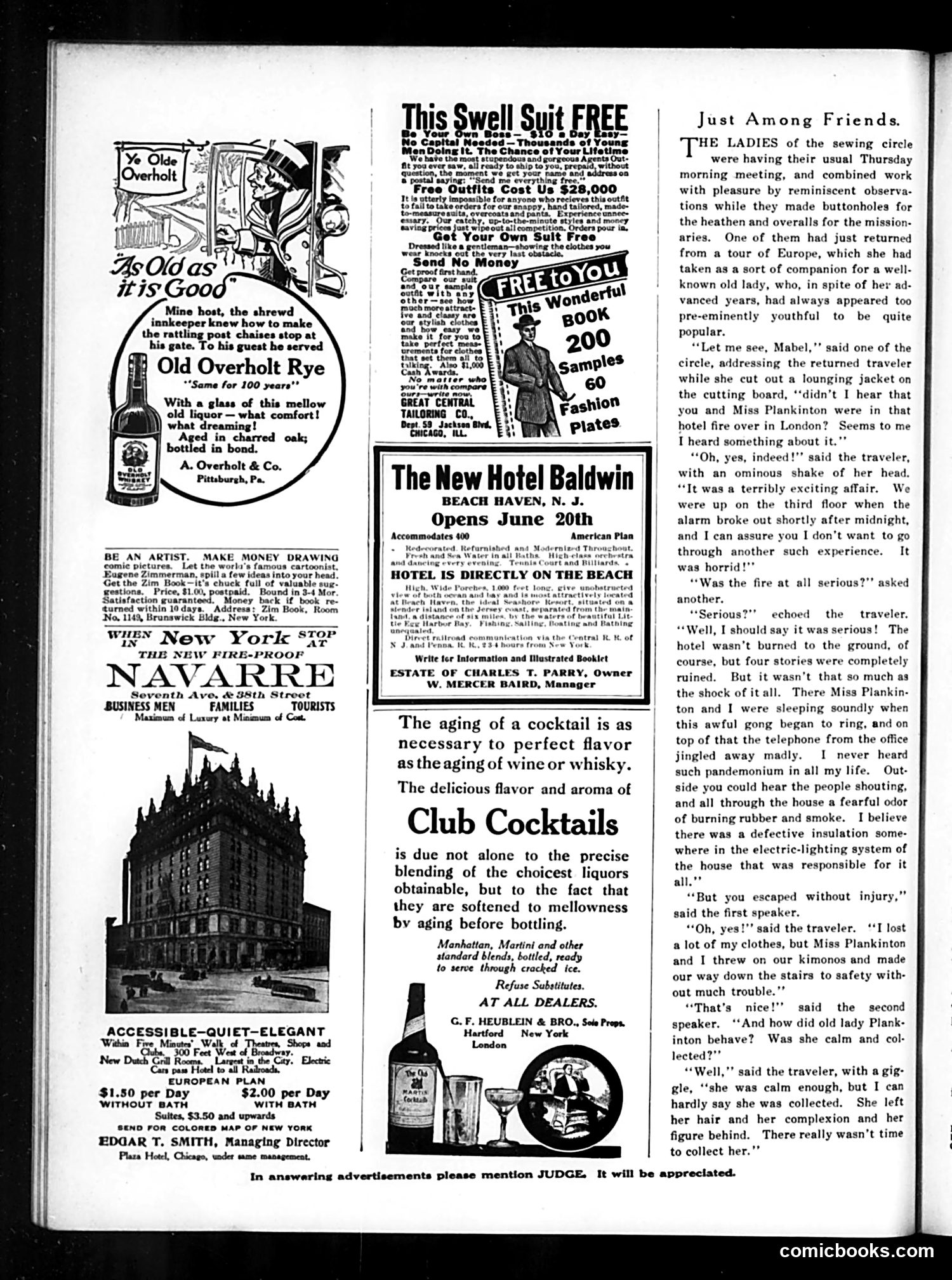
This page is primarily **advertising with one narrative cartoon feature** ("Just Among Friends"). ## The Main Story/Cartoon: "Just Among Friends" depicts a sewing circle of ladies discussing a dramatic hotel fire in London. One traveler describes a harrowing experience where she and an elderly companion, Miss Plankington, were trapped on the third floor. The joke's implication: Miss Plankington, known for appearing "too pre-eminently youthful to be quite popular," survived unharmed—suggesting her youth may have been artificially maintained, or the disaster didn't disrupt her composure as it should have. The humor lies in gentle mockery of an aging woman trying to appear younger than her years. ## Context: This reflects **early 20th-century social attitudes** about aging women and propriety. The sewing circle setting—women doing charitable needlework while gossiping—was a common middle-class domestic scenario. The page is otherwise filled with **period advertisements**: Old Overholt Rye whiskey, hotel promotions (Navarre, Baldwin), art instruction books, and Club Cocktails, typical of Judge's commercial content.
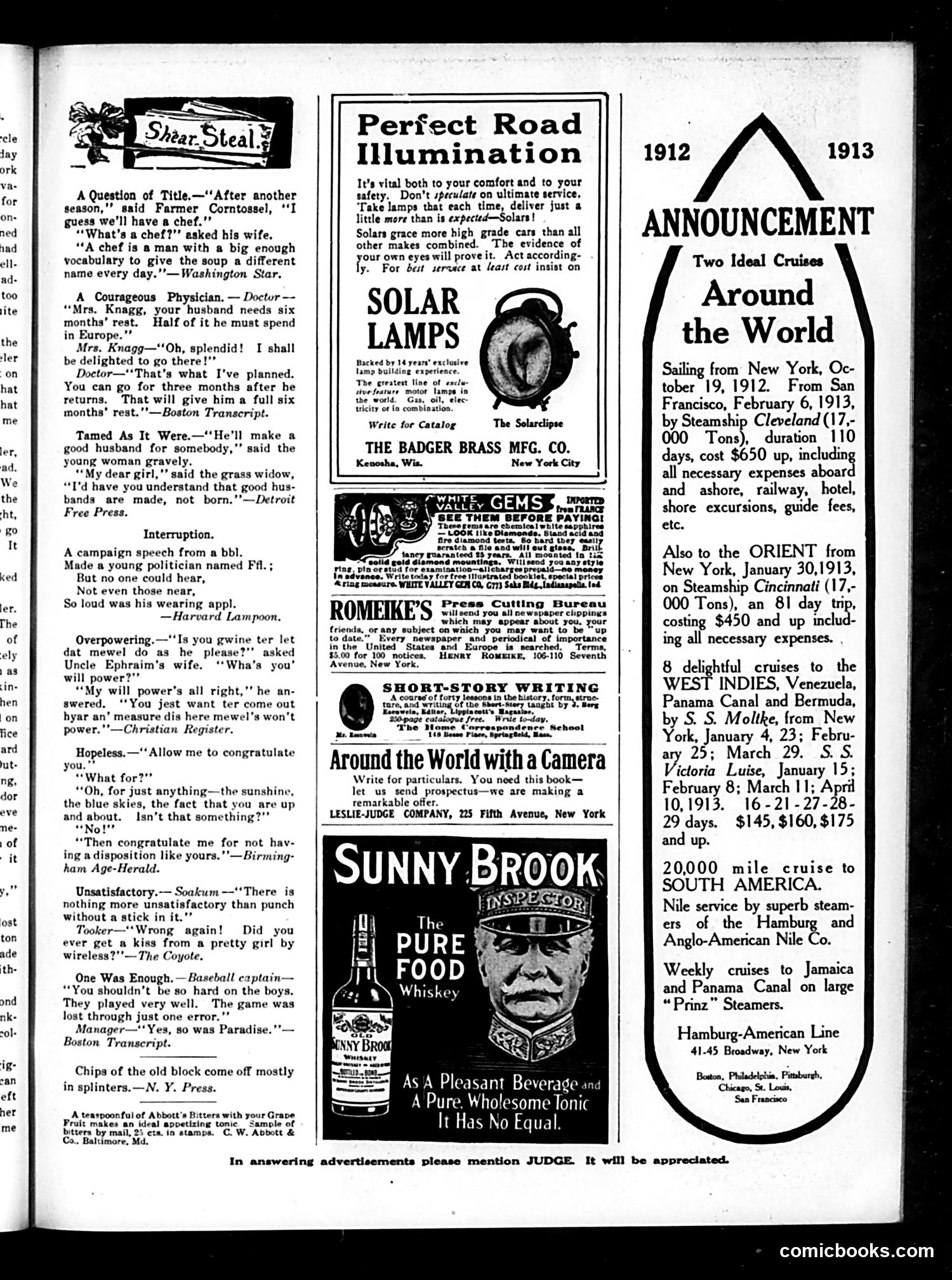
This page is primarily **advertising and humor content** rather than political cartoons. The left side contains brief satirical jokes typical of Judge magazine's format—short, punchy pieces mocking contemporary social types: a farmer's wife misunderstanding "chef," a doctor prescribing his wife a trip to get her away, and complaints about a mule's stubbornness. The right side features a large cruise ship announcement promoting exotic voyages around the world via steamship lines—reflecting the era's leisure travel industry. Below are period advertisements for Solar lamps, press clipping services, and Sunny Brook whiskey. **No specific political figures or caricatures are present.** The humor targets universal social situations (marriage dynamics, political incompetence, stubbornness) rather than current events. This represents Judge's general satirical approach: observational comedy about American life rather than topical political commentary.
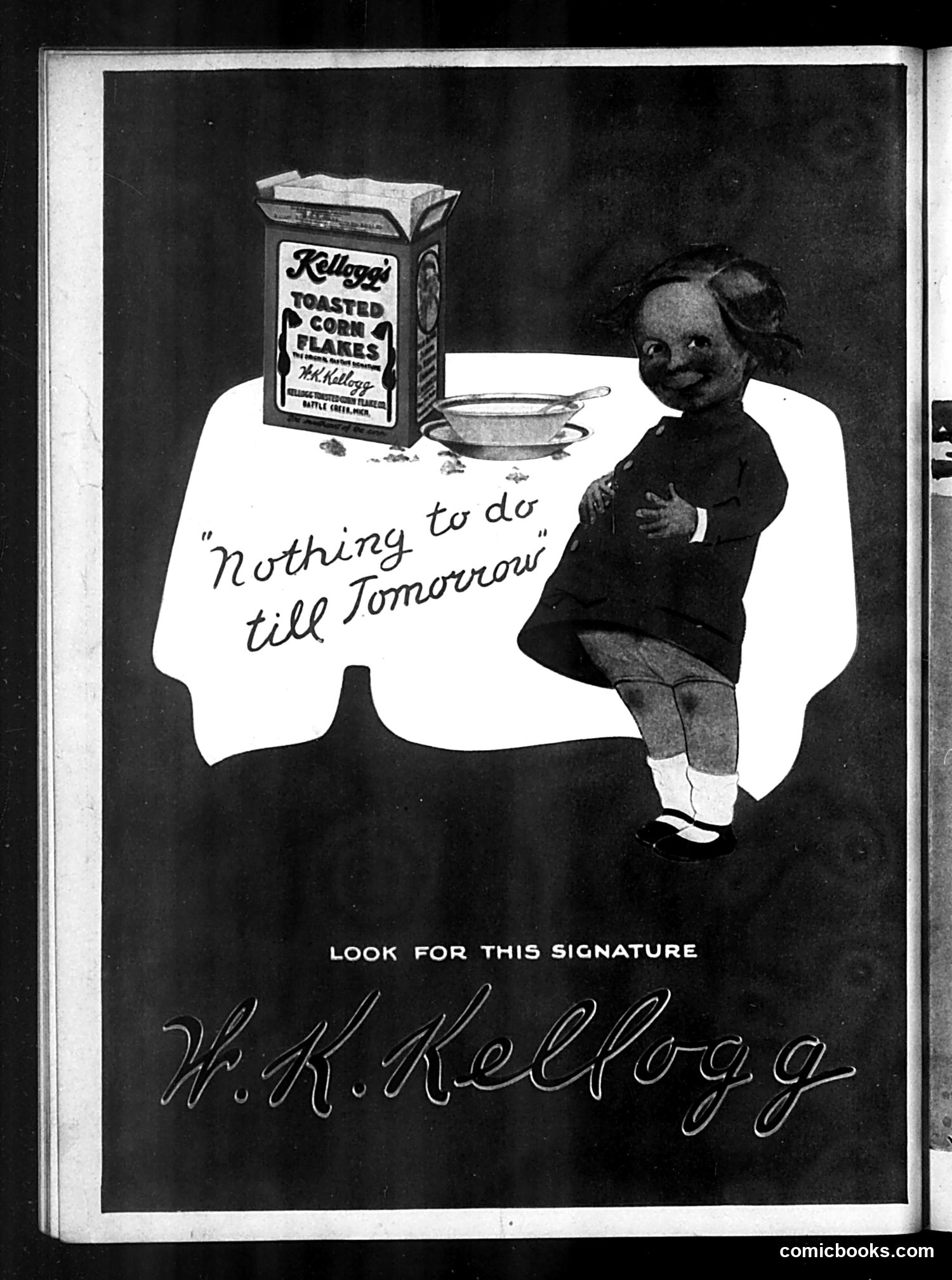
This is a **Kellogg's Toasted Corn Flakes advertisement**, not political satire. The page features a cheerful child at a breakfast table with a cereal box and bowl, accompanied by the slogan **"Nothing to do till Tomorrow."** The ad emphasizes brand recognition through W.K. Kellogg's signature at the bottom, instructing consumers to "look for this signature" as a guarantee of authenticity—important when packaged foods were still relatively new and consumers needed assurance of quality. The child's satisfied expression and leisurely pose suggest the cereal provides complete morning nutrition, requiring no additional preparation or concern. This reflects early 20th-century advertising's focus on convenience and parental ease.