
Judge, 1912-07-13 · page 8 of 24
Judge — July 13, 1912 — page 8: what you’re looking at
What you’re looking at
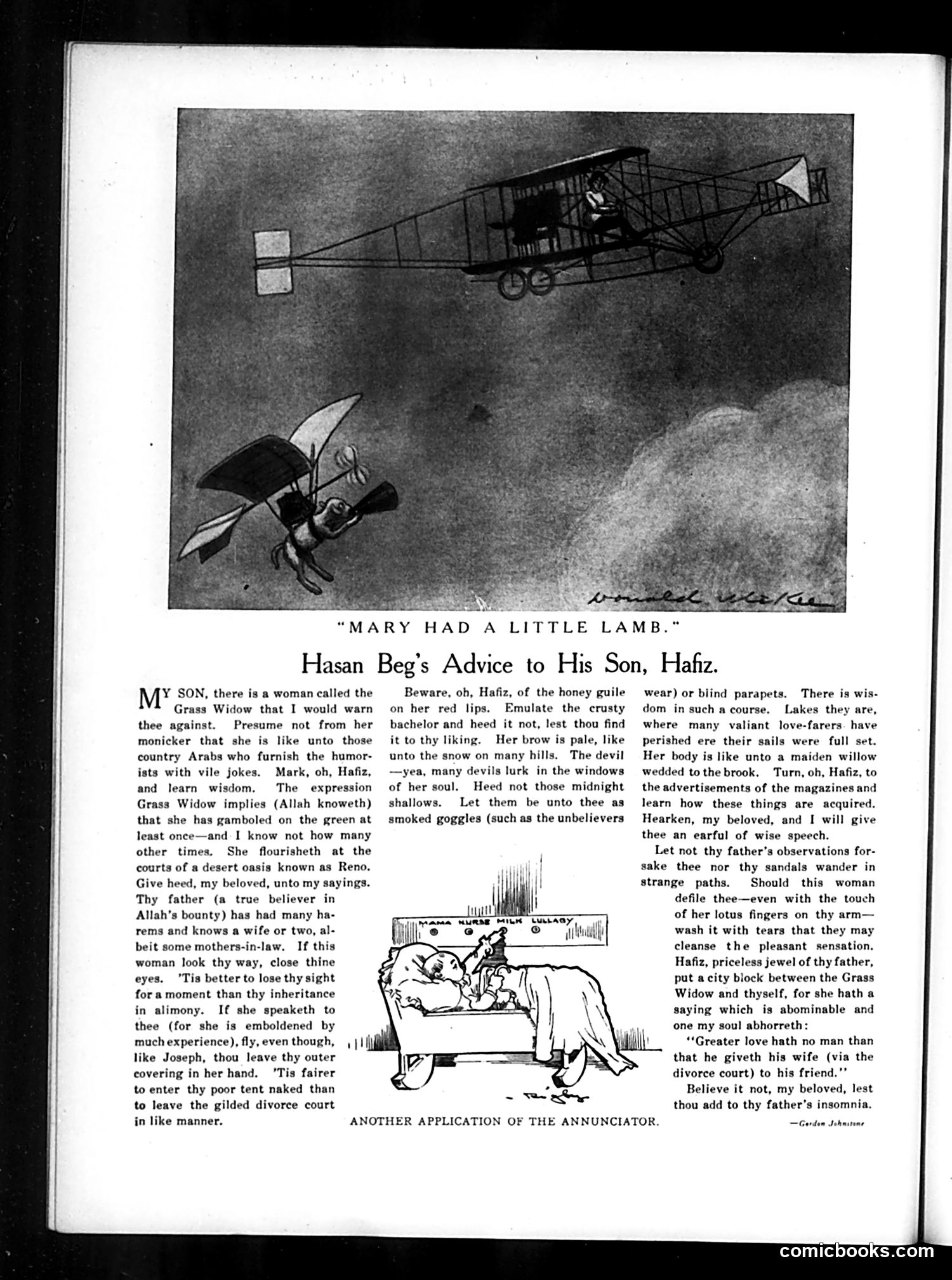
This page satirizes the "grass widow"—a divorced or separated woman, particularly those frequenting Reno, Nevada, which was known for easy divorce proceedings. The satirical advice from "Hasan Beg" to his son uses orientalist framing (mock-Arabian rhetoric) to warn against such women as marriage threats and gold-diggers. The humor targets multiple subjects: the proliferation of divorces enabled by Reno's lax laws, wealthy men's vulnerability to alimony claims, and the perceived danger of sophisticated divorced women. The top cartoon shows an early airplane alongside fantastical imagery, likely satirizing modern technology or progress—possibly suggesting the absurdity of the advice itself. The "Grass Widow" reference implies promiscuity through the crude pun on "grass"—suggesting she's been "rolling" around. This represents period anxieties about female independence and divorce in early 20th-century America, mocking both the women and the men who feared them.
📄 Transcribed text from this page (OCR, searchable)
Machine-transcribed from the original scan — historical spelling and the odd misread are preserved.
“MAR aut Y HAD A LITTLE LAMB.” Hasan Beg’s Advice to His Son, Hafiz. Y SON, there is a woman called the Grass Widow that I would warn thee against. Presume not from her monicker that she is like unto those country Arabs who furnish the humor- ists with vile jokes. Mark, oh, Hafiz, and learn wisdom. The expression Grass Widow implies (Allah knoweth) that she has gamboled on the green at least once—and I know not how many other times. She flourisheth at the courts of a desert oasis known as Reno. Give heed, my beloved, unto my sayings. Thy father (a true believer in Allah’s bounty) has had many ha- rems and knows a wife or two, al- beit some mothers-in-law. If this woman look thy way, close thine eyes. ‘Tis better to lose thy sight for a moment than thy inheritance in alimony. If she speaketh to thee (for she is emboldened by much experience), fly,even though, , like Joseph, thou leave thy outer covering in her hand, ‘Tis fairer to enter thy poor tent naked than to leave the gilded divorce court in like manner. Beware, oh, Hafiz, of the honey guile on her red lips. Emulate the crusty bachelor and heed it not, lest thou find it to thy liking. Her brow is pale, like unto the snow on many hills. The devil —yea, many devils lurk in the windows of her soul. Heed not those midnight shallows. Let them be unto thee as smoked goggles (such as the unbelievers Thame NURSE MIL LULLAGY © hl ANOTHER APPLICATION OF THE ANNUNCIATOR. wear) or biind parapets. There is wis- dom in such a course. Lakes they are, where many valiant love-farers. have perished ere their sails were full set. Her body is like unto a maiden willow wedded tothe brook. Turn, oh, Hafiz, to the advertisements of the magazines and learn how these things are acquired. Hearken, my beloved, and I will give thee an earful of wise speech. Let not thy father’s observations for- sake thee nor thy sandals wander in strange paths. Should this woman defile thee—even with the touch of her lotus fingers on thy arm— wash it with tears that they may cleanse the pleasant sensation. Hafiz, priceless jewel of thy father, put acity block between the Grass Widow and thyself, for she hath a saying which is abominable and one my soul abhorreth: “Greater love hath no man than that he giveth his wife (via the divorce court) to his friend.” Believe it not, my beloved, lest thou add to thy father’s insomnia. Gorden Johnstone comicbooks.com