
Judge, 1912-07-13 · page 16 of 24
Judge — July 13, 1912 — page 16: what you’re looking at
What you’re looking at
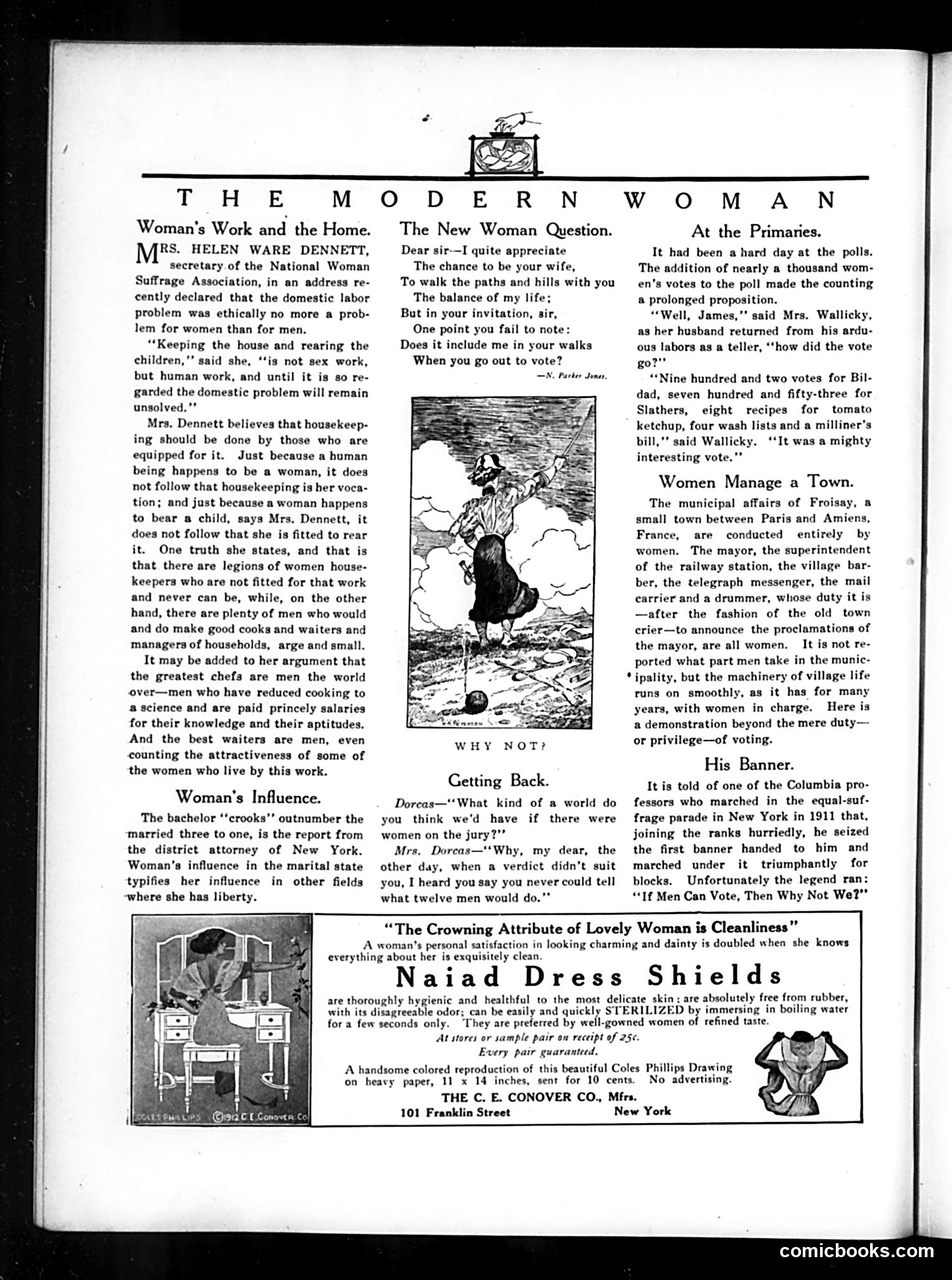
This page from Judge presents satirical commentary on women's suffrage and gender roles, circa 1911 (based on the suffrage parade reference). **Main Arguments:** - Helen Ware Dennett argues housekeeping is "human work," not inherently women's work, and should be performed by those equipped for it - A poem questions whether voting rights are truly inclusive of women - Humor targets both women and men: a husband's voting tally comically includes "eight recipes for tomato ketchup" and "wash lists" alongside actual votes, mocking the distraction women voters cause - A French town (Froisay) is presented as functioning well under female municipal leadership **The Satire:** Judge ridicules the chaos of women voting while simultaneously—through the Dennett piece and the French example—acknowledging women's actual competence. The magazine appears to mock *both* suffrage opponents (through the French success story) and suffragists (through the voting-day confusion). The Columbia professor who unknowingly carries a suffrage banner represents male obtuseness about women's rights. The page reflects pre-1920 suffrage debate's central tension: demonstrating women's capability while satirizing the disruption their political participation supposedly caused.
📄 Transcribed text from this page (OCR, searchable)
Machine-transcribed from the original scan — historical spelling and the odd misread are preserved.
T HE Woman's Work and the Home. ME: HELEN WARE DENNETT, secretary. of the National Woman Suffrage Association, in an address re- cently declared that the domestic labor problem was ethically no more a prob- lem for women than for men. “Keeping the house and rearing the children,’’ said she, ‘‘is not sex work, but human work, and until it is so re- garded the domestic problem will remain unsolved."” Mrs. Dennett believes that housekeep- ing should be done by those who are equipped for it. Just because a human being happens to be a woman, it does not follow that housekeeping is her voca- tion; and just because a woman happens to bear a child, says Mrs. Dennett, it does not follow that she is fitted to rear it. One truth she states, and that is that there are legions of women house- keepers who are not fitted for that work and never can be, while, on the other hand, there are plenty of men who would and do make good cooks and waiters and managers of households, arge and small. It may be added to her argument that the greatest chefa are men the world over—men who have reduced cooking to a science and are paid princely salaries for their knowledge and their aptitudes. And the best waiters are men, even counting the attractiveness of some of the women who live by this work. Woman's Influence. The bachelor ‘‘crooks’’ outnumber the married three to one, is the report from the district attorney of New York. Woman's influence in the marital state typifies her influence in other fields where she has liberty. MO D E RN The New Woman Question. Dear sir—I quite appreciate The chance to be your wife, To walk the paths and hills with you The balance of my life; But in your invitation, sir, One point you fail to note: Does it include me in your walks When you go out to vote? =N. Parker Jones. WHY NOT? Getting Back. Dorcas—‘*‘What kind of a world do you think we'd have if there were women on the jury?”’ Mrs. Dorcas—‘‘Why, my dear, the other day, when a verdict didn’t suit you, I heard you say you never could tell what twelve men would do.” WwW OM A N At the Primaries. It had been a hard day at the polls. The addition of nearly a thousand wom- en’s votes to the poll made the counting a prolonged proposition. “Well, James,’’ said Mrs. Wallicky, as her husband returned from his ardu- ous labors as a teller, ‘‘how did the vote go?” “Nine hundred and two votes for Bil- dad, seven hundred and fifty-three for Slathers, eight recipes for tomato ketchup, four wash lists and a milliner’s bill,’ said Wallicky. ‘‘It was a mighty interesting vote."’ Women Manage a Town. The municipal affairs of Froisay, a small town between Paris and Amiens, France, are conducted entirely by women. The mayor, the superintendent of the railway station, the village bar- ber, the telegraph messenger, the mail carrier and a drummer, whose duty it is —after the fashion of the old town crier—to announce the proclamations of the mayor, are all women. It is not re- ported what part men take in the munic- * ipality, but the machinery of village life runs on smoothly, as it has for many years, with women in charge. Here is a demonstration beyond the mere duty— or privilege—of voting. His Banner. It is told of one of the Columbia pro- fessors who marched in the equal-suf- frage parade in New York in 1911 that, joining the ranks hurriedly, he seized the first banner handed to him and marched under it triumphantly for blocks. Unfortunately the legend ran: “If Men Can Vote, Then Why Not We?” “The Crowning Attribute of Lovely Woman is Cleanliness” A woman's personal satisfaction in looking charming and dainty is doubled when she knows everything about her is exquisitely clean. Naiad Dress Shields are thoroughly hygienic and healthful to the most delicate skin; are absolutely free from rubber, with its disagreeable odor; can be easily and quickly STERILIZED by immersing in boiling water for a few seconds only. They are preferred by well-gowned women of refined taste. At stores or sample pair on receipt of 25¢. Every pair guaranteed, A handsome colored reproduction of this beautiful Coles Phillips Drawing on heavy paper, 11 x 14 inches, sent for 10 cents. No advertising. THE C. E. CONOVER CO., Mfrs. 101 Franklin Street New York i ES Pun ies Orsia€ C.Conoven Co comicbooks.com