
A complete issue · 24 pages · 1912
Judge — June 1, 1912
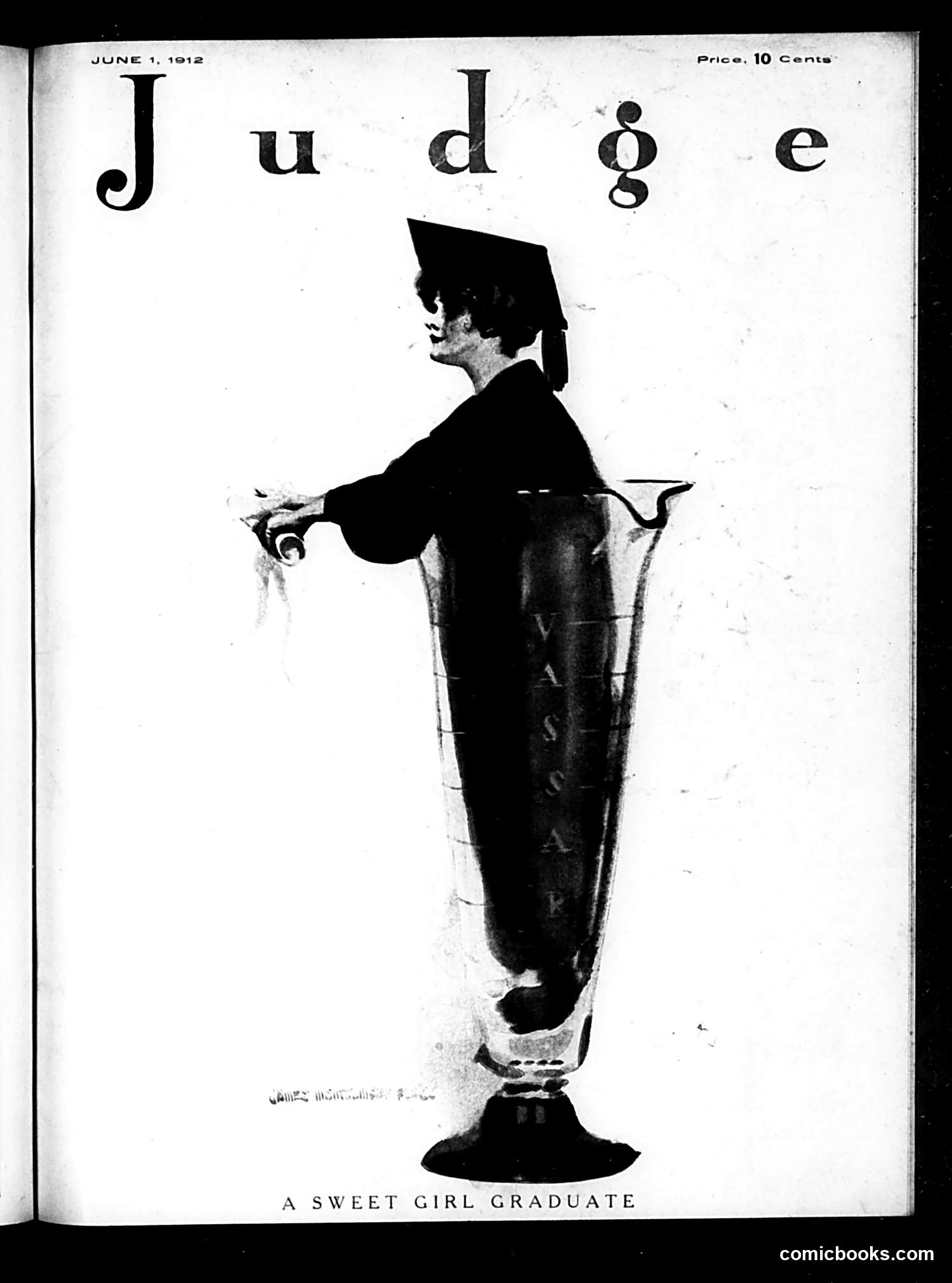
This cover illustrates "A Sweet Girl Graduate"—a young woman in academic cap and gown emerging from a large cocktail glass. The satire appears to target the emerging phenomenon of women attending college and graduating in early 20th-century America. The image conflates female higher education with intoxication or frivolity, suggesting that women's graduation was viewed as socially questionable or morally suspect by some contemporaries. The cocktail glass transforms the achievement into something trivial or concerning rather than serious. This reflects anxieties of the era about women's expanding roles and education, mocking the notion that female graduates were respectable or that their accomplishments were legitimate, rather than merely fashionable or amusing indulgences.
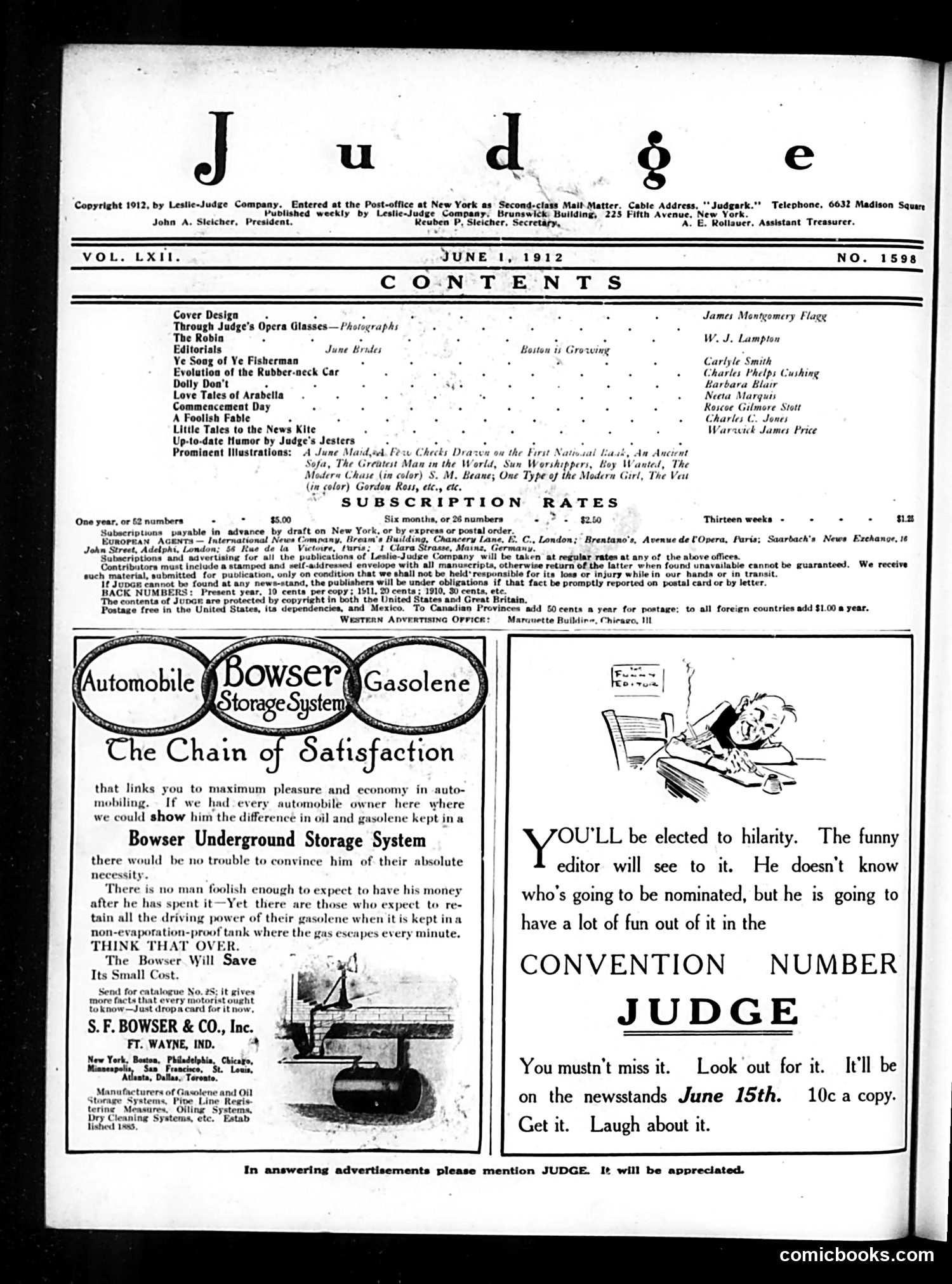
This page is primarily **advertising and subscription information** for Judge magazine, with minimal satirical content visible. The only cartoon present (right side) shows a figure at a desk labeled "Convention" with text promising hilarity about an unnamed editor being nominated to office. This appears to reference the **1912 presidential convention season**, likely the Republican or Democratic party conventions happening that summer. The joke plays on the absurdity of someone unexpected being nominated. The cartoon's humor relies on contemporary political convention gossip—readers would recognize the specific nomination being mocked, but that context is lost without additional historical documentation. The bulk of the page advertises the "Convention Number" of Judge (June 15th issue), suggesting this was a pre-publication promotional piece capitalizing on convention-season interest.
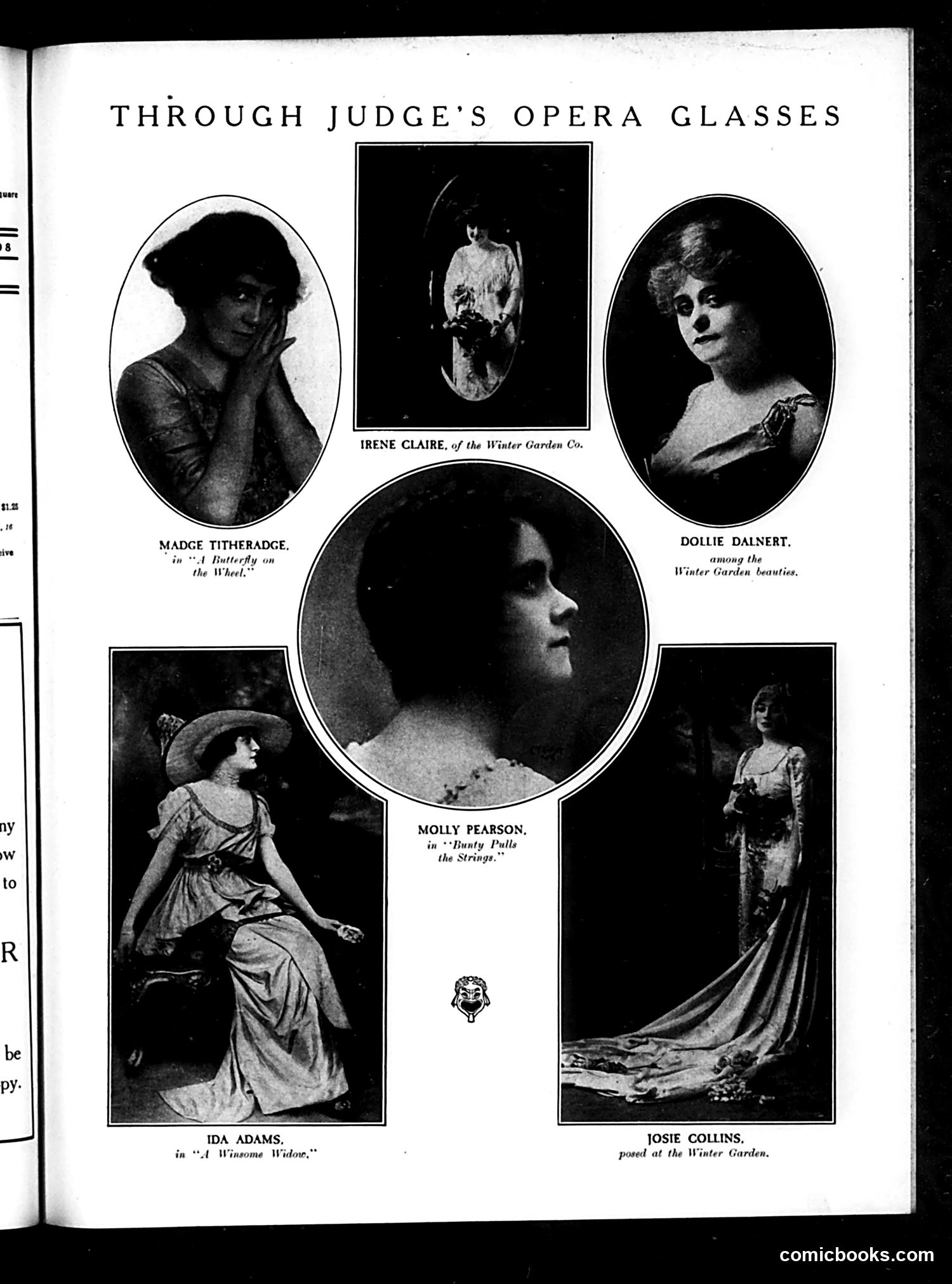
This page is **not a political cartoon**. It's a theatrical feature titled "Through Judge's Opera Glasses," showcasing six actresses from Winter Garden productions: - **Madge Titheradge** in "A Butterfly on the Wheel" - **Irene Claire** of the Winter Garden Co. - **Dollie Dainert**, a Winter Garden beauty - **Molly Pearson** in "Dainty Dolls and the Strings" - **Ida Adams** in "A Winsome Widow" - **Josie Collins**, posed at the Winter Garden The "opera glasses" metaphor frames these theatrical portraits as worthy of close scrutiny—a common Judge device for highlighting performers. This is entertainment journalism/advertising rather than satire, featuring stage actresses of the era in glamorous portrait photography.
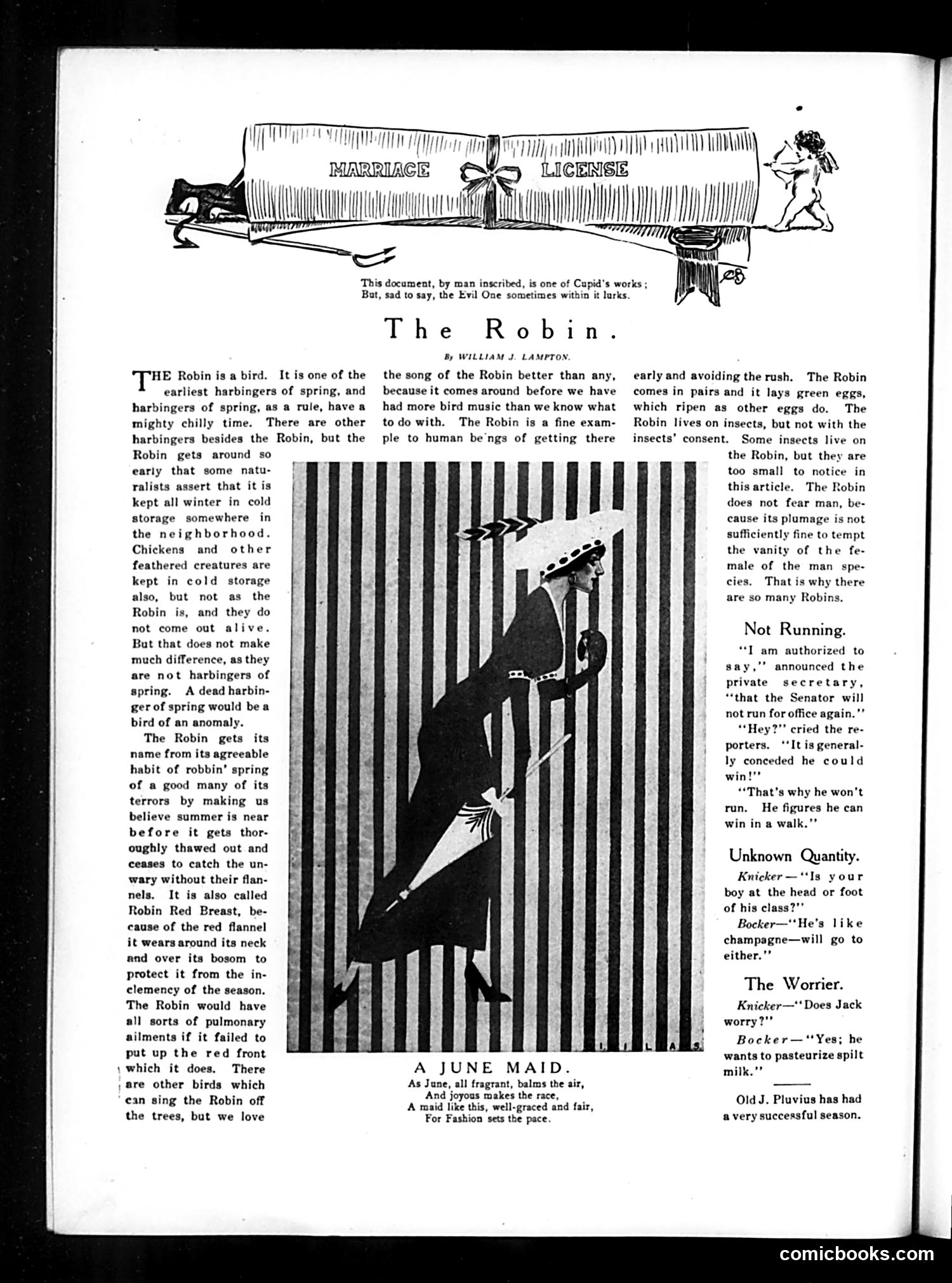
This page combines a naturalistic article about robins (the bird) with political humor. The main cartoon, "A June Maid," depicts a woman in a cage—likely representing a female voter or political candidate confined by restrictions. The small jokes below ("Not Running," "Unknown Quantity," "The Worrier") satirize a senator's reluctance to run for re-election. The humor plays on uncertainty: he "could" win but won't try because he might lose in a walk—meaning his victory would be too easy, contradicting his caution. The specific senator and election year are unclear from this page alone, but the satire targets political cowardice and the contradiction between confidence in one's abilities and unwillingness to compete.
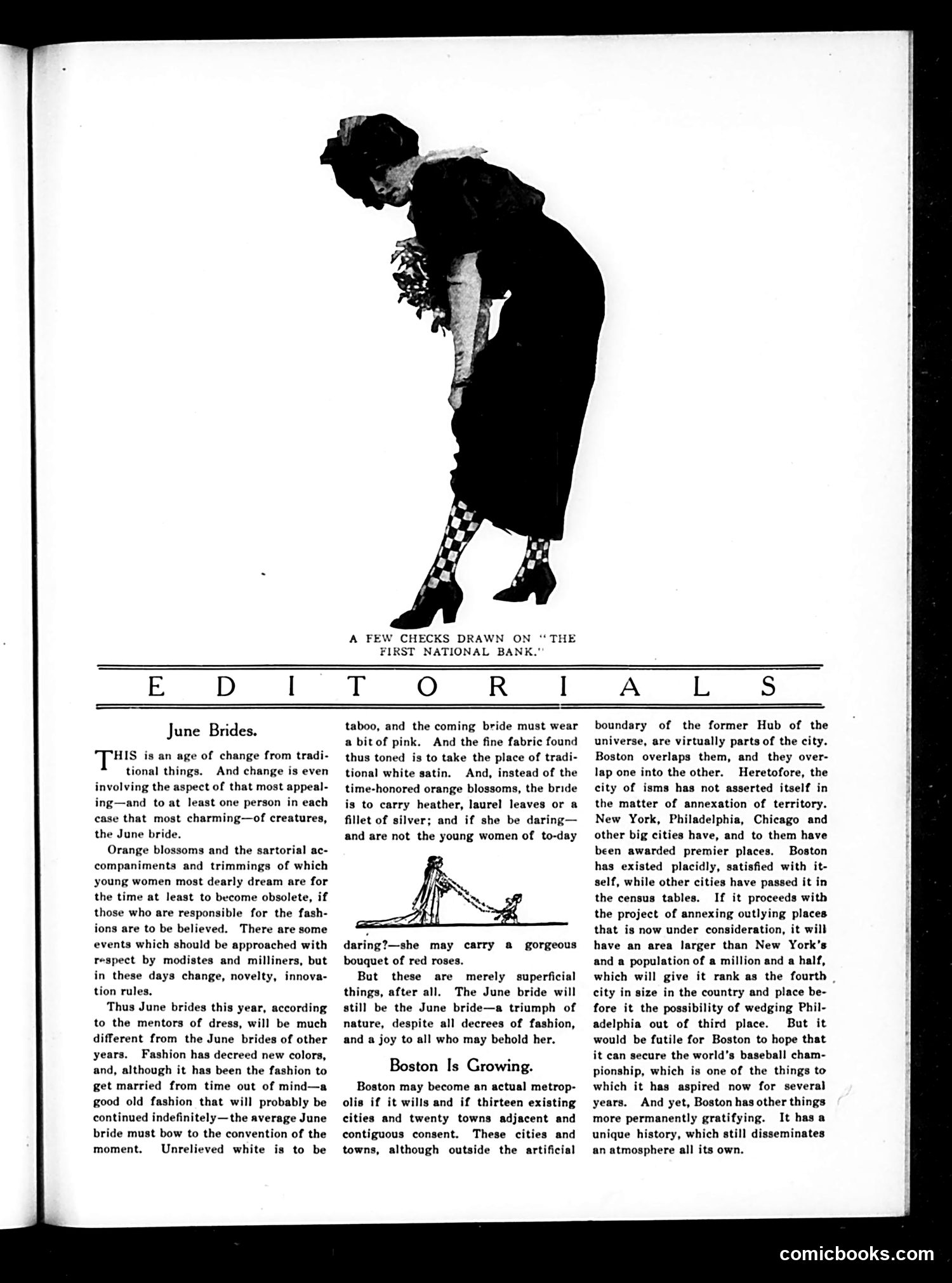
The silhouette cartoon depicts a woman in fashionable dress bending over to examine or write checks at a bank, captioned "A Few Checks Drawn on 'The First National Bank.'" The accompanying editorial "June Brides" discusses changing wedding traditions—specifically how modern June brides are abandoning orange blossoms and white satin for red roses and contemporary fashion. The text celebrates this modernization while noting traditionalists resist such changes. The cartoon likely satirizes women's increasing financial independence and involvement in banking. The woman's posture—bowing obsequiously—suggests ironic commentary on either women's newfound economic power or society's awkward adjustment to women handling finances, which was unconventional for the era. The overall page critiques evolving social conventions around weddings, fashion, and women's roles.
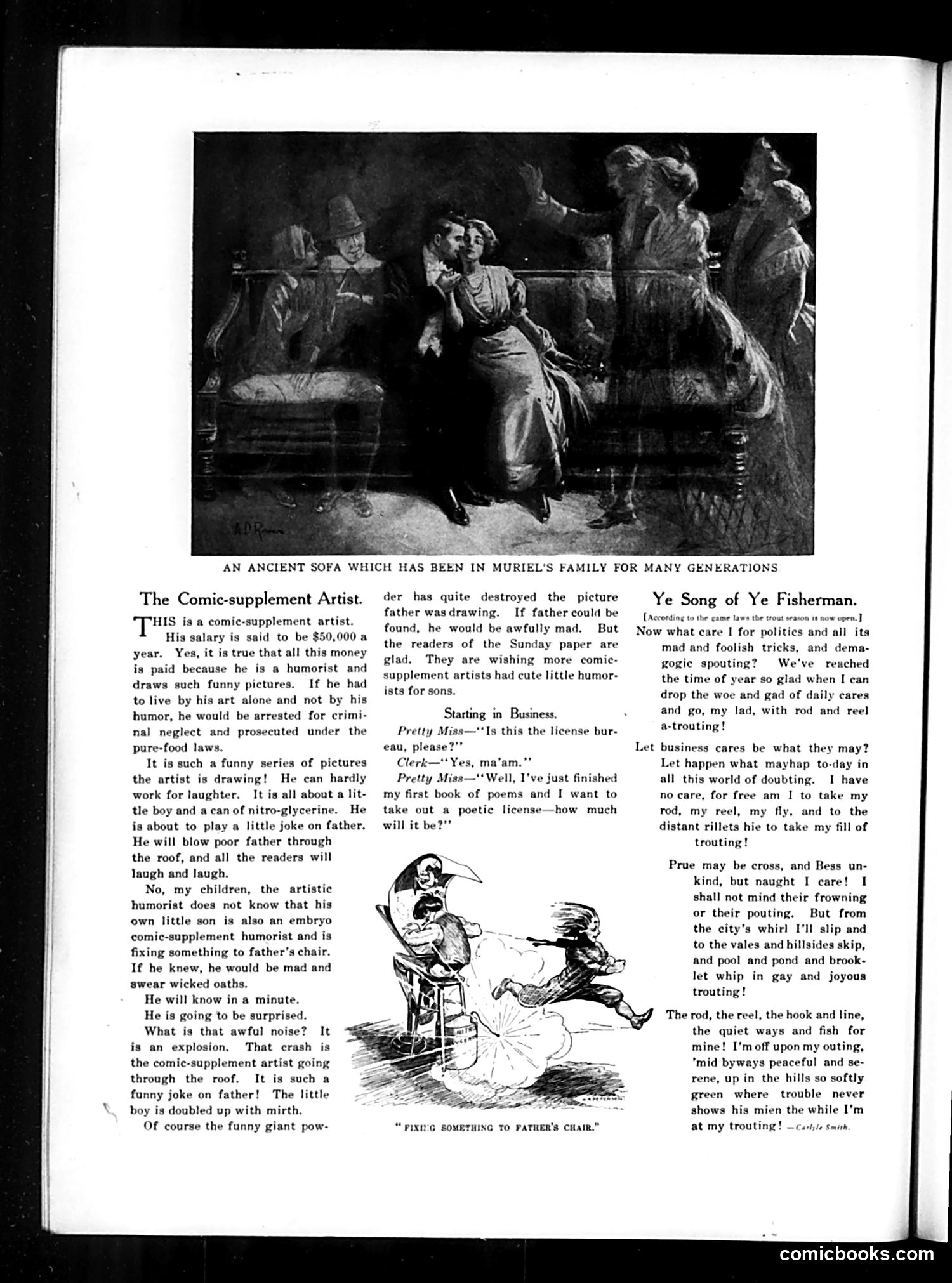
This satire mocks both the absurd earnings of comic strip artists ($50,000/year—enormous for the era) and the tastelessness of their humor. The joke: an artist draws a "funny" strip about a boy placing nitro-glycerine on his father's chair as a prank. The irony is that the artist's own son is doing the exact same thing to *his* father's chair. The artist will soon experience violent comeuppance—blown through the roof by his own child's prank—while newspaper readers find this karmic explosion hilarious. The accompanying humor pieces are lighter fare: a woman applying for a "poetic license" (a pun), and a nostalgic poem celebrating fishing season over worldly worries. These suggest the magazine's mix of biting satire and gentle wordplay typical of Judge magazine's approach to American social commentary.
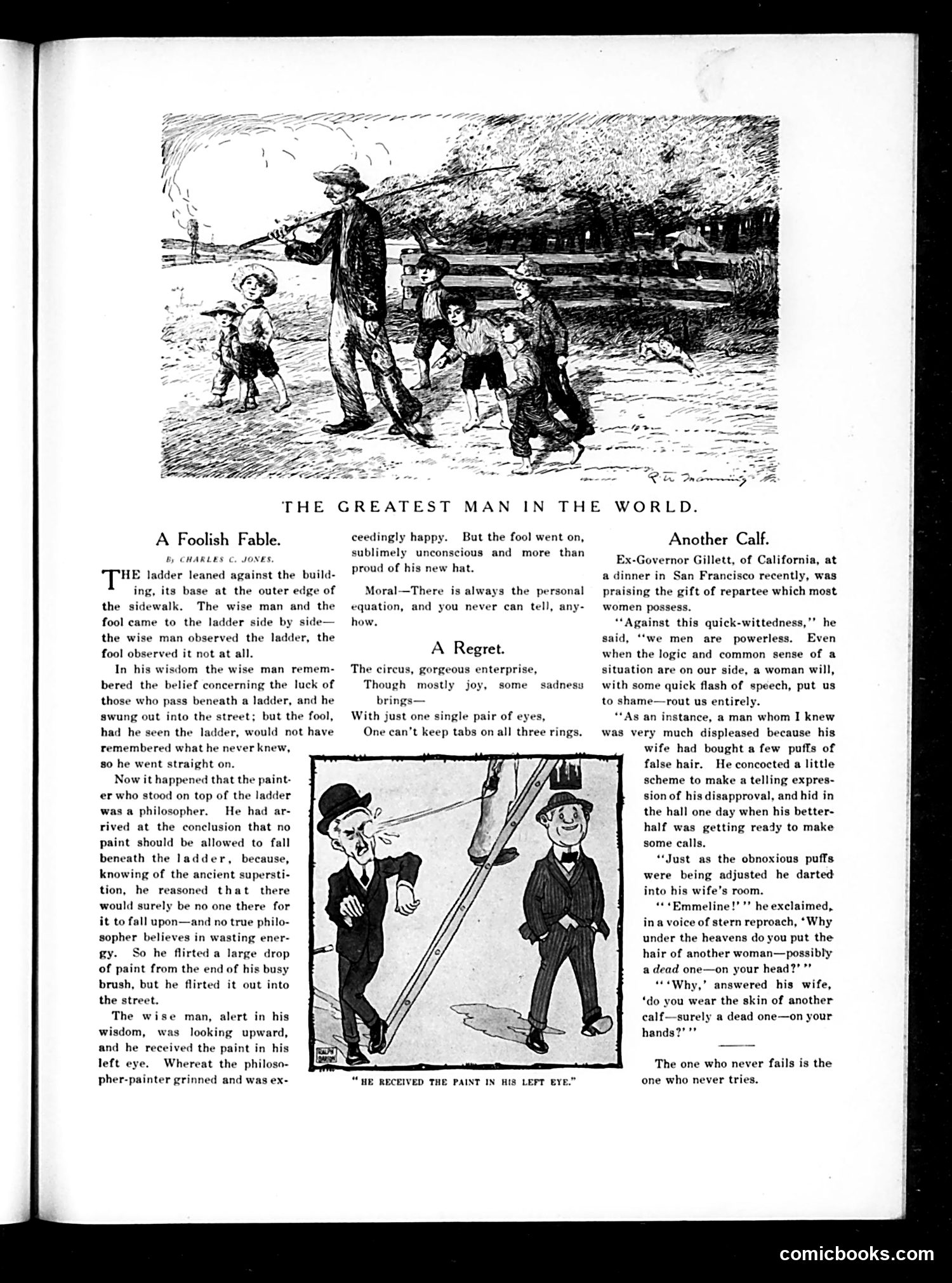
This page contains three distinct pieces of satirical content: **"The Greatest Man in the World: A Foolish Fable"** (top left) presents a moral tale about superstition versus logic. A wise man avoids walking under a ladder due to superstition, while a fool walks straight through unconsciously. Ironically, the painter atop the ladder—reasoning philosophically that no one would pass beneath—flicks paint into the street, hitting the "wise" man's eye. The moral mocks the unreliability of reason and superstition alike. **"A Regret"** (center) is a brief joke about circus limitations—one pair of eyes cannot watch three rings simultaneously. **"Another Calf"** (right) is an anecdote about a California ex-governor's dinner story. A husband attempts to shame his wife for wearing false hair by sarcastically asking why she wears "dead" hair. She retorts by asking why he wears animal skin (leather) gloves—turning his moral disapproval against him through quick wit. The anecdote satirizes male attempts to shame women's appearance.
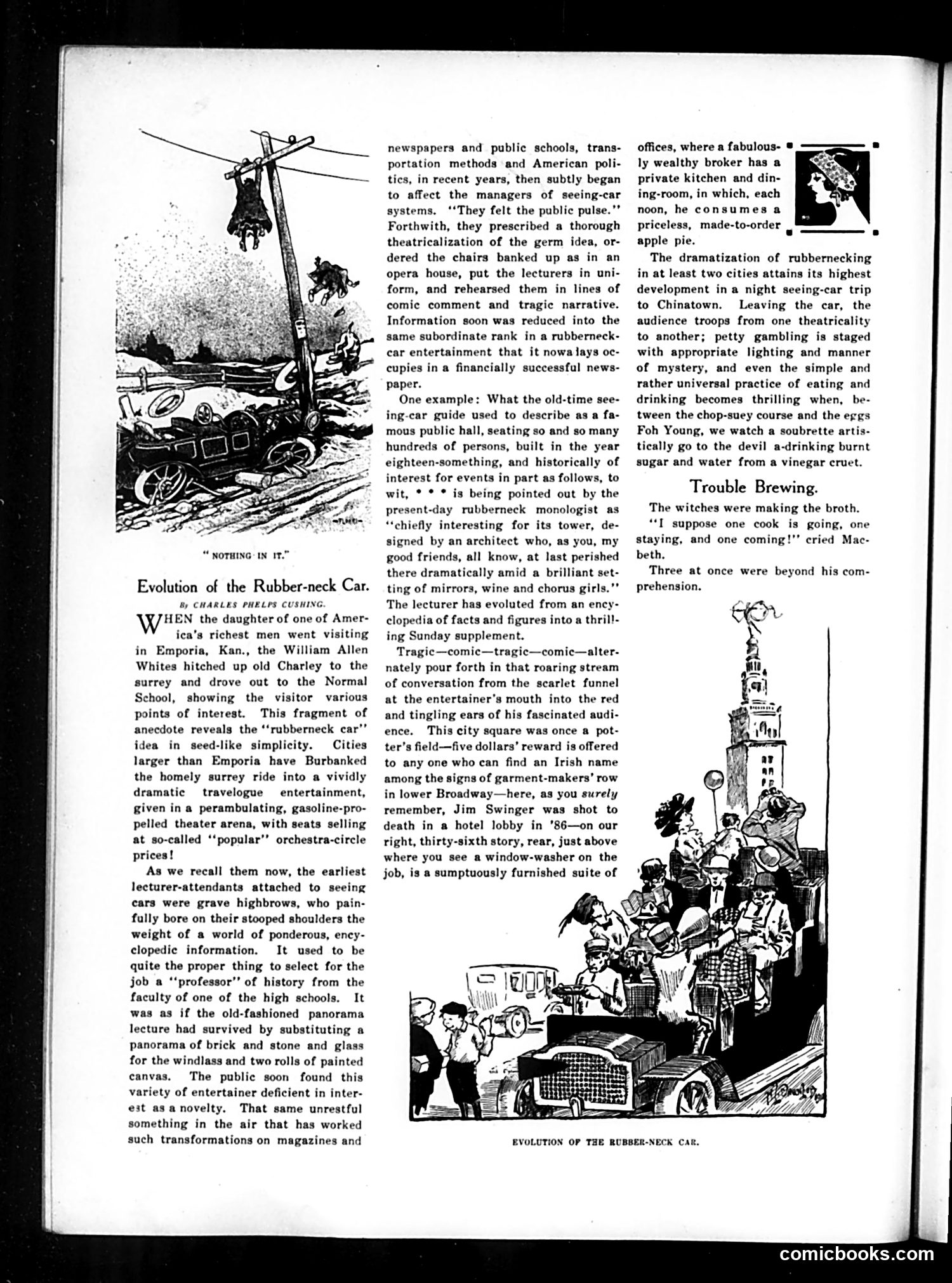
This article satirizes the commercialization of **sightseeing tours** (called "rubber-neck cars"—vehicles where tourists gawk at city attractions). The author contrasts two eras: Early guides were scholarly "professors" who delivered dry historical facts about buildings and landmarks. Modern tour operators have replaced substance with **sensationalism and entertainment**—theatrical delivery, dramatic staging, and lurid anecdotes (murders, scandals, wealthy brokers' fancy kitchens) presented as if from a "Sunday supplement" (sensational newspaper section). The satire critiques how American culture—magazines, newspapers, schools, politics—increasingly prioritizes entertainment and emotional stimulation over genuine information. Tours to Chinatown are presented as the peak of this theatrical excess. The cartoons (left and right) illustrate the "evolution" from simple horse-drawn surreys to elaborate motorized theater-like vehicles packed with paying audiences, visualizing this shift from humble transportation to mass entertainment spectacle.
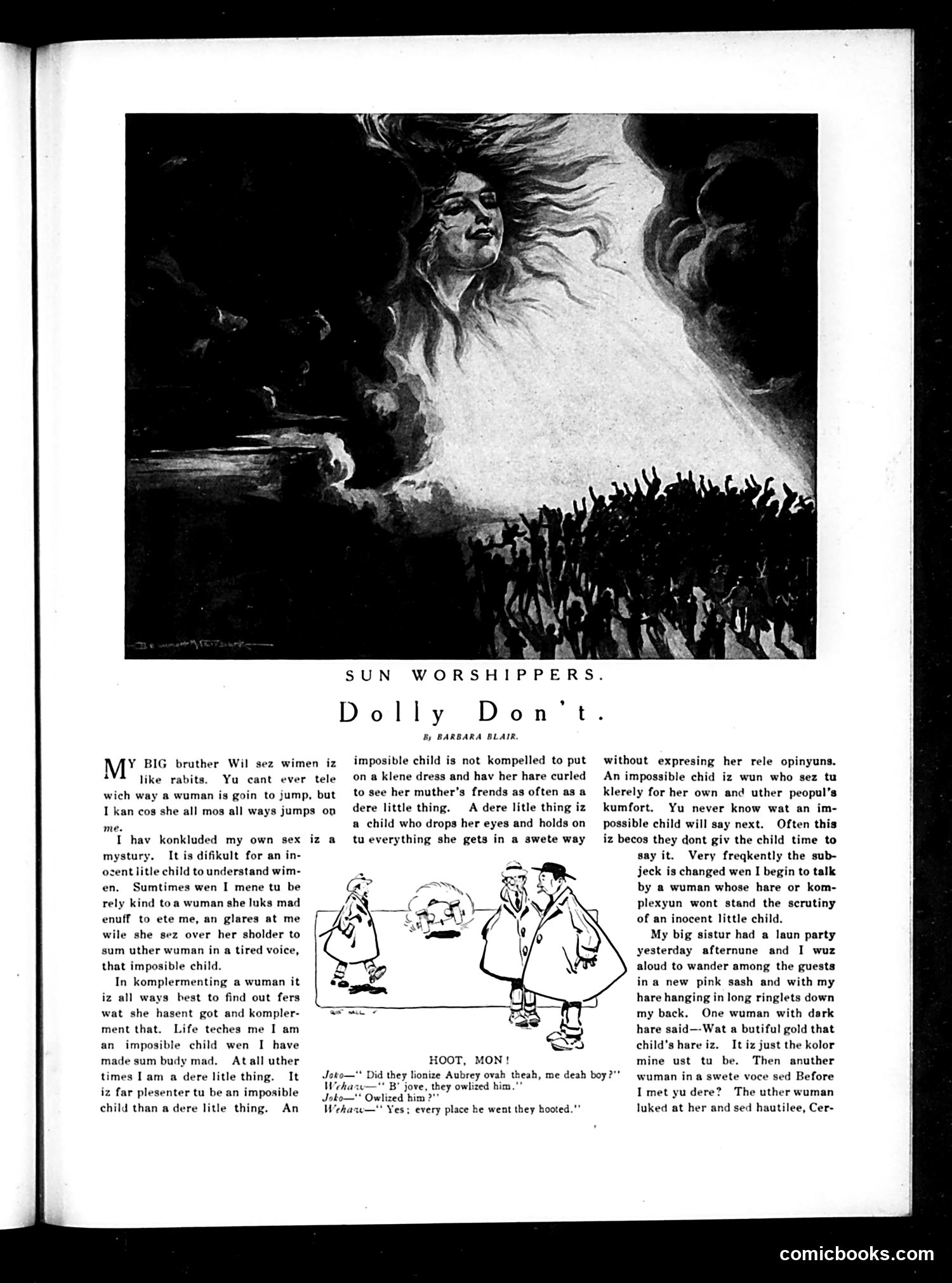
This piece by Barbara Blair satirizes the contradictory social expectations placed on young girls. The narrator, an "impossible child," observes how adults demand girls behave as "dere little things"—demure, compliant, silent about observations—while simultaneously resenting their honesty when they speak plainly. The humor lies in the child's frank observations of adult hypocrisy: women who praise each other's appearances insincerely, who scold children for directness, and who expect childish deference without granting children autonomy or time to speak. The title "Dolly Don't" suggests rules imposed on girls. The comic dialogue shows adults ("Jots," "Wiskers") gossiping about someone named Aubrey with typical social pretense. The satire critiques how society trains girls toward artificiality and silence rather than authentic self-expression—making them "impossible" through impossible contradictory demands.
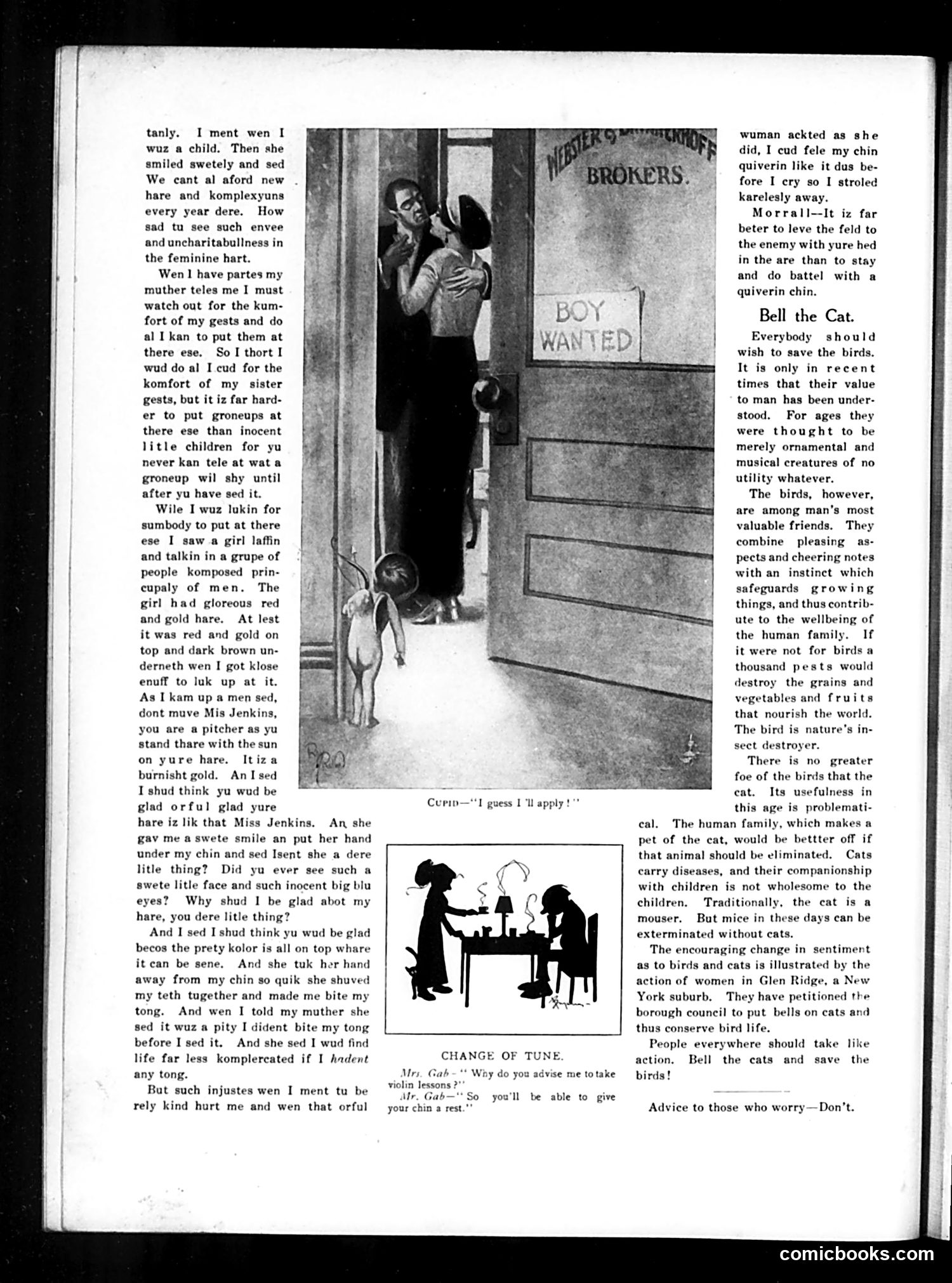
This page contains three satirical pieces typical of early 20th-century American humor: 1. **Main narrative (left)**: A phonetically-written dialect story mocking a guest who criticizes another woman's hair color, then becomes offended when the narrator points out the hair is dyed. The satire targets feminine vanity and hypocrisy—the woman praises artifice while resenting honest observation about it. 2. **"Change of Tune" cartoon (bottom)**: A married couple dialogue where a husband sarcastically suggests his wife take violin lessons so she'll "have something to rest your chin on"—implying she talks too much. This mocks nagging wives, a recurring Judge theme. 3. **"Bell the Cat" essay (right)**: An earnest advocacy piece for putting bells on cats to protect birds, referencing actual action by women in Glen Ridge, New York. This represents the magazine's occasional sincere reformist content alongside its satire. The humor relies on period gender stereotypes: vain women, talkative wives, and domestic friction.
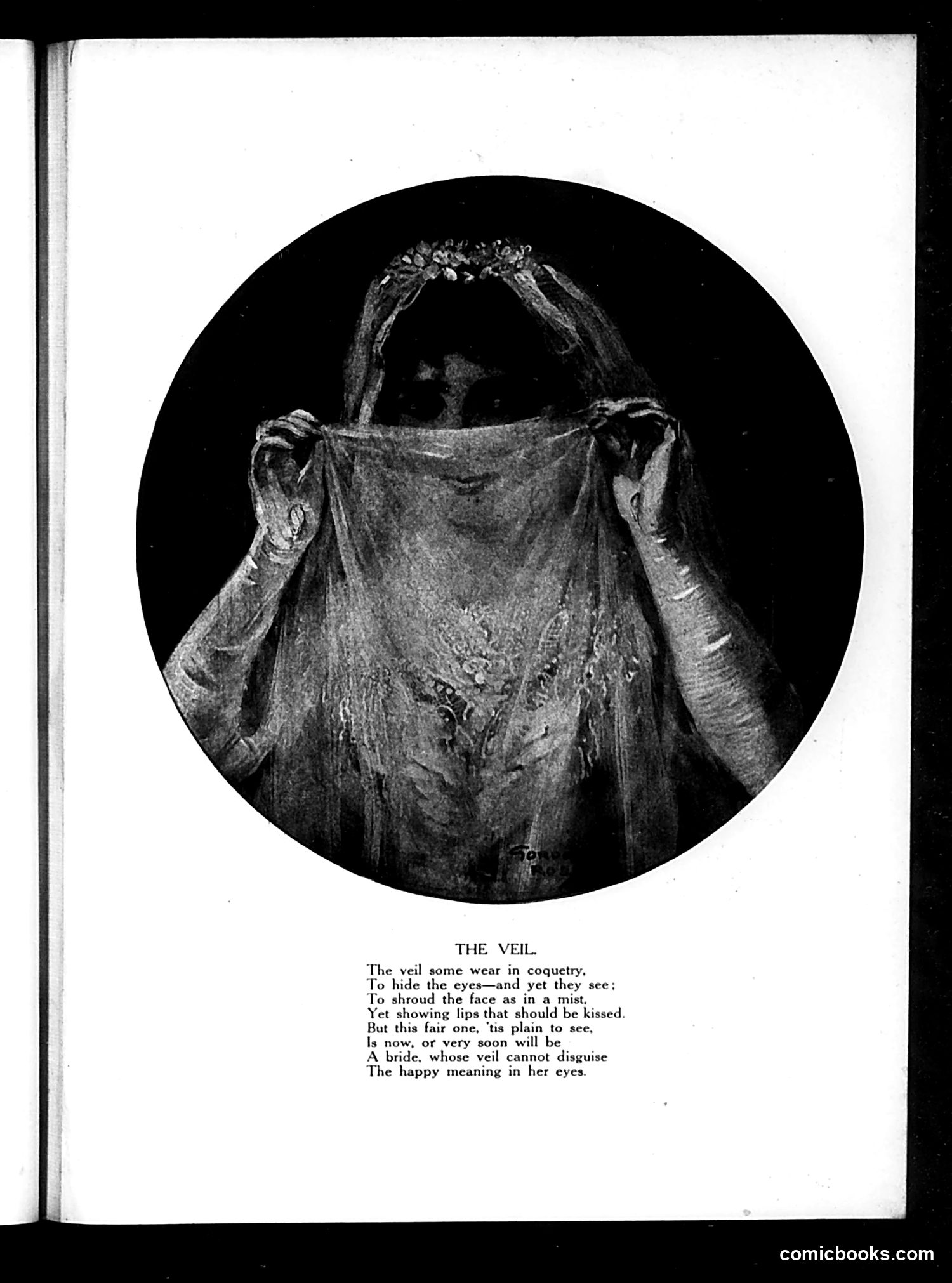
This page features a photograph of a woman wearing a veil, accompanied by verse commentary. The satire contrasts two uses of veils: decorative coquetry versus bridal wear. The poem suggests that women typically wear veils to flirt—concealing while simultaneously revealing themselves. However, this particular woman's veil serves a different purpose: it announces her impending marriage. The satire's point is that her evident happiness about becoming a bride is so transparent that even her veil cannot hide it—"the happy meaning in her eyes" betrays her true emotional state. The humor relies on the era's assumptions about women's motivations and the cultural significance of veils in courtship and marriage. The image illustrates how genuine emotion (bridal joy) supersedes artifice (veiling for mystery).
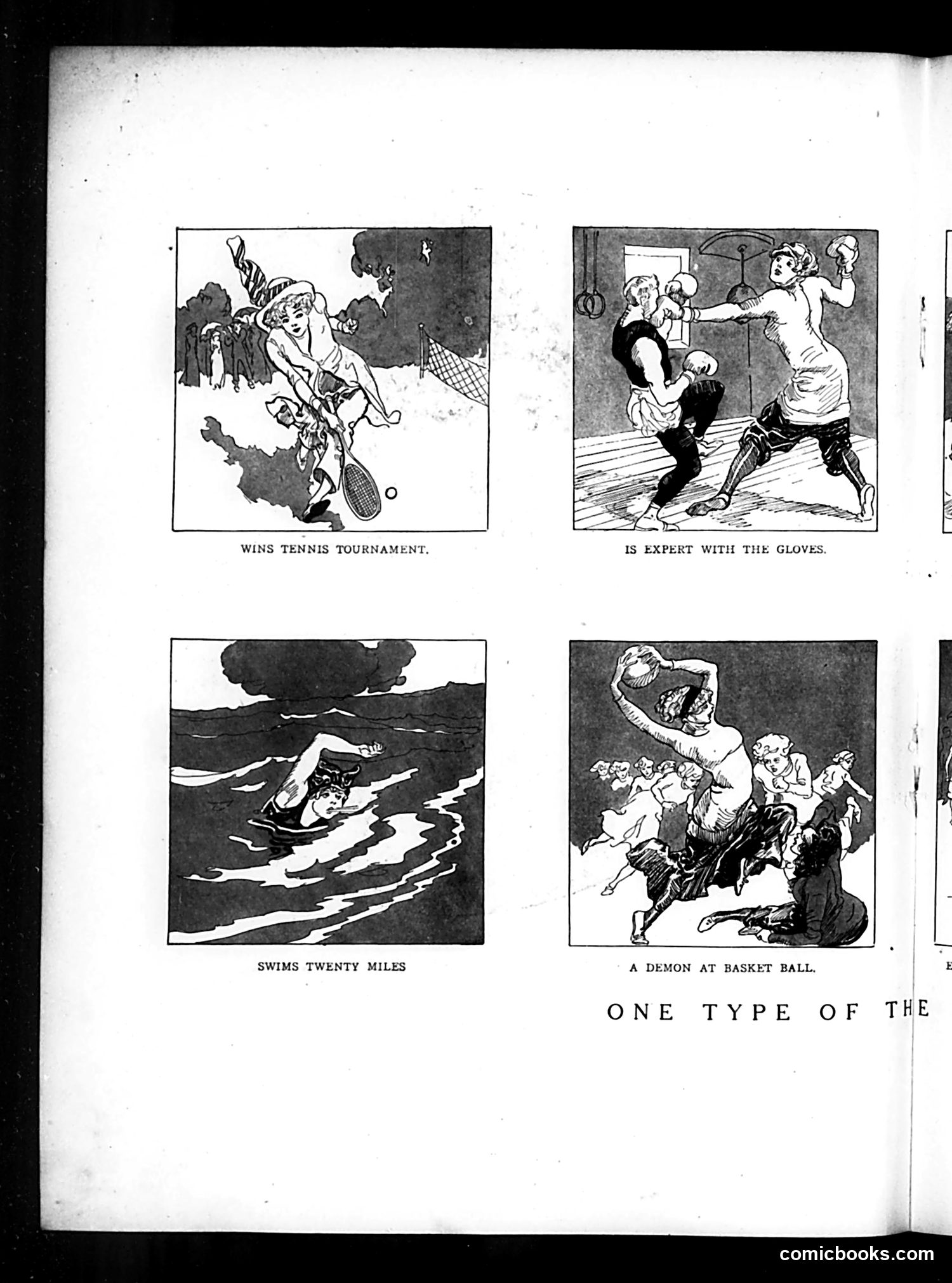
This page from *Judge* magazine appears to showcase four panels depicting various athletic feats: winning a tennis tournament, boxing expertise, swimming twenty miles, and basketball prowess. The heading "ONE TYPE OF" suggests these panels introduce a character type—likely depicting an exceptionally athletic or "new woman" of the era. The satirical point targets the Gibson Girl or "modern woman" phenomenon: late 19th/early 20th century women who participated in sports previously considered masculine domains. The exaggerated athleticism across multiple disciplines satirizes contemporary anxieties about changing gender roles and women's increasing physical independence. Without visible artist attribution or date, the exact satirical target remains somewhat unclear, but the overall message critiques evolving social norms around female athleticism.
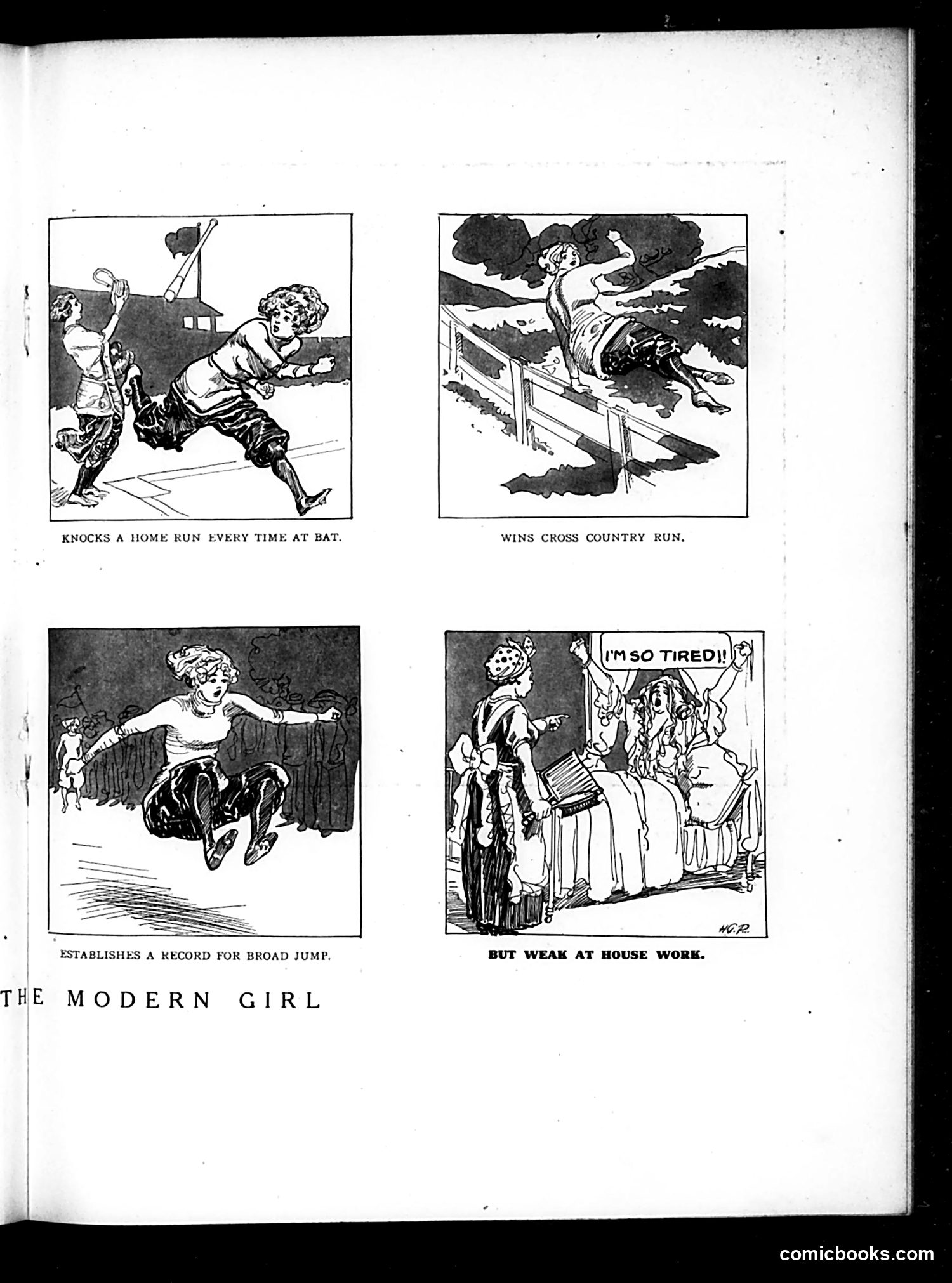
This four-panel comic satirizes the "New Woman" of the early 20th century—women embracing athletic independence and rejecting traditional domestic roles. The humor relies on contradiction: panels 1-3 celebrate an athletic woman who excels at baseball, cross-country running, and broad jumping. Panel 4 subverts this empowerment through mockery—despite her athletic prowess, she claims exhaustion from housework, collapsing in bed while declaring "I'M SO TIRED!!" The satire targets anxieties about changing gender roles. The "Modern Girl" can outperform men athletically but allegedly cannot manage basic household tasks. This exposes period anxieties: if women abandoned domestic duties for sports and independence, who would maintain the home? The joke reinforces the era's conservative position that female athleticism was unnatural and incompatible with "proper" womanhood.
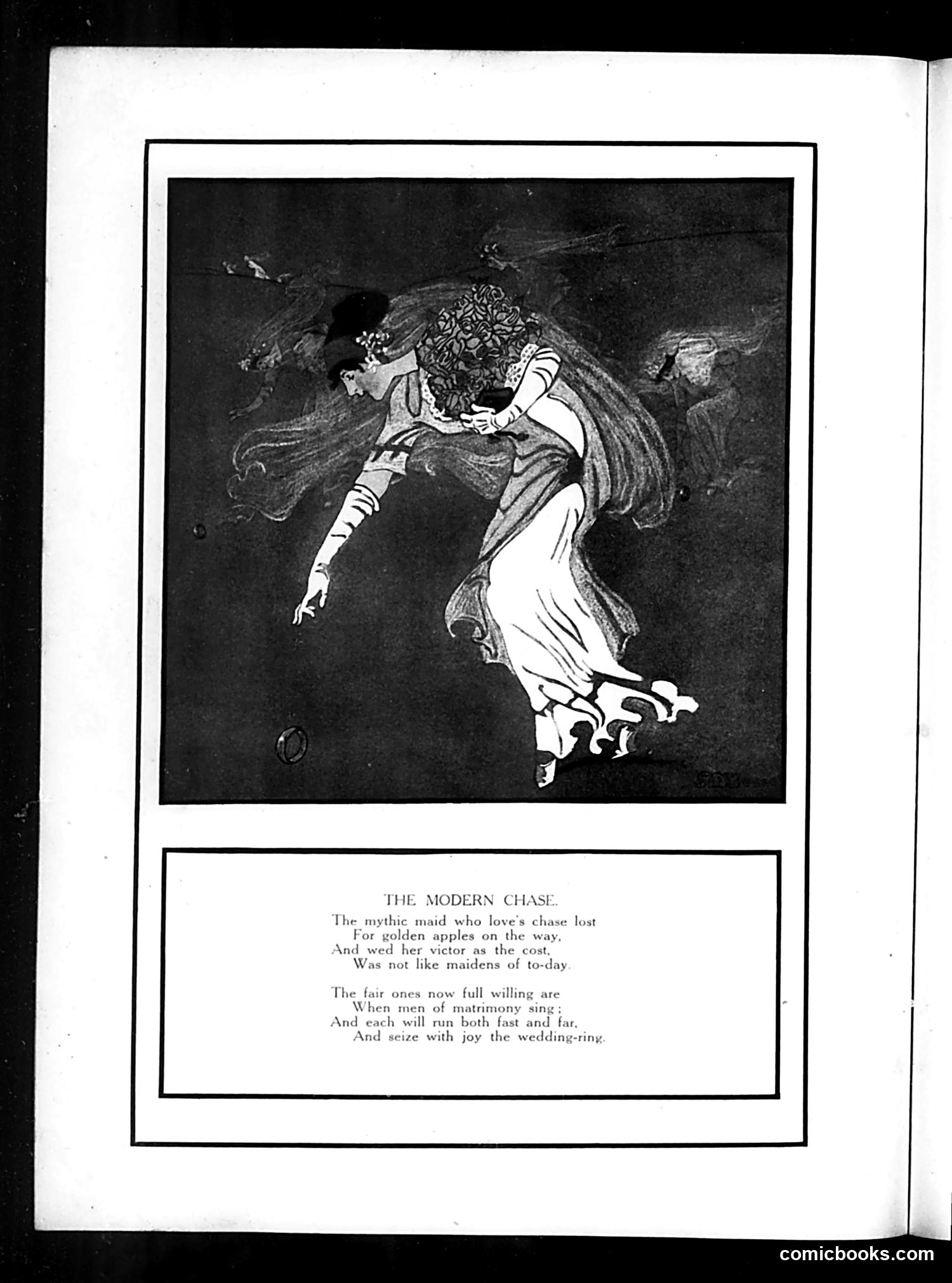
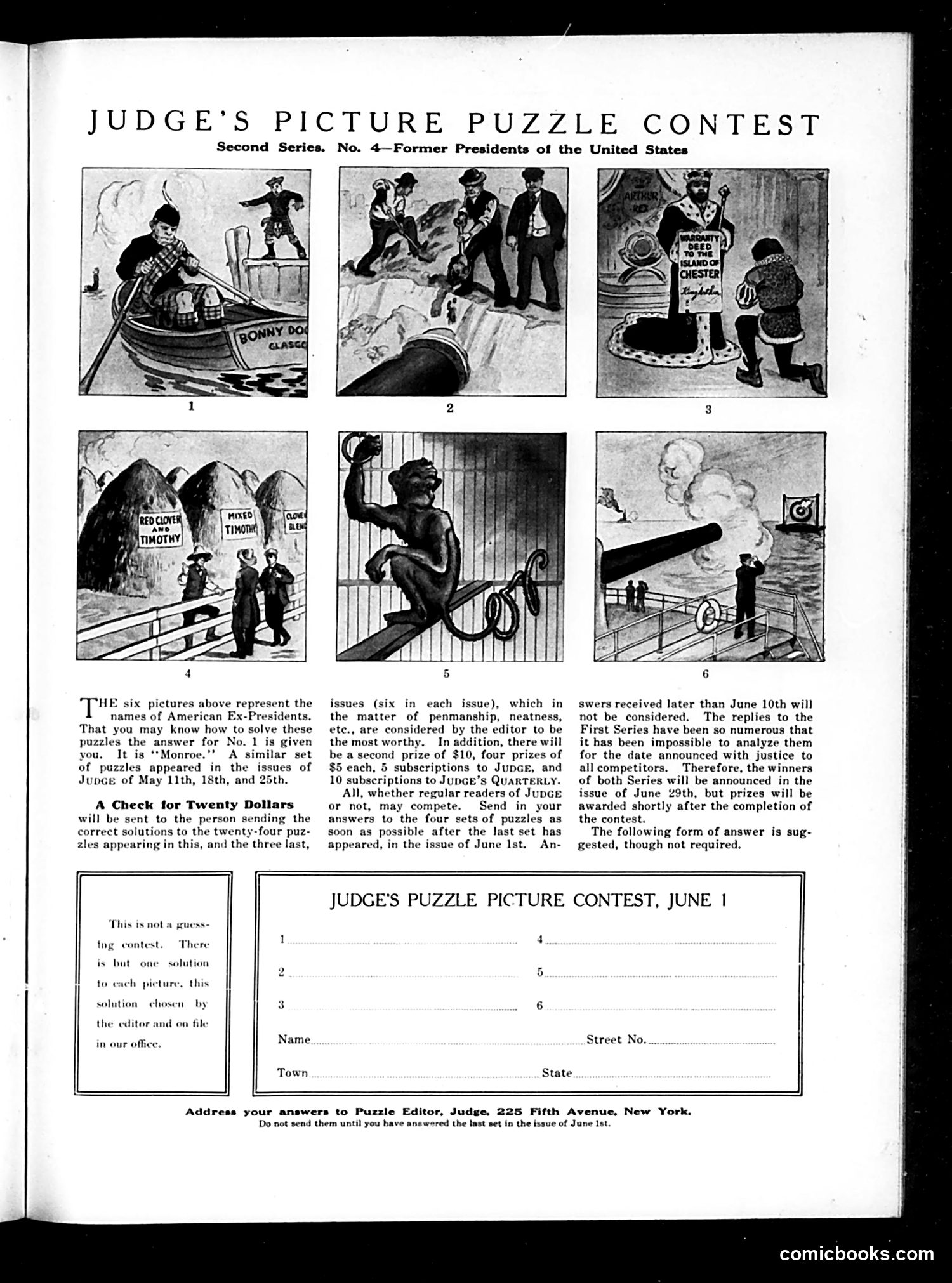
This page presents a visual puzzle contest where readers must identify which former U.S. Presidents are depicted in six satirical cartoon illustrations. The contest is part of Judge magazine's "Second Series," offering cash prizes ($20 for first place) to contestants with the neatest, most legible correct answers. The six unlabeled cartoons use visual metaphors and symbolic imagery to represent different presidents. Picture 1, revealed as the example answer, shows "Monroe" in a Venetian gondola (referencing the Monroe Doctrine's protection of the Western Hemisphere). Other images employ similar allegorical approaches—eagles, political symbols, and historical events—to encode presidential identities that contemporary readers would recognize through period newspapers and common knowledge. The contest invited both regular and new readers to compete, with answers due by June 10th and winners announced in the June 29th issue.
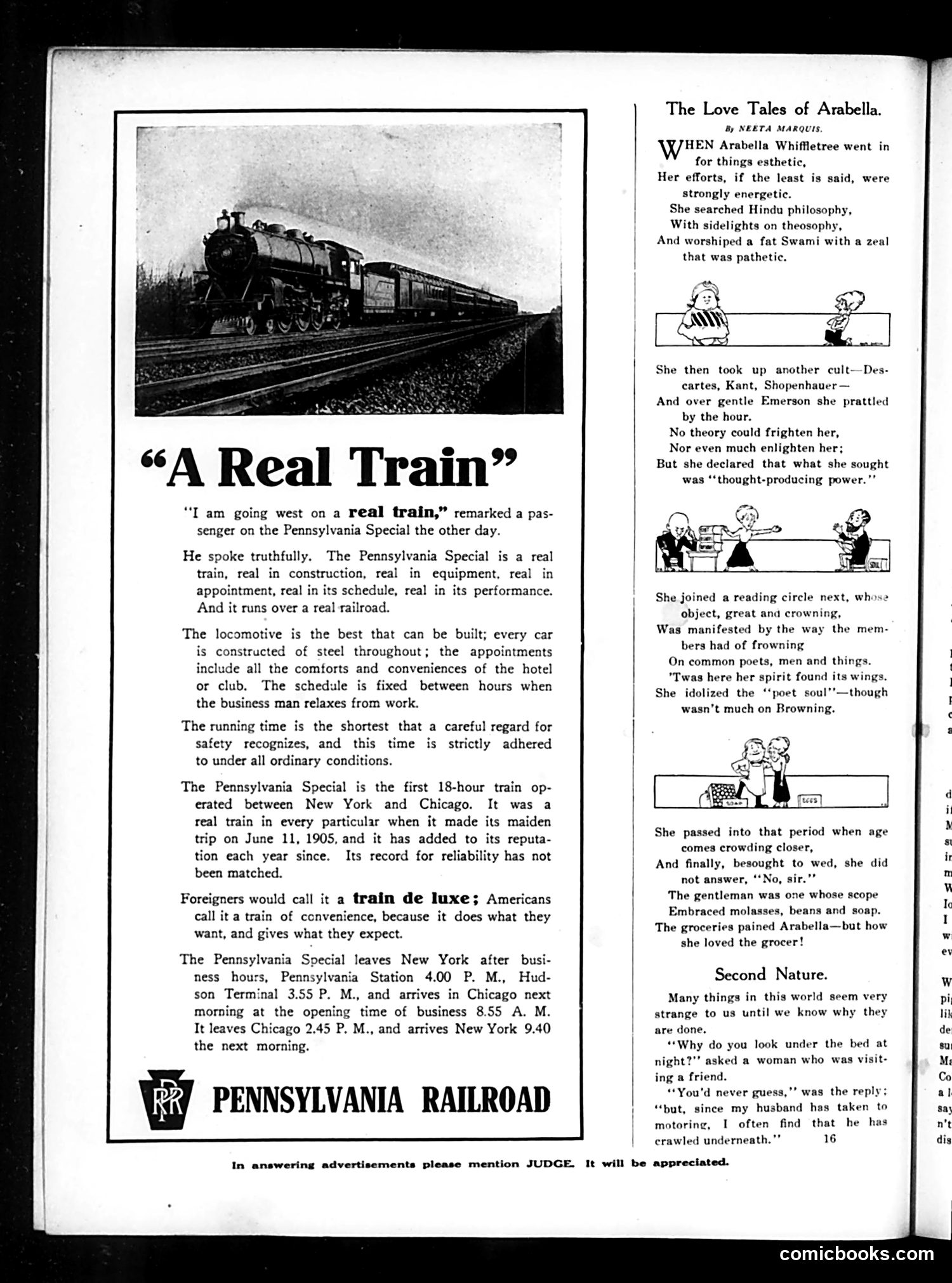
This page contains two distinct items: **Left side:** A Pennsylvania Railroad advertisement for the "Pennsylvania Special" train, emphasizing its reliability, speed (18 hours New York to Chicago), and luxury accommodations. It appeals to businessmen by promising convenient scheduling around work hours. The ad uses the phrase "train de luxe" (French) versus "train of convenience" (American) to position the service as practical rather than merely fancy. **Right side:** "The Love Tales of Arabella" by Neeta Marquis—a humorous poem with three small comic strips. It satirizes a character who obsessively pursues intellectual and spiritual fads (Hindu philosophy, German philosophers, reading circles) searching for "thought-producing power," only to ultimately marry a humble grocer. The satire mocks pretentious intellectualism and suggests such pursuits are ultimately superficial affectation. A separate "Second Nature" joke puns on husbands taking up automobiles as a hobby. The page is primarily advertising with entertainment content, typical of Judge's format blending commerce and satire.
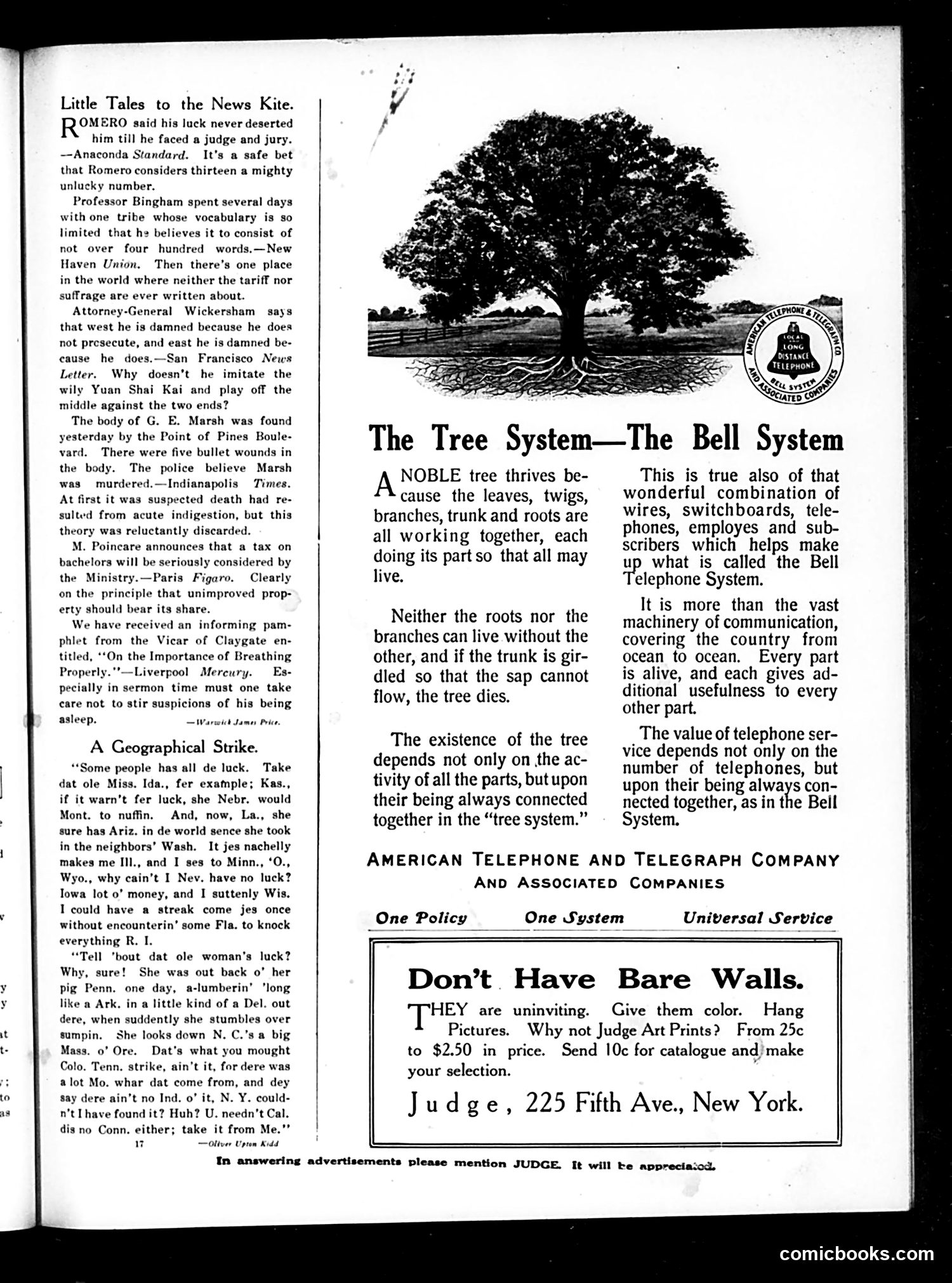
This page mixes satirical news commentary with corporate advertising. The top section, "Little Tales to the News Kite," collects brief humorous jabs at contemporary figures and events—including Attorney-General Wickersham's political predicament and a murder investigation. The "Geographical Strike" piece is a dialect joke playing on U.S. state abbreviations woven into colloquial speech, treating geographical names as words in a conversation about luck. The centerpiece is a full-page advertisement by American Telephone & Telegraph Company using an extended metaphor: a tree's interconnected systems (roots, branches, trunk) represent the telephone network's interdependence. The message emphasizes that individual phones are valuable only when connected to the broader "Bell System"—essentially corporate propaganda disguised as natural philosophy, promoting the company's monopolistic vision of unified telephone service. A small print advertisement for wall art follows. The corporate ad represents how large companies used editorial magazines for sophisticated brand messaging during this era.
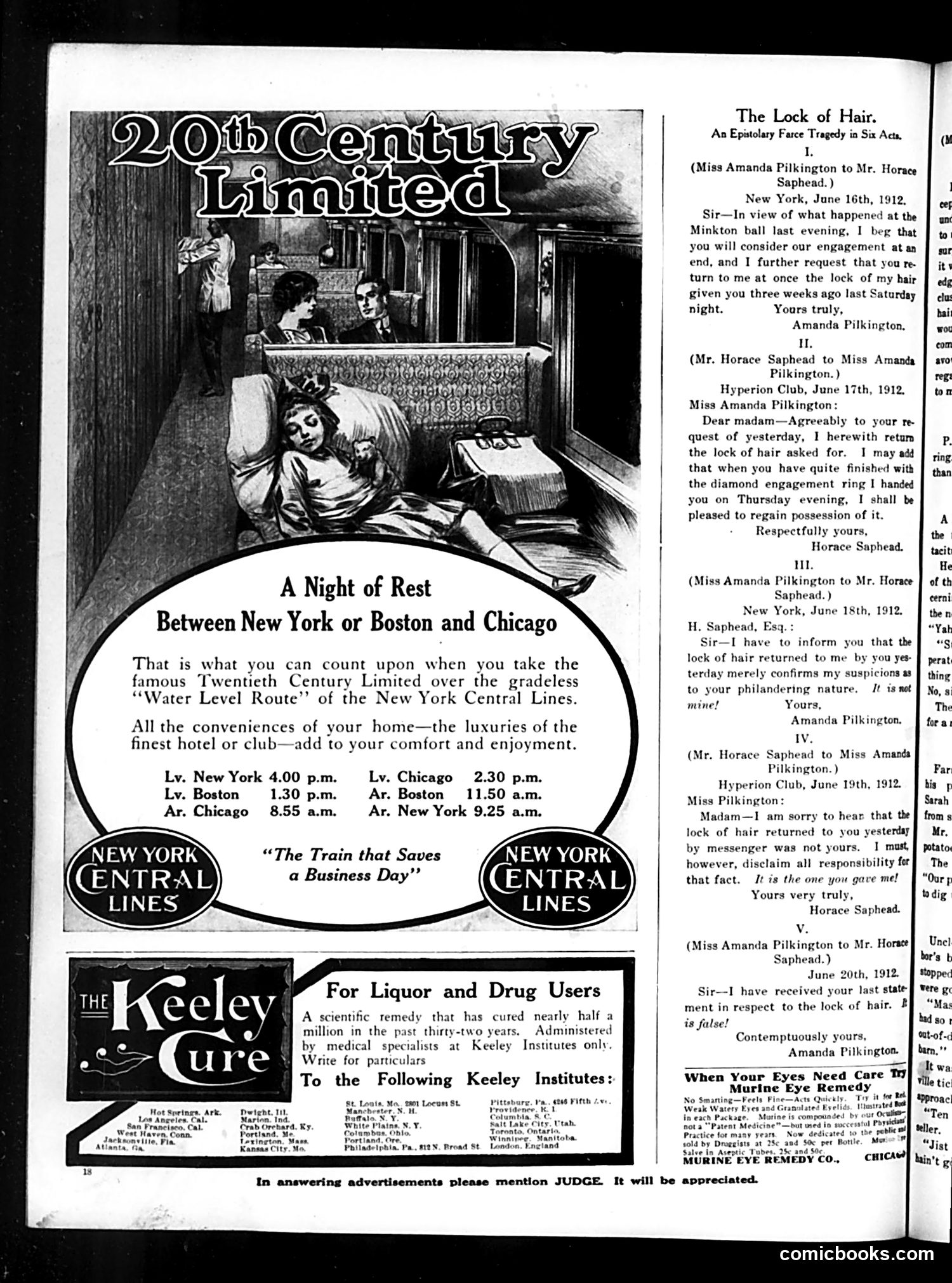
This page presents a six-act epistolary comedy about a broken engagement between Miss Amanda Pilkington and Mr. Horace Saphead. The humor derives from a trivial dispute over a returned lock of hair that escalates into absurd mutual accusations. The satire mocks Victorian courtship conventions and dramatic overreaction. Each letter exchanges increasingly petty claims: she breaks the engagement over an incident at a ball; he counters by demanding return of an expensive diamond ring; she suggests he switched her hair with someone else's; he denies responsibility. By Act V, she calls his explanation "false!" The comedy lies in treating a silly romantic squabble with the formal gravity of tragic correspondence. Modern readers would recognize this as early 20th-century satire of social pretension and how couples weaponize minor disputes. The page also contains advertisements for New York Central Railways and Keeley Institutes (addiction treatment centers), typical for Judge magazine.
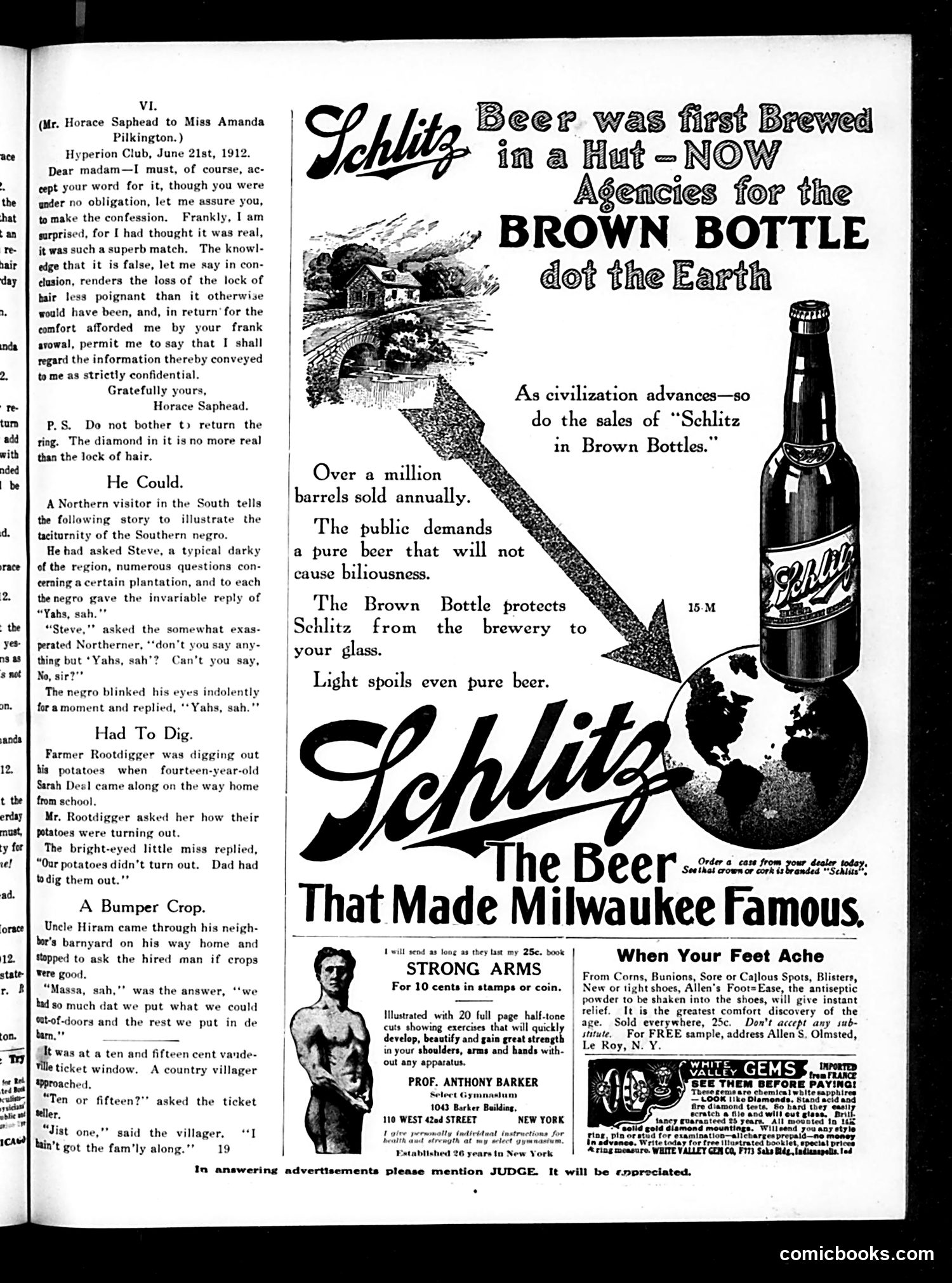
This page contains **primarily advertisements** interspersed with brief humorous anecdotes. The main content is a large **Schlitz beer advertisement** featuring a hut illustration and a brown bottle. The ad emphasizes that brown bottles protect beer from light spoilage during distribution—a practical sales pitch framed around "civilization advances." It claims over a million barrels sold annually. The left column contains short comedic sketches typical of Judge's humor: - A letter from "Horace Saphead" about a false diamond and hair lock, satirizing upper-class gentlemen's gullibility - A racial dialect joke featuring "Steve," a Southern Black man who only says "Yahs, sah"—reflecting the era's offensive stereotyping - Rural humor about potatoes and crops The remaining advertisements include "Strong Arms" exercise instruction and Allen's Foot-Ease powder. The satire and offensive racial content reflect early-1900s Judge magazine conventions, targeting Victorian pretension and regional stereotypes rather than specific political events.
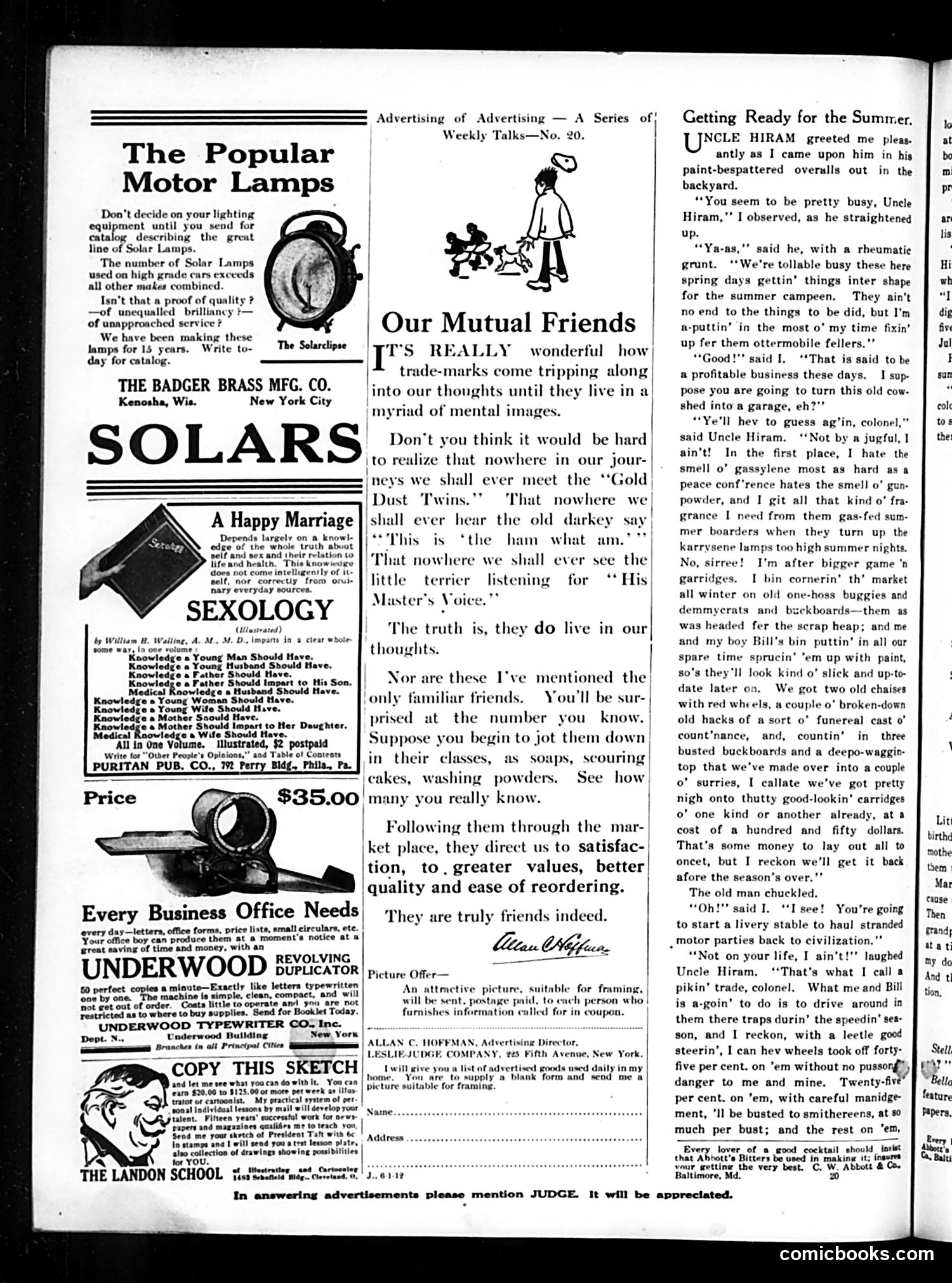
This page is primarily **advertisements with one short satirical article** titled "Our Mutual Friends." ## The Main Article's Satire The piece humorously explores how **brand mascots and advertising slogans become embedded in American consciousness** despite never appearing in real life. It references: - **"Gold Dust Twins"** (cleaning product mascot) - The phrase **"This is 'the ham what am'"** (likely referencing a dialect-heavy advertisement) - **"His Master's Voice"** (the RCA Victor dog trademark) The satire's point: These fictional characters and catchphrases live so vividly in our minds that we almost forget they're purely invented marketing tools, not real encounters. The author suggests this proves advertising's psychological power—trade-marks direct our purchasing decisions by creating false familiarity. The accompanying sketch shows a simplified figure, though its specific relevance is unclear. ## The Rest The page is dominated by product advertisements (motor lamps, typewriters, educational books) typical of early 20th-century Judge magazine. The "Getting Ready for Summer" column beginning on the right appears to be conversational humor about rural life.
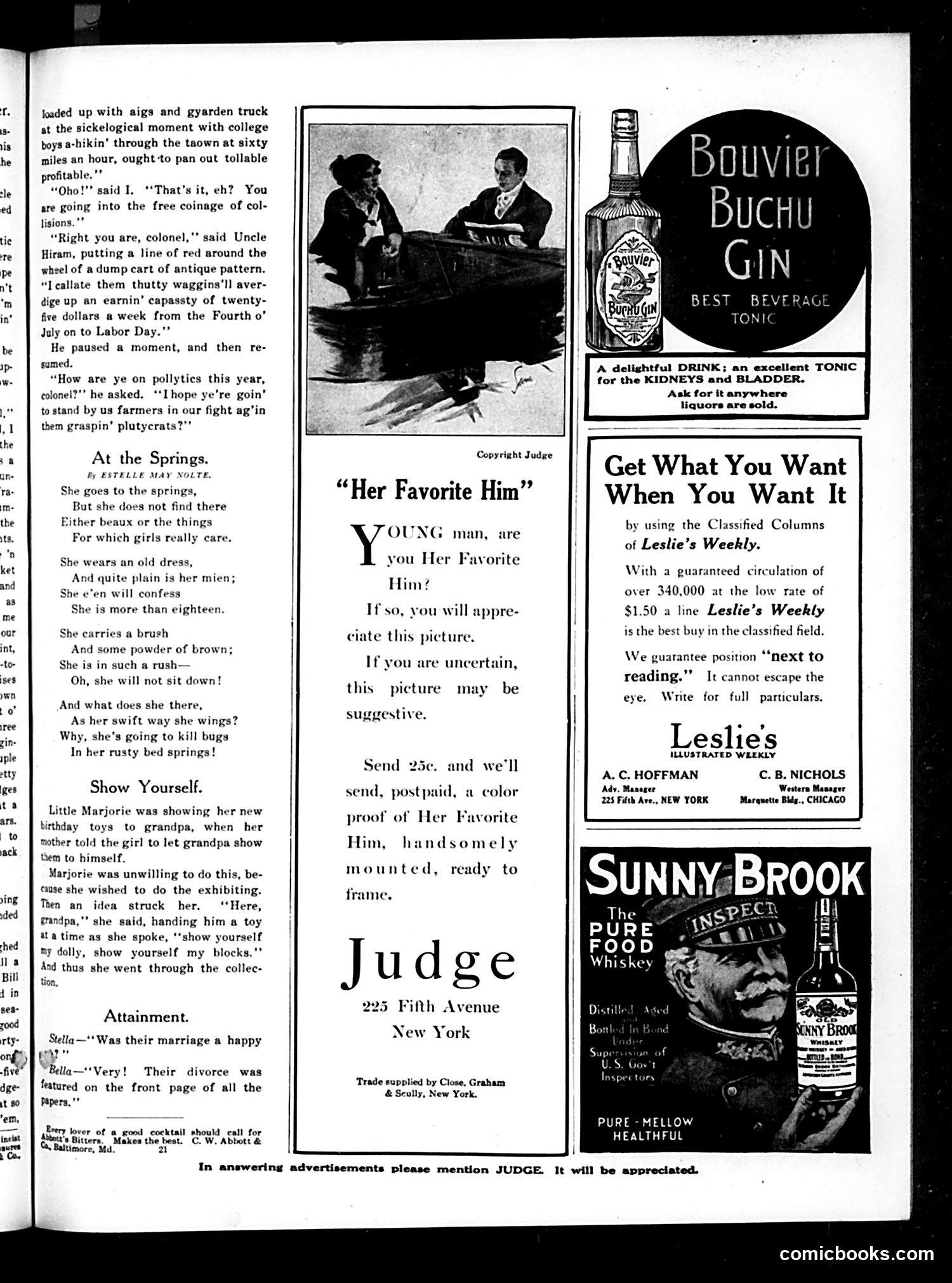
This page contains multiple short humorous pieces typical of early 20th-century satirical magazines: **"Her Favorite Him"** (center): A suggestive cartoon advertisement offering a colored portrait for 25 cents. The accompanying text plays on romantic uncertainty—a young man wonders if he's "her favorite," with the implication that the picture will clarify his romantic status. **Political dialogue (top left)**: Uncle Hiram, depicted as a rural farmer, discusses with a colonel his scheme to profit from reckless college drivers hitting his farm equipment. The satire mocks both the farmer's opportunism and wealthy young men's recklessness. When asked about politics, Hiram appeals to class resentment, asking the colonel to support "farmers...against...grasping plutycrats"—reflecting early 20th-century agrarian populist sentiment. **Other pieces**: "At the Springs" mocks women's spa culture; "Show Yourself" is a children's humor piece; "Attainment" jokes about divorce publicity. **Advertisements** for gin, whiskey, and Leslie's Weekly classified ads fill remaining space—typical period magazine content.
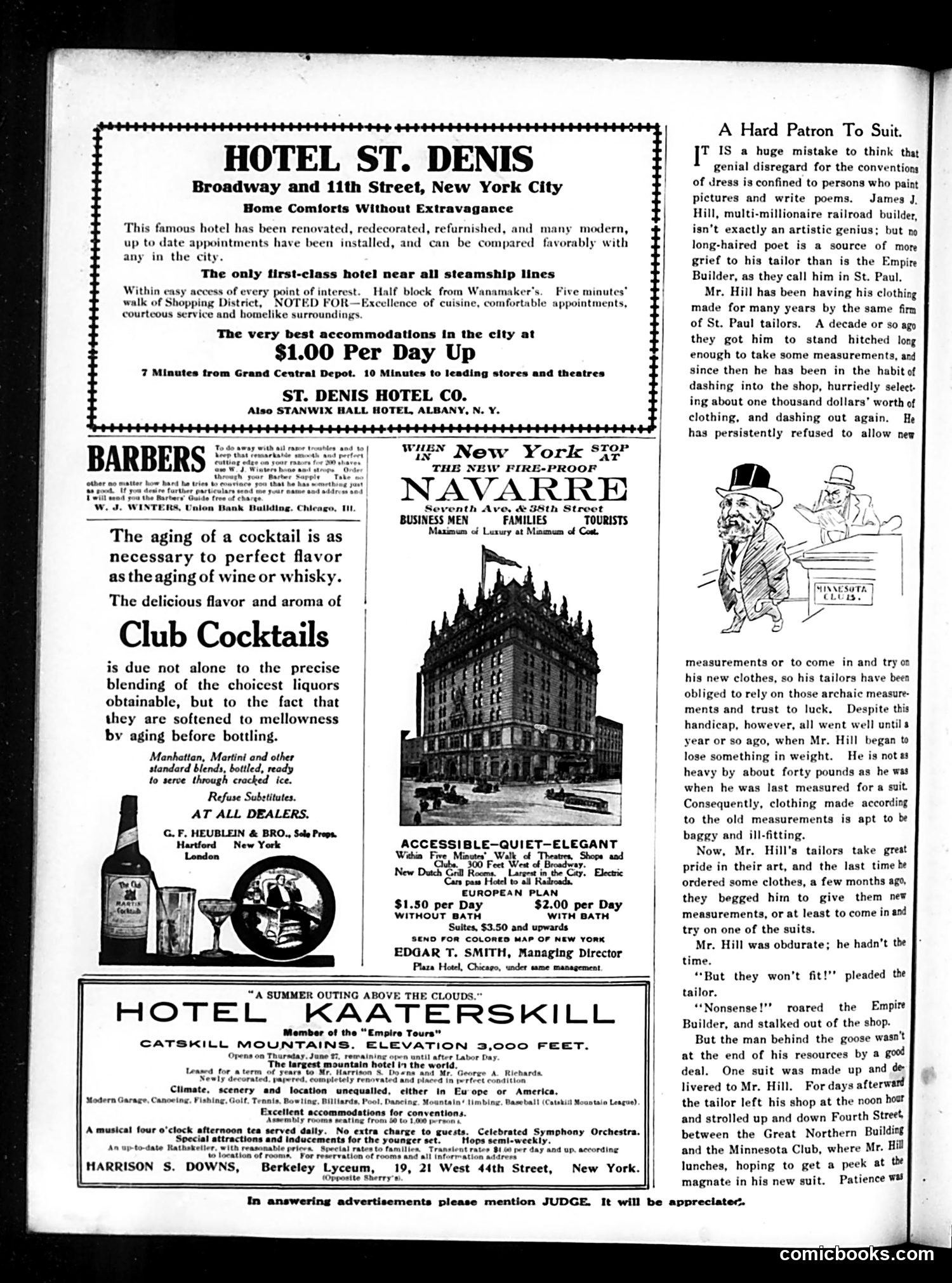
This satirical article mocks James J. Hill, the wealthy railroad magnate (the "Empire Builder"), for being an impossibly difficult customer to his St. Paul tailors. Hill, despite his prominence and wealth, refuses basic tailoring practices: he won't take new measurements or try on clothes, instead impulsively buying around $1,000 worth of garments and rushing out. His tailors have resorted to using old measurements and guesswork, resulting in ill-fitting clothes. Hill then demands they adjust the suits without providing proper measurements—a catch-22 that exasperates the tailors. The joke's premise is ironic: while artistic temperament excuses eccentric behavior, a hardheaded businessman like Hill has no such excuse for being equally unreasonable. The satire suggests that great wealth and power don't grant immunity from basic courtesy or cooperation—Hill's refusal to accommodate his tailors' reasonable requests makes him worse than the stereotypical temperamental artist.
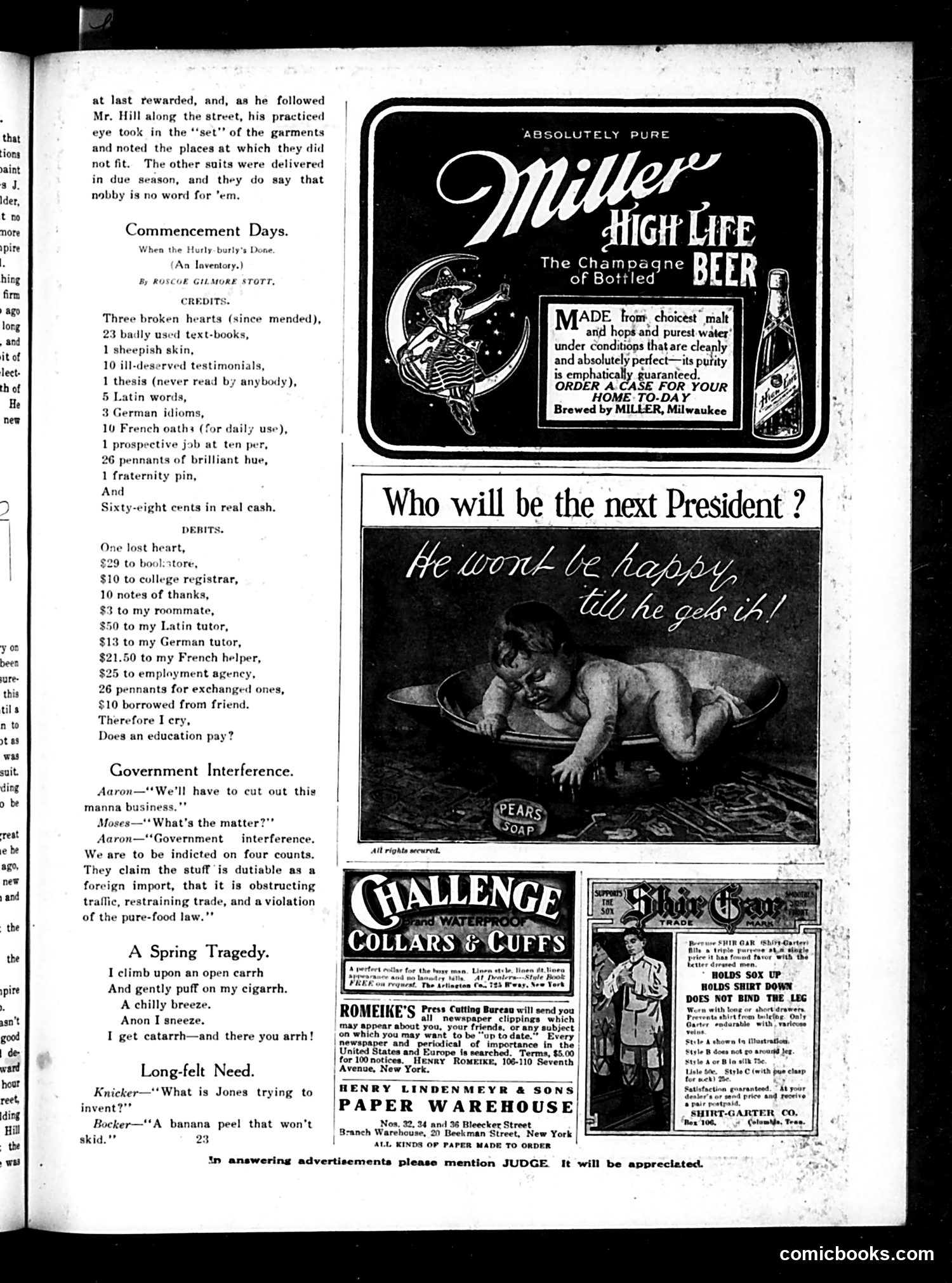
This page from *Judge* magazine contains primarily **advertisements and light humor pieces** rather than political cartoons. The most notable political content is the headline **"Who will be the next President?"** paired with a Pears Soap advertisement. The caption reads "He won't be happy, till he gets it!"—a cynical joke suggesting that presidential candidates are motivated by desire for office rather than public service, using the soap ad's slogan ironically. The text pieces are satirical vignettes about college life: "Commencement Days" humorously tallies a student's debts versus credits (broken hearts, Latin words, borrowed money), asking "Does an education pay?" The "Government Interference" dialogue mocks alcohol prohibition or tariff regulations. Other sketches offer wordplay about spring and failed inventions. The page reflects *Judge's* style of **gentle social satire** aimed at educated readers—poking fun at education costs, government regulation, and political ambition rather than mounting serious critique.
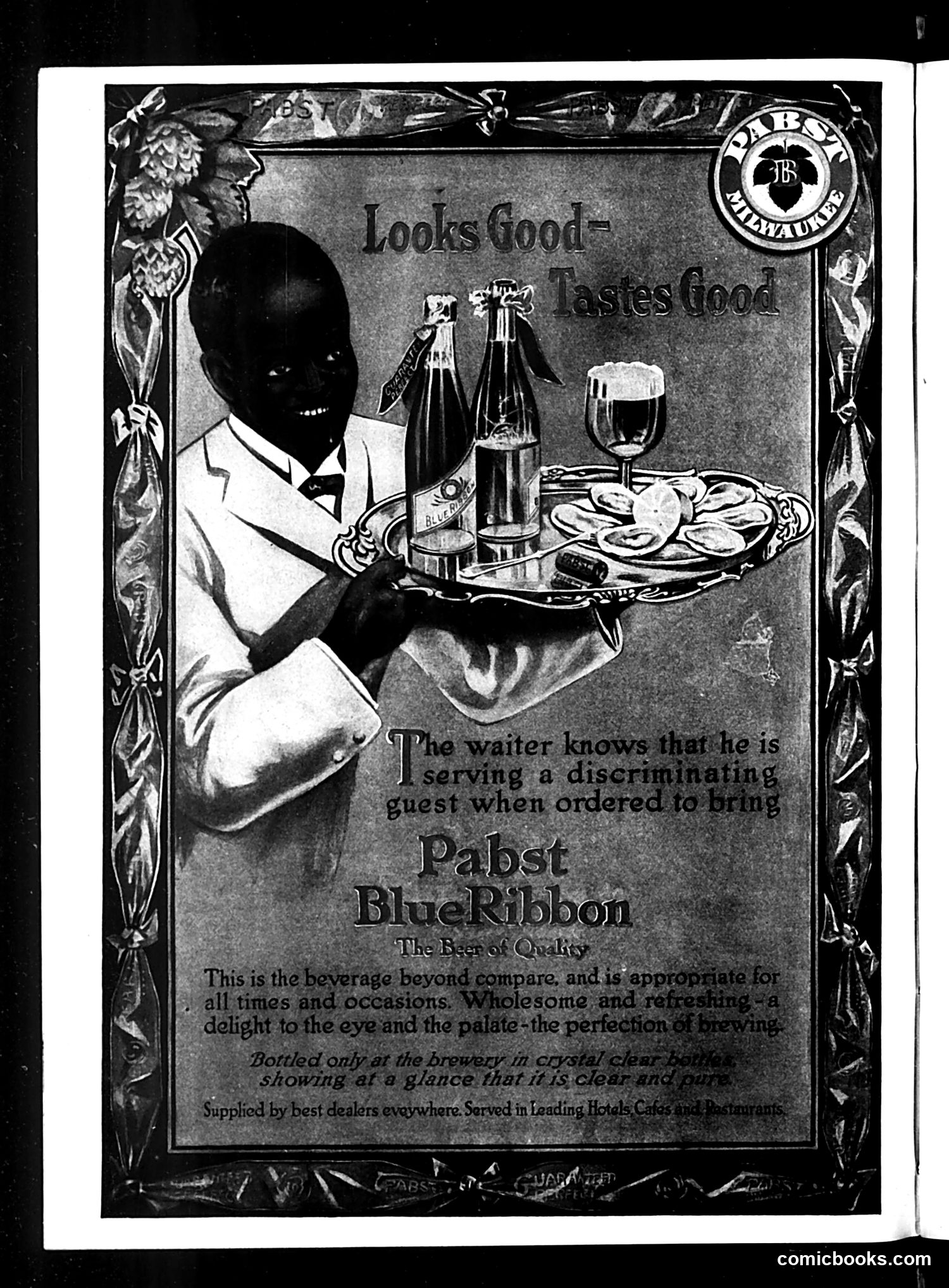
This is a Pabst Blue Ribbon beer advertisement from *Judge* magazine. The ad depicts a Black waiter serving beer and oysters with the headline "Looks Good—Tastes Good." The accompanying text states: "The waiter knows that he is serving a discriminating guest when ordered to bring Pabst Blue Ribbon." **What this reveals:** This advertisement relies on a deeply racist caricature and stereotype—portraying a Black server as inherently knowing how to serve "discriminating" (elite) guests. The imagery and messaging use the racial caricature to associate the beer brand with quality and refinement, exploiting both racist visual tropes and labor stereotypes common in early 20th-century American advertising. This represents the casual, normalized racism embedded in period advertising that modern viewers would find shocking and offensive.