
Judge, 1912-06-01 · page 8 of 24
Judge — June 1, 1912 — page 8: what you’re looking at
What you’re looking at
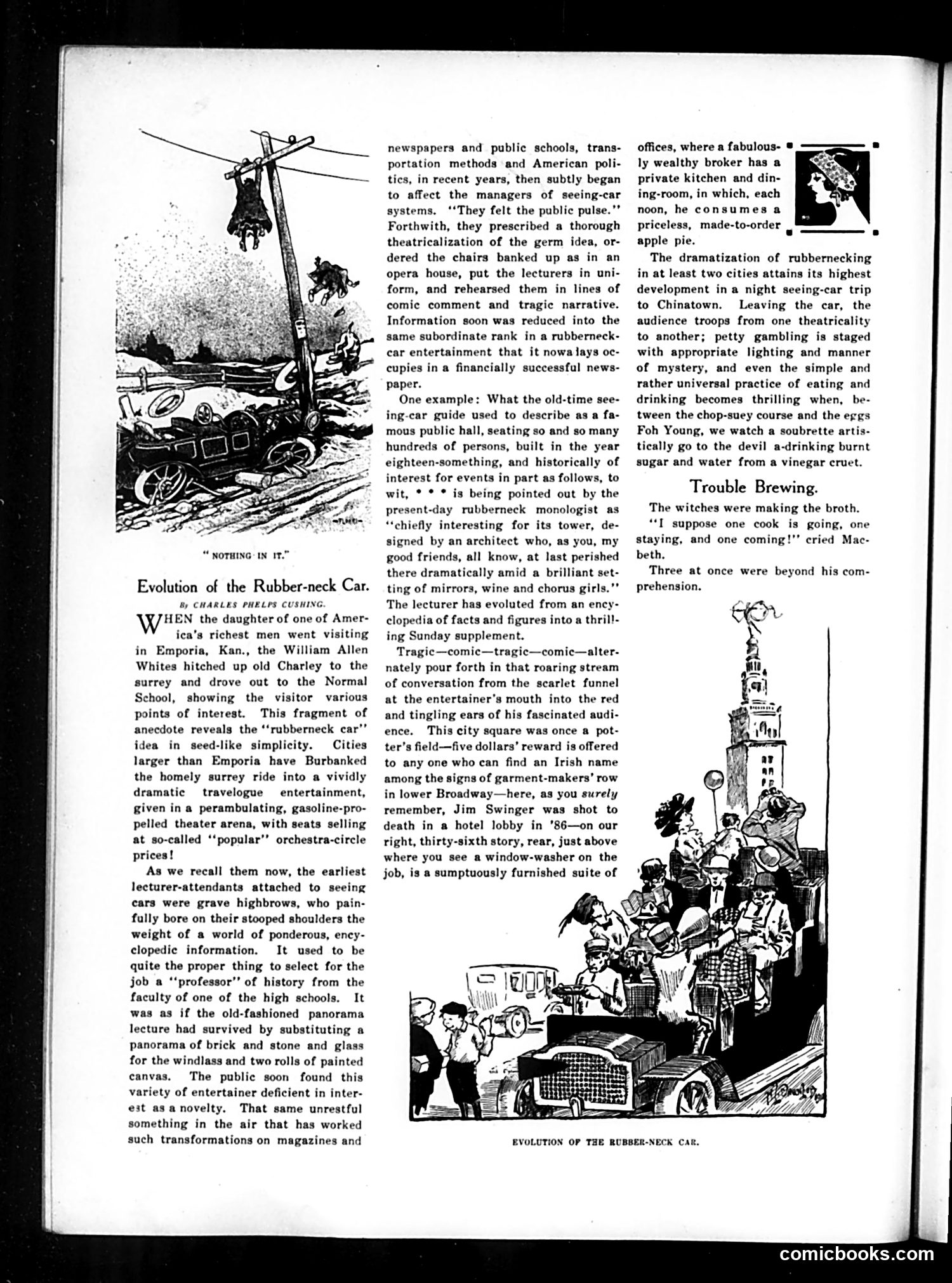
This article satirizes the commercialization of **sightseeing tours** (called "rubber-neck cars"—vehicles where tourists gawk at city attractions). The author contrasts two eras: Early guides were scholarly "professors" who delivered dry historical facts about buildings and landmarks. Modern tour operators have replaced substance with **sensationalism and entertainment**—theatrical delivery, dramatic staging, and lurid anecdotes (murders, scandals, wealthy brokers' fancy kitchens) presented as if from a "Sunday supplement" (sensational newspaper section). The satire critiques how American culture—magazines, newspapers, schools, politics—increasingly prioritizes entertainment and emotional stimulation over genuine information. Tours to Chinatown are presented as the peak of this theatrical excess. The cartoons (left and right) illustrate the "evolution" from simple horse-drawn surreys to elaborate motorized theater-like vehicles packed with paying audiences, visualizing this shift from humble transportation to mass entertainment spectacle.
📄 Transcribed text from this page (OCR, searchable)
Machine-transcribed from the original scan — historical spelling and the odd misread are preserved.
“ NOTHING: IN IT.” Evolution of the Rubber-neck Car. by CHARLES PHELPS CUSHING. WHEN the daughter of one of Amer- ica’s richest men went visiting in Emporia, Kan., the William Allen Whites hitched up old Charley to the surrey and drove out to the Normal School, showing the visitor various points of interest. This fragment of anecdote reveals the ‘‘rubberneck car’’ idea in seed-like simplicity. Cities larger than Emporia have Burbanked the homely surrey ride into a vividly dramatic travelogue entertainment, given in a perambulating, gasoline-pro- pelled theater arena, with seats selling at so-called ‘‘popular’’ orchestra-circle prices! As we recall them now, the earliest lecturer-attendants attached to seeing cars were grave highbrows, who pain- fully bore on their stooped shoulders the weight of a world of ponderous, ency- clopedic information. It used to be quite the proper thing to select for the job a ‘‘professor’’ of history from the faculty of one of the high schools. It was as if the old-fashioned panorama lecture had survived by substituting a panorama of brick and stone and glass for the windlass and two rolls of painted canvas. The public soon found this variety of entertainer deficient in inter- e3t asanovelty. That same unrestful something in the air that has worked such transformations on magazines and newspapers and public schools, trans- portation methods and American poli- tics, in recent years, then subtly began to affect the managers of seeing-car systems. ‘‘They felt the public pulse.’” Forthwith, they prescribed a thorough theatricalization of the germ idea, or- dered the chairs banked up as in an opera house, put the lecturers in uni- form, and rehearsed them in lines of comic comment and tragic narrative. Information soon was reduced into the same subordinate rank in a rubberneck- car entertainment that it nowa lays oc- cupies in a financially successful news- paper. One example: What the old-time see- ing-car guide used to describe as a fa- mous public hall, seating so and so many hundreds of persons, built in the year eighteen-something, and historically of interest for events in part as follows, to wit, * * * is being pointed out by the present-day rubberneck monologist as “chiefly interesting for its tower, de- signed by an architect who, as you, my good friends, all know, at last perished there dramatically amid a brilliant set- ting of mirrors, wine and chorus girls."” The lecturer has evoluted from an ency- clopedia of facts and figures into a thril!- ing Sunday supplement. Tragic—comic—tragic—comic—alter- nately pour forth in that roaring stream of conversation from the scarlet funnel at the entertainer’s mouth into the red and tingling ears of his fascinated audi- ence. This city square was once a pot- ter’s field—five dollars’ reward is offered to any one who can find an Irish name among the signs of garment-makers’ row in lower Broadway—here, as you surely remember, Jim Swinger was shot to death in a hotel lobby in '86—on our right, thirty-sixth story, rear, just above where you see a window-washer on the job, is a sumptuously furnished suite of EVOLUTION OF THE RUBBER-NECK Can. offices, where a fabulous- © ——=—— _® ly wealthy broker has a private kitchen and din- ing-room, in which, each noon, he consumes a priceless, made-to-order apple pie. The dramatization of rubbernecking in at least two cities attains its highest development ina night seeing-car trip to Chinatown. Leaving the car, the audience troops from one theatricality to another; petty gambling is staged with appropriate lighting and manner of mystery, and even the simple and rather universal practice of eating and drinking becomes thrilling when, be- tween the chop-suey course and the eggs Foh Young, we watch a soubrette artis- tically go to the devil a-drinking burnt sugar and water from a vinegar cruet. Trouble Brewing. The witches were making the broth. “I suppose one cook is going, one staying, and one coming!"’ cried Mac- beth. Three at once were beyond his com- prehension. comicbooks.com