
Judge, 1912-06-01 · page 5 of 24
Judge — June 1, 1912 — page 5: what you’re looking at
What you’re looking at
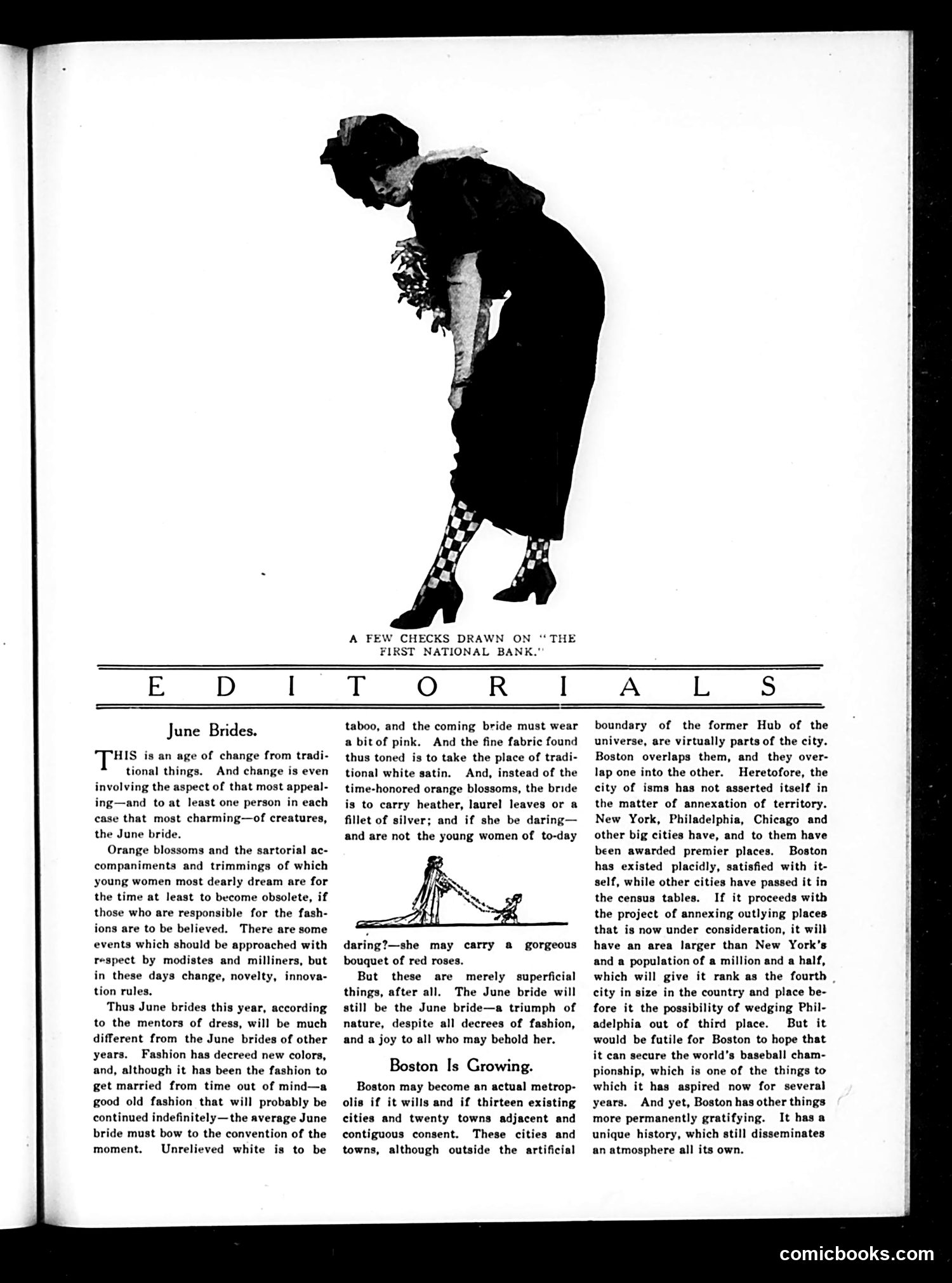
The silhouette cartoon depicts a woman in fashionable dress bending over to examine or write checks at a bank, captioned "A Few Checks Drawn on 'The First National Bank.'" The accompanying editorial "June Brides" discusses changing wedding traditions—specifically how modern June brides are abandoning orange blossoms and white satin for red roses and contemporary fashion. The text celebrates this modernization while noting traditionalists resist such changes. The cartoon likely satirizes women's increasing financial independence and involvement in banking. The woman's posture—bowing obsequiously—suggests ironic commentary on either women's newfound economic power or society's awkward adjustment to women handling finances, which was unconventional for the era. The overall page critiques evolving social conventions around weddings, fashion, and women's roles.
📄 Transcribed text from this page (OCR, searchable)
Machine-transcribed from the original scan — historical spelling and the odd misread are preserved.
ED June Brides. HIS is an age of change from tradi- tional things. And change is even involving the aspect of that most appeal- ing—and to at least one person in each case that most charming—of creatures, the June bride. Orange blossoms and the sartorial ac- companiments and trimmings of which young women most dearly dream are for the time at least to become obsolete, if those who are responsible for the fash- ions are to be believed. There are some events which should be approached with respect by modistes and milliners, but in these days change, novelty, innova- tion rules. Thus June brides this year, according to the mentors of dress, will be much different from the June brides of other years. Fashion has decreed new colors, and, although it has been the fashion to get married from time out of mind—a good old fashion that will probably be continued indefinitely—the average June bride must bow to the convention of the moment. Unrelieved white is to be A FEW CHECKS DRAWN ON “THE FIRST NATIONAL BANK." O R taboo, and the coming bride must wear a bitof pink. And the fine fabric found thus toned is to take the place of tradi- tional white satin. And, instead of the time-honored orange blossoms, the bride is to carry heather, laurel leaves or a fillet of silver; and if she be daring— and are not the young women of to-day daring?—she may carry a gorgeous bouquet of red roses. But these are merely superficial things, after all. The June bride will still be the June bride—a triumph of, nature, despite all decrees of fashion, and a joy to all who may behold her. Boston Is Growing. Boston may become an actual metrop- olis if it wills and if thirteen existing cities and twenty towns adjacent and contiguous consent. These cities and towns, although outside the artificial LS A boundary of the former Hub of the universe, are virtually parts of the city. Boston overlaps them, and they over- lap one into the other. Heretofore, the city of isms has not asserted itself in the matter of annexation of territory. New York, Philadelphia, Chicago and other big cities have, and to them have been awarded premier places, Boston has existed placidly, satisfied with it- self, while other cities have passed it in the census tables. If it proceeds with the project of annexing outlying places that is now under consideration, it will have an area larger than New York's and a population of a million and a half, which will give it rank as the fourth city in size in the country and place be- fore it the possibility of wedging Phil- adelphia out of third place. But it would be futile for Boston to hope that it can secure the world’s baseball cham- pionship, which is one of the things to which it has aspired now for several years. And yet, Boston has other things more permanently gratifying. It hasa unique history, which still disseminates an atmosphere all its own. comicbooks.com