
Judge, 1912-06-01 · page 7 of 24
Judge — June 1, 1912 — page 7: what you’re looking at
What you’re looking at
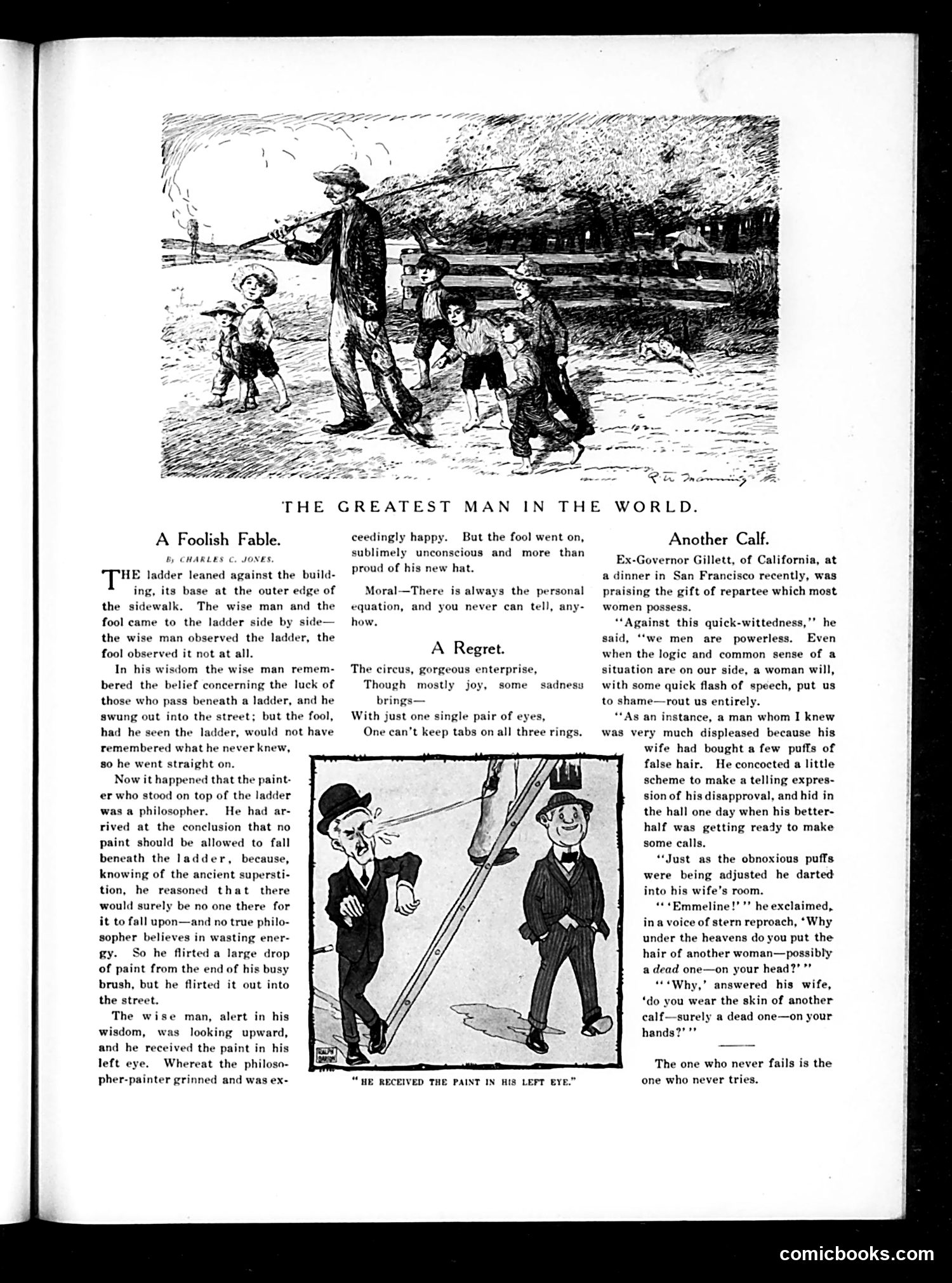
This page contains three distinct pieces of satirical content: **"The Greatest Man in the World: A Foolish Fable"** (top left) presents a moral tale about superstition versus logic. A wise man avoids walking under a ladder due to superstition, while a fool walks straight through unconsciously. Ironically, the painter atop the ladder—reasoning philosophically that no one would pass beneath—flicks paint into the street, hitting the "wise" man's eye. The moral mocks the unreliability of reason and superstition alike. **"A Regret"** (center) is a brief joke about circus limitations—one pair of eyes cannot watch three rings simultaneously. **"Another Calf"** (right) is an anecdote about a California ex-governor's dinner story. A husband attempts to shame his wife for wearing false hair by sarcastically asking why she wears "dead" hair. She retorts by asking why he wears animal skin (leather) gloves—turning his moral disapproval against him through quick wit. The anecdote satirizes male attempts to shame women's appearance.
📄 Transcribed text from this page (OCR, searchable)
Machine-transcribed from the original scan — historical spelling and the odd misread are preserved.
THE GREATEST MAN A Foolish Fable. By CHARLES C. JONES HE ladder leaned against the build- ing, its base at the outer edge of the sidewalk. The wise man and the fool came to the ladder side by side— the wise man observed the ladder, the fool observed it not at all. In his wisdom the wise man remem- bered the belief concerning the luck of those who pass beneath a ladder, and he swung out into the street; but the fool, had he seen the ladder, would not have remembered what he never knew, so he went straight on. Now it happened that the paint- er who stood on top of the ladder was a philosopher. He had ar- rived at the conclusion that no paint should be allowed to fall beneath the ladder, knowing of the ancient supersti- tion, he reasoned that there would surely be no one there for it to fall upon—and no true philo- sopher believes in wasting ener- gy. So he flirted a large drop of paint from the end of his busy brush, but he flirted it out into the street. The wise man, alert in his looking upward, and he received the paint in his left eye. Whereat the philoso- pher-painter grinned and was ex- because, wisdom, was But the fool went on, more than ceedingly happy. sublimely unconscious and proud of his new hat. Moral—There is always the personal equation, and you never can tell, any- how. A Regret. The circus, gorgeous enterprise, Though joy, brings— With just one single pair of eyes, One can’t keep tabs on all three rings. mostly some sadness “HE RECEIVED THE PAINT IN HIS LEPT EYE.” RO Ina IN THE WORLD. Another Calf. Ex-Governor Gillett, of California, at a dinner in San Francisco recently, was praising the gift of repartee which most women possess. “Against this quick-wittedness,’’ he said, ‘we men are powerless. Even when the logic and common sense of a situation are on our side, a woman will, with some quick flash of speech, put us to shame—rout us entirely. ‘*As an instance, a man whom I knew was very much displeased because his wife had bought a few puffs of false hair. He concocted a little scheme to make a telling expres- sion of his disapproval, and hid in the hall one day when his better- half was getting ready to make some calls. “Just as the obnoxious puffs were being adjusted he darted into his wife’s room. «**Emmeline!’’’ he exclaimed, ina voice of stern reproach, ‘Why under the heavens do you put the hair of another woman—possibly a dead one—on your head?’ ”’ answered his wife, ‘do you wear the skin of another calf—surely a dead one—on your hands?’ ’” The one who never fails is the one who never tries. comicbooks.com