
Judge, 1912-06-01 · page 4 of 24
Judge — June 1, 1912 — page 4: what you’re looking at
What you’re looking at
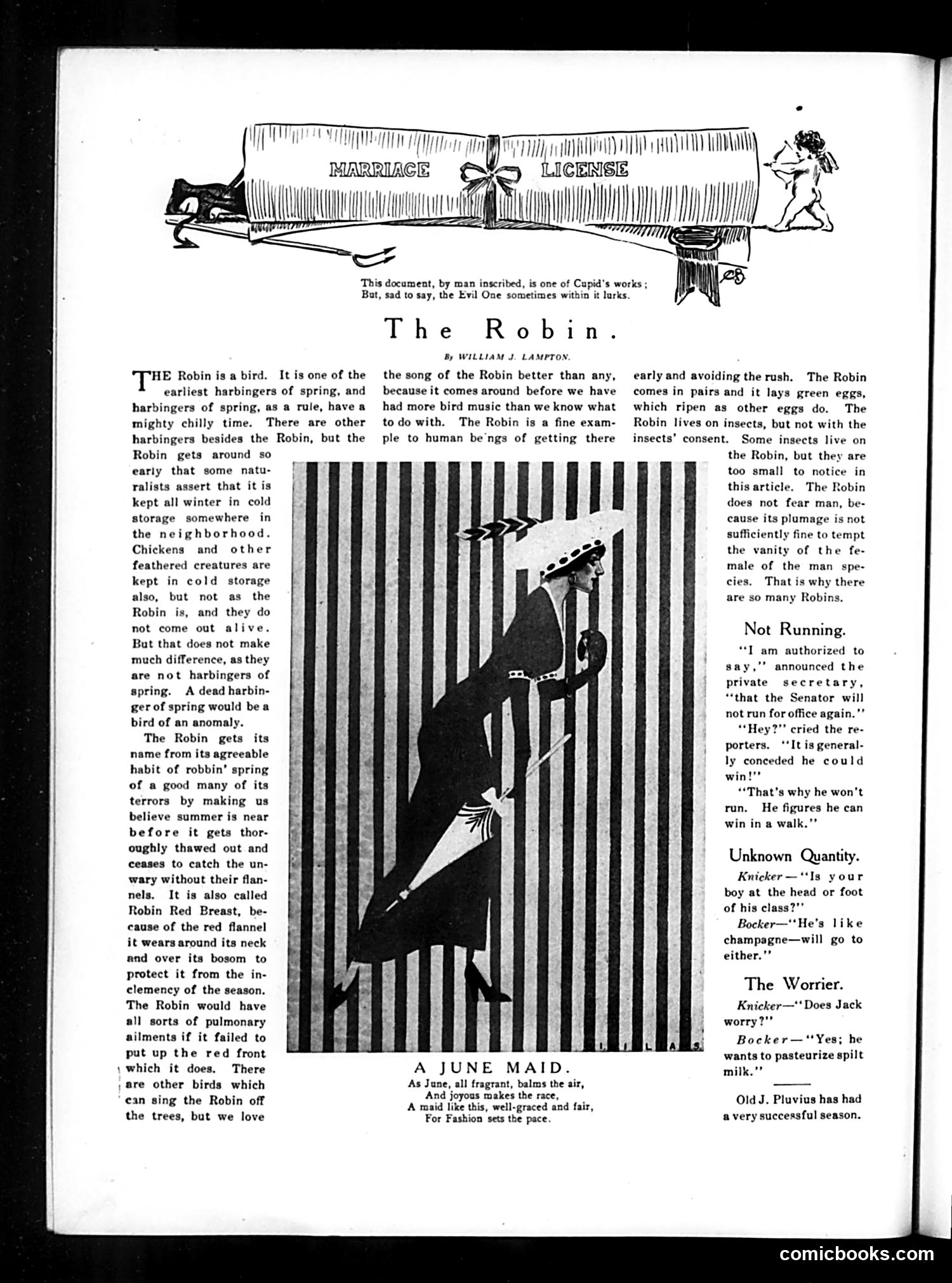
This page combines a naturalistic article about robins (the bird) with political humor. The main cartoon, "A June Maid," depicts a woman in a cage—likely representing a female voter or political candidate confined by restrictions. The small jokes below ("Not Running," "Unknown Quantity," "The Worrier") satirize a senator's reluctance to run for re-election. The humor plays on uncertainty: he "could" win but won't try because he might lose in a walk—meaning his victory would be too easy, contradicting his caution. The specific senator and election year are unclear from this page alone, but the satire targets political cowardice and the contradiction between confidence in one's abilities and unwillingness to compete.
📄 Transcribed text from this page (OCR, searchable)
Machine-transcribed from the original scan — historical spelling and the odd misread are preserved.
TT TT Ws. * W— LICENGE Li a Ay | This document, by man inscribed, is one of Cupid's works ; Bat, sad to say, the Evil One sometimes within it lurks. HE Robin is a bird. It is one of the earliest harbingers of spring, and harbingers of spring, as a rule, havea mighty chilly time. There are other harbingers besides the Robin, but the Robin gets around so early that some natu- ralists assert that it is } kept all winter in cold storage somewhere in But that does not make much difference, as they are not harbingers of spring. A dead harbin- ger of spring would bea bird of an anomaly. The Robin gets its name from its agreeable habit of robbin’ spring of a good many of its terrors by making us believe summer is near before it gets thor- oughly thawed out and ceases to catch the un- wary without their flan- nels. It is also called Robin Red Breast, be- cause of the red flannel it wears around its neck and over its bosom to protect it from the in- clemency of the season. The Robin would have all sorts of pulmonary ailments if it failed to put up the red front which it does. There ) are other birds which ean sing the Robin off the trees, but we love ‘ The Robin. By WILLIAM J. LAMPTON. the song of the Robin better than any, because it comes around before we have had more bird music than we know what todo with. The Robin is a fine exam- ple to human be'ngs of getting there the neighborhood. ; 2 Chickens and other | feathered creatures are kept in cold. storage also, but not as the : Robin is, and they do not come out alive. A JUNE MAID. As Jane, all fragrant, balms the air, And joyous makes the race, A maid like this, well-graced and fair, For Fashion sets the pace. early and avoiding the rush. The Robin comes in pairs and it lays green eggs, which ripen as other eggs do. The Robin lives on insects, but not with the insects’ consent. Some insects live on the Robin, but they are too small to notice in this article. The Robin does not fear man, be- cause its plumage is not sufficiently fine to tempt the vanity of the fe- male of the man spe- cies. That is why there are so many Robins. Not Running. “I am authorized to say,’’ announced the private secretary, “that the Senator will not run for office again. “Hey?” cried the re- porters. ‘‘It is general- ly conceded he could win!"" “That's why he won't run. He figures he can win in a walk.” Unknown Quantity. Knicker —“‘Ia your boy at the head or foot of his class?’" Bocker—‘*He's like champagne—will go to either.’’ The Worrier. Knicker—* Does Jack worry ?"’ Bocker—“Yes; he wants to pasteurize spilt milk.” Old J. Pluvius has had avery successful season. comicbooks.com