
A complete issue · 23 pages · 1912
Judge — February 3, 1912
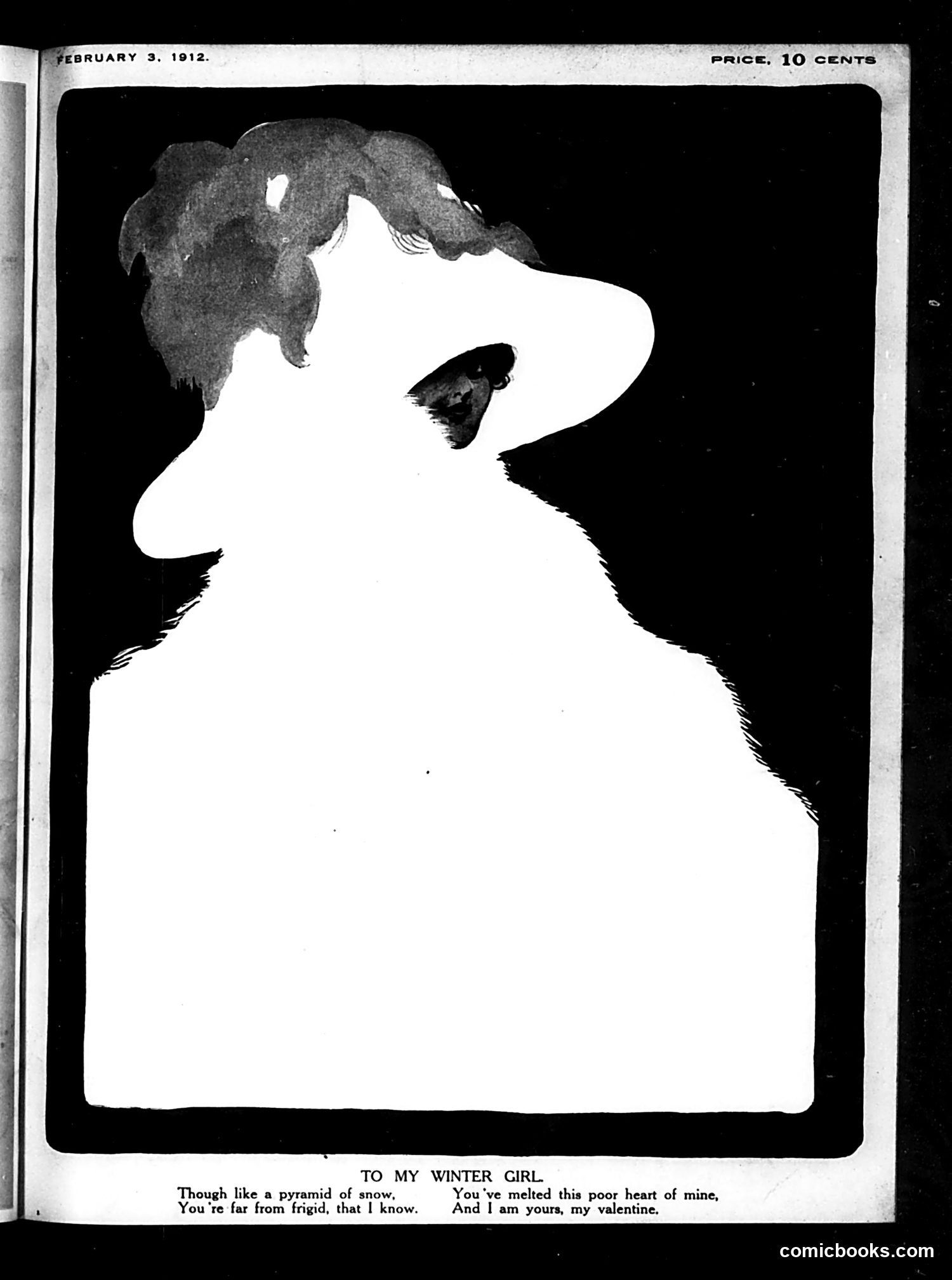
This is a **romantic Valentine's Day illustration** from *Judge* magazine (February 3, 1912), not political satire. The image shows a silhouette of a woman's profile in white against black, with dark curly hair visible at the top. The accompanying poem frames her as a "winter girl"—using snow imagery ("pyramid of snow," "frigid") as metaphor for her emotional coldness. The speaker claims her aloofness has paradoxically warmed his heart ("melted this poor heart of mine"), making her his valentine despite the emotional distance. This represents typical early-20th-century sentimental romantic humor: the unrequited or difficult lover as a stock literary theme. The silhouette technique was a popular artistic style of the era.
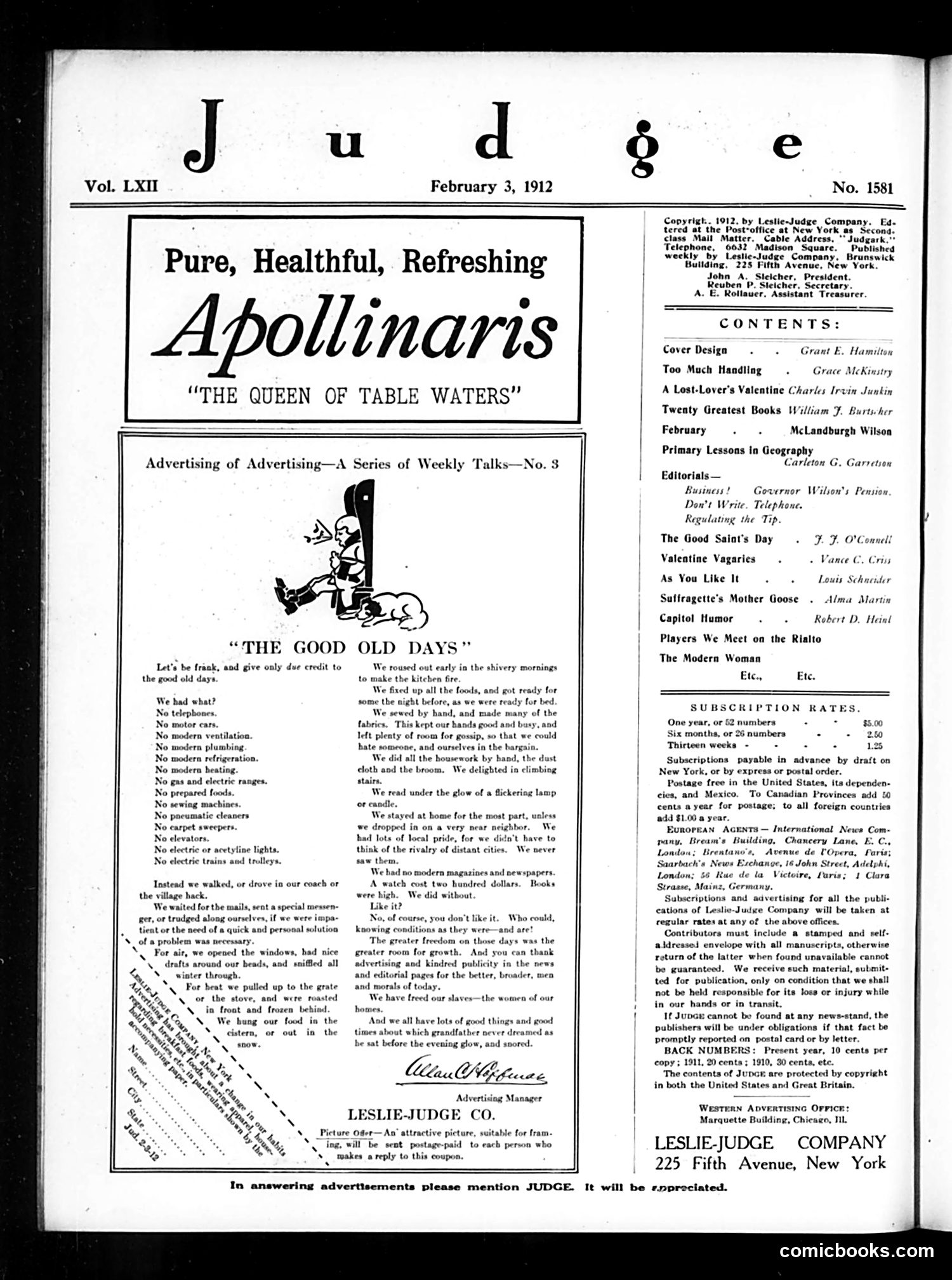
This page is primarily an **advertisement for Apollinaris mineral water**, positioned as "The Queen of Table Waters." The ad emphasizes purity and refreshment. Below it is a nostalgic article titled **"The Good Old Days,"** illustrated with a vintage-style cartoon showing people in old-fashioned dress. The piece contrasts modern conveniences (electricity, refrigeration, plumbing) with the simpler past, celebrating pre-industrial life with some irony. It humorously lists what didn't exist then—"No telephones," "No automobiles"—while romanticizing manual labor and home-based living. The satire appears gentle, mocking the widespread nostalgia of the era rather than making sharp political commentary. This reflects early 1900s anxiety about rapid modernization.
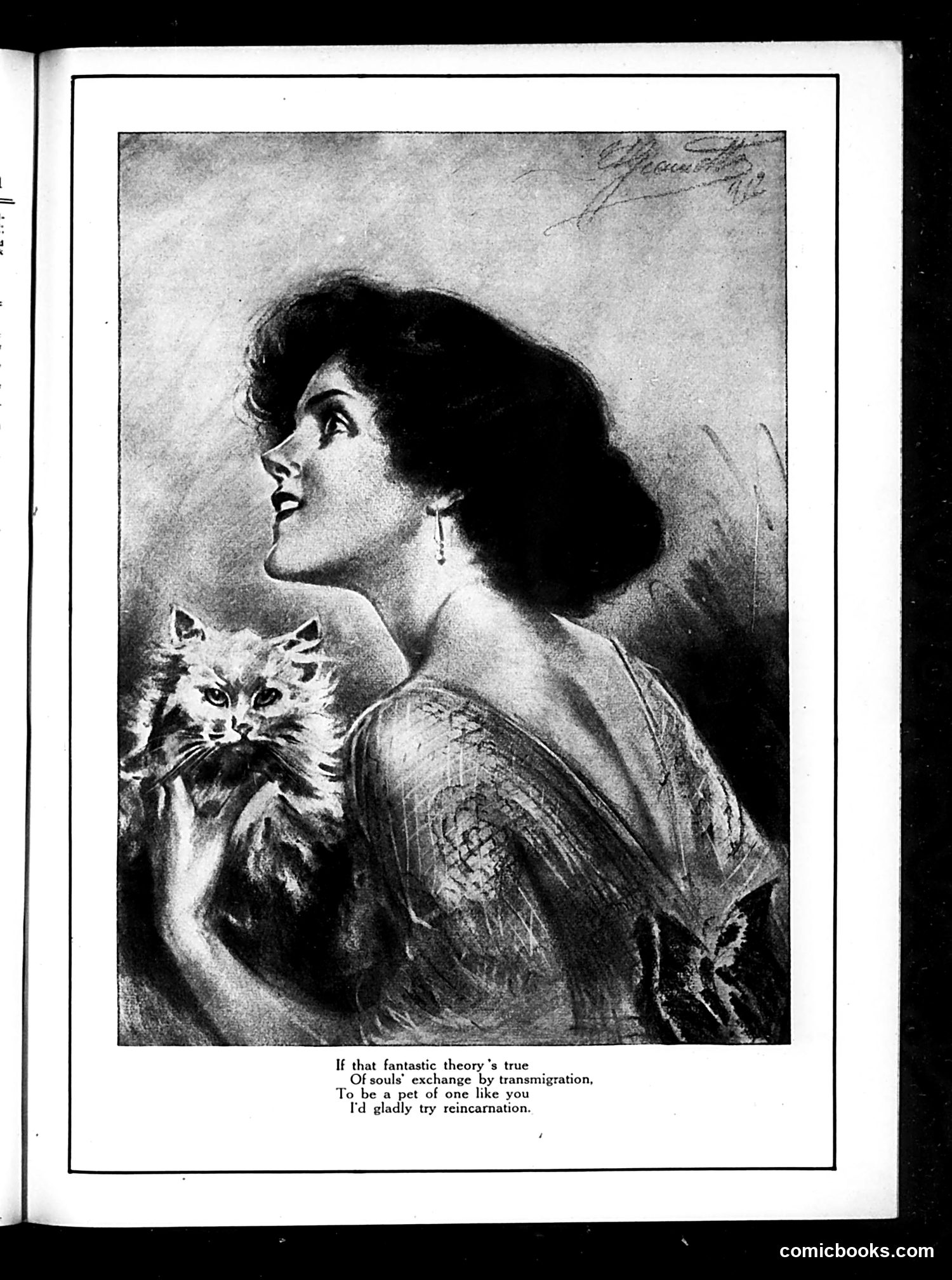
This page shows a portrait of a woman in profile holding a fluffy cat, accompanied by verse about reincarnation. The text reads: "If that fantastic theory's true / Of souls' exchange by transmigration, / To be a pet of one like you / I'd gladly try reincarnation." The satire is a **flirtation poem** typical of early 20th-century Judge magazine. The "fantastic theory" references Eastern religious concepts of reincarnation that were exotic and trendy among educated Western audiences. The joke is a playful compliment—the speaker suggests he'd accept reincarnation as a pet (cat) merely to remain close to an attractive woman. It's sentimental humor mixing pseudo-philosophical language with romantic flattery, mocking both the fashionability of Eastern mysticism and contemporary courtship conventions.
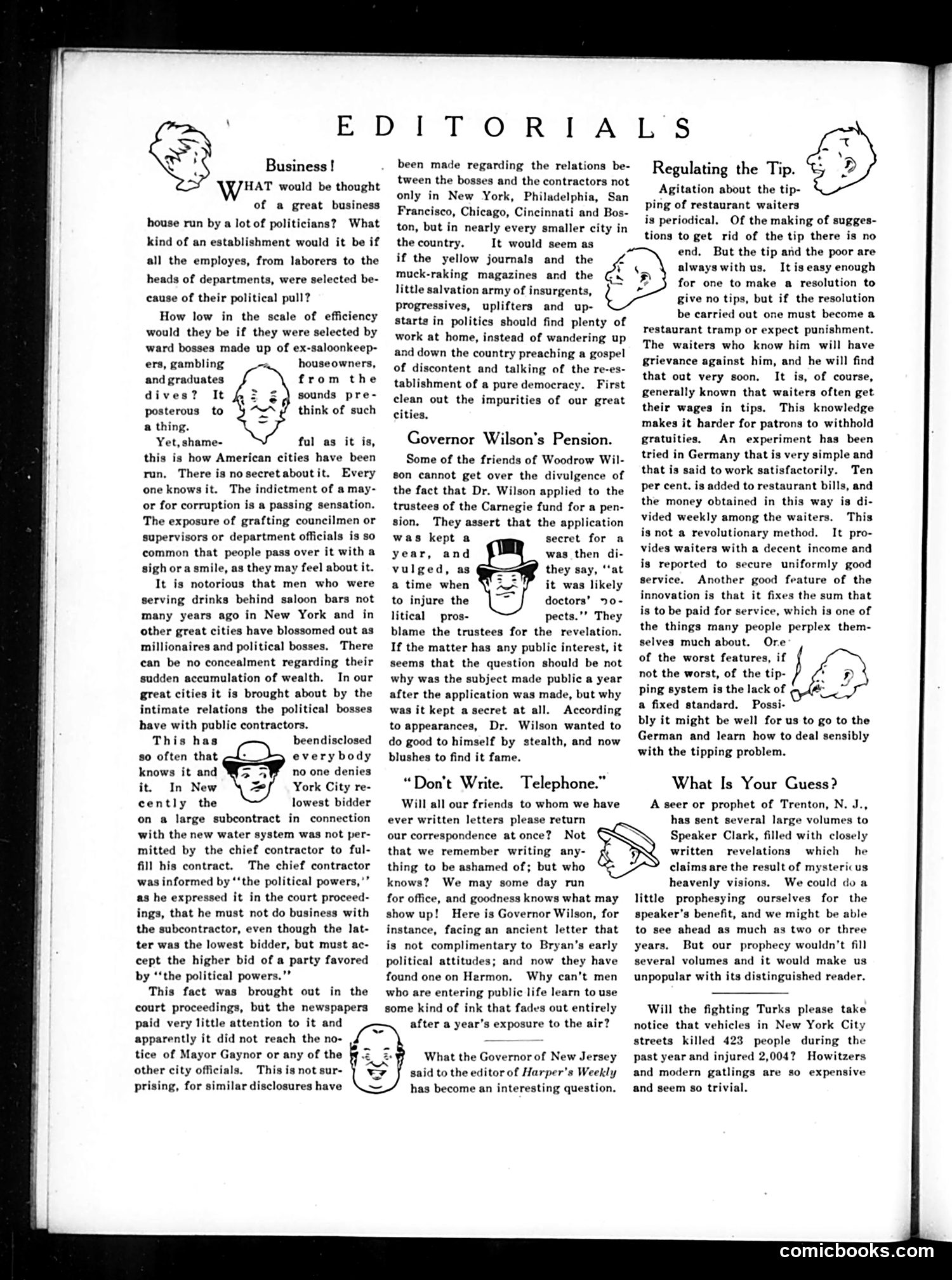
This page comprises four separate editorials with accompanying caricatures rather than integrated political cartoons. **"Business!"** critiques how American cities are run by politicians selecting employees based on patronage rather than merit—from laborers to department heads. The satire emphasizes corruption and inefficiency plaguing municipal government. **"Governor Wilson's Pension"** discusses Woodrow Wilson's application to Carnegie trustees for a pension, suggesting he sought secrecy to avoid damaging his reputation. The piece questions why this wasn't made public. **"Don't Write. Telephone."** appears to reference Governor Wilson again, sarcastically suggesting politicians use phones instead of letters to avoid written records of potentially embarrassing communications. **"Regulating the Tip"** and other brief items address social customs and current events, though their specific references remain unclear without additional context.
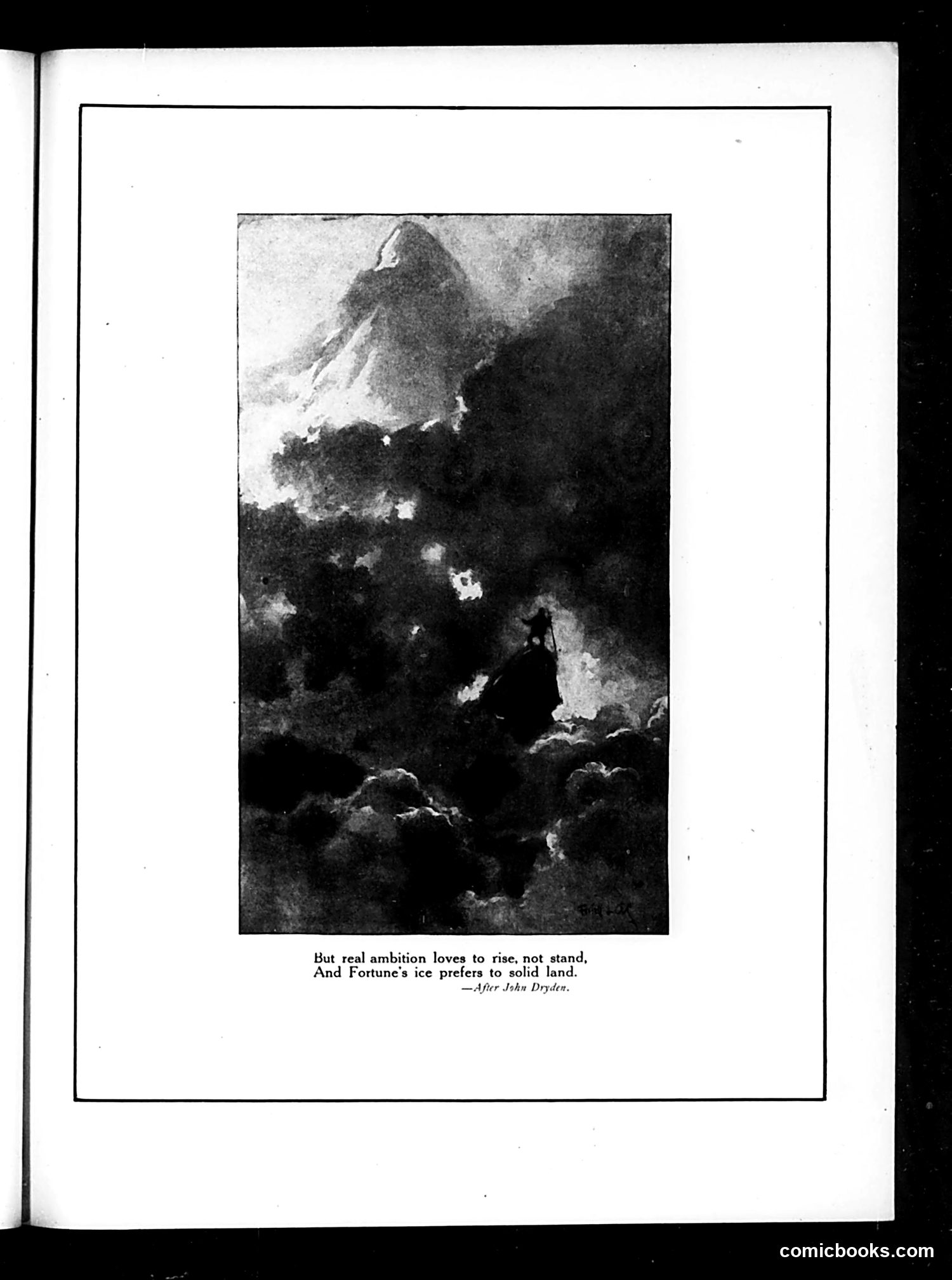
This page from *Judge* magazine features a dramatic illustration depicting a mountainous, cloudy landscape with a solitary figure silhouetted against towering peaks and mist. The accompanying quote—"But real ambition loves to rise, not stand, / And Fortune's ice prefers to solid land"—is attributed to "After John Dryden." The image appears to be a *visual metaphor* for ambition and striving, showing a figure attempting to ascend treacherous, icy mountain terrain. The quote suggests that true ambition requires constant upward movement rather than stagnation, and that fortune favors those who pursue difficult goals. Without additional context or captions identifying specific political figures or events, this seems to be a *general satirical commentary* on ambition, aspiration, and the pursuit of success—themes *Judge* frequently addressed through allegorical imagery rather than direct political caricature.
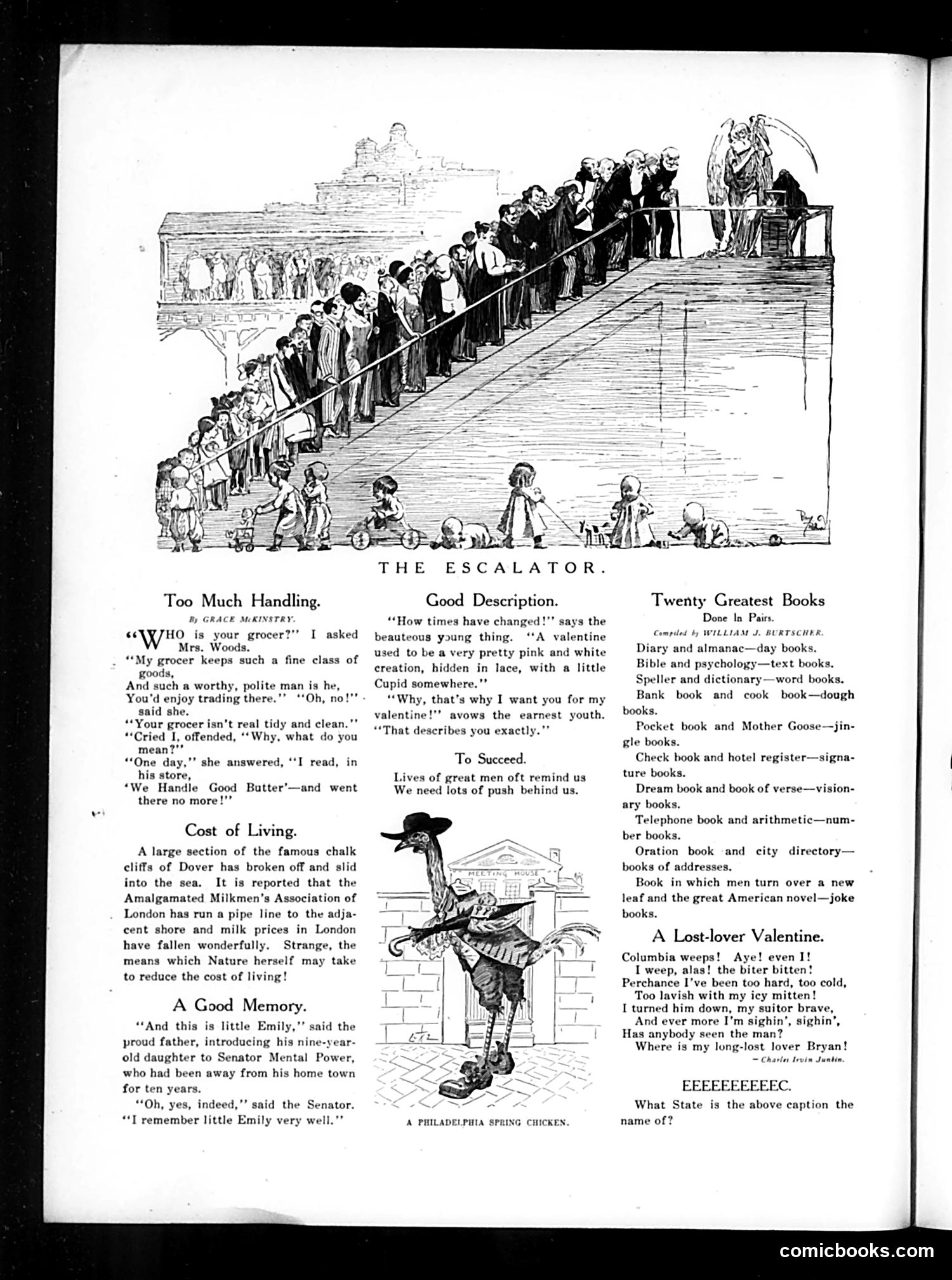
This page from **Judge** (an American satirical magazine) contains several brief humor pieces and illustrations typical of early-20th-century society satire: **"Too Much Handling"** mocks grocery store advertising language—the joke being that a grocer's sign reading "We Handle Good Butter" inadvertently suggests he's been touching the product excessively, deterring the customer. **"Cost of Living"** is absurdist commentary on rising milk prices, joking that a Dover cliff collapse creating a "natural" milk shortage paradoxically lowered London prices. **"The Escalator"** illustration shows a long queue of people ascending, likely satirizing crowded urban conditions or consumerism. **"A Lost-lover Valentine"** parodies a heartbroken woman's lament, apparently referencing **William Jennings Bryan** (the politician), though the exact satirical point remains unclear without publication date context. The page also includes miscellaneous short humor items and a "Twenty Greatest Books" list pairing concepts humorously (e.g., "Bank book and cook book—dough books").
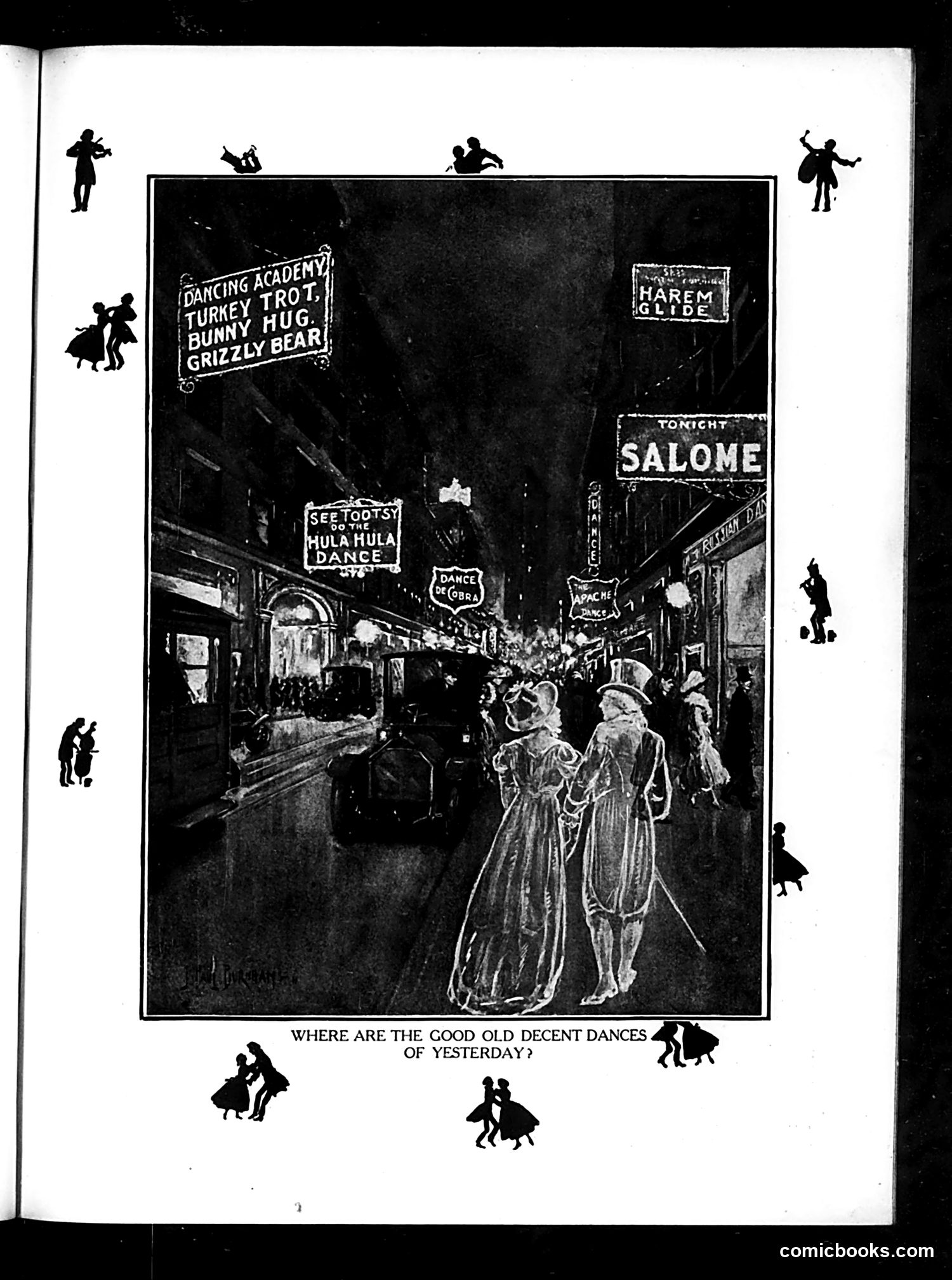
This Judge magazine cartoon satirizes the decline of "decent" social dancing. The central image depicts a crowded nightclub street scene with multiple marquees advertising modern dances: "Dancing Academy! Turkey Trot, Bunny Hug, Grizzly Bear," "See Tootsy in Hula Hula Dance," "Salome," and "Apache Dance." The two elegantly-dressed women in the foreground—drawn in sharp contrast to the chaotic scene—represent traditional society lamenting this change. Their formal attire and questioning caption suggest nostalgia for Victorian-era ballroom dancing. The satire targets early 1900s anxieties about "ragtime" dances (Turkey Trot, Bunny Hug, etc.), which were considered scandalously modern, sexually suggestive, and socially improper by conservative Americans. The decorative dancing silhouettes framing the page emphasize the era's dance-obsessed culture. This reflects genuine moral panic among older generations about changing social mores.
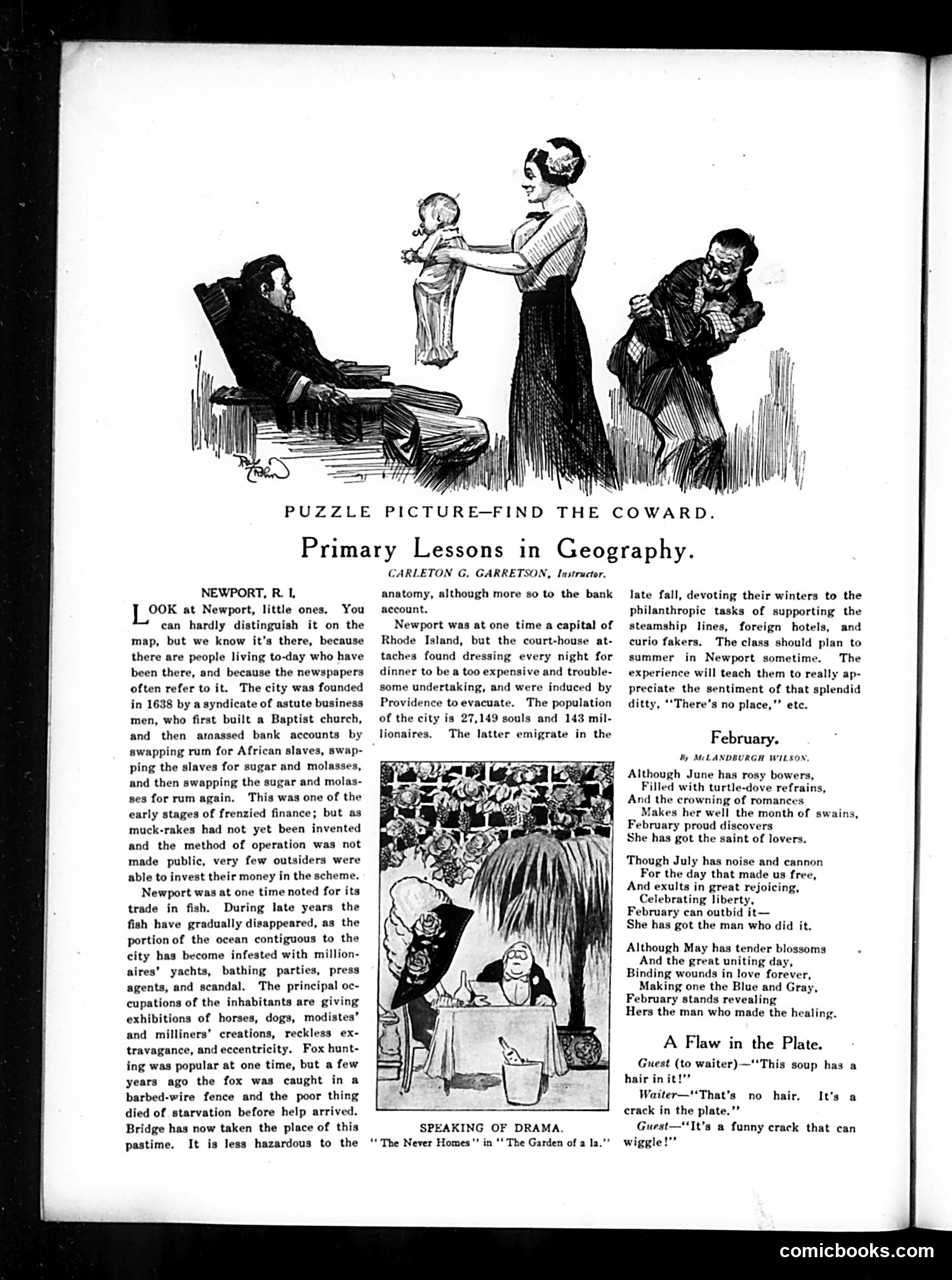
**The Puzzle Picture (top):** This sketch depicts a domestic scene where a man sits passively at a desk while a woman manages a child and another man carries a baby. The caption "Find the Coward" sarcastically identifies the seated man as cowardly for his passivity—likely a jab at men avoiding domestic responsibilities or failing to assist their wives with childcare and household management. **The Geography Section:** Judge uses humor to mock Newport, Rhode Island's wealthy elite. The text reveals satire about the city's origins in the slave trade ("swapping rum for African slaves") and critiques contemporary wealthy residents' frivolous activities: yacht ownership, extravagant spending, and scandal. The sarcastic tone suggests Newport's "millionaires" contribute little of value, merely supporting steamship lines and foreign hotels through conspicuous consumption. **Context:** This reflects late-19th-century American class consciousness and satire targeting the newly wealthy Gilded Age elite, particularly those at fashionable resort destinations.
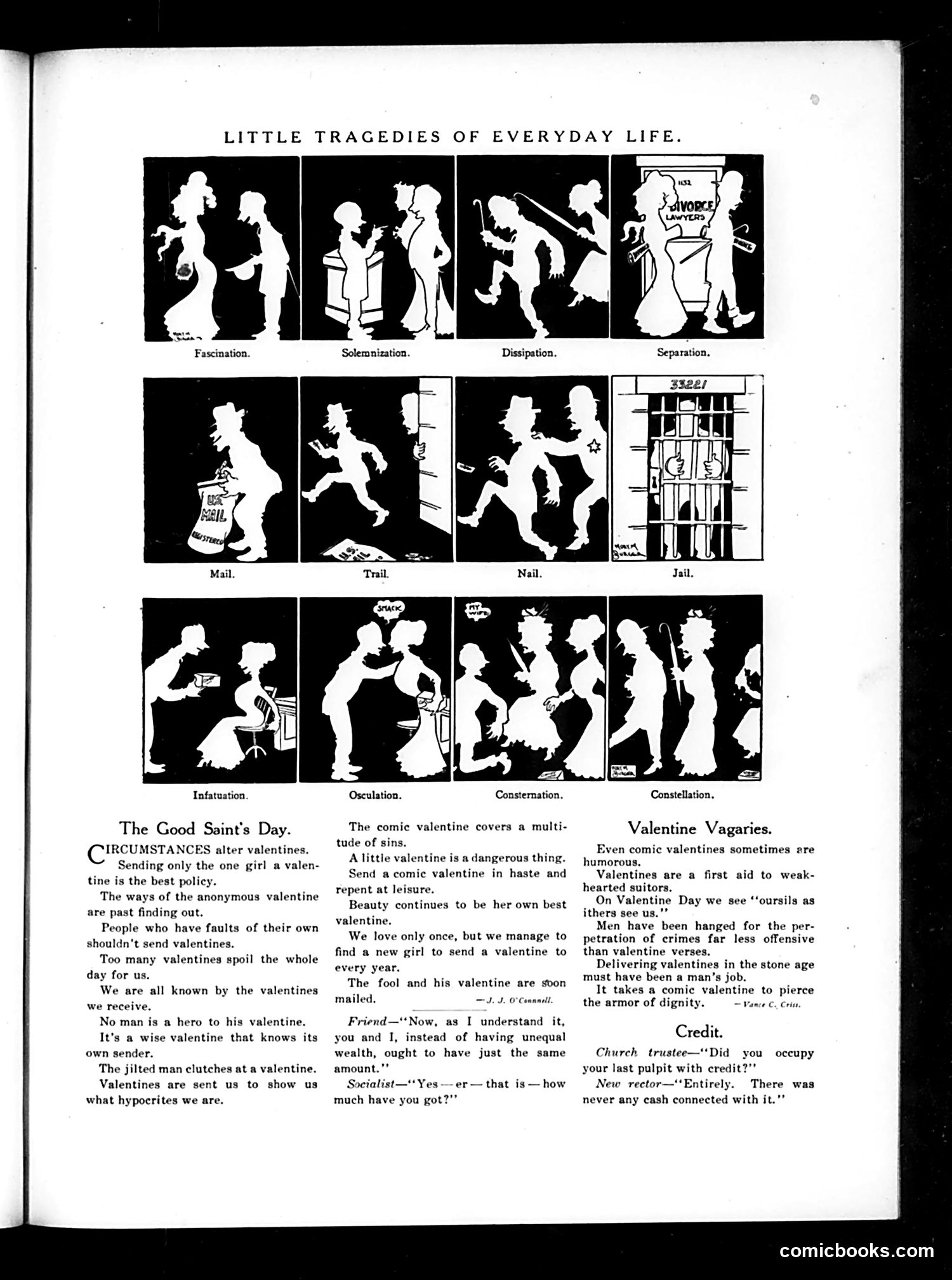
This page mocks Valentine's Day customs through silhouette vignettes labeled with romantic stages ("Fascination," "Infatuation," "Osculation," etc.) that humorously chart relationship trajectories—culminating in "Jail" and "Separation," suggesting romance inevitably ends badly. The accompanying aphorisms satirize insincere valentine practices: anonymous senders, hypocritical declarations, and the commercialization of romance. One joke skewers socialist ideology through a dialogue where a Socialist advocates wealth equality, then asks "how much have you got?"—exposing hypocrisy about redistribution. A separate "Credit" joke plays on double meaning: a new church rector claims he brought "credit" to his pulpit because no actual money was involved—mocking both clerical poverty and financial dishonesty. The overall message: Valentine's Day reveals human pretense and shallow sentiment. The medium (crude silhouettes) underscores the foolishness of romantic posturing.
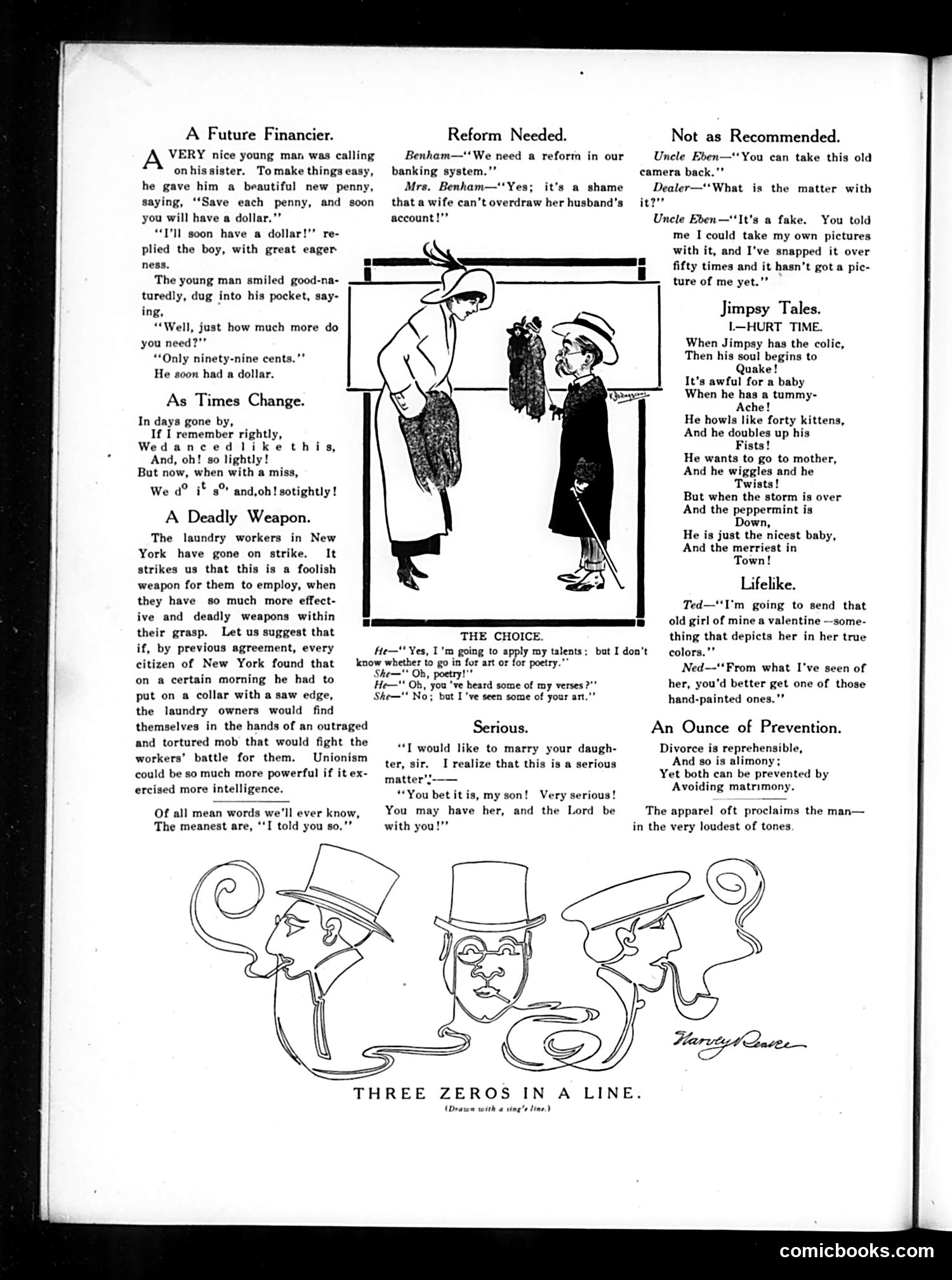
This page contains multiple short humor pieces typical of early 20th-century satirical magazines: **"A Future Financier"** mocks children's financial naïveté—a boy asks for ninety-nine cents to complete a dollar, revealing he doesn't understand the concept. **"Reform Needed"** jokes about wives' limited financial autonomy; a Mrs. Benham wishes she could overdraw her husband's bank account, satirizing marital financial control. **"A Deadly Weapon"** critiques a New York laundry workers' strike as ineffective, suggesting they'd gain more sympathy if workers wore shirts with sharp collars, forcing owners to experience discomfort. **"As Times Change"** compares old-fashioned loose dancing to modern tight dancing. Smaller pieces include "The Choice" (talent vs. practicality), "Serious" (father's grim approval of suitor), "Not as Recommended" (defective camera), and various light verse about children and relationships. **"Three Zeros in a Line"** shows three caricatured faces in profile—likely representing notable figures, though specific identities aren't indicated. The overall tone reflects period attitudes toward gender, labor, and social conventions.
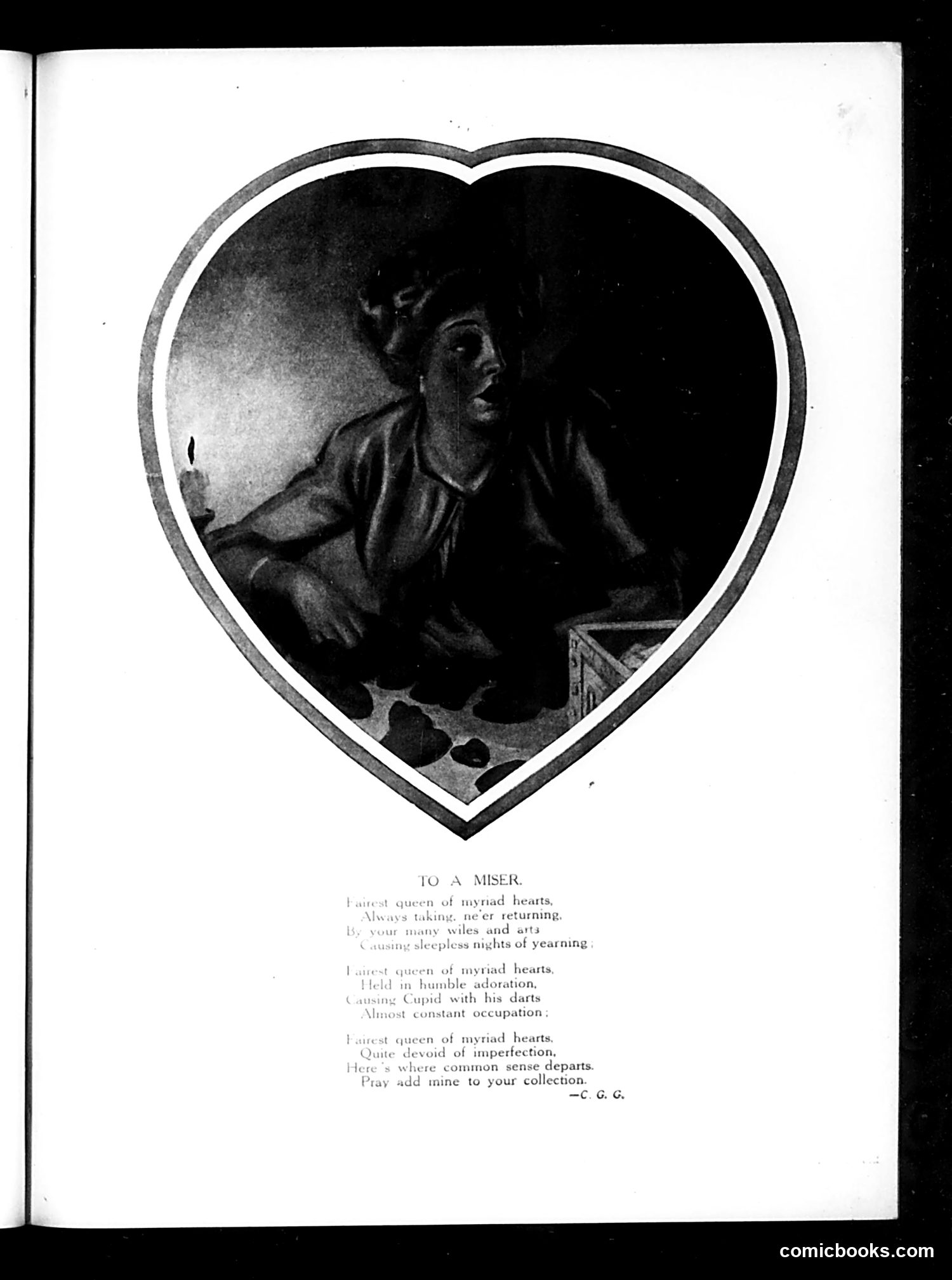
This page presents a poem titled "To a Miser," illustrated with a heart-shaped vignette showing a figure hunched over money or valuables in darkness. The poem satirizes miserliness through repeated invocations of "fairest queen of myriad hearts"—addressing the miser's obsession with wealth as if it were romantic love. The satire works by treating financial greed as absurd devotion: the miser causes "sleepless nights of yearning" in others through his hoarding, holds wealth "in humble adoration," and is "quite devoid of imperfection" only in his single-minded pursuit of money. The final couplet mocks this, inviting the miser to add the poet's heart to his collection—suggesting he values hearts only as economic assets. The satirist is C.G.G. (initials only visible).
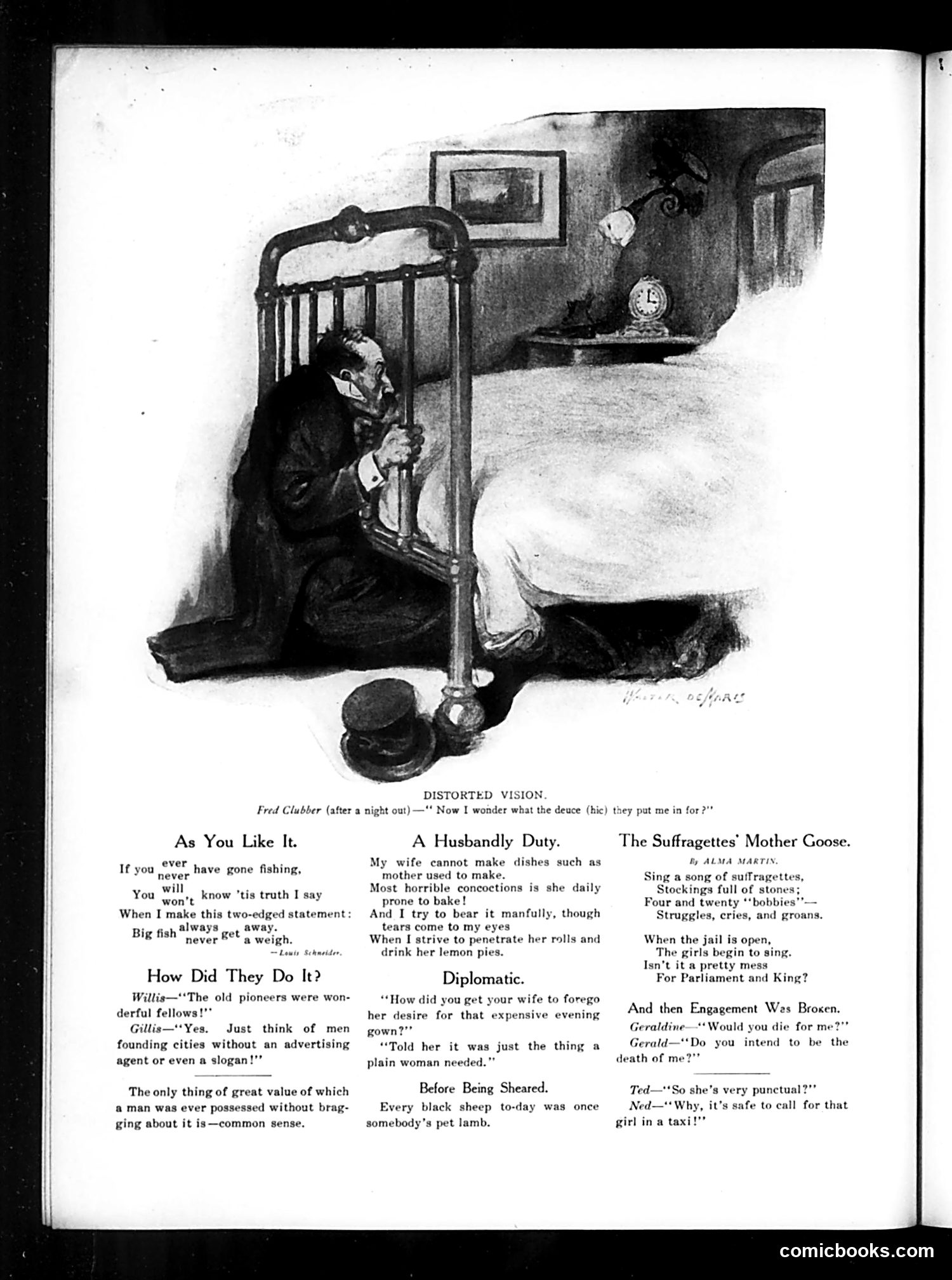
This page contains multiple satirical pieces reflecting early 20th-century American social anxieties: The main cartoon, "Distorted Vision," depicts a drunk man (Fred Clubber) wondering why he was arrested—the satire targets excessive drinking and its consequences. The text pieces mock contemporary social issues: "A Husbandly Duty" jokes about wives' poor cooking skills; "The Suffragettes' Mother Goose" satirizes the women's suffrage movement, portraying suffragettes as troublemakers whose activism disrupts society and results in jail time—reflecting anti-suffrage sentiment of the era. Other brief jokes target advertising's role in modern society, question how pioneers succeeded without marketing, and make conventional observations about common sense and character. The overall tone reflects conservative attitudes skeptical of social change, particularly women's political activism, while celebrating "traditional" values and social order.
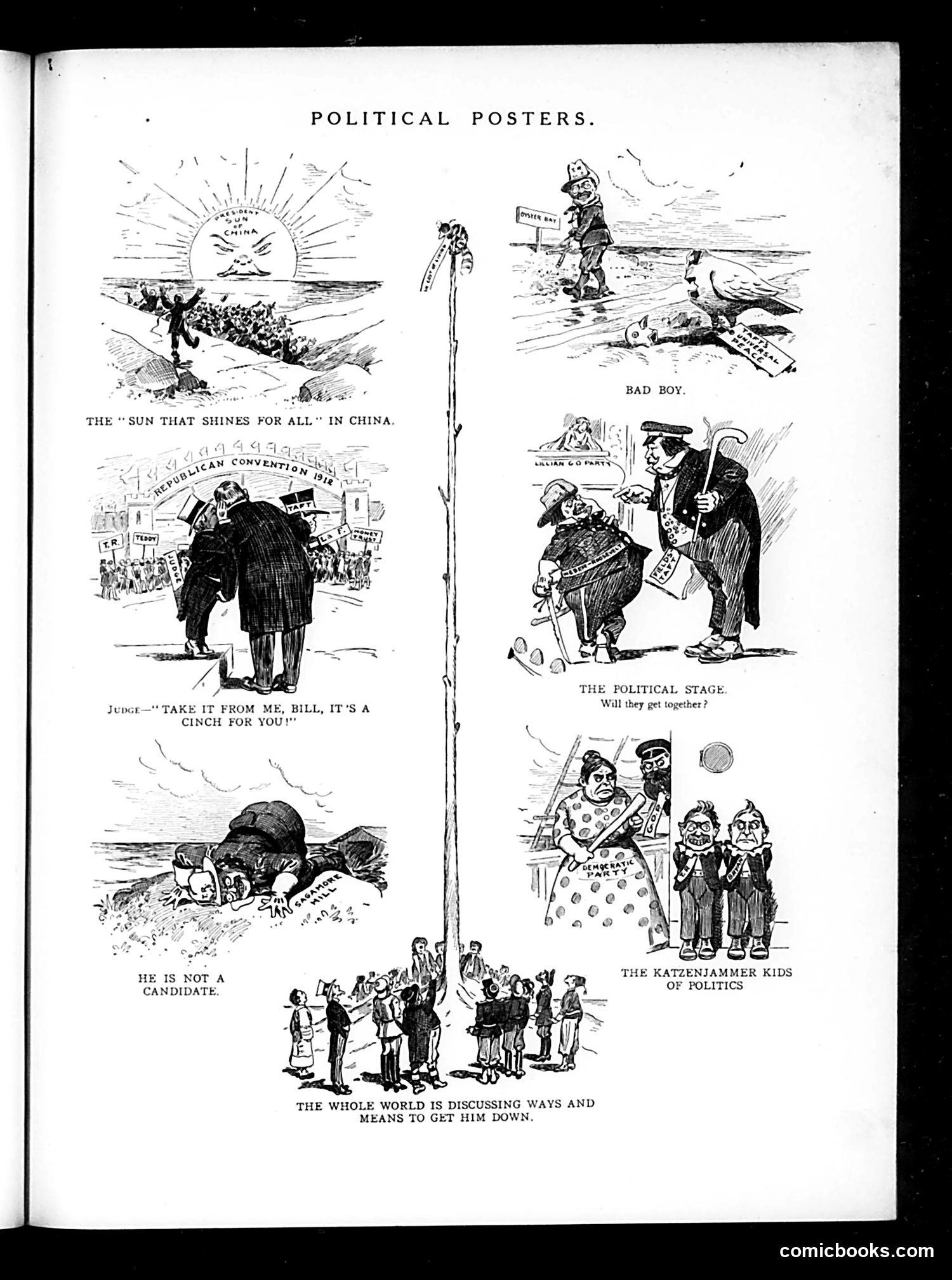
This Judge magazine page collects satirical cartoons mocking political figures and international affairs, likely from the 1912 election era. **Top left**: "The Sun That Shines for All in China" depicts Western powers (represented by a rising sun over China) exploiting Chinese resources while crowds below scramble for scraps—critiquing imperial intervention. **Judge and Bill cartoon**: References a specific political deal or inside arrangement, suggesting corrupt backroom politics. **"Bad Boy"**: Shows a figure being disciplined, likely referencing a political figure's misconduct or scandal. **"The Political Stage"**: Questions whether rival politicians will cooperate or compete. **"He Is Not a Candidate"**: A dead figure labeled "Not a Candidate"—dark satire suggesting someone's political viability is finished. **"Katzenjammer Kids of Politics"**: References the popular comic strip to mock politicians behaving like undisciplined children. **Bottom**: "The Whole World Is Discussing Ways and Means to Get Him Down"—likely depicts a prominent political figure facing international or domestic opposition seeking his defeat.
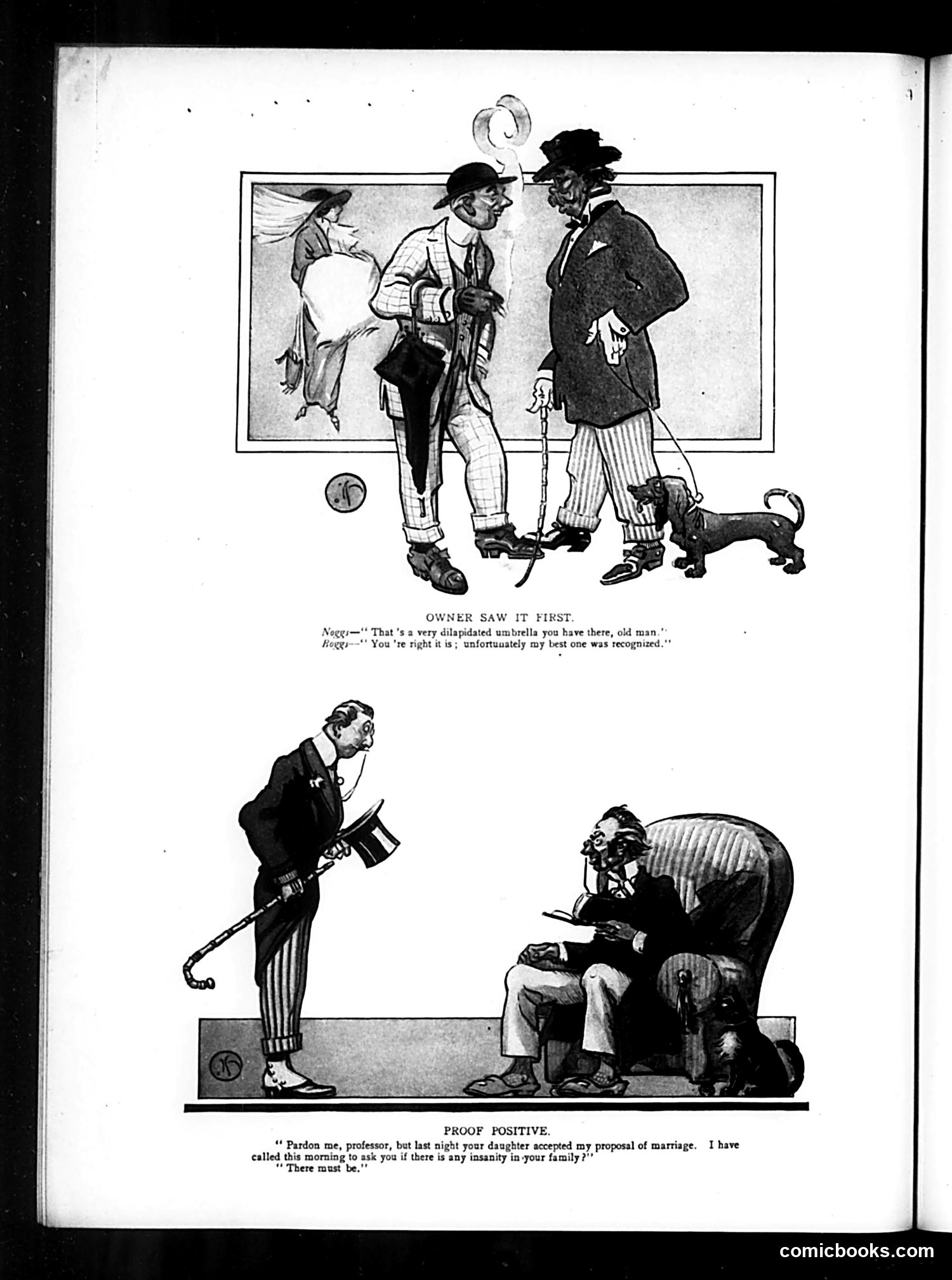
This page contains two satirical cartoons mocking social conventions of the era. **"Owner Saw It First"** jokes about umbrella theft. Two characters discuss a shabby umbrella; one notes his "best one was recognized"—implying he deliberately carries a worn umbrella in public to avoid it being stolen, since thieves wouldn't bother with obviously worthless items. The humor targets the prevalence of theft in urban society. **"Proof Positive"** satirizes marriage proposals and class anxiety. A suitor asks a father whether insanity runs in the family after the daughter accepted his proposal. The father's reply—"There must be"—suggests the daughter must be mentally unsound to accept such a proposal, likely implying the suitor is of lower social status or otherwise unsuitable. The cartoon mocks both paternal concern about daughters' marriage choices and the suitor's audacious questioning.
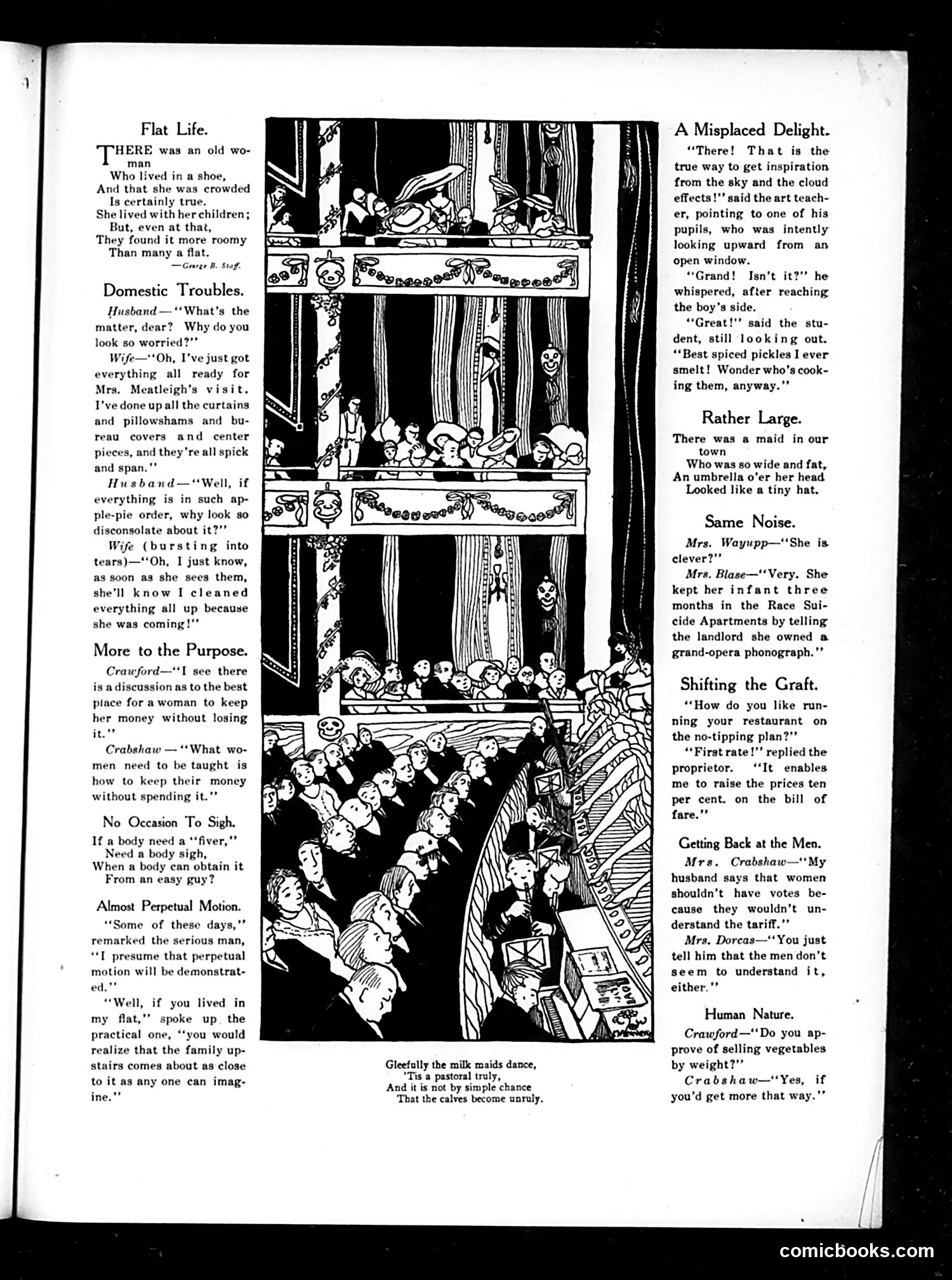
This page from *Judge* contains multiple short satirical pieces targeting early 20th-century domestic and social life: **"Flat Life"** mocks cramped urban apartment living, contrasting it unfavorably with the nursery rhyme's crowded shoe. **"Domestic Troubles"** satirizes wives' anxiety about impressing visiting women—the wife's worry that her guest will *know* she cleaned specifically for the visit undermines the effort itself. **"More to the Purpose"** and other quips mock gender relations: women's spending habits, men's financial naiveté, and class dynamics (the "easy guy" lending money). **"A Misplaced Delight"** jokes about artistic pretension versus practical concerns—the student admires the sky while actually smelling cooking food. **"Same Noise"** references "Race Suicide Apartments"—period anxieties about declining birth rates—used as a deceptive rental claim. **"Getting Back at the Men"** presents a proto-feminist joke: women voting rights debates, with the punchline that men understand tariffs no better than women do. The central wood-engraved panel shows a crowded theater or public venue, illustrating urban density themes.
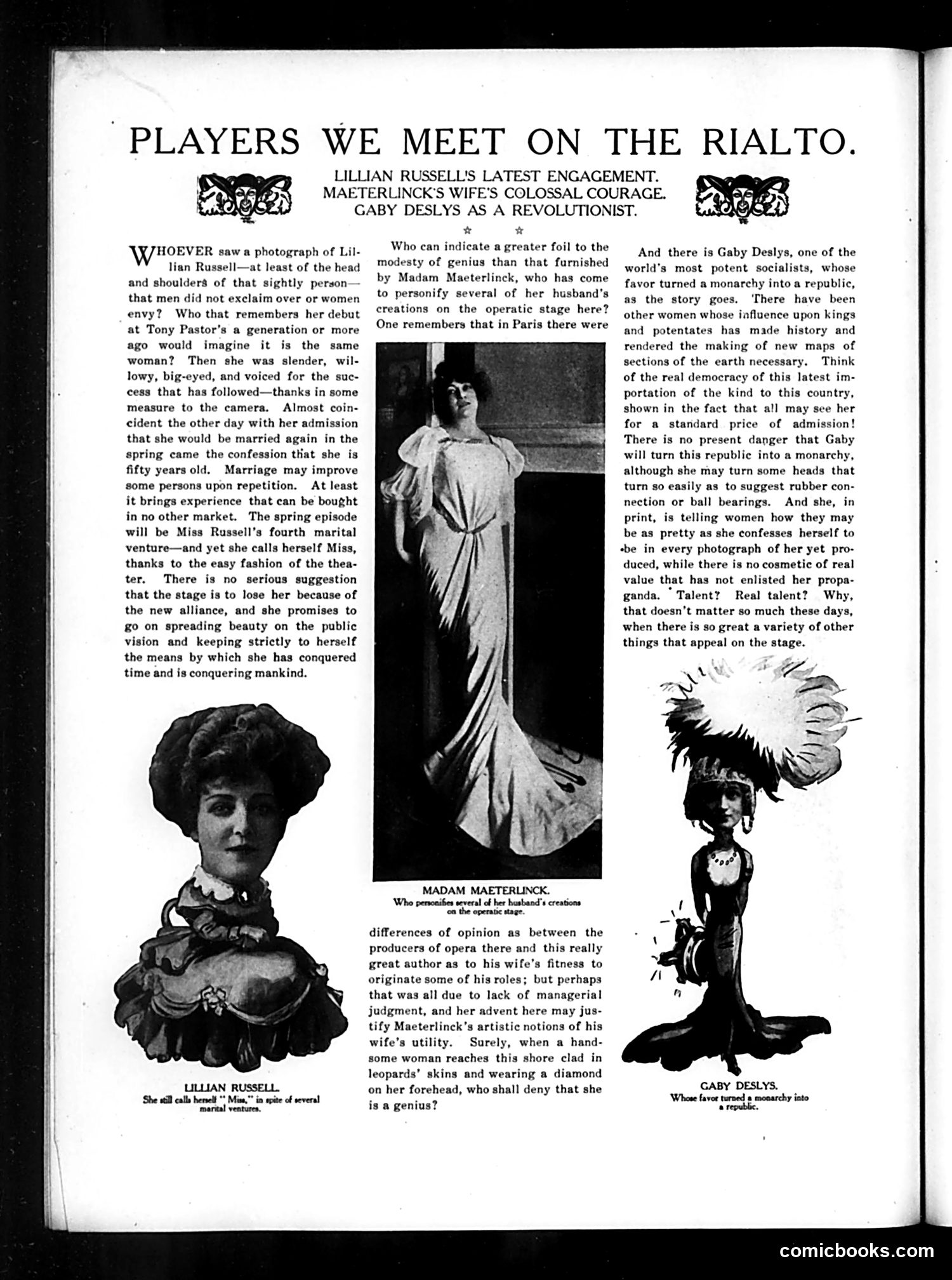
This page mocks three famous stage performers of the early 1900s. **Lillian Russell**, the aging actress, is ridiculed for claiming to be fifty years old while seeking her fourth marriage—the satire questions how she's maintained her beauty and public image through repeated "marital ventures." **Madame Maeterlinck** is satirized for her husband (Belgian playwright Maurice Maeterlinck) casting her in his operatic works despite Parisian producers' doubts about her talent; the text sarcastically suggests wearing leopard skins and a diamond forehead jewel proves genius. **Gaby Deslys**, a French entertainer, is mocked for her rumored affair with a king (implied to have caused political upheaval—"turned a monarchy into a republic"). The satire suggests her fame rests entirely on scandal and beauty products, not actual theatrical talent, and warns she could dangerously influence American men's heads. The overall joke: these celebrated performers succeed through appearance, scandal, and marketing rather than genuine artistic merit—a critique of celebrity culture masking mediocrity.
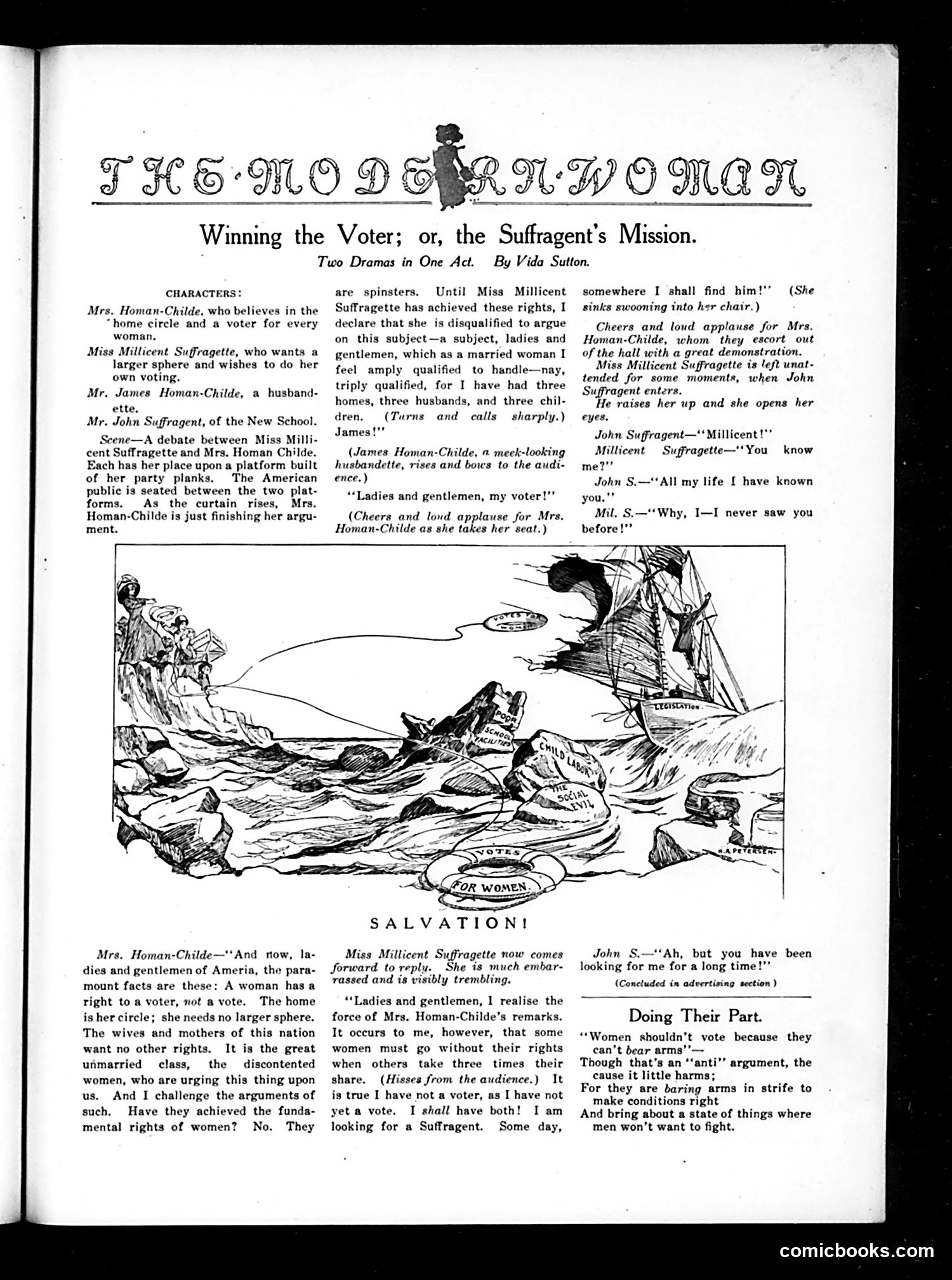
This is a satirical one-act play from *Judge* magazine mocking the women's suffrage debate. The cartoon depicts two opposing female characters debating voting rights before an audience (the American public). **Mrs. Homan-Childe** represents the anti-suffrage position: she argues women shouldn't vote because they achieve power through marriage and motherhood. She literally presents her "meek-looking" husband as her credential to speak on voting—he's called her "voter," implying women vote *through* men. **Miss Millicent Suffragette** represents the pro-suffrage position but is portrayed as trembling and needy—she faints and must be rescued by "John Suffragent" (a pun on "suffragist"), undermining her argument for independence. The satire ridicules *both sides*: anti-suffragists as dependent on husbands, and suffragists as dramatic and helpless. The bottom caption sarcastically notes women "baring arms" (rolling up sleeves) for social change while supposedly unable to bear weapons—a common anti-suffrage argument. The illustration shows chaos and shipwreck imagery labeled "VOTES FOR WOMEN," suggesting the debate itself is destructive.
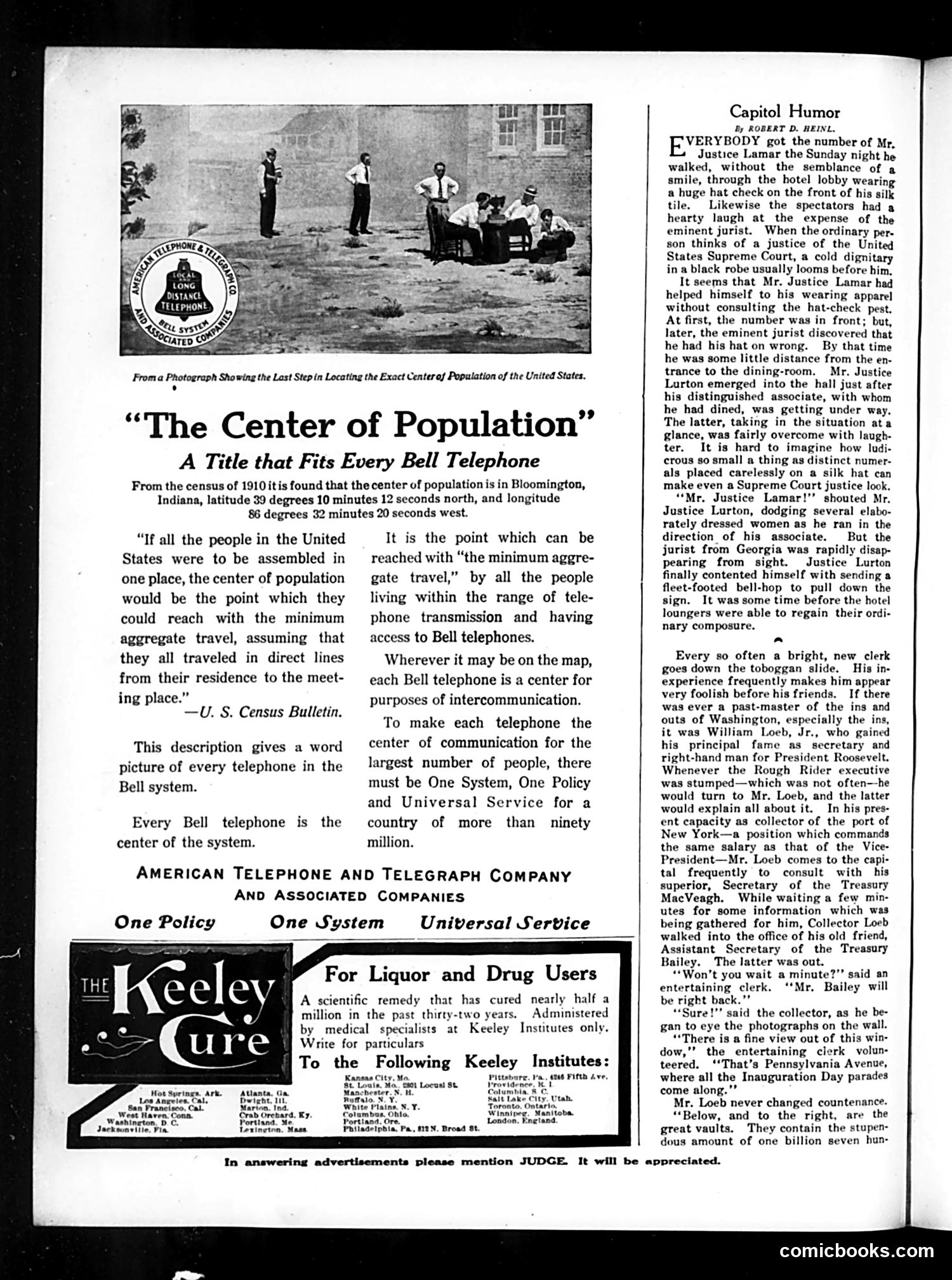
This is a humorous anecdote about Supreme Court Justice Lamar, who accidentally walked through a hotel lobby wearing a hat-check ticket on the front of his formal silk top hat. The joke exploits the incongruity of a dignified federal judge looking ridiculous due to this small mishap. When Justice Lurton (another justice) spotted Lamar with the numbered ticket prominently displayed, he laughed so hard he chased after him through the lobby to alert him. The humor lies in how a minor wardrobe error can make even an august legal authority appear foolish—the satire gently mocks the pretentiousness of Supreme Court dignity by showing it can be undermined by something as trivial as a hat-check number. The page also contains extensive advertising, including Bell Telephone's "Center of Population" campaign and a Keeley Institute advertisement for addiction treatment.
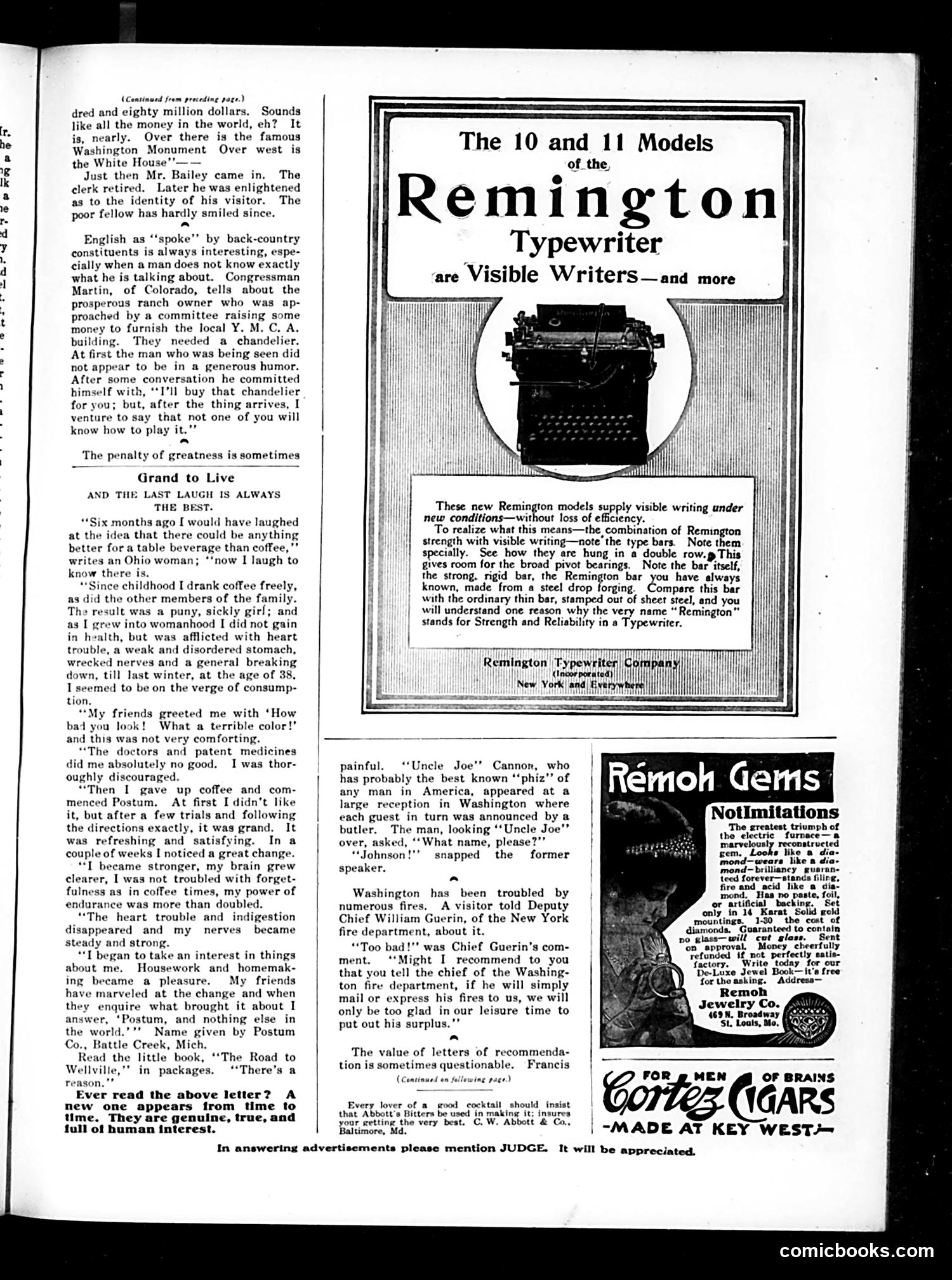
This page is primarily **advertising and testimonial content**, not political satire. The main elements are: **Remington Typewriter Ad** (center): Promotes Models 10 and 11 as "Visible Writers," emphasizing engineering features—double-row type bars and rigid construction—as proof of "Strength and Reliability." **Postum Advertisement** (left): A testimonial from an Ohio woman claiming coffee caused her lifelong health problems (sickly appearance, heart trouble, weak nerves) that vanished after switching to Postum, a caffeine-free coffee substitute. This represents typical early-1900s patent medicine advertising exploiting health anxieties. **Minor References**: The text mentions Congressman Martin of Colorado and "Uncle Joe" Cannon (Speaker of the House), but these appear in anecdotal stories unrelated to satire—one about misunderstanding a "chandelier" as a musical instrument. **Bottom Ad**: Cortez Cigars advertisement. This appears to be a standard Judge issue mixing light humor with commercial advertising rather than featuring political cartoons or satire.
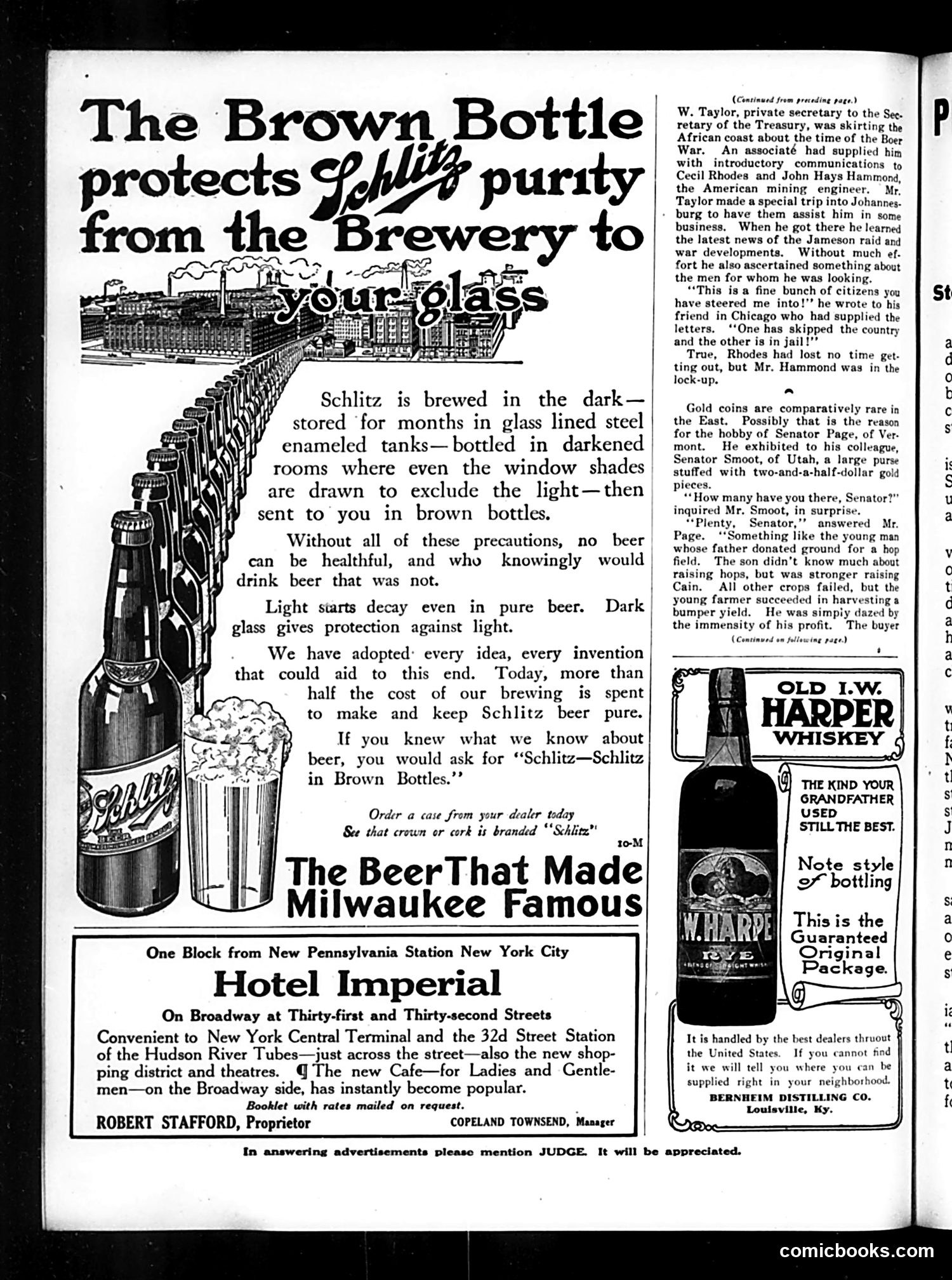
This page is primarily **advertising** rather than satirical cartoons. The dominant content is a Schlitz beer advertisement emphasizing that brown bottles protect beer from light decay—a legitimate early 20th-century brewing concern (light exposure does degrade beer). The ad claims Schlitz's purity protection justifies its cost. The right column contains **editorial text** (continued from a previous page) featuring anecdotes about American politicians and businessmen. One story describes Secretary of Treasury aide W. Taylor encountering Cecil Rhodes and John Hays Hammond during the Boer War era; another recounts Senator Page showing Senator Smoot a purse of rare gold coins while joking about a farmer's accidental success growing hops for alcohol rather than agricultural crops. A secondary advertisement for **Old I.W. Harper Whiskey** appears in the bottom right, marketed as "the kind your grandfather used." The content reflects turn-of-the-century American politics and social humor but contains **no identifiable political cartoons or satire**—primarily commercial messaging.
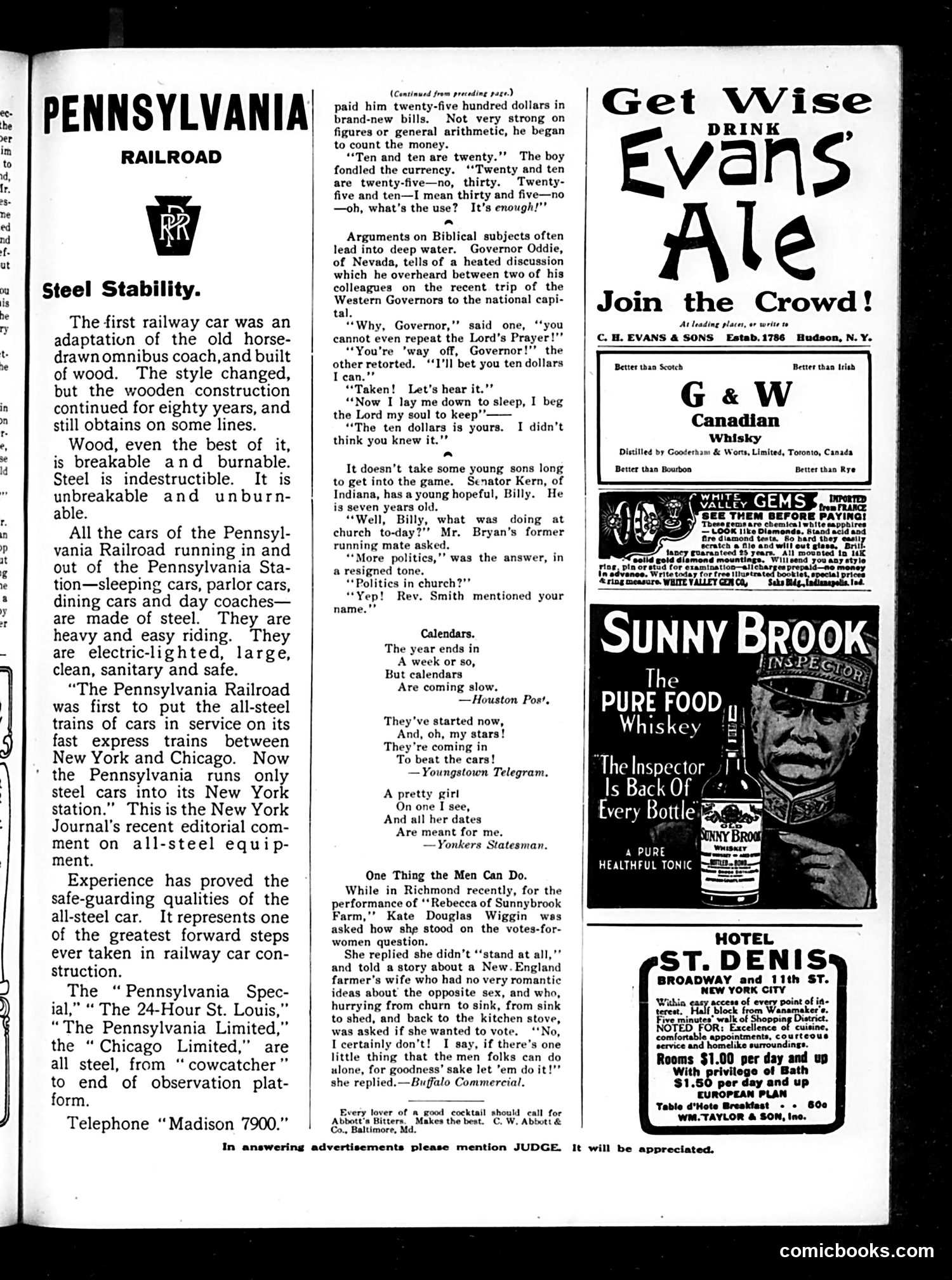
This page is primarily **advertising and editorial content** rather than political satire. The main feature is a Pennsylvania Railroad advertisement celebrating all-steel train cars as superior to wooden construction—emphasizing safety, durability, and modernity. This reflects early 20th-century industrial progress marketing. The remaining text consists of humorous anecdotes and light verse. Notable items include: - A joke about a boy struggling to count money - Governor Oddie's anecdote about two colleagues disputing whether one can recite the Lord's Prayer (he mistakenly quotes "Now I lay me down to sleep," a children's bedtime prayer, and loses a bet) - Brief poems about calendars and pretty girls - An anti-suffrage anecdote featuring author Kate Douglas Wiggin, where a New England farm wife argues men should have *at least one thing* they can do alone—voting—implying women shouldn't vote The suffrage reference reflects the contentious women's voting rights debate of the early 1900s-1920s era.
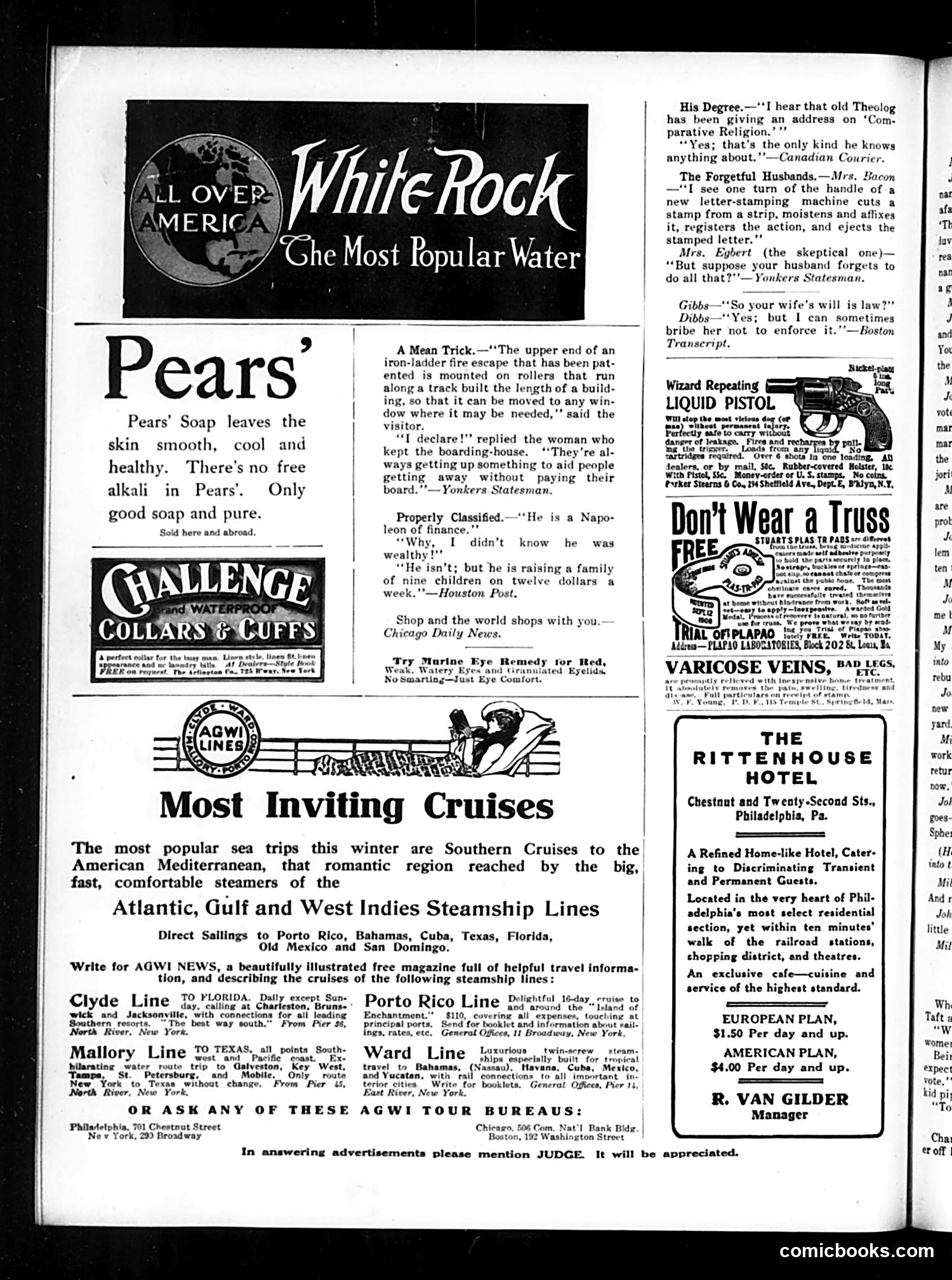
This is primarily an **advertising page** with several short humorous anecdotes sprinkled throughout. The jokes satirize everyday domestic and social situations: - **"His Degree"**: Mocks a theology professor whose only expertise is comparative religion—suggesting limited intellectual range. - **"The Forgetful Husbands"**: A woman jokes that a new letter-stamping machine won't help absent-minded husbands forget steps. - **"A Mean Trick"**: A boarding-house keeper uses a mobile fire escape as an excuse to help deadbeat tenants escape without paying rent—satirizing landlord-tenant tensions. - **"Properly Classified"**: Humor about a man called a "Napoleon of finance" who merely stretches twelve dollars weekly to support a large family—mocking pretentious labels. The majority of the page consists of advertisements for cruise lines (Clyde, Mallory, Ward Lines), the Rittenhouse Hotel, Pears' Soap, and medical products. The content reflects early 20th-century consumer culture and leisure travel marketing.
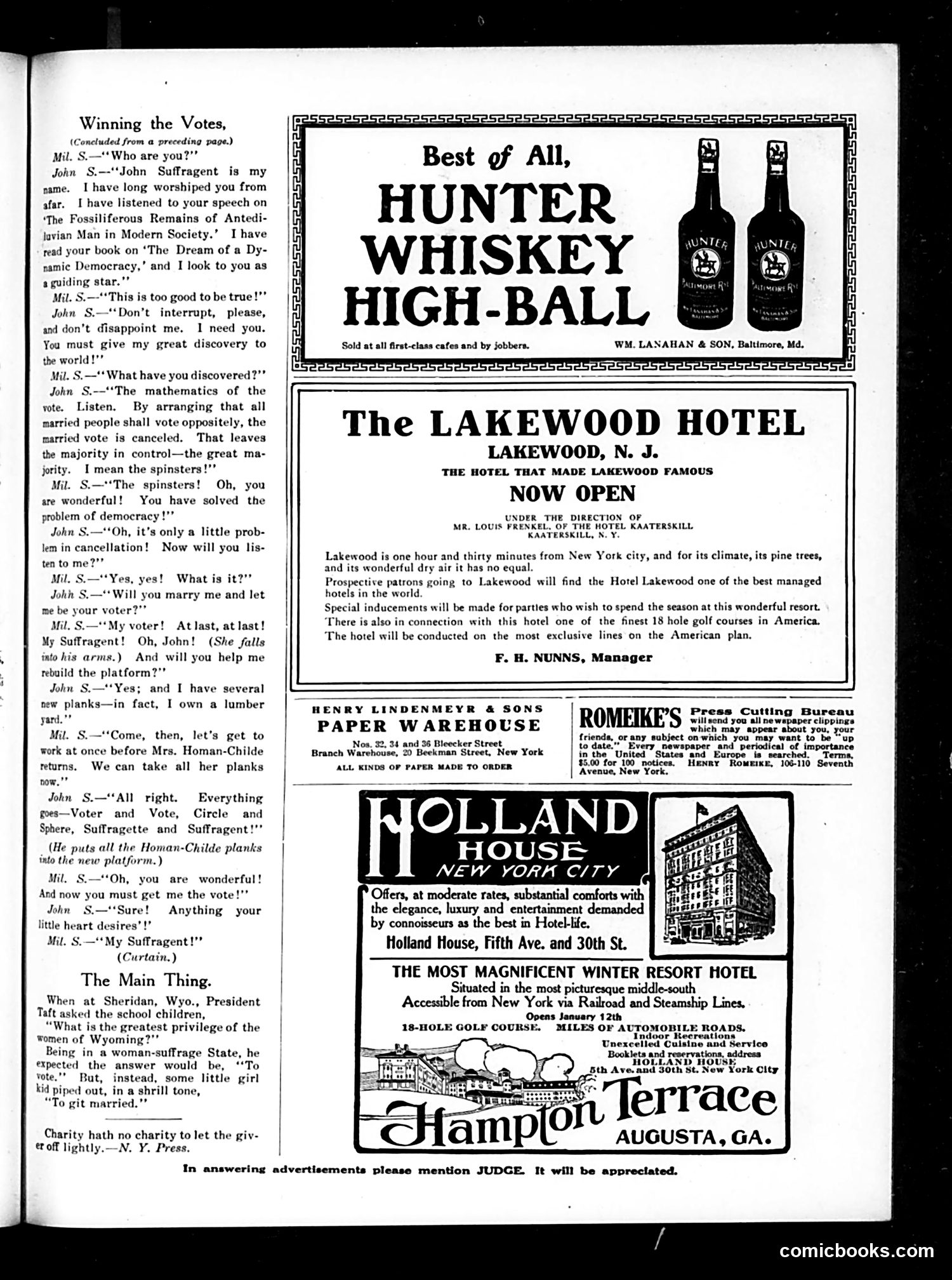
This multi-panel comic satirizes early women's suffrage movements. A character named "John Suffragent" (a pun on "suffrage") proposes to female activist "Mil. S." by claiming he's solved democracy through mathematics: if married couples vote oppositely, their votes cancel, leaving "spinsters" in control—a absurd premise mocking suffragists' reasoning. The joke equates women's political ambitions with romantic desperation. When asked what Wyoming women value most, a girl replies "to git married" rather than voting rights, suggesting women activists' true motivations are matrimonial, not political. The satire presents suffragists as intellectually confused ideologues whose movement is ultimately frivolous. The page is otherwise filled with hotel and whiskey advertisements, typical of Judge's commercial content from this era.