
Judge, 1912-02-03 · page 4 of 23
Judge — February 3, 1912 — page 4: what you’re looking at
What you’re looking at
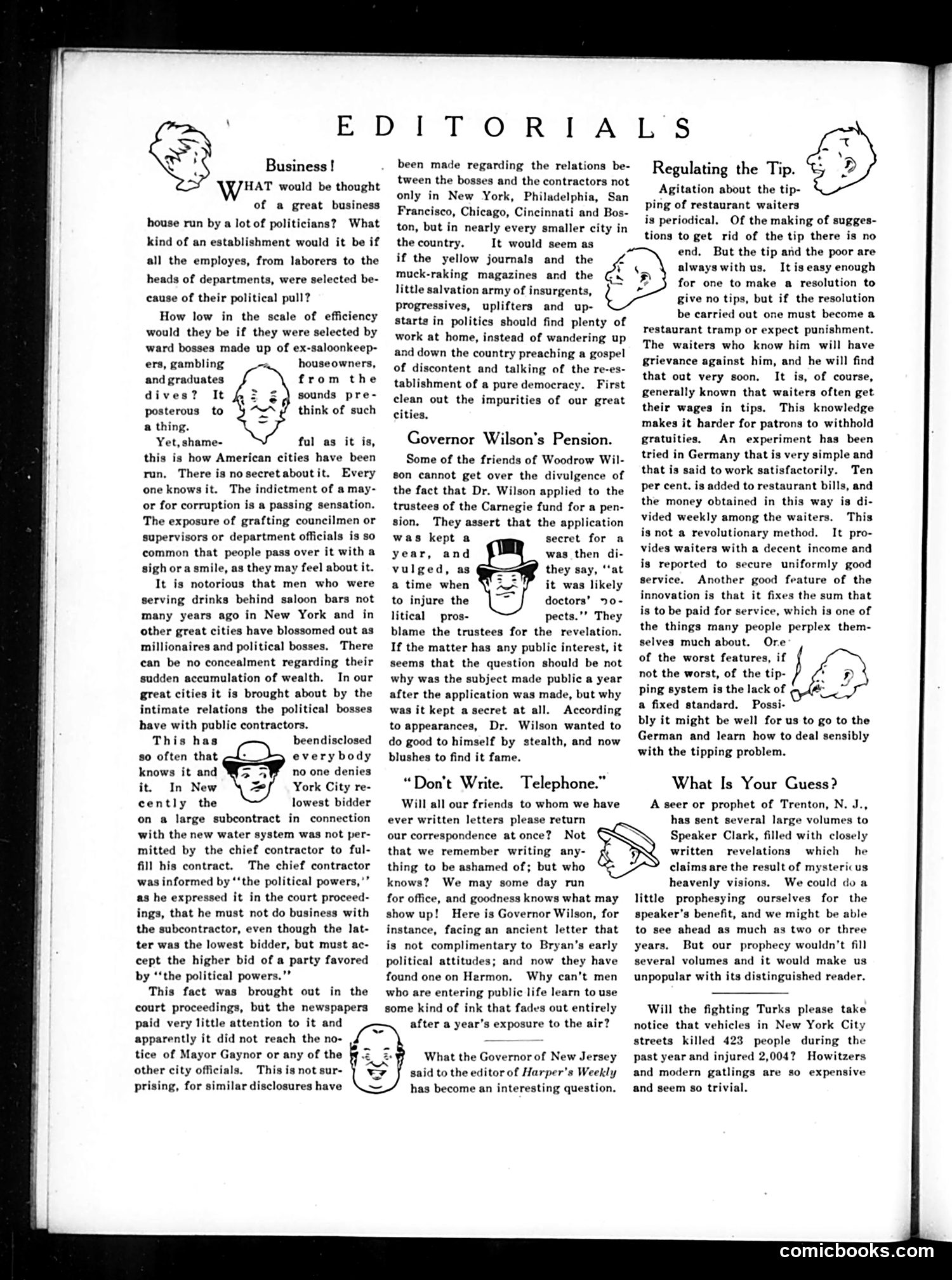
This page comprises four separate editorials with accompanying caricatures rather than integrated political cartoons. **"Business!"** critiques how American cities are run by politicians selecting employees based on patronage rather than merit—from laborers to department heads. The satire emphasizes corruption and inefficiency plaguing municipal government. **"Governor Wilson's Pension"** discusses Woodrow Wilson's application to Carnegie trustees for a pension, suggesting he sought secrecy to avoid damaging his reputation. The piece questions why this wasn't made public. **"Don't Write. Telephone."** appears to reference Governor Wilson again, sarcastically suggesting politicians use phones instead of letters to avoid written records of potentially embarrassing communications. **"Regulating the Tip"** and other brief items address social customs and current events, though their specific references remain unclear without additional context.
📄 Transcribed text from this page (OCR, searchable)
Machine-transcribed from the original scan — historical spelling and the odd misread are preserved.
EDT oO RTA LS Business! HAT would be thought of a great business house run by a lot of politicians? What kind of an establishment would it be if all the employes, from laborers to the heads of departments, were selected be- cause of their political pull? How low in the scale of efficiency would they be if they were selected by ward bosses made up of ex-saloonkeep- ers, gambling houseowners, and graduates from the dives? It sounds pre- posterous to think of such a thing. Yet, shame- ful as it is, this is how American cities have been run. There is nosecretaboutit. Every one knows it. The indictment of a may- or for corruption is a passing sensation. The exposure of grafting councilmen or supervisors or department officials is so common that people pass over it with a sigh ora smile, as they may feel about it. It is notorious that men who were serving drinks behind saloon bars not many years ago in New York and in other great cities have blossomed out as millionaires and political bosses, There can be no concealment regarding their sudden accumulation of wealth. In our great cities it is brought about by the intimate relations the political bosses have with public contractors. This has beendisclosed a0 often that -L- > everybody knows it and no one denies it. In New Vey York City re- cently the lowest bidder on a large subcontract in connection with the new water system was not per- mitted by the chief contractor to ful- fill his contract. The chief contractor was informed by ‘‘the political powers,’’ as he expressed it in the court proceed- ings, that he must not do business with the subcontractor, even though the lat- ter was the lowest bidder, but must ac- cept the higher bid of a party favored by ‘‘the political powers.’”” This fact was brought out in the court proceedings, but the newspapers paid very little attention to it and apparently it did not reach the no- tice of Mayor Gaynor or any of the other city officials. This is not sur- prising, for similar disclosures have been made regarding the relations be- tween the bosses and the contractors not only in New York, Philadelphia, San Francisco, Chicago, Cincinnati and Bos- ton, but in nearly every smaller city in thecountry. It would seem as if the yellow journals and the muck-raking magazines and the little salvation army of insurgents, progressives, uplifters and up- starts in politics should find plenty of work at home, instead of wandering up and down the country preaching a gospel of discontent and talking of the re-es- tablishment of a pure democracy. First clean out the impurities of our great cities. Governor Wilson's Pension. Some of the friends of Woodrow Wil- son cannot get over the divulgence of the fact that Dr. Wilson applied to the trustees of the Carnegie fund for a pen- They assert that the application i, sion, was kept a year, and vulged, as a time when to injure the doctors’ 70- litical pros- pects."’ They blame the trustees for the revelation. If the matter has any public interest, it seems that the question should be not why was the subject made public a year after the application was made, but why was it kept asecret at all. According to appearances, Dr. Wilson wanted to do good to himself by stealth, and now blushes to find it fame. “Don’t Write. Telephone.” Will all our friends to whom we have ever written letters please return our correspondence at once? Not that we remember writing any- thing to be ashamed of; but who knows? We may some day run for office, and goodness knows what may show up! Here is Governor Wilson, for instance, facing an ancient letter that is not complimentary to Bryan’s early political attitudes; and now they have found one on Hermon. Why can’t men who are entering public life learn to use some kind of ink that fades out entirely after a year’s exposure to the air? secret for a was then di- they say, ‘‘at it was likely What the Governor of New Jersey said to the editor of Harper's Weekly has become an interesting question. ER Regulating the Tip. Agitation about the tip- ping of restaurant waiters is periodical. Of the making of sugges- tions to get rid of the tip there is no end. But the tip and the poor are always with us. Itis easy enough for one to make a resolution to give no tips, but if the resolution be carried out one must become a restaurant tramp or expect punishment. The waiters who know him will have grievance against him, and he will find that out very soon. It is, of course, generally known that waiters often get their wages in tips. This knowledge makes it harder for patrons to withhold gratuities, An experiment has been tried in Germany that is very simple and that is said to work satisfactorily. Ten per cent. is added to restaurant bills, and the money obtained in this way is di- vided weekly among the waiters. This is not a revolutionary method. It pro- vides waiters with a decent income and igs reported to secure uniformly good service. Another good feature of the innovation is that it fixes the sum that is to be paid for service, which is one of the things many people perplex them- selves much about. Ore of the worst features, if not the worst, of the tip- ping system is the lack of a fixed standard. Possi- bly it might be well for us to go to the German and learn how to deal sensibly with the tipping problem. What Is Your Guess? A seer or prophet of Trenton, N. J., has sent several large volumes to Speaker Clark, filled with closely written revelations which he claims are the result of mystericus heavenly visions. We could do a little prophesying ourselves for the speaker's benefit, and we might be able to see ahead as much as two or three years. But our prophecy wouldn’t fill several volumes and it would make us unpopular with its distinguished reader. Will the fighting Turks please take notice that vehicles in New York City streets killed 423 people during the past year and injured 2,004? Howitzers and modern gatlings are so expensive and seem so trivial. comicbooks.com