
Judge, 1912-02-03 · page 15 of 23
Judge — February 3, 1912 — page 15: what you’re looking at
What you’re looking at
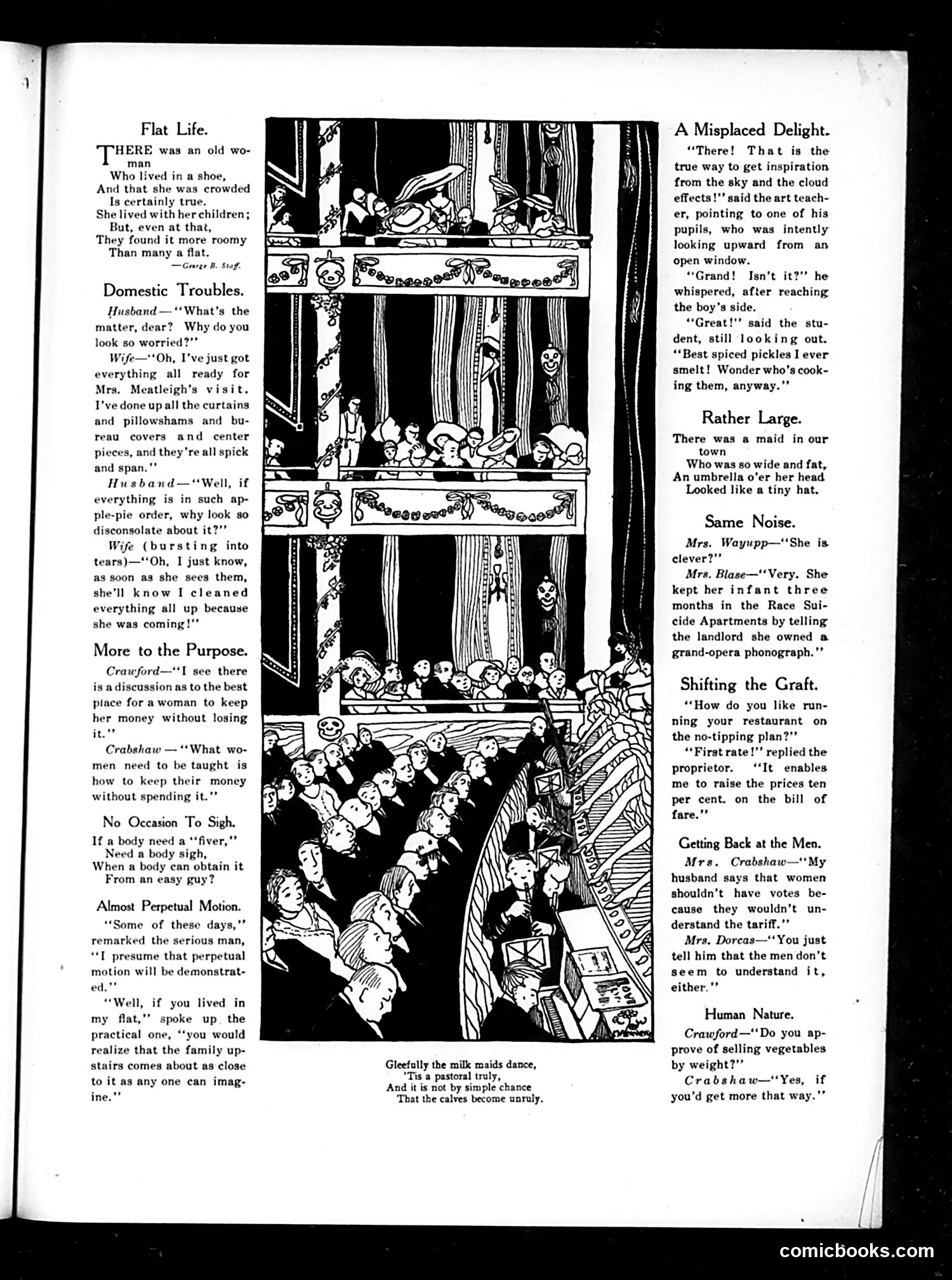
This page from *Judge* contains multiple short satirical pieces targeting early 20th-century domestic and social life: **"Flat Life"** mocks cramped urban apartment living, contrasting it unfavorably with the nursery rhyme's crowded shoe. **"Domestic Troubles"** satirizes wives' anxiety about impressing visiting women—the wife's worry that her guest will *know* she cleaned specifically for the visit undermines the effort itself. **"More to the Purpose"** and other quips mock gender relations: women's spending habits, men's financial naiveté, and class dynamics (the "easy guy" lending money). **"A Misplaced Delight"** jokes about artistic pretension versus practical concerns—the student admires the sky while actually smelling cooking food. **"Same Noise"** references "Race Suicide Apartments"—period anxieties about declining birth rates—used as a deceptive rental claim. **"Getting Back at the Men"** presents a proto-feminist joke: women voting rights debates, with the punchline that men understand tariffs no better than women do. The central wood-engraved panel shows a crowded theater or public venue, illustrating urban density themes.
📄 Transcribed text from this page (OCR, searchable)
Machine-transcribed from the original scan — historical spelling and the odd misread are preserved.
Flat Life. HERE was an old wo- man Who lived in a shoe, And that she was crowded Is certainly true. She lived with her children; But, even at that, They found it more roomy Than many a flat. —Gearge B. Staf. Domestic Troubles. Husband —‘*What's the matter, dear?) Why do you look so worried?”’ Wife—Oh, I’ve just got everything all ready for Mrs. Meatleigh’s visit. I’ve done up all the curtains and pillowshams and bu- reau covers and center pieces, and they're all spick and span."’ Husband—“‘Well, if everything is in such ap- ple-pie order, why look so disconsolate about it?’’ Wife (bursting into tears)—‘‘Oh, I just know, as soon as she sees them, she'll know I cleaned everything all up because she was coming!" More to the Purpose. Crawford—I see there is a discussion as to the best place for a woman to keep her money without losing it” Crabshaw — ‘‘What wo- men need to be taught is how to keep their money without spending it.’” No Occasion To Sigh. If a body need a “‘fiver,”” Need a body sigh, When a body can obtain it From an easy guy? Almost Perpetual Motion. “Some of these days,’? remarked the serious man, “‘T presume that perpetual motion will be demonstrat- ed."" “Well, if you lived in my flat,’ spoke up. the practical one, “you would realize that the family up- stairs comes about as close to it as any one can imag- ine.”" . A a Gleefully the milk maids dance, Tis a pastoral truly, And it is not by simple chance ‘That the calves become unruly, \ A Misplaced Delight. “There! That is the true way to get inspiration from the sky and the cloud effects !’’ said the art teach- er, pointing to one of his pupils, who was intently looking upward from an open window. “Grand! Isn't it?’ he whispered, after reaching the boy’s side. “Great!'’ said the stu- dent, still looking out. “Best spiced pickles I ever smelt! Wonder who's cook- ing them, anyway.’’ Rather Large. There was a maid in our town Who was so wide and fat, An umbrella o’er her head Looked like a tiny hat. Same Noise. Mrs. Wayupp—‘'She is clever?”’ Mrs. Blase—‘‘Very. She kept her infant three months in the Race Sui- cide Apartments by telling the landlord she owned a grand-opera phonograph.’’ Shifting the Graft. “How do you like run- ning your restaurant on the no-tipping plan?”” “First rate!"’ replied the proprietor. ‘‘It enables me to raise the prices ten per cent. on the bill of fare.”’ Getting Back at the Men. Mrs. Crabshaw—‘‘My husband says that women shouldn’t have votes be- cause they wouldn’t un- derstand the tariff.’’ Mrs. Dorcas—‘‘ You just tell him that the men don’t seem to understand it, either."’ Human Nature. Crawford—‘‘Do you ap- prove of selling vegetables by weight?” Crabshaw—"Yes, if you'd get more that way.’” comicbooks.com