
Judge, 1912-02-03 · page 8 of 23
Judge — February 3, 1912 — page 8: what you’re looking at
What you’re looking at
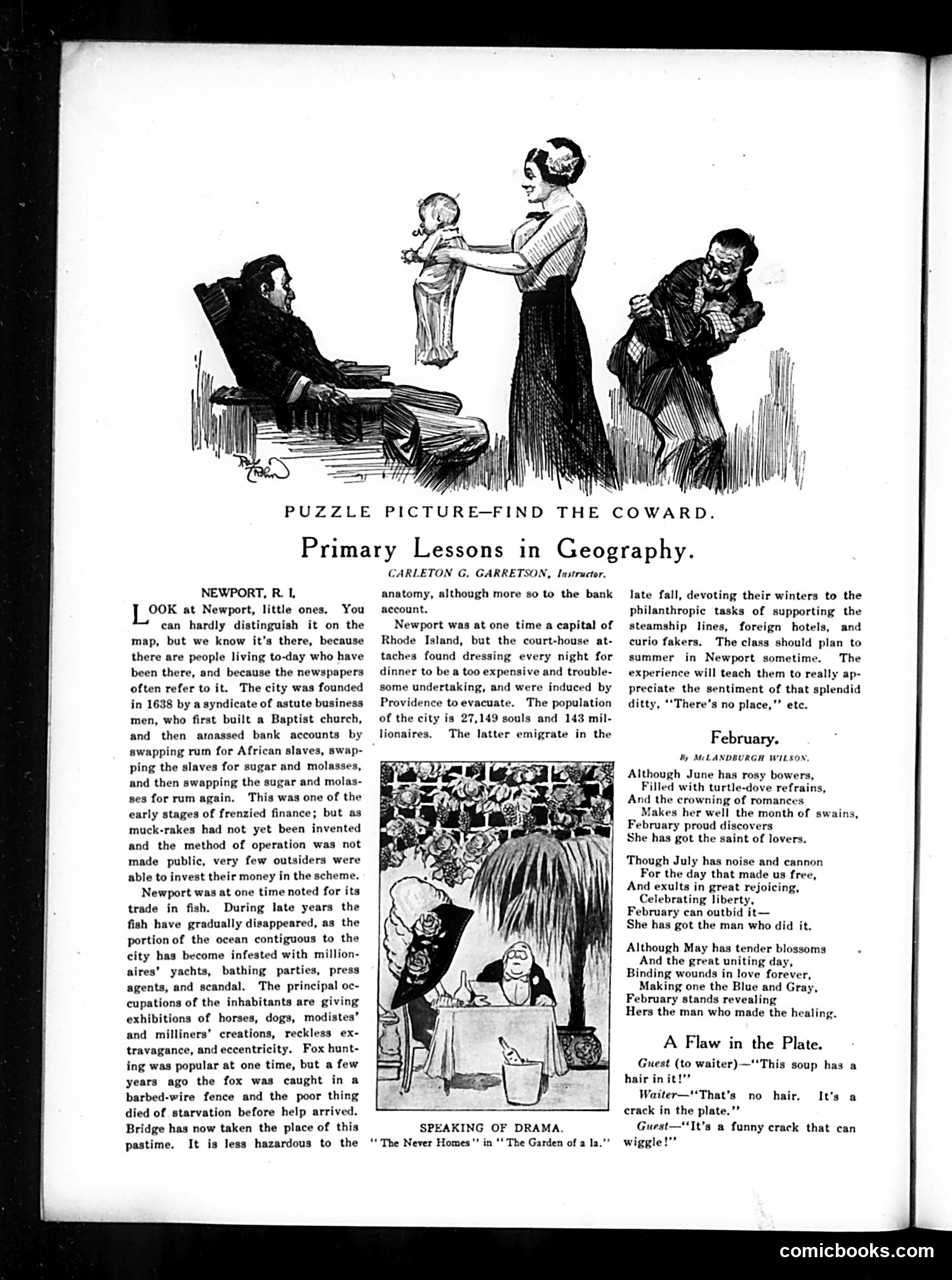
**The Puzzle Picture (top):** This sketch depicts a domestic scene where a man sits passively at a desk while a woman manages a child and another man carries a baby. The caption "Find the Coward" sarcastically identifies the seated man as cowardly for his passivity—likely a jab at men avoiding domestic responsibilities or failing to assist their wives with childcare and household management. **The Geography Section:** Judge uses humor to mock Newport, Rhode Island's wealthy elite. The text reveals satire about the city's origins in the slave trade ("swapping rum for African slaves") and critiques contemporary wealthy residents' frivolous activities: yacht ownership, extravagant spending, and scandal. The sarcastic tone suggests Newport's "millionaires" contribute little of value, merely supporting steamship lines and foreign hotels through conspicuous consumption. **Context:** This reflects late-19th-century American class consciousness and satire targeting the newly wealthy Gilded Age elite, particularly those at fashionable resort destinations.
📄 Transcribed text from this page (OCR, searchable)
Machine-transcribed from the original scan — historical spelling and the odd misread are preserved.
PUZZLE PICTURE—-FIND THE COWARD. Primary Lessons in Geography. NEWPORT, R. I, OOK at Newport, little ones. You can hardly distinguish it on the map, but we know it’s there, because there are people living to-day who have been there, and because the newspapers often refer to it. The city was founded in 1638 by a syndicate of astute business men, who first built a Baptist church, and then atnassed bank accounts by swapping rum for African slaves, swap- ping the slaves for sugar and molasses, and then swapping the sugar and molas- ses for rum again. This was one of the early stages of frenzied finance; but as muck-rakes had not yet been invented and the method of operation was not made public, very few outsiders were able to invest their money in the scheme. Newport was at one time noted for its trade in fish. During late years the fish have gradually disappeared, as the portion of the ocean contiguous to the city has become infested with million- aires’ yachts, bathing parties, press agents, and scandal. The principal oc- cupations of the inhabitants are giving exhibitions of horses, dogs, modistes’ and milliners’ creations, reckless ex- travagance, and eccentricity. Fox hunt- ing was popular at one time, but a few years ago the fox was caught in a barbed-wire fence and the poor thing died of starvation before help arrived. Bridge has now taken the place of this pastime. It is less hazardous to the CARLETON G, GARRETSON, Iastructor. anatomy, although more so to the bank account. Newport was at one time a capital of Rhode Island, but the court-house at- taches found dressing every night for dinner to be a too expensive and trouble- some undertaking, and were induced by Providence to evacuate. The population of the city is 27,149 souls and 143 mil- lionaires. The latter emigrate in the SPEAKING OF DRAMA, “The Never Homes’ in ‘' The Garden of a la." late fall, devoting their winters to the philanthropic tasks of supporting the steamship lines, foreign hotels, and curio fakers. The class should plan to summer in Newport sometime. The experience will teach them to really ap- preciate the sentiment of that splendid ditty, ‘‘There’s no place,” etc. February. By McLANDBURGH WILSON. Although June has rosy bowers, Filled with turtle-dove refrains, And the crowning of romances Makes her well the month of swains, February proud discovers She has got the saint of lovers. Though July has noise and cannon For the day that made us free, And exults in great rejoicing, Celebrating liberty, February can outbid it— She has got the man who did it. Although May has tender blossoms And the great uniting day, Binding wounds in love forever, Making one the Blue and Gray, February stands revealing Hers the man who made the healing. A Flaw in the Plate. Guest (to waiter)—‘‘This soup has a hair ini Waiter—‘‘That’s no hair. crack in the plate.’” Guest—‘‘It’s a funny crack that can wiggle! It’s a comicbooks.com