
Judge, 1912-02-03 · page 17 of 23
Judge — February 3, 1912 — page 17: what you’re looking at
What you’re looking at
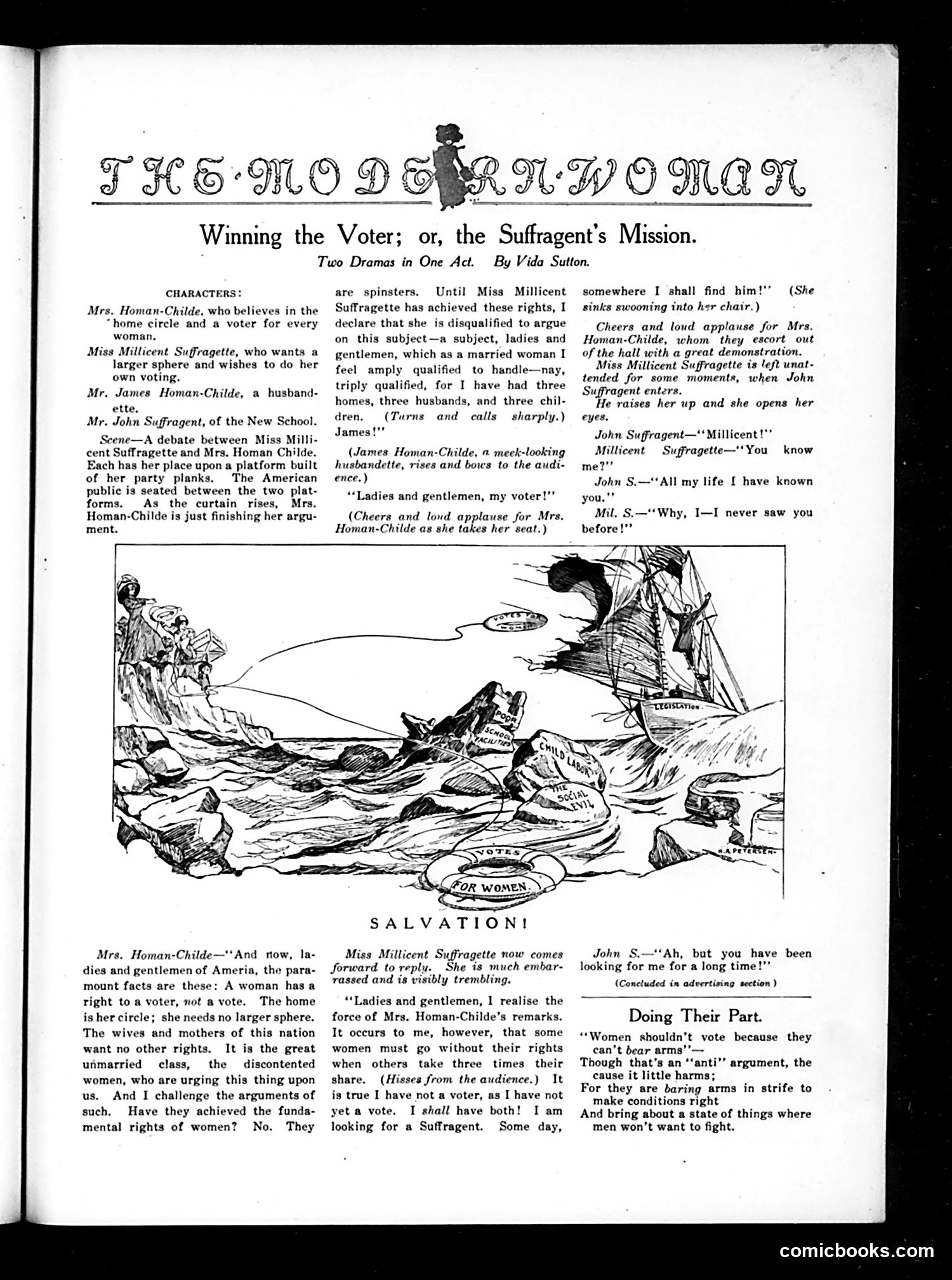
This is a satirical one-act play from *Judge* magazine mocking the women's suffrage debate. The cartoon depicts two opposing female characters debating voting rights before an audience (the American public). **Mrs. Homan-Childe** represents the anti-suffrage position: she argues women shouldn't vote because they achieve power through marriage and motherhood. She literally presents her "meek-looking" husband as her credential to speak on voting—he's called her "voter," implying women vote *through* men. **Miss Millicent Suffragette** represents the pro-suffrage position but is portrayed as trembling and needy—she faints and must be rescued by "John Suffragent" (a pun on "suffragist"), undermining her argument for independence. The satire ridicules *both sides*: anti-suffragists as dependent on husbands, and suffragists as dramatic and helpless. The bottom caption sarcastically notes women "baring arms" (rolling up sleeves) for social change while supposedly unable to bear weapons—a common anti-suffrage argument. The illustration shows chaos and shipwreck imagery labeled "VOTES FOR WOMEN," suggesting the debate itself is destructive.
📄 Transcribed text from this page (OCR, searchable)
Machine-transcribed from the original scan — historical spelling and the odd misread are preserved.
THE MODS Winning the Voter; or, Two Dramas in One Act. CHARACTERS: Mrs. Homan-Childe, who believes in the “home circle and a voter for every woman, Miss Millicent Suffragette, who wants a larger sphere and wishes to do her own voting. Mr. James Homan-Childe, a husband- ette. Mr. John Suffragent, of the New School. Scene—A debate between Miss Milli- cent Suffragette and Mrs. Homan Childe. Each has her place upon a platform built of her party planks. The American public is seated between the two plat- forms. As the curtain rises, Mrs. Homan-Childe is just finishing her argu- ment. OMA I are spinsters. Until Miss Millicent Suffragette has achieved these rights, I declare that she is disqualified to argue on this subject—a subject, ladies and gentlemen, which as a married woman I feel amply qualified to handle—nay, triply qualified, for I have had three homes, three husbands, and three chil- dren. (Turns and calls sharply.) James!"' (James Homan-Childe, @ meek-looking husbandette, rises and bows to the audi- ence.) “*Ladies and gentlemen, my voter!"’ (Cheers and lond applause for Mrs. Homan-Childe as she takes her seat.) the Suffragent’s Mission. By Vida Sutton. somewhere I shall find him!'’ (She sinks swooning into her chair.) Cheers and loud applause for Mrs. Homan-Childe, whom they escort out of the hall with a great demonstration. Miss Millicent Suffragette is left unat- tended for some moments, when John Suffragent enters. He raises her up and she opens her eyes. John Suffragent—* Millicent !"" Millicent Sugfragette—"* You me?” John S.—'‘All my life I have known you.”’ Mil. S.—“Why, I—I never saw you before !"" know Mrs. Homan-Childe—‘‘And now, la- dies and gentlemen of Ameria, the para- mount facts are these: A woman hasa right to a voter, not a vote. The home is her circle; she needs no larger sphere. The wives and mothers of this nation want no other rights. It is the great unmarried class, the discontented women, who are urging this thing upon And I challenge the arguments of Have they achieved the funda- No. They us. such, mental rights of women? SALVATION! Miss Millicent Suffragette now comes forward to reply. She ts much embar- rassed and is visibly trembling. “Ladies and gentlemen, | realise the force of Mrs. Homan-Childe’s remarks. It occurs to me, however, that some women must go without their rights when others take three times their share. (Hisses from the audience.) It is true I have not a voter, as I have not yet a vote. I shall have both! I am looking for a Suffragent. Some day, John S.—*Ah, but you have been looking for me for a long time!”’ (Concluded in advertising section ) Doing Their Part. ‘‘Women shouldn’t vote because they can’t bear arms’’— Though that’s an ‘‘anti’’ argument, the cause it little harms; For they are baring arms in strife to make conditions right And bring about a state of things where men won't want to fight. comicbooks.com