
A complete issue · 25 pages · 1911
Judge — December 30, 1911
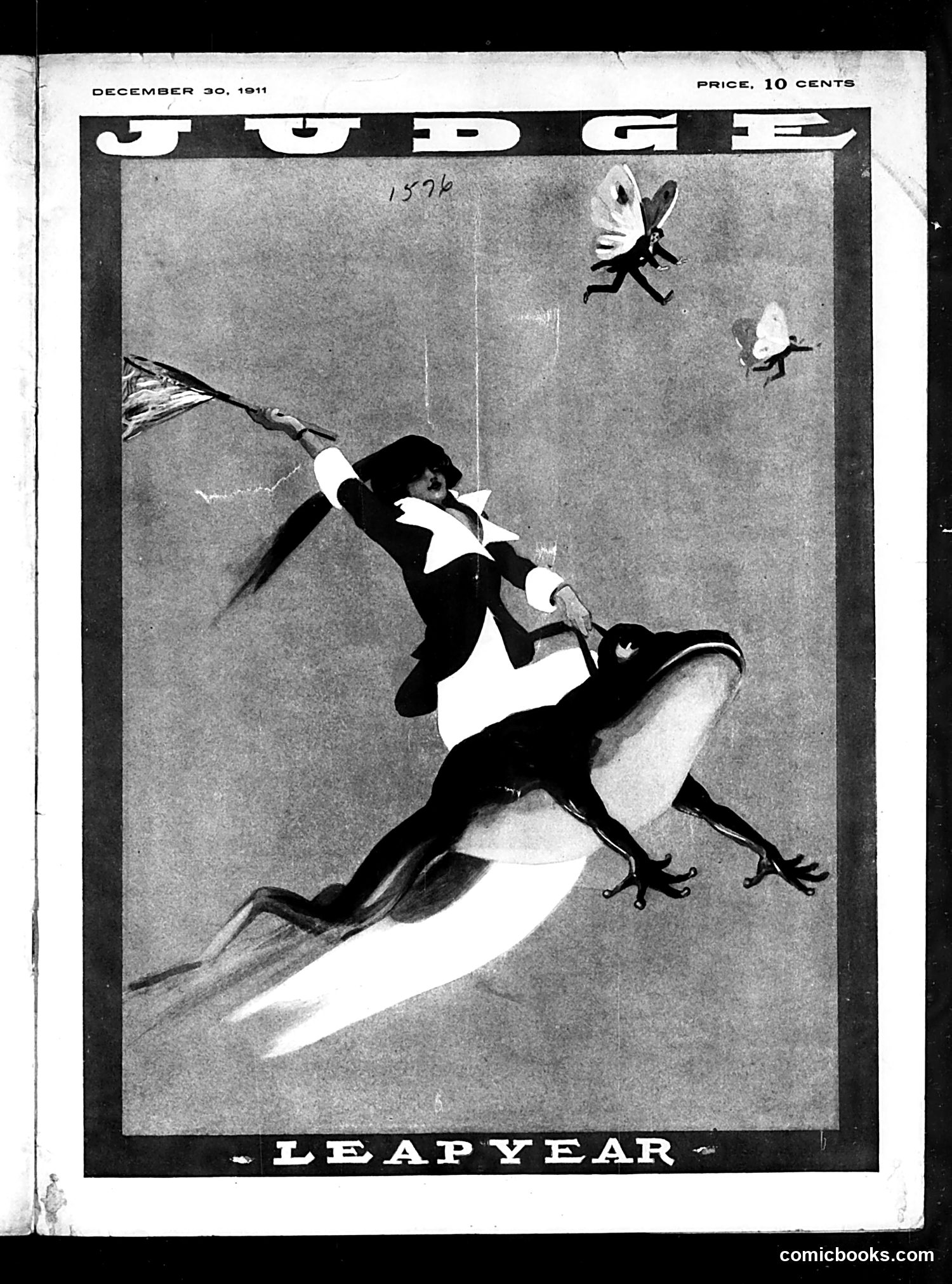
This is a "Leap Year" issue cover featuring a woman in formal attire (tuxedo jacket, white shirt and pants) actively chasing butterflies with a net while appearing to pursue or "chase" a man who is fleeing or lying down beneath her. The satire references the tradition of Leap Year (occurring every four years), when social convention supposedly allowed women to reverse gender roles and pursue men romantically. The image humorously exaggerates this concept—depicting an aggressive, dominant woman in masculine formal dress actively hunting both butterflies and a male figure. The joke plays on early-20th-century anxieties about changing gender roles and women's increasing social independence, presenting the Leap Year custom as a comedic inversion of "proper" courtship dynamics.
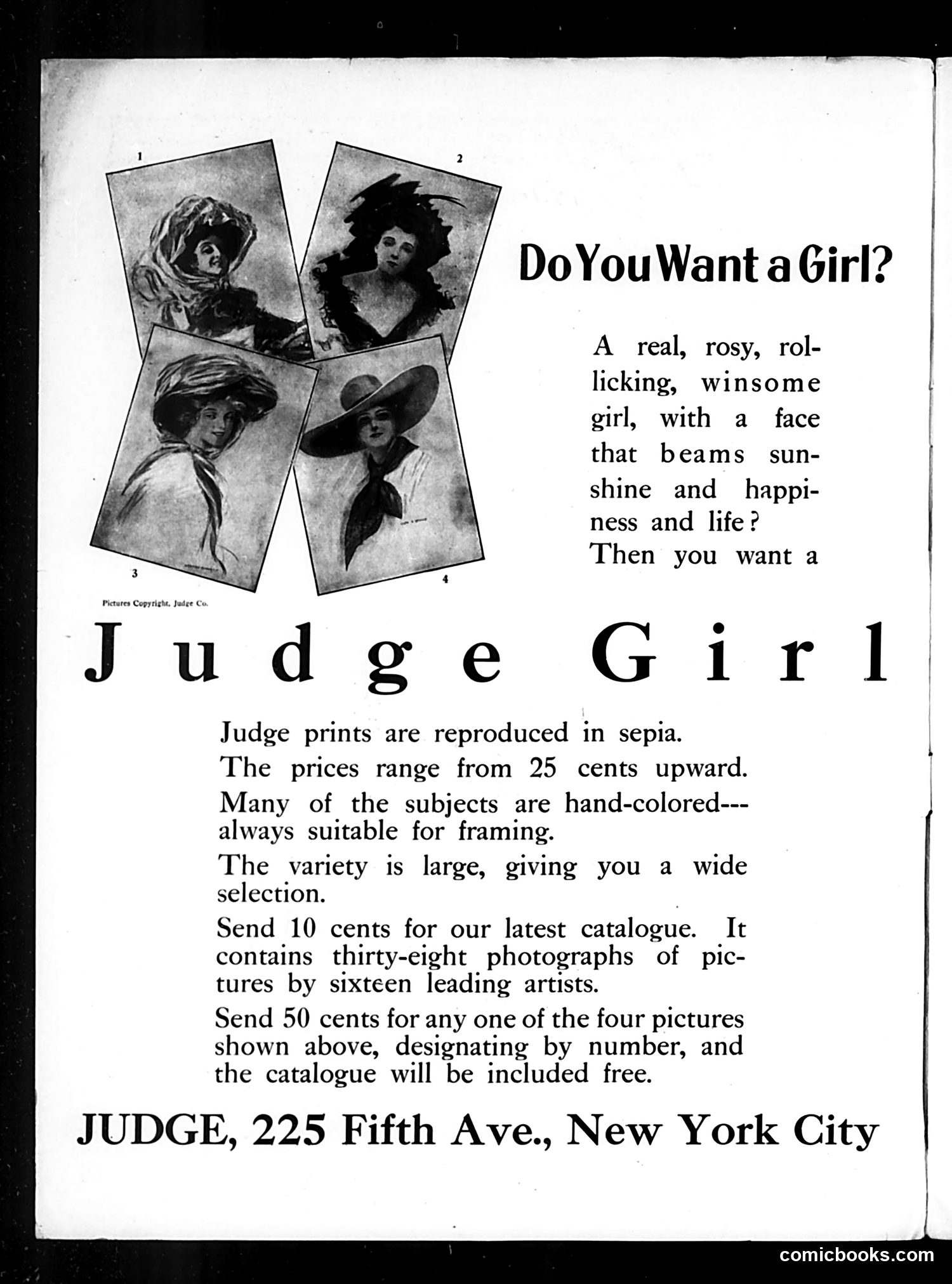
This page is primarily **advertising, not satire**. Judge magazine is promoting "Judge Girl" prints—a commercial product line of portrait illustrations. The advertisement features four numbered photographs of women's faces, each wearing fashionable hats of the early 20th century. The copy uses playful language ("Do You Want a Girl?") to market these sepia-toned prints as decorative home items. The "joke" is gentle wordplay: asking if you want an attractive girl, then revealing the answer is artwork depicting girls. The portraits appear to showcase different hat styles popular in the era, suggesting these prints were contemporary fashion imagery marketed to appeal to period aesthetics. Pricing starts at 25 cents, with catalogs and individual prints available by mail from Judge's New York office.
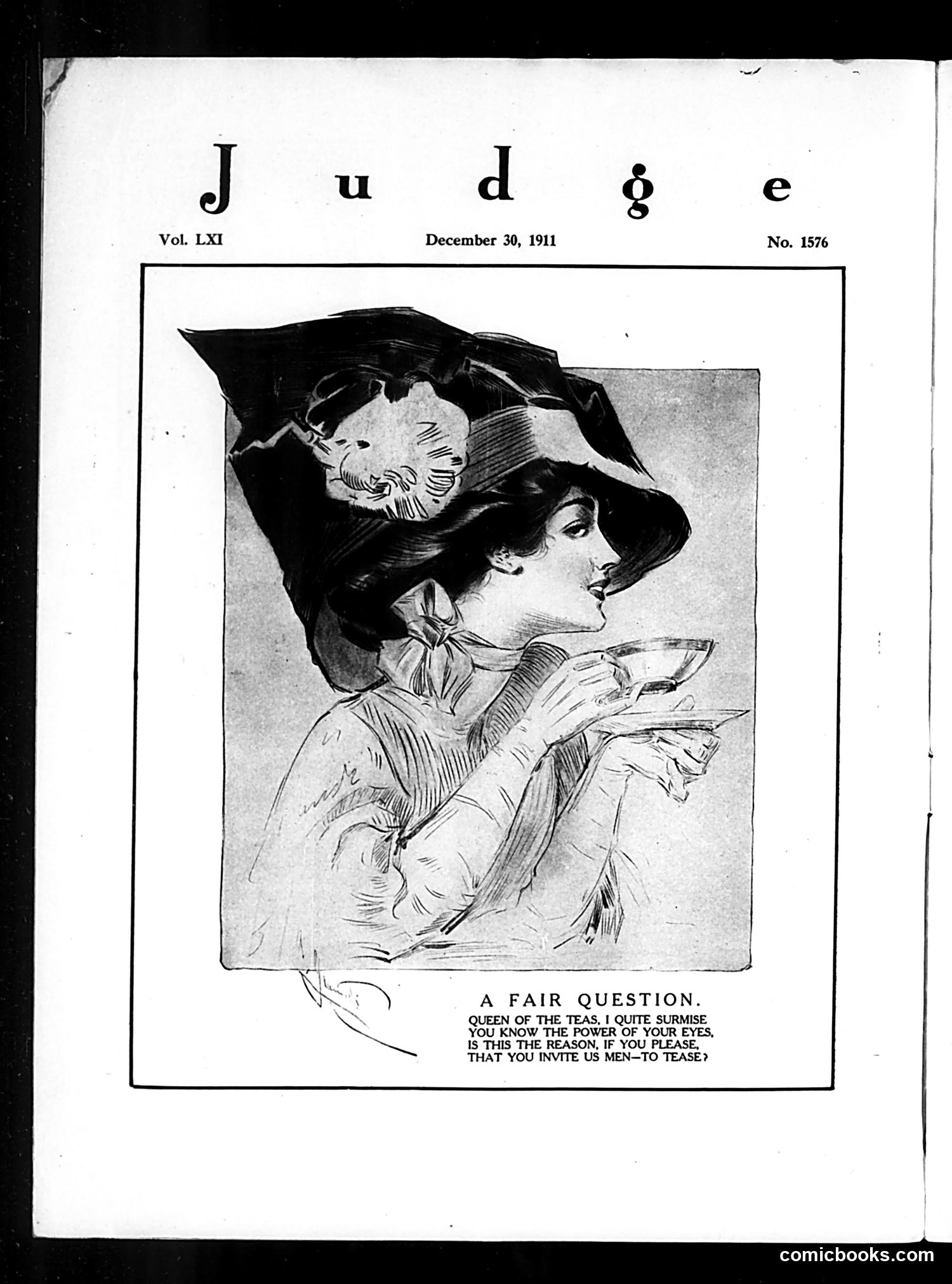
This illustration depicts a fashionably dressed woman wearing an elaborate feathered hat, shown in profile. The caption reads: "QUEEN OF THE TEAS. I QUITE SURPRISE YOU KNOW THE POWER OF YOUR EYES. IS THIS THE REASON, IF YOU PLEASE, THAT YOU INVITE US MEN—TO TEAS?" The satire targets the social institution of women's tea gatherings in early 20th-century upper-class society. The "fair question" poses ironic skepticism about women's motivations for hosting these events—suggesting the woman uses her beauty and charm to attract male guests, rather than genuine hospitality. The elaborate hat and refined appearance emphasize her status while the flirtatious undertone mocks both feminine social conventions and male vanity of the era.
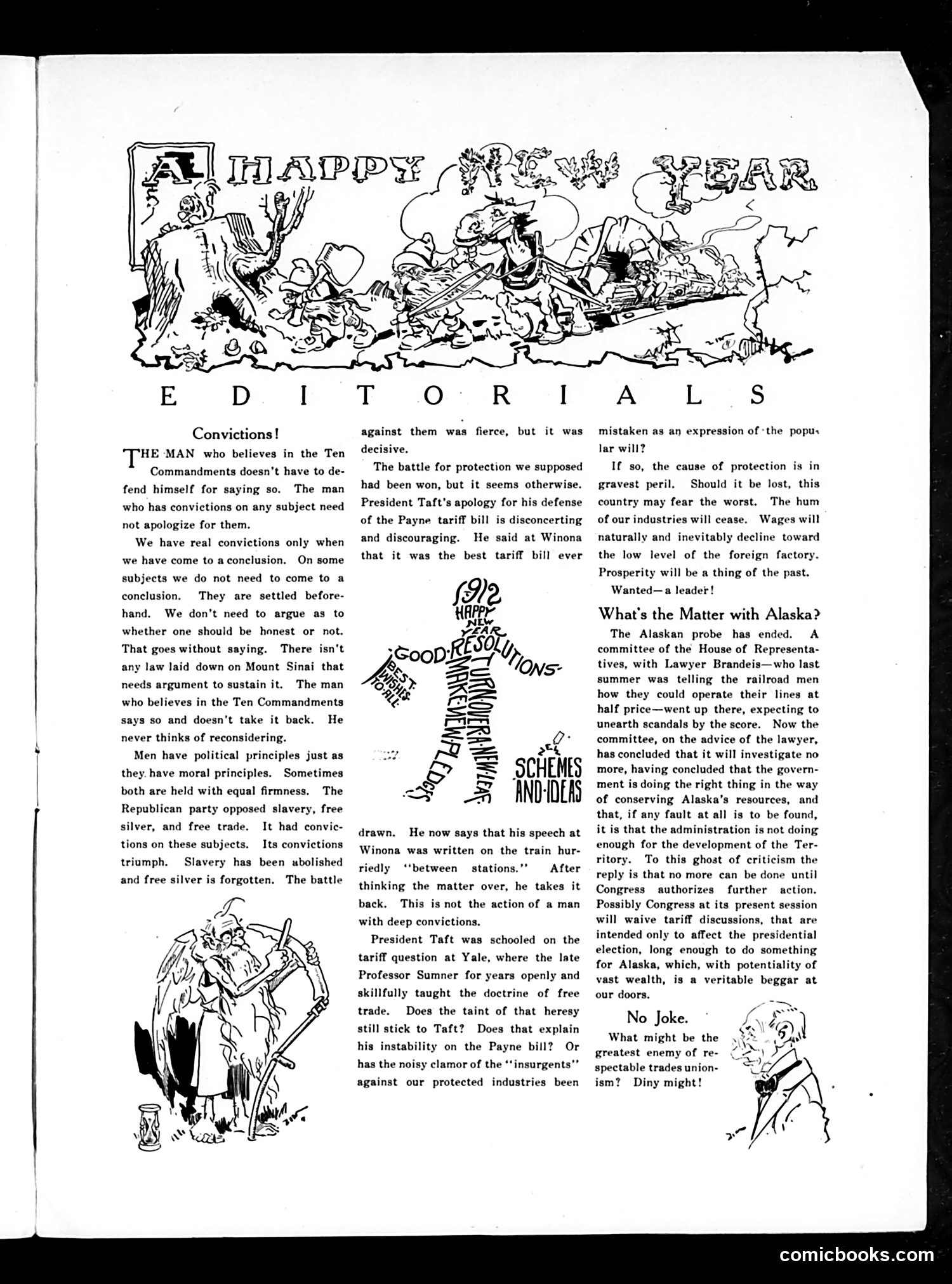
This page contains early 1912 editorial commentary attacking President William Howard Taft's policies and leadership. The main article "Convictions!" criticizes Taft for lacking firm moral principles—specifically regarding the Payne tariff bill and his defense of protective tariffs that the author sees as economically harmful. A second piece, "What's the Matter with Alaska?," mocks Taft's inaction on developing Alaska's resources, noting that Congressional committees have abandoned investigation due to administration inaction. The cartoons depict Taft as weak and indecisive. The illustrations suggest frustration with his presidency during a period of Republican Party fracturing that would culminate in the 1912 split between Taft and Theodore Roosevelt.
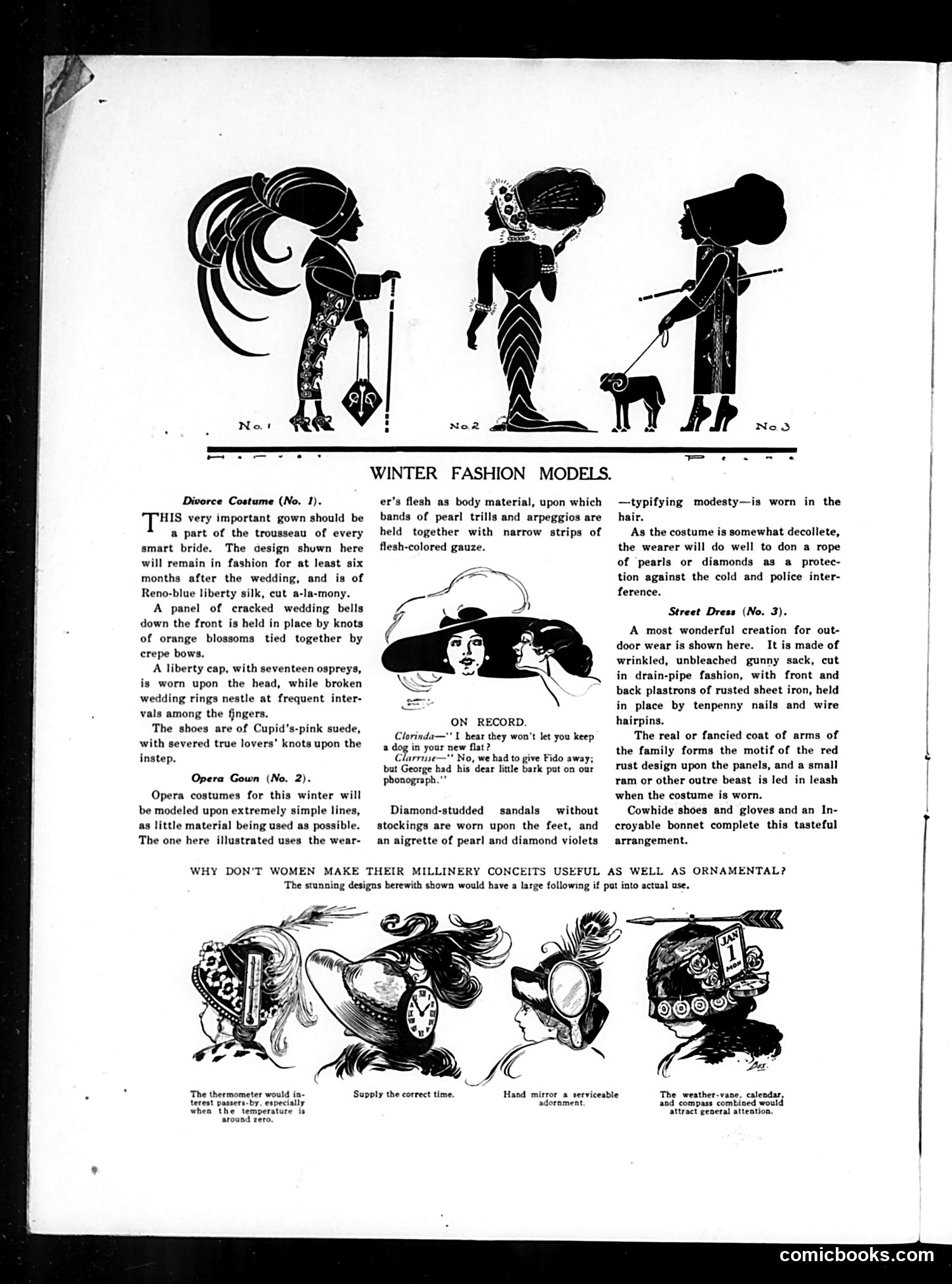
This Judge page mocks 1920s women's fashion through absurdist costume descriptions. The "Divorce Costume" sarcastically references Reno, Nevada—then famous as a divorce destination—with details like "cracked wedding bells" and "severed true lovers' knots." The "Opera Gown" jokes about scandalously minimal clothing by suggesting the wearer's own flesh serves as the garment's material. The "Street Dress" ridicules impractical fashion by describing a burlap sack with sheet iron panels held by nails. The lower section humorously proposes millinery (hat) designs that serve practical functions—thermometers, clocks, mirrors, weather vanes—suggesting women's elaborate hats are ornamental but useless. The "ON RECORD" dialogue mocks wealthy affectation: a woman must give away her dog but records its bark on a phonograph, prioritizing pretense over genuine companionship. The satire targets upper-class women's obsession with fashionable absurdity and conspicuous consumption.
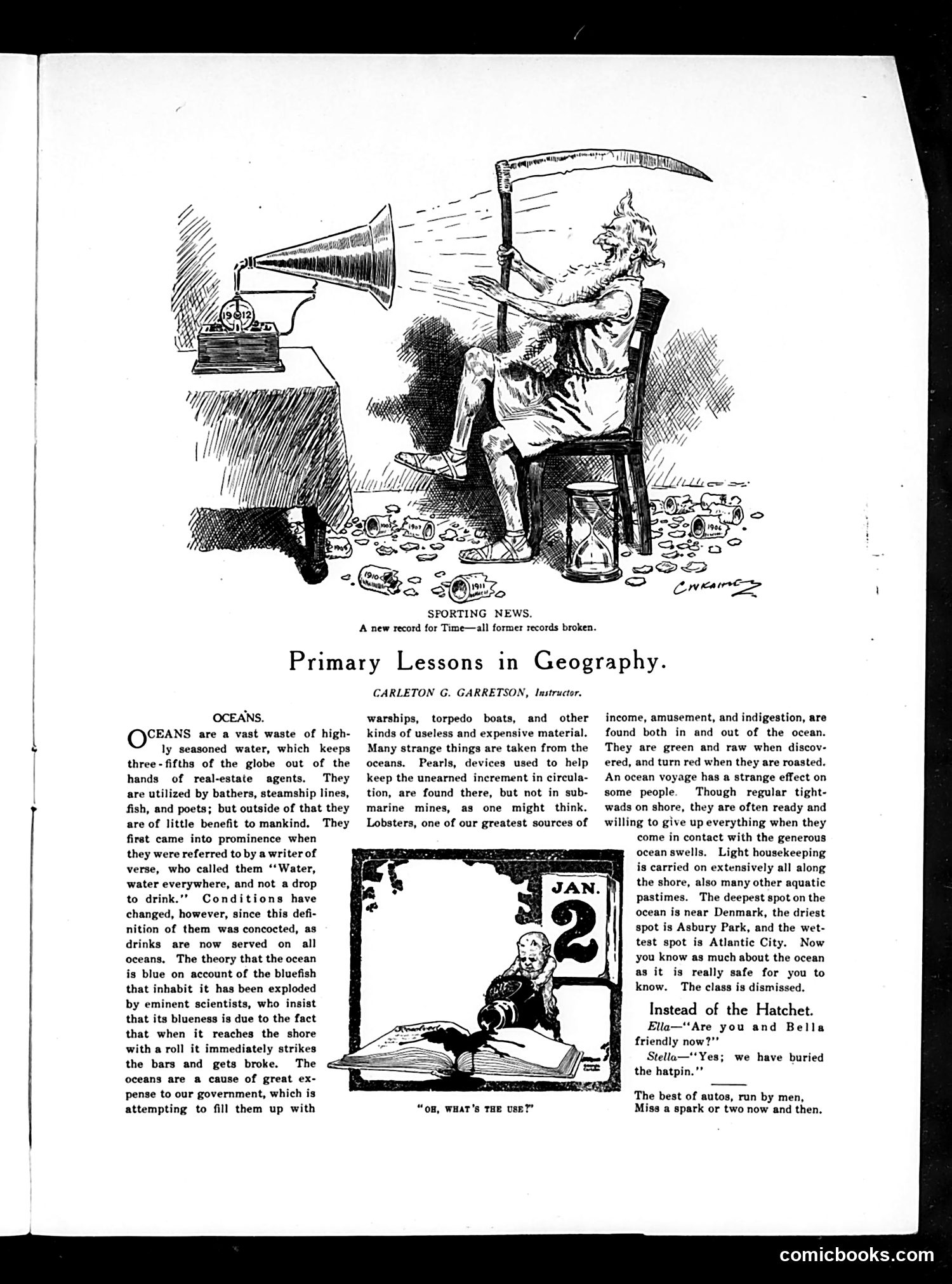
**The Main Cartoon:** Titled "Sporting News," the top illustration depicts Death (a skeletal figure with a scythe) listening to a gramophone. The caption "A new record for Time—all former records broken" suggests dark humor about mortality—Death is enjoying records about breaking time records, a macabre pun on the gramophone's function. **"Primary Lessons in Geography":** This is satirical educational content by Carleton G. Garretson. The "lesson" on oceans uses absurdist humor—claiming oceans are "useless," that their blueness comes from bars getting "broke," and that the deepest spot is "near Denmark" while the "wettest spot is Atlantic City." It mocks both overly simplified geography instruction and contemporary social attitudes, including implied commentary on naval spending and coastal commercialism. **The Small Jokes Below:** Include wordplay like "buried the hatpin" (instead of "hatchet") and automobile humor typical of the era. The page exemplifies Judge's satirical style: intellectual humor mixing political critique with absurdist comedy.
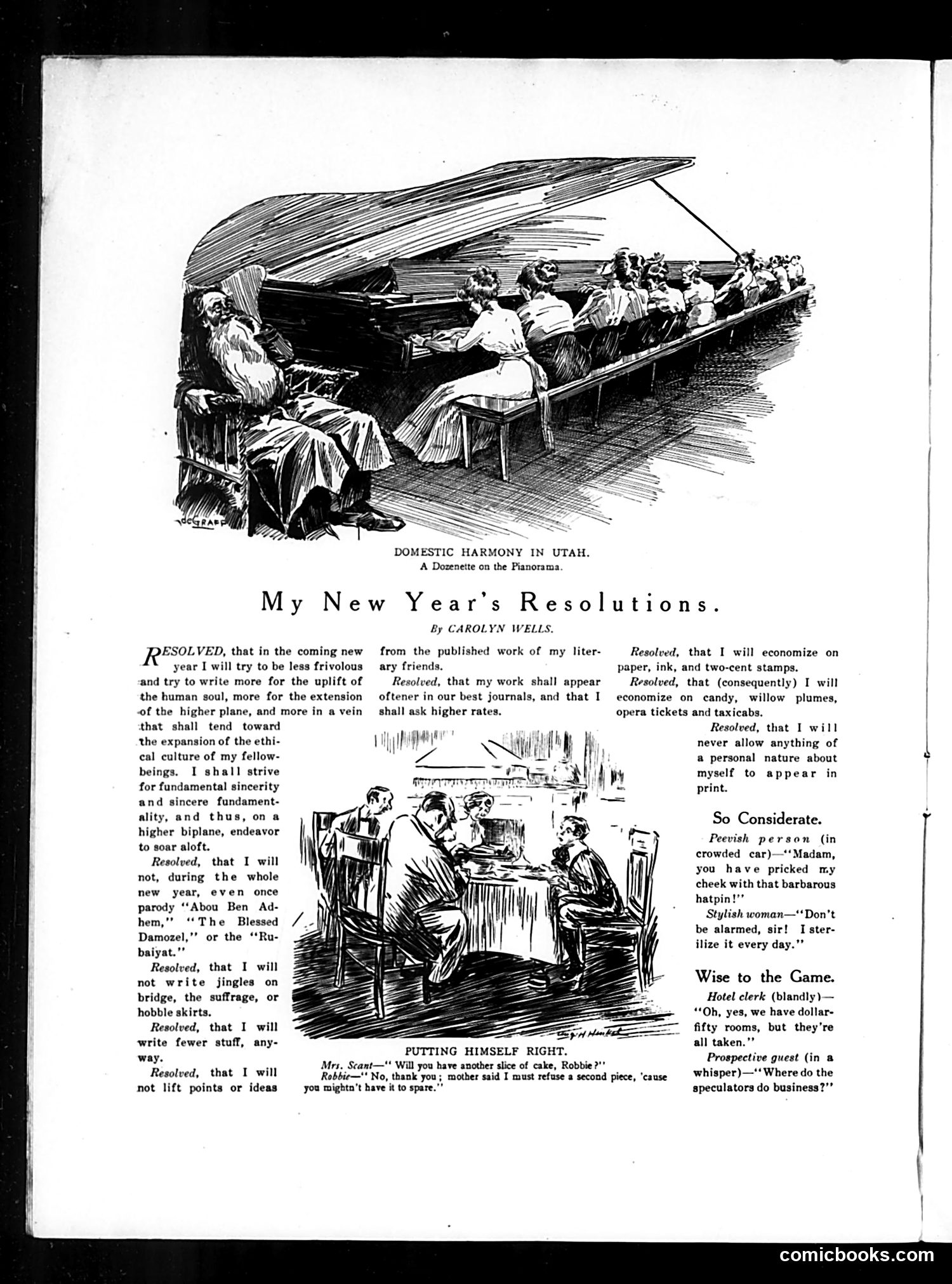
This page from *Judge* magazine contains satirical content mocking early 20th-century literary and social pretensions. **"My New Year's Resolutions"** by Carolyn Wells parodies the self-important declarations of aspiring writers. Wells humorously lists grandiose goals ("expansion of the ethical culture of my fellowbeings") alongside contradictory admissions of materialism (economizing on opera tickets and taxicabs). The satire targets writers who claim artistic seriousness while pursuing profit and social status—a common hypocrisy *Judge* mocked. **The three illustrated jokes** are unrelated social humor: - "Domestic Harmony in Utah" (top) appears to reference polygamy practices associated with Utah's Mormon history - "Putting Himself Right" jokes about a boy refusing cake to appear considerate - "So Considerate" and "Wise to the Game" are brief one-liners about social awkwardness and deceptive hotel practices The page satirizes literary pretension and captures period social anxieties about manners, materialism, and authenticity—typical *Judge* fare targeting educated urban audiences.
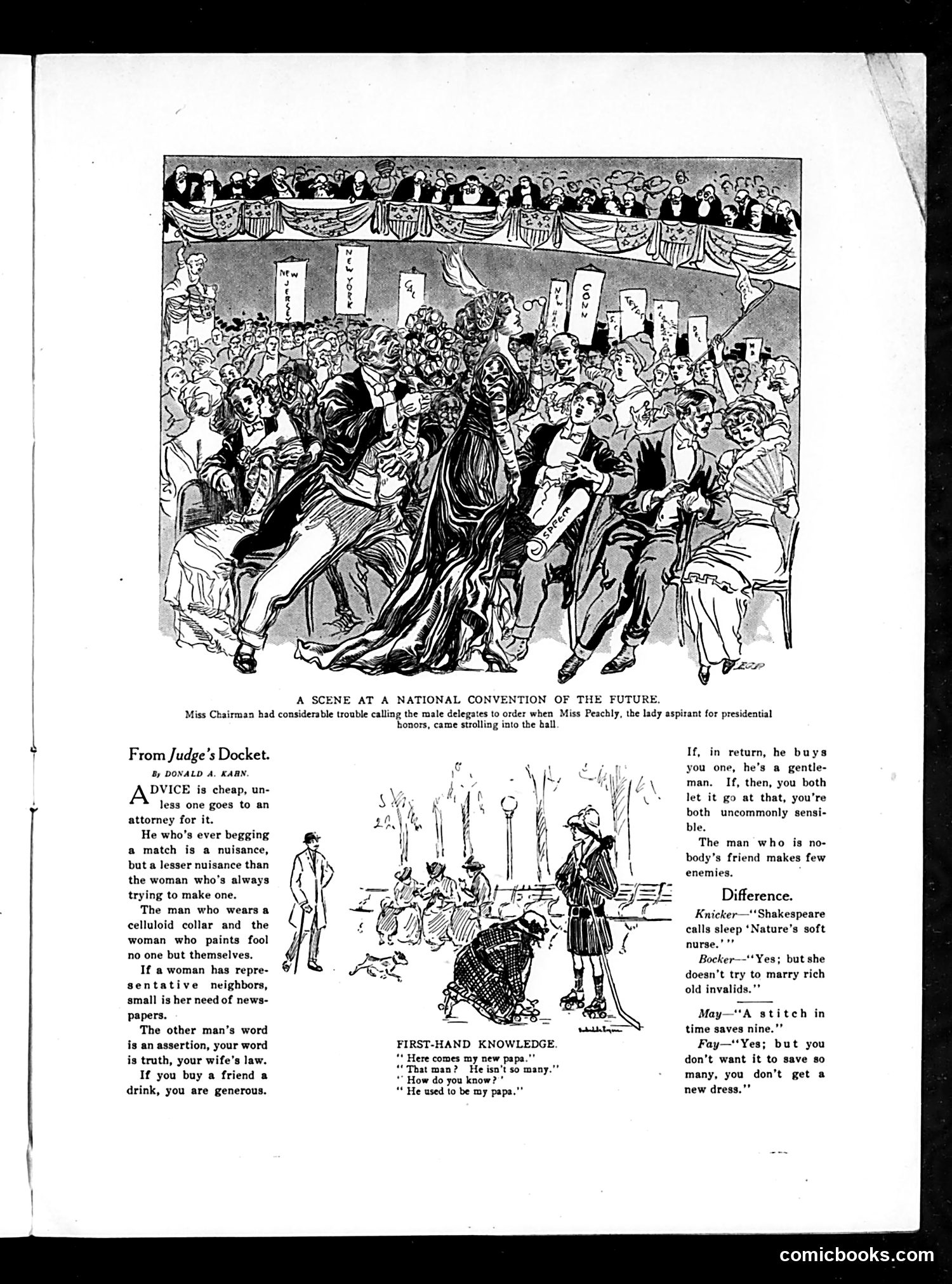
This cartoon satirizes the emerging women's suffrage movement of the early 20th century. The top illustration depicts a hypothetical future "National Convention" presided over by a female chairwoman, with a female presidential candidate ("Miss Peachly") causing chaos among male delegates who become distracted and unruly. The satire's point: male politicians would be unable to maintain order or conduct serious business if women participated in politics—a common anti-suffrage argument of the era. The caption notes the chairwoman had "considerable trouble" maintaining decorum, mocking women's fitness for political leadership. The smaller jokes below reinforce traditional gender stereotypes about women's frivolity and unreliability, supporting the underlying message that women belonged in domestic, not political, spheres. This represents typical Judge magazine opposition to women's suffrage during the Progressive Era.
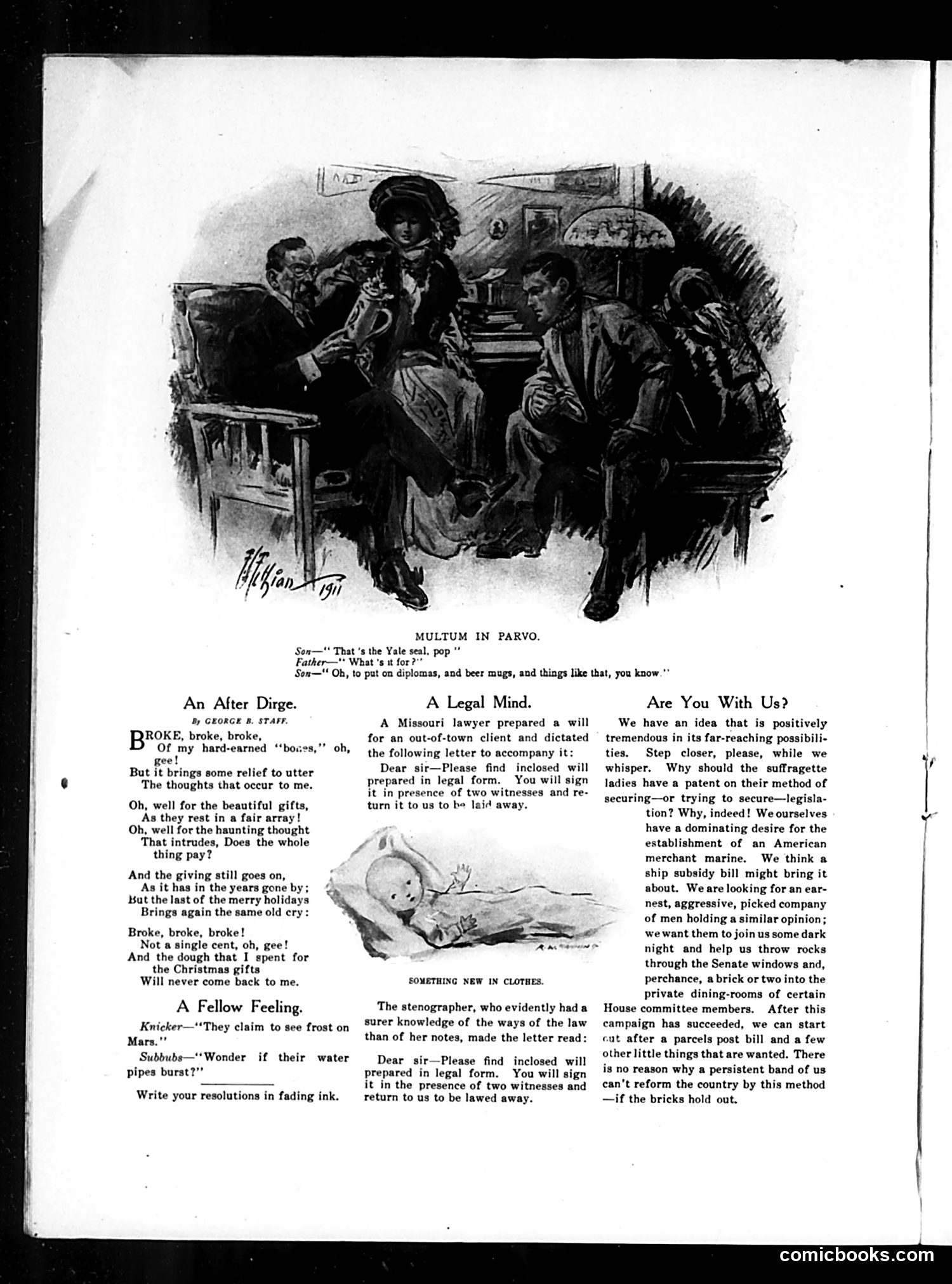
**Main Cartoon ("Multum in Parvo"):** Depicts a father and son discussing a Yale University seal. The son explains it's used on diplomas and beer mugs—a joke mocking the diminished value of elite education, suggesting Yale degrees matter primarily as decorative items rather than meaningful credentials. **Text Content:** The page features several pieces satirizing contemporary concerns: 1. **"An After Dirge"** — Laments post-Christmas financial exhaustion, a relatable middle-class complaint about holiday spending. 2. **"A Legal Mind"** — Mocks a lawyer's stenographer who transcribes "lawed away" instead of "laid away," poking fun at legal professionals' pretentious language and incompetence. 3. **"Are You With Us?"** — Satirizes the suffragette movement by proposing using their militant tactics (window-breaking, brick-throwing at legislators) to lobby for a ship subsidy bill, suggesting male reformers should adopt women's aggressive activism methods. This is clearly satirical commentary on suffragette protests.
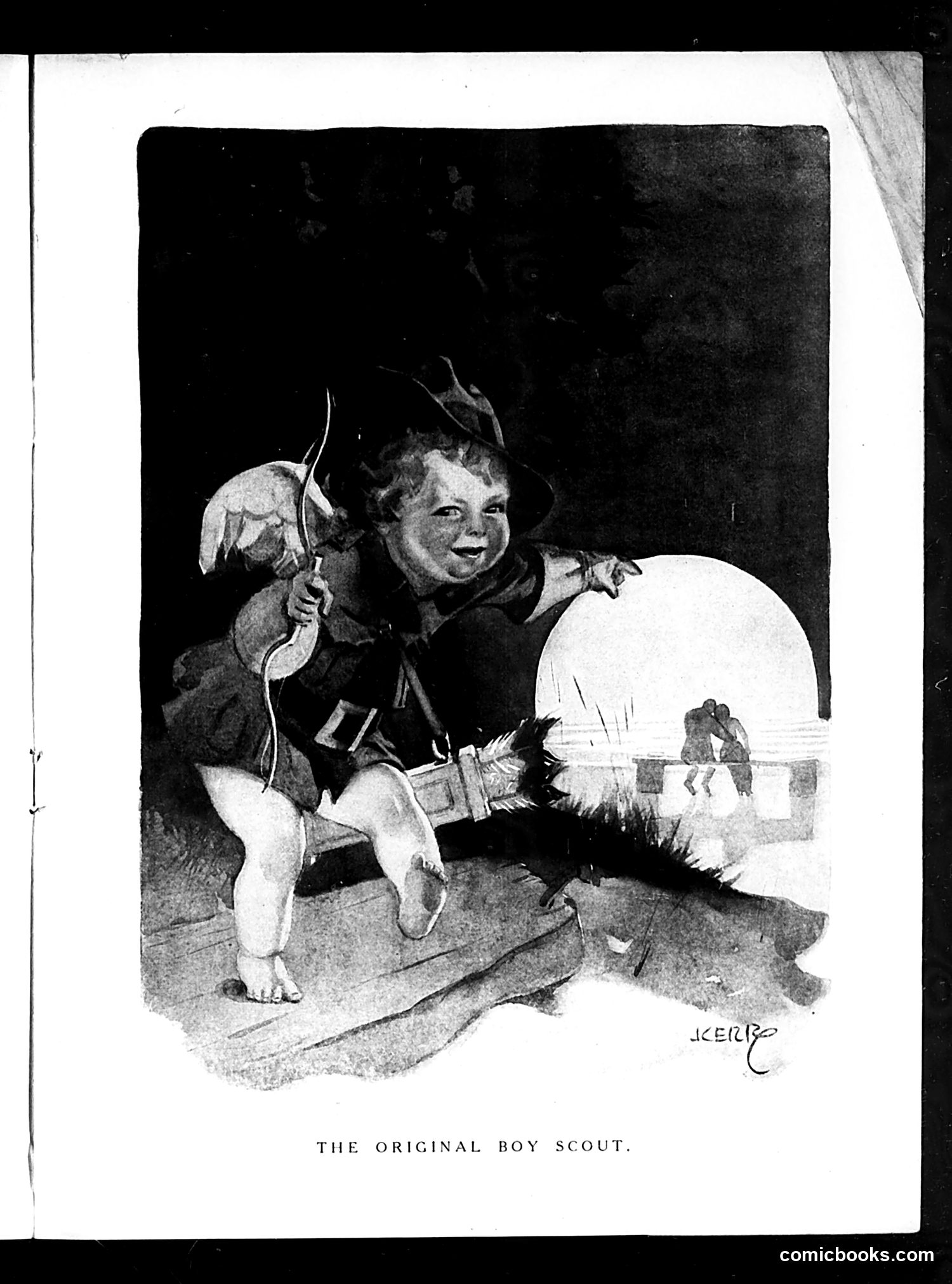
This satirical illustration depicts a cherubic young boy in scout-like attire holding a curved sword or scimitar, with what appears to be a crescent moon visible in the background. The caption "The Original Boy Scout" is ironic — the figure represents a mischievous or demonic entity (suggested by the horns and impish expression) rather than the wholesome Boy Scout movement, which was relatively new and popular in early 20th-century America. The satire likely mocks the Boy Scout organization itself, perhaps suggesting its idealism is misplaced or that its innocent reputation masks something more troublesome. The "original" reference may contrast ancient mischief with modern scouting. Without additional context about the specific publication date, the exact target of this satire remains unclear, though it appears to be social commentary on contemporary youth movements.
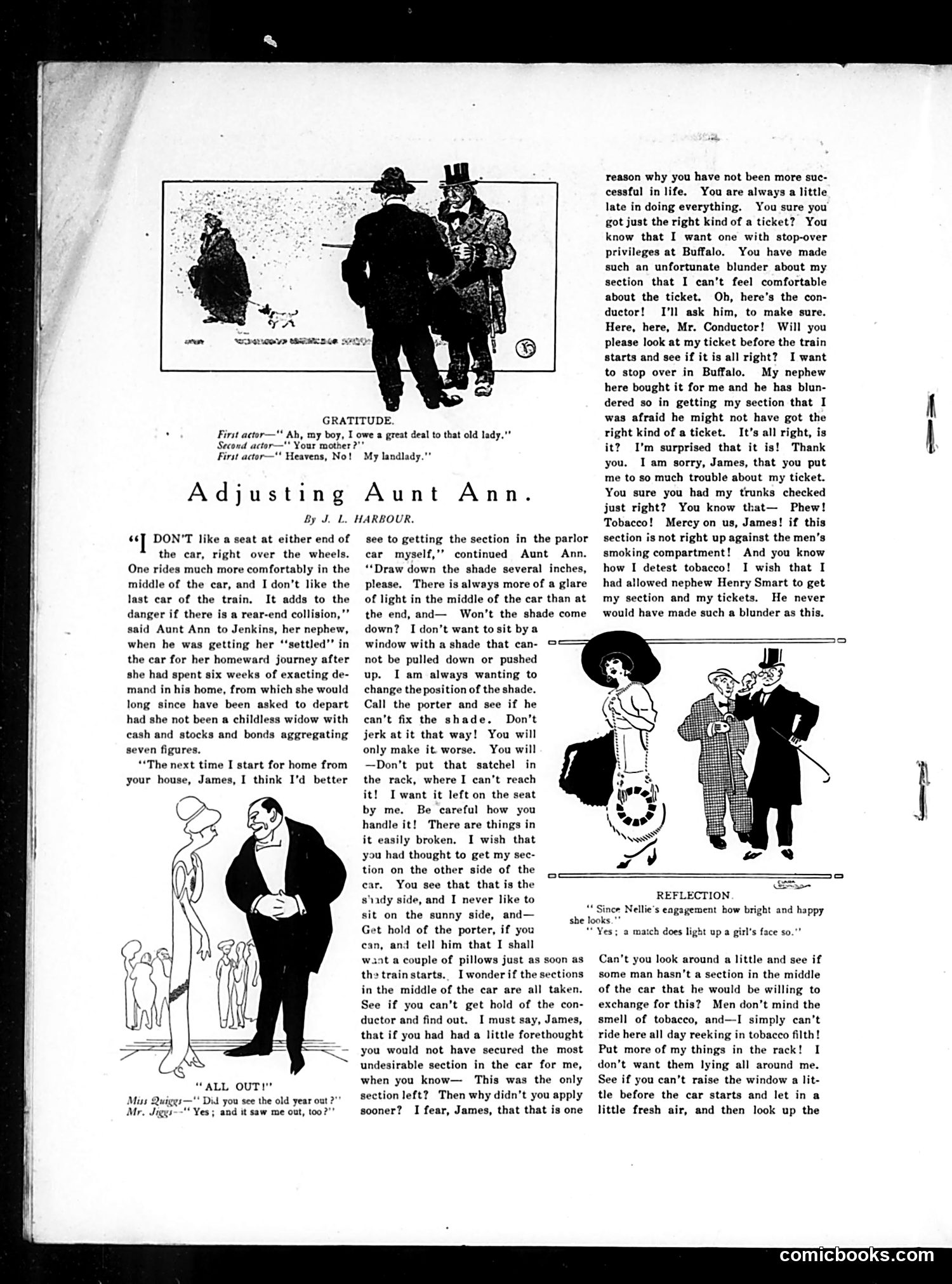
This page satirizes the archetypal demanding elderly relative. The main story concerns Aunt Ann, a wealthy widow visiting her nephew James, who must endure her relentless complaints during a train journey home. She faults him for nearly everything: her railroad seat location, window shade positioning, section placement, ticket type, and trunk handling. She constantly threatens to have preferred relatives (nephew Henry Smart) handle her affairs instead. The satire targets two things: the tyranny of wealthy relations who control family finances through their estates, and the passive, anxious nephew who must absorb endless criticism despite his genuine efforts. The humor lies in Aunt Ann's absurd perfectionism and her weaponized comparisons to other family members—a period-specific anxiety about inheritance and family obligation. The smaller cartoons address unrelated topics (theater gratitude, New Year's customs, and engagements).
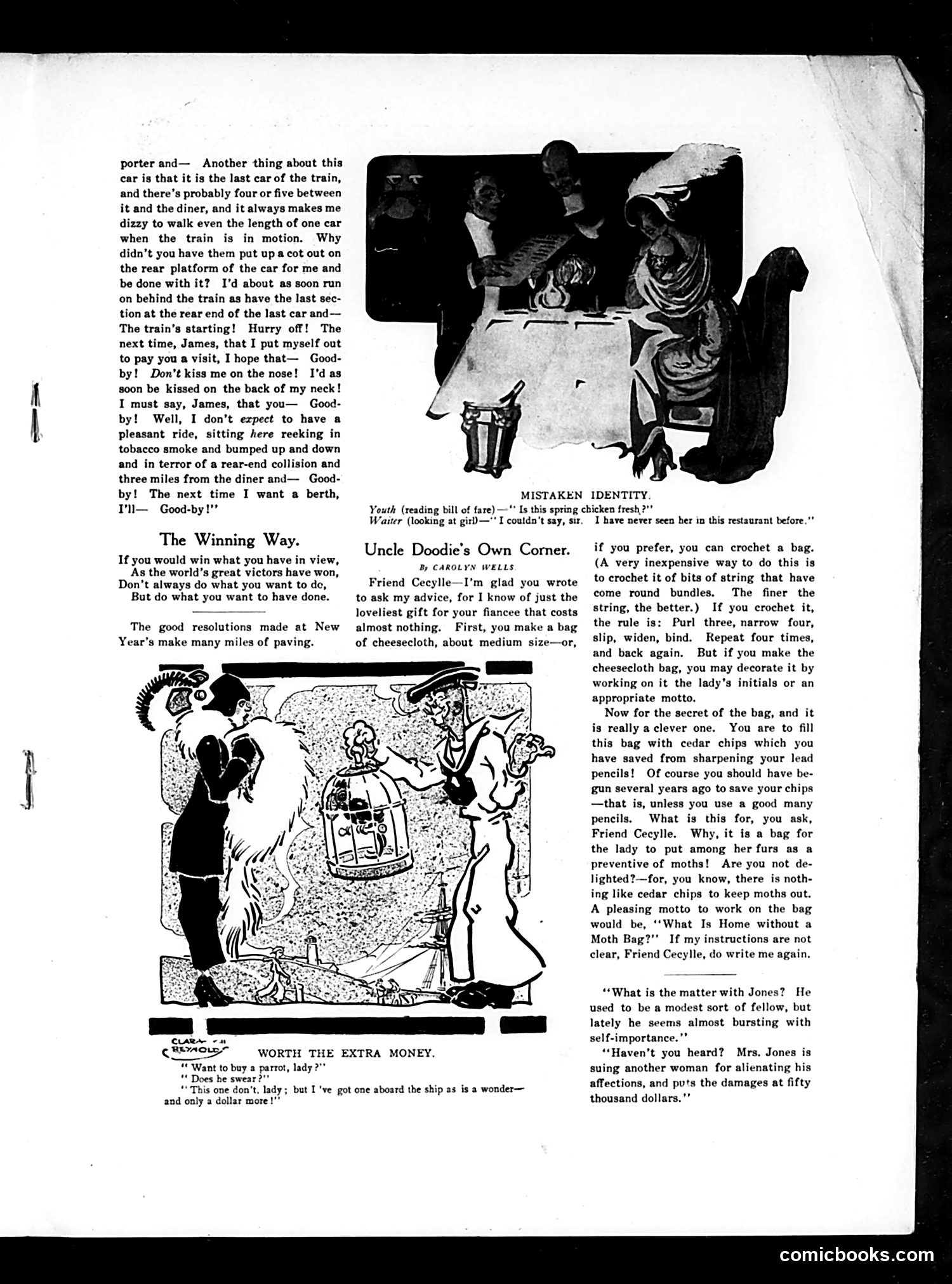
This page contains three separate humorous pieces typical of early 20th-century American satire: **"Mistaken Identity"** (top cartoon): A waiter, upon being asked if the spring chicken is fresh, looks at a young woman dining nearby and makes a double entendre—treating her as if she were the "spring chicken" in question. The humor relies on the dated slang term for an attractive young woman. **"Worth the Extra Money"** (bottom cartoon): A ship captain tries to upsell a woman on a parrot, claiming his more expensive bird "swears." The joke plays on the woman's apparent interest in a non-swearing parrot versus the captain's superior but profane option. **"Uncle Doodie's Own Corner"** (right column): Advice columnist "Carolyn Wells" humorously suggests making an inexpensive moth-repellent sachet from cedar chips saved from pencil sharpening—presenting this humble, thrifty gift as elegant advice for an engaged woman. The page satirizes consumer behavior, gender relations, and advice-giving conventions of the era through gentle, domestic humor rather than political commentary.
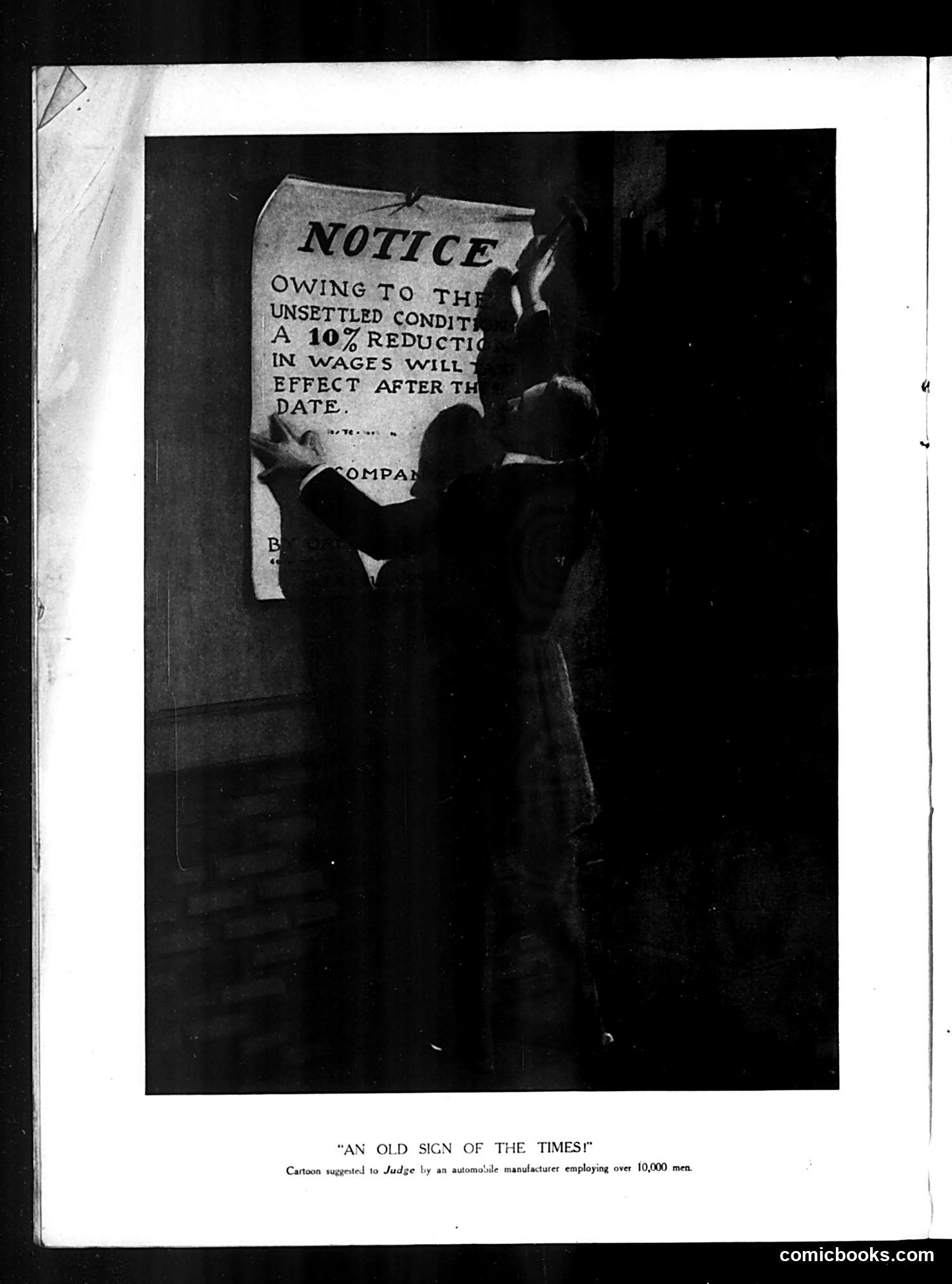
This cartoon satirizes wage cuts during economic hardship. Two silhouetted figures are posting a notice announcing a 10% wage reduction, attributed to "unsettled conditions." The caption "An Old Sign of the Times!" suggests this was a familiar occurrence—employers using economic uncertainty to justify cutting workers' pay. The subtitle notes the cartoon was "suggested to Judge by an automobile manufacturer employing over 10,000 men," indicating this depicted an actual contemporary practice by a major industrial employer. The satire works on two levels: it mocks both the vague corporate language ("unsettled conditions") used to justify cuts and the regularity with which such notices appeared. For modern readers, this reflects early-to-mid 20th century labor tensions before strong unions and wage protections existed, when employers could unilaterally reduce pay with minimal worker recourse.
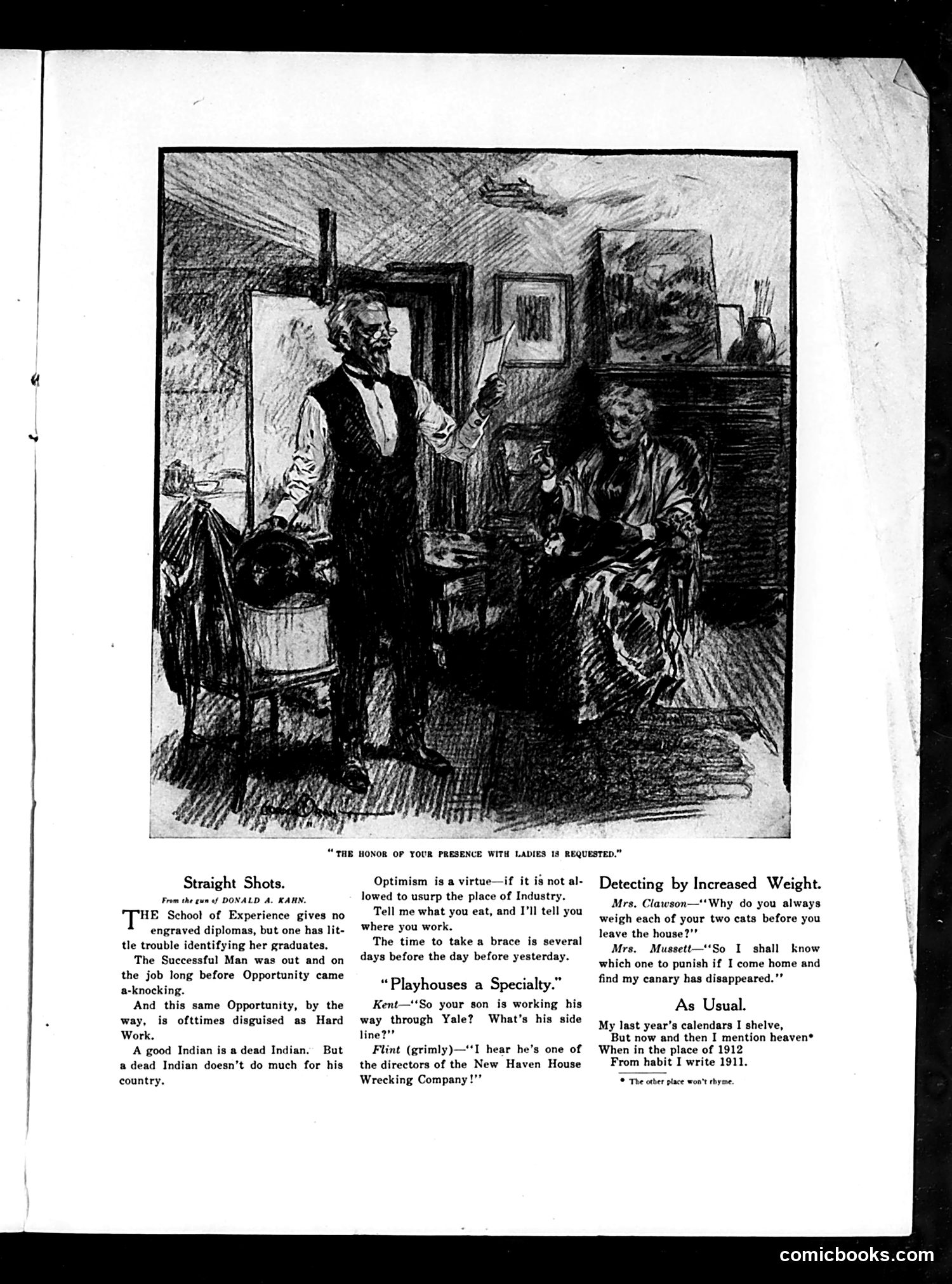
This page contains multiple short satirical pieces by cartoonist Donald A. Kahn, typical of Judge's format. The main illustration depicts a formal social scene where a man presents an invitation to ladies, likely satirizing pretentious social conventions of the era. The text pieces include: **"Straight Shots"** — Brief philosophical quips about success, hard work, and opportunity, mocking sentimentality with the blunt line "A good Indian is a dead Indian." **"Playhouses a Specialty"** — A joke where a Yale student's "side line" is directing the New Haven House Wrecking Company—satirizing either students' entrepreneurial schemes or the destructive nature of young men's activities. **"Detecting by Increased Weight"** — A domestic humor piece where a wife weighs her cats before leaving to determine which ate her canary—mocking women's domestic anxieties. **"As Usual"** — A brief piece about absent-mindedly writing the previous year's date, poking fun at human habit and forgetfulness. The page is primarily humorous social commentary rather than overt political satire.
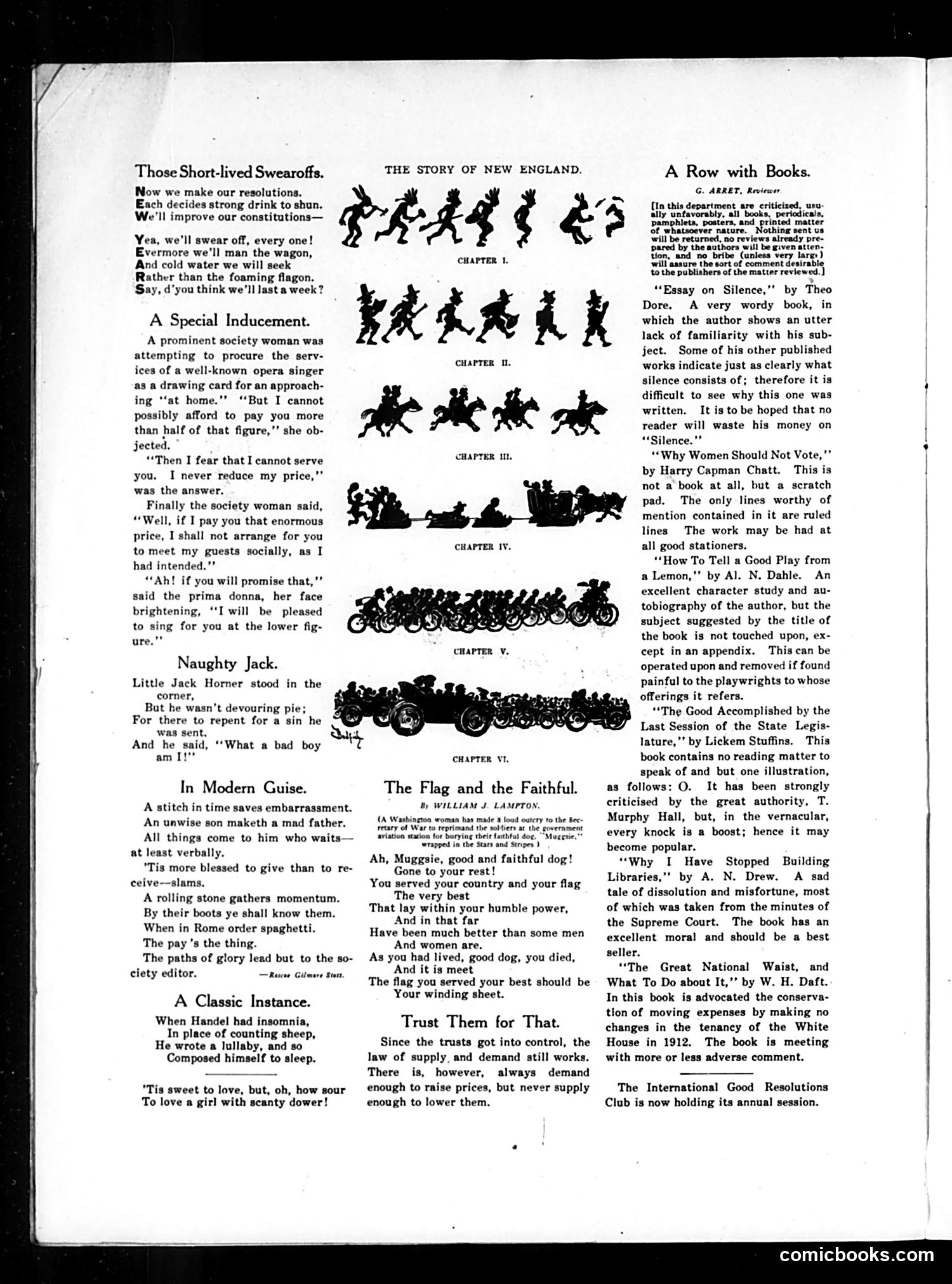
This is a mixed-content page from Judge featuring short humorous pieces and social commentary typical of early 20th-century American satire. **Key Content:** The opening poem "Those Short-lived Swearoffs" satirizes New Year's resolutions about abstinence from alcohol—suggesting readers won't maintain their pledges ("Say, d'you think we'll last a week?"). **The illustrated chapters** (I-VI) appear to depict "The Story of New England" through silhouettes showing escalating action: people running, people on horseback, people in carriages, and finally motorcycles—likely satirizing technological progress or changing social behaviors. **"The Flag and the Faithful"** is a sentimental poem about a dog buried wrapped in the American flag, used to serve country and flag. It's unclear if this is sincere patriotic sentiment or gentle mockery of excessive flag reverence. **The book review section** ("A Row with Books") mocks pretentious or poorly-written works, including one author who writes extensively *about* silence while being verbose. **Overall tone:** Light satire on social habits, technological change, patriotic excess, and intellectual pretension—the standard fare of Judge's humor.
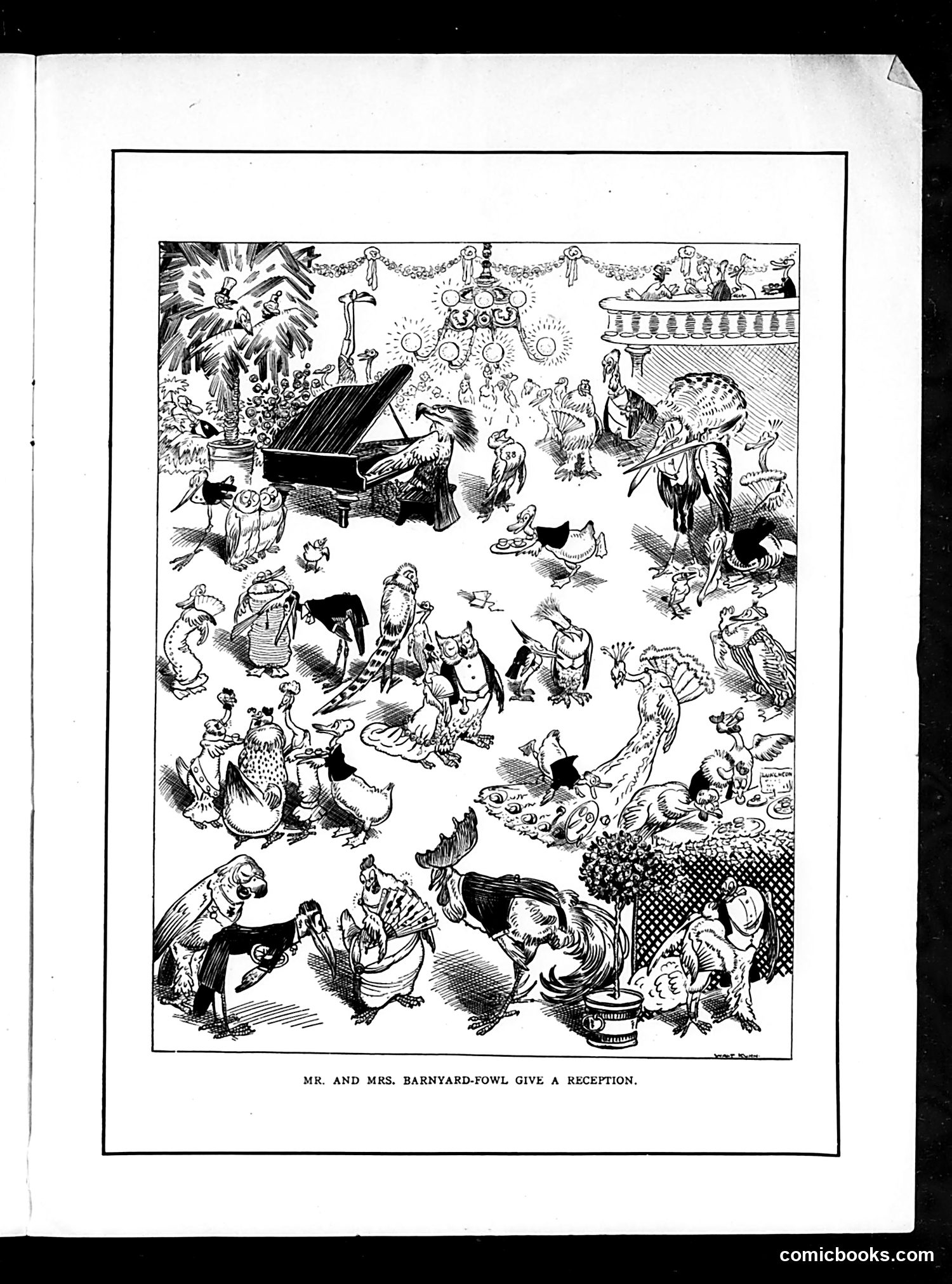
This cartoon depicts a chaotic party hosted by anthropomorphized chickens and roosters. The animals are dressed in formal attire and top hats, engaging in various human social behaviors—dancing, conversing, playing piano, and socializing beneath decorative elements like chandeliers and garlands. The satire appears to mock the pretensions of high society and formal receptions by showing barnyard fowl attempting to mimic human upper-class refinement. The humor lies in the incongruity: crude farm animals awkwardly imitating elaborate etiquette and formality. This likely comments on social climbing or the absurdity of rigid class conventions, suggesting that refined manners are merely surface performance rather than genuine sophistication. The crowded, chaotic composition emphasizes the ridiculous nature of the gathering.
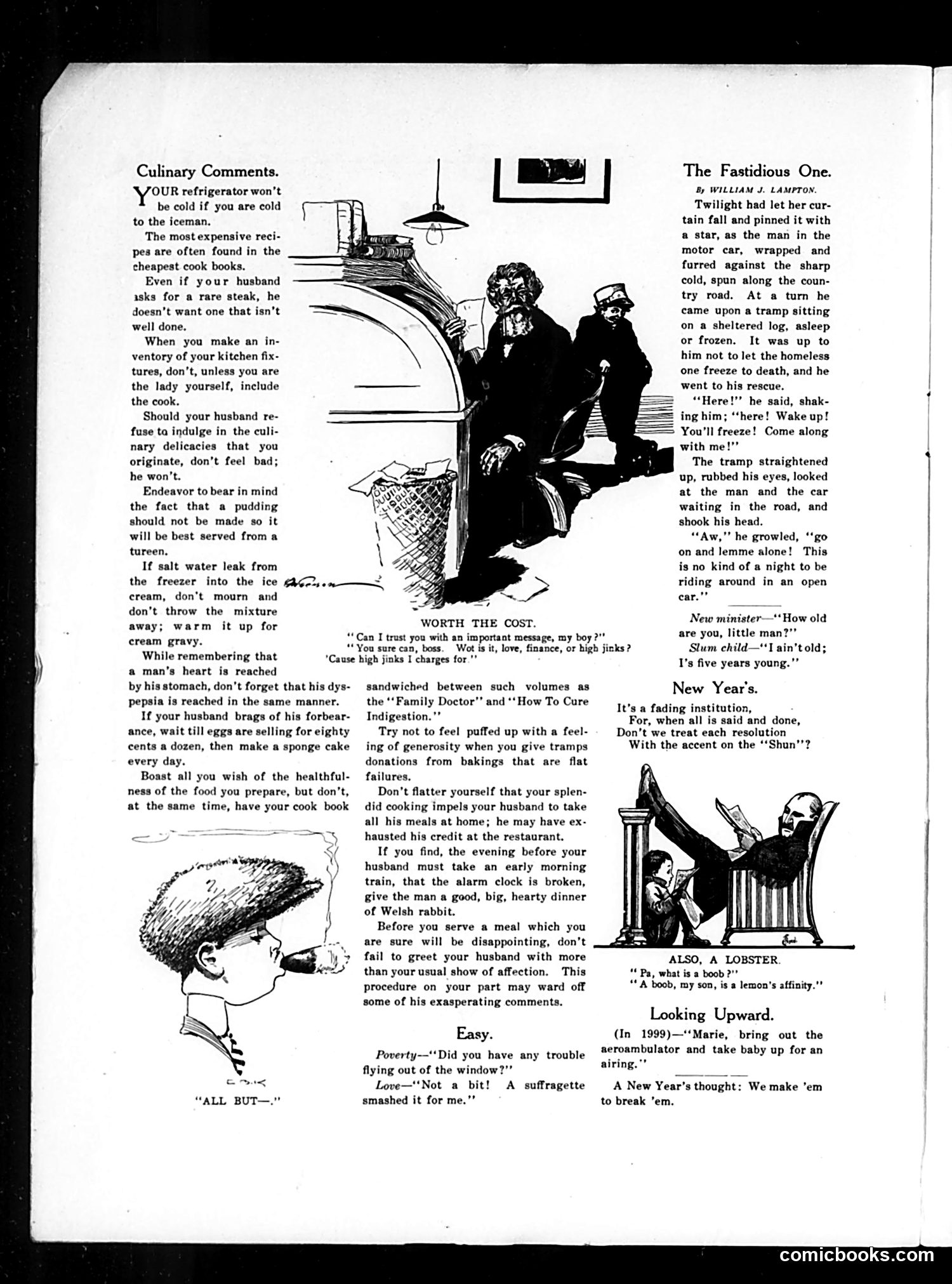
**Main Cartoon:** A wealthy motorist in an open car offers shelter to a freezing tramp, who refuses—not from pride, but because riding in an open car on a cold night is too unpleasant. The satire inverts expected class dynamics: the poor man rejects the rich man's charity based on comfort standards, mocking both upper-class condescension and the tramp's fastidiousness. **Other Content:** The page includes domestic humor columns ("Culinary Comments," "Easy," "New Year's") mocking marriage, cooking, and New Year's resolutions—standard Judge fare. A brief joke references "suffragettes" smashing windows, referencing early 1900s women's suffrage activism. **Context:** This appears early 20th century, when Judge satirized class pretension, gender roles, and social reform movements through exaggerated scenarios and light verse.
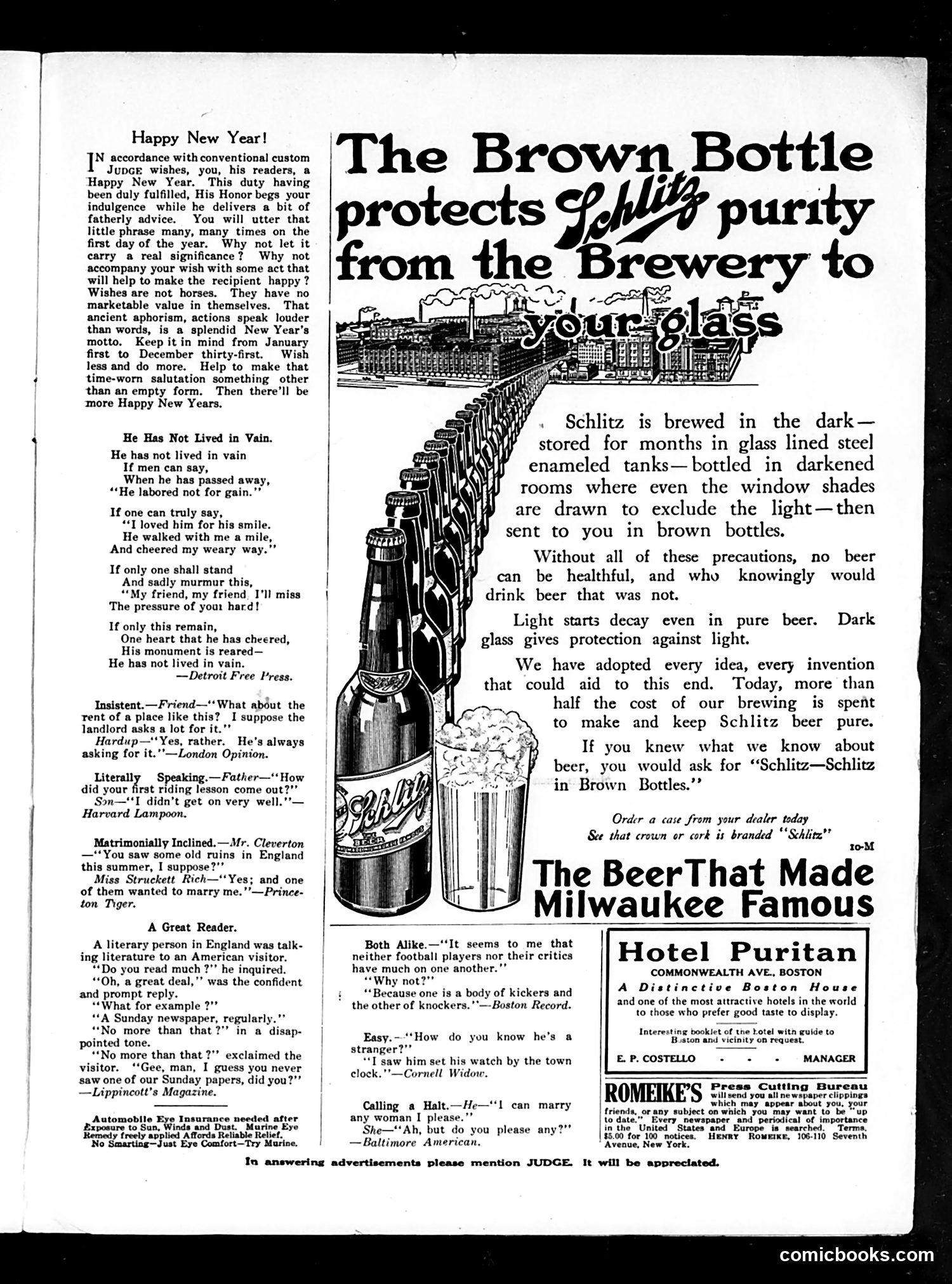
This page from *Judge* magazine combines a New Year's editorial with advertisements and light humor pieces. The main content is **not a political cartoon** but rather: 1. **Editor's message** (top left): Judge's editor offers conventional New Year's wishes while urging readers to accompany wishes with meaningful actions—"actions speak louder than words." 2. **Poetry and jokes** (left column): Sentimental verse about living a meaningful life, followed by humorous anecdotes about landlords, riding lessons, and literary pretension (an Englishman dismisses an American for reading only Sunday newspapers). 3. **Large advertisement** (right side): Schlitz beer emphasizes that brown bottles protect beer from light damage during storage and transport—a genuine quality-control innovation. The copy suggests informed consumers would specifically request "Schlitz in Brown Bottles." 4. **Hotel advertisement** (bottom right): The Puritan hotel in Boston. The satire is minimal; this is primarily a **magazine page blending editorial content with advertising**, typical of early 20th-century American periodicals.
This page is **primarily advertisements** for luxury hotels, not political cartoons. The content consists of four hotel advertisements: 1. **The Georgian Terrace** (Atlanta) 2. **The Lakewood Hotel** (New Jersey) 3. **Holland House** (New York City) 4. **Champion Terrace** (Augusta, Georgia) The right column contains **"Hit or Miss,"** Judge's humor section with brief jokes and witticisms on various topics—marriage, doctors, business, politics, and gender relations. These are generic satirical quips typical of early 20th-century magazines, poking fun at: - Los Angeles and "hysteria" - Farmers and debt - Sleep remedies - Church attendance - Women in politics and voting **There are no political cartoons or specific caricatures visible.** The page reflects era-typical satire about social customs and gender roles rather than addressing particular political figures or events. This appears to be a magazine section mixing advertising with light social commentary.
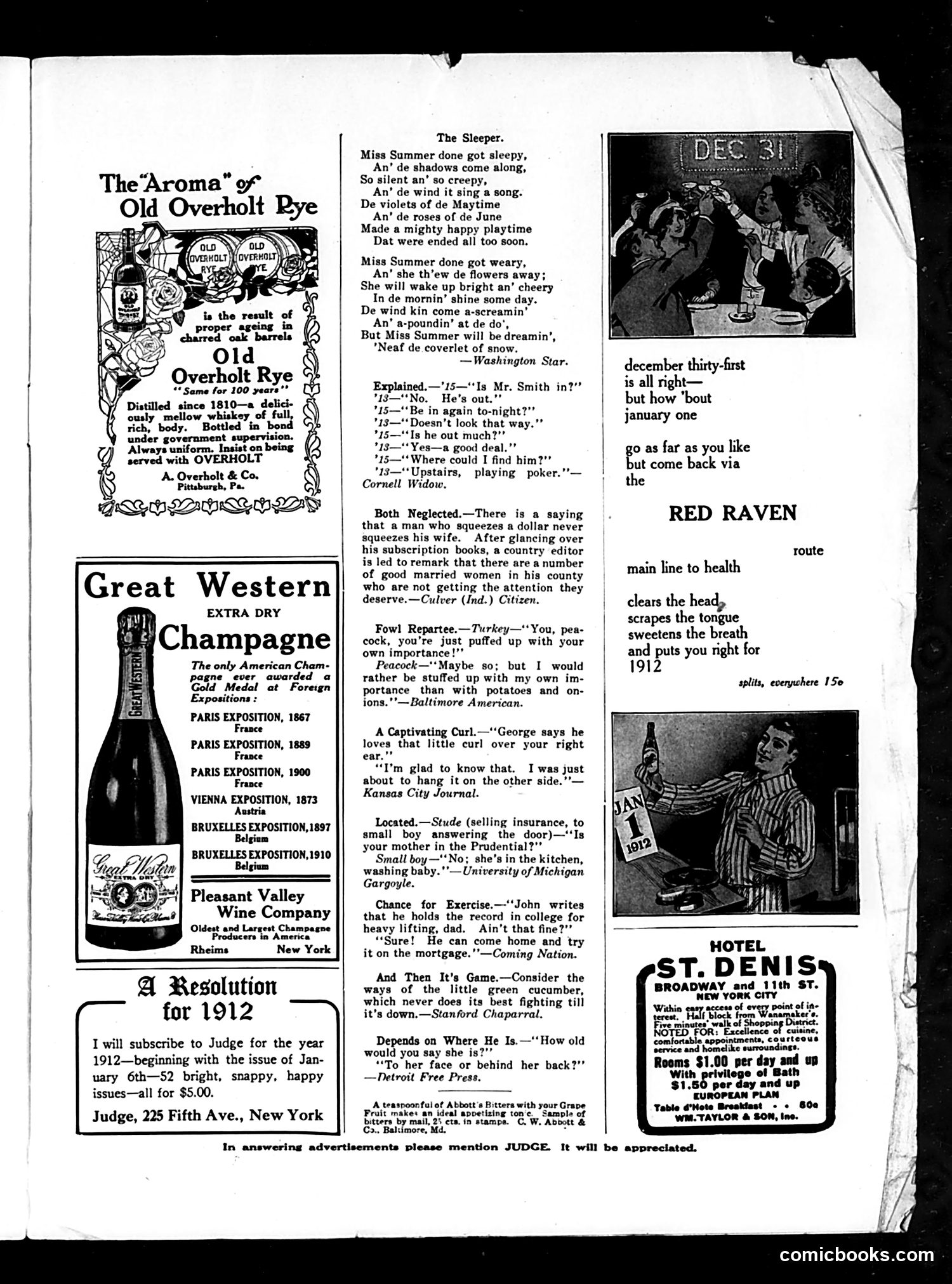
This page from Judge (circa 1912) is primarily **advertising and filler content** rather than political satire. The dominant features are liquor and wine advertisements (Old Overholt Rye whiskey, Pleasant Valley Champagne, Red Raven beverage) and a hotel ad, typical of Judge's revenue model. The text content consists of mild **humorous anecdotes and jokes** on universal domestic/social themes—marital dynamics, business interactions, animal behavior—rather than topical satire. "The Sleeper" poem uses personified "Summer" to describe seasonal change in folk-vernacular dialect. The single substantive item is a **subscription offer for Judge itself** at $5.00 for 52 issues in 1912, positioning the magazine as "bright, snappy, happy" reading. There are no identifiable political figures, current events, or pointed social commentary visible. This appears to be a standard interior page balancing modest editorial content with profitable advertising space.
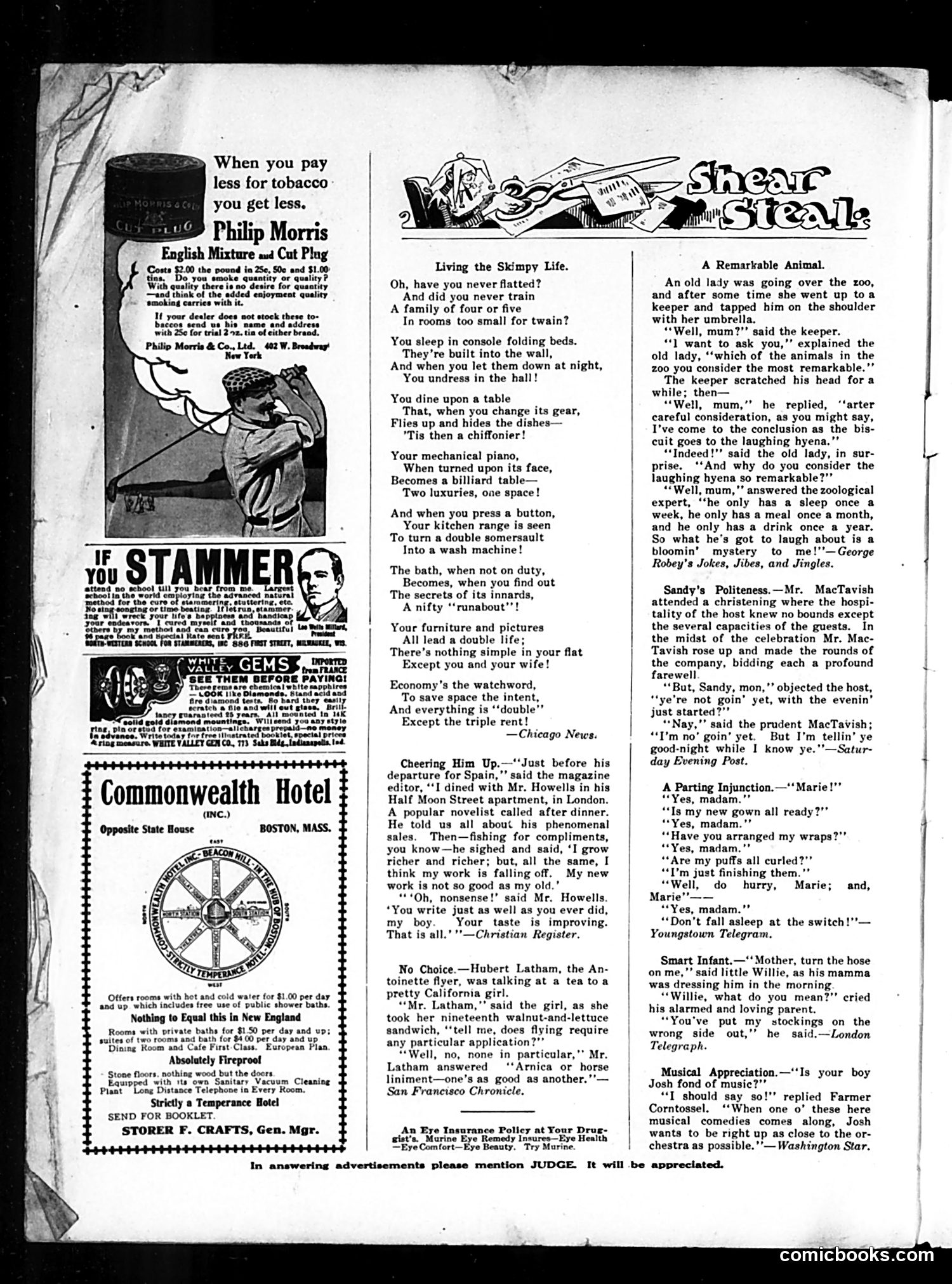
This page from **Judge** (an American satirical weekly) contains several humor pieces mocking early 20th-century life: **"Living the Skimpy Life"** satirizes cramped urban apartment living, where furniture serves multiple purposes—beds fold into walls, tables transform into chiffoniers, pianos become billiard tables. The joke is the absurd contortions required to fit a family into tiny spaces while paying "triple rent." **The other brief anecdotes** mock literary pretension ("Cheering Him Up"—a novelist fishing for compliments), aviation fads (Hubert Latham, a real aviator, makes a joke about flying remedies), and sexual naivety. The **Philip Morris and "If You Stammer"** advertisements are period commercial messaging. The **Commonwealth Hotel** ad emphasizes budget lodging as a virtue—$1/day rooms with modern amenities. **"A Remarkable Animal"** (partially visible) appears to be a setup for a joke about zoo animals, likely playing on mistaken identity or expectations. The satire reflects concerns about crowded living conditions and commercialized modern life circa 1910s America.
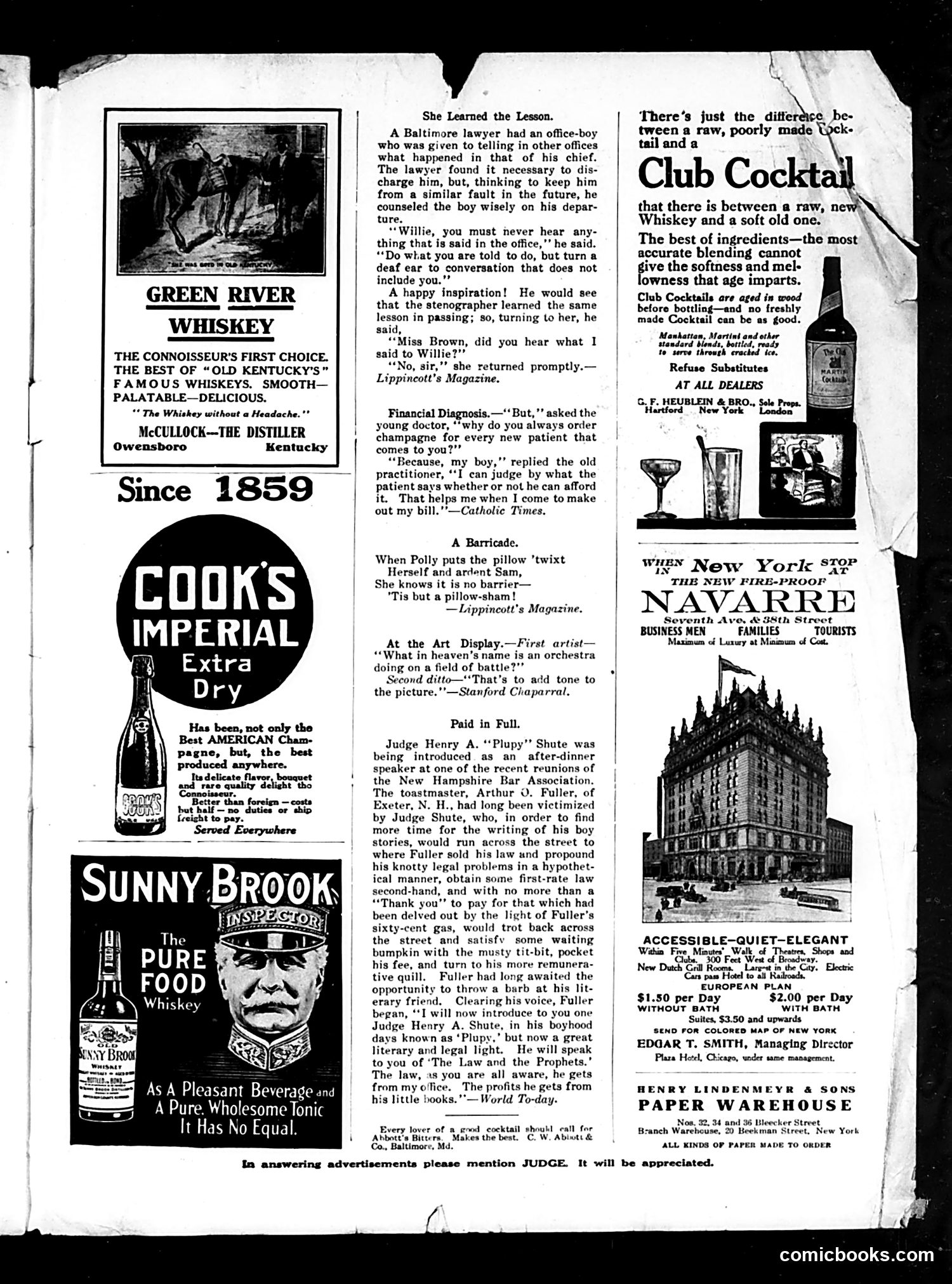
This page is primarily **advertising**, with several short humorous anecdotes interspersed. The main content consists of **whiskey and spirits advertisements** (Green River Whiskey, Cook's Imperial, Sunny Brook, Club Cocktail) typical of the era. There's also a hotel advertisement for the Navarre in New York. The satirical content appears in brief **joke snippets**: - "She Learned the Lesson": A lawyer counsels his indiscreet office boy about discretion, but the stenographer immediately proves she wasn't listening—ironic commentary on workplace gossip. - "Paid in Full": Judge Henry A. "Plupy" Shute, a writer of boys' stories, habitually exploits a lawyer colleague (Fuller) for free legal advice, then profits from his own books while giving nothing back. The toastmaster's introduction serves as public payback for this parasitic relationship. These jokes reflect early 20th-century office culture and professional ethics, using humor to critique dishonesty and exploitation.
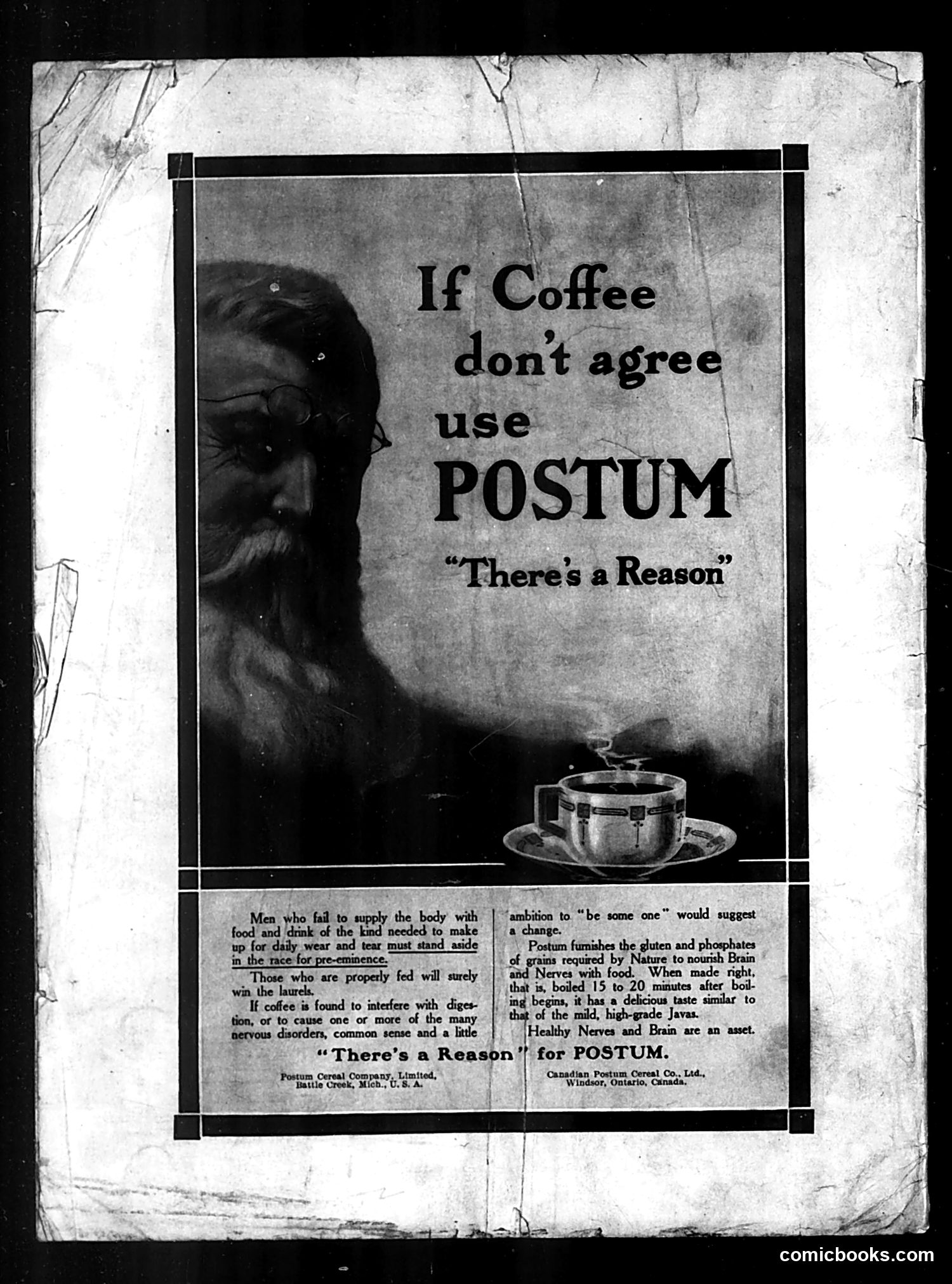
This is a **Postum cereal advertisement** disguised as editorial content, not political satire. The image shows a bearded man (appears to be a generic "unsuccessful" figure) with the headline "If Coffee don't agree use POSTUM—'There's a Reason.'" The ad argues that coffee interferes with nerves and health, while Postum—a caffeine-free grain beverage—provides necessary nutrients (gluten and phosphates) for brain and nerve function. The tagline "There's a Reason" was Postum's actual slogan. This reflects early 1900s health marketing, when Postum aggressively claimed coffee caused "nervous disorders" and other ailments. The "bearded failure" imagery suggests that proper nutrition (via Postum) leads to success and ambition. There is no political cartoon here—merely period advertising pseudoscience promoting a commercial product.

I'm unable to provide a meaningful analysis of this page. The image is almost entirely black or severely degraded, making it impossible to discern any cartoon illustrations, caricatures, text, or satirical content clearly enough to interpret. While the OCR text footer identifies this as from Judge magazine (via comicbooks.com), the actual page content is not legible in this reproduction. To properly analyze the political cartoon(s) or satire, I would need a clearer, higher-contrast version of the image where the illustrations and any accompanying text are visible.