
Judge, 1911-12-30 · page 16 of 25
Judge — December 30, 1911 — page 16: what you’re looking at
What you’re looking at
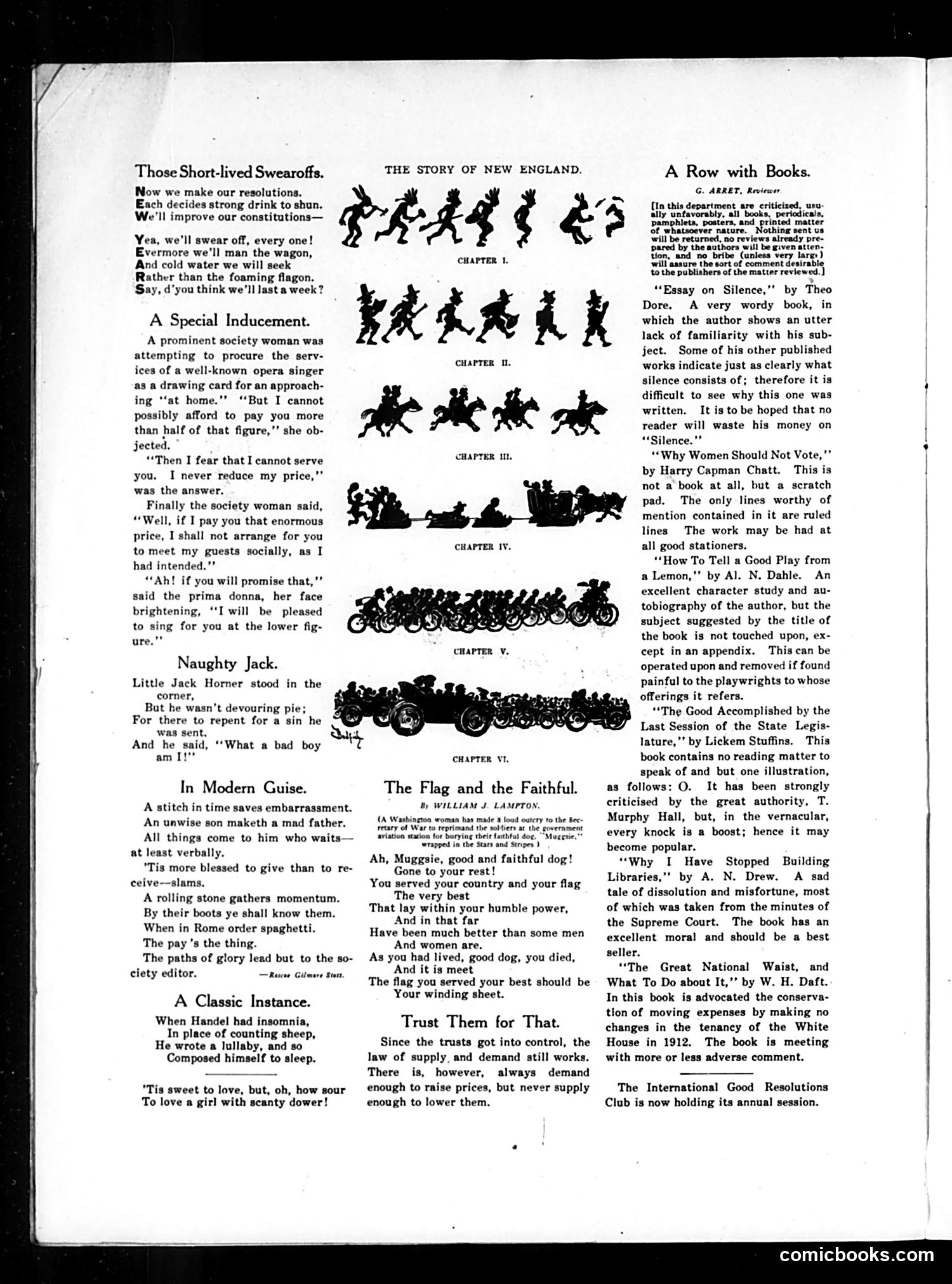
This is a mixed-content page from Judge featuring short humorous pieces and social commentary typical of early 20th-century American satire. **Key Content:** The opening poem "Those Short-lived Swearoffs" satirizes New Year's resolutions about abstinence from alcohol—suggesting readers won't maintain their pledges ("Say, d'you think we'll last a week?"). **The illustrated chapters** (I-VI) appear to depict "The Story of New England" through silhouettes showing escalating action: people running, people on horseback, people in carriages, and finally motorcycles—likely satirizing technological progress or changing social behaviors. **"The Flag and the Faithful"** is a sentimental poem about a dog buried wrapped in the American flag, used to serve country and flag. It's unclear if this is sincere patriotic sentiment or gentle mockery of excessive flag reverence. **The book review section** ("A Row with Books") mocks pretentious or poorly-written works, including one author who writes extensively *about* silence while being verbose. **Overall tone:** Light satire on social habits, technological change, patriotic excess, and intellectual pretension—the standard fare of Judge's humor.
📄 Transcribed text from this page (OCR, searchable)
Machine-transcribed from the original scan — historical spelling and the odd misread are preserved.
Those Short-lived Swearoffs. Now we make our resolutions. ~ G. ARRET, Reviewer Each decides strong drink to shun. a Up this department are criticized, uru- Wi i — ly unfavorably, 'S, pes ies We'll improve our constitutions a Dargis pours and rine matte Of whatsoever nature. Yea, we'll swear off, every one! y will be returned, no reviews already ps Evermore we'll man the wagon, And cold water we will seek Rather than the foaming flagon. Say, d’you think we'll last a week? A Special Inducement. A prominent society woman was attempting to procure the serv- ices of a well-known opera singer as a drawing card for an approach- ing ‘fat home.”’ ‘But I cannot possibly afford to pay you more than half of that figure,’’ she ob- jected. “Then I fear that I cannot serve you. I never reduce my price,’” was the answer. Finally the society woman said, “Well, if I pay you that enormous price, I shall not arrange for you to meet my guests socially, as I had intended.’” “Ah! if you will promise that,’’ said the prima donna, her face brightening, “I will be pleased to sing for you at the lower fig- ure. Naughty Jack. Little Jack Horner stood in the corner, But he wasn’t devouring pie; For there to repent for a sin he was sent. And he said, ‘‘What a bad boy am I!"" In Modern Guise. A stitch in time saves embarrassment. An unwise son maketh a mad father. All things come to him who waits— at least verbally. 'Tis more blessed to give than to re- ceive—slams, A rolling stone gathers momentum. By their boots ye shall know them. When in Rome order spaghetti. The pay ’s the thing. The paths of glory lead but to the so- ciety editor. Renee Gilmore Site A Classic Instance. When Handel had insomnia, In place of counting sheep, He wrote a lullaby, and so Composed himself to sleep. ‘Tis sweet to love, but, oh, how sour To love a girl with scanty dower! THE STORY OF NEW ENGLAND. CHAPTER 1. A Row with Books. tion, and no bribe (unless very larg) will assure the sort of comment desirable tothe publishers of the matter reviewed. ] “Essay on Silence,"’ by Theo Dore. A very wordy book, in which the author shows an utter lack of familiarity with his sub- CHAPTER 0. ject. Some of his other published works indicate just as clearly what silence consists of; therefore it is difficult to see why this one was written. It is to be hoped that no reader will waste his money on CHAPTER I, CHAPTER IV. CHAPTER VI. The Flag and the Faithful. By WILLIAM J. LAMPTON. (A Washington woman has made 2 load outcry to the Bec retary of War to reprimand the soliers at the government aviation station for barying their Luthful doe. “Mugesie.” ‘wrapped in the Sears and Senpes } Ah, Muggsie, good and faithful dog! Gone to your rest! You served your country and your flag The very best That lay within your humble power, And in that far Have been much better than some men And women are. As you had lived, good dog, you died, And it is meet The flag you served your best should be Your winding sheet. Trust Them for That. Since the trusts got into control, the law of supply, and demand still works. There is, however, always demand enough to raise prices, but never supply enough to lower them. “Silence."” “«Why Women Should Not Vote,”” by Harry Capman Chatt. This is not a book at all, but a scratch pad. The only lines worthy of mention contained in it are ruled lines The work may be had at all good stationers. ‘How To Tell a Good Play from a Lemon,”’ by Al. N, Dahle. An excellent character study and au- tobiography of the author, but the subject suggested by the title of the book is not touched upon, ex- cept in an appendix. This can be operated upon and removed if found painful to the playwrights to whose offerings it refers. “The Good Accomplished by the Last Session of the State Legis- lature,’’ by Lickem Stuffins. This book contains no reading matter to speak of and but one illustration, as follows: O. It has been strongly criticised by the great authority, T. Murphy Hall, but, in the vernacular, every knock is a boost; hence it may become popular. “Why I Have Stopped Building Libraries,” by A. N. Drew. A sad tale of dissolution and misfortune, most of which was taken from the minutes of the Supreme Court. The book has an excellent moral and should be a best seller. “The Great National Waist, and What To Do about It,’’ by W. H. Daft. In this book is advocated the conserva- tion of moving expenses by making no changes in the tenancy of the White House in 1912. The book is meeting with more or less adverse comment. The International Good Resolutions Club is now holding its annual session. comicbooks.com