
Judge, 1911-12-30 · page 5 of 25
Judge — December 30, 1911 — page 5: what you’re looking at
What you’re looking at
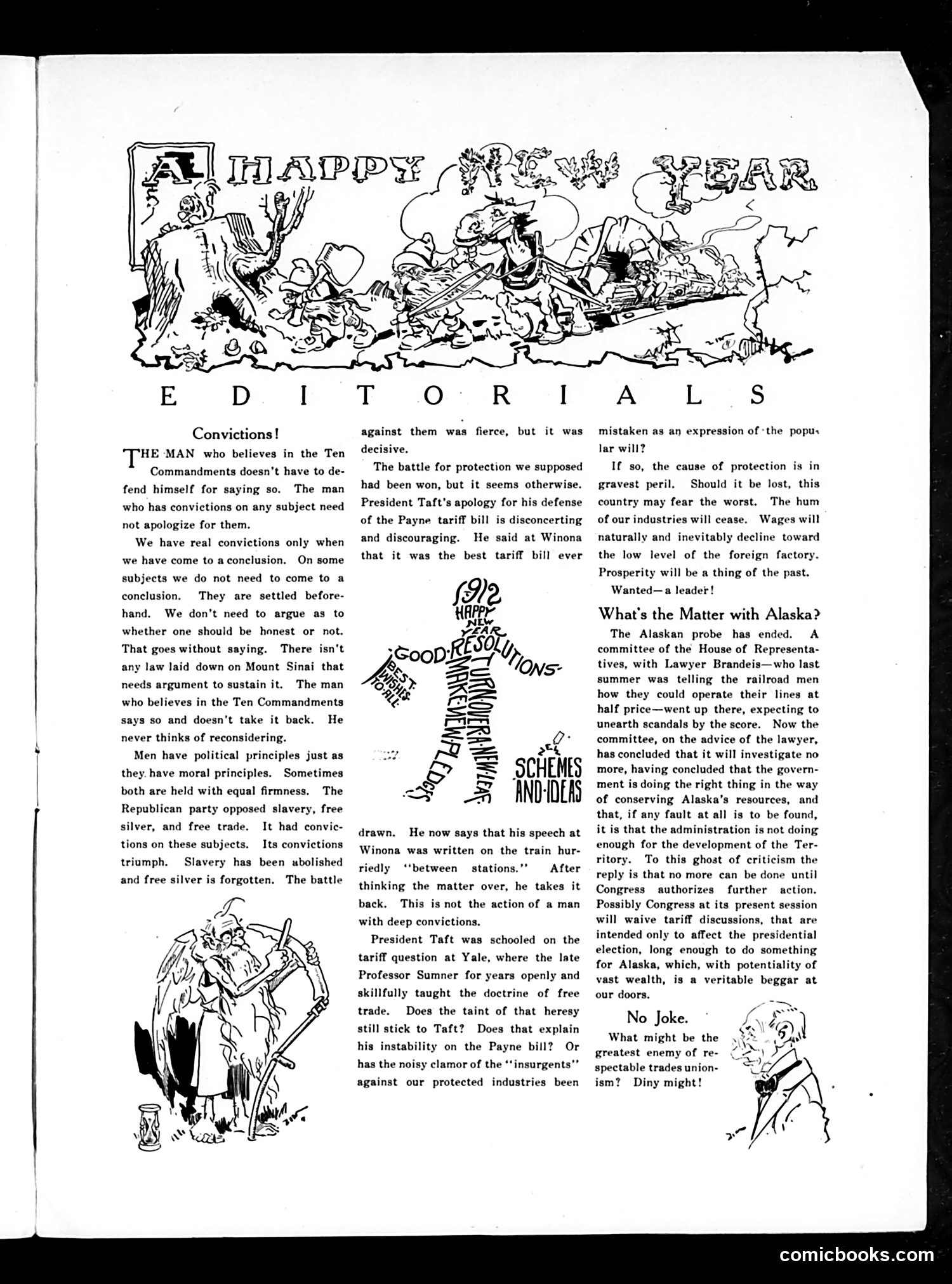
This page contains early 1912 editorial commentary attacking President William Howard Taft's policies and leadership. The main article "Convictions!" criticizes Taft for lacking firm moral principles—specifically regarding the Payne tariff bill and his defense of protective tariffs that the author sees as economically harmful. A second piece, "What's the Matter with Alaska?," mocks Taft's inaction on developing Alaska's resources, noting that Congressional committees have abandoned investigation due to administration inaction. The cartoons depict Taft as weak and indecisive. The illustrations suggest frustration with his presidency during a period of Republican Party fracturing that would culminate in the 1912 split between Taft and Theodore Roosevelt.
📄 Transcribed text from this page (OCR, searchable)
Machine-transcribed from the original scan — historical spelling and the odd misread are preserved.
~~. Convictions! HE MAN who believes in the Ten Commandments doesn’t have to de- fend himself for saying so. The man who has convictions on any subject need not apologize for them. We have real convictions only when we have come to aconclusion. On some subjects we do not need to come to a conclusion. They are settled before- hand. We don’t need to argue as to whether one should be honest or not. That goes without saying. There isn’t any law laid down on Mount Sinai that needs argument to sustain it. The man who believes in the Ten Commandments says so and doesn’t take it back. He never thinks of reconsidering. Men have political principles just as they. have moral principles. Sometimes both are held with equal firmness. The Republican party opposed slavery, free silver, and free trade. It had convic- tions on these subjects. Its convictions triumph. Slavery has been ubolished and free silver is forgotten. The battle against them was fierce, but it was decisive. The battle for protection we supposed had been won, but it seems otherwise. President Taft’s apology for his defense of the Payne tariff bill is disconcerting and discouraging. He said at Winona that it was the best tariff bill ever * BS soit <> INDE drawn. He now says that his speech at Winona was written on the train hur- riedly ‘‘between — stations.’" After thinking the matter over, he takes it back. This is not the action of a man with deep convictions. President Taft was schooled on the tariff question at Yale, where the late Professor Sumner for years openly and skillfully taught the doctrine of free trade. Does the taint of that heresy still stick to Taft? Does that explain his instability on the Payne bill? Or has the noisy clamor of the ‘‘insurgents”’ against our protected industries been mistaken as an expression of the popus lar will? If so, the cause of protection is in gravest peril. Should it be lost, this country may fear the worst. The hum of our industries will cease. Wages will naturally and inevitably decline toward the low level of the foreign factory. Prosperity will be a thing of the past. Wanted—a leader! What's the Matter with Alaska? The Alaskan probe has ended. A committee of the House of Representa- tives, with Lawyer Brandeis—who last summer was telling the railroad men how they could operate their lines at half price—went up there, expecting to unearth scandals by the score. Now the committee, on the advice of the lawyer, has concluded that it will investigate no more, having concluded that the govern- ment is doing the right thing in the way of conserving Alaska’s resources, and that, if any fault at all is to be found, it is that the administration is not doing enough for the development of the Ter- ritory. To this ghost of criticism the reply is that no more can be done until Congress authorizes further action. Possibly Congress at its present session will waive tariff discussions, that are intended only to affect the presidential election, long enough to do something for Alaska, which, with potentiality of vast wealth, is a veritable beggar at our doors. No Joke. What might be the greatest enemy of re- spectable trades union- ism? Diny might! comicbooks.com