
A complete issue · 28 pages · 1911
Judge — December 9, 1911
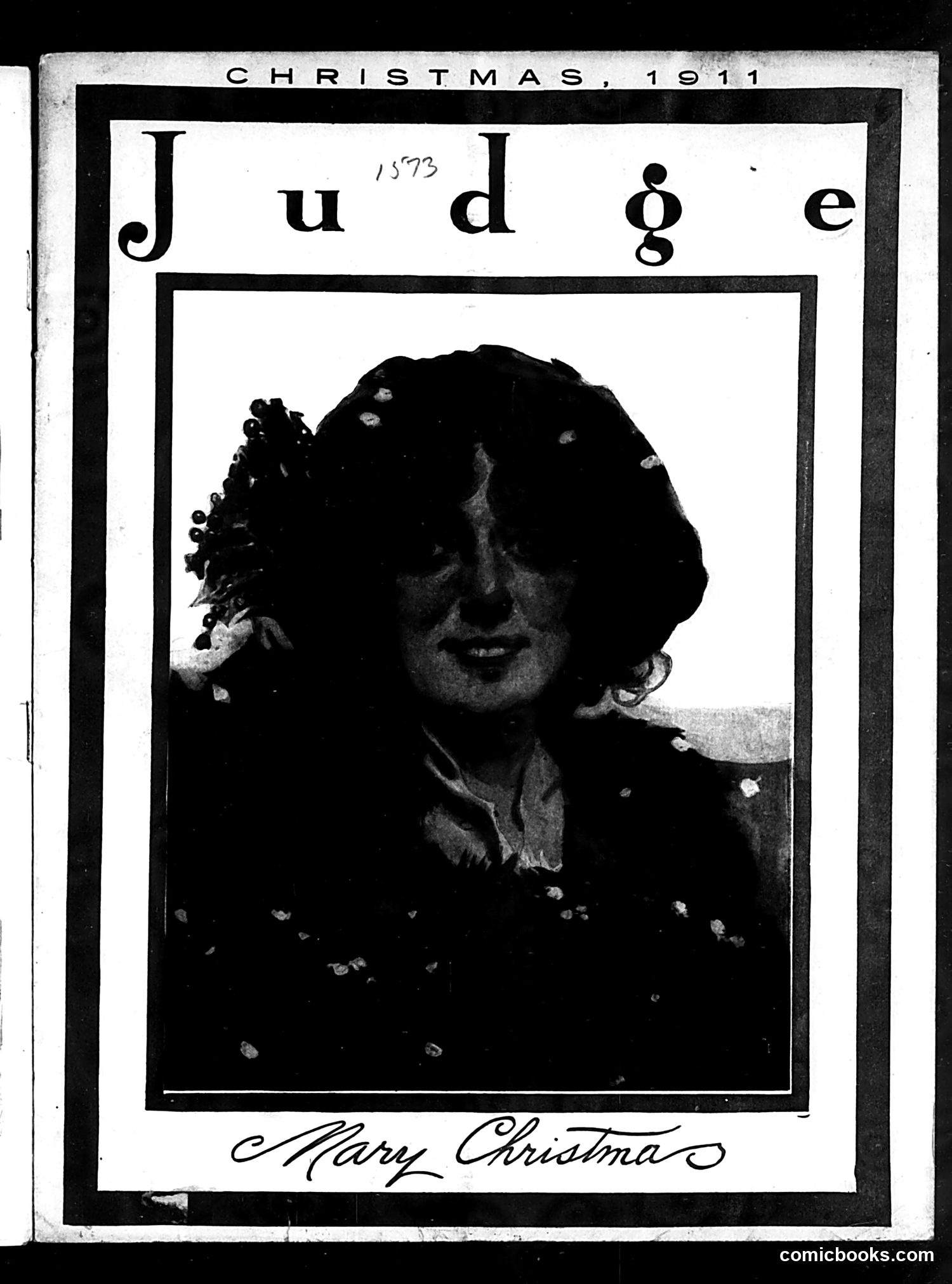
This appears to be a Christmas greeting page from Judge magazine's 1911 holiday issue. The page features a portrait photograph of a woman with short, curled dark hair wearing an ornate, beaded or sequined dark garment typical of early 1900s fashion. The word "Judge" appears at the top, and "Merry Christmas" is written in cursive script at the bottom. Without additional context or identifying captions, I cannot definitively state who this woman is meant to represent. The photograph style and formal presentation suggest she may have been a notable public figure, entertainer, or socialite of the period, but I cannot confirm her identity based solely on the image itself.
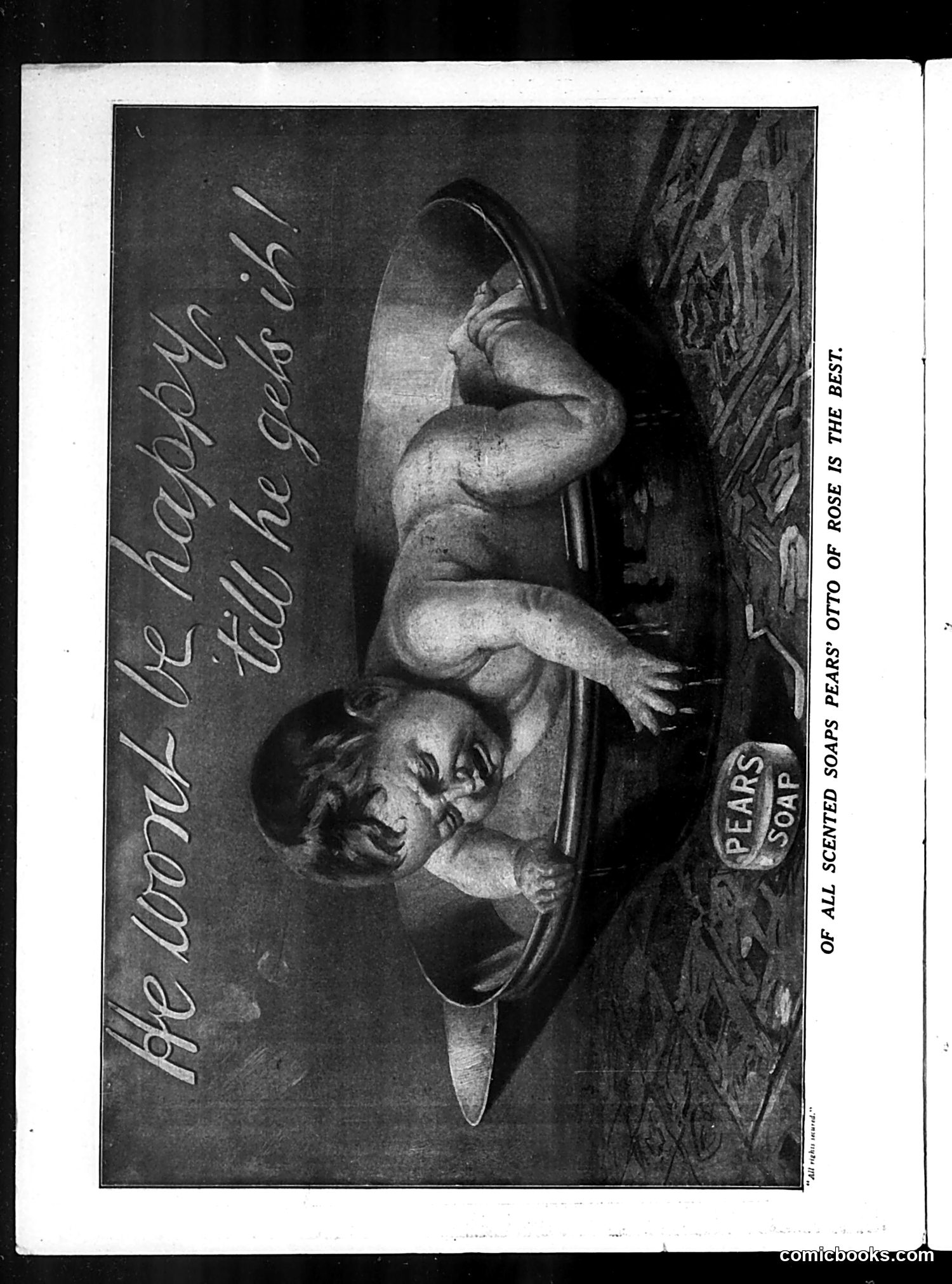
This appears to be a Pears' Soap advertisement featuring a caricatured figure holding a large bar of soap. The text reads "He won't be happy till he gets it" - a famous Pears' advertising slogan from the late 19th/early 20th century. The image shows an exaggerated caricature of what appears to be a figure in period dress, styled in a way typical of Judge magazine's satirical approach. However, without clearer identification of the specific figure or accompanying article text, I cannot definitively state who is being caricatured or what particular political/social commentary this represents beyond the obvious soap advertisement. The caption on the right confirms this is promotional material for Pears' Soap, making this primarily a commercial advertisement rather than political satire.
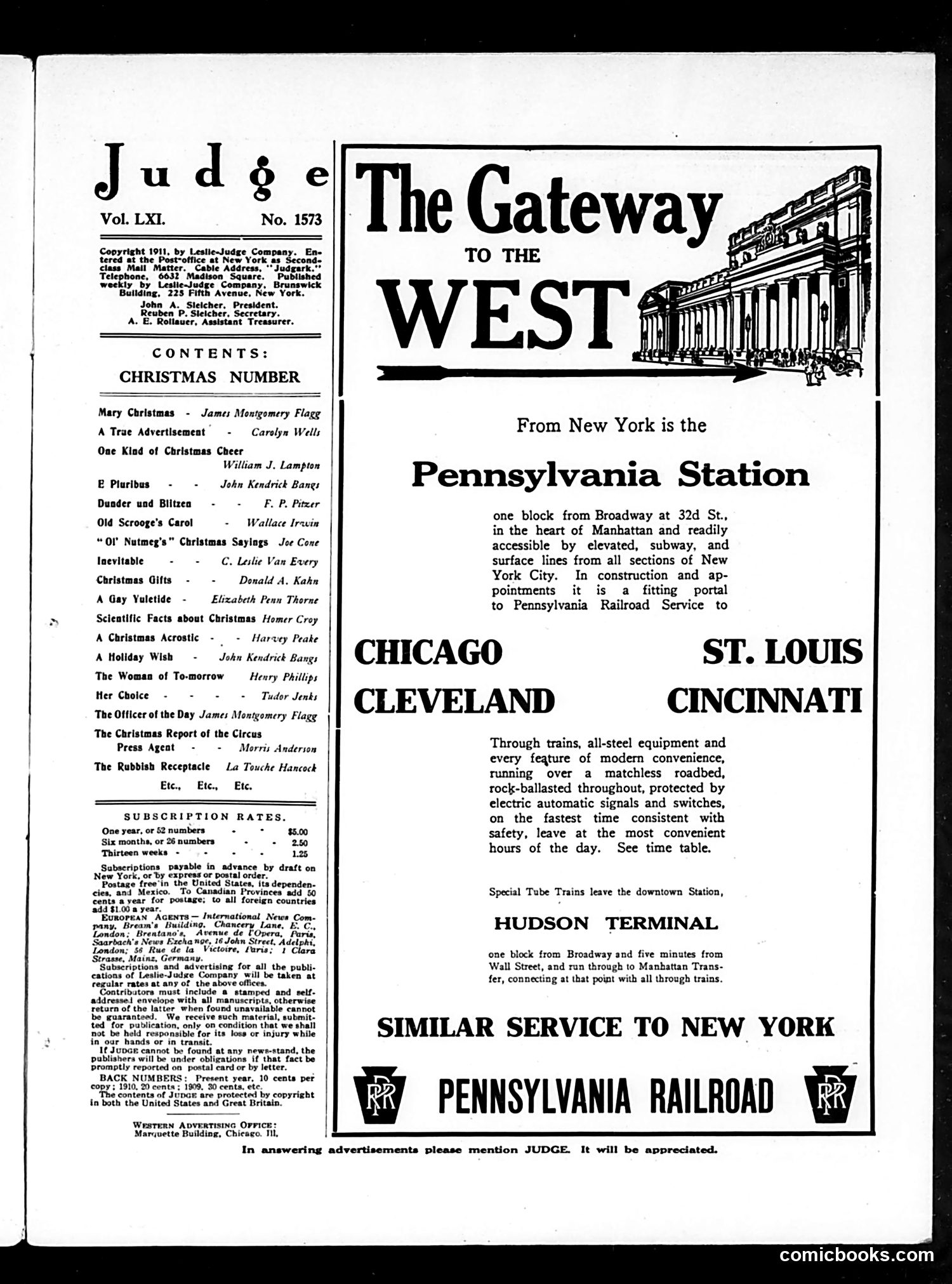
This page is **primarily a Pennsylvania Railroad advertisement** for "The Gateway to the West," promoting rail service from New York to Chicago, St. Louis, Cleveland, and Cincinnati via the Pennsylvania Station. The upper left contains a **contents page for Judge's Christmas Number**, listing holiday-themed articles and stories by various authors (James Montgomery Flagg, Carolyn Wells, etc.). These appear to be traditional Christmas fare rather than political satire. **No political cartoons or caricatures are visible** on this page. The only illustration is an architectural rendering of Pennsylvania Station itself—a straightforward promotional image showing the building's classical facade with pedestrians. This is essentially a **holiday magazine contents listing combined with corporate advertising**, not satirical political commentary.
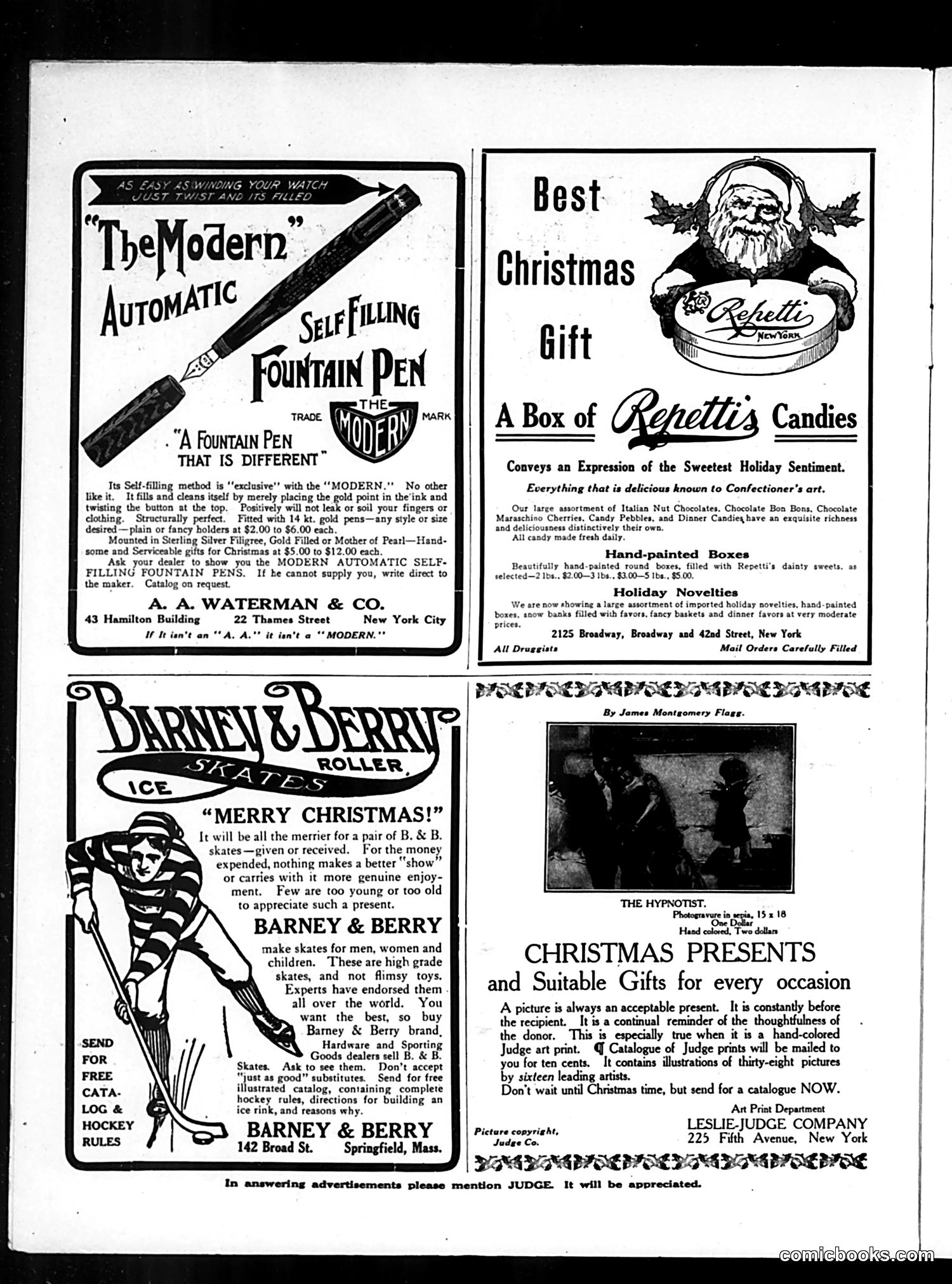
This page is **primarily advertising**, not political satire. It contains four vintage Christmas gift advertisements from approximately the early 20th century: 1. **"The Modern" Automatic Self-Filling Fountain Pen** — marketed as an exclusive writing instrument 2. **Repetti's Candies** — Italian chocolates and confections positioned as an upscale holiday gift 3. **Barney & Berry Ice Roller Skates** — sporting equipment advertised as suitable for children and families 4. **Leslie-Judge Company Art Prints** — hand-colored judge art prints marketed as affordable gift alternatives The page also includes "The Hypnotist," a photograph or illustration credited to James Montgomery Flagg, likely unrelated to the advertisements. **No political cartoons or satire appear on this page.** It represents Judge magazine's commercial content rather than its editorial voice.
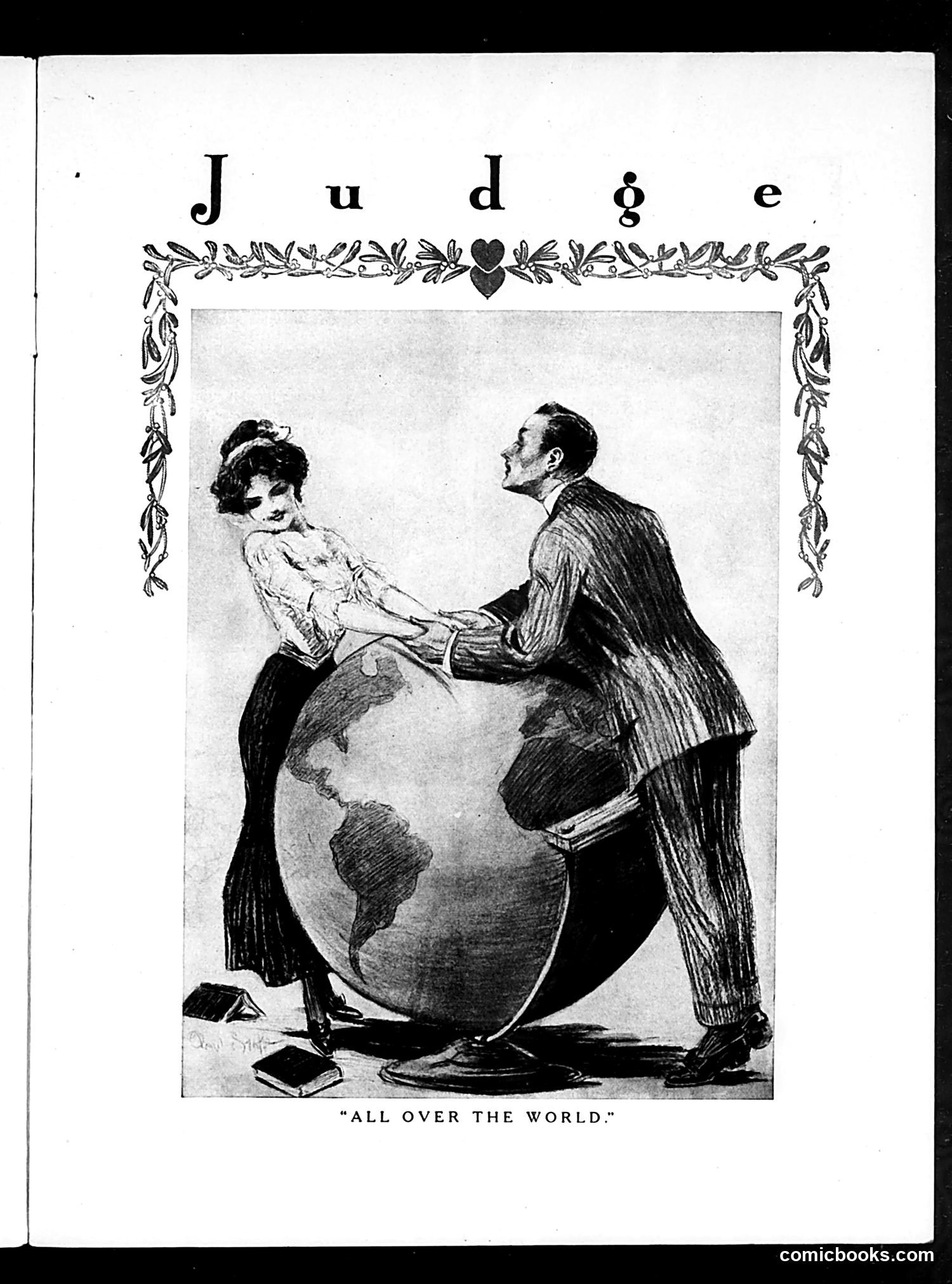
This satirical cartoon depicts a couple embracing over a globe, illustrating romantic or matrimonial entanglement on a global scale. The caption "All Over the World" suggests the cartoonist is commenting on widespread courtship, marriage, or romantic relationships as a universal human phenomenon crossing all borders and continents. The woman appears fashionably dressed in early 20th-century attire, while the man wears formal business clothing. The globe emphasizes the worldwide nature of the subject. Without additional context about the specific date or publication, the precise political or social reference remains unclear, though the cartoon likely satirizes either the universality of romance or perhaps international diplomatic/business relationships conducted between nations personified as courting figures.
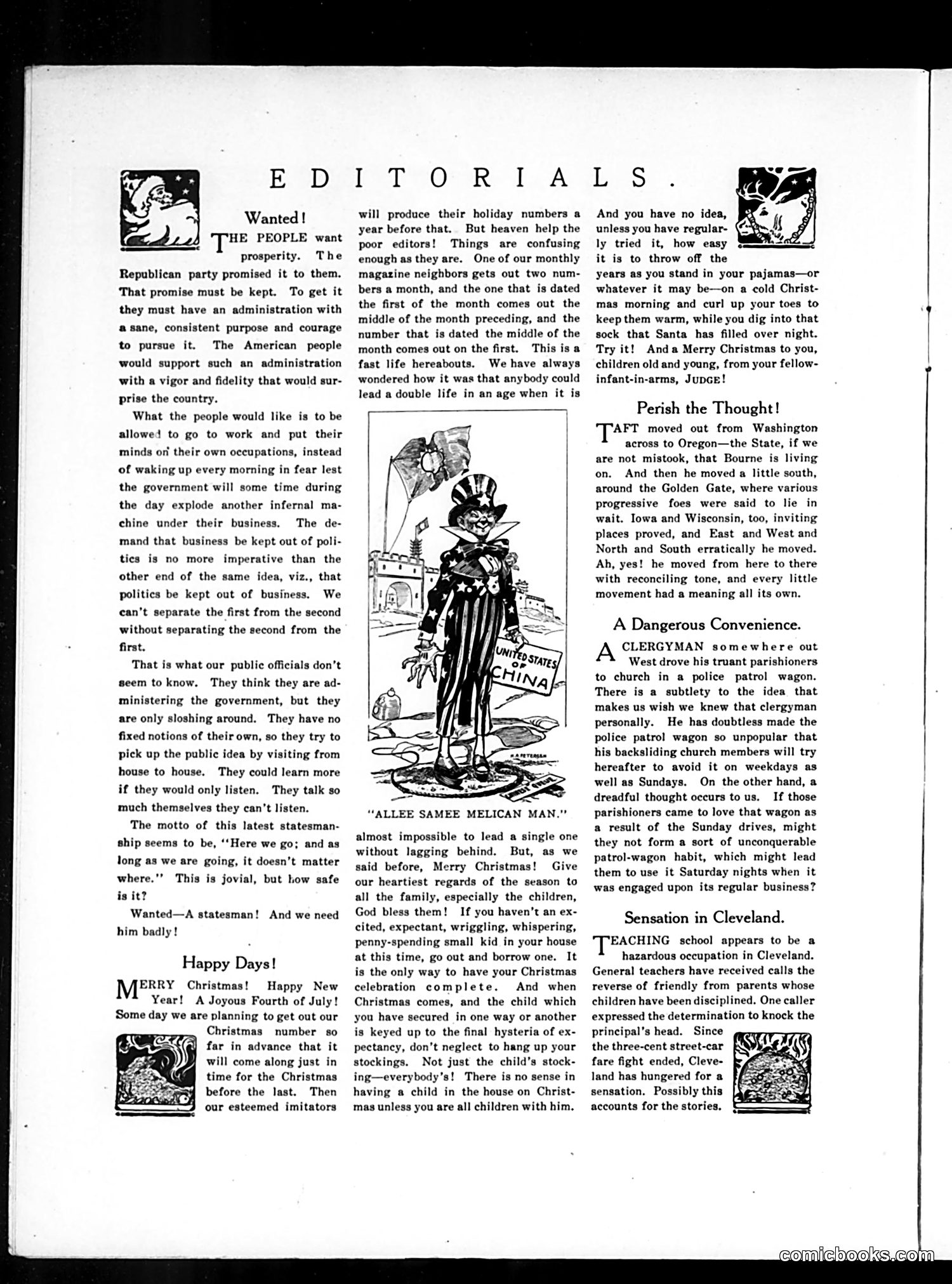
This editorial page from Judge magazine contains political commentary and holiday content, likely from around 1909-1912 (the Progressive Era). **Main Editorial ("Wanted!"):** Criticizes the Republican administration for lacking clear purpose and business acumen. It demands that politics stay out of business and vice versa—government officials should have fixed principles rather than constantly seeking public approval by "visiting from house to house." The piece attacks the administration's indecisiveness, calling for "a statesman." **"Allee Samee Melican Man" Cartoon:** The central illustration depicts Uncle Sam juggling various international concerns (likely China, based on the caption), satirizing American foreign policy's scattered, unprincipled approach—mirroring the editorial's complaint about administrative confusion. **Other Sections:** Include holiday greetings and light commentary about magazine publishing schedules, with a reference to someone named "Taft" moving around (likely President William Howard Taft or a political figure), and discussion of Progressive movement figures. The page advocates for coherent Republican governance while mocking existing administration fumbling.
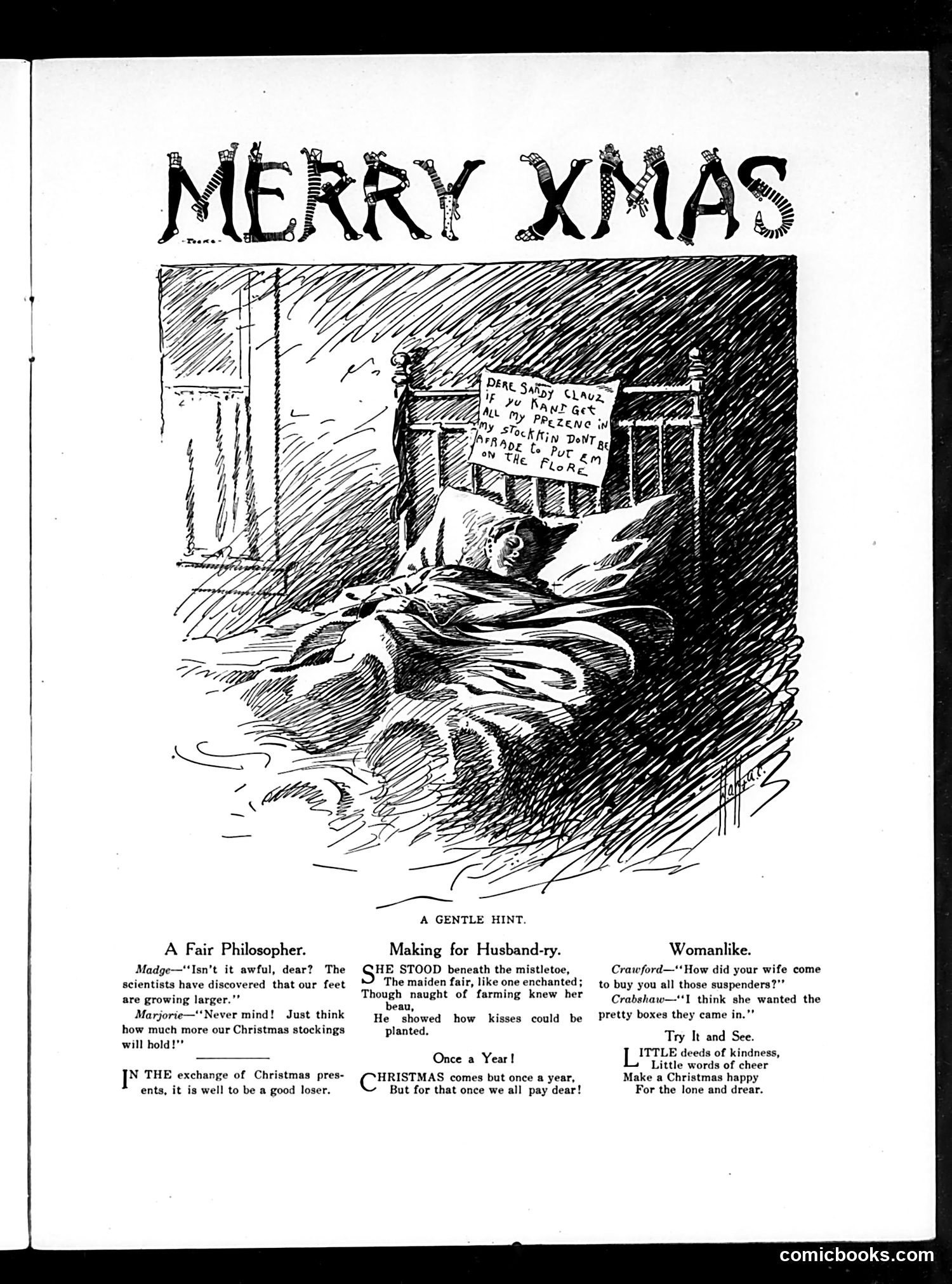
This page collects brief satirical quips and a central cartoon, all targeting gender stereotypes of the early 20th century. **The main illustration** shows Santa Claus in bed with a sign listing Christmas demands—a domestic complaint about wives' expanding holiday expectations and expense. **The surrounding jokes mock traditional gender roles:** - Women are portrayed as illogical (celebrating larger feet for bigger stockings) - A young woman under mistletoe is seduced by farming talk, satirizing rural courtship rituals - A wife supposedly buys suspenders just for their packaging, suggesting female materialism and poor judgment - The final sentiment about Christmas kindness appears sincere, contrasting with the cynicism above **The satire targets:** the commercialization of Christmas, marital discord (husbands resenting wives' spending), and the era's common caricatures of female frivolity and materialism. The humor assumes a male readership sympathetic to these domestic complaints. This reflects Judge's typical demographic and editorial perspective—affluent, male-oriented social criticism wrapped in holiday packaging.
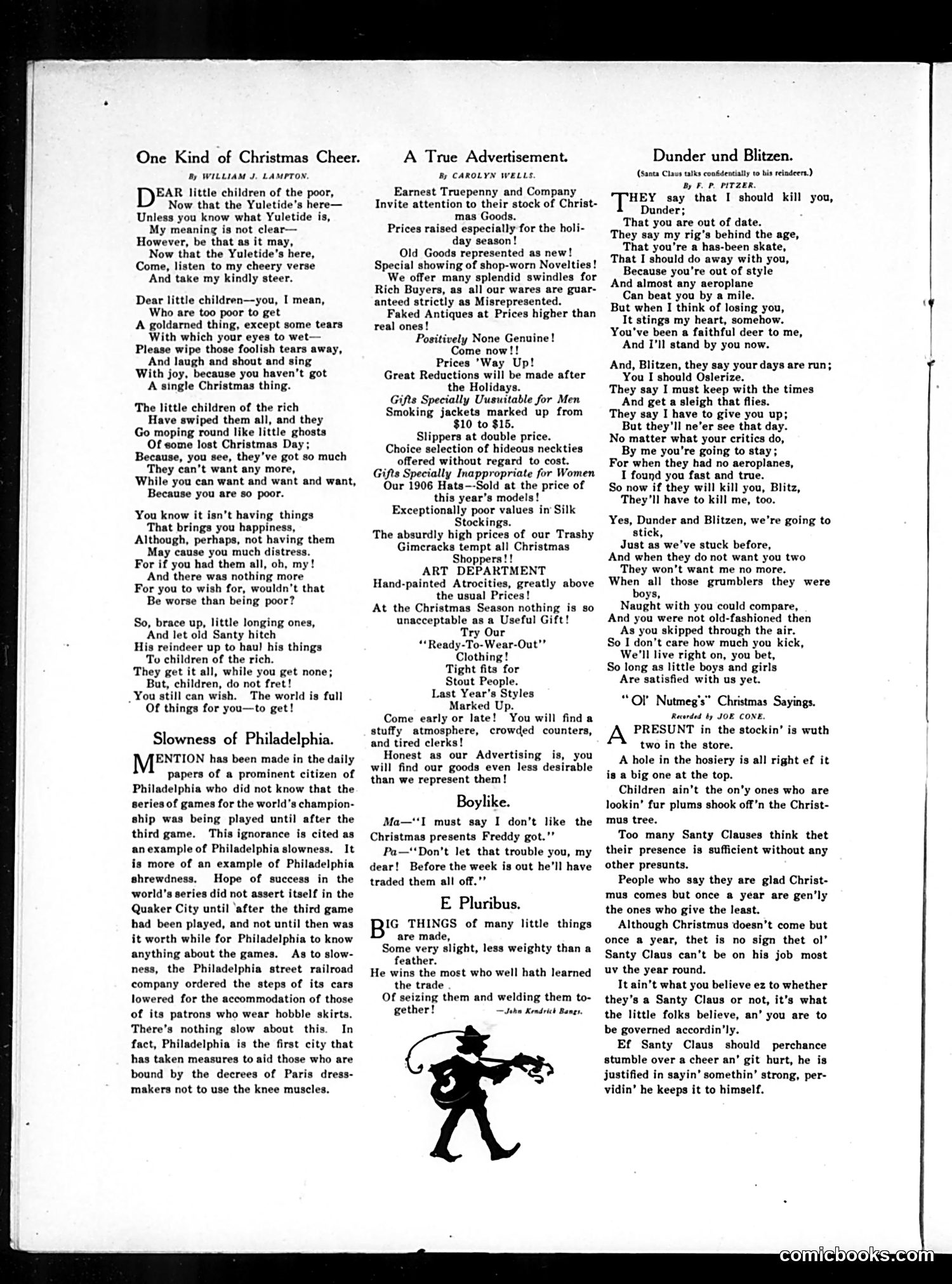
This page contains satirical poetry and a fake advertisement mocking Christmas commercialism and consumer culture circa 1906-1910. **"One Kind of Christmas Cheer"** is ironic social commentary: the poet "consoles" poor children by suggesting their poverty is actually advantageous—they can still *want* things, unlike rich children who have everything and thus want nothing. The satire targets both class inequality and hollow consolations offered to the poor. **"A True Advertisement"** by Carolyn Wells is mock-honest marketing that reveals actual retail practices: inflated holiday prices, old merchandise presented as new, shoddy goods, last year's fashions marked up. The store proudly advertises "Faked Antiques," "Positively None Genuine," and "Uusuitable" gifts—admitting to deliberate deception. This satirizes how retailers exploited Christmas shopping season by raising prices and passing off inferior merchandise. The small **silhouette cartoon** (bottom center) shows a mischievous figure, likely representing commercial greed or consumer folly. The remaining articles discuss Philadelphia's alleged slowness and hobble skirts—period fashion references—but are less clearly satirical.
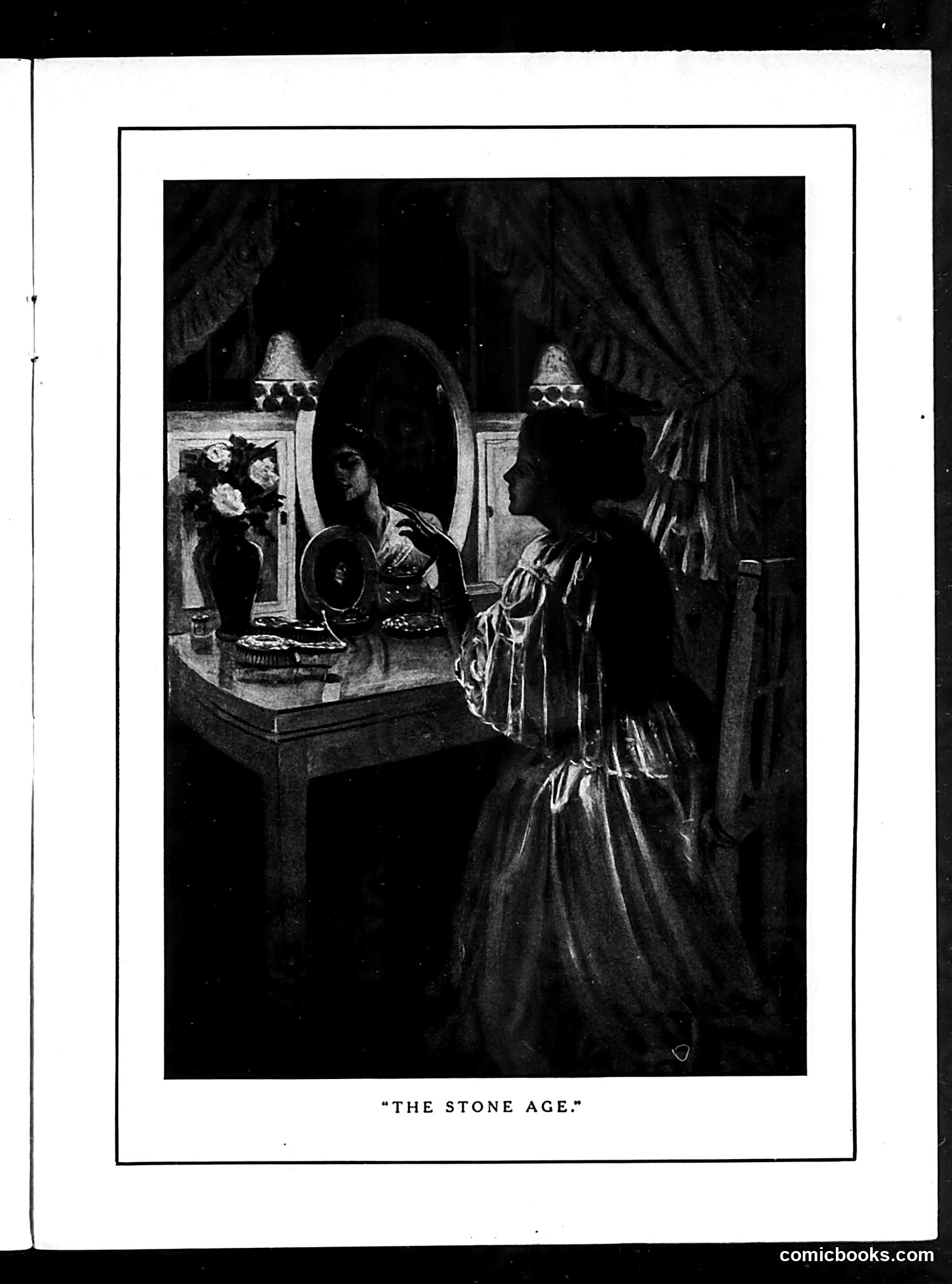
This is a satirical illustration from *Judge* magazine showing a woman at her vanity mirror, applying makeup or grooming herself. The title "The Stone Age" appears to be a pun—likely commenting on women's use of cosmetics or beauty products made with mineral/stone-based ingredients that were common in the era. The image's dark, dramatic lighting and the woman's elaborate dress suggest this is satirizing contemporary beauty practices or vanity among wealthy women. The joke likely critiques either the excessive use of cosmetics, the ingredients in beauty products, or the time/obsession women devoted to their appearance—a common theme in *Judge*'s satirical commentary on social behavior and gender roles of the period.
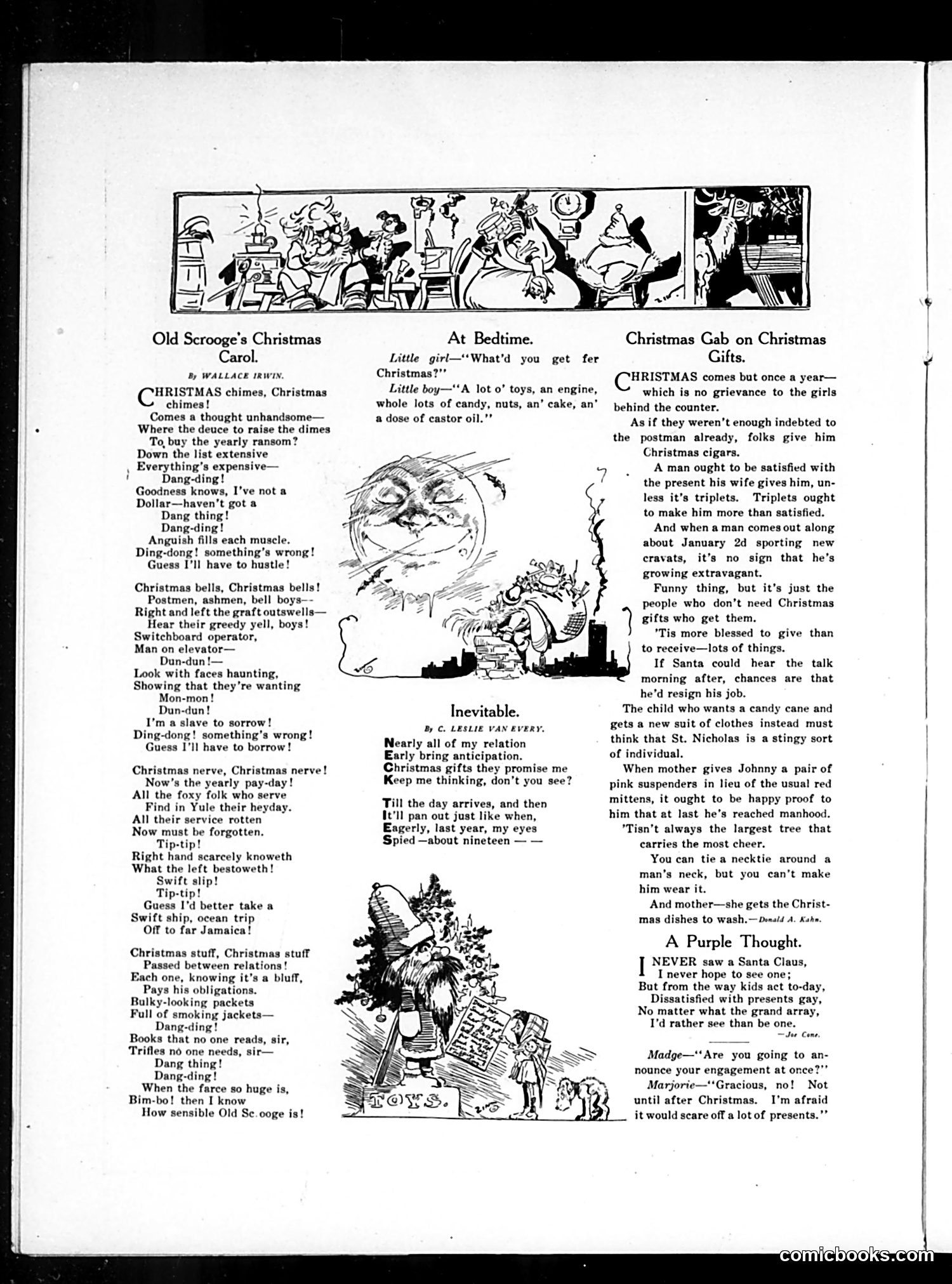
This page contains several Christmas-themed satirical pieces from an early 20th-century American magazine: **"Old Scrooge's Christmas Carol"** (by Wallace Irwin) is a cynical poem mocking the commercialization of Christmas. It depicts a financially-stressed man overwhelmed by mandatory tipping and gift-giving obligations to servants, postmen, elevator operators, and relatives—lamenting he must "borrow" money or flee to Jamaica to afford the season's expenses. **"Christmas Gab on Christmas Gifts"** offers biting social commentary on gift-giving hypocrisy: people give unwanted items, mothers give impractical clothes instead of desired gifts, and men receive gifts (like pink suspenders) that don't suit them. The piece sarcastically notes that those "who don't need Christmas gifts" receive them anyway. **"Inevitable"** humorously captures children's annual disappointment when anticipated Christmas gifts fail to materialize as hoped. The cartoons illustrate these domestic tensions with exaggerated characters amid holiday chaos. Overall, the page satirizes Christmas excess, obligatory spending, social pretense, and the gap between holiday expectations and reality—themes surprisingly relevant today.
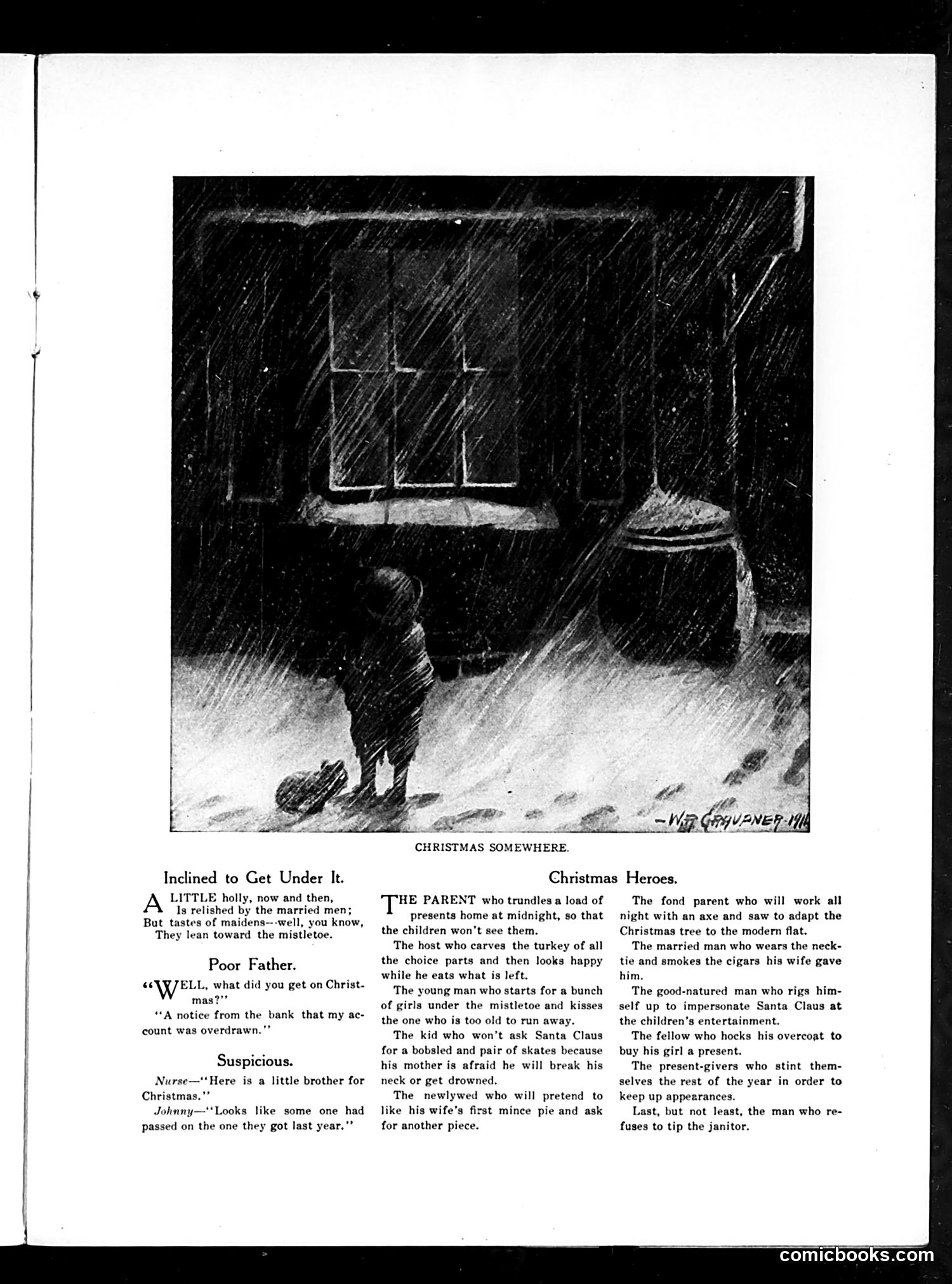
This page from *Judge* presents holiday humor mocking Christmas sentimentality and middle-class pretense. The top cartoon shows a child looking at a lit window in snow—titled "Christmas Somewhere"—implying contrast between ideal Christmas imagery and harsh reality. Below are four satirical vignettes: **"Poor Father"** jokes about married men enjoying holiday treats (holly, mistletoe) while unmarried men don't. **"Suspicious"** has a nurse presenting a newborn as a Christmas gift; the child Johnny suspects it's a replacement for a sibling who died. **"Christmas Heroes"** is the main text—a lengthy list of ironic "heroes" describing hypocritical or financially strained people: parents hiding presents, miserly hosts, cheapskate gift-givers, men hocking coats for presents, and servants refusing tips. The satire targets the gap between Christmas's idealized image and actual behavior—exposing vanity, financial anxiety, and moral compromises among the middle and upper classes trying to maintain appearances during the holiday season.
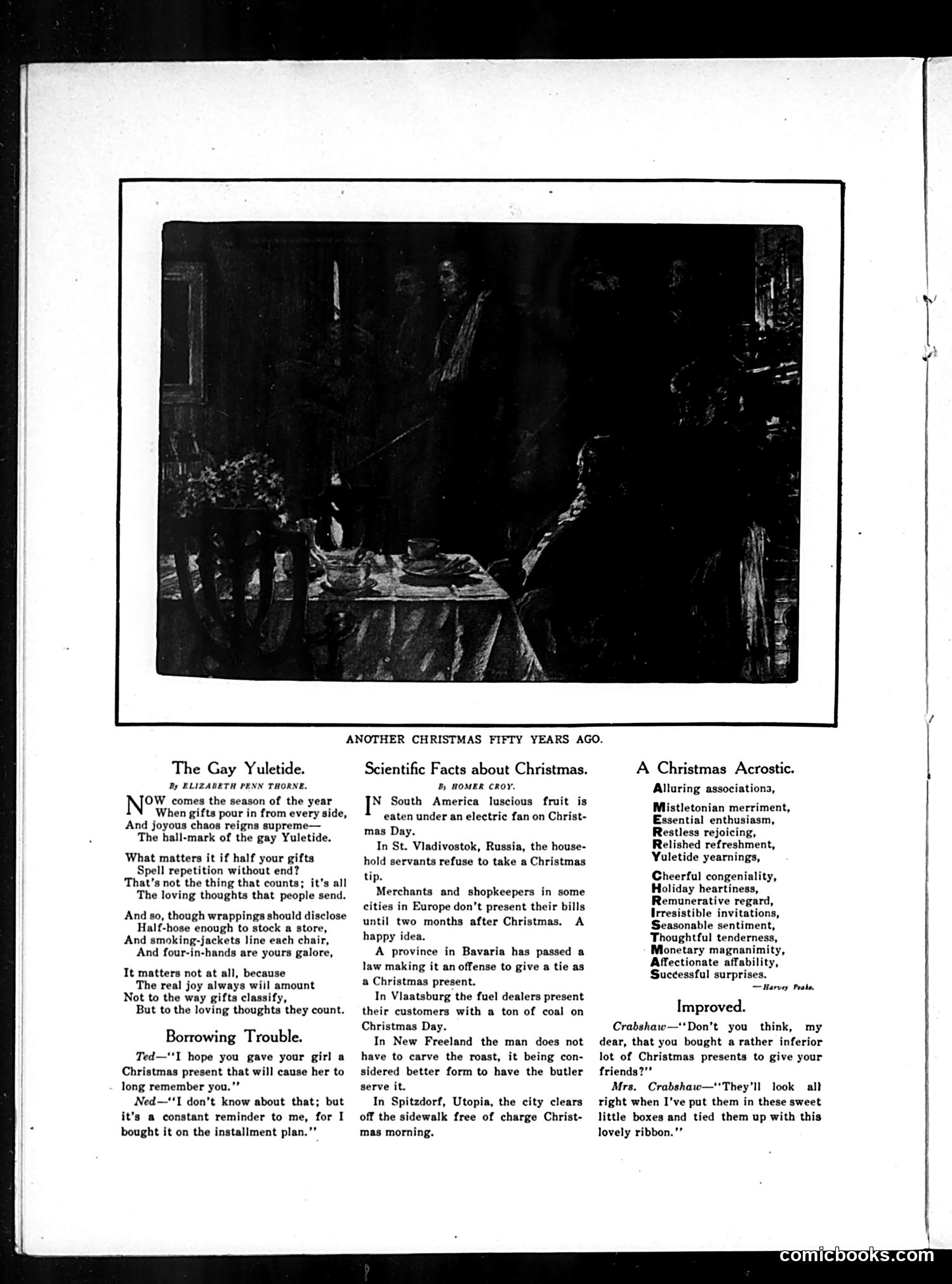
This page contains **three humorous Christmas pieces** rather than political cartoons: 1. **"The Gay Yuletide"** (poem): Satirizes the commercialization of Christmas gift-giving—the irony that people receive duplicate presents (multiple pairs of socks, smoking jackets, ties) yet claim the "loving thoughts" matter most, not the actual gifts. 2. **"Borrowing Trouble"** (dialogue joke): A brief comic exchange where "Ned" reveals his Christmas gift to his girlfriend causes *him* endless financial pain through installment payments, turning the romantic gesture into a personal burden. 3. **"Scientific Facts about Christmas"** (satire): Mock "facts" from fictional places (Utopia, Spitzdorf) poke fun at Christmas customs—Bavaria banning ties as gifts, servants refusing tips in Russia, butlers carving roasts in "New Freeland." The humor lies in absurdist inversion of real practices. 4. **"Improved"** (dialogue): Mrs. Crabshaw admits her inferior Christmas gifts will appear acceptable once wrapped nicely—satirizing superficial presentation over substance. The page collectively mocks the gap between Christmas ideals and commercial reality, cheap gift-giving disguised by wrapping, and the financial strain of holiday obligations.
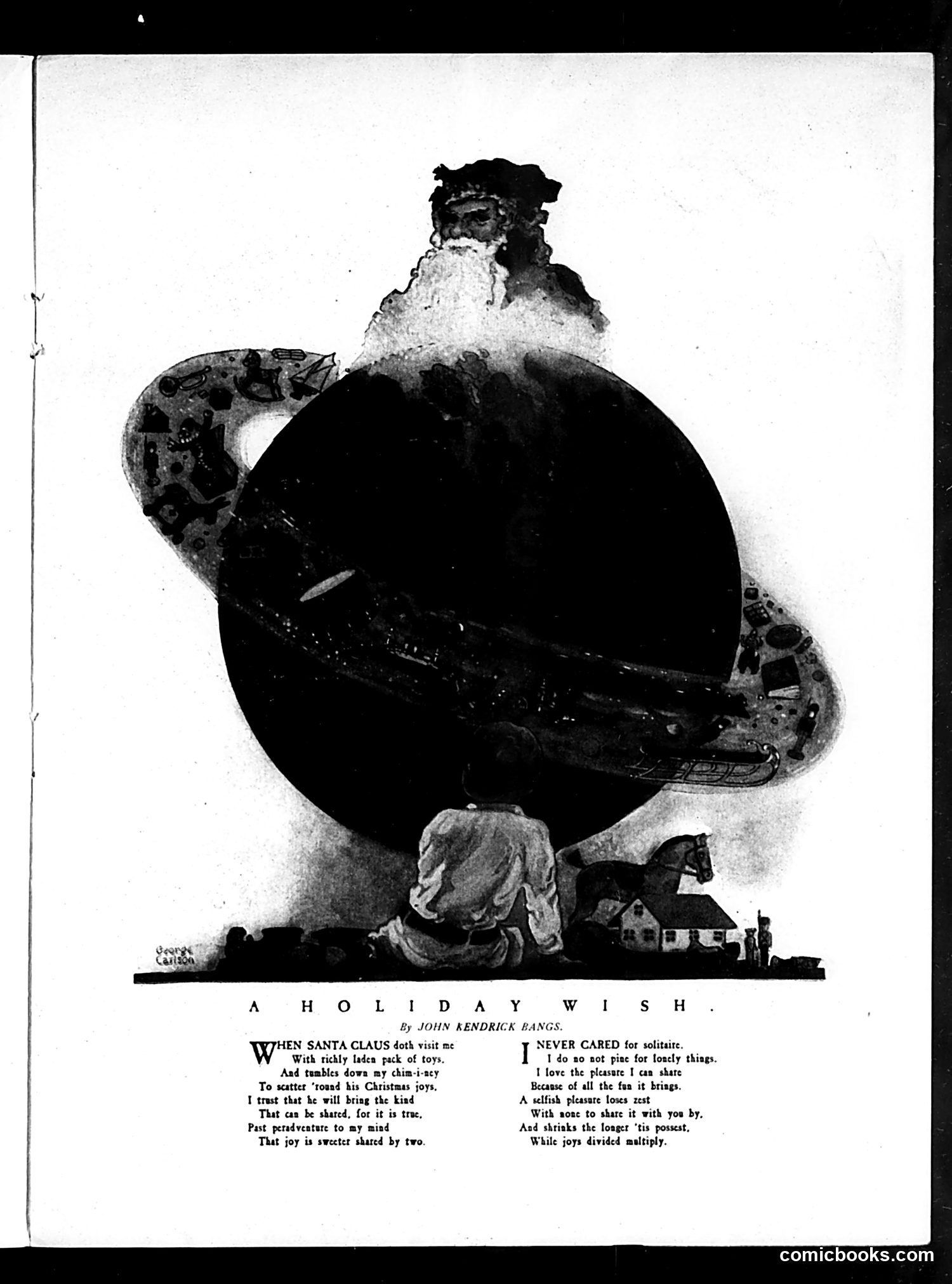
This is a sentimental Christmas poem paired with an illustration of Santa Claus descending a chimney with his bag of toys. The image shows Santa at the top of the composition, with a winter cottage scene below. The poem's theme emphasizes shared joy over solitary pleasure—a common Victorian-era moral lesson. Santa represents generosity and the Christmas spirit of giving. The text contrasts selfish enjoyment ("solitaire," "lonely things") with the multiplied happiness that comes from sharing gifts and experiences with others. For a Judge magazine audience, this likely served as wholesome holiday content promoting family values and togetherness during the Christmas season, contrasting with the magazine's typical satirical fare. The John Kendrick Bangs byline suggests quality literary contribution to the publication.
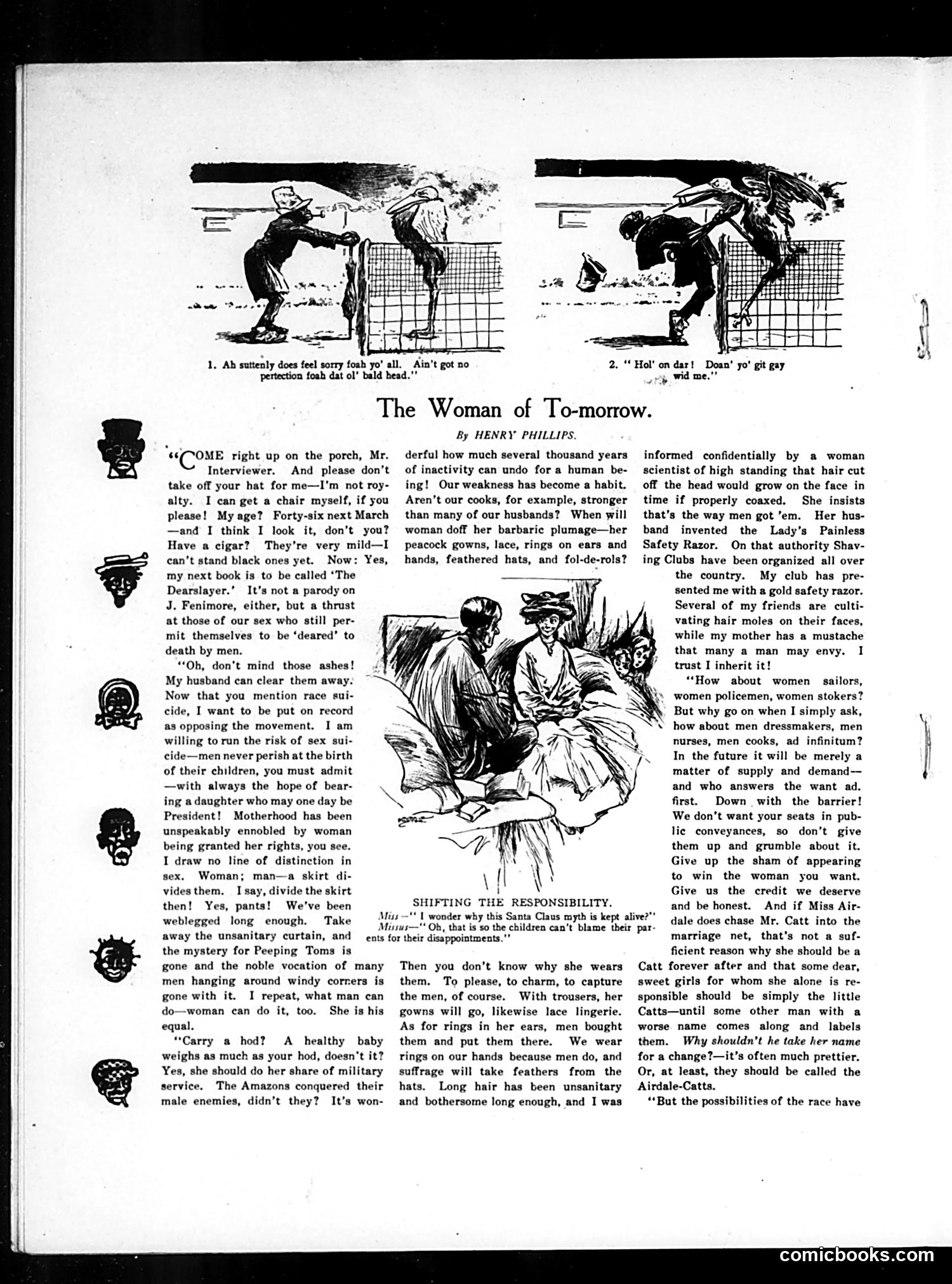
This page satirizes early-20th-century feminism and women's suffrage advocates through an interview with an exaggerated "New Woman" character who advocates radical gender equality. The satirist (Henry Phillips) mocks feminist positions by having the woman propose absurdities: women wearing pants and joining the military, abandoning ornamental dress, growing facial hair, working as sailors and stokers. The accompanying small cartoons (top) use racist dialect humor typical of the era's Judge magazine. A secondary joke ridiculing women appears in the "Shifting Responsibility" section: a woman admits she wears jewelry and cosmetics solely to attract men—undermining the feminist speaker's claims of rejecting "barbaric plumage." The satire's target: portraying suffragists as unreasonable extremists whose demands extend beyond voting into absurd territory. The tone suggests Judge magazine viewed women's equality advocacy as both ridiculous and threatening to traditional gender roles—a common conservative reaction to 1910s-era feminism.
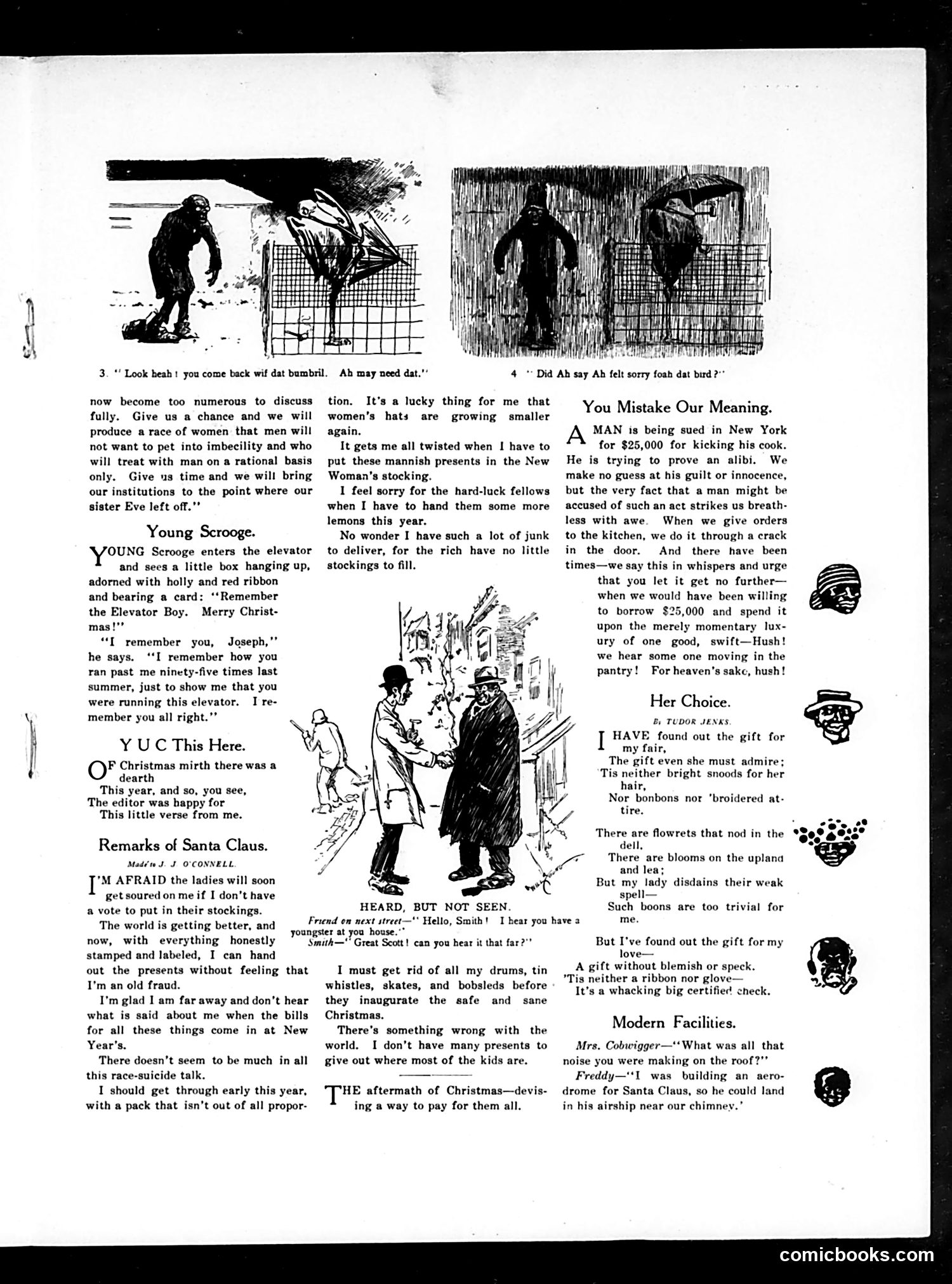
This page contains multiple satirical pieces addressing early 20th-century American social issues: **"Young Scrooge"** mocks wealthy misers who exploit service workers—a man refuses to tip an elevator operator who previously annoyed him. **"Remarks of Santa Claus"** satirizes women's rights and changing gender roles. Santa complains about fitting "mannish presents" into "New Woman's stockings," references the "race-suicide" debate (concerns about declining birth rates among educated women), and jokes about women's suffrage ("ladies will soon get soured on me if I don't have a vote"). **"You Mistake Our Meaning"** humorously describes the speaker's fantasy of kicking his cook, framed as sympathy for a man sued for doing so—satirizing class relations and servants. **"Her Choice"** is a poem about finding the perfect gift: money ("certified check"). The sketches labeled 3 and 4 appear to show dialect humor, likely stereotypical African American characters, typical of this era's problematic cartooning. Overall, the page reflects contemporary anxieties about women's independence, labor relations, and modern life.
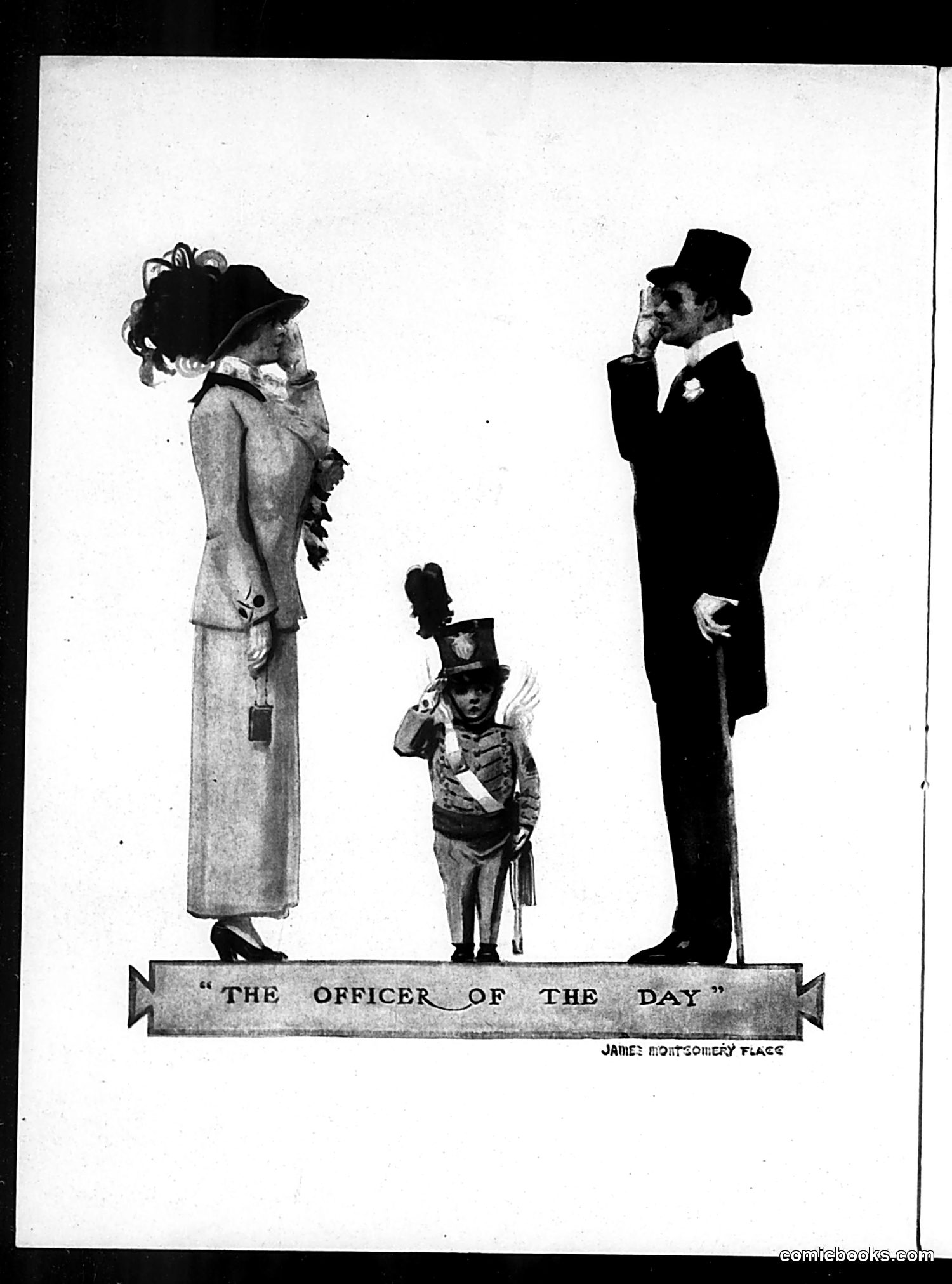
This illustration by James Montgomery Flagg depicts three figures in formal attire arranged by height: a tall woman on the left, a small child in military dress in the center, and a tall man in a top hat on the right. The title "The Officer of the Day" appears to be satirizing the contrast between proper military hierarchy and the absurdity of placing a child in an official military position. The woman holds what appears to be a small dog, adding to the comedic juxtaposition of domestic life with military formality. The satire likely comments on incompetence in military leadership or appointments of the era, using the visual absurdity of a child "officer" flanked by civilians to mock the serious business of military command.
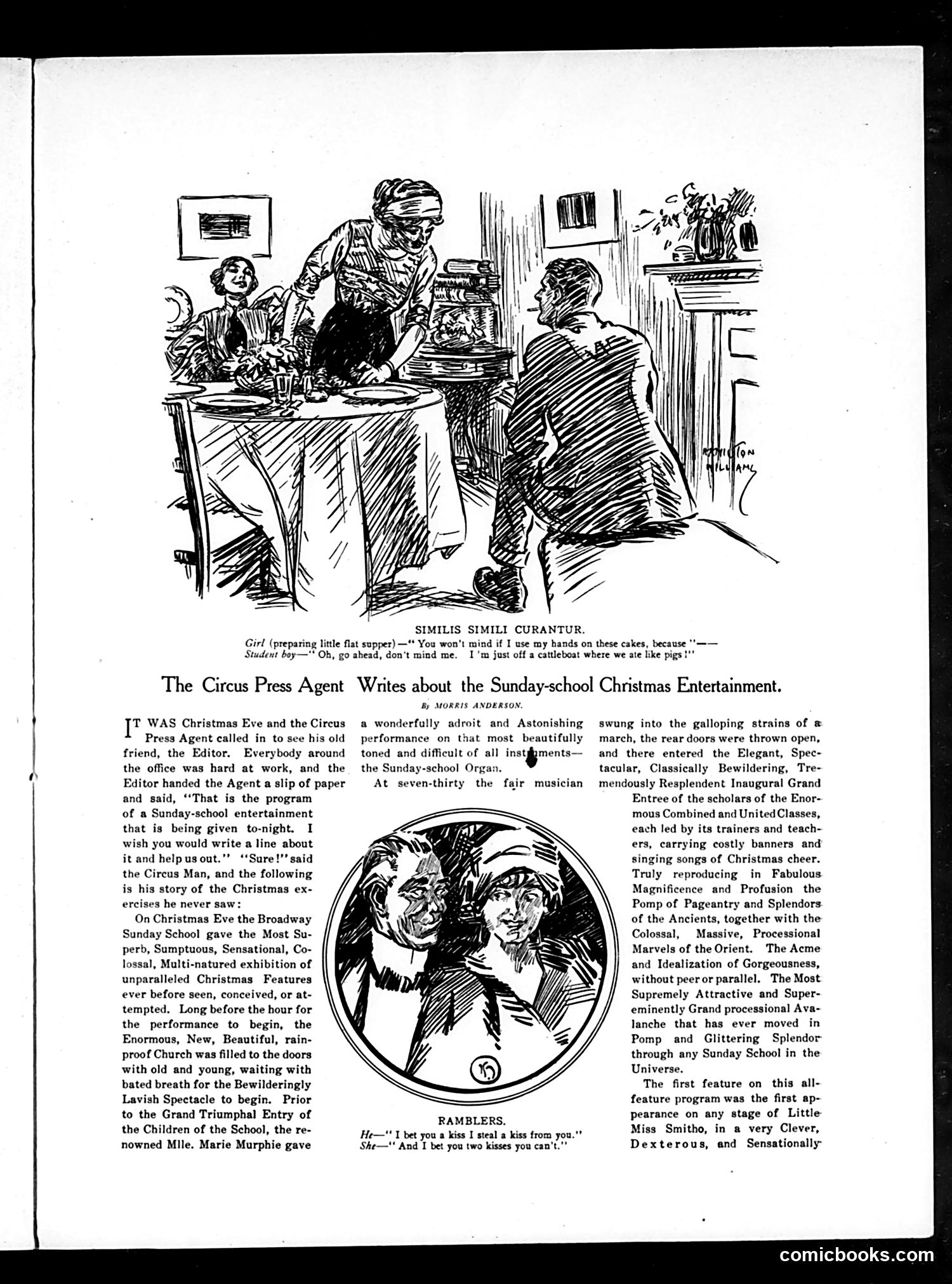
This page contains two separate satirical pieces from Judge magazine: **Top cartoon ("Similis Simili Curantur")**: A domestic humor sketch about a girl preparing food while a student visitor arrives. The Latin title means "like cures like"—the joke being that the girl offers to handle the food with her bare hands, and the boy doesn't object because he's just arrived from a cattle boat where rough conditions meant eating poorly. **Main article**: A more pointed satire about a circus press agent who fabricates an wildly exaggerated account of a modest Sunday-school Christmas program. The agent never actually attended but writes absurdly inflated descriptions—calling a simple children's event a "Colossal, Multi-natured exhibition" with "Pomp and Glittering Splendor." The satire mocks both: 1. **Sensationalist journalism** of the era, where press agents and newspapers routinely embellished or invented details 2. **Circus publicity tactics**—known for outrageous hype—applied to mundane community events The humor lies in the gap between the humble reality (a local school program) and the overwrought theatrical language used to describe it.
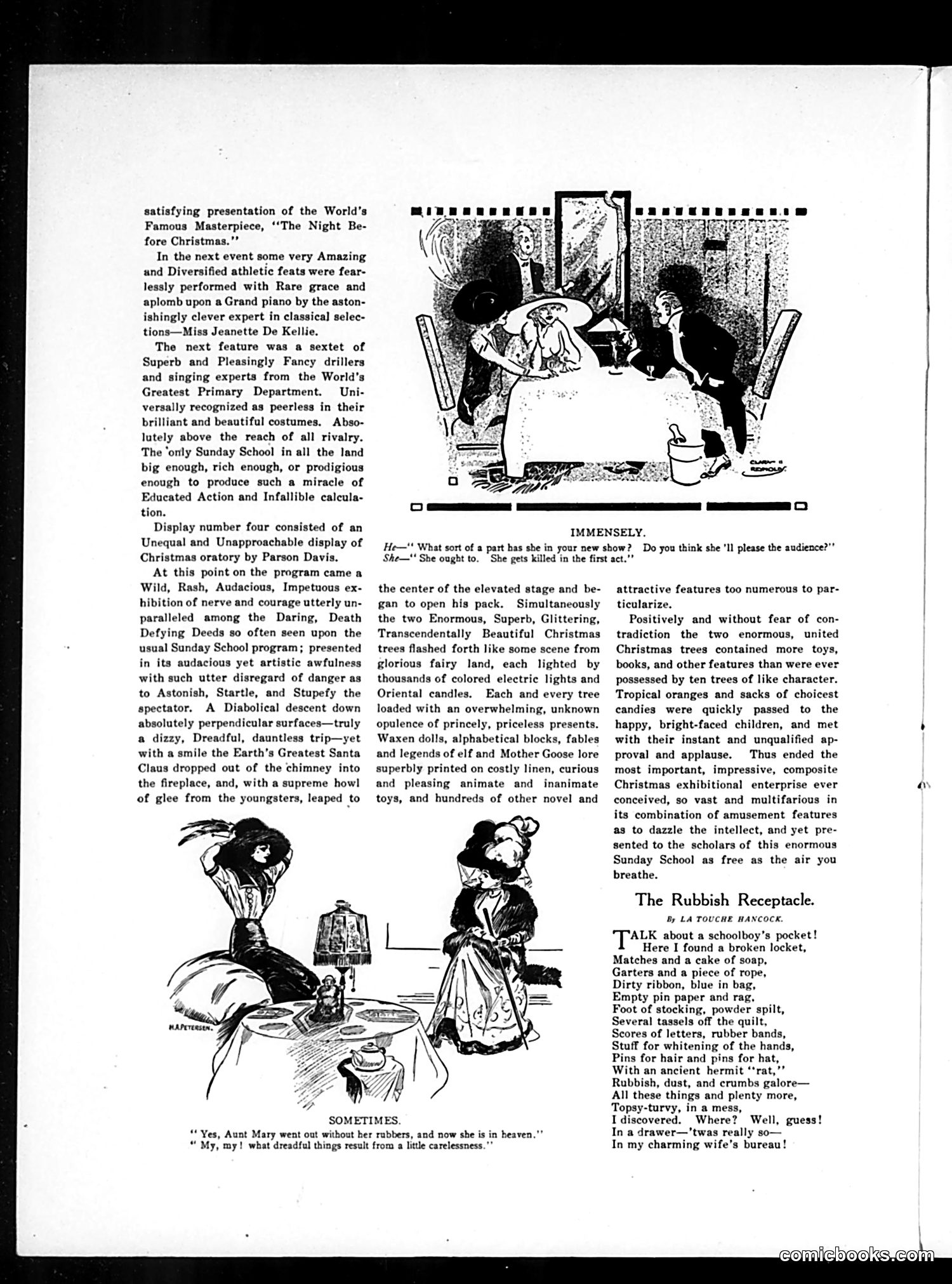
This page contains satirical commentary on a Sunday School Christmas pageant and two humorous pieces. **The Main Article** describes an elaborate, over-the-top Sunday School Christmas program with mock-grandiose language ("Transcendentally Beautiful," "Unequal and Unapproachable"). The satire targets institutional excess—the article sarcastically praises the school's wealth, suggesting it's the "only Sunday School...big enough, rich enough, or prodigious enough" to afford such spectacle. The humor lies in inflating a modest school event into hyperbolic grandeur, mocking both the institution's pretensions and the breathless program descriptions themselves. **"Sometimes" cartoon** presents dark irony: Aunt Mary died from going outside without rubbers (galoshes), yet her death is treated matter-of-factly as a consequence of minor carelessness—the joke being the absurd causality and casual acceptance of fatal outcomes. **"The Rubbish Receptacle" poem** by La Touche Hancock humorously catalogs a schoolboy's pocket contents (broken locket, soap, rope, hermit rat), treating trivial items with elevated poetic language—a lighter satire on childhood disorder.
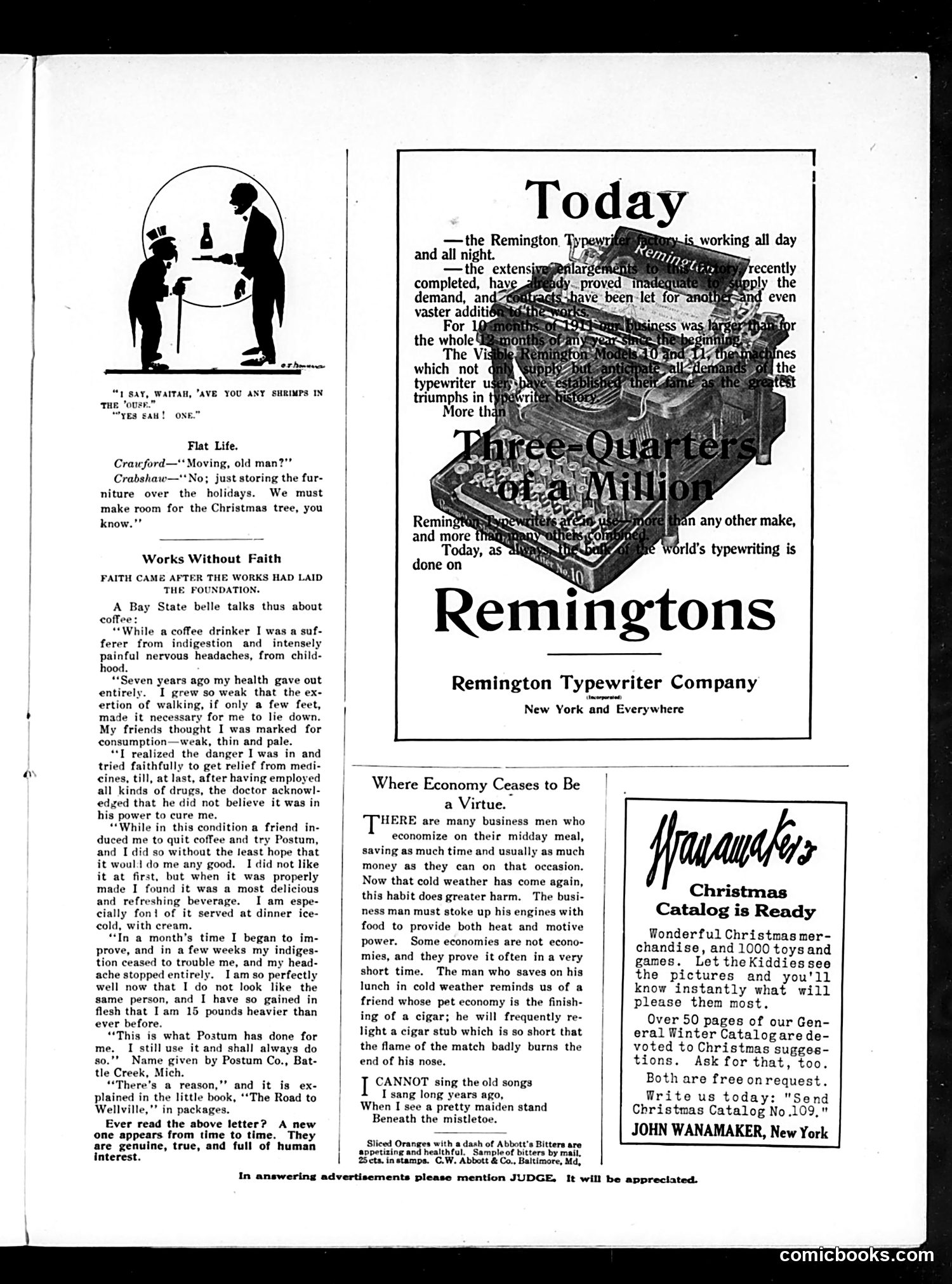
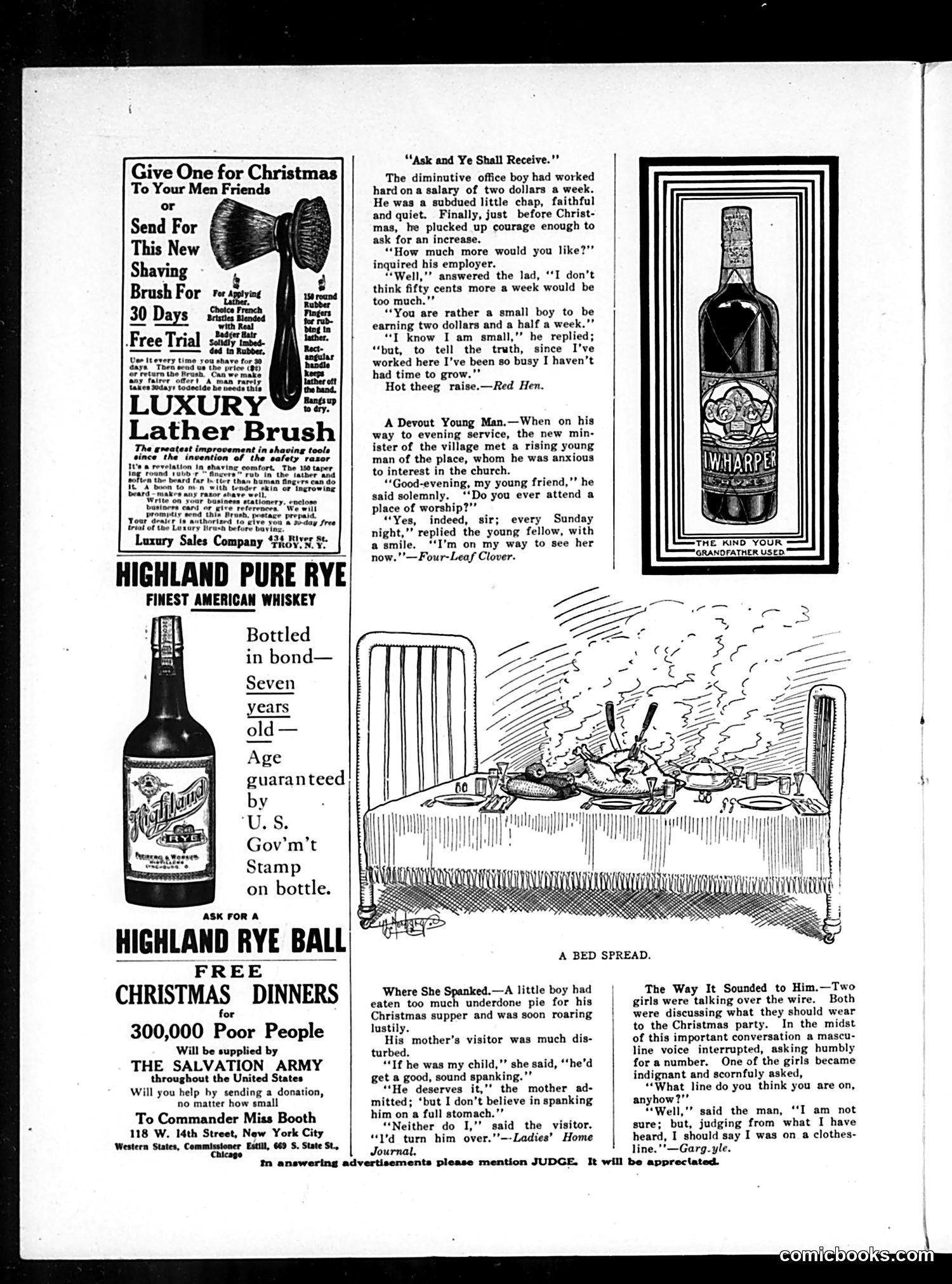
This page contains **advertisements and humorous anecdotes** rather than political cartoons. The content reflects early 20th-century American attitudes: **Advertisements:** Products like the "Luxury Lather Brush" and "Highland Pure Rye" whiskey represent typical consumer goods, while the Salvation Army's free Christmas dinner appeal highlights poverty relief efforts of the era. **The Jokes:** Four brief anecdotes satirize social pretensions and gender roles: - An office boy's modest wage increase request mocks class hierarchies - A young man's church attendance really means visiting a girl - A mother refuses spanking her sick child, prompting crude humor about the "proper" method - Two girls monopolize a telephone line discussing party clothes; an interrupted man's "clothes-line" quip suggests women are frivolous with communication technology The humor is gentle mockery of everyday life—class anxiety, courtship, parenting, and the novelty of telephone culture. The page represents Judge's typical mix of consumerism and domestic comedy aimed at middle-class readers.
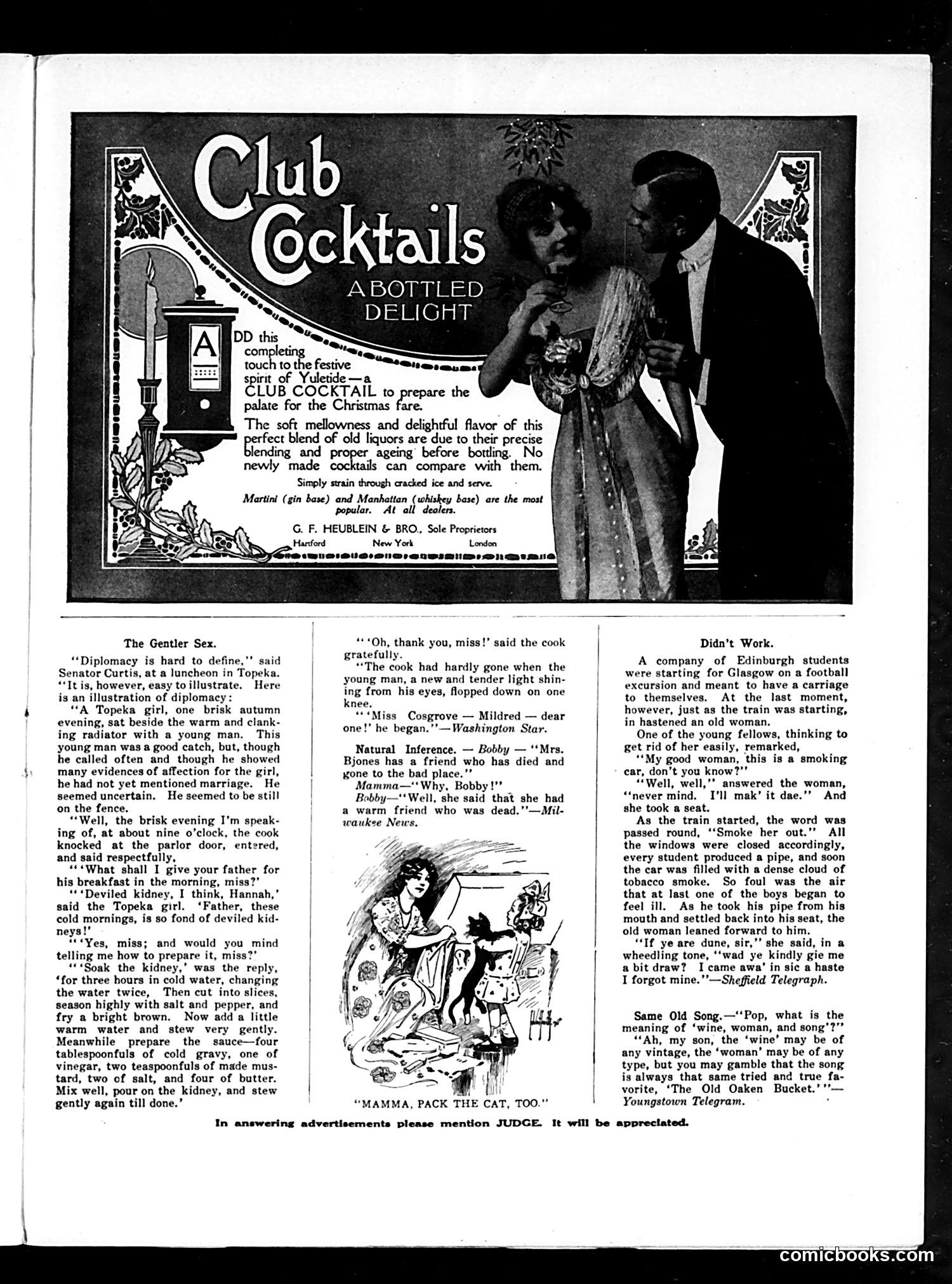
This page combines a **cocktail advertisement** (top) with several **humorous anecdotes** below, typical of Judge's satirical format. The **Club Cocktails ad** promotes bottled martinis and manhattans as festive Christmas drinks, playing on Prohibition-era sensibilities (bottled cocktails were marketed as convenient, pre-made solutions). The humor pieces include: 1. **"The Gentler Sex"**: Senator Curtis illustrates "diplomacy" through a girl who manipulates her hesitant suitor into proposing by loudly discussing deviled kidneys to his father—implying women use domestic/culinary talk strategically to achieve romantic goals. 2. **"Natural Inference"**: A child misinterprets a woman's reference to a "warm friend who was dead" as evidence she knew someone in hell—simple wordplay humor. 3. **"Didn't Work"**: Students try smoking out an elderly woman from their train car; she outwits them by asking to borrow a pipe, turning the prank against them—celebrating working-class shrewdness over youthful arrogance. The page reflects early 20th-century attitudes: gender stereotyping, class humor, and Prohibition-era beverage culture.
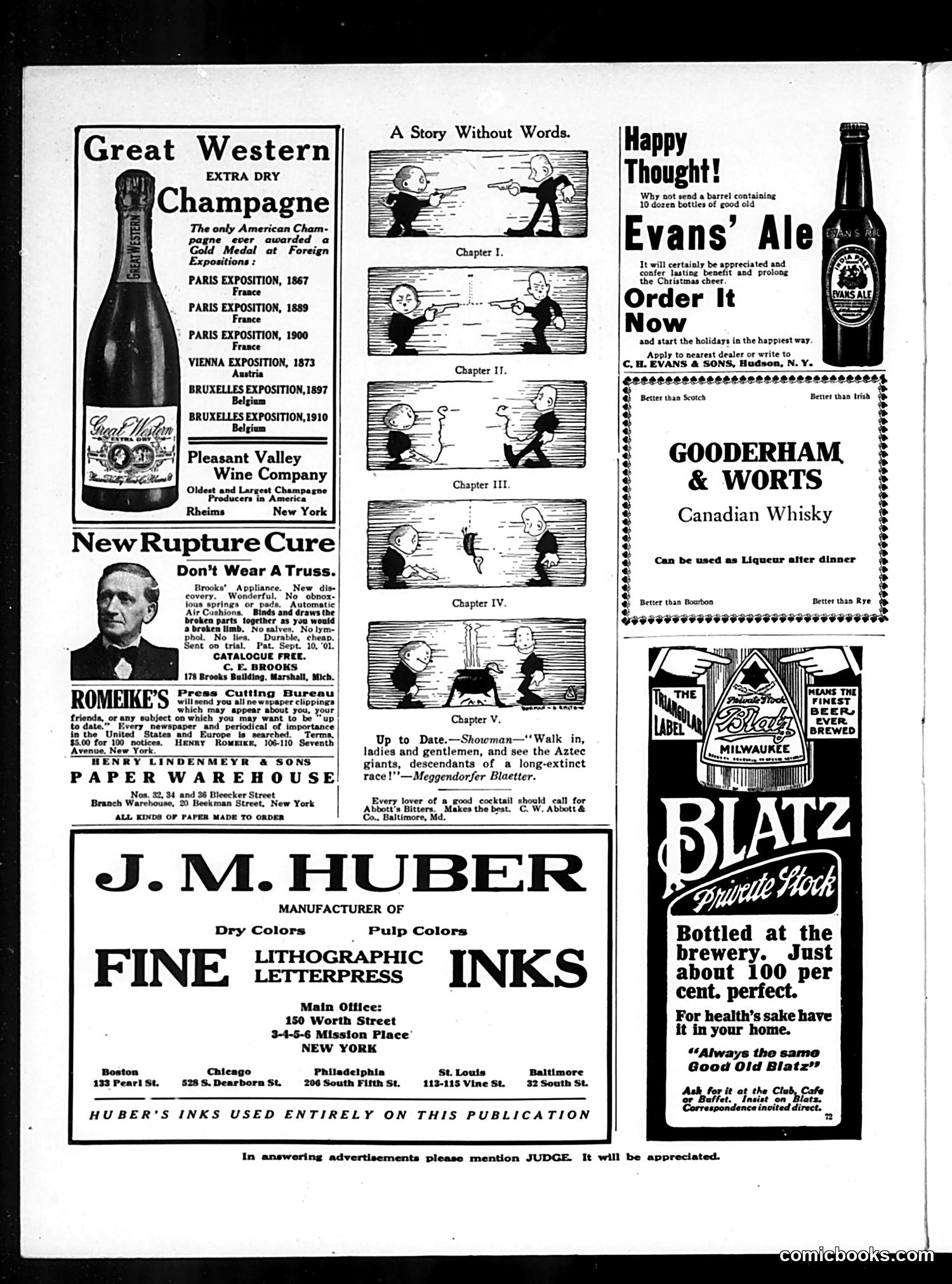
This page is primarily **advertising** for alcoholic beverages (champagne, ale, whisky, beer), with a small sequential comic strip titled "A Story Without Words" occupying the center. The five-panel comic appears to depict a **slapstick confrontation between two men**—likely representing social classes or stereotypes common to early 1900s humor. The panels show them pointing guns, fighting, and struggling over what seems to be a woman or object. The final caption references a "Meggendorfer Blaetter" quote about "Aztec giants, descendants of a long-extinct race," suggesting the humor derives from the absurdity of the situation or perhaps ethnic/physical stereotyping. Without knowing the specific comic's original context, the precise satire remains unclear, but the "wordless" format was a popular magazine gimmick showcasing artists' visual storytelling skills. The ads dominate the page—typical for Judge's revenue model.
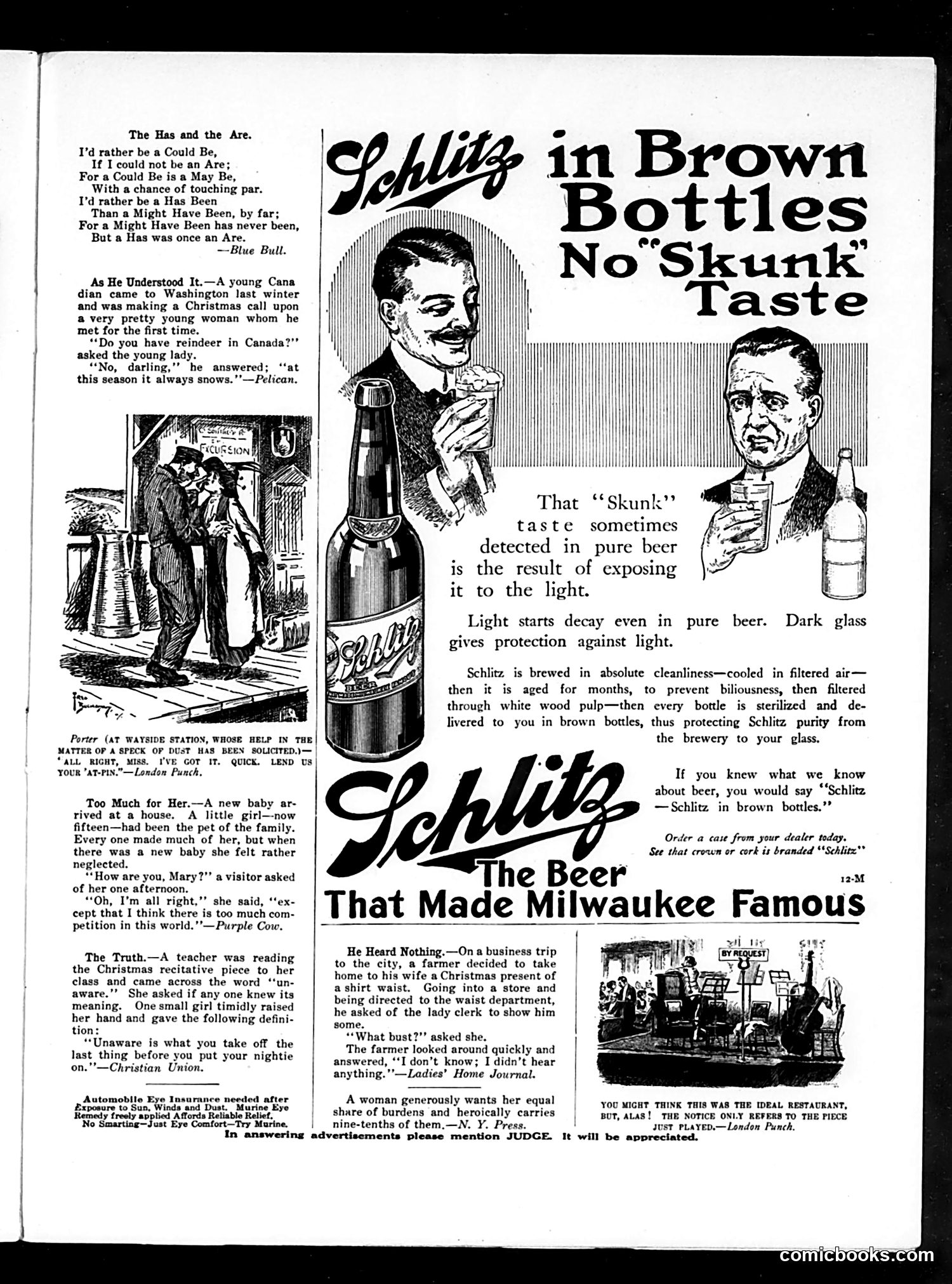
This is primarily a **Schlitz beer advertisement** dominating the right side of the page, with humorous anecdotes filling the left column. **The Main Advertisement:** The ad addresses a common complaint about beer: the "skunk" taste. Schlitz explains this off-flavor results from light exposure and claims their brown bottles prevent this by protecting the beer from light damage. The ad emphasizes their rigorous brewing process (filtered air, aged for months, sterilized bottles) to assure purity. **The Humor Section (Left):** Contains several short jokes typical of *Judge* magazine's satirical style: - A Canadian's misunderstanding about reindeer (plays on the snow/reindeer confusion) - A porter using a lady's hat pin to remove dust from her eye - A child feeling neglected after a new baby arrives, lamenting "too much competition" - A farmer's innocent misinterpretation of "bust" when shopping for a shirt waist These represent early-20th-century domestic humor aimed at middle-class readers, featuring wordplay and innocent misunderstandings.
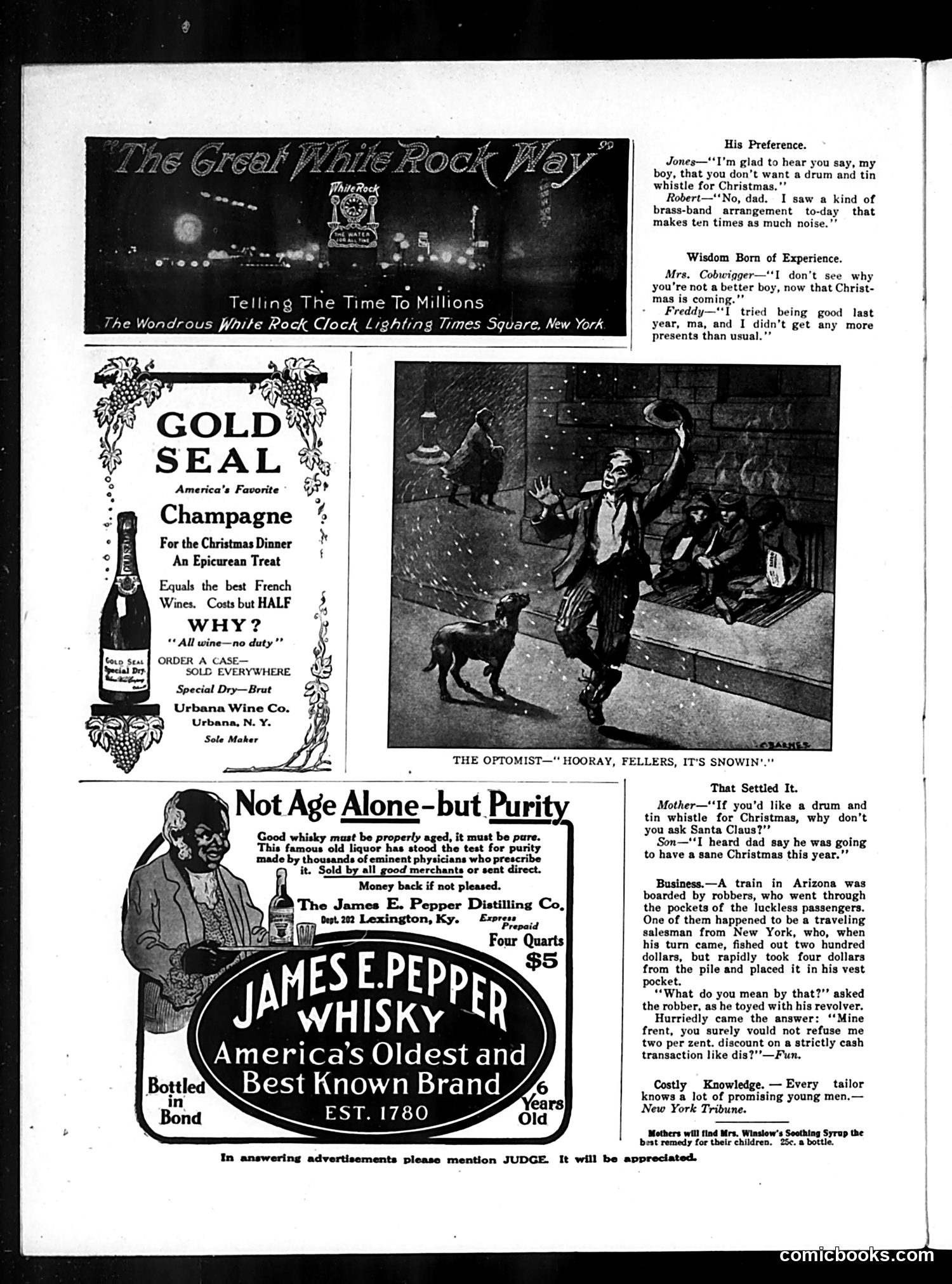
This page is primarily **advertising and humor shorts** rather than political cartoons. The advertisements promote luxury goods (Gold Seal Champagne, James E. Pepper Whiskey) targeting affluent Christmas shoppers, reflecting pre-Prohibition America's drinking culture. The humor pieces are light domestic and commercial jokes: - **"His Preference"** and **"Wisdom Born of Experience"**: Children subverting parental expectations about Christmas gifts—preferring noise-making toys or rejecting Santa entirely because past good behavior yielded no reward. - **"The Optimist"**: Wordless visual gag showing a man celebrating snow while others appear distressed (likely because snow disrupts travel/commerce). - **"Business"**: A traveling salesman negotiates a 2% "cash discount" with train robbers—satirizing American commercial persistence and immigrant speech patterns (the salesman's accent). - **"Costly Knowledge"**: Brief observation that tailors attract young men seeking credit. These are gentle satirical jabs at consumerism, childhood manipulation of adults, and commercial culture—typical of Judge's light satirical approach.
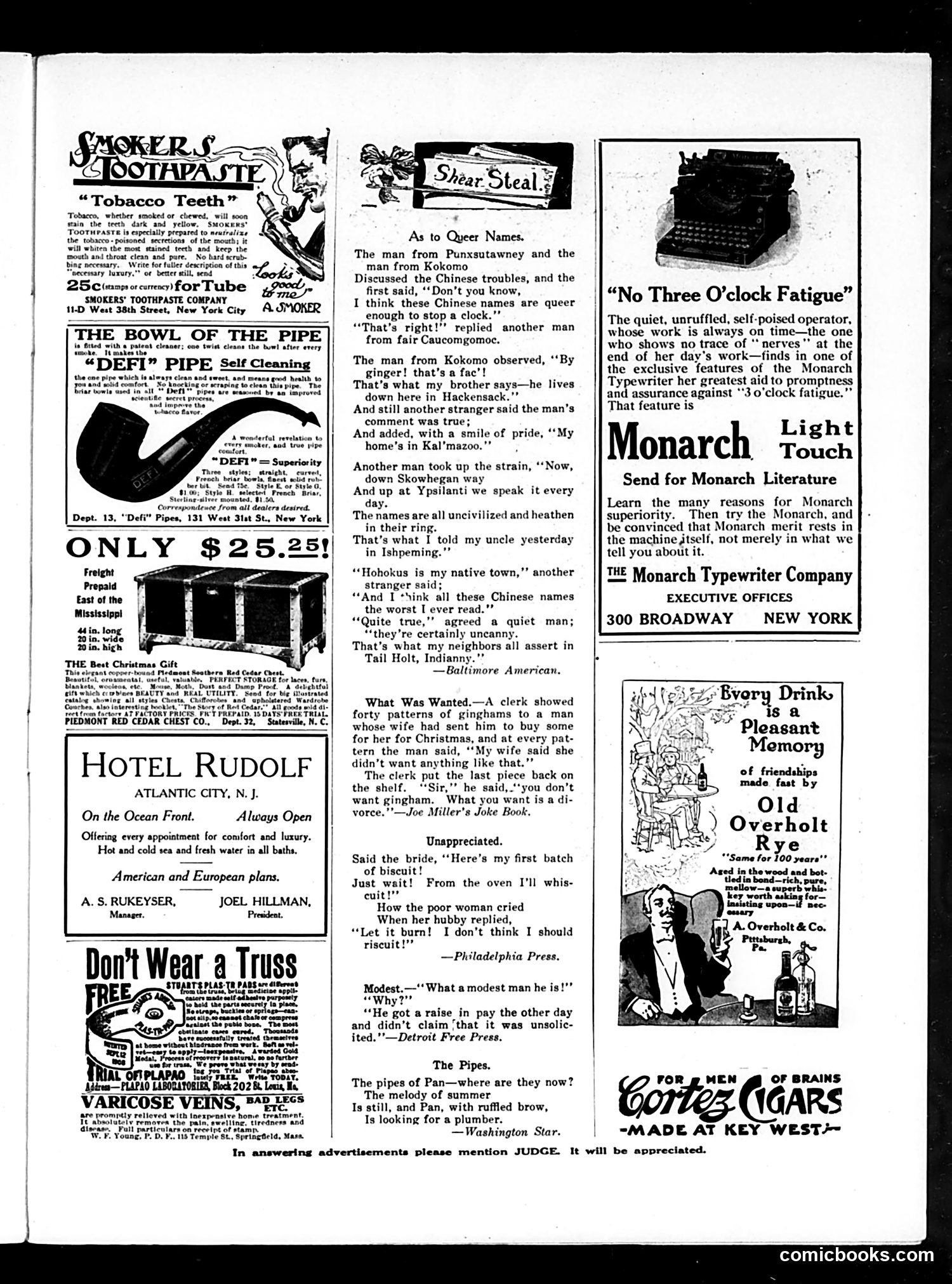
This page is primarily **advertising and humor content** rather than political cartooning. The main satirical piece is "As to Queer Names," which mocks American regional place names by having characters from towns like Punxsutawney, Kokomo, Hackensack, and Ypsilanti argue that *Chinese* names sound strange. The joke's irony is that these Americans fail to recognize their own towns have equally unusual names. This reflects early-20th-century American attitudes: the piece gently ridicules provincial Americans' cultural blind spots and ethnocentrism regarding "foreign" names while they live in places with Native American or equally peculiar-sounding local origins. The remainder of the page consists of period advertisements (typewriters, hotel, chest furniture, toothpaste, cigars) with accompanying light humor pieces unrelated to current events or politics.
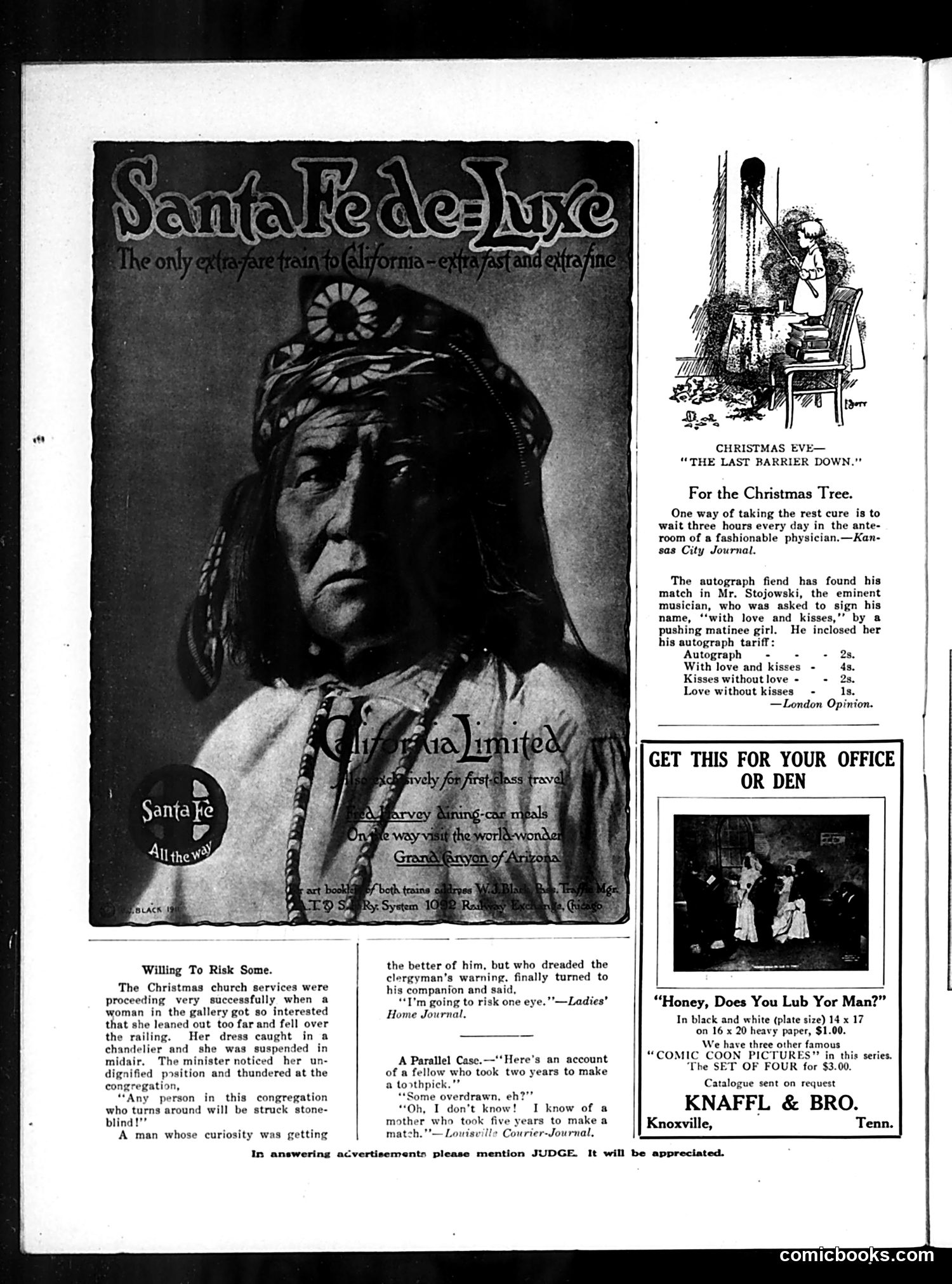
This page contains primarily **short humorous anecdotes and advertisements** rather than political cartoons. The **main visual** is a Santa Fe Railway advertisement featuring a Native American figure, promoting train travel to California and the Grand Canyon. The **text content** includes brief jokes: - A church incident where a woman falls but a minister threatens blindness to anyone who looks - Wordplay about a "toothpick" versus matchmaking (mother) - Observations about doctor's waiting rooms and fashionable physicians - A musician (Stojowski) creating a humorous "tariff" for autographs with varying prices for kisses and love The **advertising section** notably includes what's labeled "COMIC COON PICTURES"—a series of illustrations using a racial slur common in early 20th-century advertising. This reflects the casual racism of the era. The overall tone is light, domestic humor typical of Judge's miscellaneous content pages, with no apparent political commentary or significant satire.
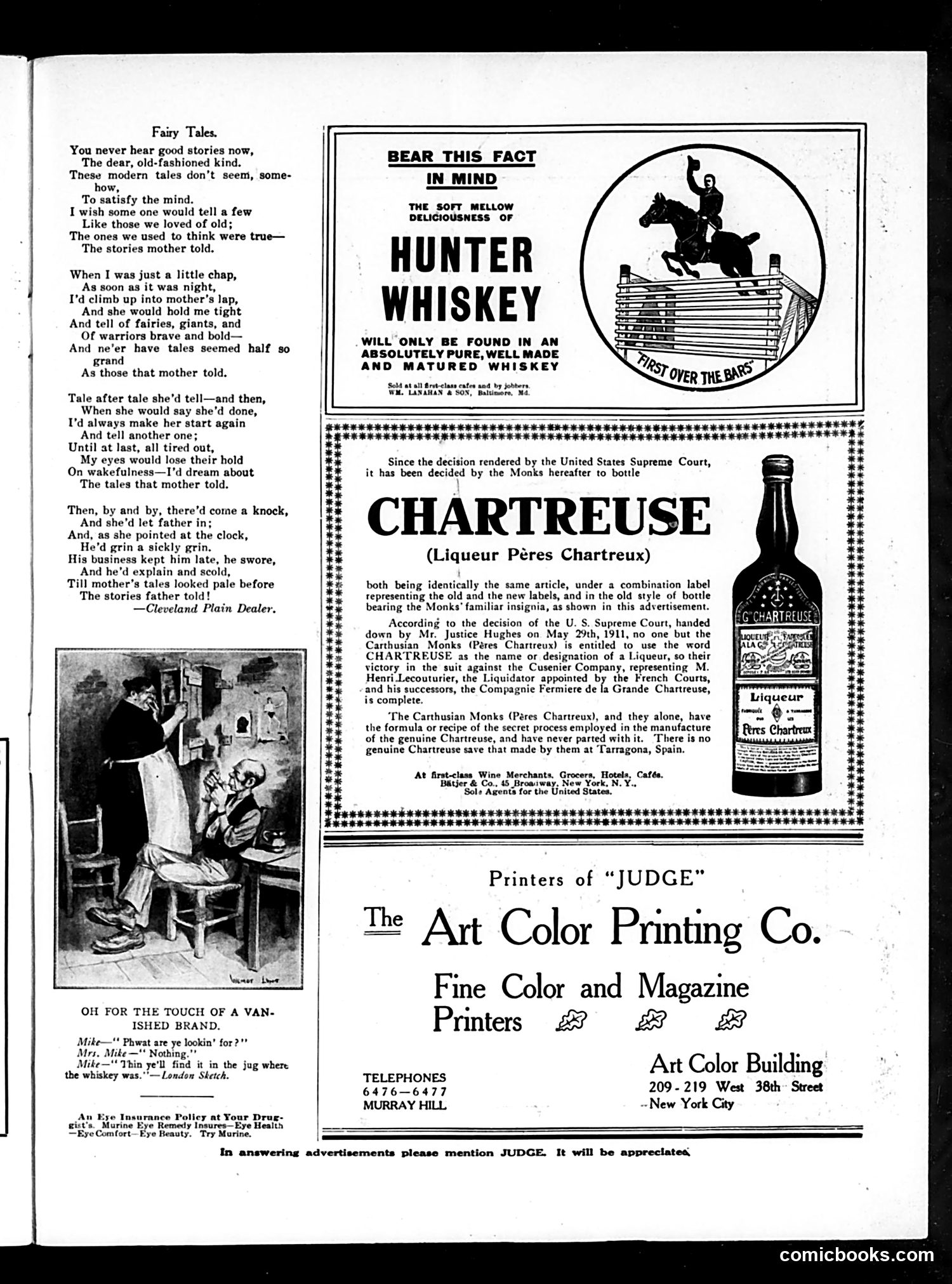
This page contains **three distinct elements**: a poem about nostalgia, whiskey advertisements, and printer information. **"Fairy Tales" Poem**: A sentimental piece lamenting the loss of old-fashioned storytelling. The narrator recalls his mother's enchanting bedtime tales, contrasted with his father's late-night arrivals home. The final couplet suggests the father's real-world troubles ("stories father told") are grimmer than fiction—a mild social commentary on adult responsibilities versus childhood innocence. **Advertisements**: Two liquor ads exploit **Prohibition-era nostalgia**. The "Hunter Whiskey" ad emphasizes purity and quality, while the "Chartreuse" ad announces a Supreme Court decision (May 1911) granting Carthusian monks exclusive rights to the name and formula, defeating competitor claims. Both suggest these products are *legitimate* and *authentic*—crucial selling points during alcohol regulation debates preceding the 1920 Prohibition era. The page reflects early 20th-century anxieties about modernization, authenticity, and legal control of consumer goods.
I can see this is a black and white illustration from Judge magazine showing what appears to be a coffin or casket on a dark background, with some decorative objects nearby including what looks like a wreath or floral arrangement and a candlestick. However, the image is quite dark and the specific details are difficult to discern clearly. Without clearer visibility of text, captions, or identifying labels on the image itself, I cannot reliably identify who or what is being satirized or what political/social commentary this cartoon intends. The coffin imagery suggests commentary on something "dead" or defunct—possibly a political movement, policy, or public figure—but I cannot specify what without risking inaccuracy. If you have access to the original text or caption for this cartoon, that would clarify its meaning considerably.