
Judge, 1911-12-09 · page 14 of 28
Judge — December 9, 1911 — page 14: what you’re looking at
What you’re looking at
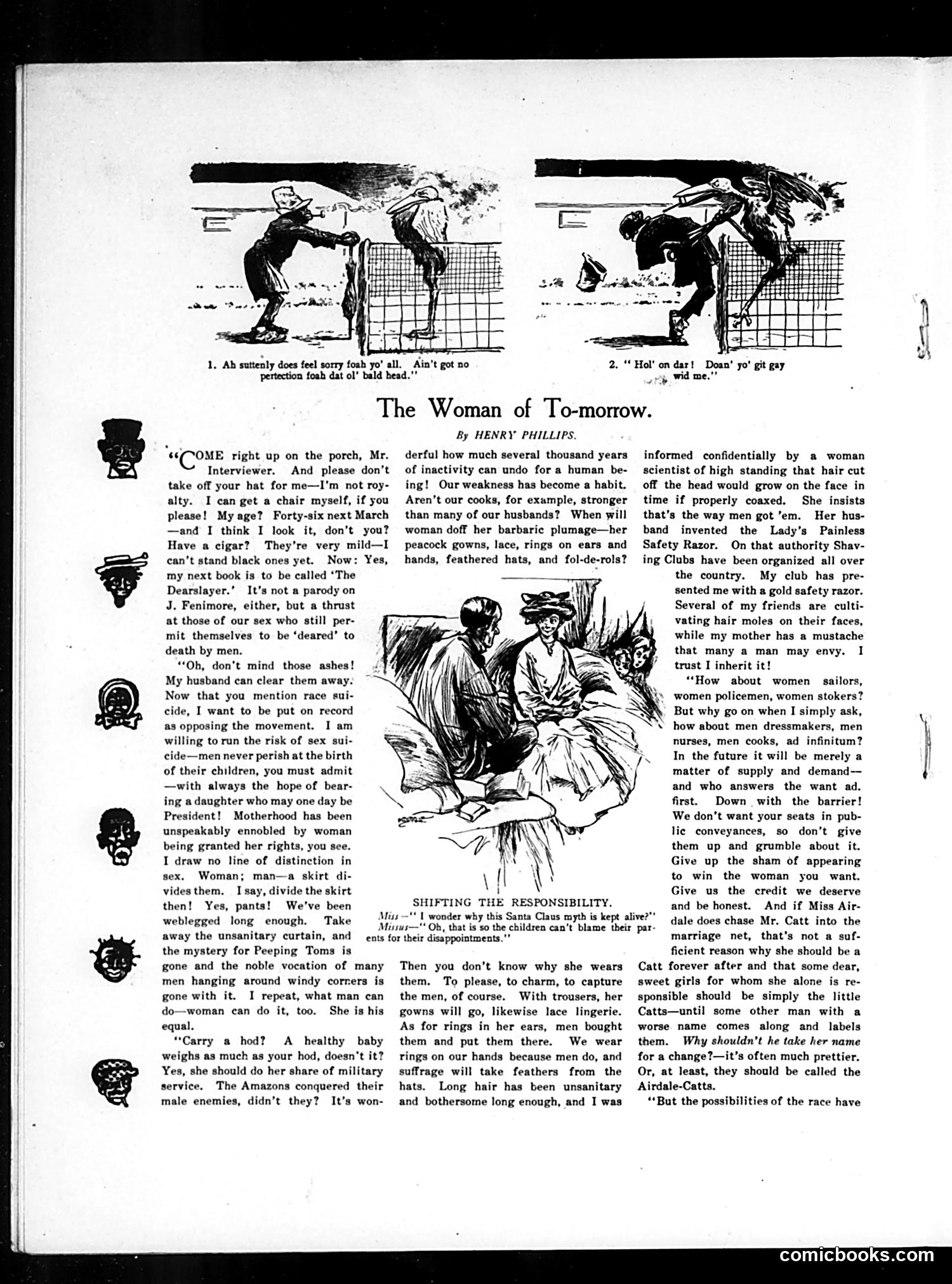
This page satirizes early-20th-century feminism and women's suffrage advocates through an interview with an exaggerated "New Woman" character who advocates radical gender equality. The satirist (Henry Phillips) mocks feminist positions by having the woman propose absurdities: women wearing pants and joining the military, abandoning ornamental dress, growing facial hair, working as sailors and stokers. The accompanying small cartoons (top) use racist dialect humor typical of the era's Judge magazine. A secondary joke ridiculing women appears in the "Shifting Responsibility" section: a woman admits she wears jewelry and cosmetics solely to attract men—undermining the feminist speaker's claims of rejecting "barbaric plumage." The satire's target: portraying suffragists as unreasonable extremists whose demands extend beyond voting into absurd territory. The tone suggests Judge magazine viewed women's equality advocacy as both ridiculous and threatening to traditional gender roles—a common conservative reaction to 1910s-era feminism.
📄 Transcribed text from this page (OCR, searchable)
Machine-transcribed from the original scan — historical spelling and the odd misread are preserved.
% ¥ a 8 e @ 1, Ab suttenly does feel sorry foah yo’ all. Ain't got no pertection foah dat ol’ bald head.’ * Hol’ on dar! Doan’ yo’ git gay wid me."” ne The Woman of To-morrow. ‘(COME right up on the porch, Mr. Interviewer. And please don’t take off your hat for me—I'm not roy- alty. I can get a chair myself, if you please! My age? Forty-six next March —and I think I look it, don’t you? Have a cigar? They’re very mild—I can’t stand black ones yet. Now: Yes, my next book is to be called ‘The Dearslayer.’ It’s not a parody on J. Fenimore, either, but a thrust at those of our sex who still per- mit themselves to be ‘deared’ to death by men. “Oh, don't mind those ashes! My husband can clear them away: Now that you mention race sui- cide, I want to be put on record as opposing the movement. I am willing to run the risk of sex sui- cide—men never perish at the birth of their children, you must admit —with always the hope of bear- ing a daughter who may one day be President! Motherhood has been unspeakably ennobled by woman being granted her rights, you see. I draw no line of distinction in sex. Woman; man—a skirt di- vides them, I say, divide the skirt then! Yes, pants! We've been weblegged long enough. Take away the unsanitary curtain, and the mystery for Peeping Toms is gone and the noble vocation of many men hanging around windy corners is gone with it. I repeat, what man can do—woman can do it, too. She is his equal. “Carry a hod? A healthy baby weighs as much as your hod, doesn't it? Yes, she should do her share of military service. The Amazons conquered their male enemies, didn't they? It's won- Miss By HENRY PHILLIPS. derful how much several thousand years of inactivity can undo for a human be- ing! Our weakness has become a habit. Aren’t our cooks, for example, stronger than many of our husbands? When will woman doff her barbaric plumage—her peacock gowns, lace, rings on ears and hands, feathered hats, and fol-de-rols? SHIFTING THE RESPONSIBILITY. “| wonder why this Santa Claus myth is kept alive?"’ Missus—"* Ob, that is so the children can't blame their par- ents for their disappointments."” Then you don’t know why she wears them. To please, to charm, to capture the men, of course. With trousers, her gowns will go, likewise lace lingerie. As for rings in her ears, men bought them and put them there. We wear rings on our hands because men do, and suffrage will take feathers from the hats. Long hair has been unsanitary and bothersome long enough, and I was informed confidentially by a woman scientist of high standing that hair cut off the head would grow on the face in time if properly coaxed. She insists that’s the way men got ’em. Her hus- band invented the Lady’s Painless Safety Razor. On that authority Shav- ing Clubs have been organized all over the country. My club has pre- sented me with a gold safety razor. Several of my friends are culti- vating hair moles on their faces, while my mother has a mustache that many a man may envy. I trust I inherit it! “‘How about women sailors, women policemen, women stokers? But why go on when I simply ask, how about men dressmakers, men nurses, men cooks, ad infinitum? In the future it will be merely a matter of supply and demand— and who answers the want ad. first. Down with the barrier! We don’t want your seats in pub- lic conveyances, so don’t give them up and grumble about it. Give up the sham of appearing to win the woman you want. Give us the credit we deserve and be honest. And if Miss Air- dale does chase Mr. Catt into the marriage net, that’s not a suf- ficient reason why she should be a Catt forever after and that some dear, sweet girls for whom she alone is re- sponsible should be simply the little Catts—until some other man with a worse name comes along and labels them. Why shouldn't he take her name for a change?—it’s often much prettier. Or, at least, they should be called the Airdale-Catts. “But the possibilities of the race have comicbooks.com o \