
Judge, 1911-12-09 · page 21 of 28
Judge — December 9, 1911 — page 21: what you’re looking at
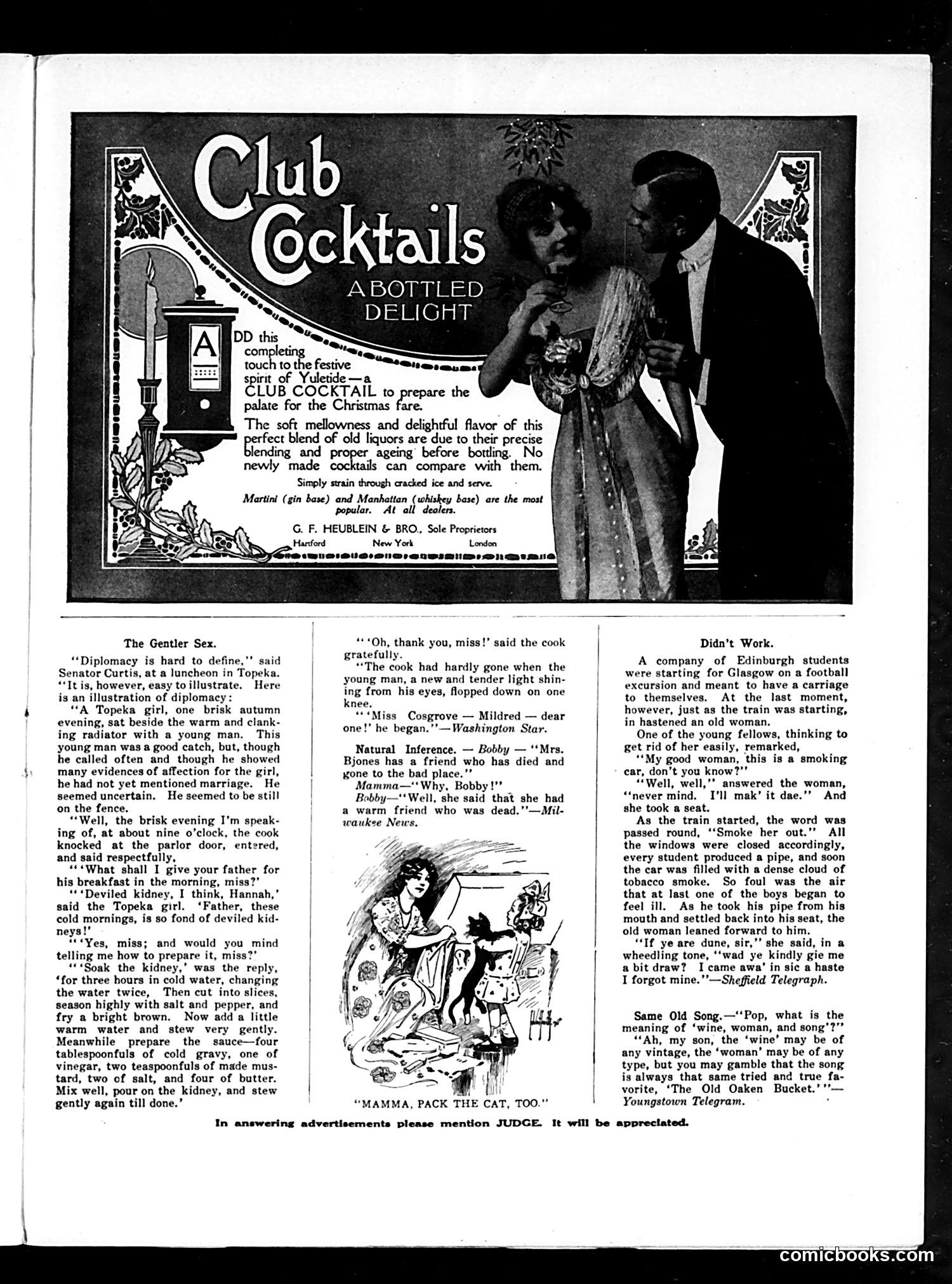
What you’re looking at
This page combines a **cocktail advertisement** (top) with several **humorous anecdotes** below, typical of Judge's satirical format. The **Club Cocktails ad** promotes bottled martinis and manhattans as festive Christmas drinks, playing on Prohibition-era sensibilities (bottled cocktails were marketed as convenient, pre-made solutions). The humor pieces include: 1. **"The Gentler Sex"**: Senator Curtis illustrates "diplomacy" through a girl who manipulates her hesitant suitor into proposing by loudly discussing deviled kidneys to his father—implying women use domestic/culinary talk strategically to achieve romantic goals. 2. **"Natural Inference"**: A child misinterprets a woman's reference to a "warm friend who was dead" as evidence she knew someone in hell—simple wordplay humor. 3. **"Didn't Work"**: Students try smoking out an elderly woman from their train car; she outwits them by asking to borrow a pipe, turning the prank against them—celebrating working-class shrewdness over youthful arrogance. The page reflects early 20th-century attitudes: gender stereotyping, class humor, and Prohibition-era beverage culture.
📄 Transcribed text from this page (OCR, searchable)
Machine-transcribed from the original scan — historical spelling and the odd misread are preserved.
ABOTTLED DELIGHT com} toucl may COCKTAIL the t palate for the Christmas fare oo The soft mellowness and delightful flavor of this Fete Mend blend of old liquors are due to their precie ageing’ before bottling. newly a ils can compare with hem: Simply strain through cracked ice and serve. Martini (gin base) and Manhattan (whiskey base) are the most ¥j popular. At all dealers. G. F. HEUBLEIN & BRO., Sole Proprietors The Gentler Sex. “Diplomacy is hard to define," said Senator Curtis, at a luncheon in Topeka. “‘It is, however, easy to illustrate. Here is an illustration of diplomacy: “A Topeka girl, one brisk autumn evening, sat beside the warm and clank- ing radiator with a young man. This young man was a good catch, but, though he called often and though he showed many evidences of affection for the girl, he had not yet mentioned marriage. He seemed uncertain. He seemed to be still on the fence. “Well, the brisk evening I'm speak- ing of, at about nine o’clock, the cook knocked at the parlor door, entered, and said respectfully, «What shall I give your father for his breakfast in the morning, miss?’ “Deviled kidney, I think, Hannah,’ said the Topeka girl. ‘Father, these cold mornings, is so fond of deviled kid- neys!’ Yes, miss; and would you mind telling me how to prepare it, miss?’ “‘*Soak the kidney,’ was the reply, ‘for three hours in cold water, changing the water twice, Then cut into slices, season highly with salt and pepper, and fry a bright brown. Now add a little warm water and stew very gently. Meanwhile prepare the sauce—four tablespoonfuls of cold gravy, one of vinegar, two teaspoonfuls of made mus- tard, two of salt, and four of butter. Mix well, pour on the kidney, and stew gently again till done.’ London PSUS arn anemia) “Oh, thank you, miss!’ said the cook gratefully. “The cook had hardly gone when the young man, a new and tender light shin- ing from his eyes, flopped down on one knee. ***Miss Cosgrove — Mildred — dear one!’ he began.’— Washington Star. Natural Inference. — Bobby — ‘‘Mrs. Bjones has a friend who has died and xone to the bad place.” Mamma—‘‘Why, Bobby !’’ Bobby—‘‘ Well, she said that she had a warm friend who was dead.””—Mil- waukee News. “MAMMA, PACK THE car, TOO." In answering advertisements please mention JUDGE. It will be appreciated. Didn't Work. A company of Edinburgh students were starting for Glasgow on a football excursion and meant to have a carriage to themselves. At the last moment, however, just as the train was starting, in hastened an old woman. One of the young fellows, thinking to get rid of her easily, remarked, ‘‘My good woman, this is a smoking car, don’t you know?” “Well, well,’’ answered the woman, “never mind. I'll mak’ it dae.’’ And she took a seat. As the train started, the word was passed round, ‘‘Smoke her out.’’ All the windows were closed accordingly, every student produced a pipe, and soon the car was filled with a dense cloud of tobacco smoke. So foul was the air that at last one of the boys began to feel ill. As he took his pipe from his mouth and settled back into his seat, the old woman leaned forward to him. “If ye are dune, sir,”’ she said, in a wheedling tone, ‘‘wad ye kindly gie me abit draw? I came awa’ in sic a haste I forgot mine."’—Sheffield Telegraph. Same Old Song.—‘‘Pop, what is the meaning of ‘wine, woman, and song'?”” “Ah, my son, the ‘wine’ may be of any vintage, the ‘woman’ may be of any type, but you may gamble that the song ‘ays that same tried and true fa- vori e, ‘The Old Oaken Bucket.’ ”’— Youngstown Telegram.