
A complete issue · 24 pages · 1911
Judge — November 4, 1911
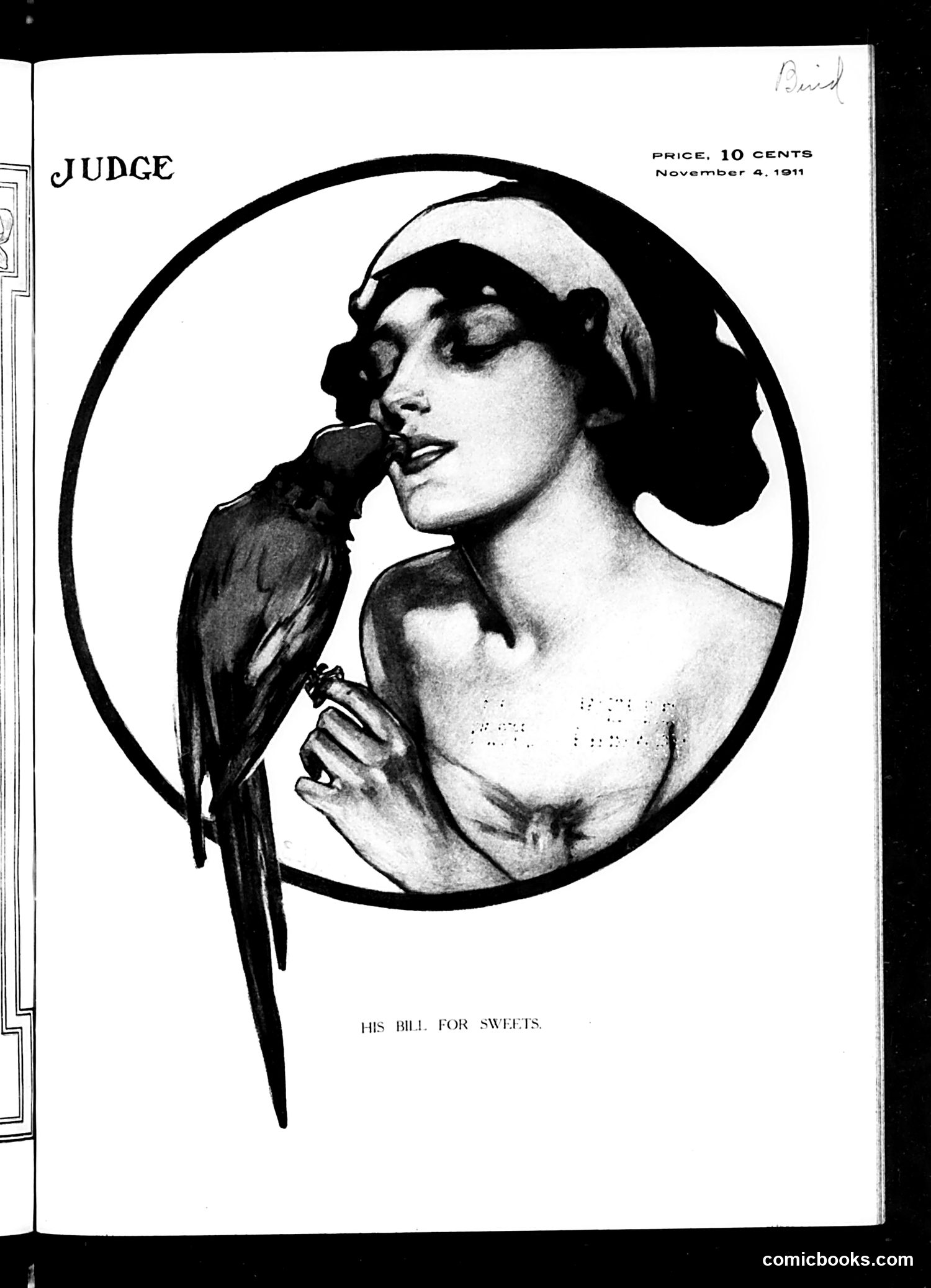
This satirical cover depicts a woman with a parrot perched on her shoulder, titled "His Bill for Sweets." The joke appears to be a visual pun: the parrot's "bill" (beak/mouth) is positioned near the woman's face, while "bill for sweets" suggests a monetary bill or expense account. The satire likely comments on romantic or financial dynamics between men and women in the early 1900s—specifically, a man's cost ("bill") for courting a woman through gifts and treats ("sweets"). The parrot, known for mimicking behavior, may represent superficiality or the repetitive nature of courtship expenses. The illustration reflects period attitudes about gender relations and the financial burden romantic pursuits placed on men.
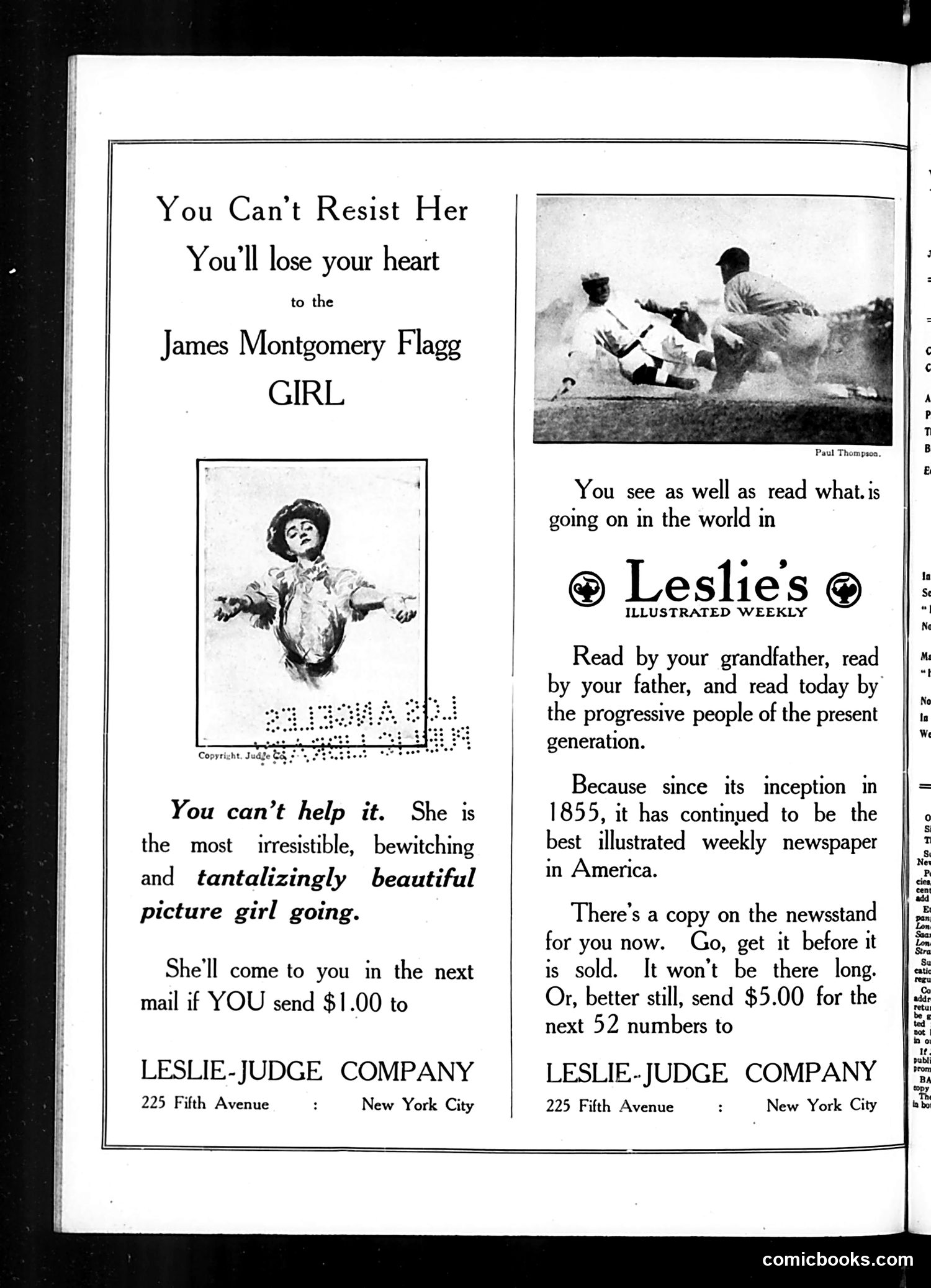
This page is primarily **advertising for Leslie's Illustrated Weekly**, a major American magazine founded in 1855. The left side features a promotional ad for a James Montgomery Flagg "Girl" illustration, using charged language ("irresistibly bewitching and tantalizingly beautiful") to entice male readers to mail $1.00 for the picture. The right side advertises Leslie's itself, emphasizing its long history and broad readership across generations. A baseball photograph (credited to Paul Thompson) appears as an example of the magazine's illustrated content. This is **not political satire** but rather period advertising reflecting early 20th-century marketing tactics: using attractive female imagery and appeals to masculine desire to drive subscriptions. The language and approach would be considered inappropriately gendered by modern standards.
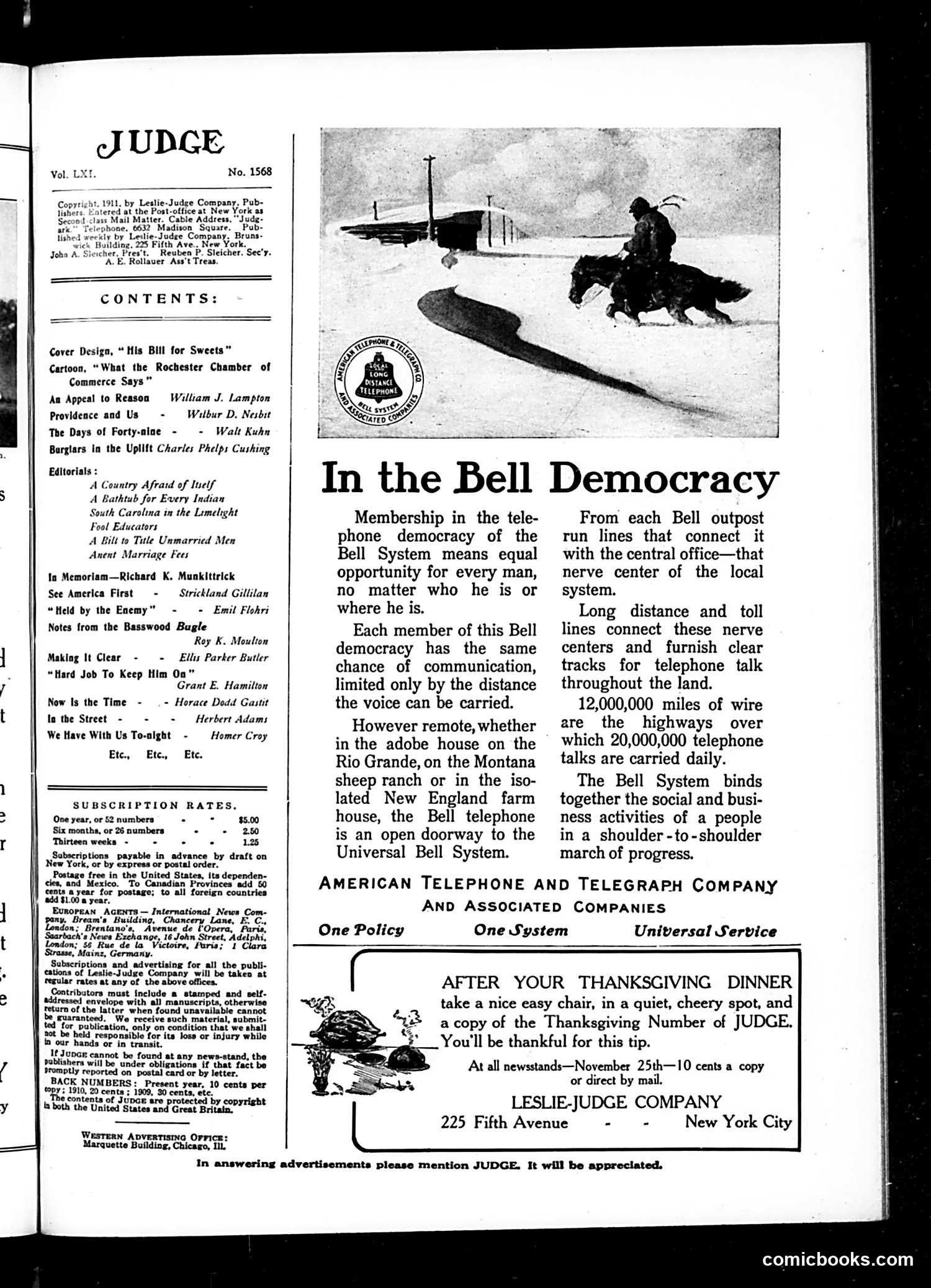
This page is primarily **advertising content** rather than editorial satire. The main feature is a full-page advertisement for the American Telephone and Telegraph Company (AT&T) and associated Bell System companies. The ad's headline, "In the Bell Democracy," uses democratic rhetoric to market telephone service, claiming membership provides "equal opportunity for every man" to communicate regardless of location. The accompanying photograph shows a rural/snowy scene with people and what appears to be an airplane, illustrating Bell's reach into remote areas. The ad emphasizes the Bell System's infrastructure (12,000,000 miles of wire) as binding together "the social and business activities of a people." A smaller boxed advertisement below promotes Judge magazine's Thanksgiving issue.
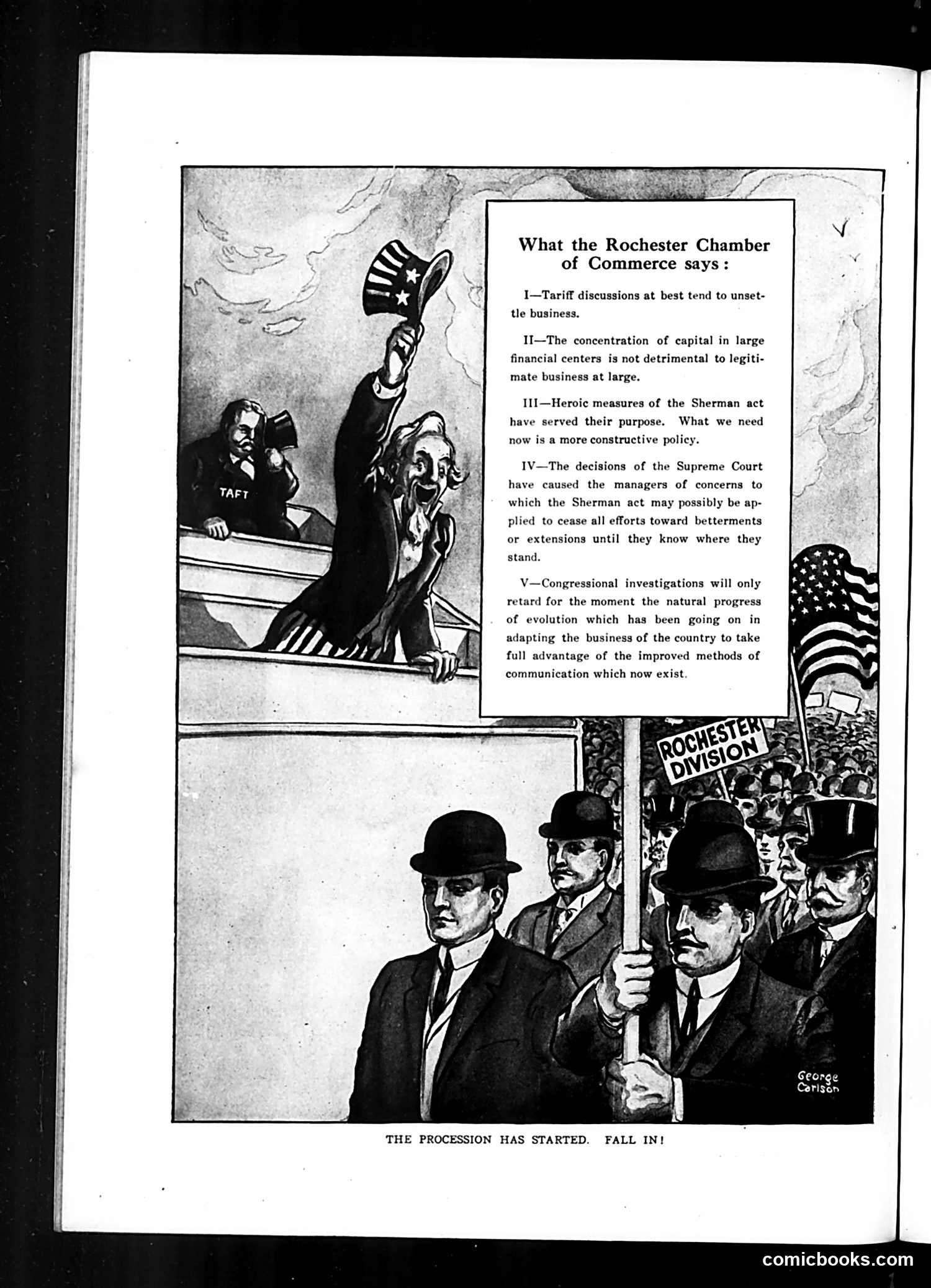
This cartoon satirizes the Rochester Chamber of Commerce's business-friendly positions on tariffs, antitrust law, and government regulation. The upper panel shows two figures labeled "TAFT"—likely President William Howard Taft—wrestling with tariff policy while holding a top hat marked with an American flag. The lower panel depicts a procession of businessmen marching under a "Rochester Division" banner, with the caption "THE PROCESSION HAS STARTED. FALL IN!" This mocks the Chamber's call for conservative business policies, suggesting businessmen blindly follow such recommendations. The five numbered statements express skepticism toward tariff debates, capital concentration, Sherman Act enforcement, Supreme Court decisions, and congressional investigations—positioning these as obstacles to business "evolution" and modern commerce methods.
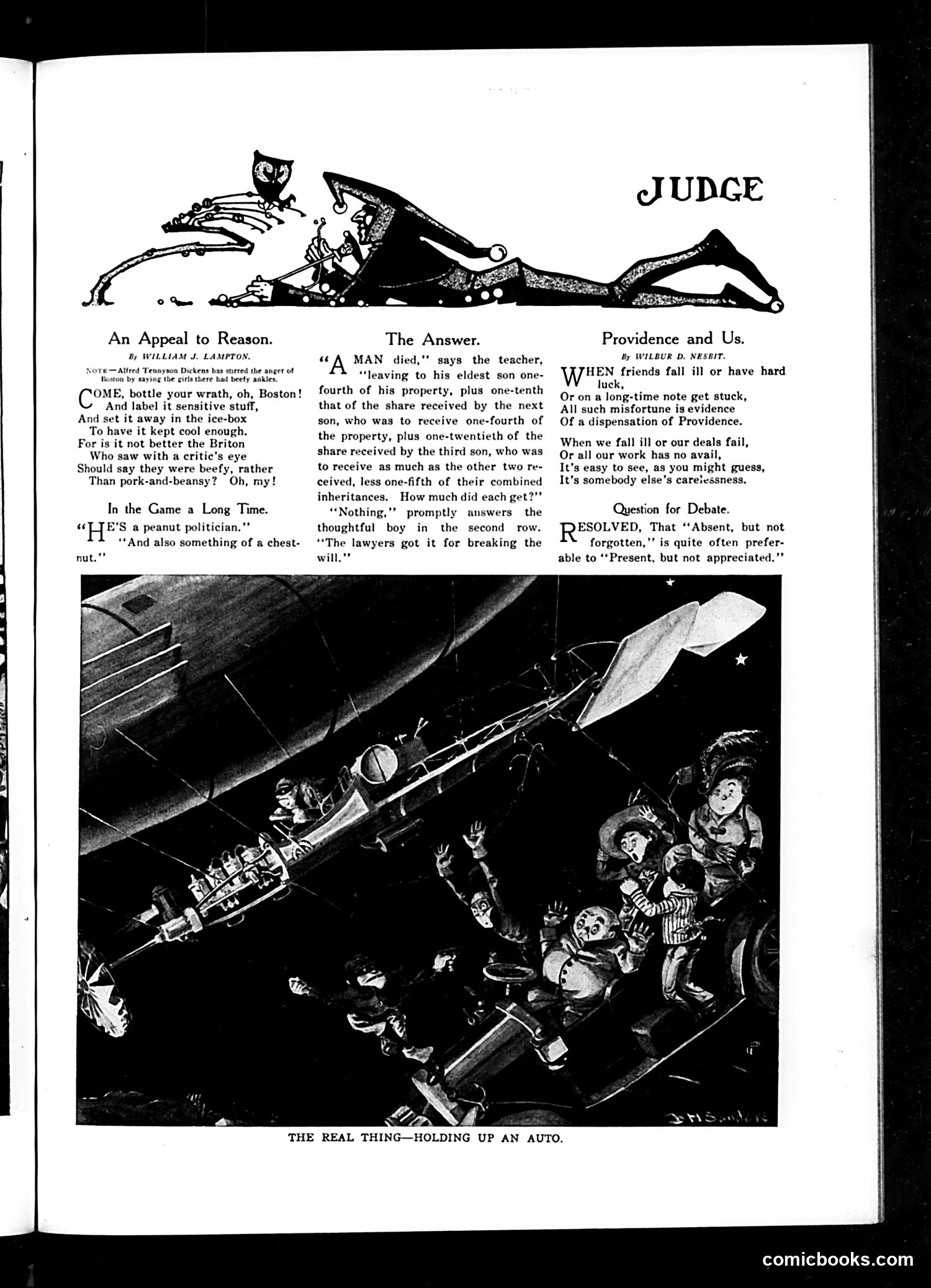
This page contains four separate editorial pieces satirizing American politics and society, likely from the early 20th century. **Top section:** "An Appeal to Reason" mocks Boston's Brahmin class; "The Answer" satirizes a will dispute where lawyers are the only winners; "Providence and Us" questions whether divine intervention or luck explains life's fortunes. **Main illustration ("The Real Thing—Holding Up an Auto"):** This is the page's centerpiece—a surreal nighttime scene depicting what appears to be multiple figures literally "holding up" a car, as if committing robbery. The caption creates a double meaning: it likely comments on highway bandits or labor unrest affecting transportation, though the specific historical reference is unclear without additional context. The figures' exaggerated expressions suggest social anxiety about crime or lawlessness. The overall tone criticizes wealth, legal systems, and public safety concerns.
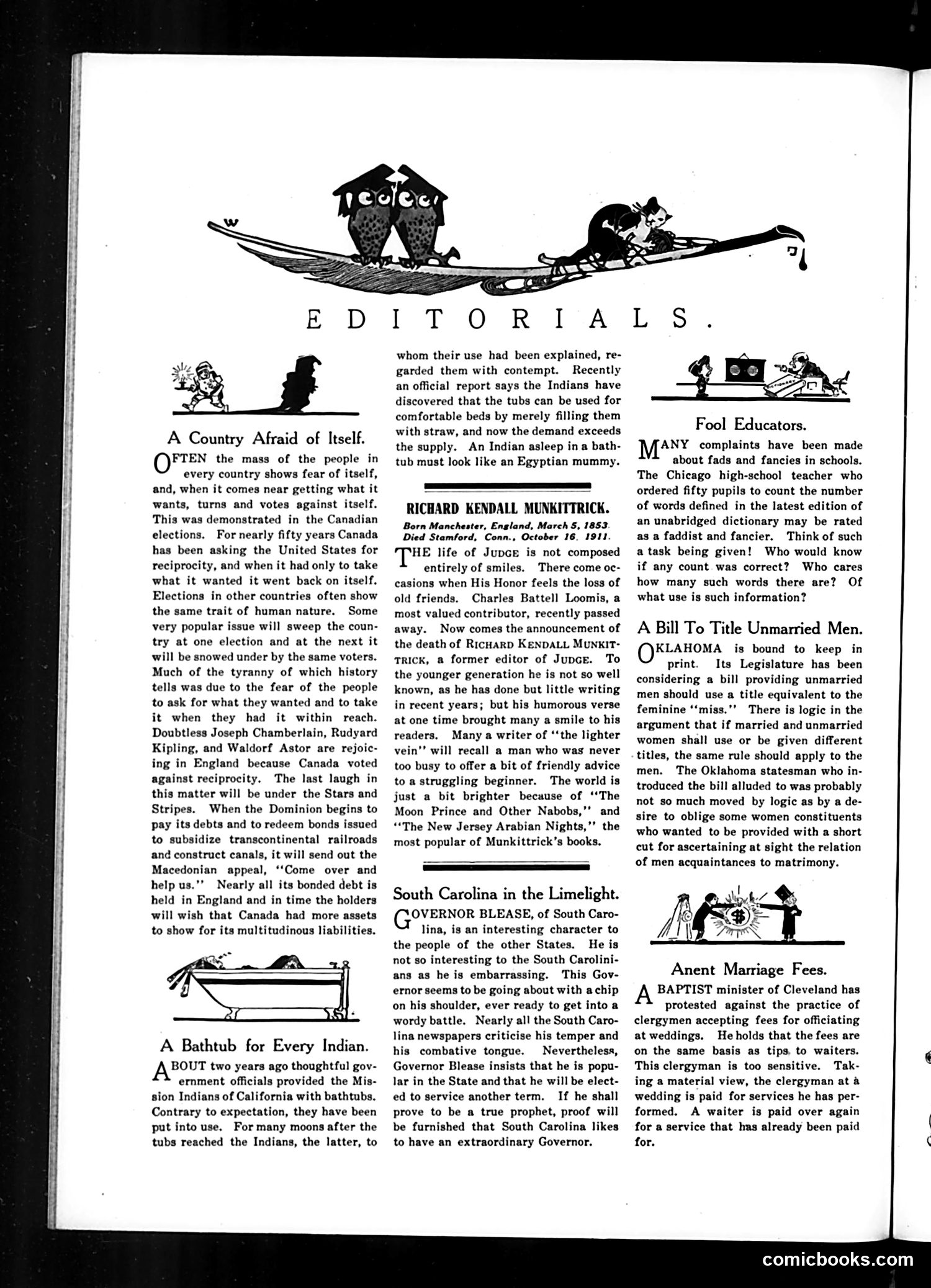
This page from Judge magazine contains several satirical editorials typical of early 20th-century American commentary: **"A Country Afraid of Itself"** critiques Canada's 1911 rejection of reciprocity with the United States, despite decades of requesting it. Judge argues Canadians voted against their own interests from fear—a common human failing. The piece suggests England's imperialists (Chamberlain, Kipling, Astor) celebrated Canada's decision, but predicts Canada will eventually need American financial help. **"A Bathtub for Every Indian"** mocks the U.S. government's initiative providing bathtubs to California Mission Indians. The joke: Indians repurposed them as beds filled with straw rather than using them as intended, inverting the civilizing mission's assumptions about "progress." **"Fool Educators"** (partial) criticizes trendy educational fads, referencing a Chicago teacher's peculiar assignment counting dictionary definitions. The page also includes an obituary for Richard Kendall Munkittrick, a former Judge editor and humorist.
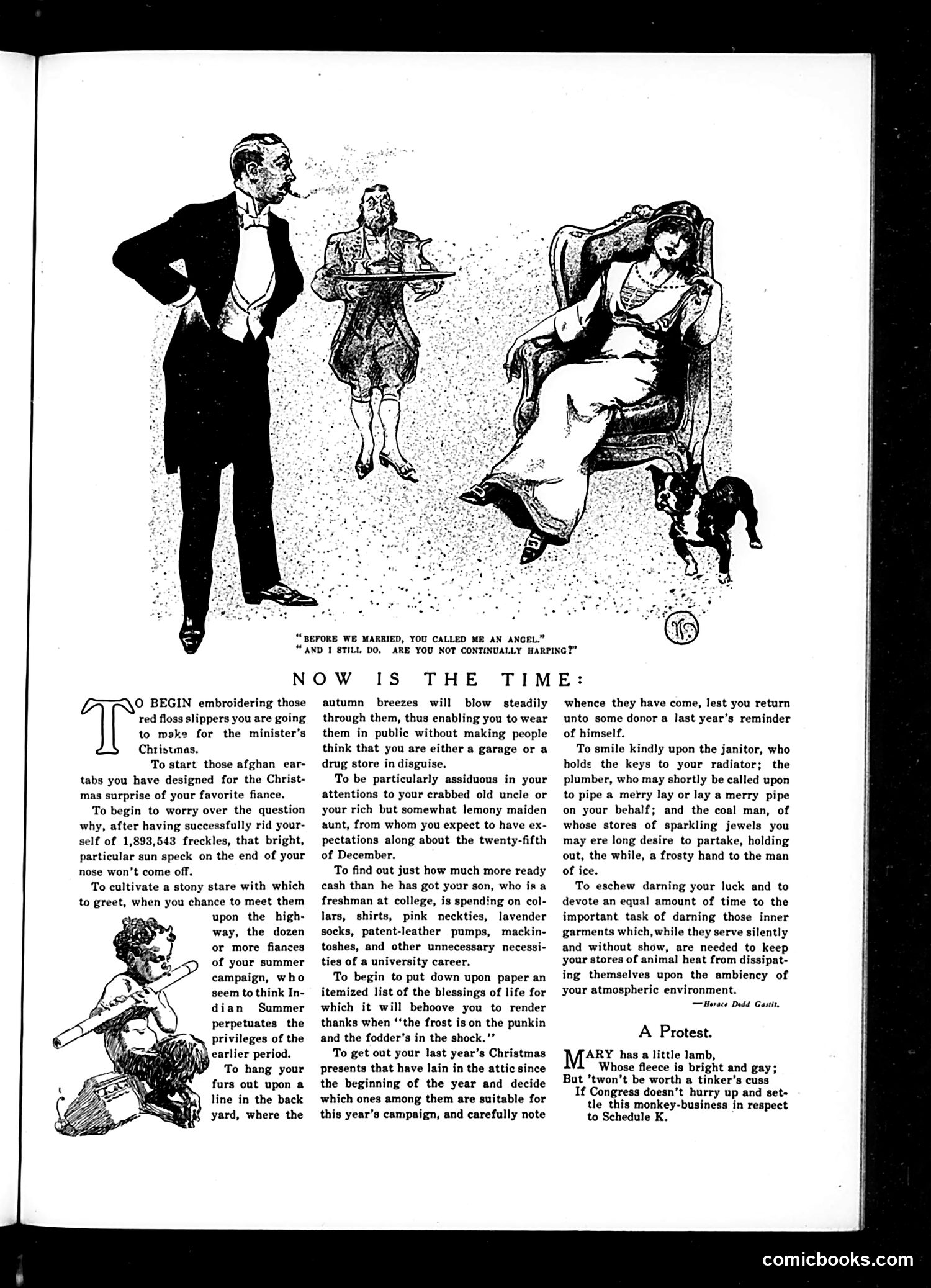
This is a humorous advice column titled "Now Is the Time" offering tongue-in-cheek pre-Christmas suggestions for wives and fiancées. The cartoon at top depicts a domestic scene: a husband complains that his wife, now married, constantly nags him—contrasting with how he called her "an angel" before marriage. The satire mocks the gap between courtship romance and marital reality. The column itself playfully catalogs holiday tasks and social obligations: embroidering gifts, cultivating indifference toward multiple romantic interests from summer, managing multiple "fiancés," currying favor with wealthy relatives for Christmas money, and enduring discomfort (cold radiators, poor heating) while remaining gracious to service workers. The brief poem at bottom ("Mary Has a Little Lamb") appears unrelated—likely advertising or filler—protesting some congressional trade schedule issue. The satire targets early 20th-century upper-middle-class domesticity and the financial pressures underlying holiday season social performance.
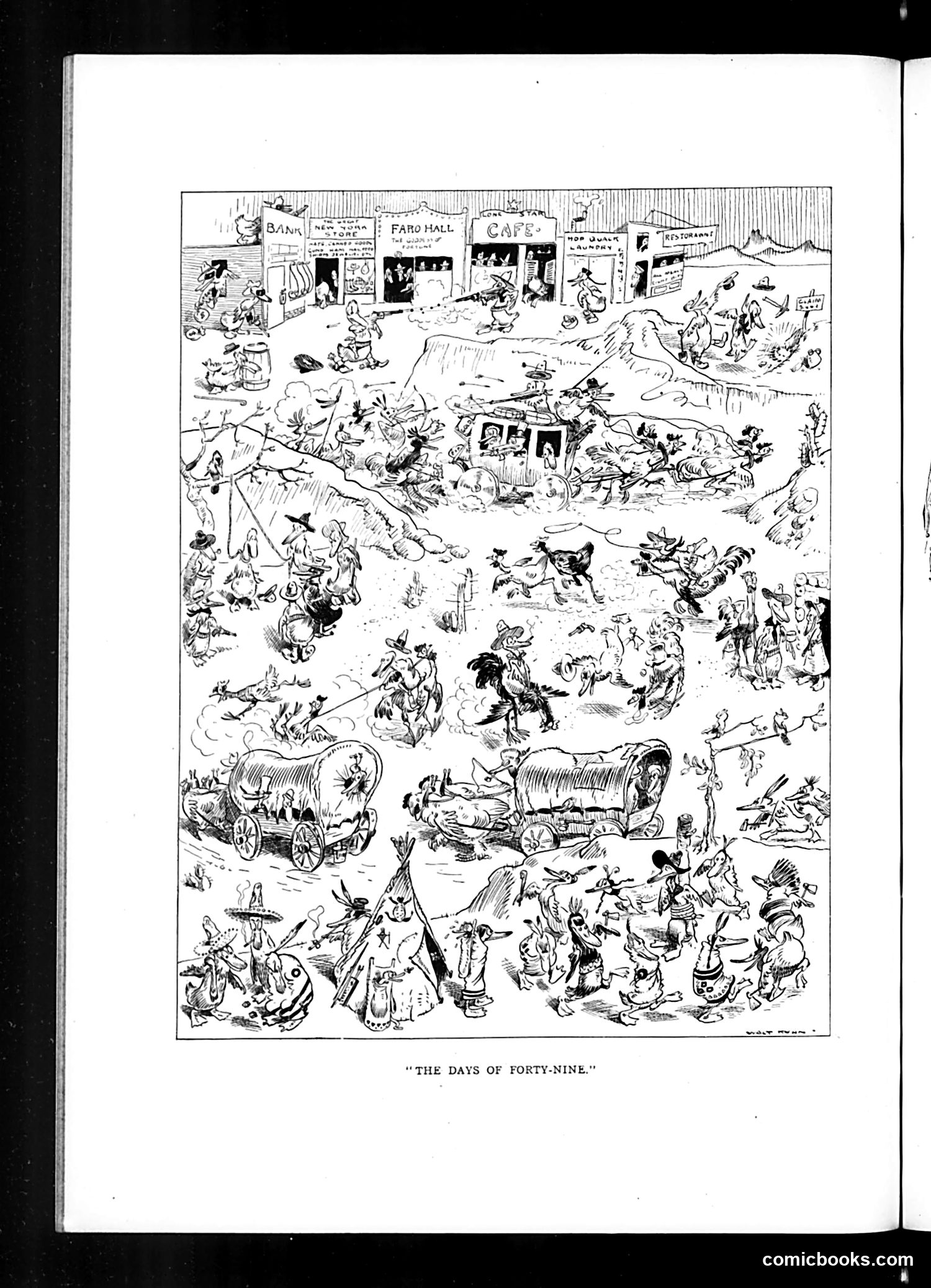
This satirical cartoon depicts chaos at what appears to be a Gold Rush settlement, likely referencing the California Gold Rush of 1849. The illustration shows a lawless frontier town with various establishments (bar, dance hall, café, restaurant) surrounded by pandemonium: miners fighting, gambling, drinking, and engaging in general mayhem. Two covered wagons dominate the center, with Native Americans, prospectors, and fortune-seekers scattered throughout in comic disorder. The satire appears to mock the romanticized mythology of the Gold Rush era—presenting it not as noble frontier adventure but as chaotic, violent, and disorganized. The exaggerated comic style emphasizes the absurdity and moral chaos of unregulated frontier life, contrasting sharply with contemporary nostalgic celebrations of "Forty-Niner" history.
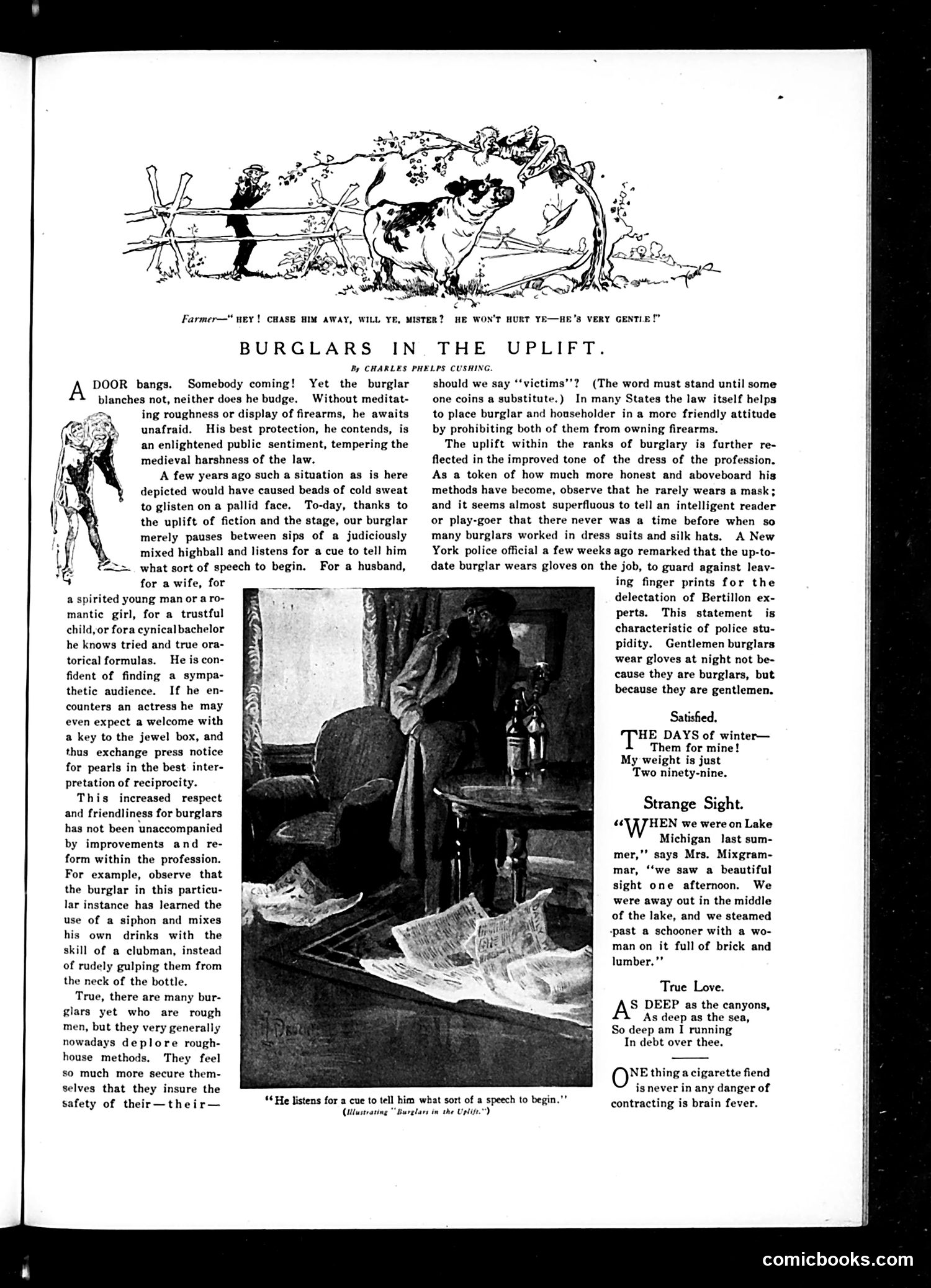
This satirical piece mocks the Progressive Era's reform movement (the "uplift"). The cartoon depicts a burglar calmly stealing while a farmer tries weakly to stop him, with the farmer reassuring everyone the burglar is "very gentle." The article's ironic premise: modern fiction and theater have so romanticized criminals that burglars now behave like gentlemen—wearing dress suits, gloves (to avoid fingerprints), and mixing cocktails with clubman skill. Police even praise their refined methods. The satire targets two things: (1) sentimental literature that portrays criminals sympathetically, encouraging public sympathy for them, and (2) reform advocates who focus on criminal rehabilitation rather than actual crime prevention. The farmer's helplessness while praising the burglar's gentility embodies the absurdity—society has become so enamored with the criminal's "improvement" that it no longer effectively stops crime. It's a conservative critique: well-intentioned reforms have backfired, making burglars *more* dangerous by rendering victims passive and sympathetic.
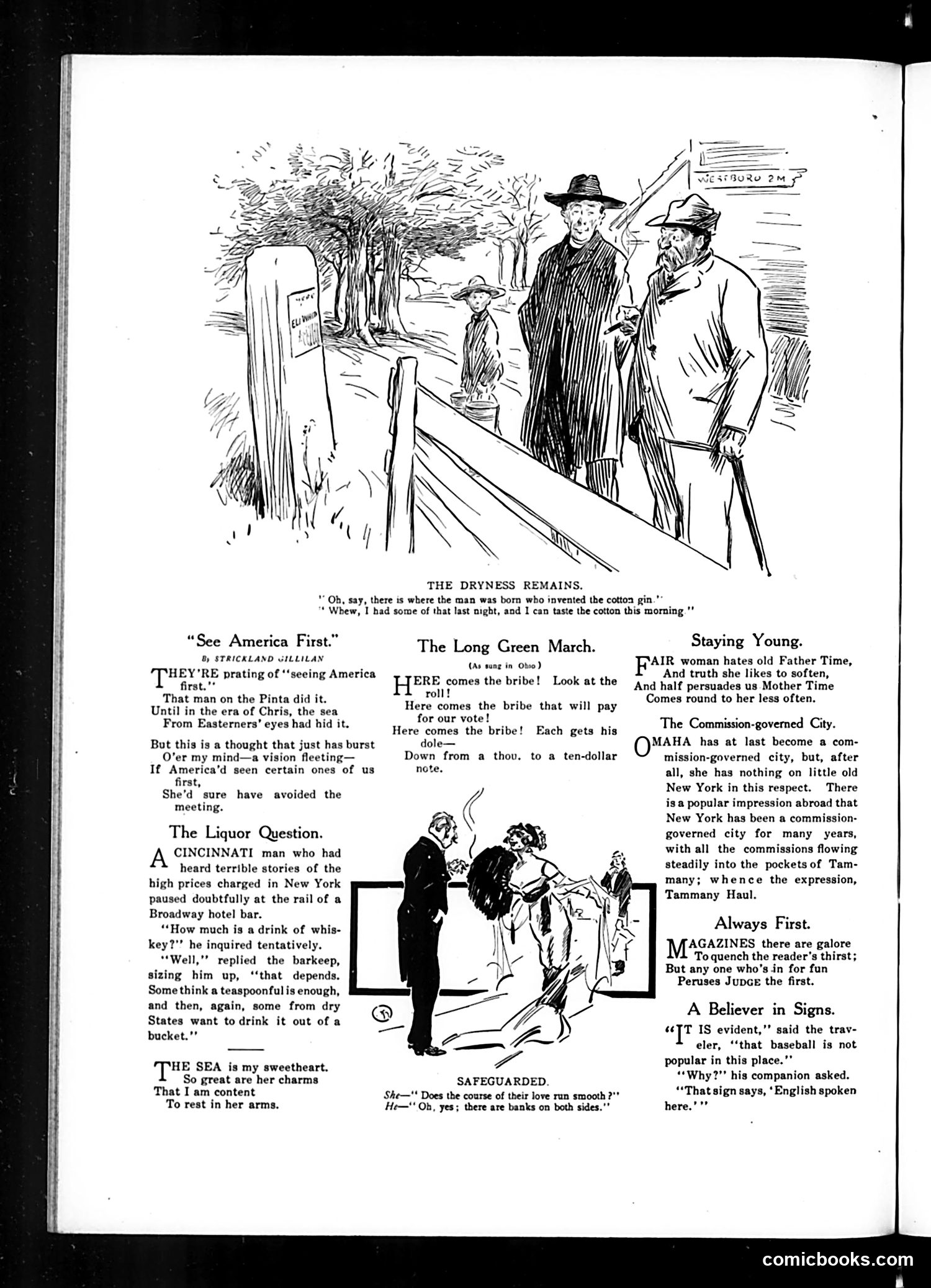
This page contains several short satirical pieces reflecting early 20th-century American concerns: **"The Dryness Remains"** mocks Prohibition's ineffectiveness—a visitor to New York tastes "cotton" in his drink, suggesting bootleg whiskey's poor quality despite the liquor ban. **"The Long Green March"** directly attacks political corruption, depicting bribes flowing "from a thou. to a ten-dollar note" to secure votes, likely referencing urban machine politics. **"The Liquor Question"** jokes about regional differences: Easterners pay high prices for whiskey while visitors from "dry States" (where alcohol was banned) want to drink excessively. **"Tammany Haul"** sarcastically claims Omaha's new commission government is nothing compared to New York's—a dig at Tammany Hall, the notoriously corrupt Democratic political machine that dominated NYC. The remaining pieces are lighter humor about aging women, love, and baseball's unpopularity in certain regions. Overall, the page reflects Progressive Era frustrations with urban corruption and Prohibition enforcement.
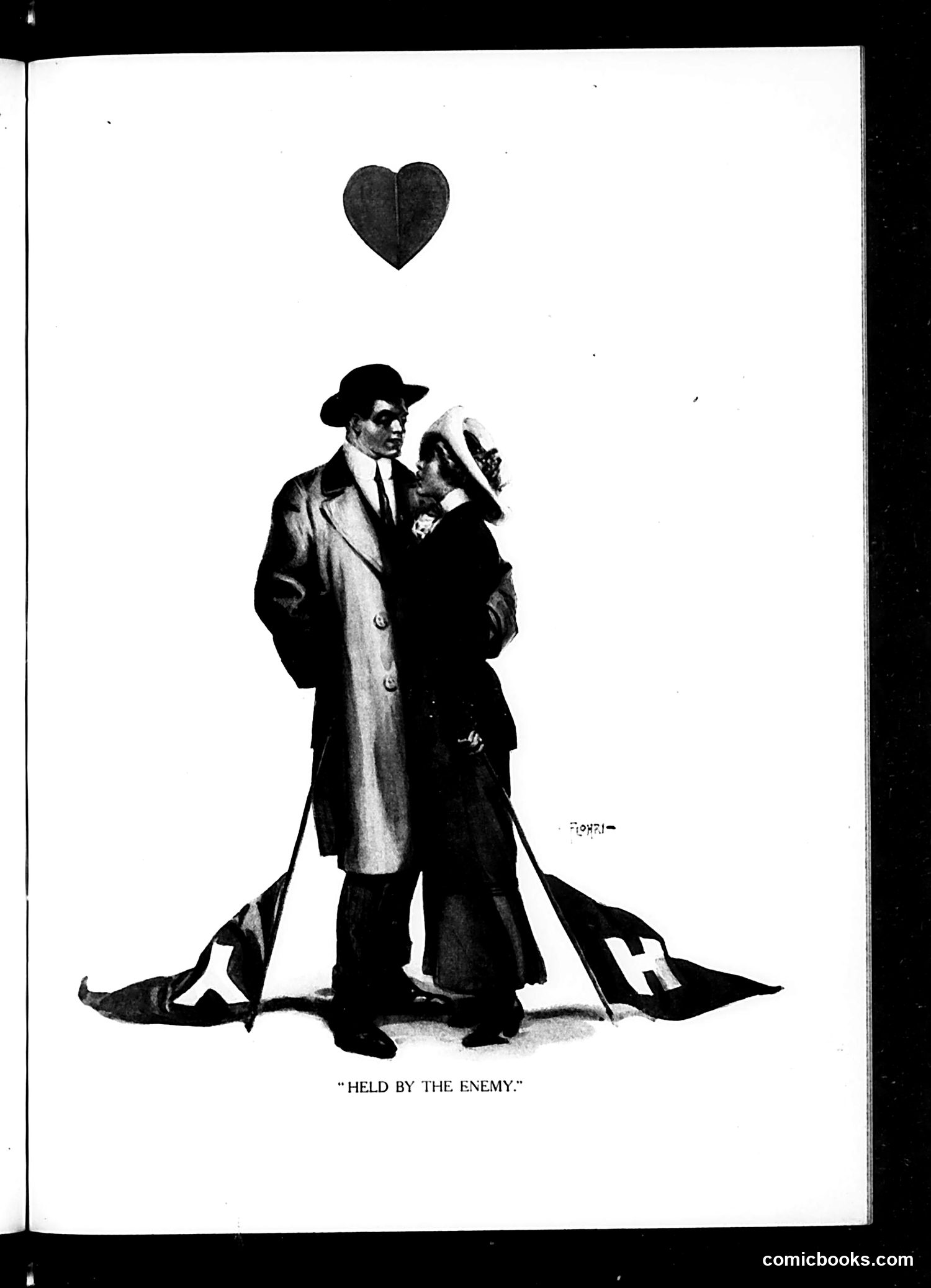
This political cartoon depicts a man and woman standing together beneath a large heart symbol, surrounded by what appear to be enemy flags or banners at their feet. The caption reads "HELD BY THE ENEMY." The image appears to be WWI-era propaganda or commentary, likely criticizing how romantic love or personal relationships might distract from patriotic duty during wartime. The "enemy" flags suggest the couple is metaphorically "held captive" by their romantic bond rather than fully committed to the nation's war effort. The specific identities of the figures are unclear without additional context, but the satire critiques the tension between personal love and national loyalty during a period of conflict.
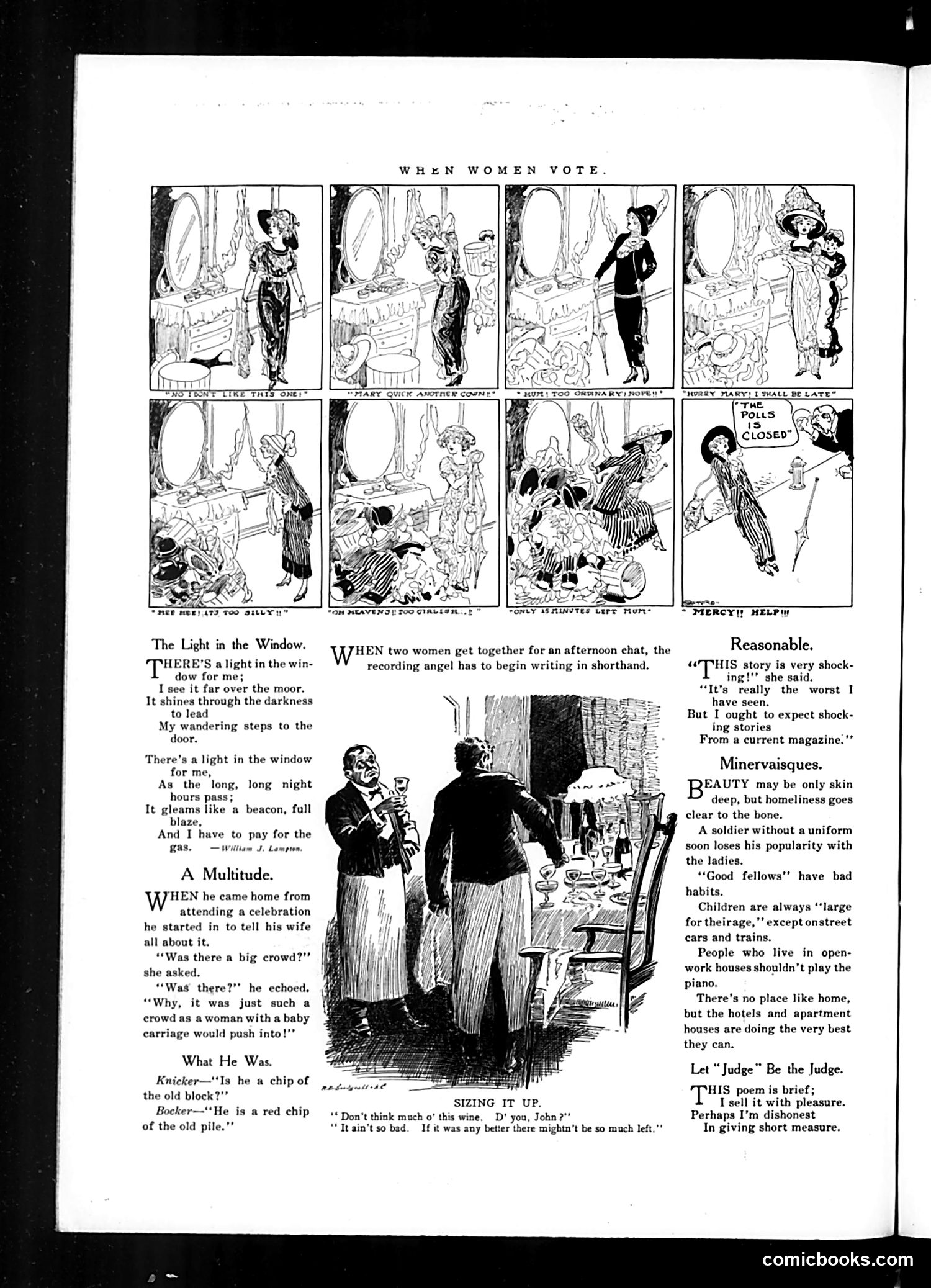
The title strip depicts women preparing to vote, shown primping at mirrors and obsessing over appearance—suggesting women voters are vain and superficial rather than serious about civic duty. This mocks women's suffrage advocates. The accompanying humor pieces reinforce stereotypes: women are gossips ("recording angel has to begin writing in shorthand"), materialistic, and frivolous. One joke contrasts a man's matter-of-fact crowd estimate with how a woman would describe it—implying women exaggerate and are less rational. The "Minervaisques" column offers sardonic observations about social behavior, treating human nature cynically. Overall, this page uses cartoons and comic vignettes to ridicule the notion of women voters as incapable of serious political judgment, positioning them as concerned only with fashion, gossip, and vanity. The satire opposes women's suffrage by caricaturing women as unfit for voting responsibilities.
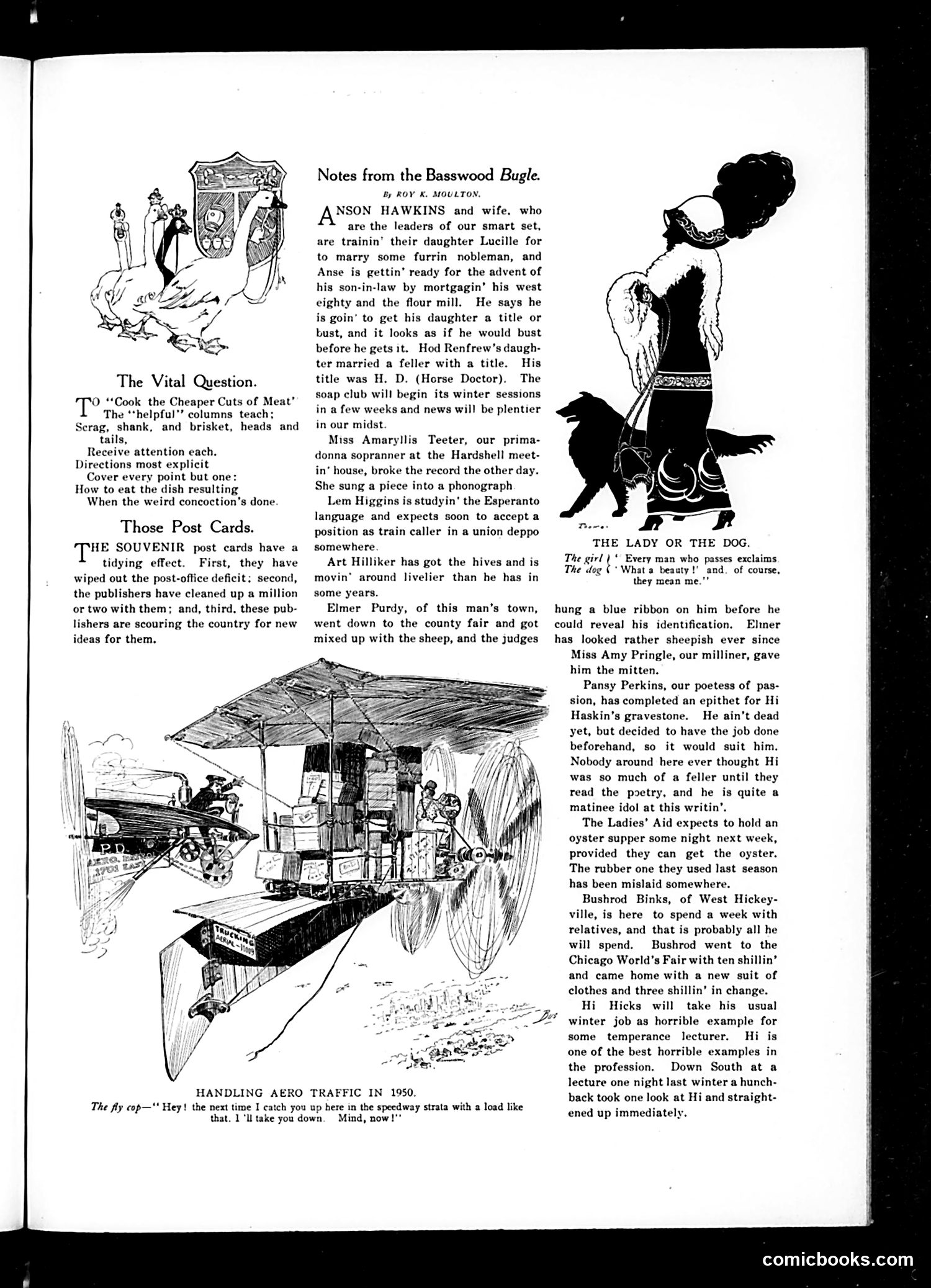
This page contains three distinct satirical pieces: **"The Vital Question"** mocks domestic advice columns that explain how to cook cheap meat cuts but never address the fundamental problem: the resulting dishes are inedible. **"Notes from the Basswood Bugle"** is rural gossip satirizing small-town pretension. Anson Hawkins mortgages his farm trying to marry his daughter to foreign nobility, while his neighbor's daughter married a "Horse Doctor" (H.D.)—the satire being that social climbing often proves pointless. **"Handling Aero Traffic in 1950"** is futuristic humor imagining flying vehicles so common that traffic cops patrol the skies, suggesting early-20th-century anxiety about technological progress. The illustrations support these themes with period-appropriate caricature style. The overall tone reflects Judge's characteristic mockery of American social aspirations and technological optimism.
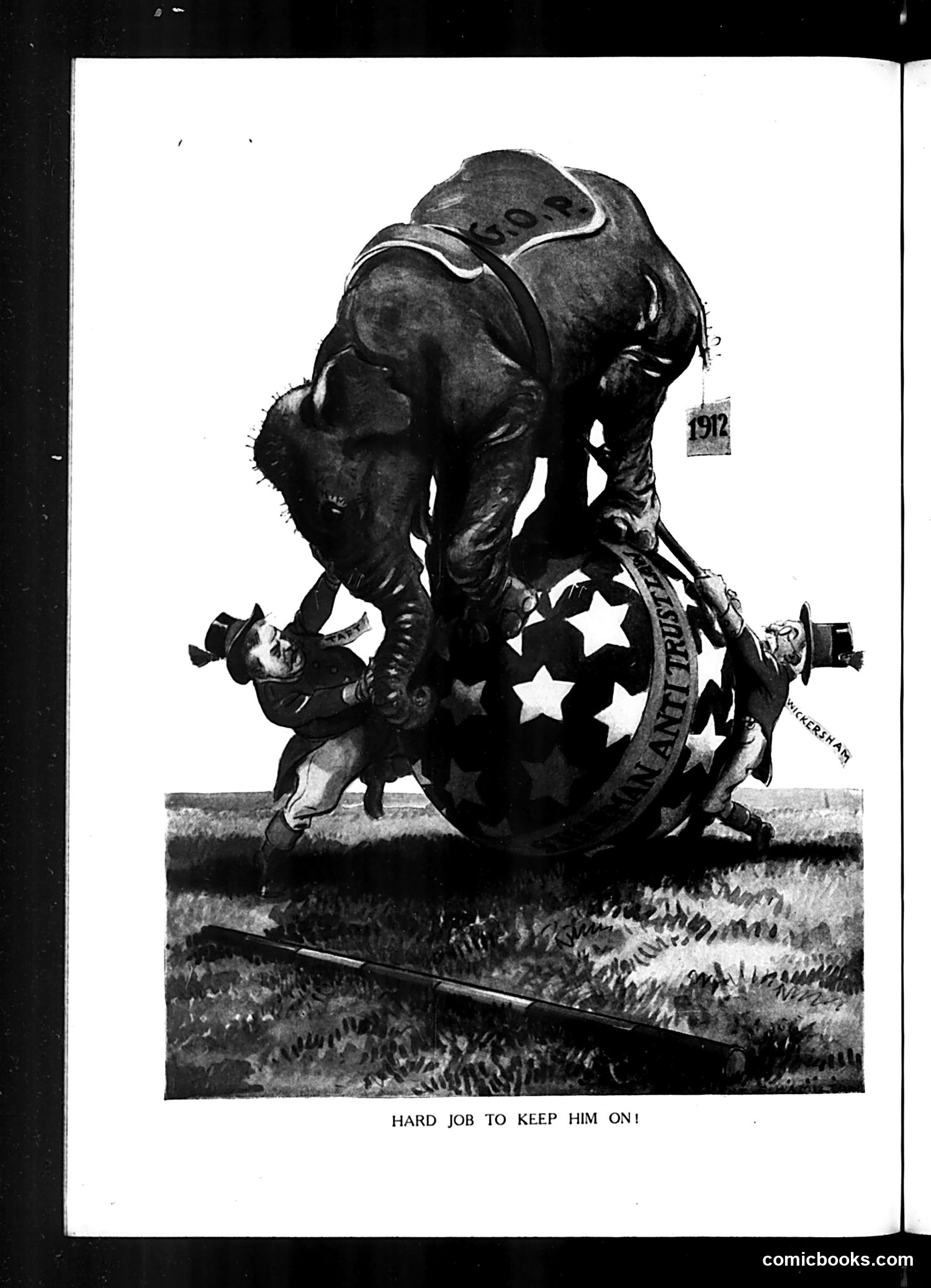
This 1912 political cartoon depicts an elephant (representing the Republican Party) struggling to carry a large ball marked with stars and labeled "Progressivism" or similar reformist ideals. Small figures appear to be working to keep the elephant balanced and moving forward. The cartoon satirizes the Republican Party's difficulty maintaining internal unity around progressive reforms during the 1912 election cycle—likely referencing the party split between President Taft's conservative faction and Theodore Roosevelt's Progressive "Bull Moose" movement. The burden imagery suggests that keeping the party's progressive commitments in place while managing competing factions was an exhausting, precarious task. The "hard job to keep him on" caption emphasizes this strain on party cohesion.
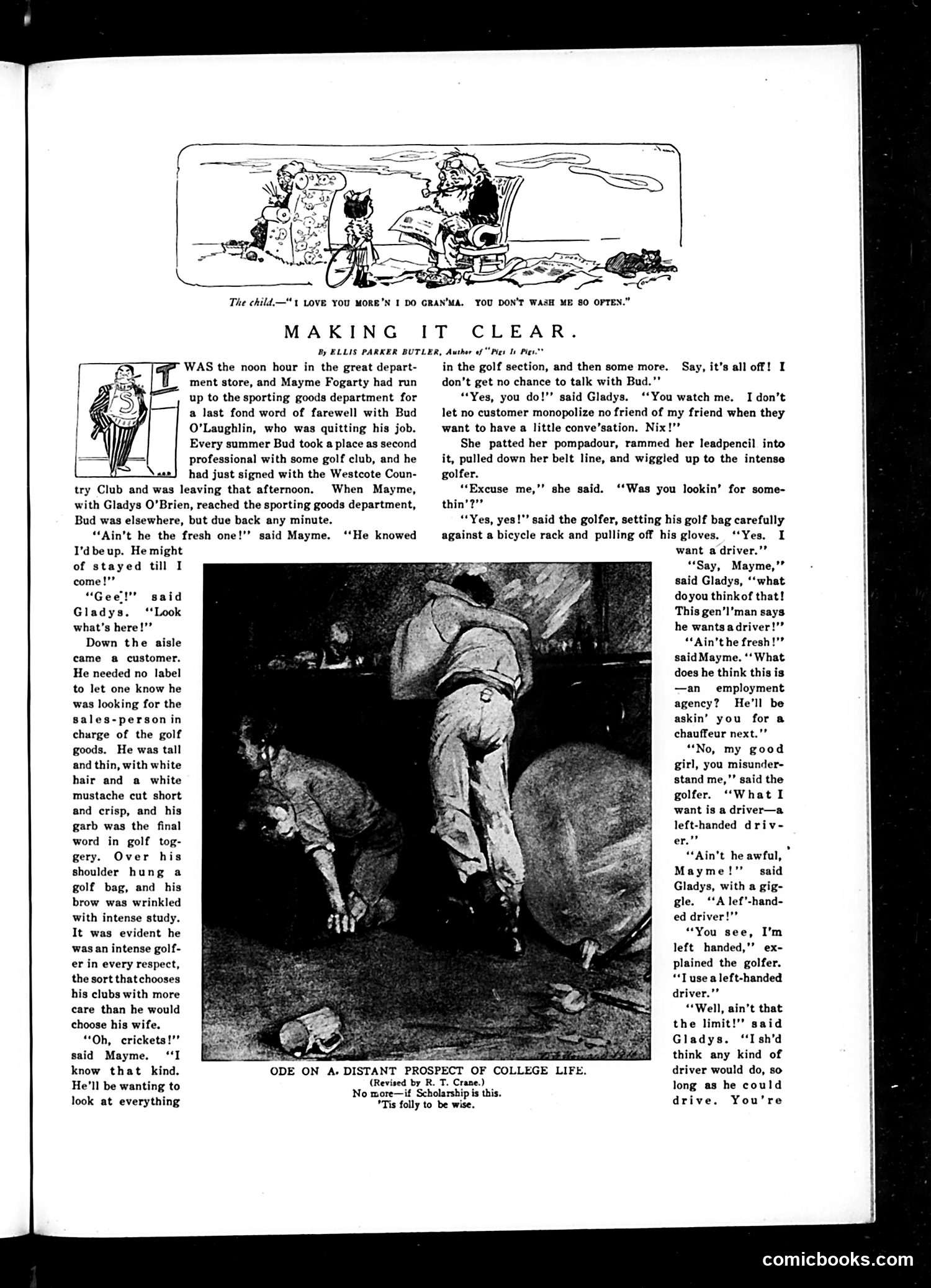
This is a humorous short story by Ellis Parker Butler with an accompanying illustration. The joke relies on a deliberate misunderstanding: Two department store salesgirls, Mayme and Gladys, encounter an elderly, distinguished golfer shopping for sporting goods. When he asks for "a driver," the girls—unfamiliar with golf terminology—assume he means an automobile chauffeur, treating his request as absurdly out of place in a department store. The golfer's confusion and his attempts to clarify that he wants a left-handed golf driver (a type of club) are met with incredulous commentary from the girls, who find it ridiculous that anyone would want a "left-handed driver" of any kind. The satire targets working-class salesgirls' ignorance of leisure pursuits like golf—a sport associated with wealthier customers. The generation gap and class difference between the refined golfer and the slangy, dismissive young women provides the humor. The illustration caption about "college life" suggests concerns about education standards among the working class.
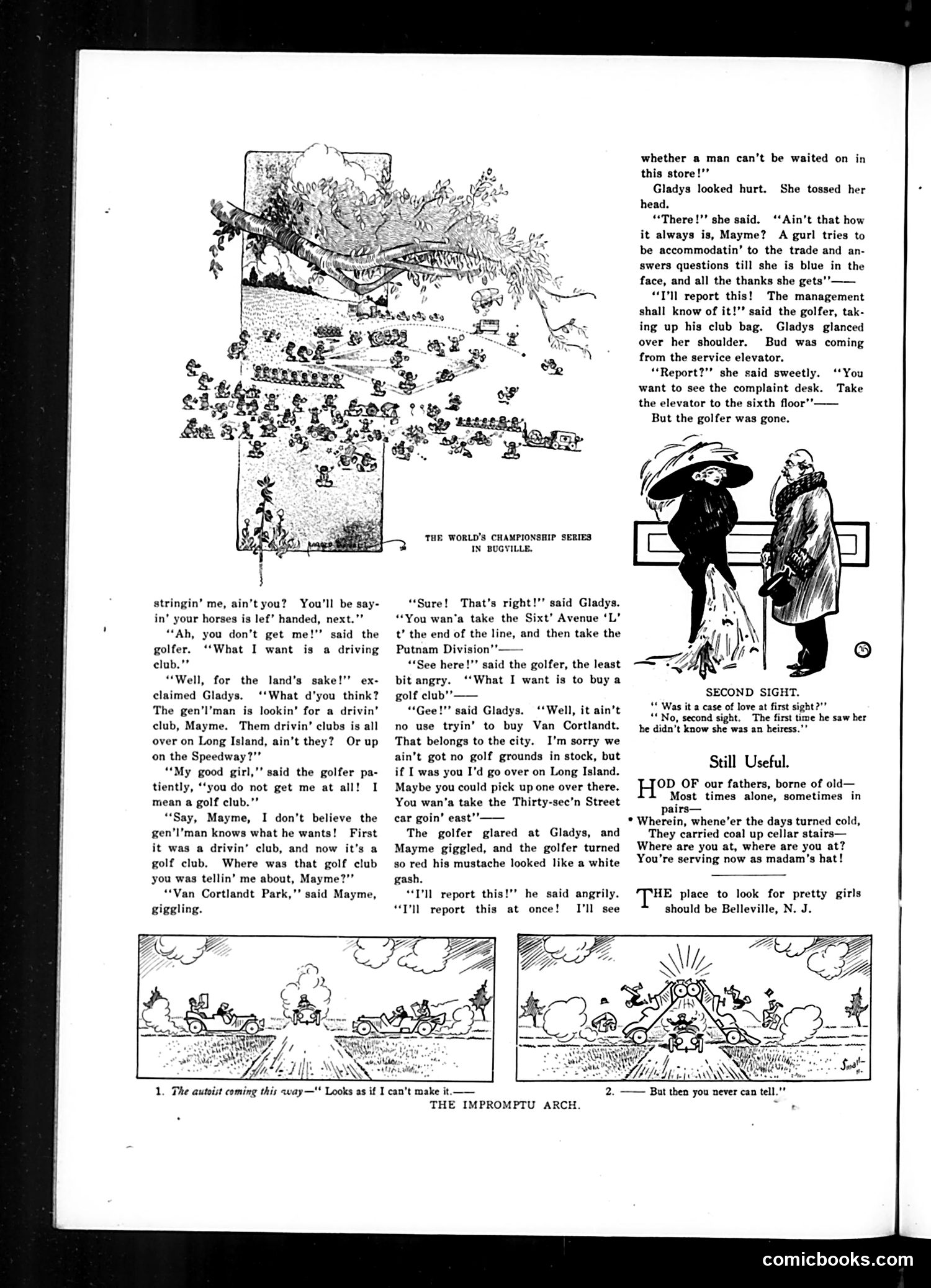
This page contains a humorous sketch about a frustrated golfer trying to buy a "golf club" (the sports equipment) at what appears to be a department store in early 20th-century New York City. Two female saleswomen—Gladys and Mayme—deliberately misunderstand him, interpreting "golf club" as a location (Van Cortlandt Park, Long Island) or confusing "driving club" with vehicles on local roads and the Speedway. Their thick working-class dialect and intentional obtuseness frustrate the gentleman customer, who eventually storms off threatening to report them. The satire mocks both the pretensions of upscale golfers and the class gap between them and working-class shop employees. The secondary cartoons below joke about love and marriage, and celebrate coal-carrying as obsolete but respectable labor. The "Bugyville" reference appears to be a fictional locale used for satirical commentary on urban commerce and class relations.
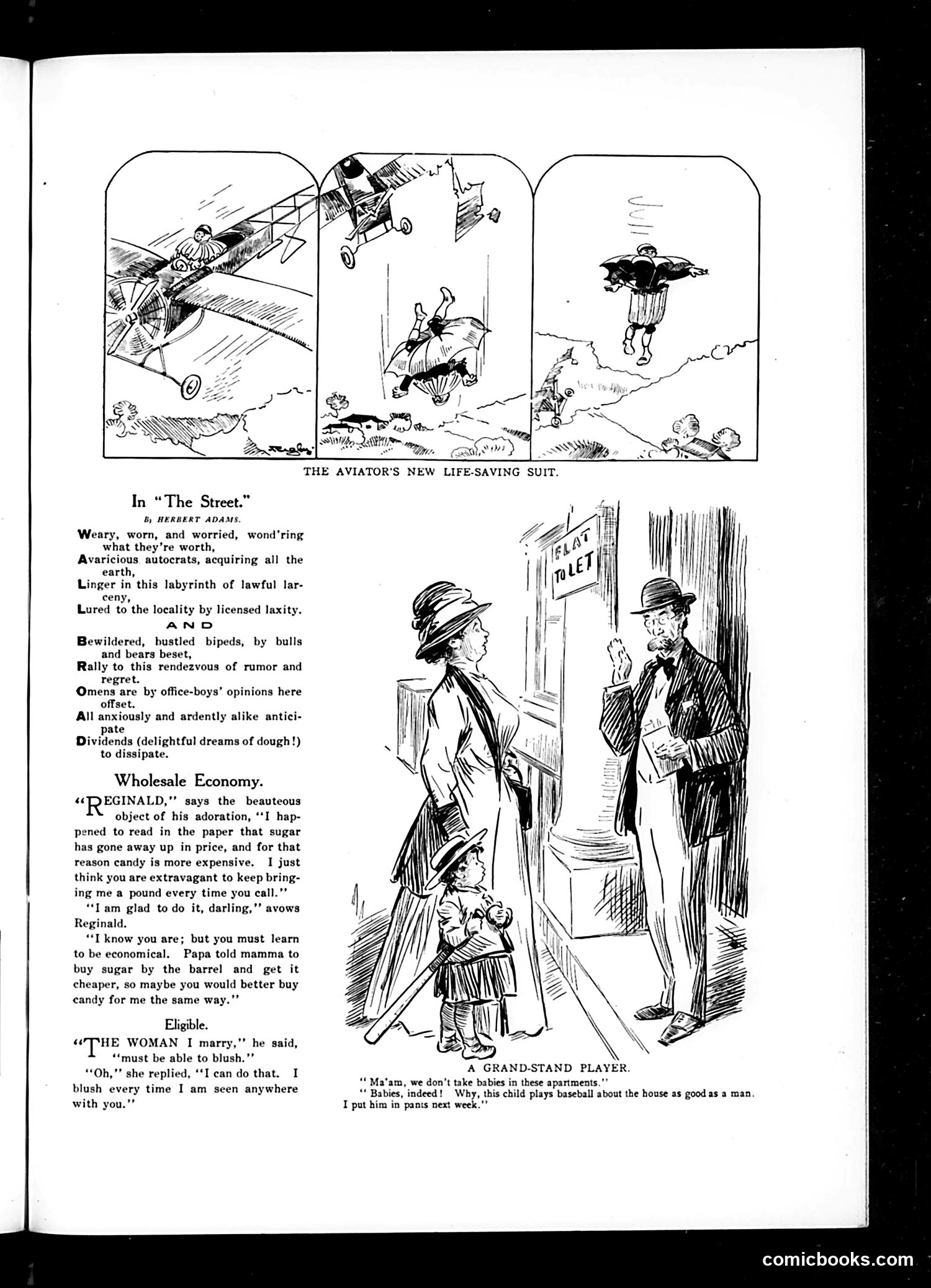
**Top Panel - "The Aviator's New Life-Saving Suit":** Early aviation satire showing a pilot with an experimental parachute device (depicted as umbrella-like contraptions). This references the nascent aviation era when parachutes were novel, dangerous inventions. The humor lies in the absurdity of these primitive safety devices. **Middle Section - "In 'The Street'":** A poem by Herbert Adams satirizing Wall Street financial culture. It mocks wealthy speculators ("avaricious autocrats"), stock market volatility controlled by rumors, and investors obsessed with dividends—stereotyped as dim-witted "office-boys." This reflects anxieties about unregulated markets and financial excess. **"Wholesale Economy" & "Eligible" Sketches:** Domestic humor showing young men pursuing women. The first depicts a suitor buying candy; his girlfriend suggests buying in bulk for savings (satirizing penny-pinching). The second shows a man seeking a woman who can blush—implying modesty—but the woman boasts she blushes whenever seen with him publicly (implying she's sexually active/scandalous). **"A Grand-Stand Player":** Jokes about landlords rejecting tenants with babies, but accepting a child who plays baseball indoors "like a man."
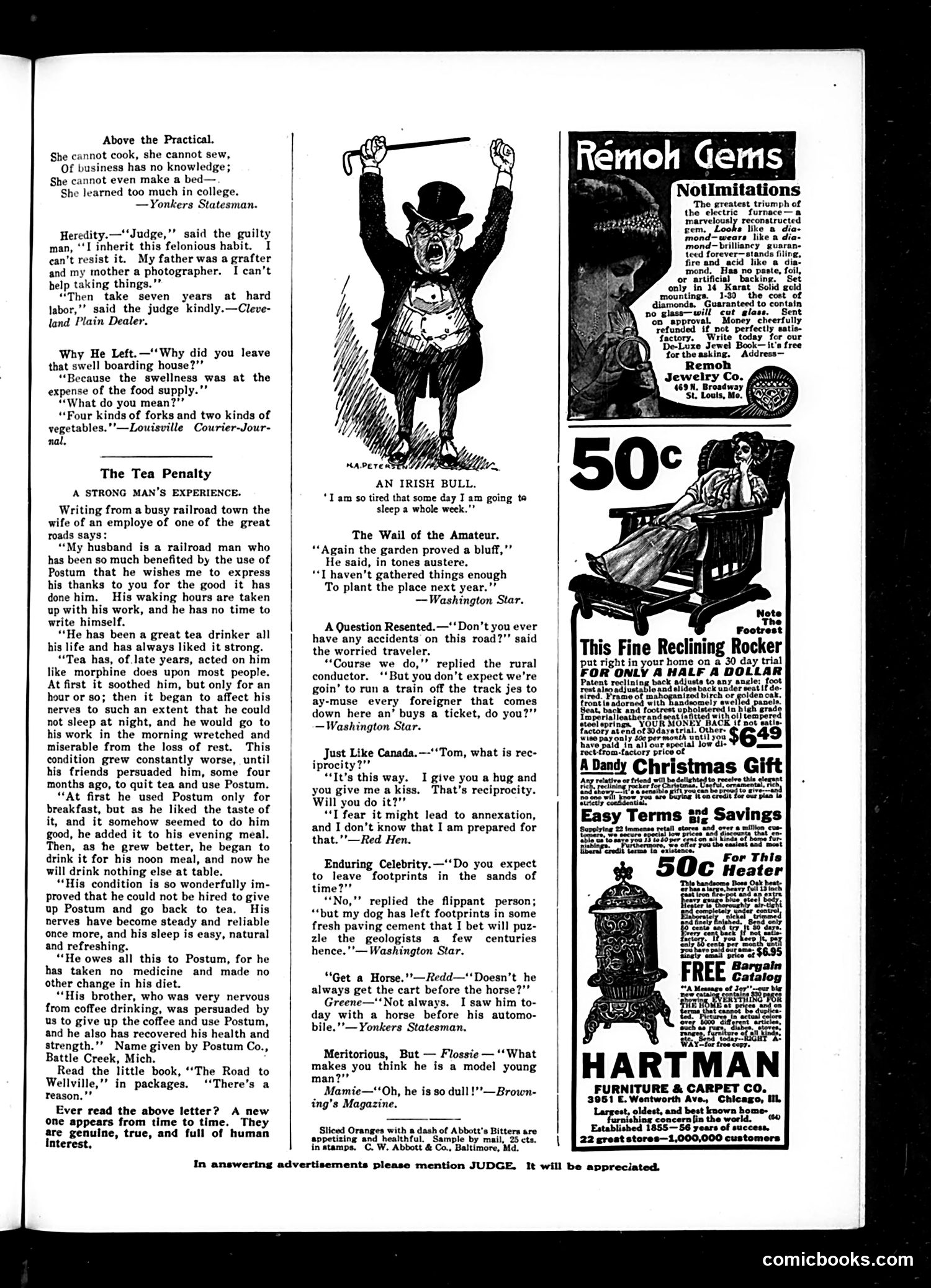
This page from Judge magazine contains primarily **humorous anecdotes and advertisements** rather than political cartoons. The central cartoon depicts **an Irish figure** ("An Irish Bull") celebrating wildly with a cane, illustrating the humor of Irish dialect humor popular in early 20th-century American publications. The accompanying joke plays on the logical absurdity of planning to sleep for a week. The text includes brief jokes mocking: - **Women's education** (suggesting college makes women impractical) - **Heredity as criminal excuse** (a judge dismisses a defendant's claim that his criminal father made him a thief) - Various social observations about food, tea's effects on health, and reciprocity The **Postum advertisement** occupies substantial space, featuring a testimonial claiming the caffeine-free beverage cured a railroad worker's tea-induced insomnia and nervousness. The page reflects early 1900s sensibilities: ethnic humor was mainstream entertainment, patent medicines claimed broad health benefits, and gender roles were rigidly defined. Most content aims for gentle, family-friendly humor rather than sharp political satire.
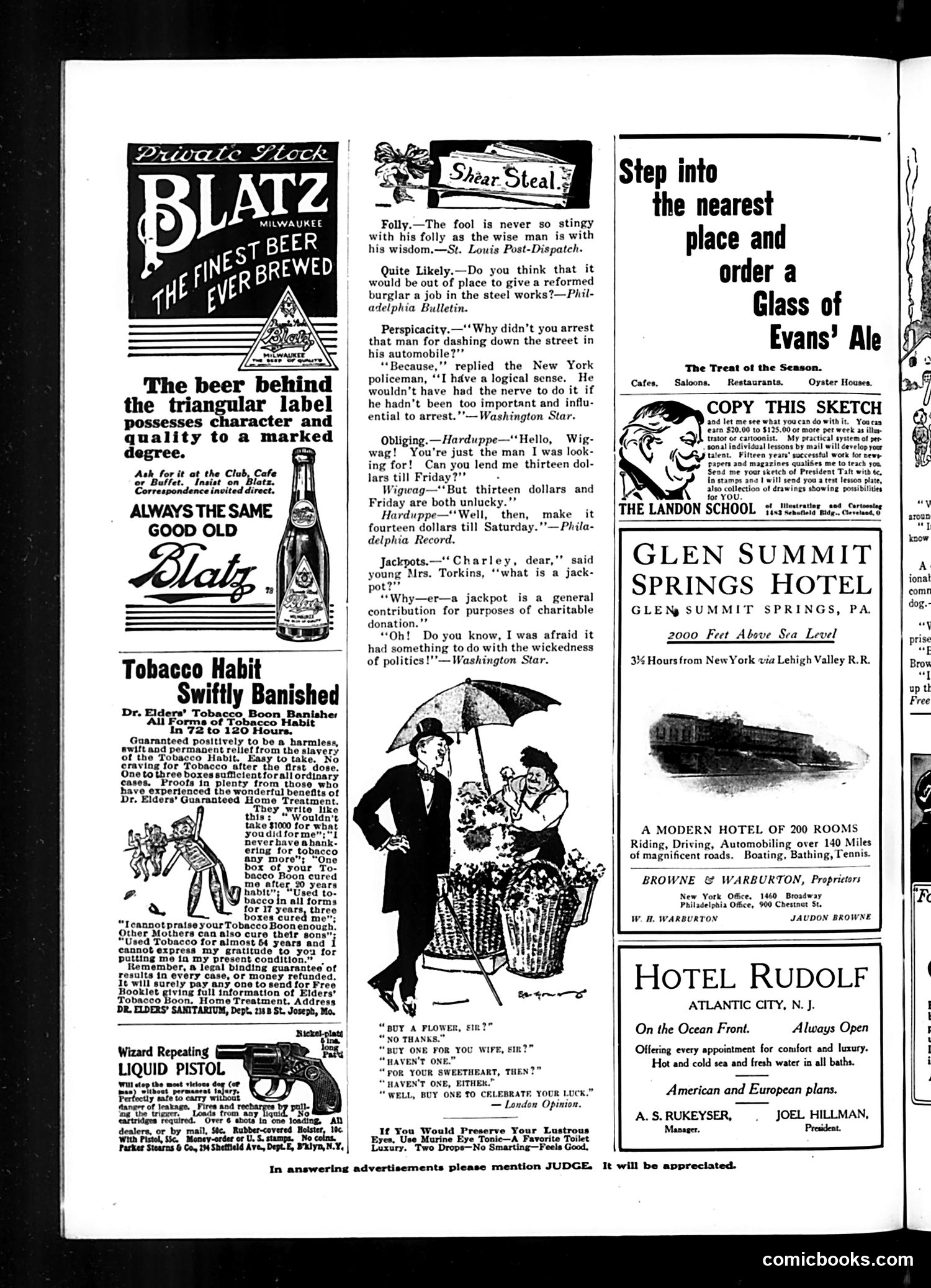
This page is primarily **advertising and filler content** rather than political satire. It contains: **Main Advertisements:** - Blatz Beer (Milwaukee) - Dr. Elders' Tobacco Boon (a patent medicine claiming to cure tobacco addiction in 72-120 hours) - Liquid Pistol toy gun - Evans' Ale - The Landon School (art instruction) - Glen Summit Springs Hotel - Hotel Rudolf **Satirical Humor Section** (upper right): A series of brief jokes labeled "Shear Steal" covering topics like foolishness, reformed burglars, police logic, unlucky numbers, and jackpots—typical light social commentary of the era. **Cartoon:** One small illustration shows a flower seller pitching blooms to a man, humorously escalating from "for your wife" to "for your sweetheart" to finally "to celebrate your luck"—mocking the vendor's persistence. The page reflects early 1900s advertising culture and mild social humor, with no identifiable political figures or serious satire.
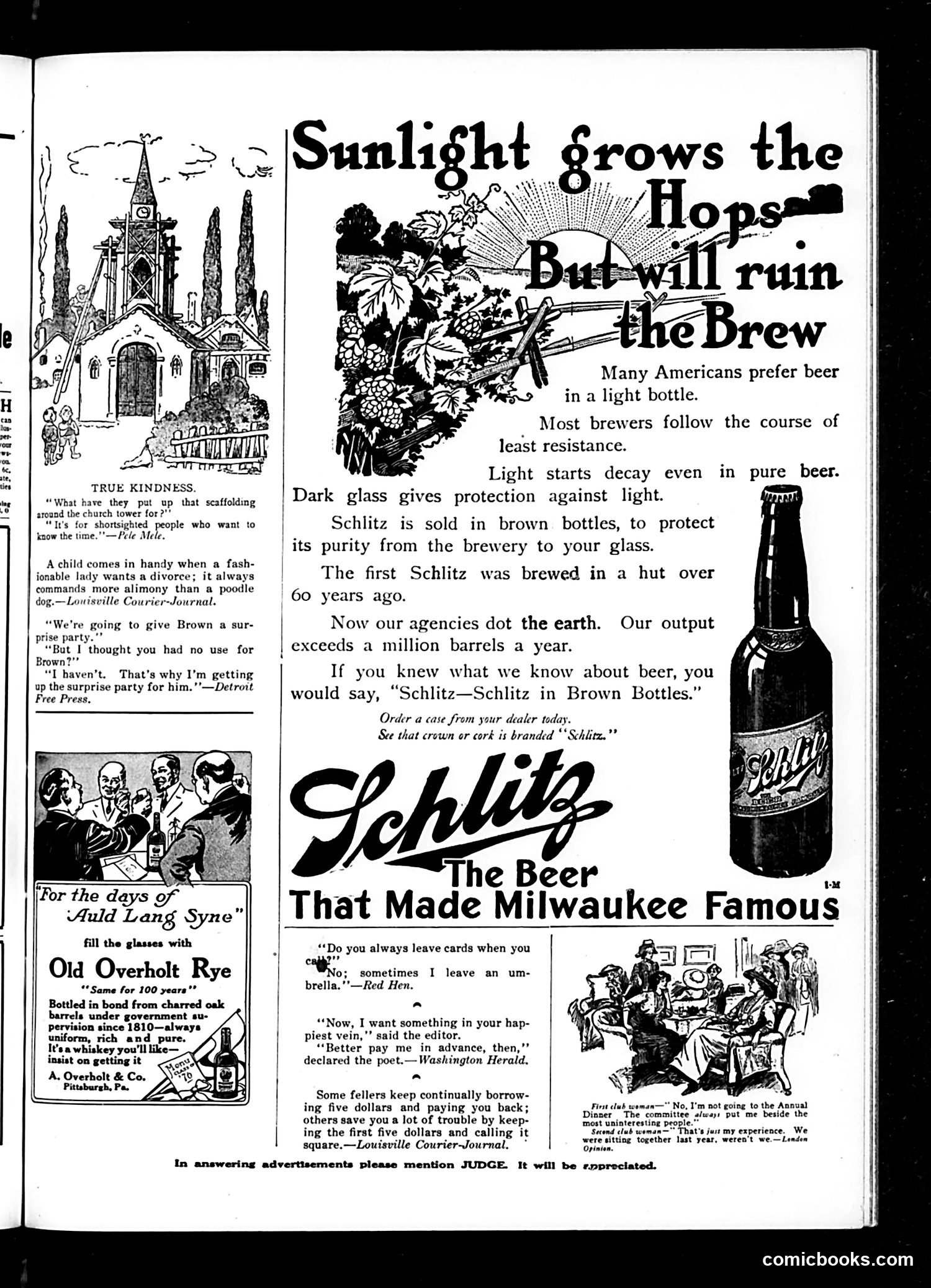
This page mixes beer and whiskey advertising with short satirical jokes typical of Judge magazine's format. **Main Content:** A large Schlitz beer advertisement argues that brown bottles protect beer from light damage, contrasting with competitors who use light bottles for convenience. The ad emphasizes Schlitz's century-old reputation and massive production ("a million barrels a year"). **The Humor:** Short jokes scattered throughout mock everyday absurdities—a church tower with scaffolding for nearsighted people wanting to see the time; a woman using a child in divorce proceedings for higher alimony than a poodle; a poet demanding advance payment before writing "happy" verses; women avoiding a club outing because they fought the previous year. **Secondary Ads:** Old Overholt Rye whiskey advertises government-supervised quality since 1810. **Context:** This reflects pre-Prohibition era advertising (likely 1910s), when beer and liquor ads appeared freely in magazines. The jokes represent Judge's characteristic style: brief, cynical observations on marriage, greed, and human nature rather than political satire.
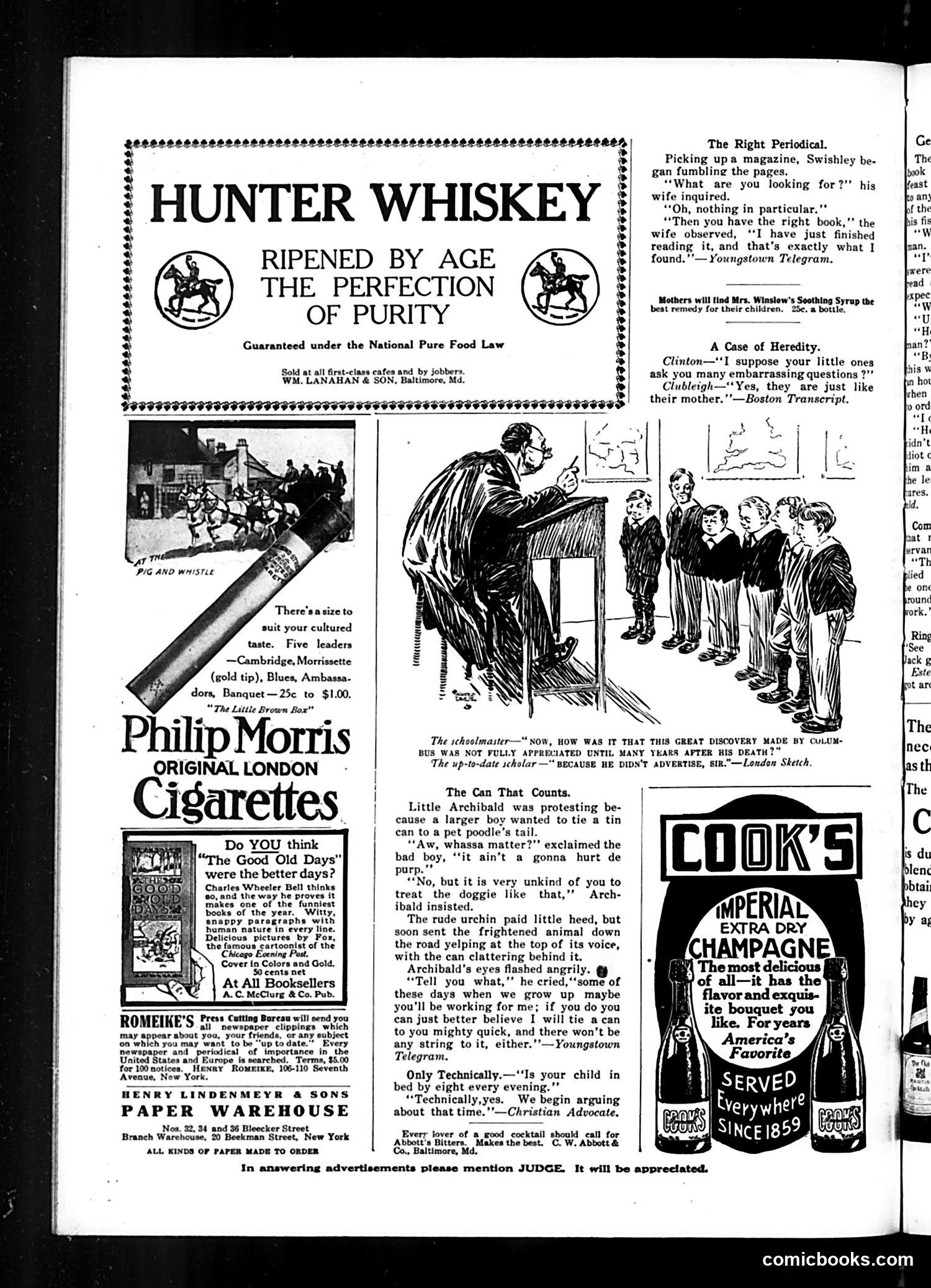
This page is primarily **advertising**, with several humorous short jokes interspersed. The main advertisements promote Hunter Whiskey, Philip Morris cigarettes, Charles Wheeler Bell's book "The Good Old Days," and Cook's Imperial Extra Dry Champagne. The humor pieces are brief, genteel jokes typical of early 20th-century American magazines: - **"The Right Periodical"**: A wife's dry wit about her husband reading a magazine with nothing in particular - **"A Case of Heredity"**: A joke equating children's behavior to their mother's - **"The Schoolmaster"**: Columbus didn't succeed because he failed at self-promotion/advertising—a meta-joke about advertising's importance - **"The Can That Counts"**: A sentimental story about a boy defending a dog from cruelty, threatening future revenge against the bully The page reflects period attitudes toward advertising, temperance debates (whiskey/champagne ads alongside family-oriented content), and gentle, moralistic humor. There are no identifiable political figures or controversial satire—this appears to be a standard commercial and entertainment page from Judge's early era.
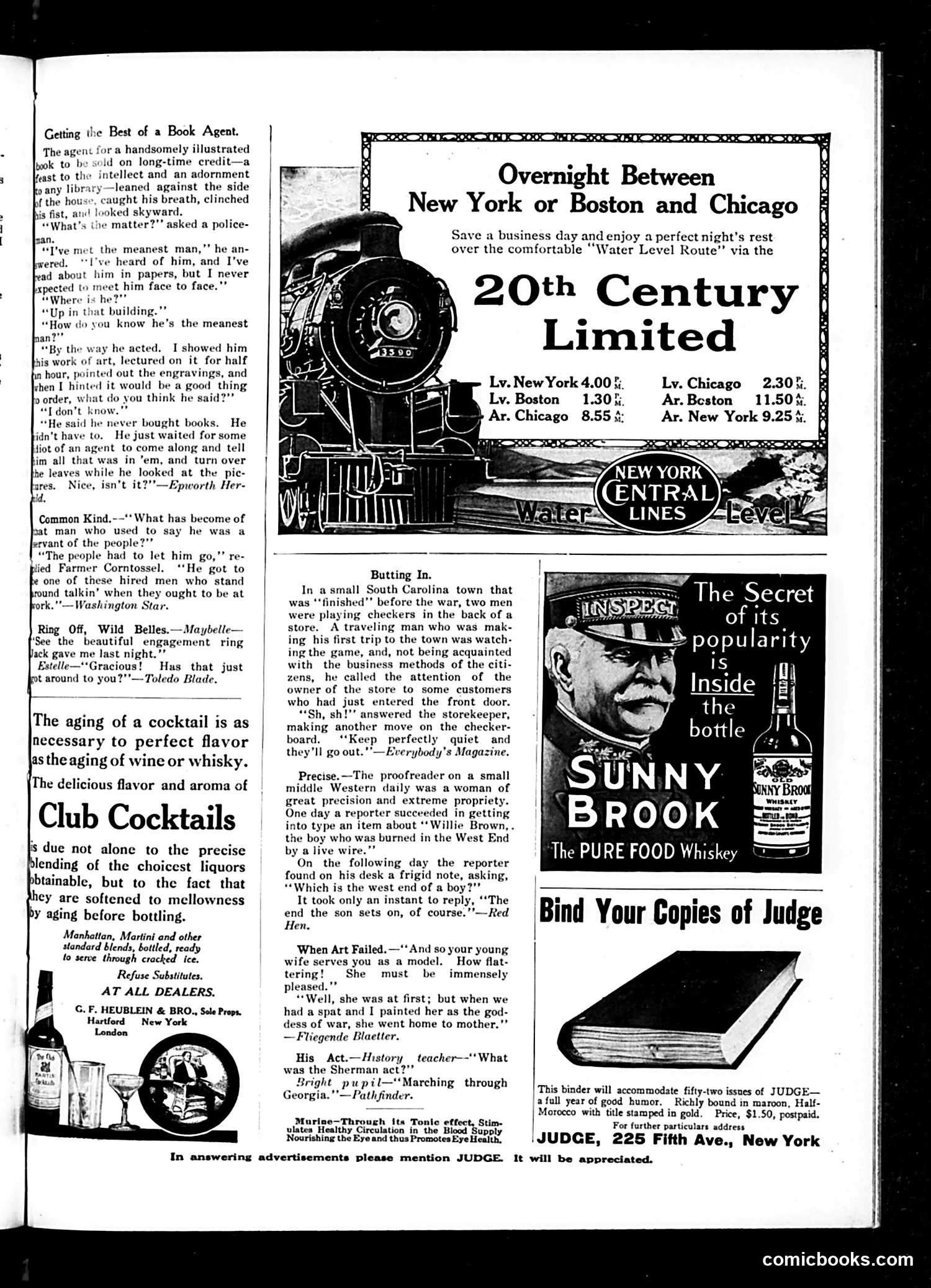
This page is primarily **advertising and humor miscellany** rather than political cartoons. The content includes: **Main Advertisement:** The 20th Century Limited train service, featuring a dramatic locomotive image promoting overnight rail travel between New York/Boston and Chicago. **Humorous Anecdotes:** Short joke pieces with light social commentary: - A book agent frustrated by a customer unwilling to buy illustrated volumes - A politician described as a "servant of the people" who became a lazy hired hand - Various one-liners about engagements, propriety, and small-town life **Other Ads:** Club Cocktails (emphasizing aging/quality), Sunny Brook whiskey, Judge magazine binding services, and Murine eye drops. The humor reflects early 20th-century commercial culture—frustrations with sales resistance, skepticism about politicians, and genteel propriety in small towns. No specific political figures or events appear to be caricatured. The page represents Judge's typical mix of light satire, advertising, and general-interest jokes rather than hard political commentary.
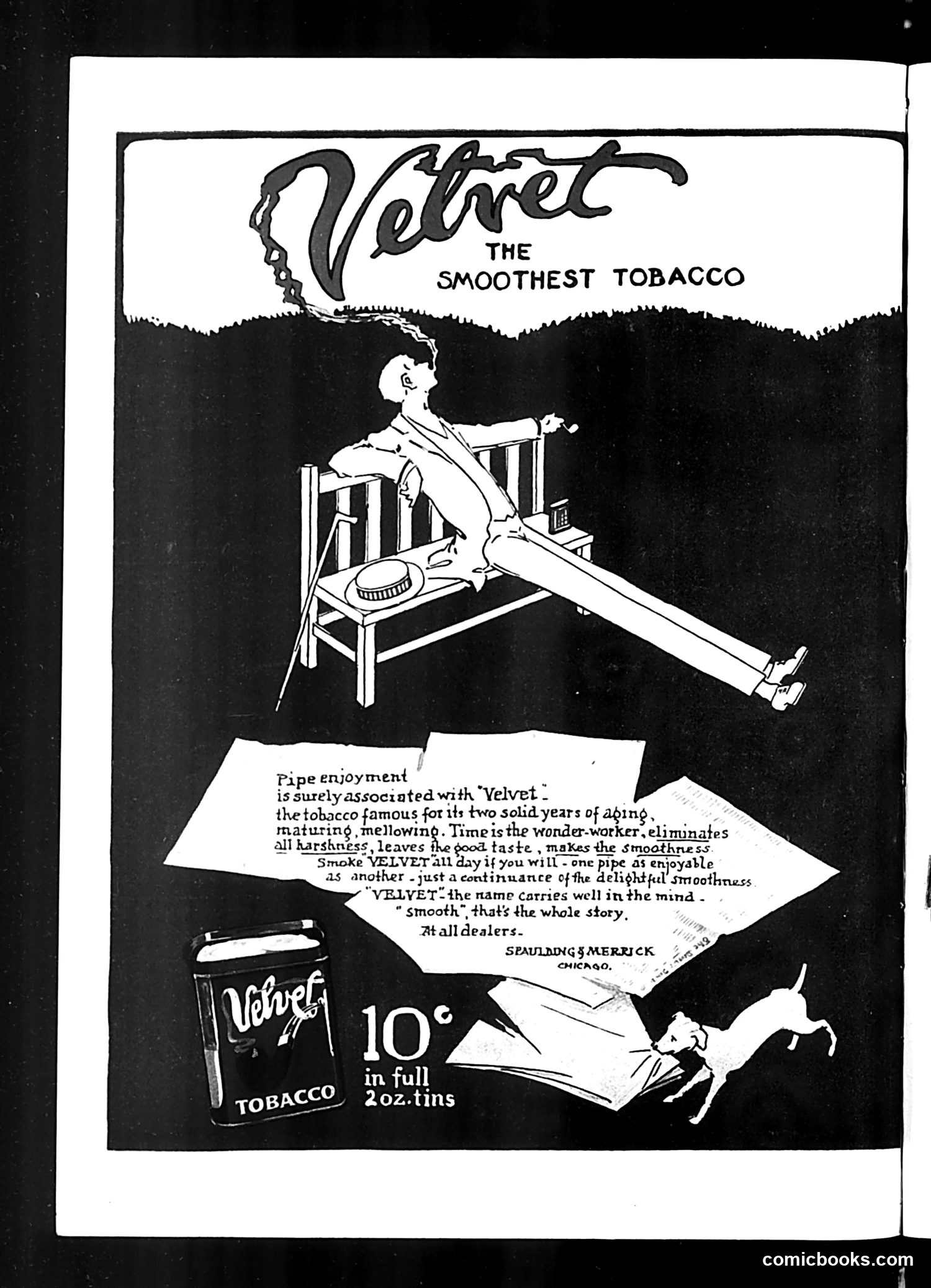
This is a **tobacco advertisement**, not political satire. It promotes Velvet pipe tobacco, manufactured by Spaulding & Merrick of Chicago, priced at 10¢ for 2-ounce tins. The ad features an illustration of a man relaxing in a chair, smoking a pipe, embodying leisure and contentment. The copy emphasizes that Velvet tobacco is aged for "two solid years," which allegedly eliminates harshness and ensures smoothness—the product's key selling point, repeated throughout. The phrase "the name carries well in the mind—'smooth' that's the whole story" uses the brand name as a marketing hook. The casual, satisfied pose of the smoker conveys the product's appeal to early-20th-century masculine leisure culture. This represents typical advertising from *Judge* magazine's era, when tobacco marketing faced no regulatory restrictions and could freely promote smoking's pleasures.