
Judge, 1911-11-04 · page 5 of 24
Judge — November 4, 1911 — page 5: what you’re looking at
What you’re looking at
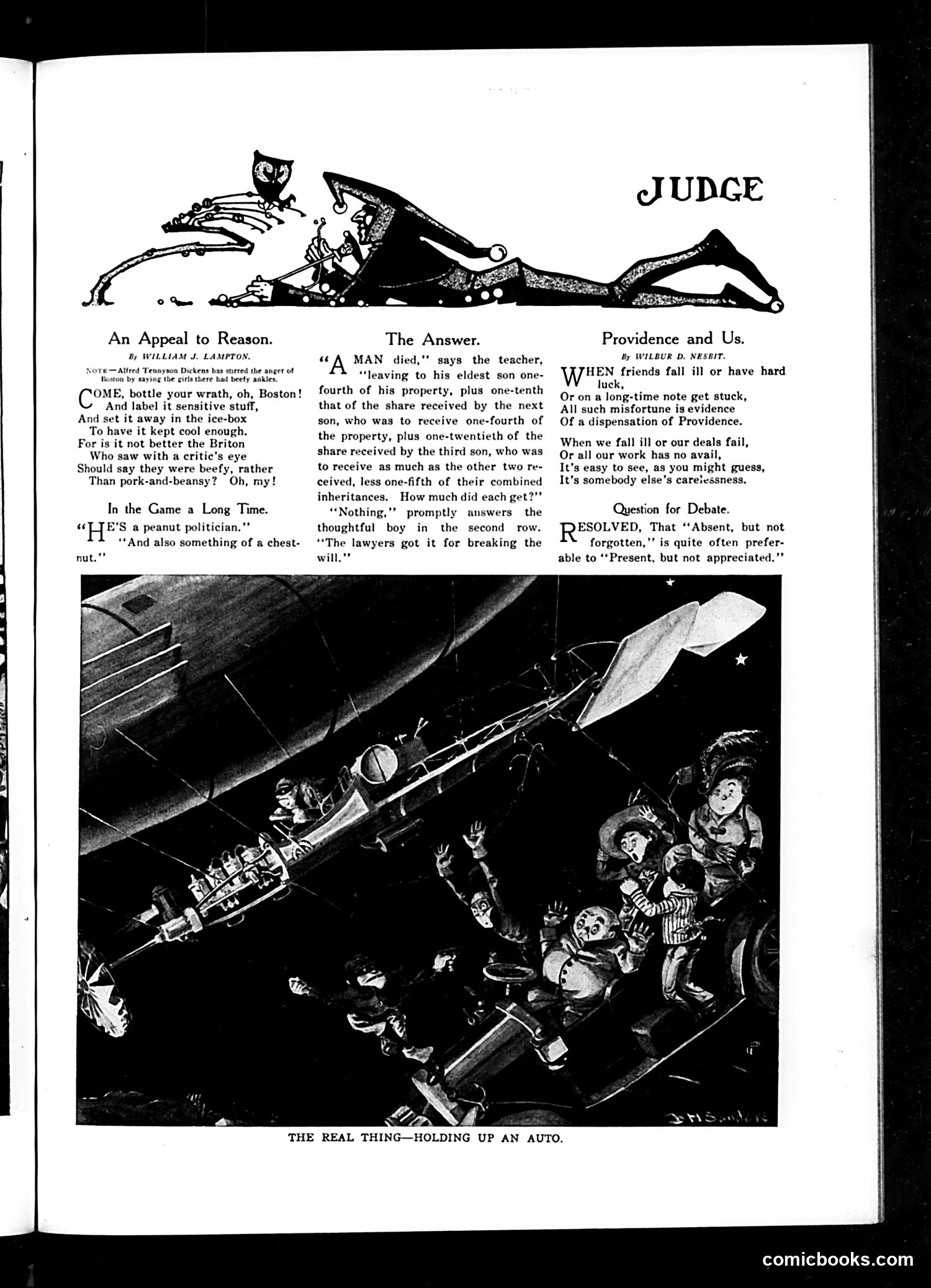
This page contains four separate editorial pieces satirizing American politics and society, likely from the early 20th century. **Top section:** "An Appeal to Reason" mocks Boston's Brahmin class; "The Answer" satirizes a will dispute where lawyers are the only winners; "Providence and Us" questions whether divine intervention or luck explains life's fortunes. **Main illustration ("The Real Thing—Holding Up an Auto"):** This is the page's centerpiece—a surreal nighttime scene depicting what appears to be multiple figures literally "holding up" a car, as if committing robbery. The caption creates a double meaning: it likely comments on highway bandits or labor unrest affecting transportation, though the specific historical reference is unclear without additional context. The figures' exaggerated expressions suggest social anxiety about crime or lawlessness. The overall tone criticizes wealth, legal systems, and public safety concerns.
📄 Transcribed text from this page (OCR, searchable)
Machine-transcribed from the original scan — historical spelling and the odd misread are preserved.
An Appeal to Reason. By WILLIAM J. LAMPTON. —Alfred Tennyson Dickens bas shirred the anger of by saying the girls there had beefy ankles. OME, bottle your wrath, oh, Boston! And label it sensitive stuff, And set it away in the ice-box To have it kept cool enough. For is it not better the Briton Who saw with a critic’s eye Should say they were beefy, rather Than pork-and-beansy? Oh, my! In the Game a Long Time. "S a peanut politician.” “‘And also something of a chest- “H nut. The Answer. “ MAN died," says the teacher, “leaving to his eldest son one- fourth of his property, plus one-tenth that of the share received by the next son, who was to receive one-fourth of the property, plus one-twentieth of the share received by the third son, who was to receive as much as the other two re- ceived, less one-fifth of their combined inheritances. How much did each get?” “Nothing,’’ promptly answers the thoughtful boy in the second row. “The lawyers got it for breaking the will."” THE REAL THING—HOLDI Providence and Us. By WILBUR D. NESBIT. HEN friends fall ill or have hard luck, Or on a long-time note get stuck, All such misfortune is evidence Of a dispensation of Providence. When we fall ill or our deals fail, Or all our work has no avail, It’s easy to see, as you might guess, It’s somebody else’s carelessness. Question for Debate. ESOLVED, That ‘‘Absent, but not forgotten,’’ is quite often prefer- able to ‘‘Present, but not appreciated.” NG UP AN AUTO. comicbooks.com