
Judge, 1911-11-04 · page 6 of 24
Judge — November 4, 1911 — page 6: what you’re looking at
What you’re looking at
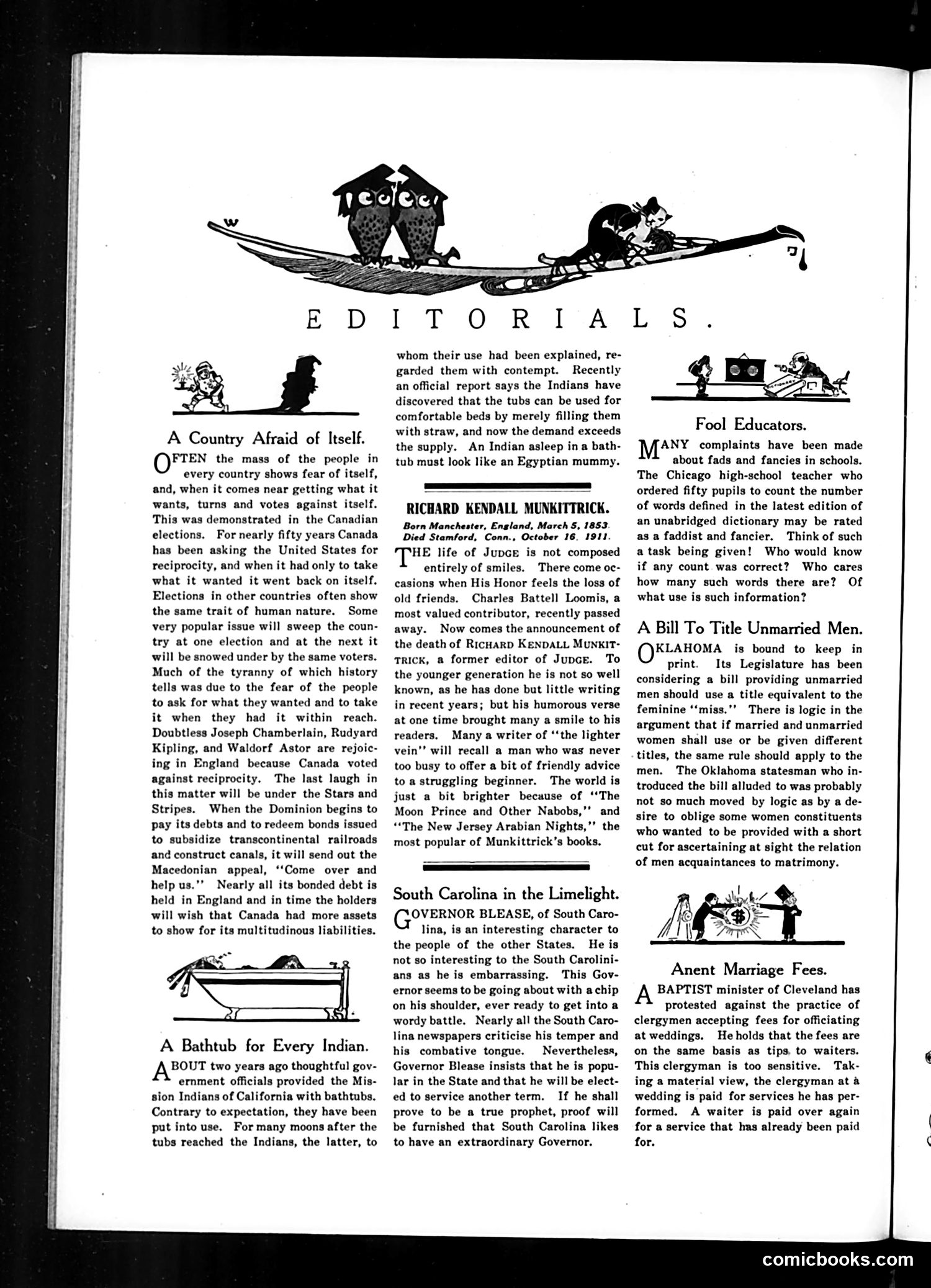
This page from Judge magazine contains several satirical editorials typical of early 20th-century American commentary: **"A Country Afraid of Itself"** critiques Canada's 1911 rejection of reciprocity with the United States, despite decades of requesting it. Judge argues Canadians voted against their own interests from fear—a common human failing. The piece suggests England's imperialists (Chamberlain, Kipling, Astor) celebrated Canada's decision, but predicts Canada will eventually need American financial help. **"A Bathtub for Every Indian"** mocks the U.S. government's initiative providing bathtubs to California Mission Indians. The joke: Indians repurposed them as beds filled with straw rather than using them as intended, inverting the civilizing mission's assumptions about "progress." **"Fool Educators"** (partial) criticizes trendy educational fads, referencing a Chicago teacher's peculiar assignment counting dictionary definitions. The page also includes an obituary for Richard Kendall Munkittrick, a former Judge editor and humorist.
📄 Transcribed text from this page (OCR, searchable)
Machine-transcribed from the original scan — historical spelling and the odd misread are preserved.
A Country Afraid of Itself. FTEN the mass of the people in every country shows fear of itself, and, when it comes near getting what it wants, turns and votes against itself. This was demonstrated in the Canadian elections. For nearly fifty years Canada has been asking the United States for reciprocity, and when it had only to take what it wanted it went back on itself. Elections in other countries often show the same trait of human nature. Some very popular issue will sweep the coun- try at one election and at the next it will be snowed under by the same voters. Much of the tyranny of which history tells was due to the fear of the people to ask for what they wanted and to take it when they had it within reach. Doubtless Joseph Chamberlain, Rudyard Kipling, and Waldorf Astor are rejoic- ing in England because Canada voted against reciprocity. The last laugh in this matter will be under the Stars and Stripes. When the Dominion begins to pay its debts and to redeem bonds issued to subsidize transcontinental railroads and construct canals, it will send out the Macedonian appeal, ‘‘Come over and help us."’ Nearly all its bonded debt is held in England and in time the holders will wish that Canada had more assets to show for its multitudinous liabilities. A Bathtub for Every Indian. About two years ago thoughtful gov- ernment officials provided the Mis- sion Indians of California with bathtubs, Contrary to expectation, they have been put into use. For many moons after the tubs reached the Indians, the latter, to IT OR whom their use had been explained, re- garded them with contempt. Recently an official report says the Indians have discovered that the tubs can be used for comfortable beds by merely filling them with straw, and now the demand exceeds the supply. An Indian asleep ina bath- tub must look like an Egyptian mummy. earl RICHARD KENDALL MUNKITTRICK. Born Manchester, England, March S, 1853. Died Stamford, Conn., October 16. 1911. HE life of Jupce is not composed entirely of smiles. There come oc- casions when His Honor feels the loss of old friends. Charles Battell Loomis, a most valued contributor, recently passed away. Now comes the announcement of the death of Ricuarp KenpaLt Munkit- TRICK, a former editor of Jupce. To the younger generation he is not so well known, as he has done but little writing in recent years; but his humorous verse at one time brought many a smile to his readers, Many a writer of ‘‘the lighter vein’’ will recall a man who was never too busy to offer a bit of friendly advice to a struggling beginner. The world is just a bit brighter because of ‘‘The Moon Prince and Other Nabobs,’’ and “The New Jersey Arabian Nights,”’ the most popular of Munkittrick’s books, South Carolina in the Limelight. OVERNOR BLEASE, of South Caro- lina, is an interesting character to the people of the other States. He is not so interesting to the South Carolini- ans as he is embarrassing. This Gov- ernor seems to be going about with achip on his shoulder, ever ready to get into a wordy battle. Nearly all the South Caro- lina newspapers criticise his temper and his combative tongue. Nevertheless, Governor Blease insists that he is popu- lar in the State and that he will be elect- ed to service another term. If he shall prove to be a true prophet, proof will be furnished that South Carolina likes to have an extraordinary Governor. I ALS Fool Educators. MAY complaints have been made about fads and fancies in schools. The Chicago high-school teacher who ordered fifty pupils to count the number of words defined in the latest edition of an unabridged dictionary may be rated as a faddist and fancier. Think of such a task being given! Who would know if any count was correct? Who cares how many such words there are? Of what use is such information? A Bill To Title Unmarried Men. KLAHOMA is bound to keep in print. Its Legislature has been considering a bill providing unmarried men should use a title equivalent to the feminine ‘‘miss.’’ There is logic in the argument that if married and unmarried women shall use or be given different titles, the same rule should apply to the men. The Oklahoma statesman who in- troduced the bill alluded to was probably not so much moved by logic as by a de- sire to oblige some women constituents who wanted to be provided with a short cut for ascertaining at sight the relation of men acquaintances to matrimony. Anent Marriage Fees. BAPTIST minister of Cleveland has protested against the practice of clergymen accepting fees for officiating at weddings. He holds that the fees are on the same basis as tips. to waiters. This clergyman is too sensitive. Tak- ing a material view, the clergyman at & wedding is paid for services he has per- formed. A waiter is paid over again for a service that has already been paid for. comicbooks.com