
A complete issue · 24 pages · 1911
Judge — September 2, 1911
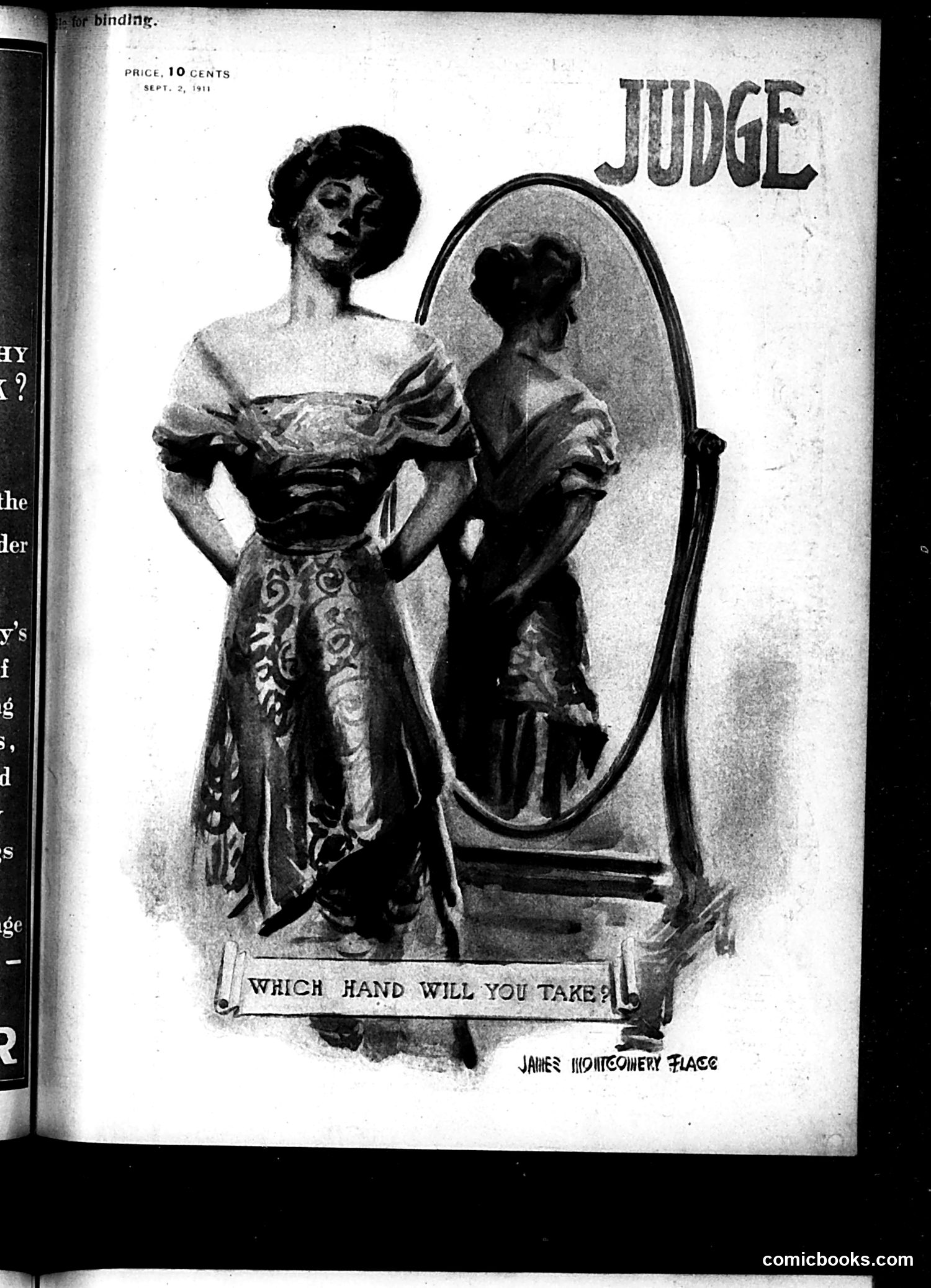
This September 2, 1911 *Judge* cover by James Montgomery Flagg presents a visual pun titled "Which Hand Will You Take?" A woman gazes into a mirror, but her reflection appears as a different figure—likely representing two contrasting versions of herself or symbolic choices. The satirical point appears to concern women's decision-making, possibly referencing contemporary debates about women's roles, marriage choices, or social identity during the Progressive Era. The mirror conceit suggests internal conflict or the gap between appearance and reality, a common *Judge* theme. Without additional context from the article text (not visible here), the specific political or social issue remains unclear, though it likely relates to women's suffrage or social reform debates prominent in 1911.
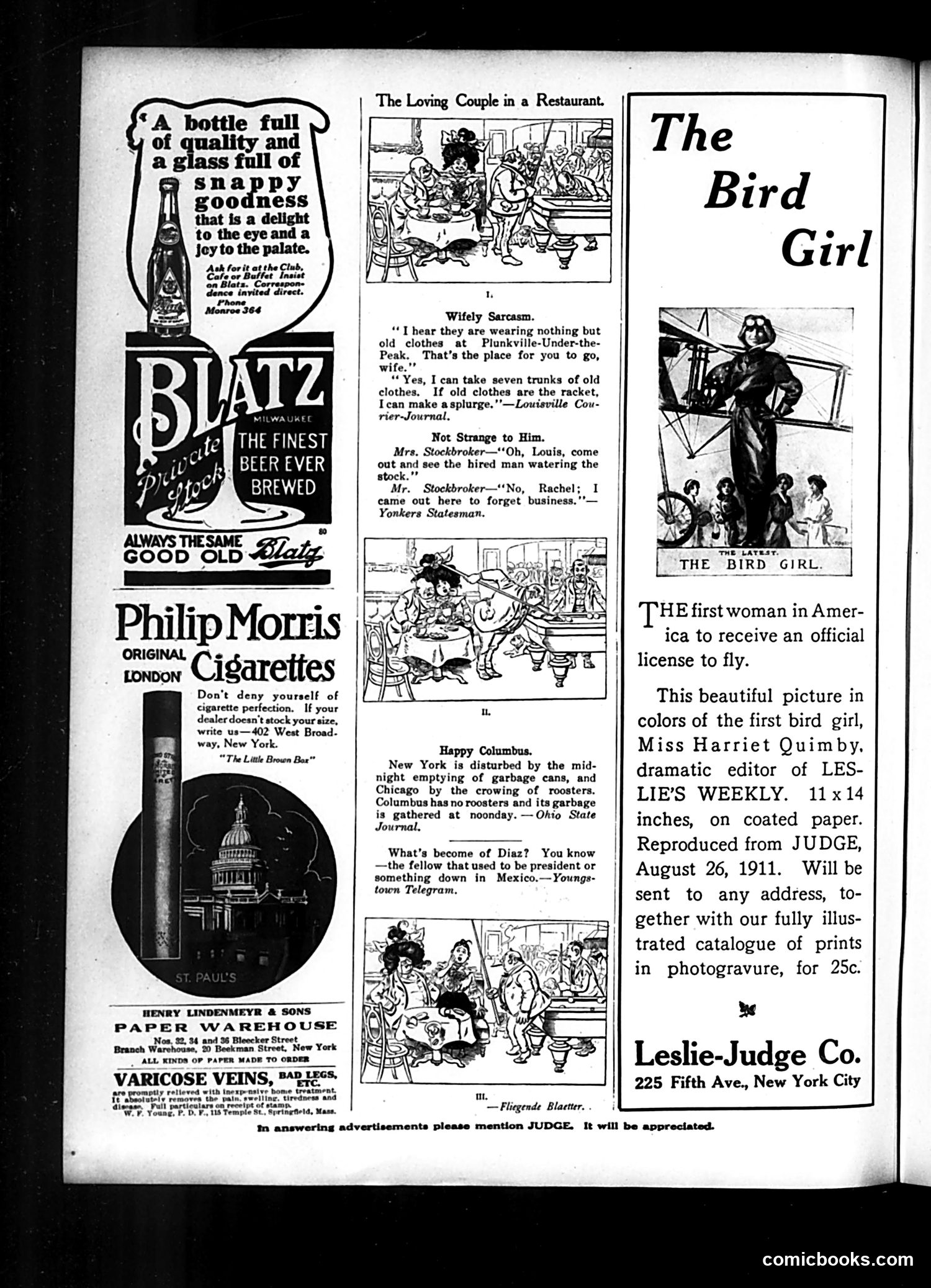
This page is primarily **advertisements** (Blatz beer, Philip Morris cigarettes, and a medical treatment for varicose veins) with three cartoon panels in the center titled "The Loving Couple in a Restaurant." The three captioned scenes appear to be **satirical vignettes** mocking domestic life and married couples' behavior in public spaces: 1. **"Widely Sarcasm"** - A husband suggests taking old clothes to Plunkville-Under-the-Peak; the wife sarcastically retorts she could make more profit from old clothes. 2. **"Not Strange to Him"** - A wife points out a hired man; the husband dismisses her, claiming he comes to forget business. 3. **"Figsoda Blatter"** - The final panel's joke is unclear from the visible text. The humor targets **married couples' petty arguments and indifference** in social settings.
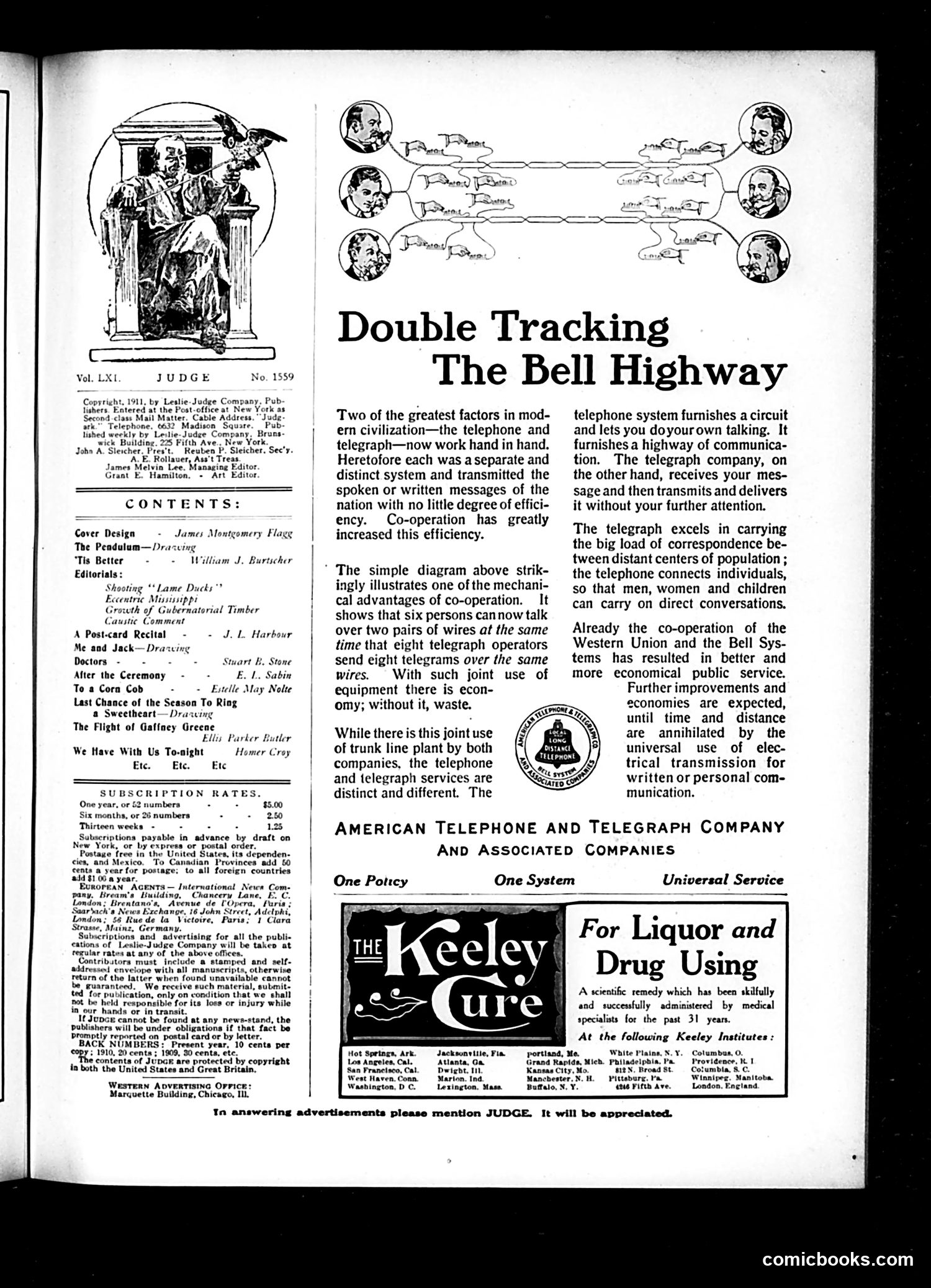
This page is primarily **advertising and editorial content** rather than satire or political cartoons. The main feature is an article titled "Double Tracking The Bell Highway," which explains how the American Telephone and Telegraph Company improved efficiency by sharing telegraph and telephone lines simultaneously. The accompanying diagram shows six individuals who can now communicate over shared wires. The illustration on the left appears to be a generic decorative vignette unrelated to the main content. Below is an advertisement for "The Keeley Cure," a purported medical treatment for alcohol and drug addiction—a common (though often ineffective) remedy marketed in early 20th-century publications. The page lacks satirical commentary or identified political figures, functioning instead as a straightforward technical explanation and commercial advertising.
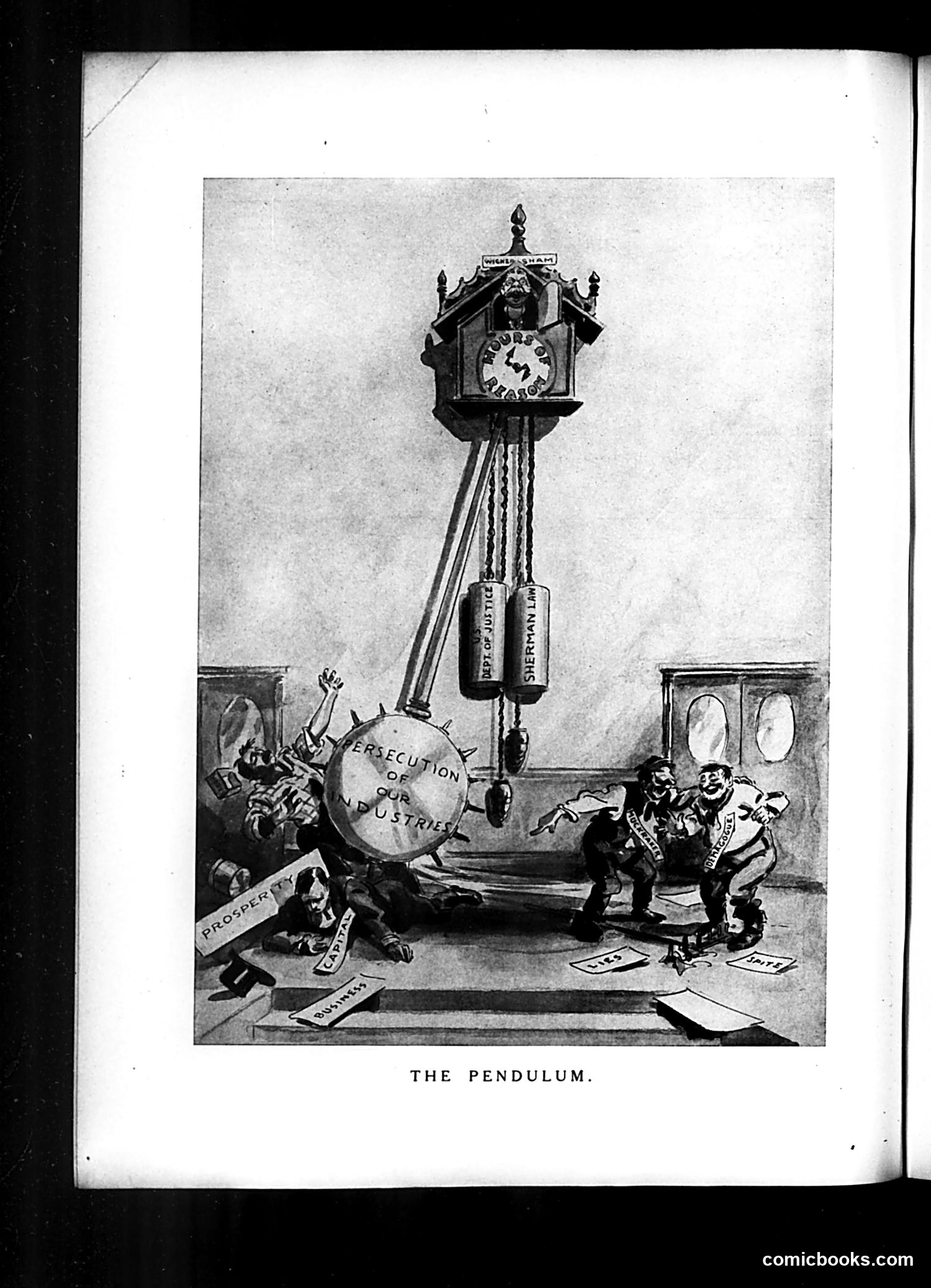
This political cartoon uses a grandfather clock as its central metaphor. The clock's pendulum swings between two extremes, labeled "Execution of our Dustries" (left) and what appears to be "Prosperity" (right). Below the clock stand caricatured figures—appearing to be politicians or industrialists—who seem trapped by this oscillating economic cycle. Papers scattered on the ground likely represent failed policies or financial documents. The satire suggests that American economic policy swings wildly between periods of industrial depression and brief prosperity, with political leadership helpless to stabilize conditions. The "Prosperity" weight and "Execution" weight suggest the nation's economy is being mechanically controlled by forces beyond politicians' control, mocking their inability to achieve sustained growth and stability.
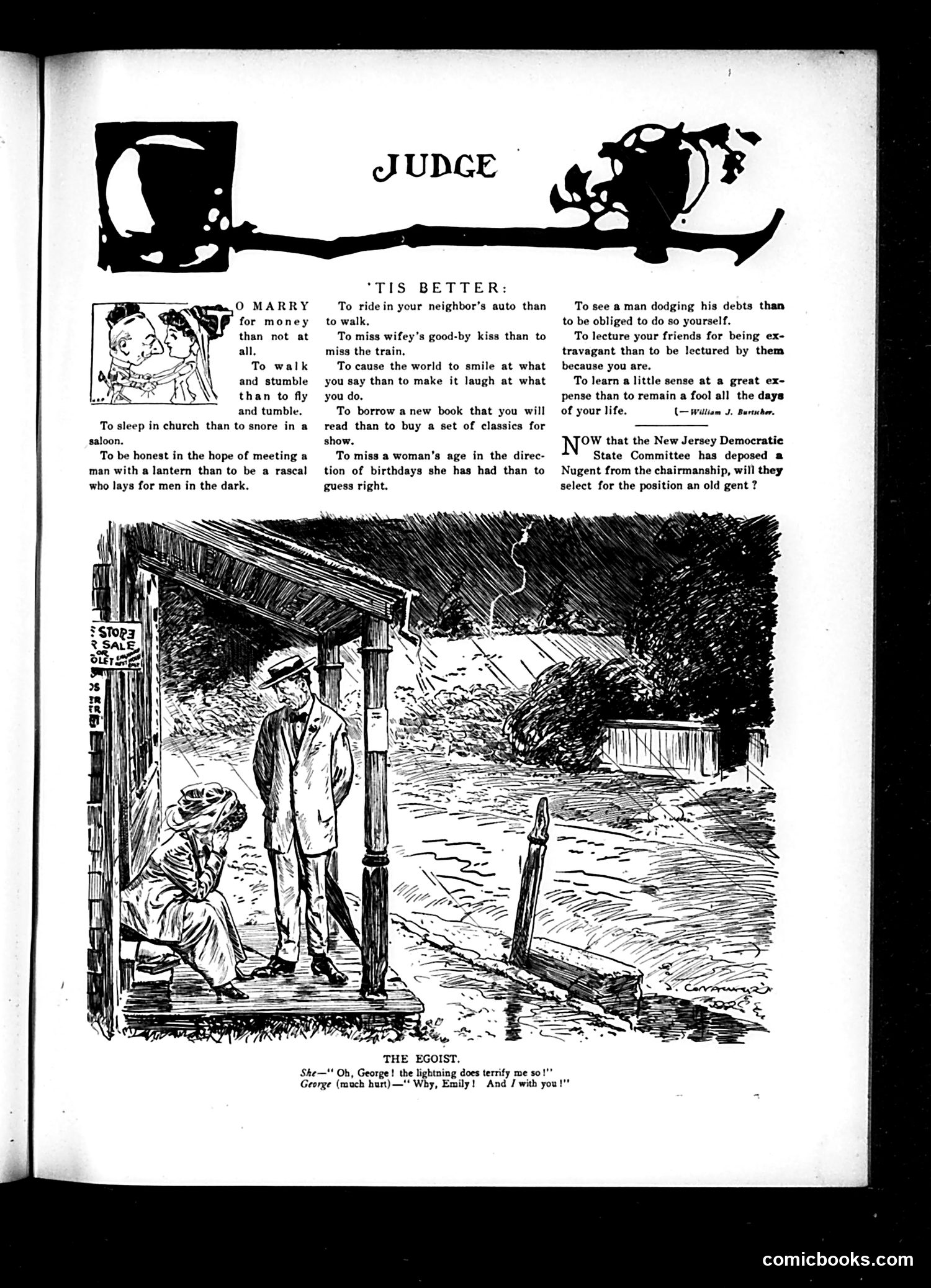
The page contains two distinct sections: **"'TIS BETTER" Column**: A humorous list of comparative statements (e.g., "To marry for money than not at all," "To walk and stumble than to fly and tumble"). These are light social commentary on practical life choices. **"The Egoist" Cartoon**: The main illustration shows a man and woman sheltering under a roof during a lightning storm. The woman expresses fear ("Oh, George! the lightning does terrify me so!"), while George responds dismissively ("Why, Emily! And I wish you!"). The joke appears to be George's self-centered arrogance—he's wishing the lightning would strike *her* rather than sympathizing with her fear. It satirizes male egotism and callousness in relationships, a common Judge theme. A brief political note references New Jersey Democratic State Committee selecting a new chairman.
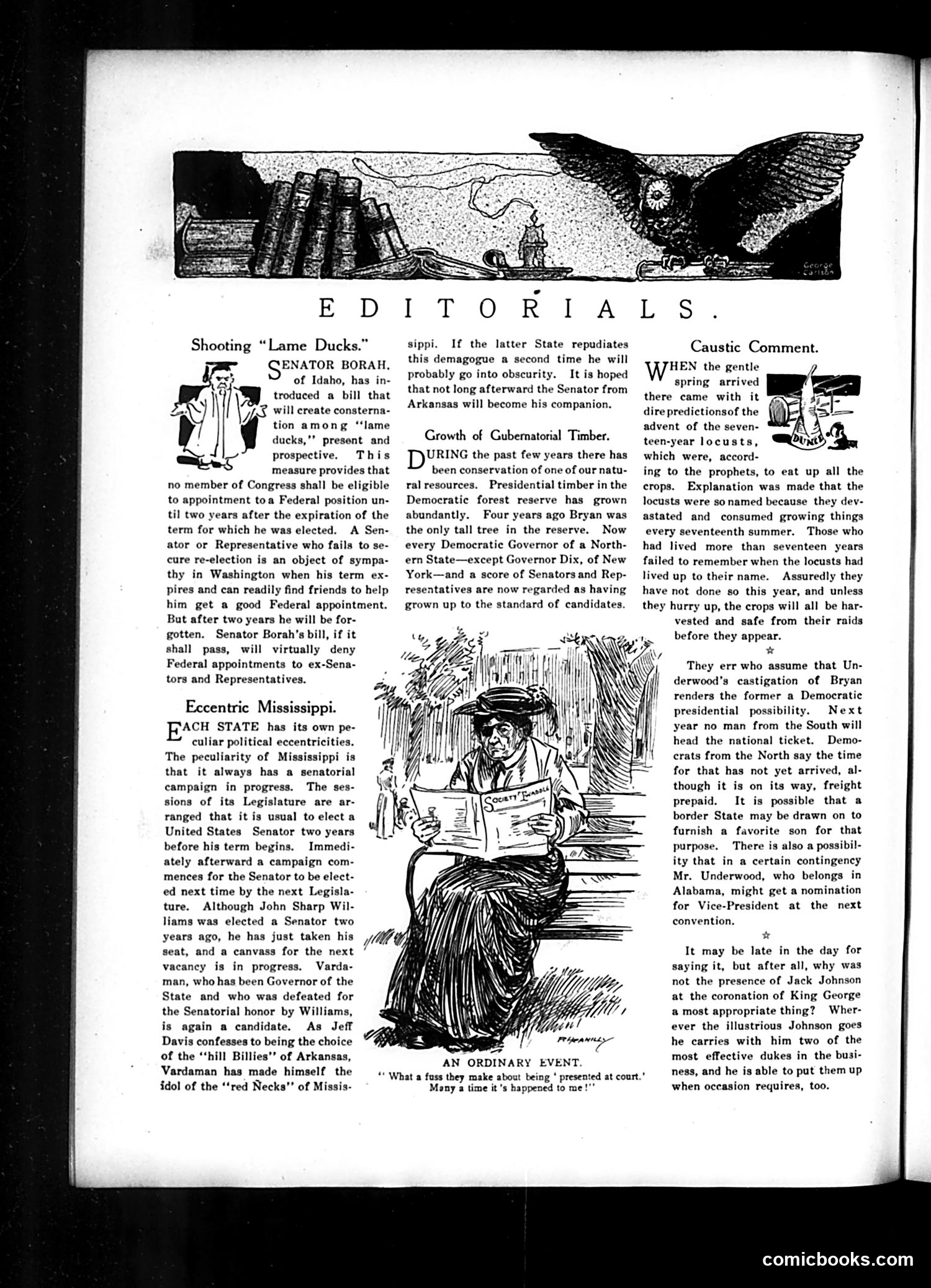
This page from the satirical magazine *Judge* contains three political commentaries: **"Shooting 'Lame Ducks'"** mocks Senator Borah's proposed bill preventing defeated congressmen from receiving federal appointments. The satire suggests such legislators exploit patronage after losing elections. **"Eccentric Mississippi"** ridicules Mississippi's constant senatorial campaigns, specifically attacking political figures James Vardaman and Jeff Davis as demagogues appealing to rural voters ("red Necks," "hill Billies"). The text implies Vardaman will fade into obscurity if defeated again. **"Growth of Gubernatorial Timber"** comments on Democratic presidential candidates, noting William Jennings Bryan was once the only viable option but now numerous governors and senators seek the nomination. The **"Caustic Comment"** section includes two brief satirical pieces: one mocking social pretension about court presentations, and another dismissing Oscar Underwood as presidential material while suggesting he might become vice-presidential candidate. The cartoons accompany these editorials with illustrations typical of early 20th-century political satire.
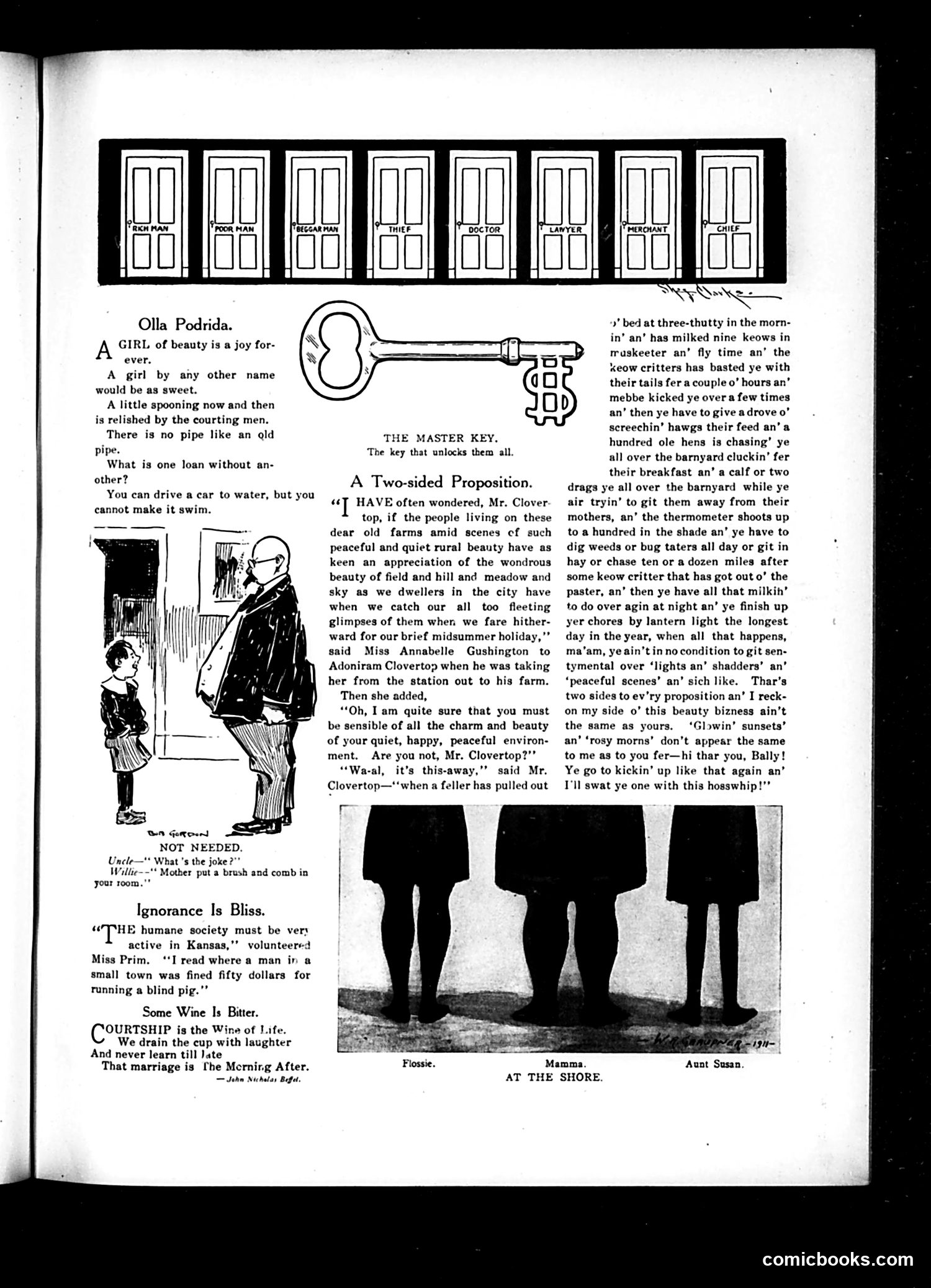
This page contains several satirical pieces typical of Judge magazine's humor: **"Olla Podrida"** (top left): A collection of humorous one-liners and observations, including a joke about a man asking his uncle "What's the joke?" when told his mother put a brush and comb in his room—implying the uncle is suggesting poor hygiene. **"A Two-sided Proposition"** (main story): A city woman, Miss Annabelle Gushington, romanticizes rural farm life to farmer Adoniram Clovertop. He responds with a brutally detailed account of actual farm labor—milking cows at 3 AM, battling insects and animals, endless chores. The satire mocks urban sentimentality about pastoral life versus rural reality's grinding hardship. **Supporting pieces**: "Ignorance is Bliss" jokes about Kansas law (a "blind pig" was illegal alcohol during Prohibition), and "Some Wine is Bitter" offers cynical observations on courtship and marriage. **Bottom image**: "At the Shore" shows three silhouetted figures labeled Posse, Mamma, and Aunt Susan—likely a social commentary on female companionship or family dynamics. The page satirizes urban pretension and rural practicality.
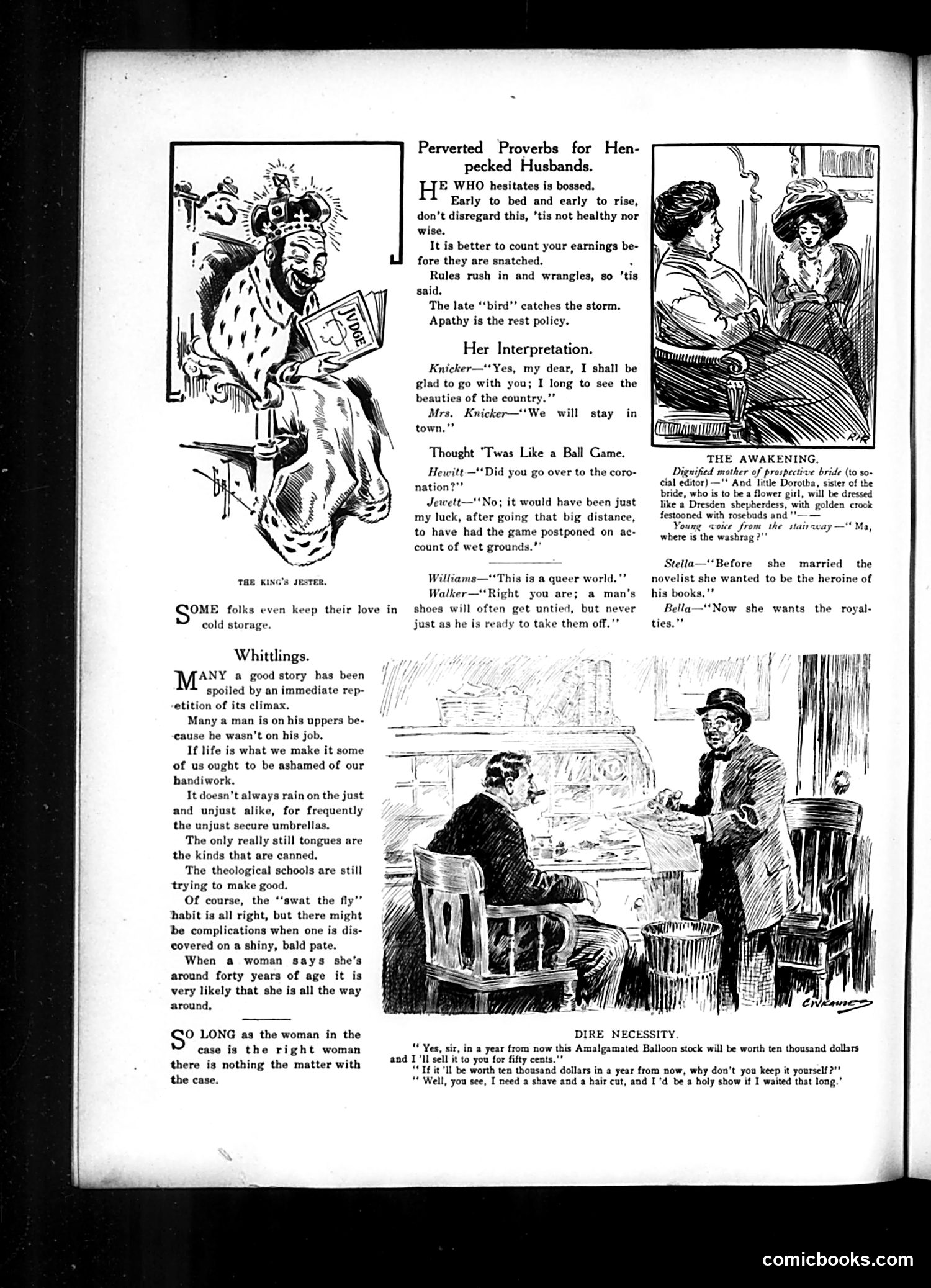
This Judge magazine page contains multiple satirical sketches about marriage, gender dynamics, and financial schemes circa early 1900s. **"The King's Jester"** and **"Perverted Proverbs"** mock henpecked husbands through inverted wisdom: "He who hesitates is bossed" and "The late 'bird' catches the storm" suggest wives dominate decision-making. "Her Interpretation" shows a husband eager for country travel; his wife insists on staying in town—illustrating marital power imbalances where wives override husbands' wishes. **"The Awakening"** satirizes social climbing. A mother prepares her daughter as a "flower girl" with elaborate costumes, but the girl pragmatically asks about laundry—deflating pretensions. **"Dire Necessity"** depicts a stock-scheme con man. When asked why he'd sell valuable Amalgamated Balloon stock cheaply, he admits needing immediate money for grooming—exposing financial desperation behind get-rich-quick pitches. The humor targets domestic subjugation, social pretension, and financial fraud—common turn-of-century anxieties.
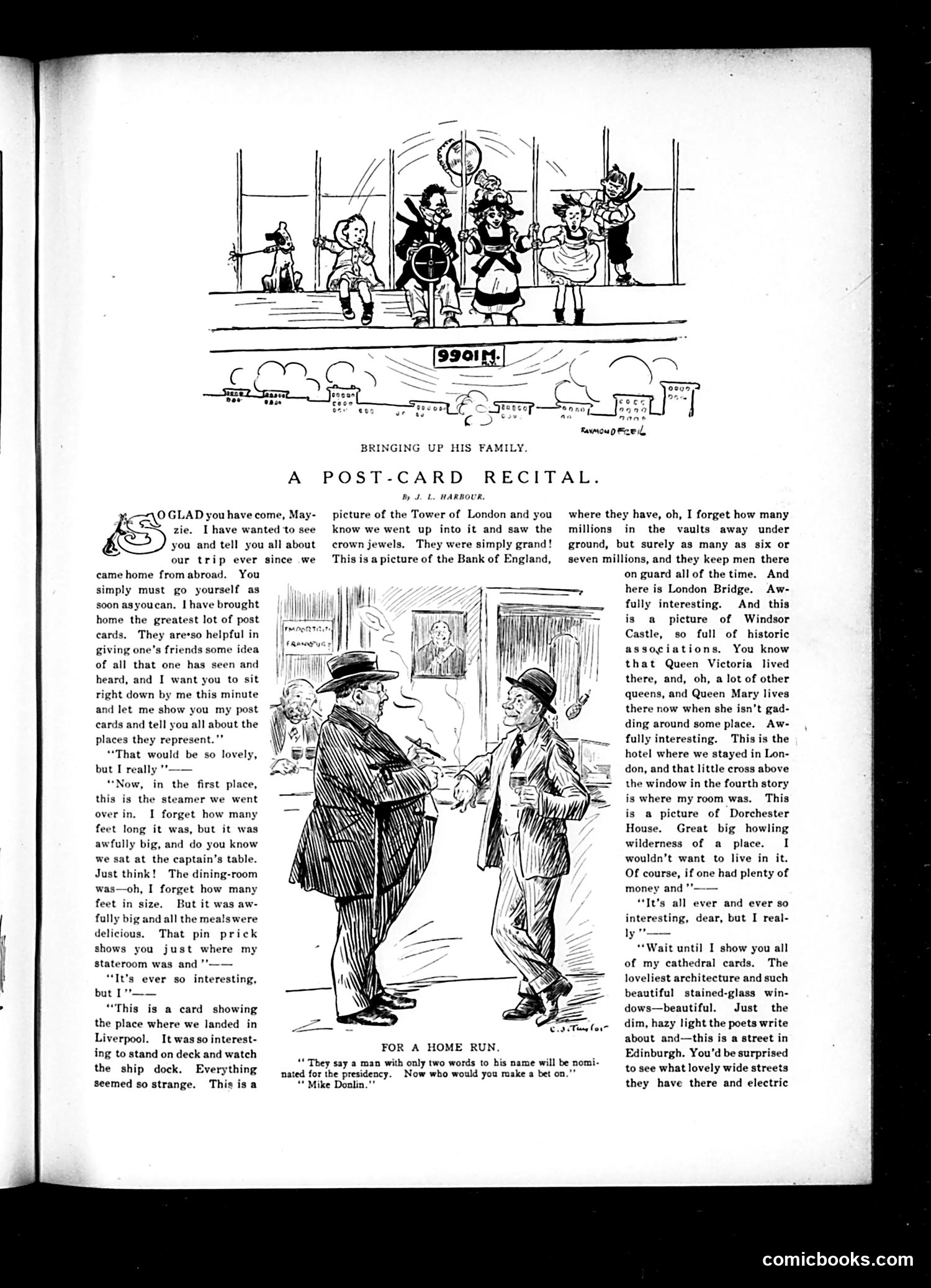
This page contains two distinct pieces: **Main Story: "A Post-Card Recital"** (by J. L. Harbour) A satirical commentary on a tedious social convention of the early 1900s. A recently-returned traveler (Mayzie) monopolizes a visitor's time showing postcards from a European trip, delivering exhausting, repetitive details about mundane observations (ship size, stateroom location, hotel features) while the other person repeatedly tries to interrupt ("but I really—"). The humor targets the social obligation to listen to travelers' endless, self-absorbed accounts and the proliferation of cheap postcards that enabled this behavior. **Sidebar Cartoon: "For a Home Run"** A brief political joke about presidential nominations. Someone predicts a candidate with only two words in his name will be nominated for president. The response names "Mike Donlin"—likely the baseball player—as a humorous non-politician alternative. The joke's specific political context is unclear without dating information. Both pieces satirize early-1900s American social customs.
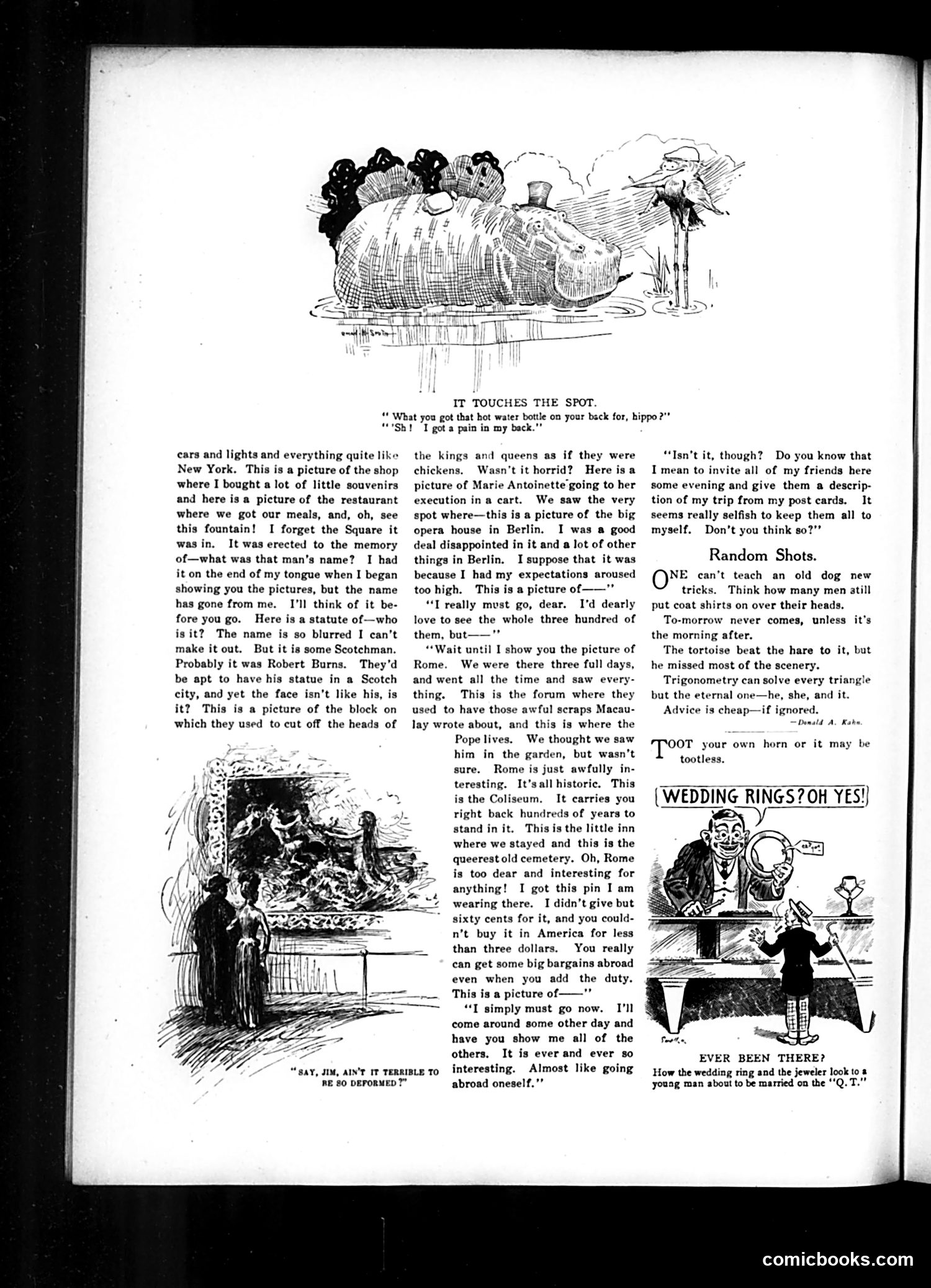
This page contains multiple satirical pieces typical of early 20th-century American humor: **"It Touches the Spot"** (top): A hippo complains of back pain from a hot water bottle. The joke plays on the hippo's massive bulk—a visual pun where the animal literally carries its own weight. **Main cartoon (center-left)**: A tedious tourist monopolizes a visitor with endless travel photographs and anecdotes about Europe (Berlin opera house, Rome's Coliseum, Marie Antoinette's execution site). The satire mocks Americans who obsessively document and bore others with their foreign travels, treating sightseeing as exhausting inventory rather than experience. The trapped listener makes repeated excuses to leave. **"Random Shots"** (right): Brief aphoristic jokes on various topics (old dogs, marriage, geometry, advice). **"Wedding Rings? Oh Yes!"** (bottom-right): A jeweler and nervous groom illustrate the expense and secrecy ("Q.T." = "on the quiet") of matrimonial ring purchases—satirizing both jewelry markups and the furtive nature of engagements. The unifying theme is American social behavior and consumerism.
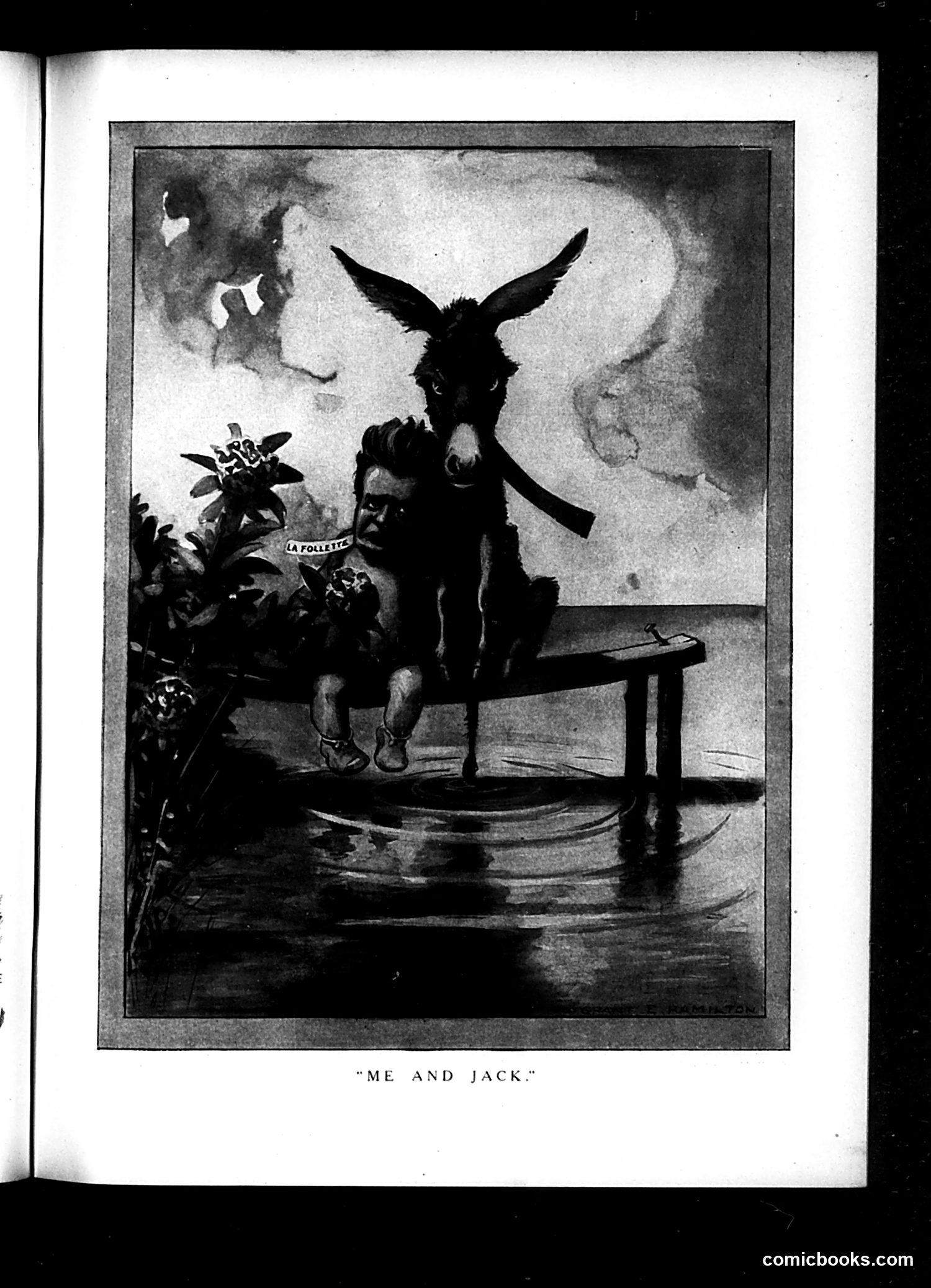
This illustration depicts a seated figure with a donkey wearing a collar labeled "LA FOLLETTE." The caption "Me and Jack" suggests a political commentary, likely referencing Robert M. La Follette, the Progressive politician. The donkey appears to represent either La Follette himself or his political movement, portrayed in a derogatory manner common to Judge magazine's satirical style. The artwork uses the donkey as a traditional symbol of stubbornness or foolishness in political cartooning. Without additional context from the magazine's date and surrounding articles, the specific political situation being mocked remains unclear, but it appears critical of La Follette's political positions or candidacy during the Progressive era.
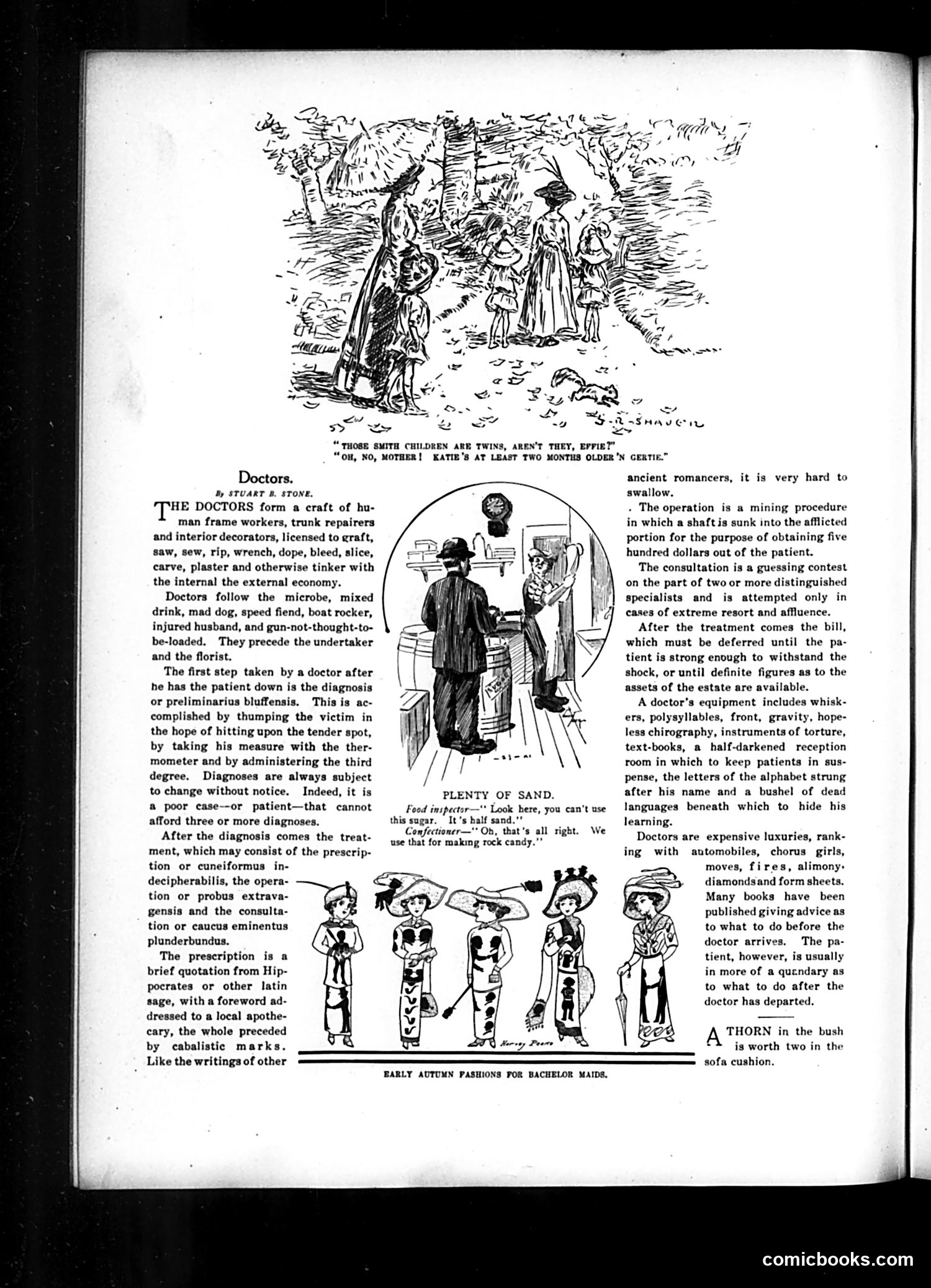
This satirical article by Stuart B. Stone viciously mocks medical practitioners as incompetent charlatans. The piece presents doctors as amateur "trunk repairers" who diagnose through guesswork (thumping patients), prescribe in illegible Latin, and perform unnecessary surgeries purely to extract money from affluent patients. Key targets of the satire include: inflated medical bills presented only after treatment; doctors' reliance on jargon and incomprehensible prescriptions to appear authoritative; unnecessary "consultations" among specialists in wealthy cases; and the profession's general veneer of expertise masking actual ignorance. The cartoon vignettes reinforce these themes—one depicts a food inspector's complaint about sand in sugar, a confectioner's brazen admission it's intentional, suggesting similar fraud in medicine. The accompanying "Early Autumn Fashions for Bachelor Maids" illustration appears unrelated filler. This reflects early 20th-century skepticism toward medical authority before antibiotics and modern diagnostics established credible medicine.
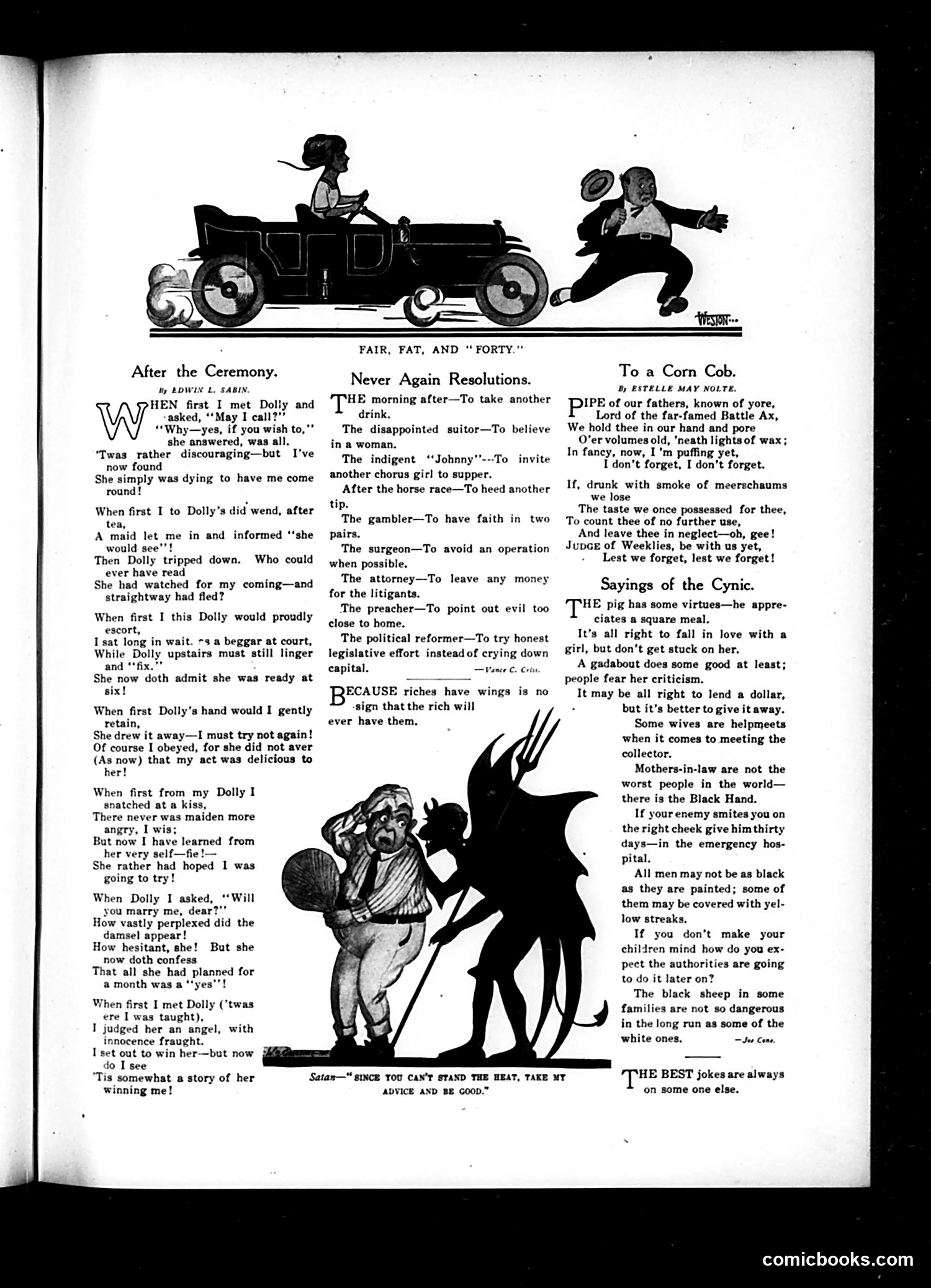
This Judge magazine page contains three main pieces of satire: **"After the Ceremony"** is a humorous poem about courtship deception. The speaker recounts how his girlfriend Dolly initially played hard-to-get—claiming indifference, making him wait, pretending to be busy—only to later confess she'd been eager all along. The joke mocks both courtship rituals and female strategic behavior: women feigned disinterest as a social norm, yet orchestrated the entire romance. **"Never Again Resolutions"** sarcastically lists hypocritical promises various types make after failures (the drunk swearing off drink, the gambler after losses, etc.). Each resolution is immediately undercut—the implication being these people never actually reform. **The Satan cartoon** depicts the devil advising someone suffering from heat to "be good"—dark humor suggesting that morality is merely a survival strategy rather than virtue. The page overall reflects early-20th-century anxieties about gender dynamics, moral hypocrisy, and social pretense—common Judge themes targeting middle-class behavior.
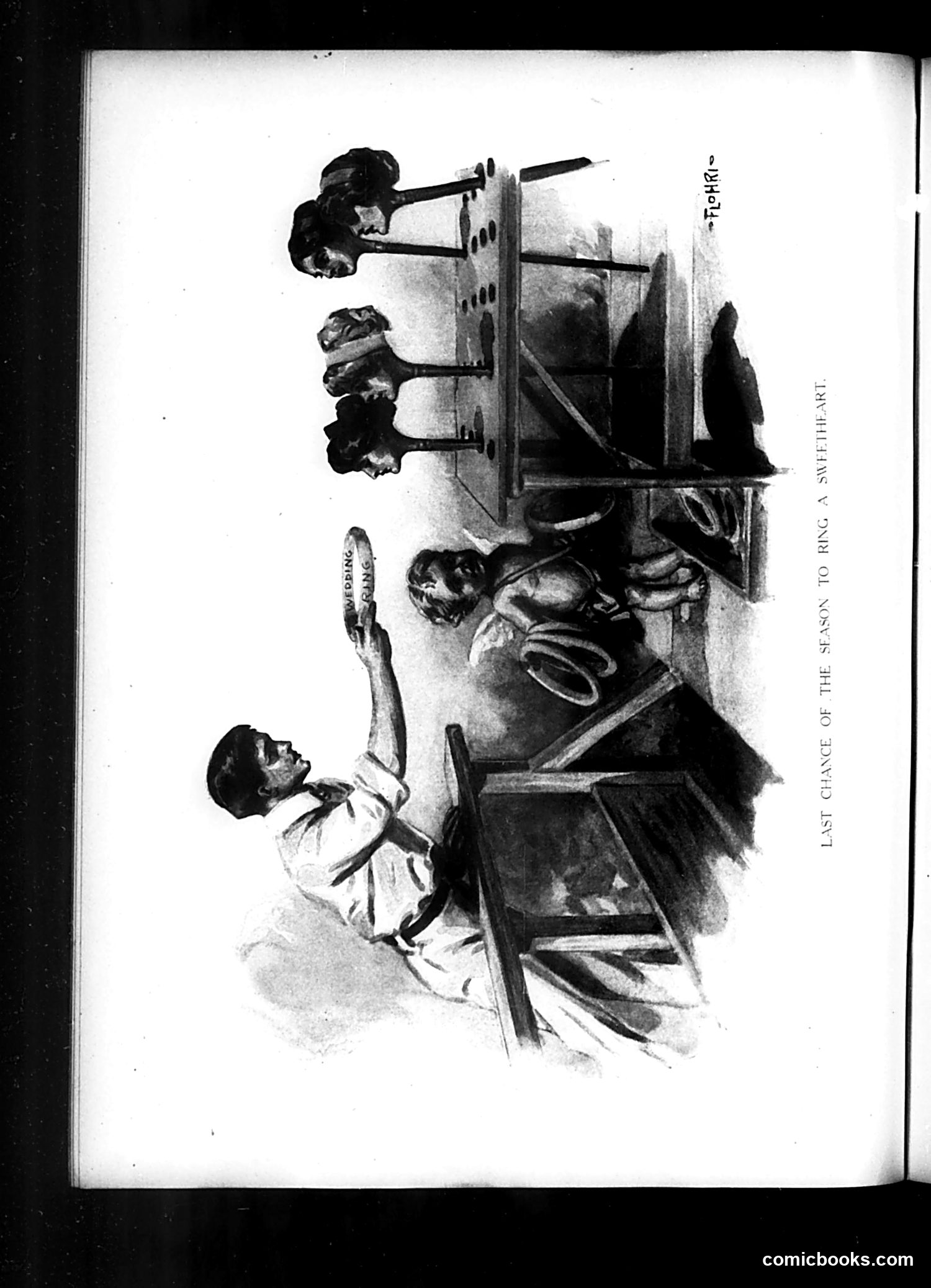
The OCR text appears corrupted and unreadable, making it impossible to identify the specific caption or title with certainty. However, the image itself shows a satirical illustration titled "LAST CHANCE OF THE SESON TO RING A SWEETHEART" (visible on the right margin). The cartoon depicts what appears to be a mechanical or carnival device with multiple figures arranged vertically—suggesting a game or betting mechanism, possibly related to courtship or romance. The style and composition are consistent with late 19th or early 20th-century Judge magazine satire. Without legible text, I cannot definitively identify the specific political figures or social commentary intended, though the artwork clearly satirizes contemporary social customs or romantic pursuits of the era.
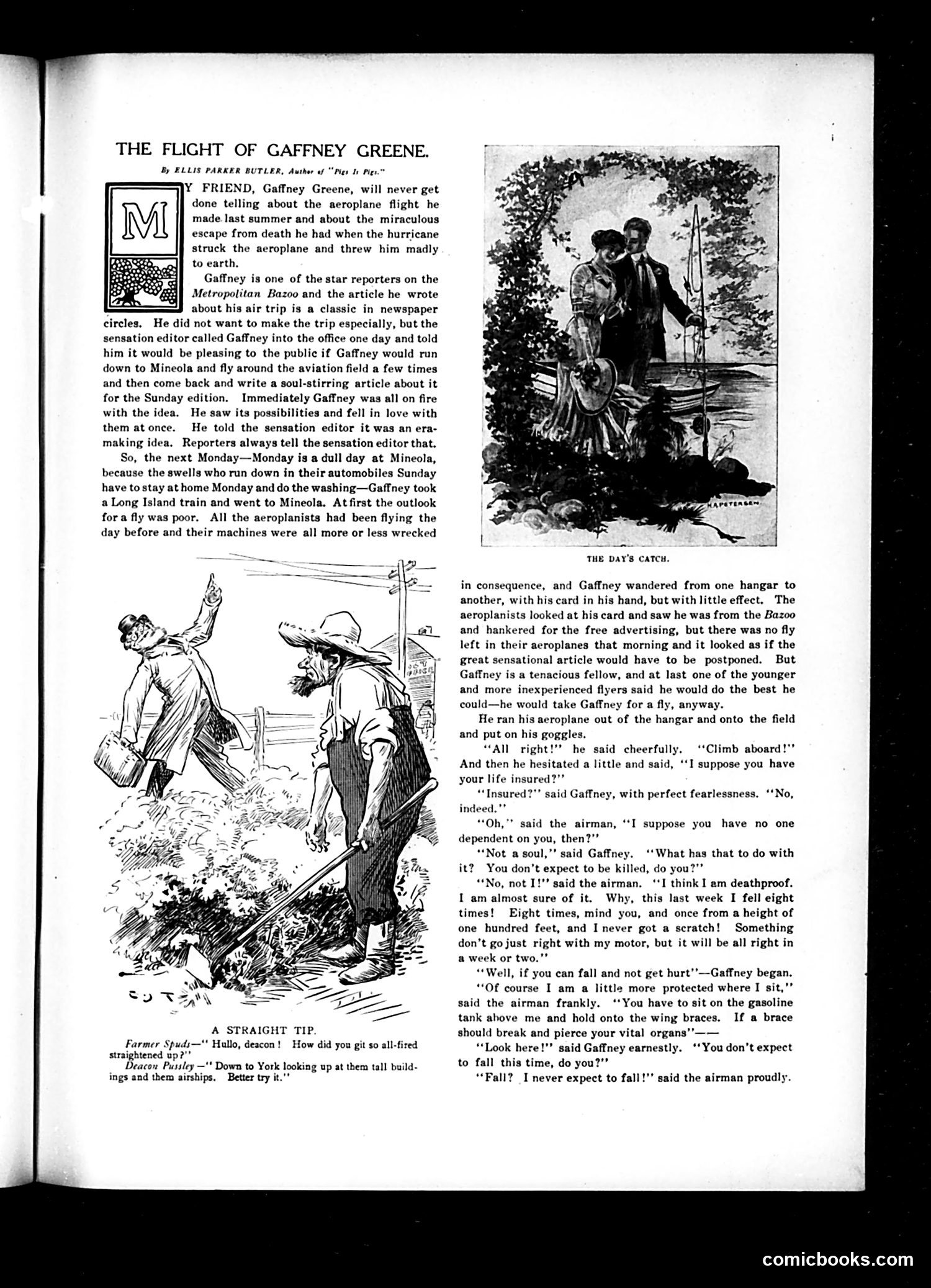
This is a serialized short story by Ellis Parker Butler (a humorist) appearing in *Judge* magazine, not primarily a political cartoon. **The Setup:** Gaffney Greene, a reporter for the *Metropolitan Bazoo* newspaper, is assigned by his sensation-seeking editor to write about early aviation at Mineola (a known airfield on Long Island). The humor derives from the primitive, dangerous state of 1910s aircraft and the braggadocio of inexperienced pilots. **The Satire:** The joke targets newspaper sensationalism and reckless reporters chasing stories. It also mocks early aviators' false confidence—the young pilot has crashed eight times but claims to be "deathproof," while casually warning Gaffney he'll sit on an exposed gasoline tank. **Supporting Illustrations:** The sketches show Gaffney meeting aviation workers and the pilot in his flying gear, and a separate "straight tip" cartoon about a farmer impressed by skyscrapers. The comedy lies in the absurdity of the aviation industry's infancy and journalistic desperation for sensational copy.
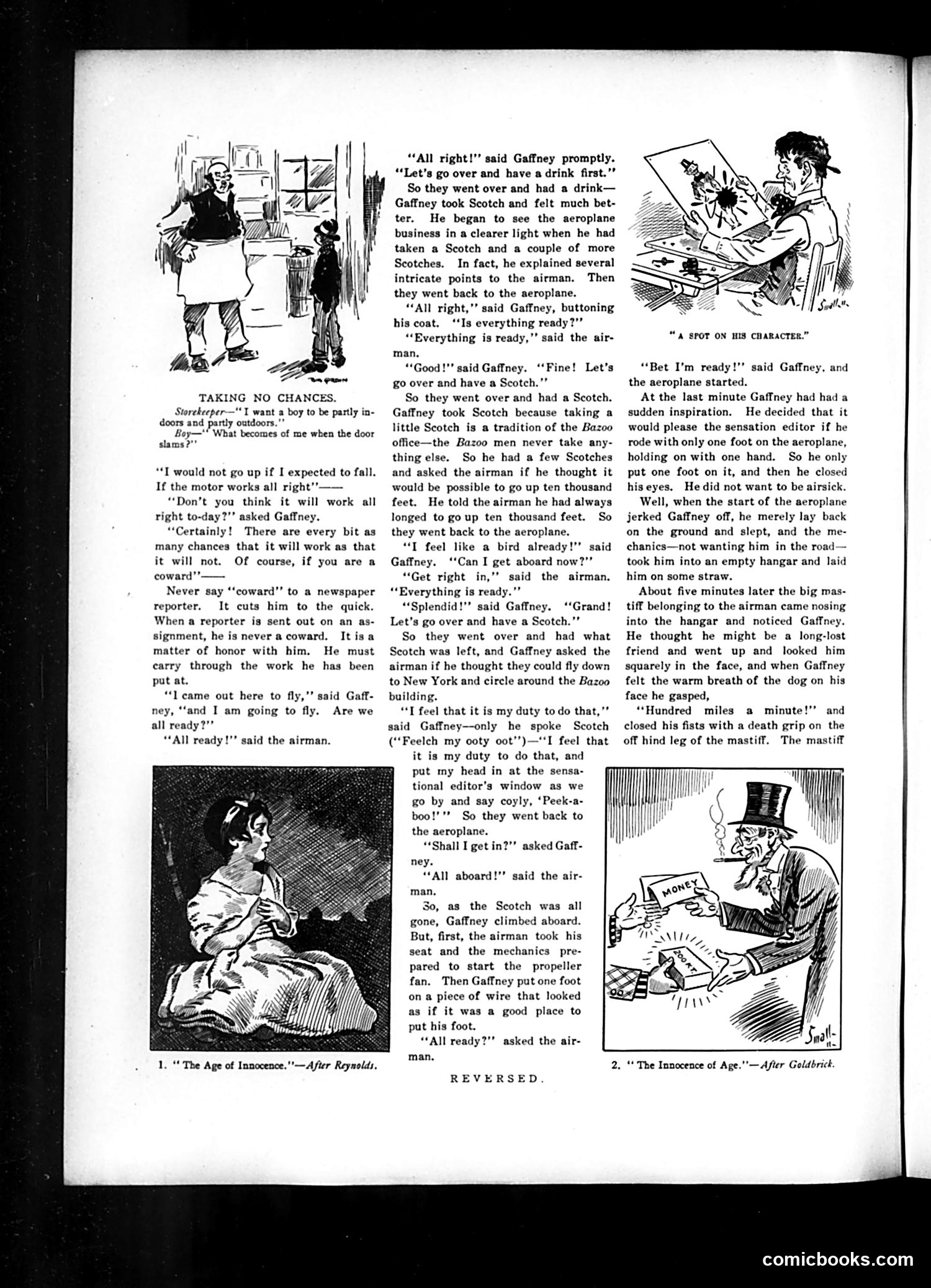
This is a humorous story about Gaffney, a newspaper reporter for the "Bazoo" (a fictional publication), who repeatedly delays an airplane flight by insisting on drinking Scotch whisky before takeoff. The satire works on multiple levels: **The joke:** Gaffney uses "coward" as a psychological taunt to overcome his own fear of flying—a new and dangerous technology in the early aviation era. However, his "courage" merely manifests as alcoholic procrastination. Each time preparations are complete, he demands another drink, getting progressively drunker. **The point:** The cartoon mocks both newspaper reporters' reckless competitiveness and the era's cavalier attitude toward emerging aviation technology. Gaffney's "brave" decision to ride one-handed ultimately backfires—he passes out and falls off before takeoff, missing the entire flight while the airman proceeds without him. The accompanying illustrations satirize masculine bravado and occupational hubris, suggesting that honor and duty can mask simple cowardice and poor judgment.
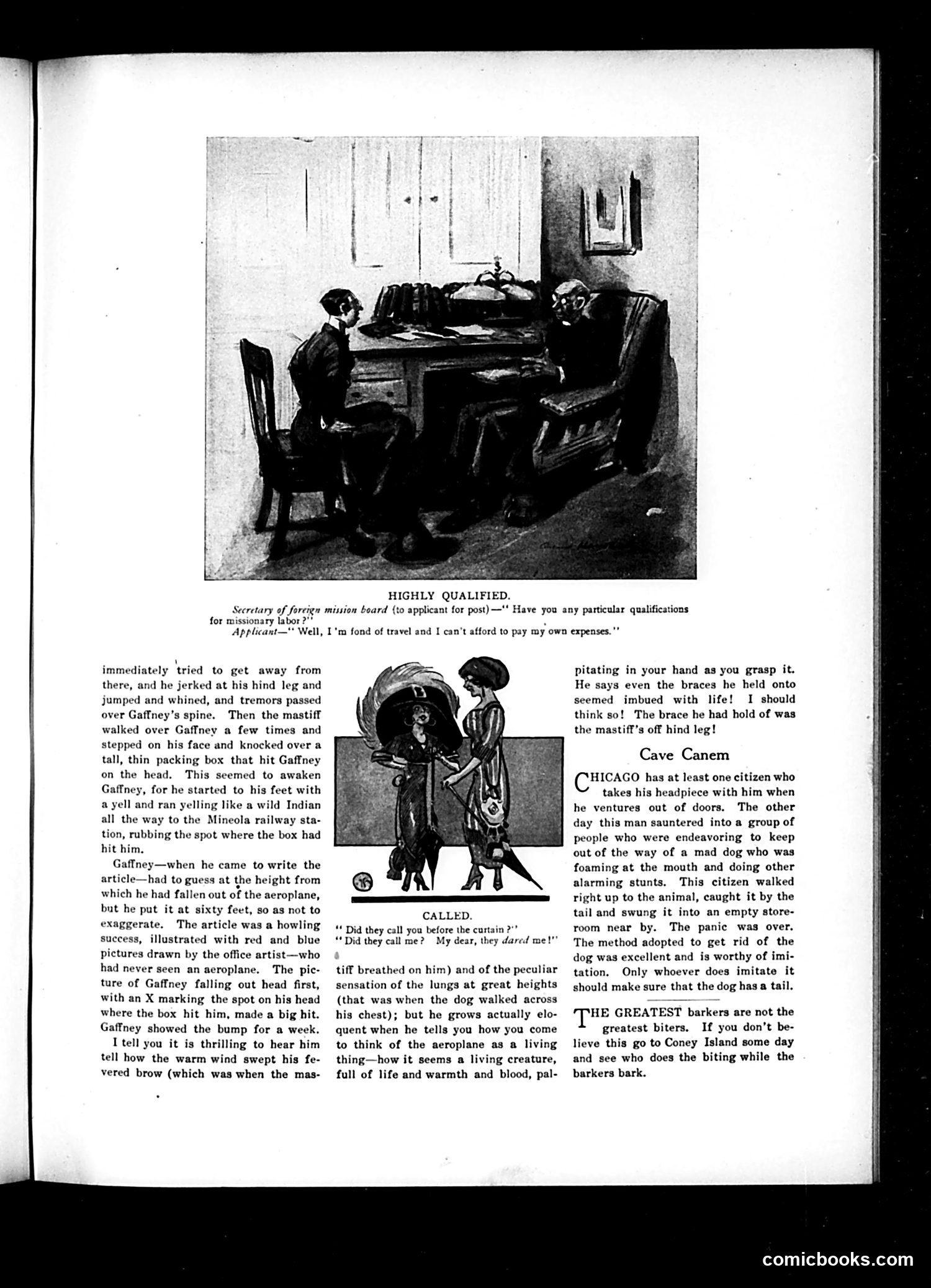
This page contains three separate satirical pieces: **"Highly Qualified"** (top): Mocks missionary recruitment by showing a foreign mission board official interviewing an applicant whose only qualifications are wanderlust and financial desperation ("I can't afford to pay my own expenses"). The satire criticizes how organizations filled missionary posts with unqualified individuals motivated purely by free travel. **"Called"** (middle): A theatrical joke—a woman claims she was "dared" rather than "called" before the curtain, suggesting she had to be coerced into performing, implying she's a reluctant or mediocre actress. **"Cave Canem"** (bottom): Two anecdotes about dogs and human behavior. The first recounts a man falling from an airplane and attributing sensations to the aircraft when he was actually being mauled by a mastiff—satirizing sensationalized journalism and exaggeration. The second praises a man who subdued a rabid dog by its tail, with a joke about the method's limitations. The overall theme involves exposing human folly, questionable judgment, and embellishment.
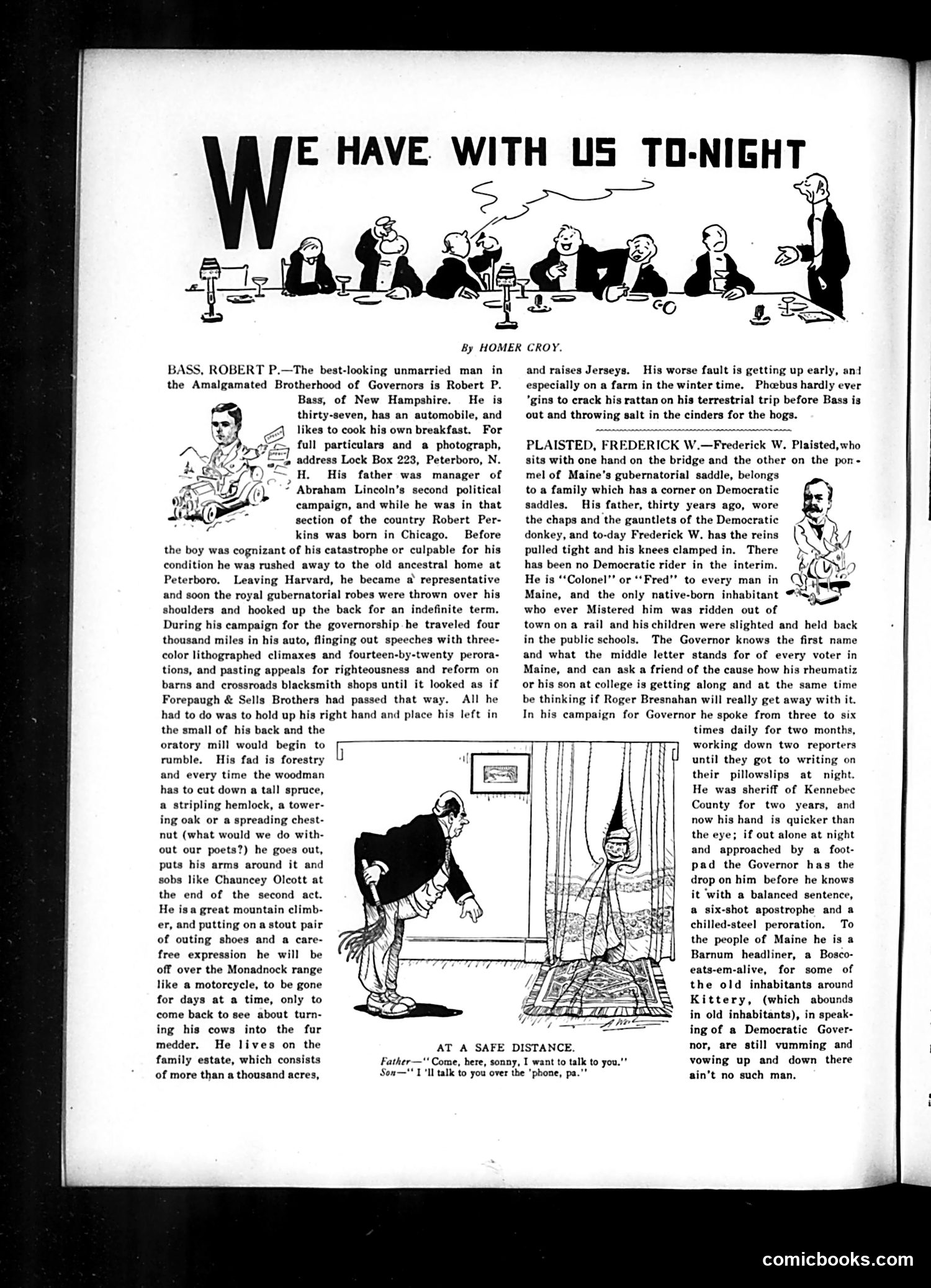
This satirical piece by Homer Croy profiles two New England governors as if introducing them at a social gathering. **Robert P. Bass** of New Hampshire is mocked as a wealthy, aristocratic bachelor who campaigns with excessive theatrical flourish—"three-color lithographed climaxes" pasted on barns. **Frederick W. Plaisted** of Maine, a Democrat, is caricatured as an emotionally overwrought politician who weeps when trees are cut down yet obsessively tracks voter information. The humor targets the vanity and eccentricity of contemporary governors during the Progressive Era. The illustration "At a Safe Distance" jokes about modern communication—a son calling his father on the telephone rather than speaking face-to-face, suggesting generational or social awkwardness. The overall satire critiques political showmanship, regionalism, and the quirky personalities wielding executive power in early 20th-century America.
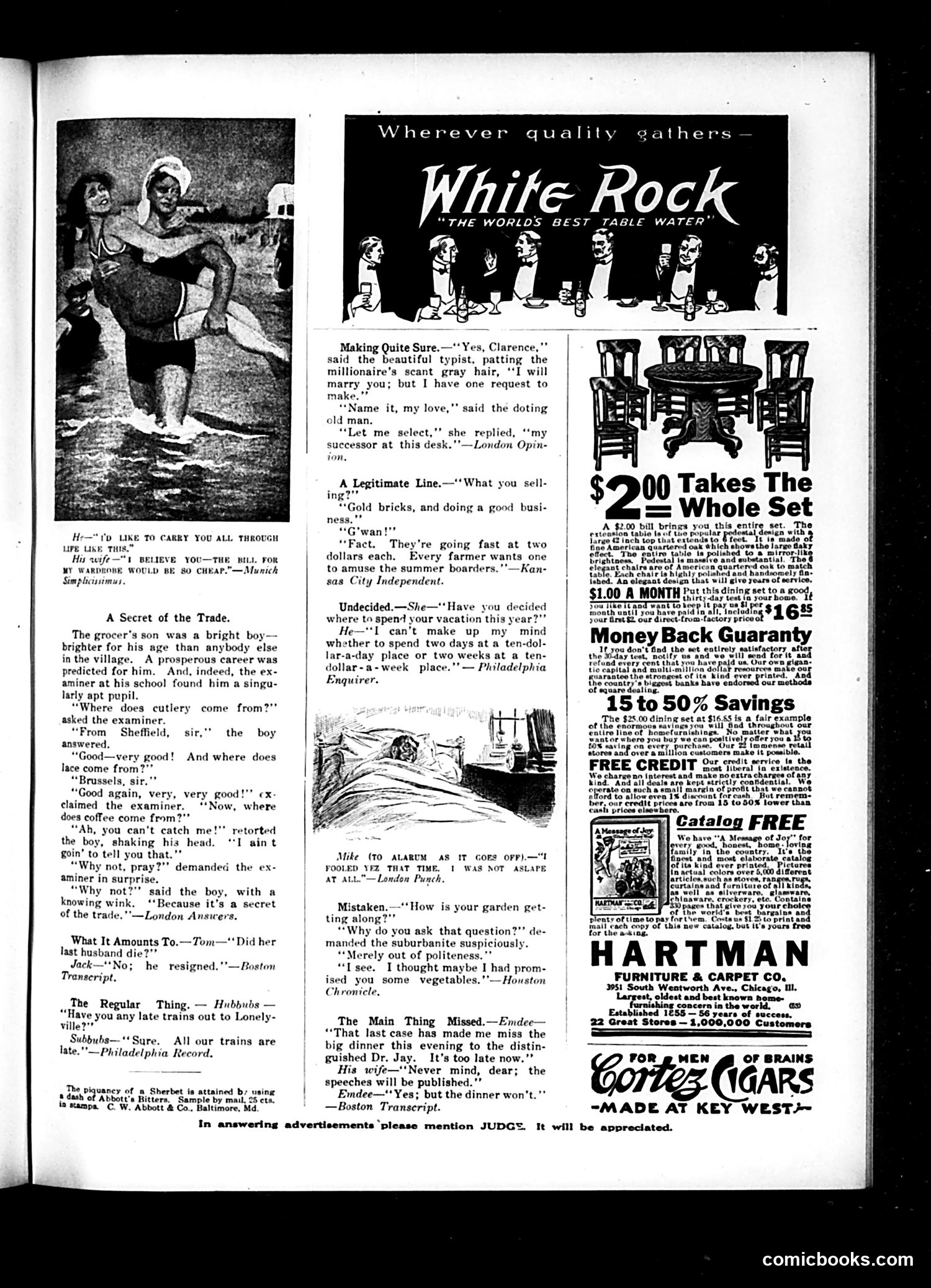
This page from **Judge** magazine contains primarily **short humorous anecdotes** rather than political cartoons, plus advertisements. ## The Humor The jokes satirize various social types: a materialistic woman (the typist marrying for money while planning her successor), con men selling worthless "gold bricks" to gullible farmers, suburbanites obsessing over vacation budgets, and a lawyer's wife who finds published speeches an adequate consolation for a missed dinner. The humor is gentle social observation—mocking pretension, greed, and absurdity in everyday life. ## Notable Features One anecdote depicts a schoolboy who refuses to reveal where coffee comes from, claiming it's a "trade secret"—satire on how businesses guard commercial knowledge. The page is dominated by **advertisements**: furniture, table settings, dining sets ($2 for a complete set), and Cortez cigars. This reflects Judge's role as both satirical magazine and advertising vehicle for turn-of-the-century consumers. No specific political figures or events are referenced; the satire is social rather than political.
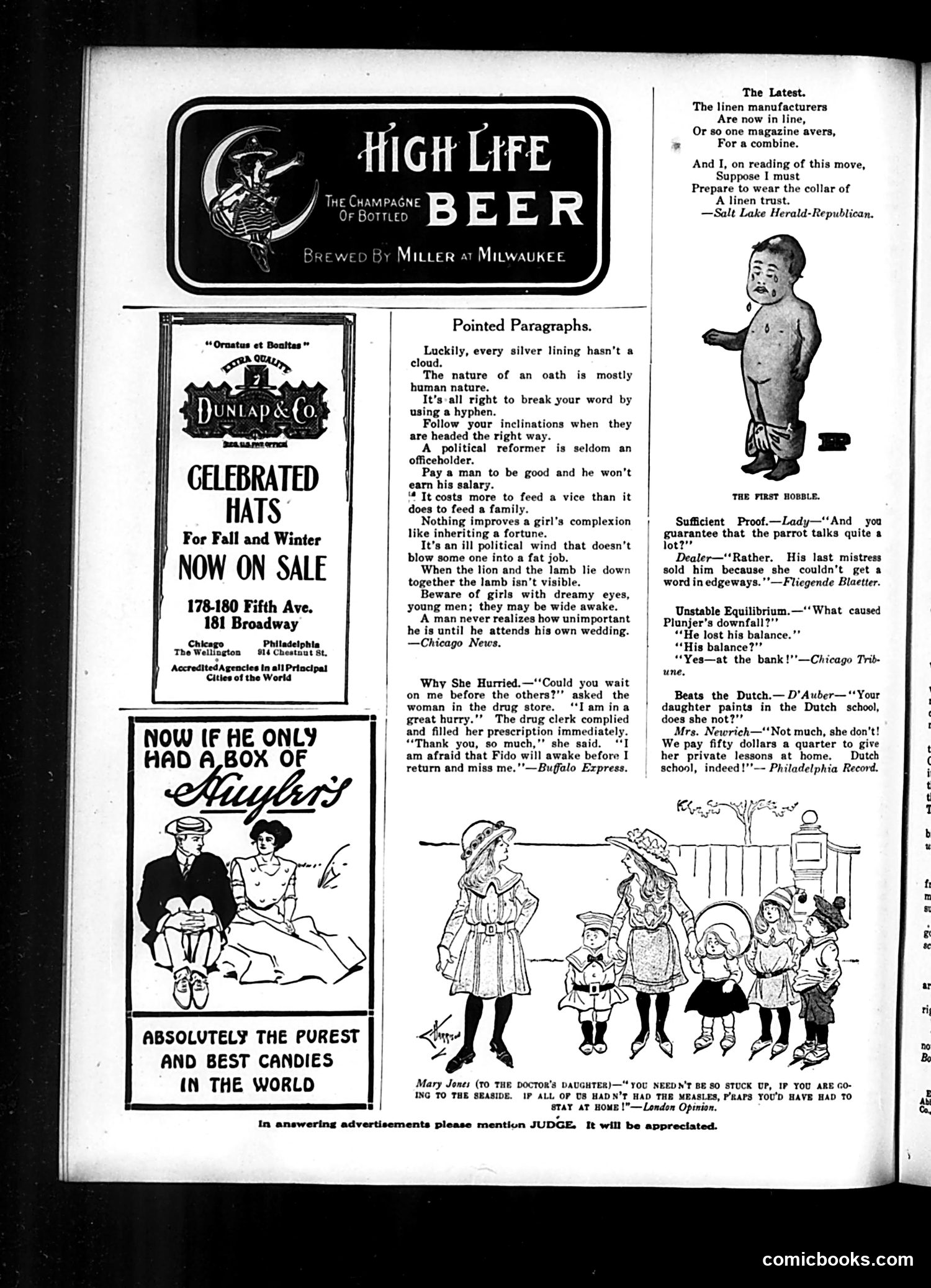
This page from *Judge* (a major American satirical weekly) combines advertisements with humor columns typical of early 20th-century social satire. **The cartoons/humor:** - **"The First Hobble"** shows a baby in constrictive clothing—likely mocking the "hobble skirt" fashion trend that severely restricted women's movement - **Bottom cartoon** depicts children at a seaside, with one girl boasting about her doctor-father's status. A working-class girl retorts that without measles epidemics affecting everyone equally, the doctor's daughter wouldn't exist—satirizing class pretension and the randomness of social hierarchy **The "Pointed Paragraphs"** are cynical one-liners mocking: - Political corruption ("ill political wind" profits officeholders) - Social hypocrisy (reformers rarely hold office) - Marriage and human nature **Advertisements** promote High Life Beer (Miller, Milwaukee) and Dunlap Hats, typical of the era's luxury goods marketed to middle-class readers. The overall tone reflects *Judge*'s satirical focus on American social conventions, class dynamics, and contemporary fashion absurdities.
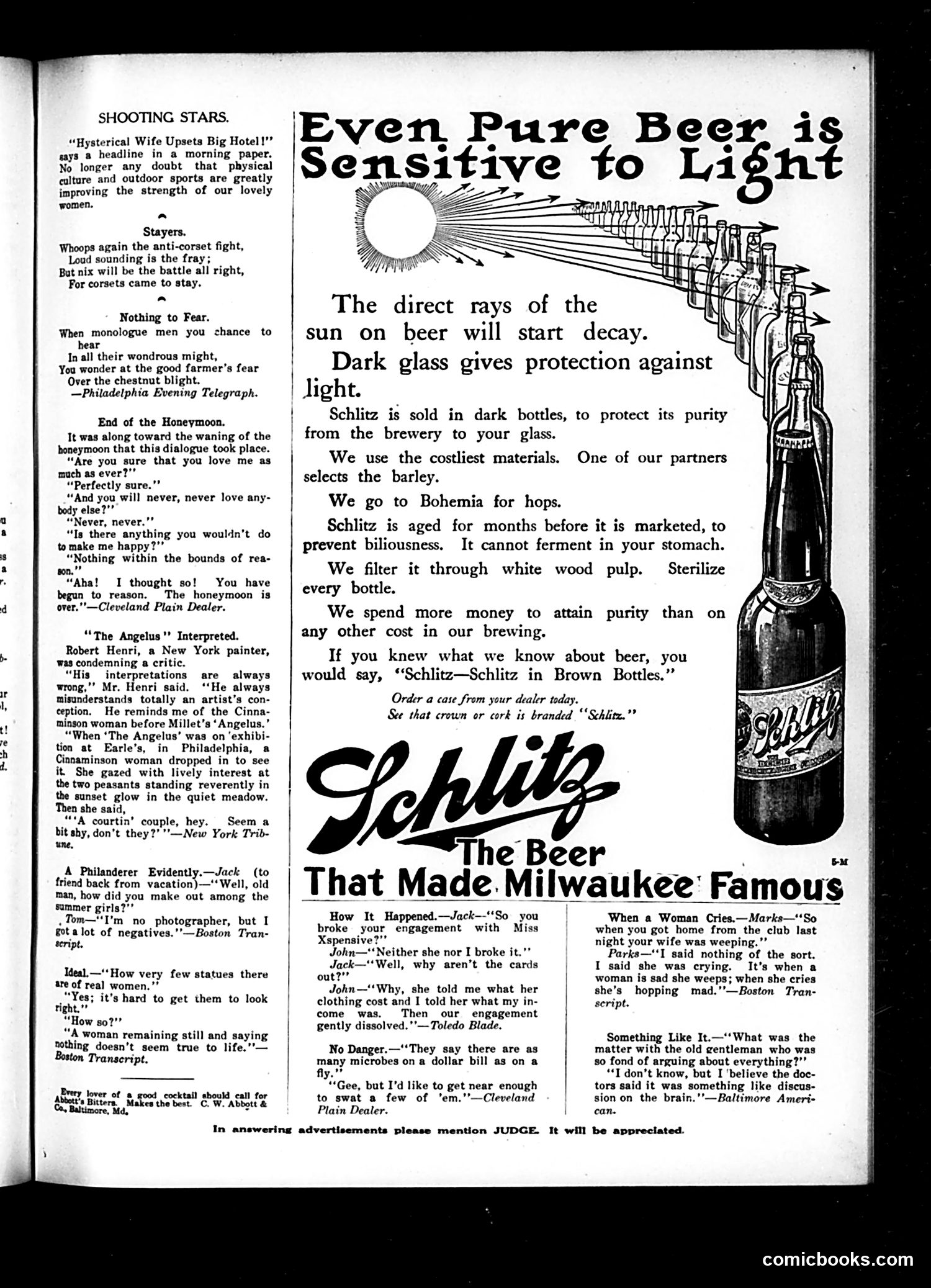
This page is primarily a **Schlitz beer advertisement** occupying most of the right side, with unrelated short humor pieces filling the left column. ## The Advertisement The Schlitz ad addresses consumers' concern about beer spoilage—a real problem in the pre-refrigeration era. It emphasizes that sunlight degrades beer, positioning dark bottles as protective. The copy appeals to quality-conscious drinkers by claiming superior ingredients (Bohemian hops, selected barley), extended aging to prevent digestive upset, and expensive purification processes. The phrase "**Schlitz in Brown Bottles**" functions as the memorable slogan. ## The Humor Pieces Left-column shorts mock various social conventions: the "anti-corset fight" (a women's health debate of the era), monologue performers, honeymoon disillusionment, and painter Robert Henri's critique of public interpretation. These are generic period humor—topical but not politically significant. **Context note:** This appears to be early 20th-century Judge content, when such magazines mixed legitimate satire with advertising revenue. The beer ad reflects Prohibition-era anxieties about product quality and purity.
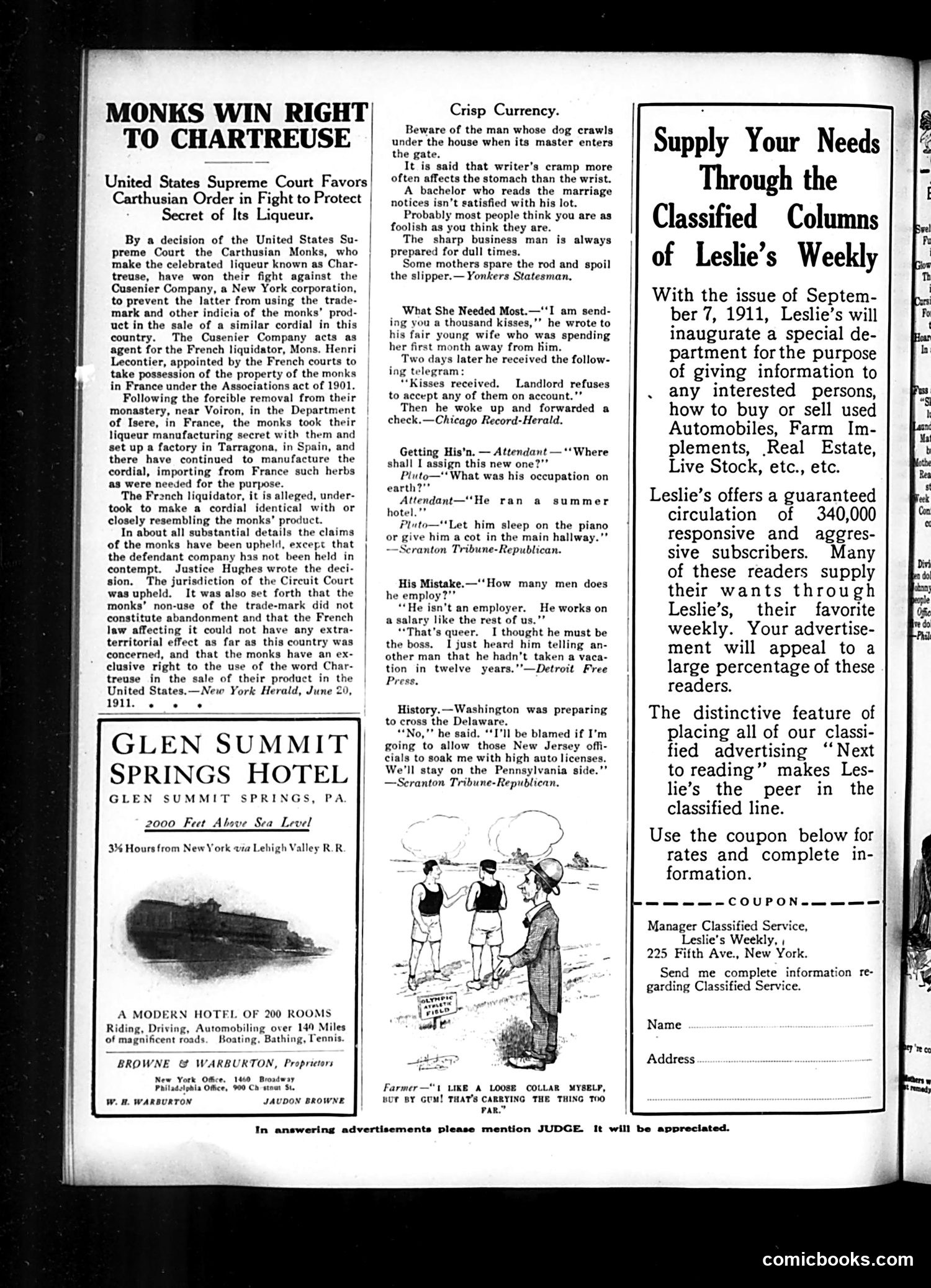
This page from Judge (circa 1911) mixes serious news reporting with satirical "crisp currency" humor columns. **Main Article**: Reports a genuine Supreme Court victory for Carthusian monks against the Cusenier Company. The monks, exiled from France after 1901, manufactured Chartreuse liqueur in Spain and successfully defended their trademark rights in U.S. courts. Justice Hughes ruled the monks' non-use didn't constitute abandonment and that French law had no authority over U.S. sales. **Satirical Sections**: The "Crisp Currency" humor pieces mock contemporary life—marital relationships, business practices, social pretense. Notable: one joke about a man who sends kisses instead of money; another satirizes class consciousness about employment status. **Context for Modern Readers**: This reflects early 20th-century American fascination with international commerce disputes and trademark law, alongside genteel humor targeting marriage, class anxiety, and workplace hierarchies—concerns recognizable today despite period-specific references.
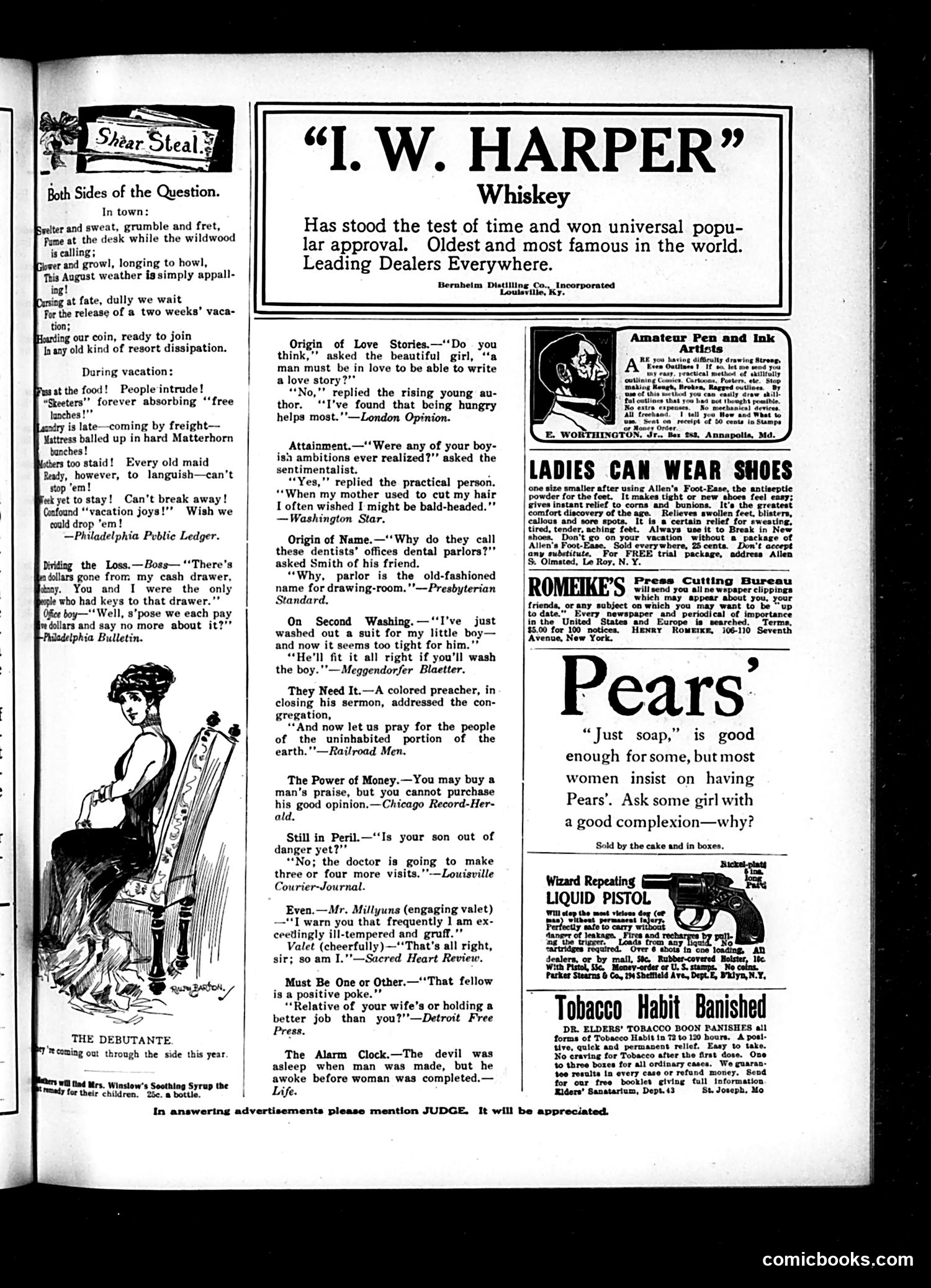
This page contains primarily **humor columns and advertisements** rather than political cartoons. The main satirical content is "Shear Steal: Both Sides of the Question," which contrasts workers' complaints during office life versus vacation reality. The joke: Office workers grumble about being trapped at desks, eagerly anticipating vacation freedom. Yet when vacation arrives, they encounter equally unpleasant realities—poor food, mosquitoes, annoying other guests, and unwanted socializing. The satire mocks the gap between vacation fantasy and disappointing reality, a timeless complaint. The accompanying illustration shows a distressed woman, likely representing the frustrated vacationer facing these disappointments. Below this are various brief humorous anecdotes about love stories, dentistry, money's limitations, and gender relations—typical light humor for Judge magazine's early-20th-century audience. The advertisements include whiskey, soap, and other commercial products typical of the era.
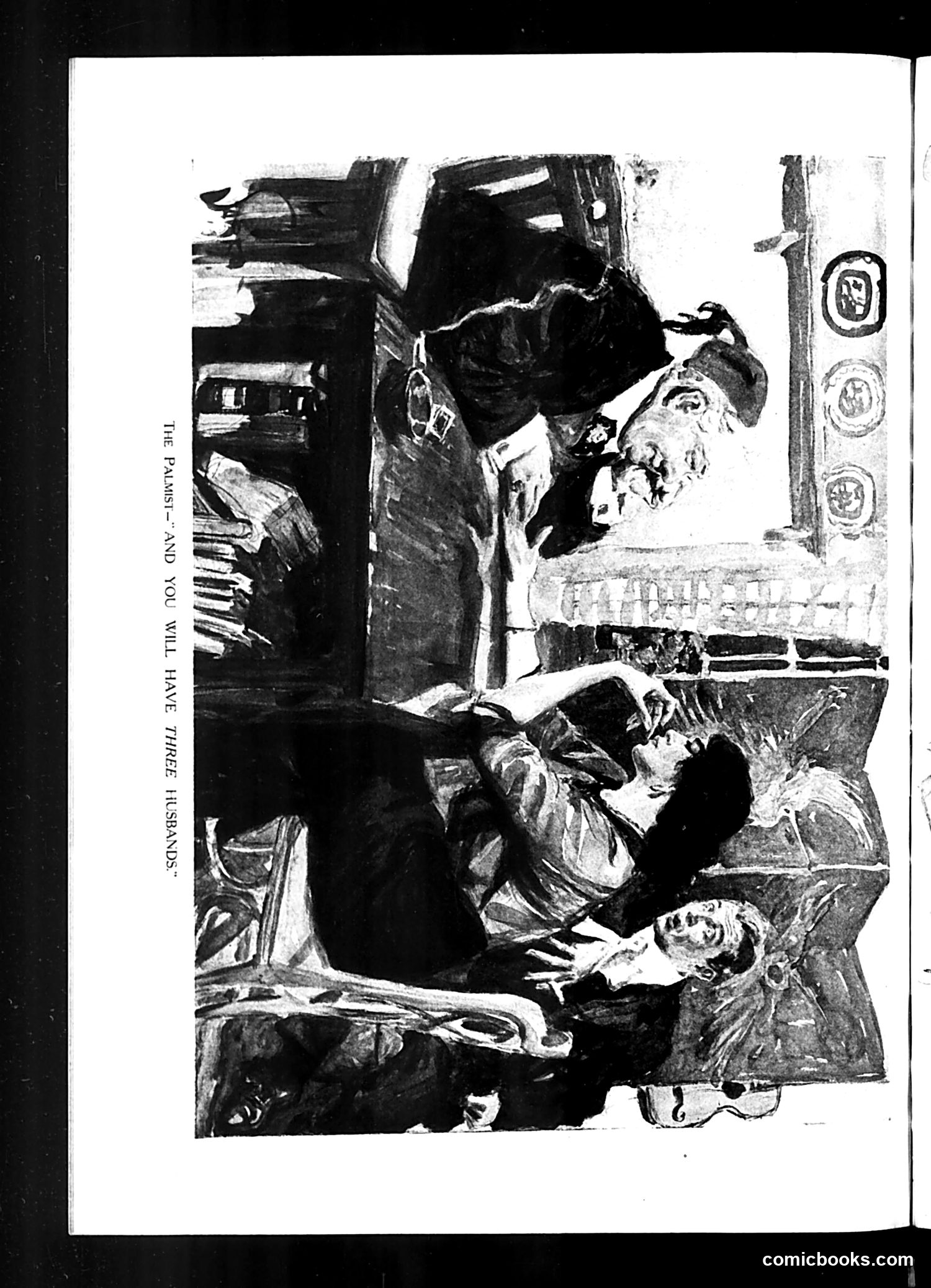
I can see this is a black and white illustration from Judge magazine, but the image is rotated and the quality makes it difficult to read the caption text clearly enough to identify specific figures or explain the satirical point with confidence. The illustration appears to depict an indoor scene with multiple figures in period clothing (possibly late 19th or early 20th century), with what looks like official or formal attire. There are decorative elements visible on the right side. Without being able to reliably read the caption or identify the specific individuals depicted, I cannot accurately explain what political or social commentary this cartoon is making. I'd need a clearer, properly-oriented image to provide the detailed historical analysis you're requesting.