
Judge, 1911-09-02 · page 21 of 24
Judge — September 2, 1911 — page 21: what you’re looking at
What you’re looking at
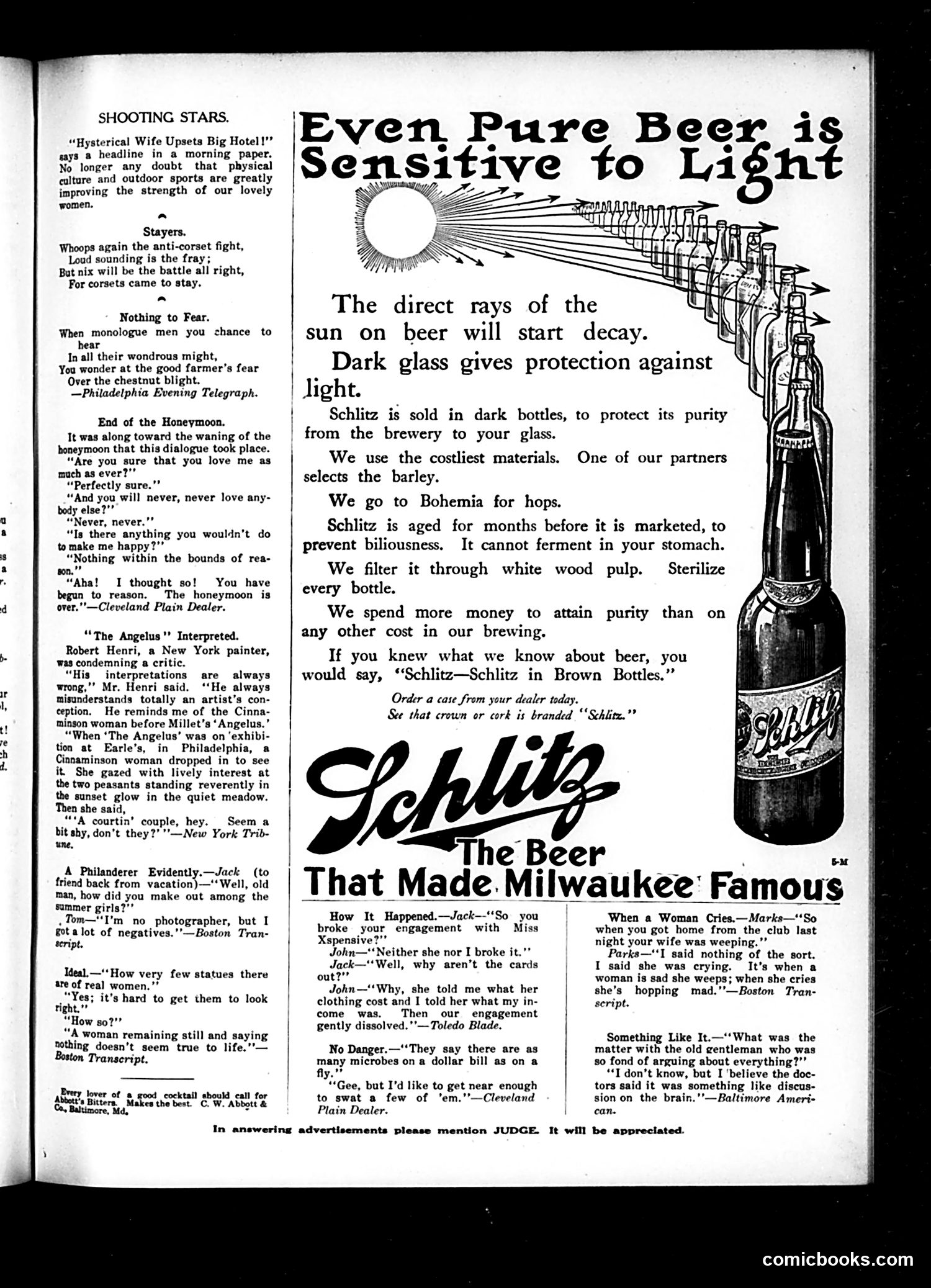
This page is primarily a **Schlitz beer advertisement** occupying most of the right side, with unrelated short humor pieces filling the left column. ## The Advertisement The Schlitz ad addresses consumers' concern about beer spoilage—a real problem in the pre-refrigeration era. It emphasizes that sunlight degrades beer, positioning dark bottles as protective. The copy appeals to quality-conscious drinkers by claiming superior ingredients (Bohemian hops, selected barley), extended aging to prevent digestive upset, and expensive purification processes. The phrase "**Schlitz in Brown Bottles**" functions as the memorable slogan. ## The Humor Pieces Left-column shorts mock various social conventions: the "anti-corset fight" (a women's health debate of the era), monologue performers, honeymoon disillusionment, and painter Robert Henri's critique of public interpretation. These are generic period humor—topical but not politically significant. **Context note:** This appears to be early 20th-century Judge content, when such magazines mixed legitimate satire with advertising revenue. The beer ad reflects Prohibition-era anxieties about product quality and purity.
📄 Transcribed text from this page (OCR, searchable)
Machine-transcribed from the original scan — historical spelling and the odd misread are preserved.
SHOOTING STARS. “Hysterical Wife Upsets Big Hotel!’’ says a headline in a morning paper. No longer any doubt that physical culture and outdoor sports are greatly improving the strength of our lovely women. a Stayers. Whoops again the anti-corset fight, Loud sounding is the fray; But nix will be the battle all right, For corsets came to stay. a Nothing to Fear. When monologue men you chance to hear In all their wondrous might, You wonder at the good farmer's fear Over the chestnut blight. —Philadelphia Evening Telegraph. End of the Honeymoon. It was along toward the waning of the honeymoon that this dialogue took place. “Are you sure that you love me as much as ever?’ “Perfectly sure.”’ “And you will never, never love any- body else?’” “Never, never.’’ “Is there anything you wouldn’t do to make me happy?” “Nothing within the bounds of rea- “Aha! I thought so! You have begun to reason. The honeymoon is over." —Cleveland Plain Dealer. “The Angelus"? Interpreted. Robert Henri, a New York painter, ndemning a critic. interpretations are always Mr. Henri said. ‘‘He always misunderstands totally an artist’s con- ception, He reminds me of the Cinna- minson woman before Millet’s ‘Angelu: “When ‘The Angelus’ was on ‘exhil tion at Earle’s, in Philadelphia, a Cinnaminson woman dropped in to see it, She gazed with lively interest at the two peasants standing reverently in the sunset glow in the quiet meadow. Then she said, "A courtin’ couple, hey. Seem a bit shy, don’t they?’ "’—New York Trib- une, A Philanderer Evidently.—Jack (to friend back from v n)—** Well, old man, how did you make out among the sammer girls?” . Tom—"'I’m no photographer, but I got alot of negatives.""—Boston Tran- script. Tdeal.—‘‘How very few statues there are of real women.” . "Yes; it's hard to get them to look right.” “How so?” “A woman remaining still and saying nothing doesn’t seem true to life.”"— Boston Transcript. Aer. Bit Suess! hala Cay Bal re, Maken the best. C. - Abbott & IEven, Pure Beer is Sensitive to Light Aypuuaanaryy _ | The direct rays of the sun on beer will start decay. Dark glass gives protection against light. Schlitz is sold in dark bottles, to protect its purity from the brewery to your glass. We use the costliest materials. selects the barley. We go to Bohemia for hops. Schlitz is aged for months before it is marketed, to prevent biliousness. It cannot ferment in your stomach. We filter it through white wood pulp. Sterilize every bottle. We spend more money to attain purity than on any other cost in our brewing. One of our partners If you knew what we know about beer, you would say, ‘Schlitz—Schlitz in Brown Bottles.” Order a case from your dealer today. See that crown or cork is branded ‘‘Schlitz.’” That Made. Milwaukee: Famous How It Happened.—Jack—‘‘So you broke your engagement with Miss er When a Woman Cries.—Marks—‘‘So when you got home from the club last night your wife was weeping.”’ Parks—‘‘I said nothing of the sort. I said she was crying. It’s when a Neither she nor I broke it.”” Well, why aren't the cards ‘Why, she told me what her clothing cost and I told her what my in- come was. Then our engagement gently dissolved."’—Toledo Blade. Something Like It.—‘‘What was the matter with the old gentleman who was so fond of arguing about everything?” “I don’t know, but I ‘believe the doc- tors said it was something like discus- sion on the brain.'’—Baltimore Ameri- can. No Danger.—‘‘They say there are as many microbes on a dollar bill as on a ly. “Gee, but I’d like to get near enough to swat a few of ’em.'’—Cleveland Plain Dealer. \ In answering advertisements please mention JUDGE. It will be appreciated. comicbooks.com