
A complete issue · 24 pages · 1911
Judge — August 12, 1911
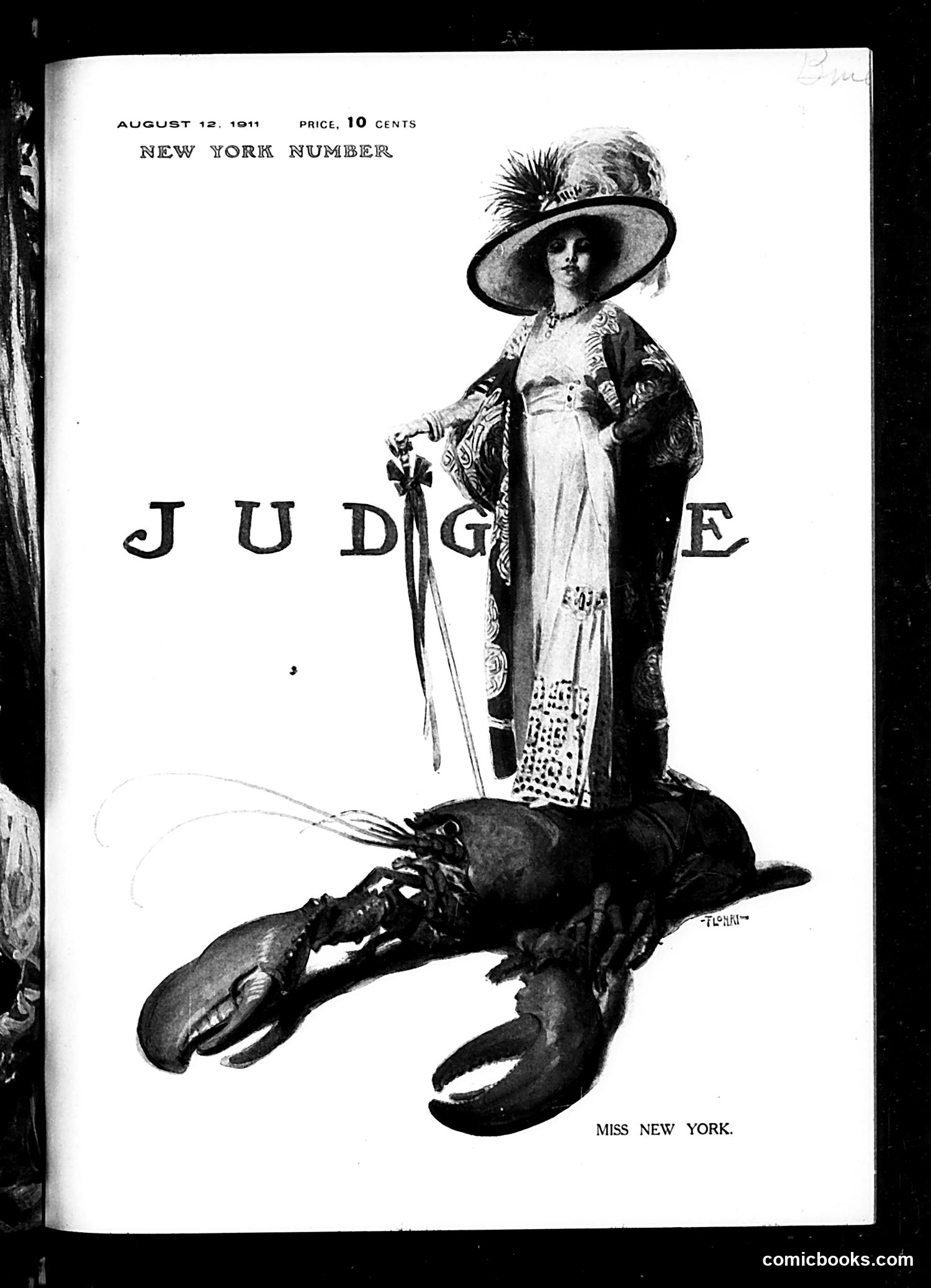
This August 12, 1911 cover depicts "Miss New York" as a elegantly dressed woman standing atop a large lobster claw. The title "JUDGE" frames the composition, with the woman holding what appears to be a sword or scepter. The satire likely comments on New York's prominence or dominance—the lobster representing either the seafood industry, coastal wealth, or possibly New York's aggressive commercial power. "Miss New York" personifies the city as a fashionable, powerful female figure literally standing above the lobster, suggesting New York's superiority or control over this industry or resource. The cartoon's exact political target remains unclear without additional context, but it appears to celebrate or satirize New York's economic or social dominance during the Edwardian era.
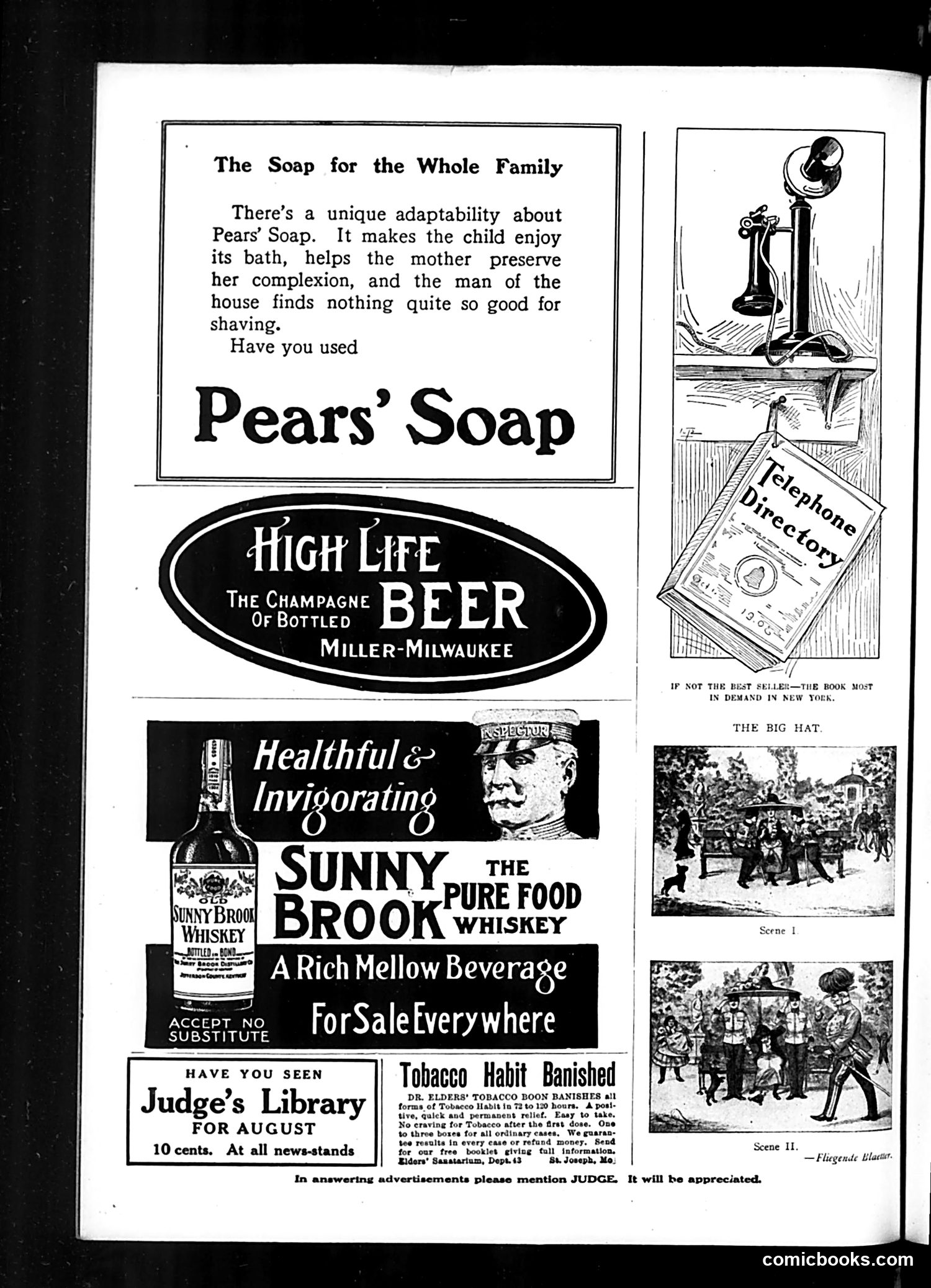
This page is primarily **advertisements**, not satirical content. The ads include: - **Pears' Soap**: Appeals to "the whole family" with gendered messaging (children's baths, mother's complexion, father's shaving) - **High Life Beer** (Miller-Milwaukee) - **Sunny Brook Whiskey**: Marketed as "healthful & invigorating" - **Judge's Library** magazine - **Dr. Elders' Tobacco Habit Banisher**: Promises tobacco cessation in 3 days The right side shows **"The Big Hat"** — two illustrated scenes from what appears to be a serialized story or comic strip (Scenes I and II, credited to "Fliegende Blätter"), though content is unclear from images alone. No clear political satire is evident. This represents typical early 20th-century advertising, including now-controversial health claims for alcohol and tobacco products.
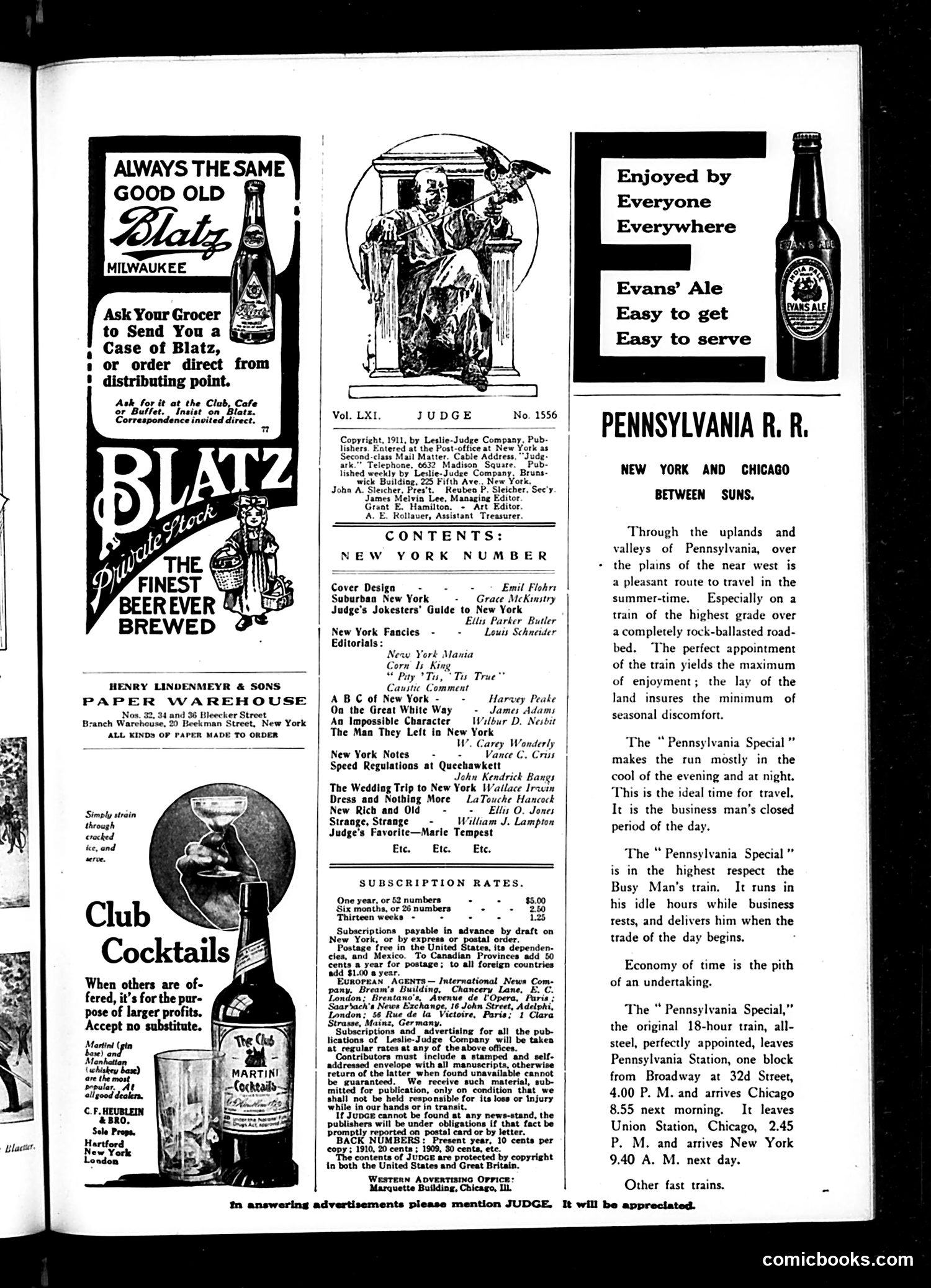
This page is primarily **advertising rather than editorial content**. It contains three separate beer and alcohol advertisements (Blatz beer, Evans' Ale, and a Martini brand cocktail mixer) and a railroad advertisement for the Pennsylvania R.R.'s "Pennsylvania Special" train service between New York and Chicago. The center shows a masthead reading "JUDGE" with what appears to be a classical judge figure, which is the magazine's standard header rather than satirical commentary. The editorial content listed in the "CONTENTS" section references various New York-focused articles and stories, but **no actual satirical cartoon or political commentary is visible on this particular page**. This appears to be a typical early 1900s magazine layout mixing advertising with publication information.
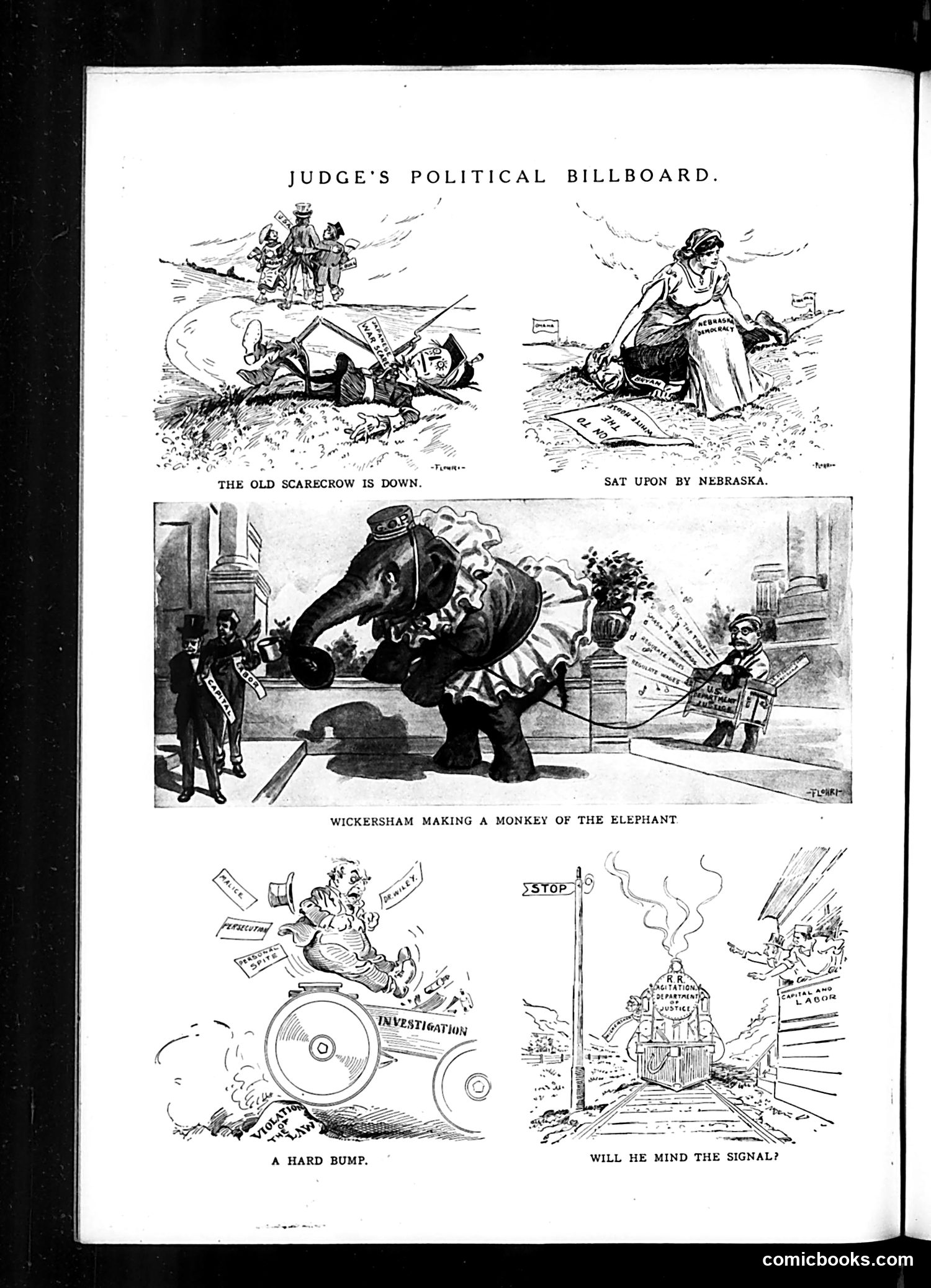
This page contains four political cartoons satirizing judicial figure(s), likely from the 1880s-90s based on style. "The Old Scarecrow Is Down" depicts someone knocked over by political forces. "Sat Upon by Nebraska" shows a figure crushed by the state, suggesting political defeat. "Wickersham Making a Monkey of the Elephant" appears to reference Republican politics, with an elephant (Republican symbol) being manipulated. "A Hard Bump" and "Will He Mind the Signal?" depict a figure on wheels encountering obstacles, possibly satirizing someone's political trajectory or reversals. Without clearer identification of the specific judge or political figure being attacked, the precise historical events remain unclear, though the cartoons uniformly mock someone's political fortunes and competence.
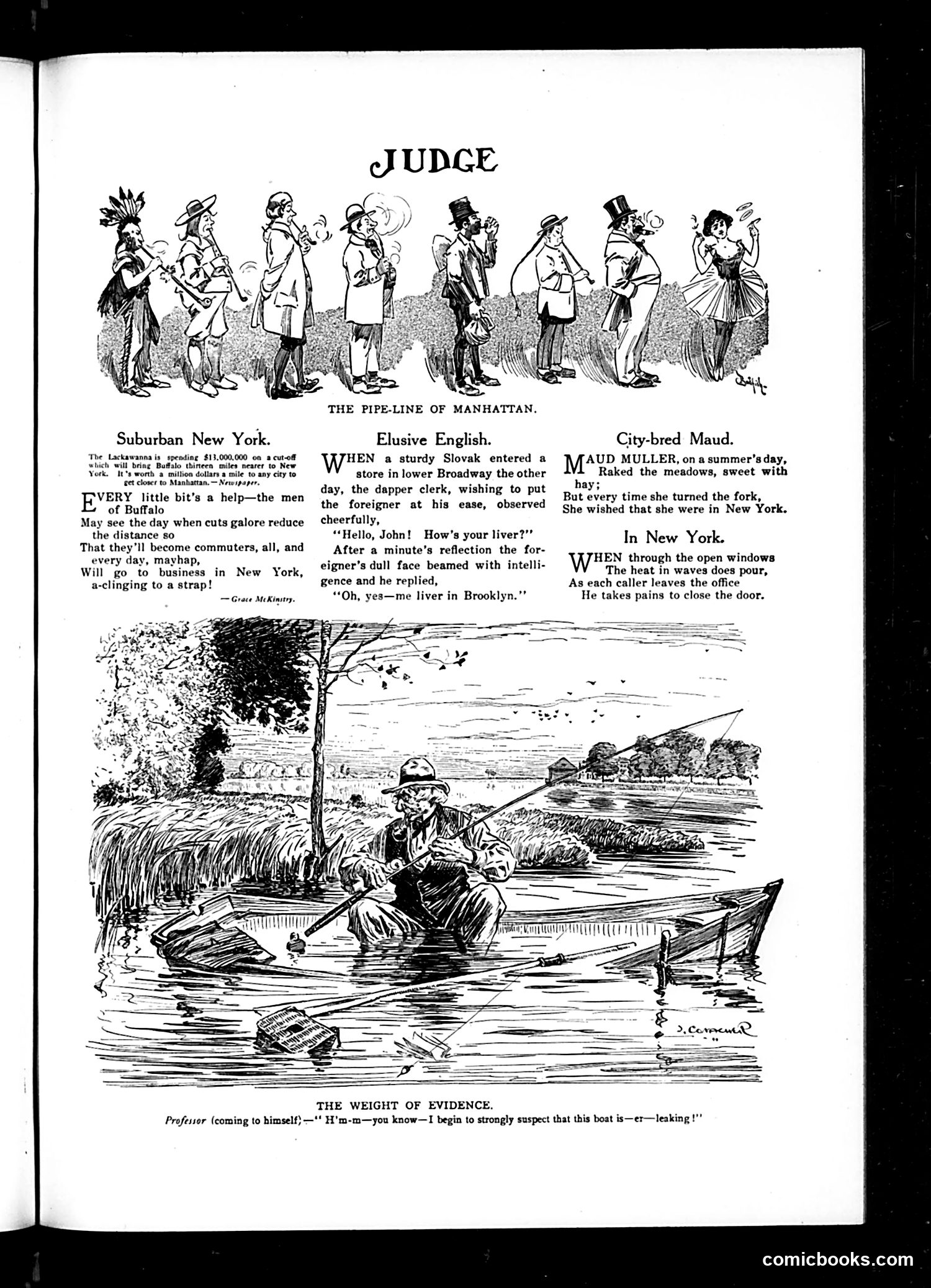
This page satirizes New York City social contrasts through three vignettes: **"Suburban New York"** mocks commuters' daily exhaustion—men traveling from Buffalo to Manhattan, clinging to straps on packed trains. **"Elusive English"** depicts a Slovak immigrant worker whose broken English amuses his American coworker ("liver in Brooklyn" instead of "liver"). The joke plays on immigrant accent humor common in early 20th-century American satire. **"City-bred Maud"** contrasts a sheltered young woman who forks hay incorrectly when visiting the countryside, having forgotten her rural origins. The bottom cartoon, **"The Weight of Evidence,"** shows a man and boat sinking—he insists the boat is "leaking" rather than admitting obvious fault, likely satirizing denial or self-deception. Overall, the page examines class, immigration, and urban-rural cultural divides in Manhattan.
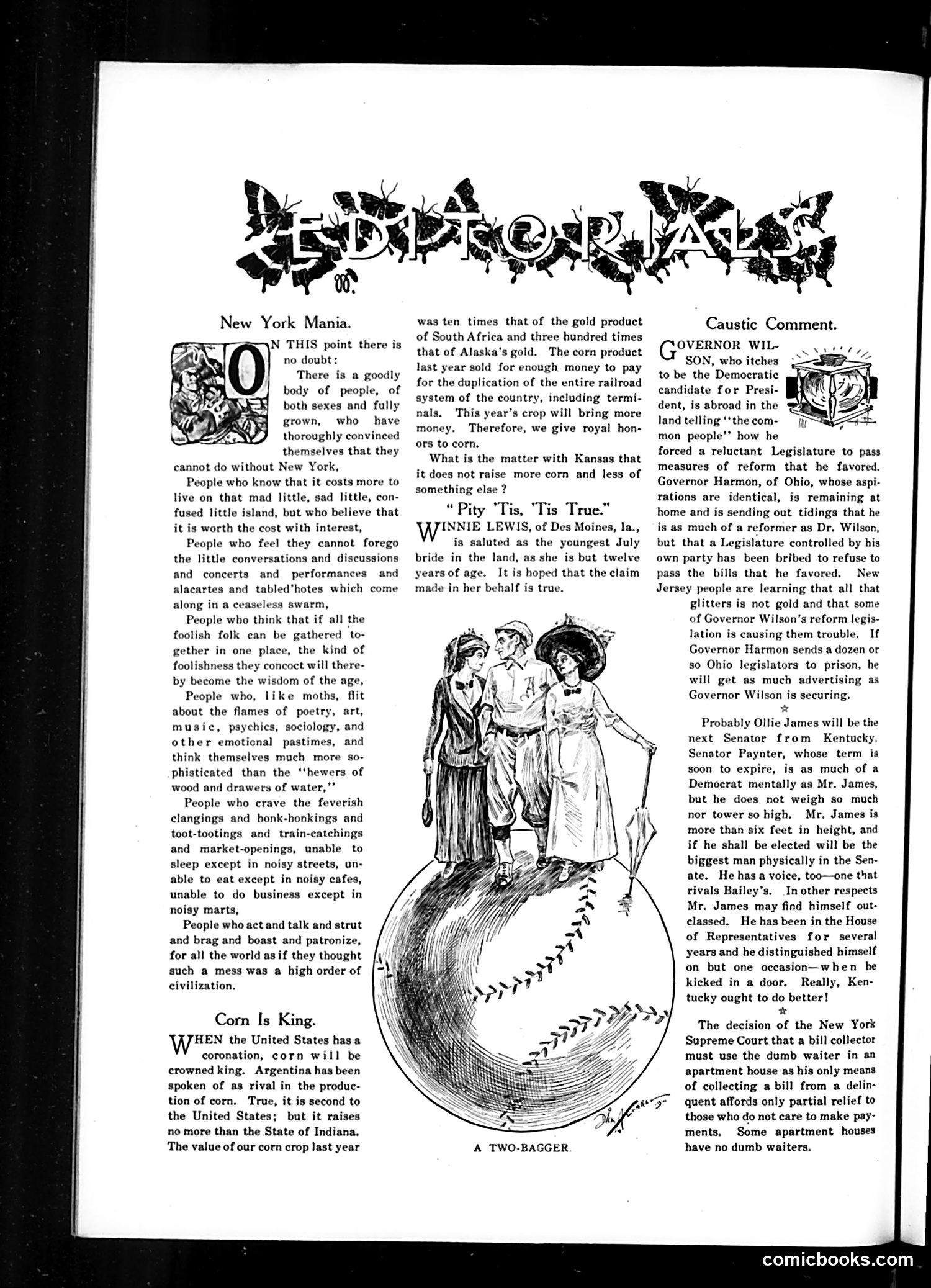
This page contains three distinct satirical commentaries: **"New York Mania"** mocks wealthy New Yorkers obsessed with Manhattan's cultural life—attending concerts, art exhibits, and intellectual discussions—while dismissing themselves as sophisticated. The satire suggests they're actually pretentious phonies convinced their urban lifestyle represents civilization. **"Corn Is King"** praises American agricultural output, noting corn production vastly exceeds gold mining in value. It questions Kansas's agricultural priorities, implying farmers should maximize corn production for national economic benefit. **"Caustic Comment"** attacks Governor Wilson (likely Woodrow Wilson) and Governor Harmon for claiming credit for reform legislation while competing for the Democratic presidential nomination. The writer suggests their reforms are self-serving political theater. It also discusses potential Kentucky Senator Ollie James, noting his physical stature would make him the Senate's largest member, with a voice rivaling Senator Bailey's. The tone throughout is sharply critical of political hypocrisy and urban pretension.
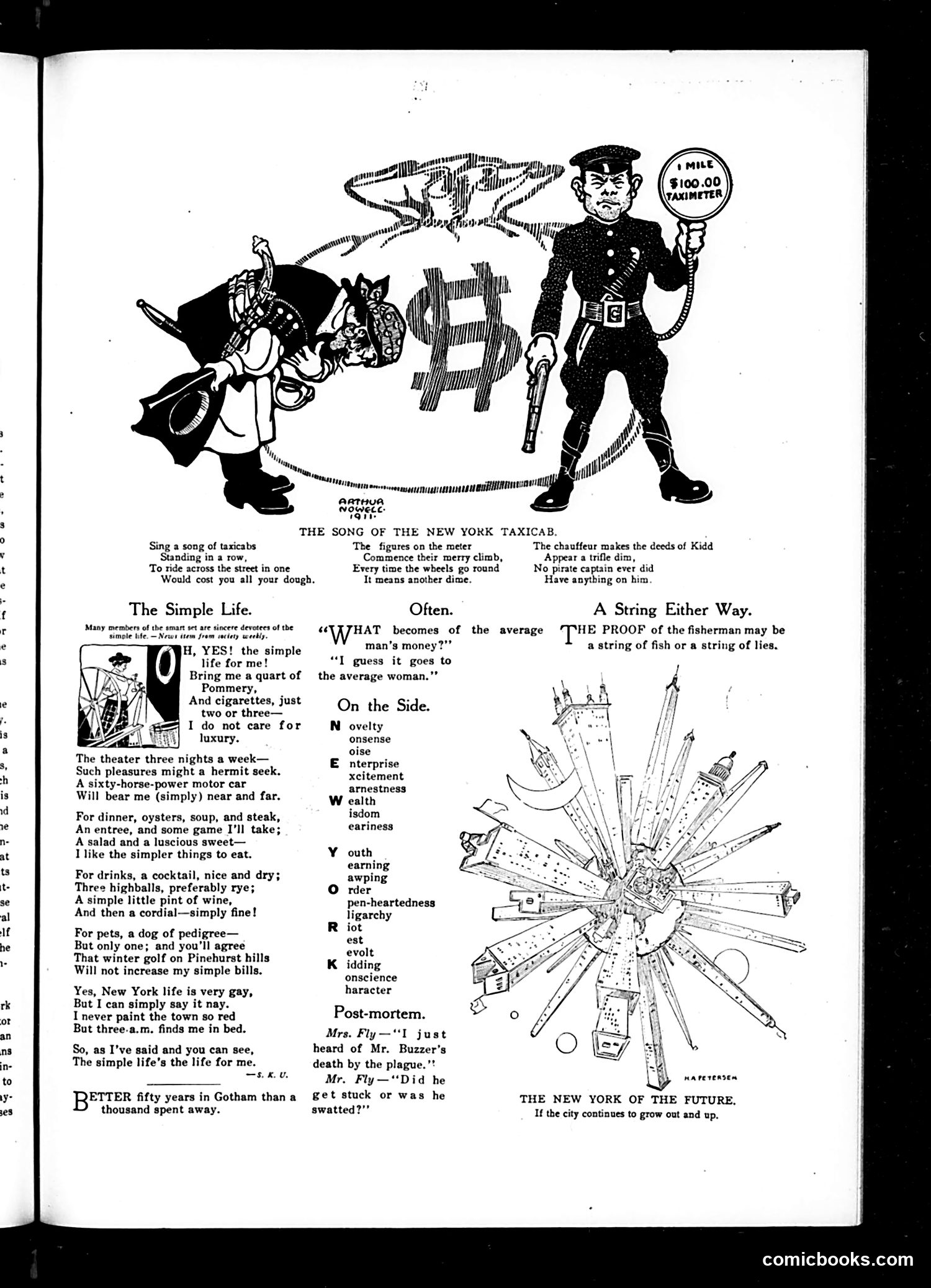
This Judge page satirizes early 1910s New York City excess and hypocrisy. The main cartoon mocks NYC taxi cabs, which were notoriously expensive—the meter running constantly as a "pirate captain" (the cabbie) fleeces passengers. "The Simple Life" parodies wealthy New Yorkers' pretense of living modestly while actually indulging in luxury: champagne, expensive restaurants, theater, and motor cars. The irony is that their "simple" lifestyle costs enormous sums. Other brief jokes target familiar urban types: taxi meters draining money, the assumption that women spend men's earnings, and the taxi driver as worse than historical criminals. "The New York of the Future" diagram humorously imagines the city growing vertically into impossible density—a commentary on rapid urbanization and skyline expansion already visible in the 1910s. The overall tone reflects Judge's satirical approach to mocking Manhattan's wealthy class and their contradictions.
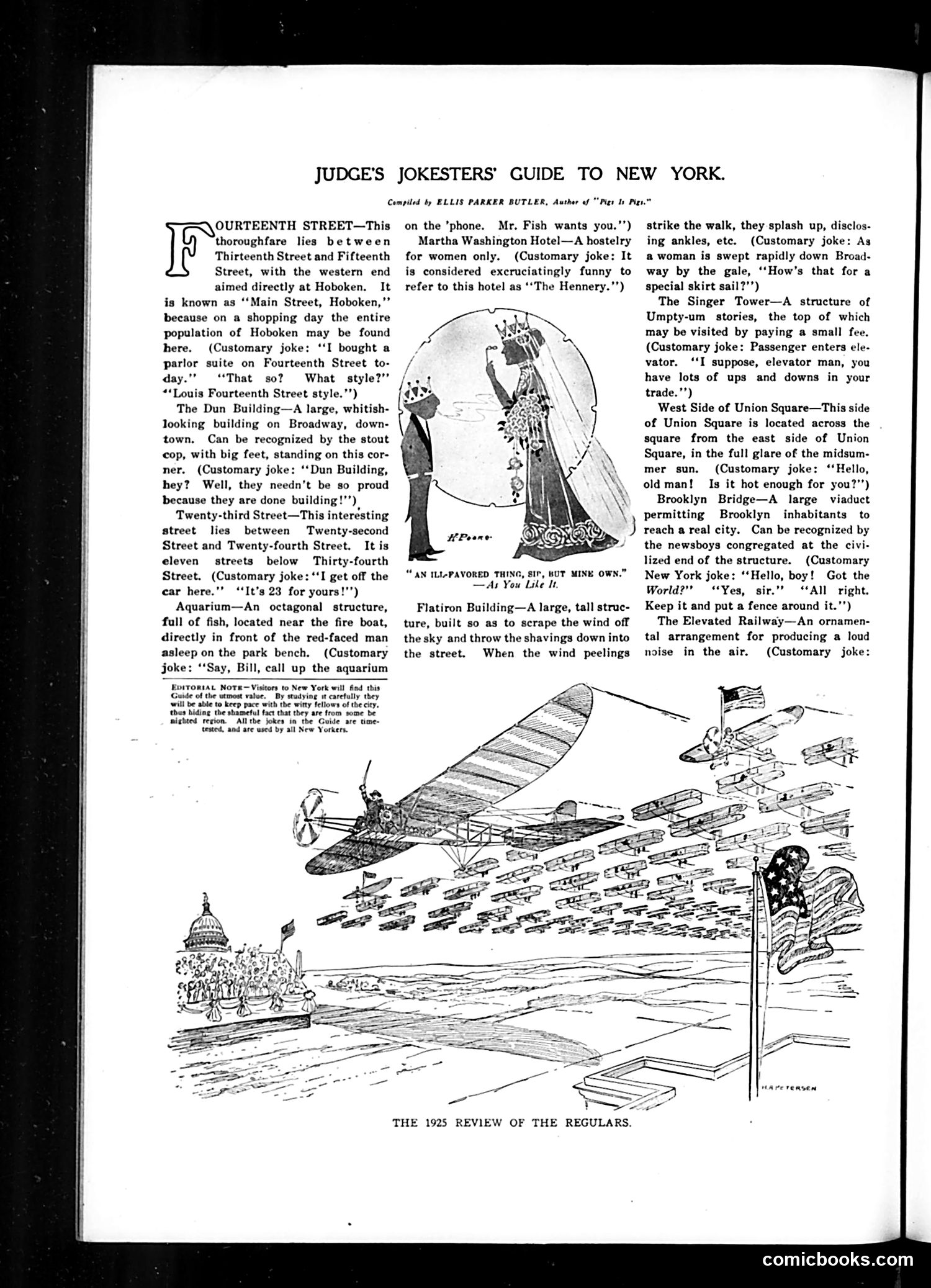
This is a humorous tourist guide satirizing New York City landmarks and the tired jokes New Yorkers perpetually make about them. Compiled by Ellis Parker Butler, it mocks both the city's famous structures and the locals' repetitive wisecracks. The page lists locations like the Flatiron Building (famous for wind gusts lifting women's skirts), the Brooklyn Bridge, and various streets, pairing each with "customary jokes"—stale punchlines New Yorkers allegedly use constantly. The humor targets New Yorkers' smugness about their city and their reliance on worn-out, predictable quips. The lower cartoon "The 1925 Review of the Regulars" (artist unclear) depicts airplanes over Washington D.C., likely satirizing military aviation developments or regulatory reviews of the era. The guide's editorial note suggests visitors should memorize these jokes to "keep pace with the witty fellows"—ironically acknowledging that New York humor is formulaic, not genuinely witty.
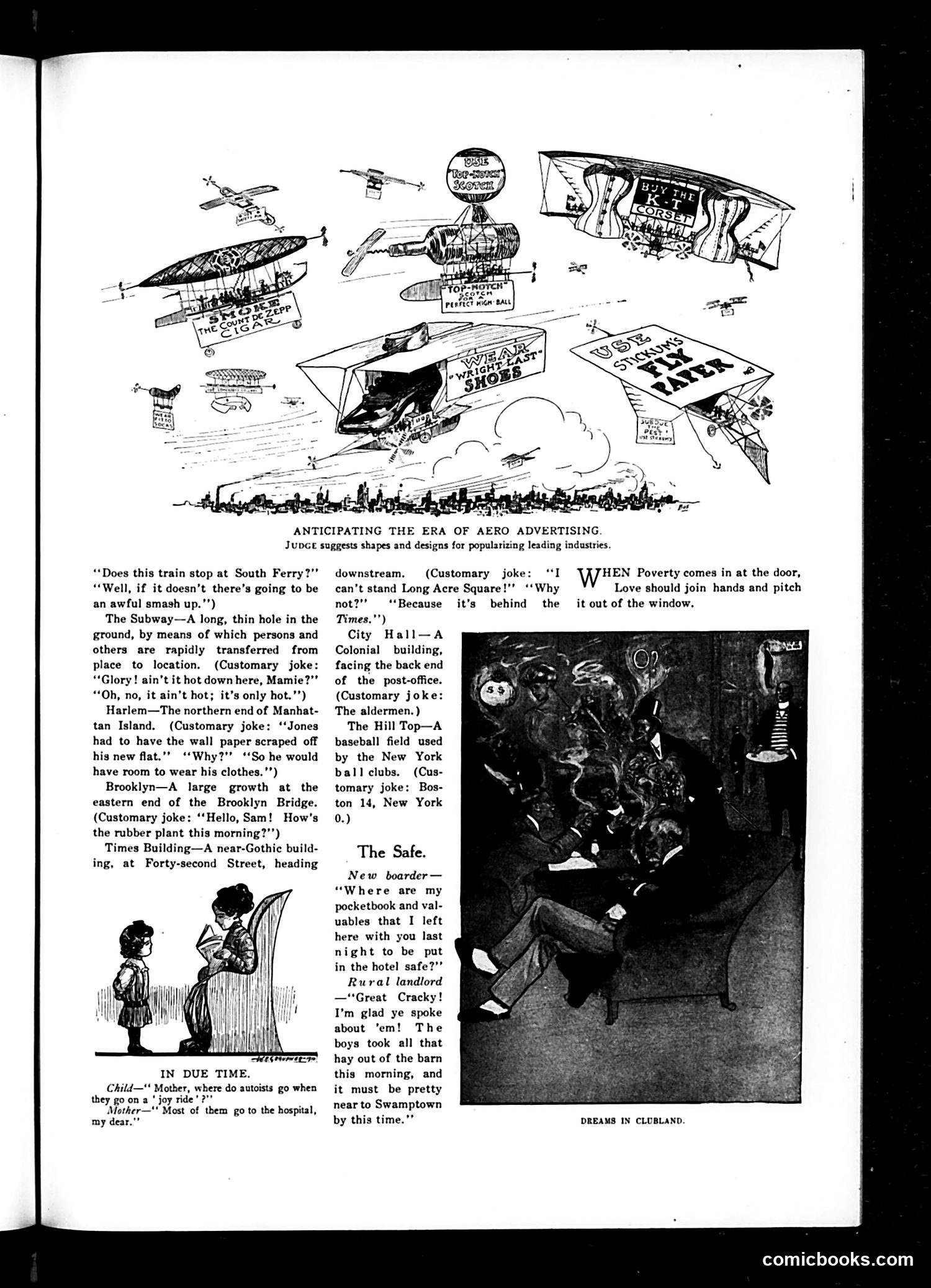
This satirical page imagines how New York City landmarks and industries might be shaped as airships for advertising purposes. The top illustration shows various proposed designs—a cigar-shaped dirigible, a shoe-shaped airship, a box-shaped vessel—floating over the Manhattan skyline. Judge satirizes both the emerging aviation industry and aggressive advertising culture of the early 1900s. The humor works on two levels: first, the absurdity of turning recognizable city locations (the Subway, City Hall, Brooklyn Bridge, Times Building) into airborne advertisements; second, accompanying jokes about each location that reveal contemporary social attitudes—cramped subway conditions, corrupt aldermen, the Times newspaper's editorial positions. The lower sections contain unrelated jokes and a photograph labeled "Dreams in Clubland," suggesting this is a miscellaneous editorial page. The content reflects Judge's characteristic mix of political commentary, urban satire, and commercial humor targeting educated middle-class New York readers.
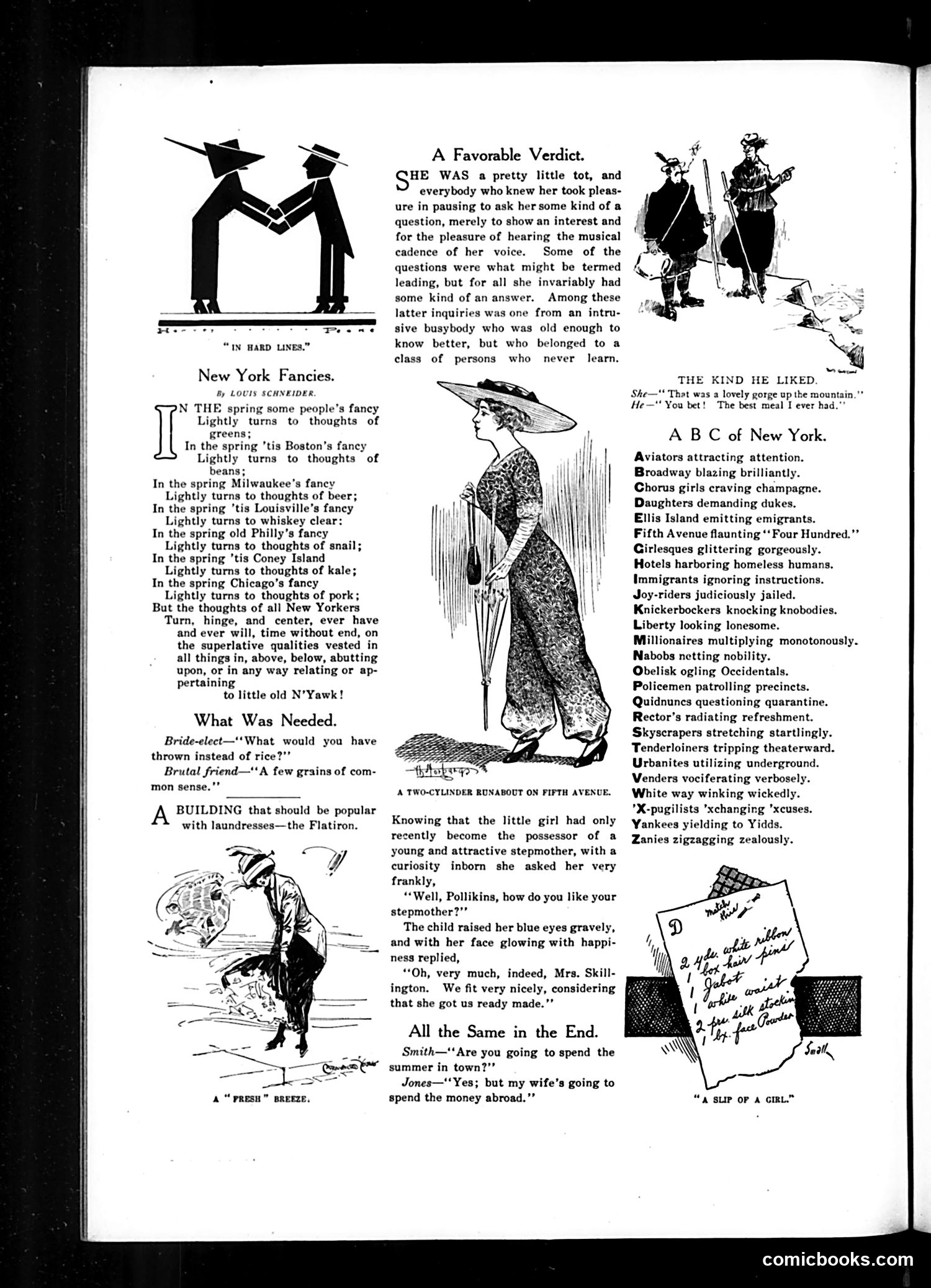
This page contains several satirical pieces mocking New York society and American regional stereotypes: **"New York Fancies"** parodies Tennyson's "The Love Song of J. Alfred Prufrock," claiming New Yorkers are uniquely obsessed with their city itself—unlike other cities fixated on food (Boston's beans, Milwaukee's beer, Philadelphia's snails). **The joke pieces** include barbs at wealth and marriage: a bride-elect criticized for lacking "common sense," and a husband whose wife spends money abroad while he stays in town. **"A B C of New York"** is alliterative social commentary targeting the wealthy ("Daughters demanding dukes"), immigrants ("Ellis Island emitting emigrants"), and modern anxieties (quarantine concerns, subway usage). The reference to "Yankees yielding to Yidds" reflects period anti-Semitic attitudes about Jewish immigration changing the city's character. The cartoons and humor reflect early 20th-century elite anxieties about urbanization, immigration, and changing social hierarchies in Gilded Age New York.
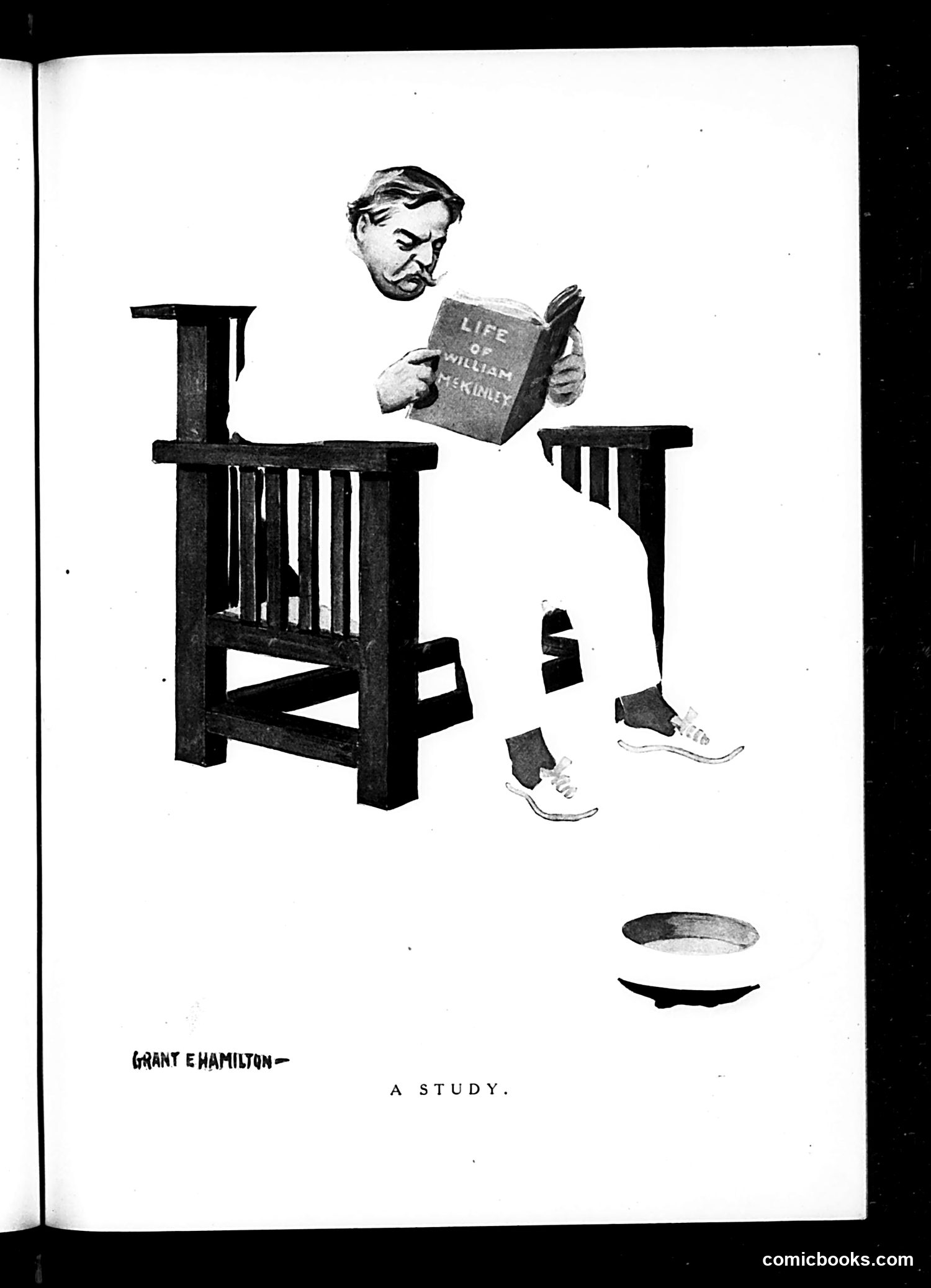
This political cartoon depicts a man reading a book titled "Life of William McKinley" while sitting between two chairs. The figure appears to be a caricature of someone examining or studying McKinley's biography—likely commentary on McKinley's political legacy or character during the late 19th century. The two empty chairs flanking the reader suggest absent figures or lost opportunities, possibly referencing political positions or influence. The scattered objects at the bottom remain unclear in meaning. Without the magazine's date and issue context, the specific political point is uncertain, but the cartoon likely critiques McKinley's presidency, political rivals, or contemporary political debates of that era. Judge magazine typically used such imagery for satirical commentary on current events.
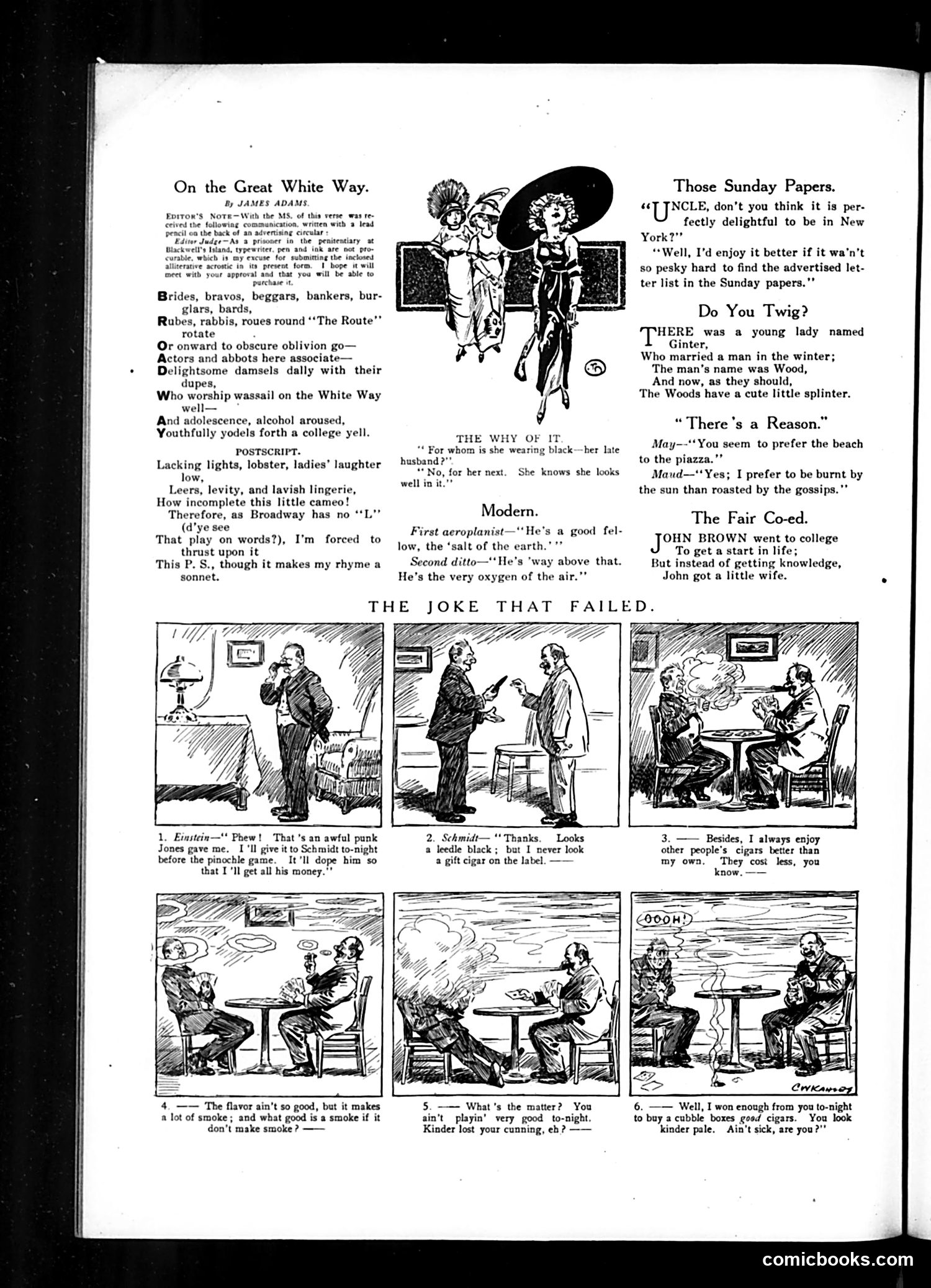
This page from *Judge* magazine contains several satirical pieces typical of early 20th-century American humor: **"The Great White Way"** is a poem by James Adams mocking Broadway and its theatrical crowd—actors, "damsels," and dissolute youth seeking oblivion through alcohol and vice. **"Those Sunday Papers"** jokes about the difficulty of finding advertised content amid the clutter of Sunday newspaper supplements—a real frustration for readers drowning in ads. **"The Joke That Failed"** is a six-panel comic depicting a failed attempt at humor: A man gives a poor-quality cigar to a friend before a card game, expecting it will impair his judgment so he can win money. The other panels show variations on giving cheap cigars and their disappointing effects. The satire targets both poor-quality merchandise and the transparency of such schemes. The other short pieces ("Do You Twig?", "Modern," "The Fair Co-ed") are typical period puns and social commentary on relationships and gender roles.
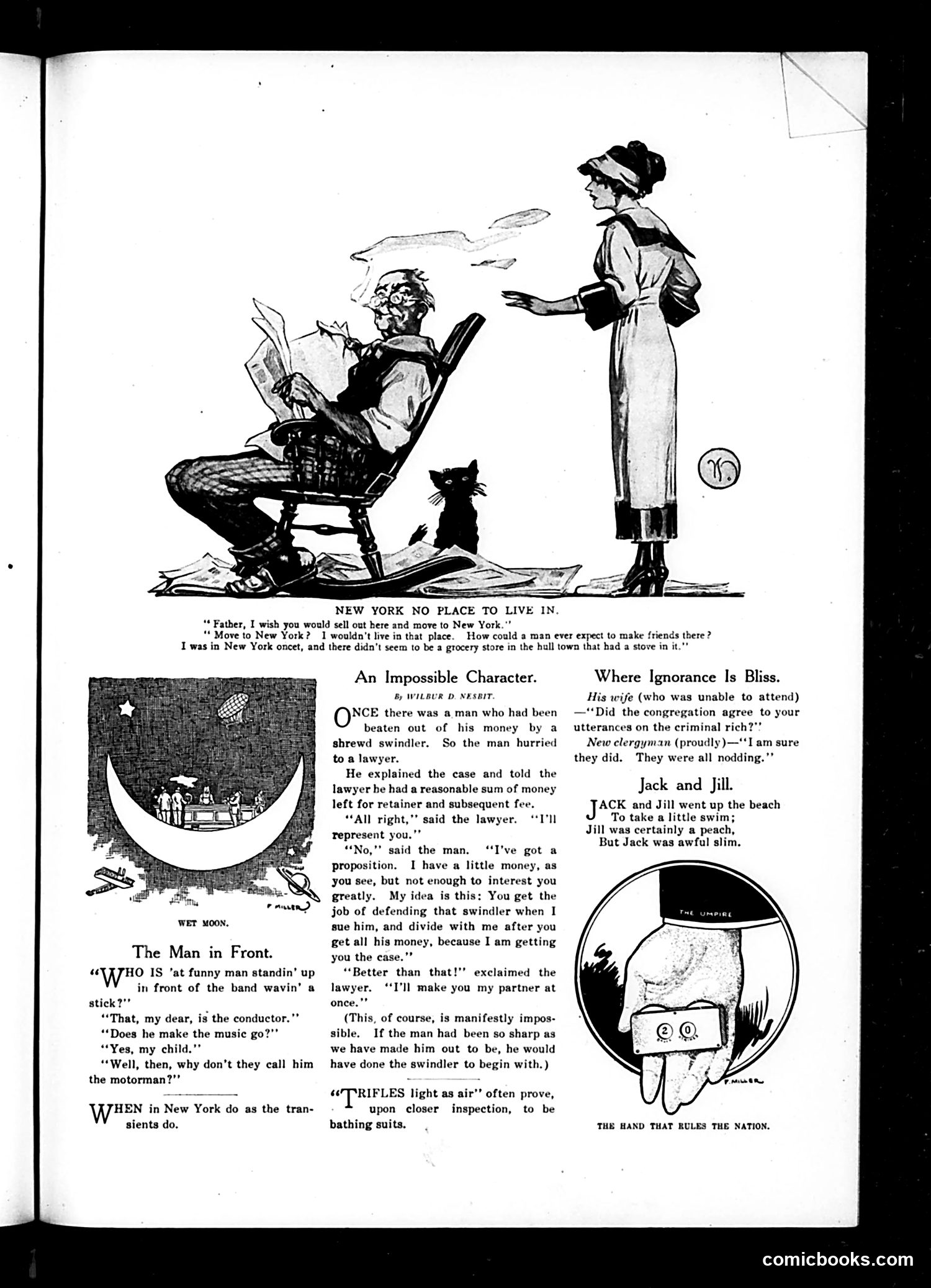
This page contains several satirical pieces targeting early 20th-century American social attitudes and New York City life. The top cartoon mocks rural skepticism about urban living—a country father dismisses New York as unfriendly and lacking basic amenities (grocery stores with stoves), reflecting period anxiety about big-city anonymity versus small-town community. "The Man in Front" makes a simple wordplay joke: a child mistakes the orchestra conductor for a "motorman" (streetcar operator), confusing the stick-waving authority figure with transit workers familiar to urban audiences. "An Impossible Character" satirizes a man attempting to propose an obviously corrupt legal scheme to a lawyer—the satire being that someone clever enough to devise such a con would have already swindled the lawyer directly. Minor pieces include jokes about bathing suits, a clergyman misreading parishioner nodding as agreement, and a "Jack and Jill" poem about beach swimming where one party is unattractive. "The Hand That Rules the Nation" (bottom right) appears to reference political/economic power, though context is unclear from this excerpt alone. The overall tone emphasizes social pretension and urban-versus-rural contrasts.
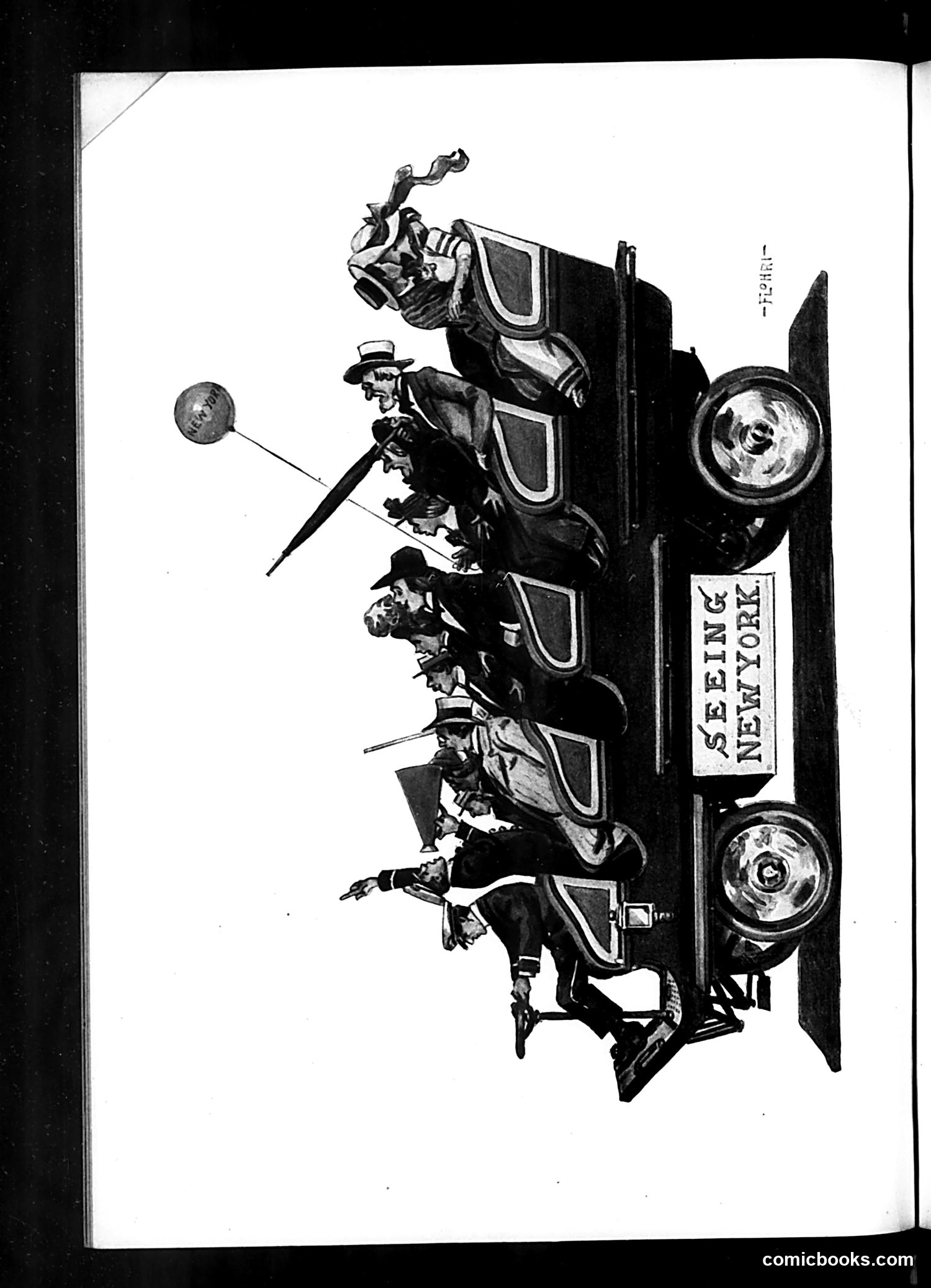
This appears to be a satirical illustration from Judge magazine showing a tour bus or sightseeing vehicle labeled "SEEING NEW YORK." The image is rotated 90 degrees, depicting several caricatured passengers in exaggerated poses—some appearing to lean precariously from the vehicle, others gesturing wildly with canes or umbrellas. The satire likely mocks tourist behavior in early 20th-century New York City, poking fun at visitors' overeager enthusiasm, awkward positioning, and undignified conduct while sightseeing. The chaotic composition emphasizes the absurdity of the scene. This represents a common Judge theme: ridiculing urban tourists and their eager but clumsy attempts to experience the city's attractions.
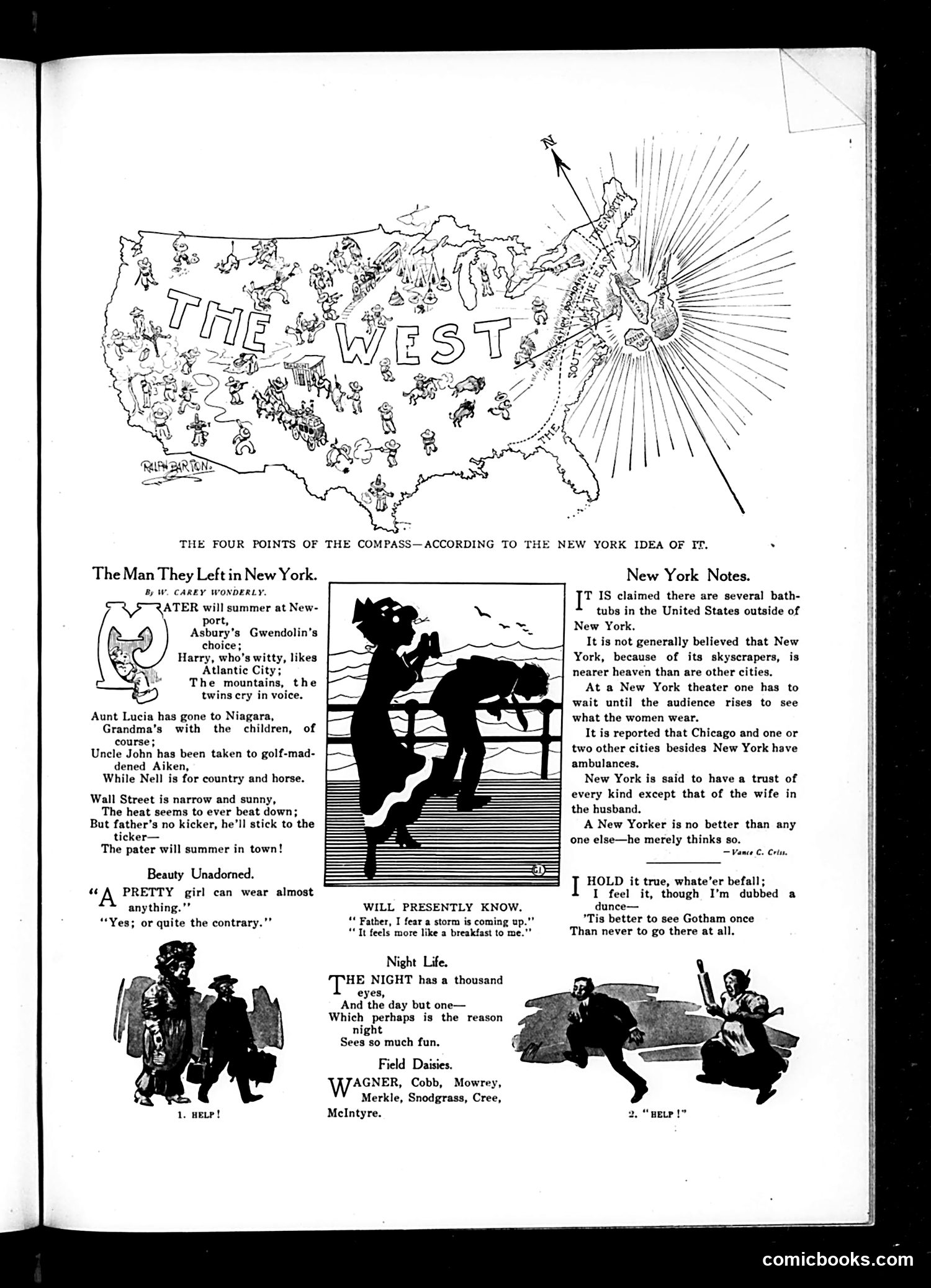
**The Main Cartoon:** "The Man They Left in New York" satirizes wealthy New York families who abandon the city for summer resorts. While relatives vacation in Newport, Atlantic City, the mountains, and Niagara Falls, the father alone remains "summering in town" on Wall Street, stuck with work while his family enjoys leisure. The joke mocks both the predictable migration patterns of the wealthy and the father's sacrifice to his business obligations. **The Sidebar Content:** "New York Notes" offers satirical quips about New York exceptionalism—mocking the city's boastfulness about skyscrapers, theaters, and modern amenities (ambulances, bathtubs) while poking fun at New Yorkers' arrogance and marital distrust. The unnamed baseball players listed (Wagner, Cobb, Snodgrass, etc.) suggest contemporary sports references, likely about New York teams. **Overall Point:** The page ridicules both the leisure habits of wealthy New Yorkers and their provincial pride in their city.
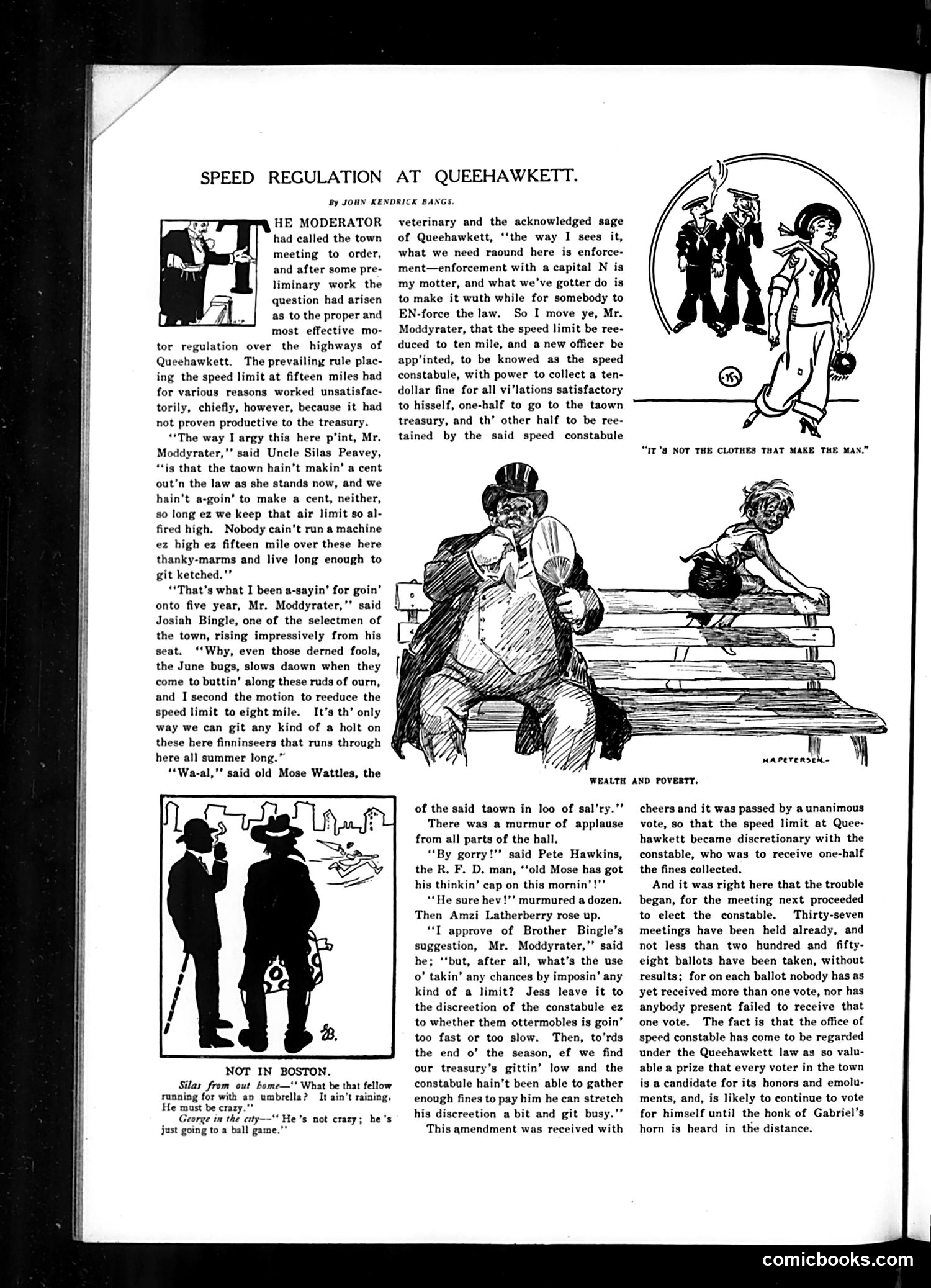
This is a satirical story by John Kendrick Bangs about a small-town New England meeting debating automobile speed limits. The humor targets municipal corruption and self-interest disguised as civic duty. The plot: A town sets a 15-mph speed limit but collects no fines, so it's ineffective. Various rustic characters propose reducing the limit to 8-10 mph and creating a "speed constable" position—one who keeps half the fines collected as salary rather than receiving wages. The satire: The townspeople gradually reveal the scheme's true purpose: not safety, but creating a profitable position for someone. The final joke—that 37 meetings and 258 ballots have failed to elect a constable because every voter wants the lucrative job for themselves—exposes how small-town graft operates: corruption masquerading as regulation, with everyone complicit. The dialect-heavy rural characters emphasize that such schemes were supposedly characteristic of rustic American towns.
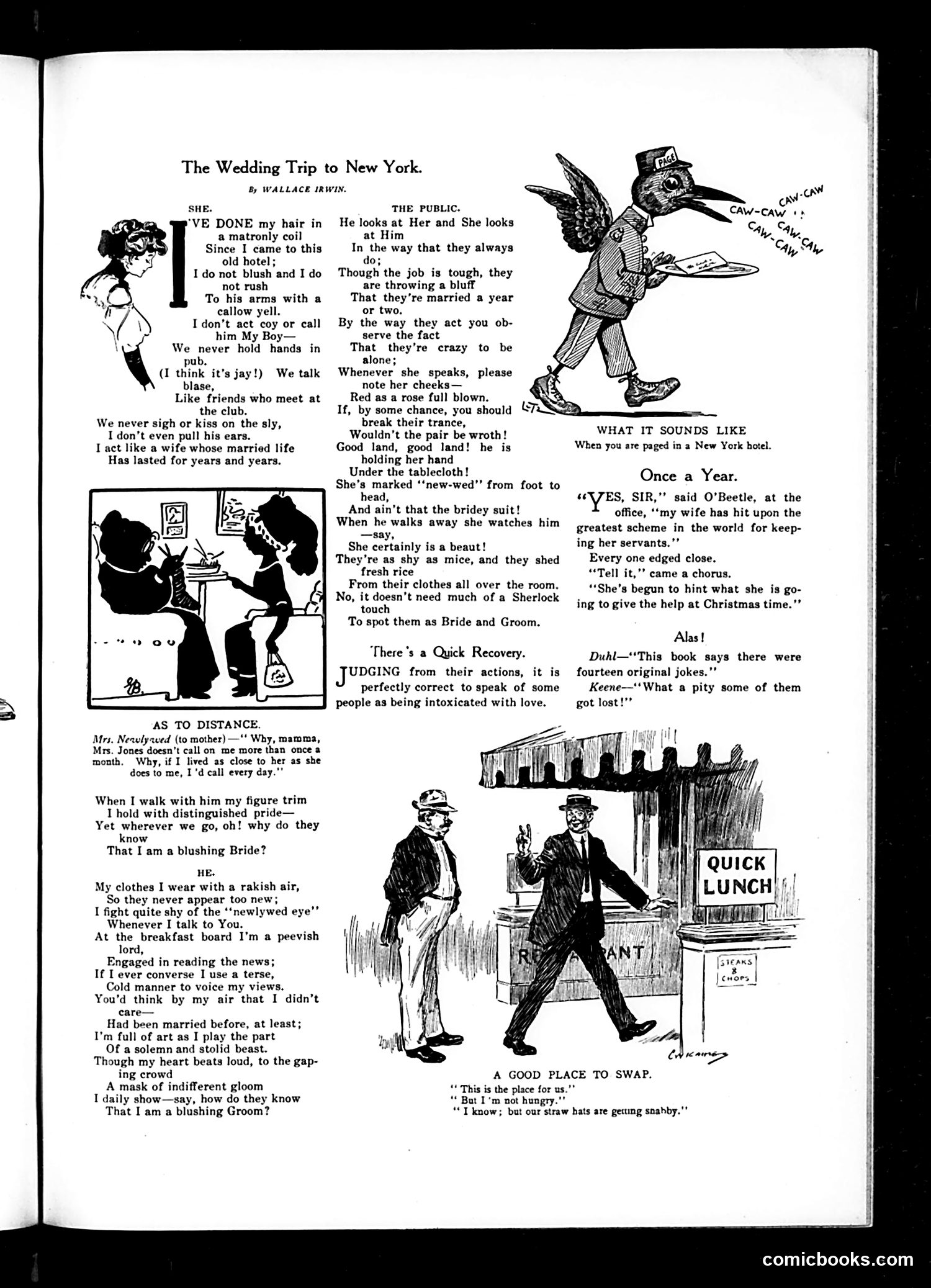
This page satirizes newlyweds' futile attempts to appear sophisticated and seasoned in public. The main piece contrasts three perspectives: the bride and groom each claim they're acting *blasé and indifferent* to disguise their newlywed status (no hand-holding, cold demeanor, reading newspapers). Yet "The Public" section reveals they're completely transparent—their blushing cheeks, hidden hand-holding under tablecloths, and scattered rice give them away instantly. The satire targets the social pretense of young married couples trying to seem worldly and experienced rather than naive and infatuated. Contemporary readers would recognize the universal awkwardness: newlyweds' self-consciousness about appearing too affectionate in public, contrasted with their obvious inability to hide their excitement. Additional vignettes mock honeymoon-related observations: servants' gift-giving schemes and couples visiting modest lunch counters while dressed in straw hats (casual wear).
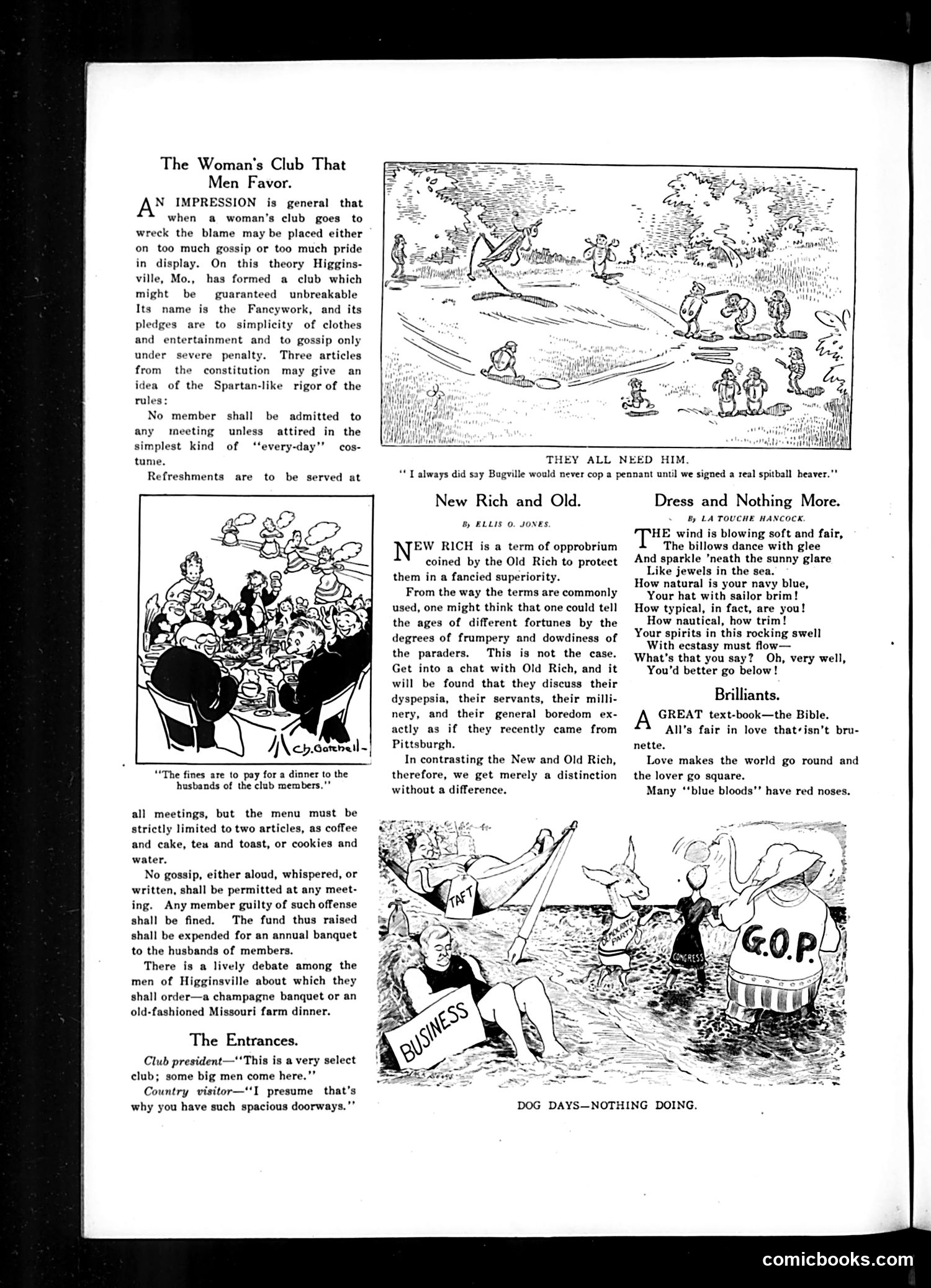
This page contains three distinct satirical pieces from Judge magazine: **"The Woman's Club That Men Favor"** mocks women's clubs by presenting Higginsville, Missouri's "Fancywork Club"—established with strict rules against gossip, fancy dress, and lavish entertaining. The satire targets both women's tendency toward frivolous club culture and the condescension men display toward them. The caption about "spacious doorways" jokes that only "big men" belong, implying members' husbands are physically large. **"New Rich and Old"** satirizes the snobbery of established wealth toward newly rich industrialists (likely from Pittsburgh, then a manufacturing hub). The piece argues both groups are equally boring and self-absorbed, rendering the distinction meaningless. **"Dress and Nothing More"** is a poem mocking women who adopt nautical fashion without understanding actual sailing, collapsing when seasick. **"Dog Days—Nothing Doing"** shows "Business" and the "G.O.P." (Republican Party) lounging lazily, suggesting political/economic stagnation during summer months.
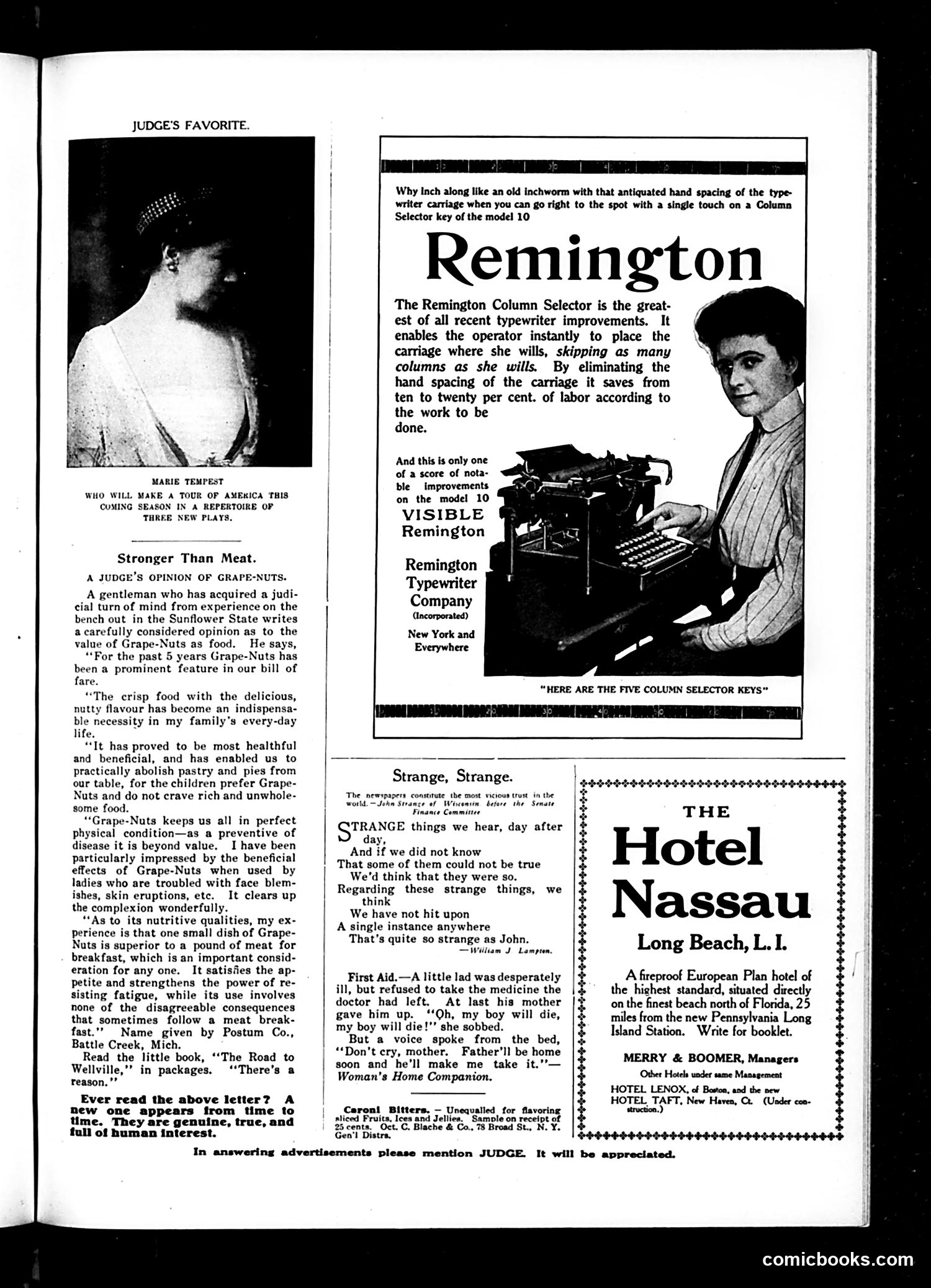
This page mixes celebrity promotion with advertising disguised as editorial content—typical of early 1900s magazines. **Left side:** Features Marie Tempest, an actress preparing an American tour. The accompanying text "Stronger Than Meat" is actually a Grape-Nuts cereal advertisement disguised as a judge's testimonial. This was common practice: the magazine published what appeared to be genuine letters praising products' health benefits (here, claiming Grape-Nuts cured skin blemishes and replaced meat). Modern readers would recognize this as deceptive marketing. **Right side:** A Remington typewriter advertisement showing a woman operator, emphasizing the "Column Selector" feature as labor-saving technology. **Bottom:** A humorous poem titled "Strange, Strange" and brief comic anecdotes, plus hotel and food product advertisements. The page reflects an era when advertising and editorial content blurred significantly, and when health claims for food products faced minimal regulation.
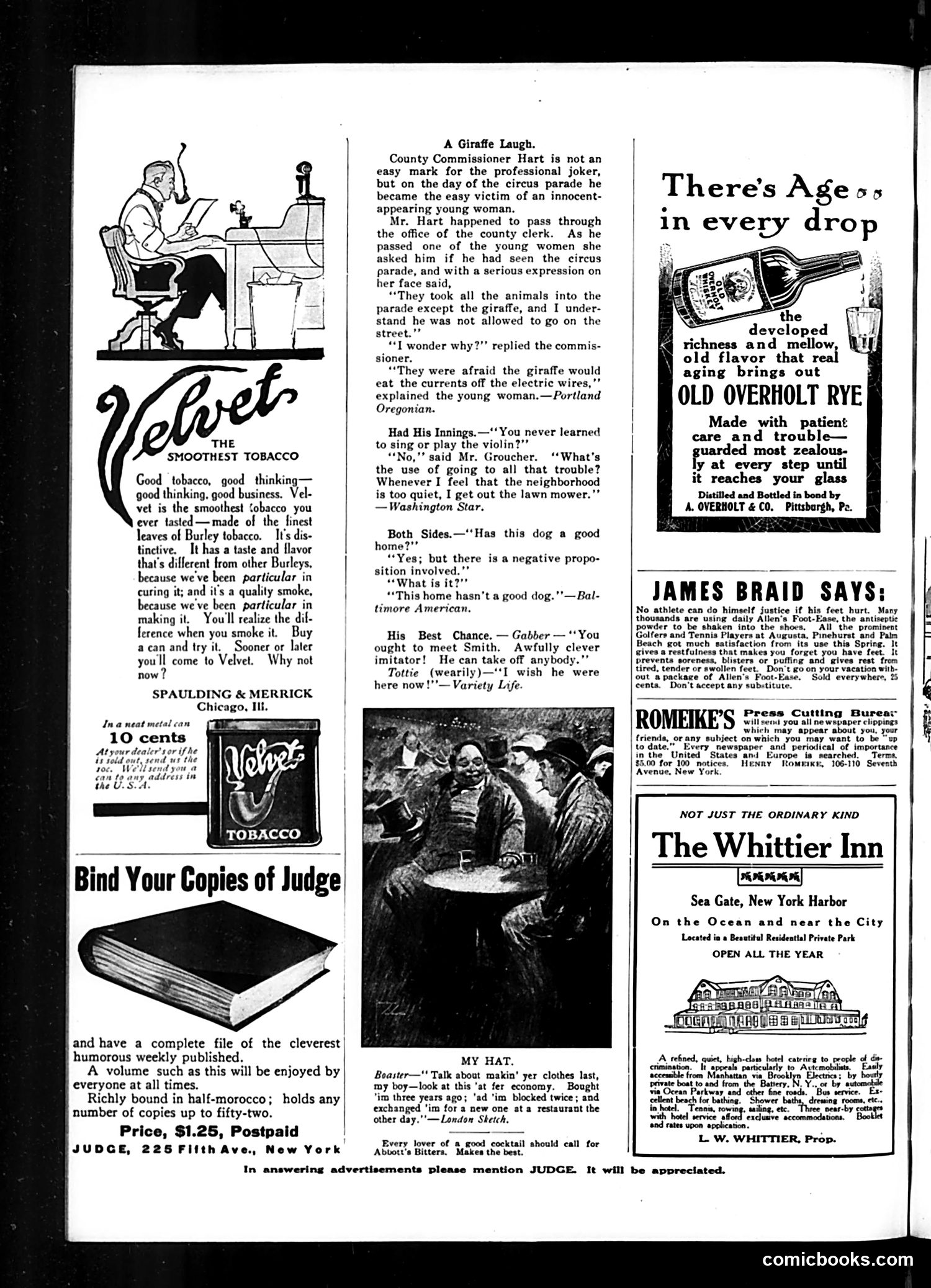
This page is primarily **advertising with brief humorous anecdotes**, typical of Judge's format. The main cartoon (top left) shows a man at a desk smoking, advertising **Velvet tobacco** — positioning it as the "smoothest" product for discerning consumers who value quality. The page includes several short jokes: - "A Giraffe Laugh": A woman tricks County Commissioner Hart by claiming giraffes were excluded from a circus parade because they'd eat electric wire insulators—a absurd premise he falls for. - Other brief quips about dogs, violin lessons, and a boasting man's hat. The **advertisements** dominate the page, selling tobacco, rye whiskey (Old Overholt), foot powder (Allen's Foot-Ease), bitters, and binding services for Judge magazines. A photograph labeled "MY HAT" shows men in period dress, accompanying a joke about a man exchanging his hat at a restaurant. The content reflects early 20th-century consumer culture and Judge's formula of light satire mixed with advertising revenue. The humor relies on obvious wordplay and everyday situations rather than political commentary.
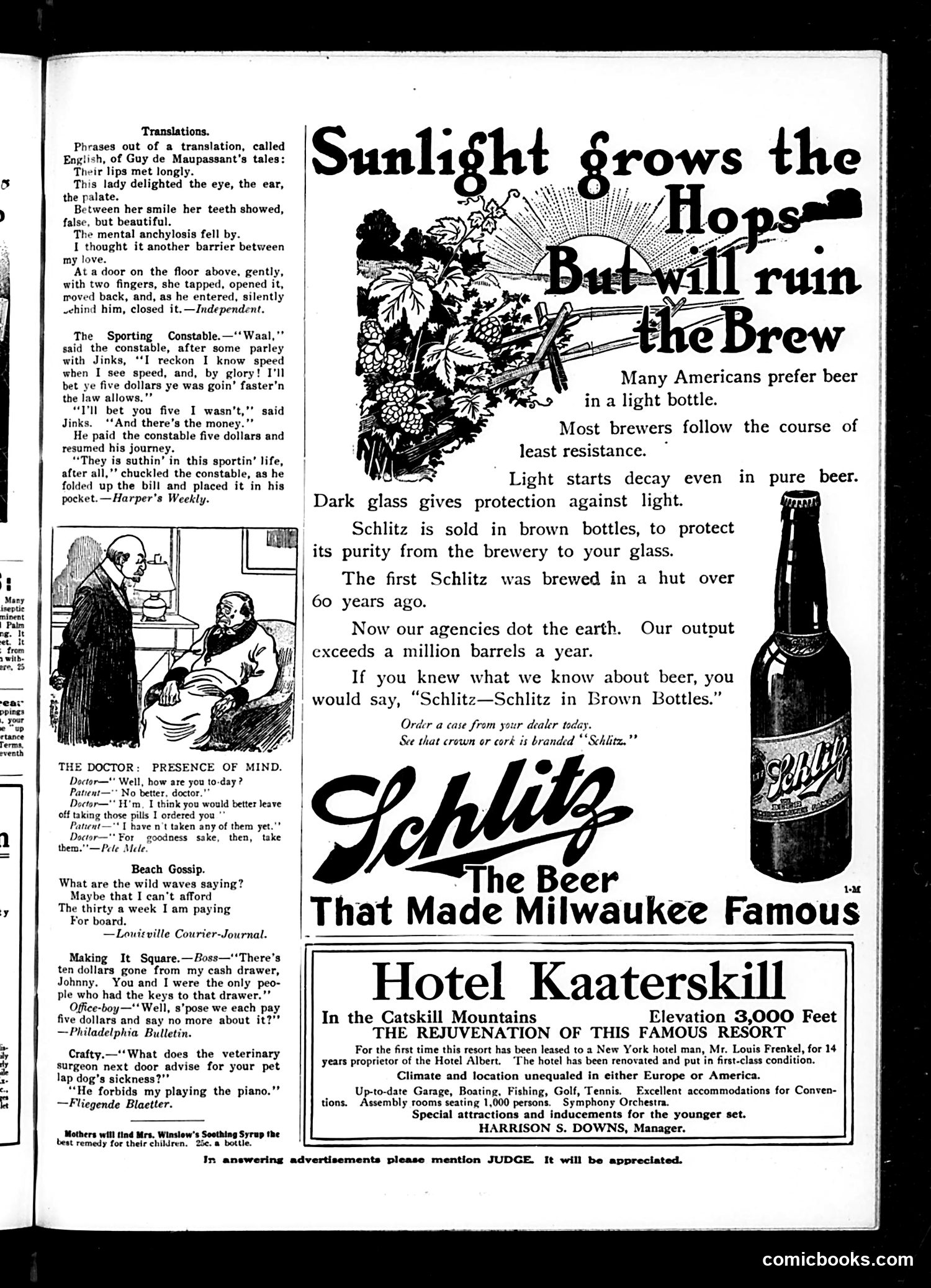
This page contains mostly **short humor pieces and advertisements** rather than political cartoons. The humor items are light social satire: - **"Translations"** mocks awkward English translations of French author Guy de Maupassant, poking fun at pretentious literary culture - **"The Sporting Constable"** satirizes a corrupt small-town police officer who accepts a bribe disguised as a bet - **"The Doctor"** jokes about a physician's illogical advice - Other brief pieces mock everyday absurdities (beach economics, office theft rationalization, pet care) The **dominant content is advertising**: A large Schlitz beer advertisement emphasizes that brown bottles protect beer from light damage, and promotes their "million barrels a year" output as proof of superiority. Below that is a resort advertisement for Hotel Kaaterskill in the Catskill Mountains. The page reflects early 20th-century American humor—genteel, focused on minor social pretensions and everyday ironies rather than sharp political commentary. The advertisements suggest this was a magazine read by middle-class Americans.
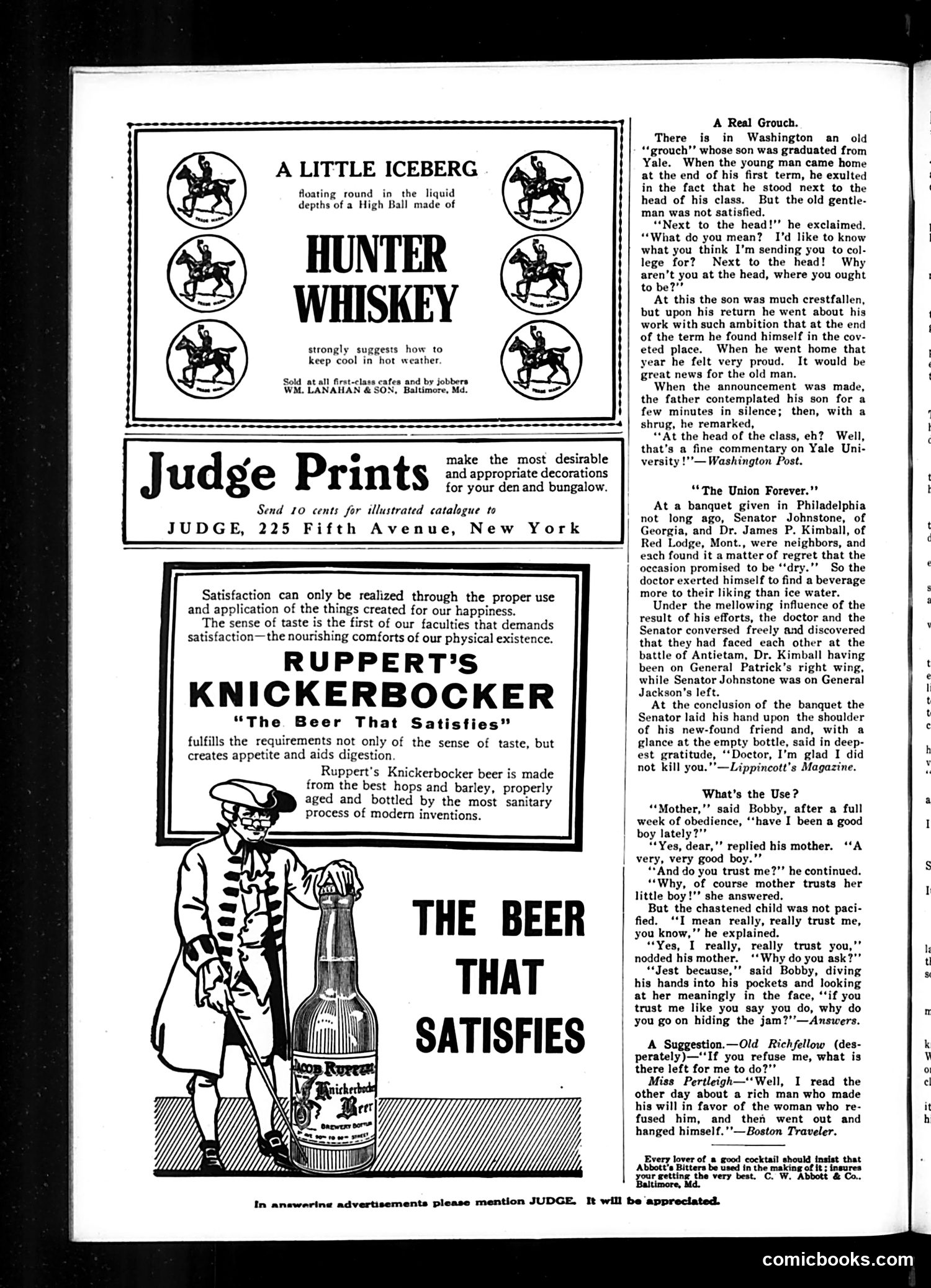
This is primarily an **advertising page** from Judge magazine, featuring liquor and beer ads alongside humorous editorial content. **The advertisements** promote Hunter Whiskey, Judge Prints, and Ruppert's Knickerbocker Beer using appeals to taste, sophistication, and digestion—typical early 20th-century marketing. **The editorial humor pieces** include: 1. **"A Real Grouch"**: A satirical anecdote about an impossibly demanding Washington father who complains his son graduated second in his Yale class, then complains when the son becomes first—mocking parental perfectionism. 2. **"The Union Forever"**: A nostalgic reconciliation story where a Union doctor (General Patrick's wing) and Confederate Senator (General Jackson's wing) discover they faced each other at Antietam, now bonding over smuggled alcohol at a "dry" banquet—celebrating post-Civil War reunion sentiments. 3. **"What's the Use?"**: A brief joke about a child manipulating parental trust to access jam, reflecting period attitudes about childhood innocence and parental discipline. These pieces reflect Judge's satirical commentary on American society, politics, and family life circa early 1900s.
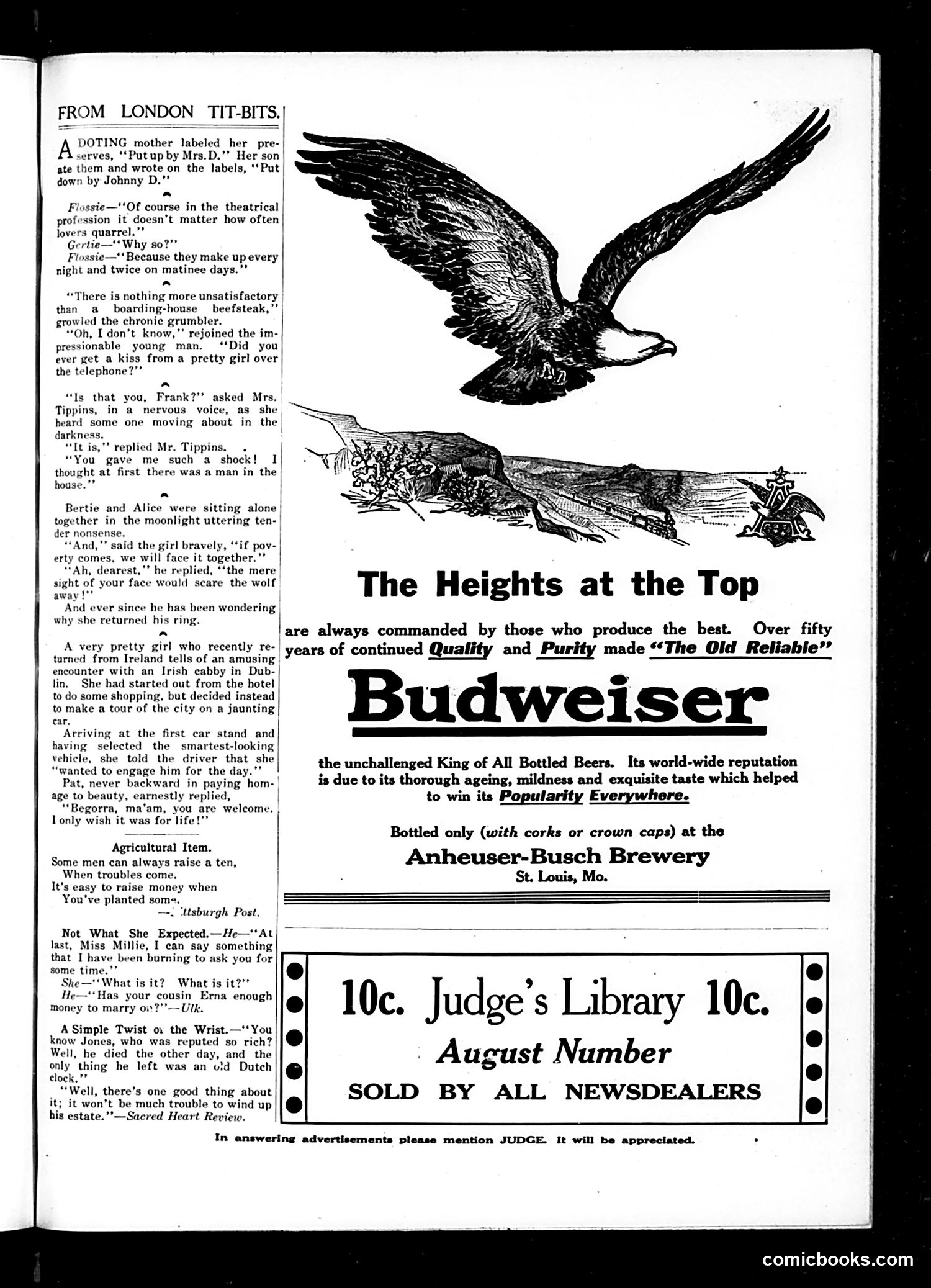
This page consists primarily of **short humorous anecdotes** reprinted from a British source, not original political cartoons. The jokes follow common early-20th-century comedy formats: **Notable jokes include:** - Wordplay on "put up/put down" (preserves vs. a child's mischief) - Theatre profession romance jokes (actors reconciling nightly) - Boarding house complaints and romantic telephone mishaps - A woman mistaking her husband's return for an intruder, implying she expected infidelity - Poverty romance clichés (lovers facing hardship together) **The satire targets:** - Domestic life and marriage anxieties - Class differences (boarding houses, wealth) - Gender relations and courtship conventions - Romantic melodrama The page is **primarily advertising**—featuring a substantial Budweiser beer advertisement and a Judge's Library promotion. The humor is genteel, non-political, and aimed at middle-class readers. There are **no identifiable political figures or specific contemporary references** visible.
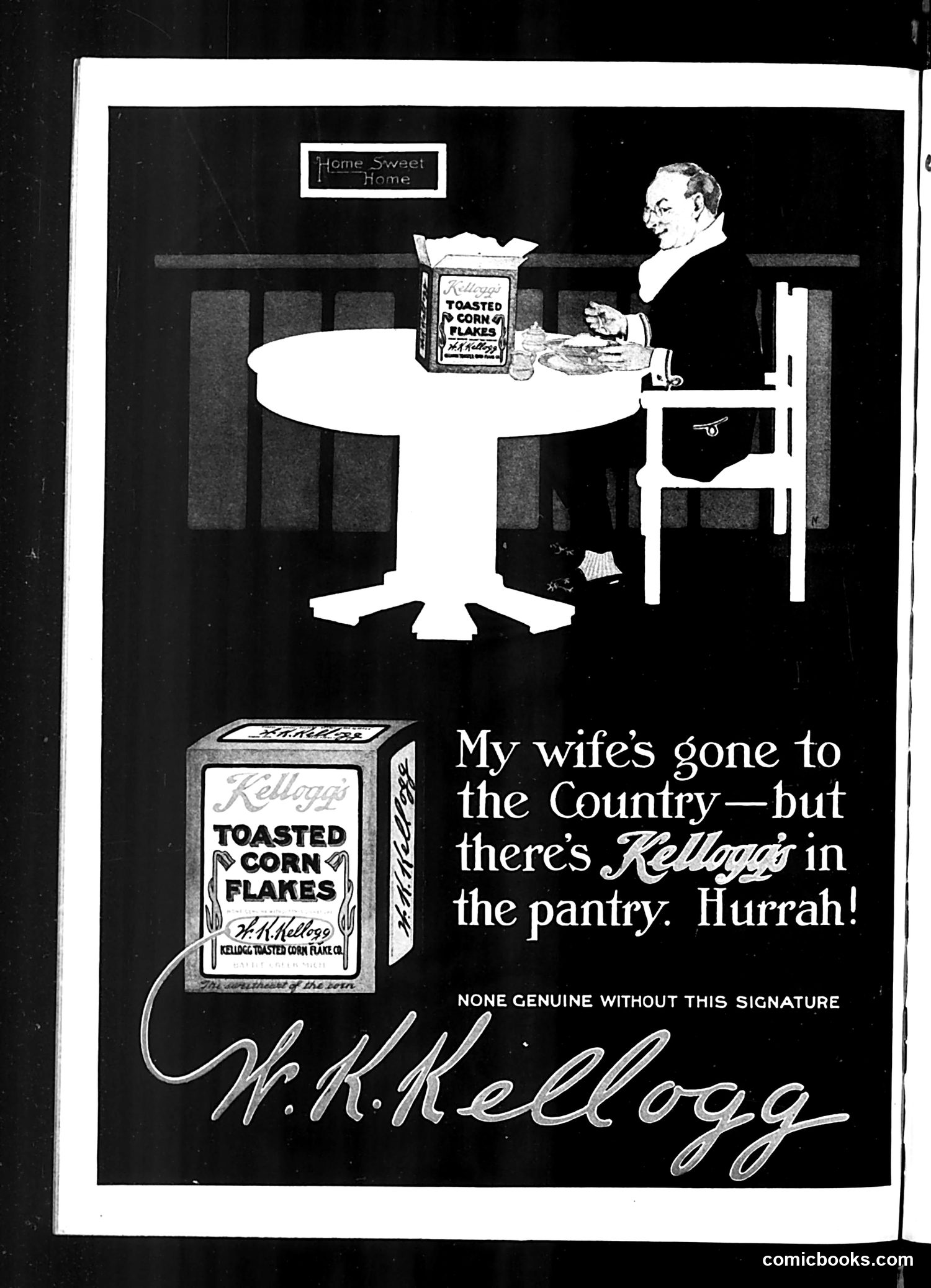
This is a **Kellogg's Toasted Corn Flakes advertisement**, not political satire. The ad depicts a man cheerfully eating cereal at home while his wife is away visiting the country. The joke is that he's happy about her absence because he has convenient, ready-to-eat cereal in the pantry—implying he'd otherwise need her cooking. The humor relies on early 20th-century gender stereotypes: wives handle domestic cooking; husbands are helpless without them. The ad positions Kellogg's as solving the "problem" of a wife's absence by providing an easy breakfast alternative. W.K. Kellogg's signature authenticates the product. The "Home Sweet Home" sign reinforces domestic coziness despite the wife's absence.