
Judge, 1911-08-12 · page 16 of 24
Judge — August 12, 1911 — page 16: what you’re looking at
What you’re looking at
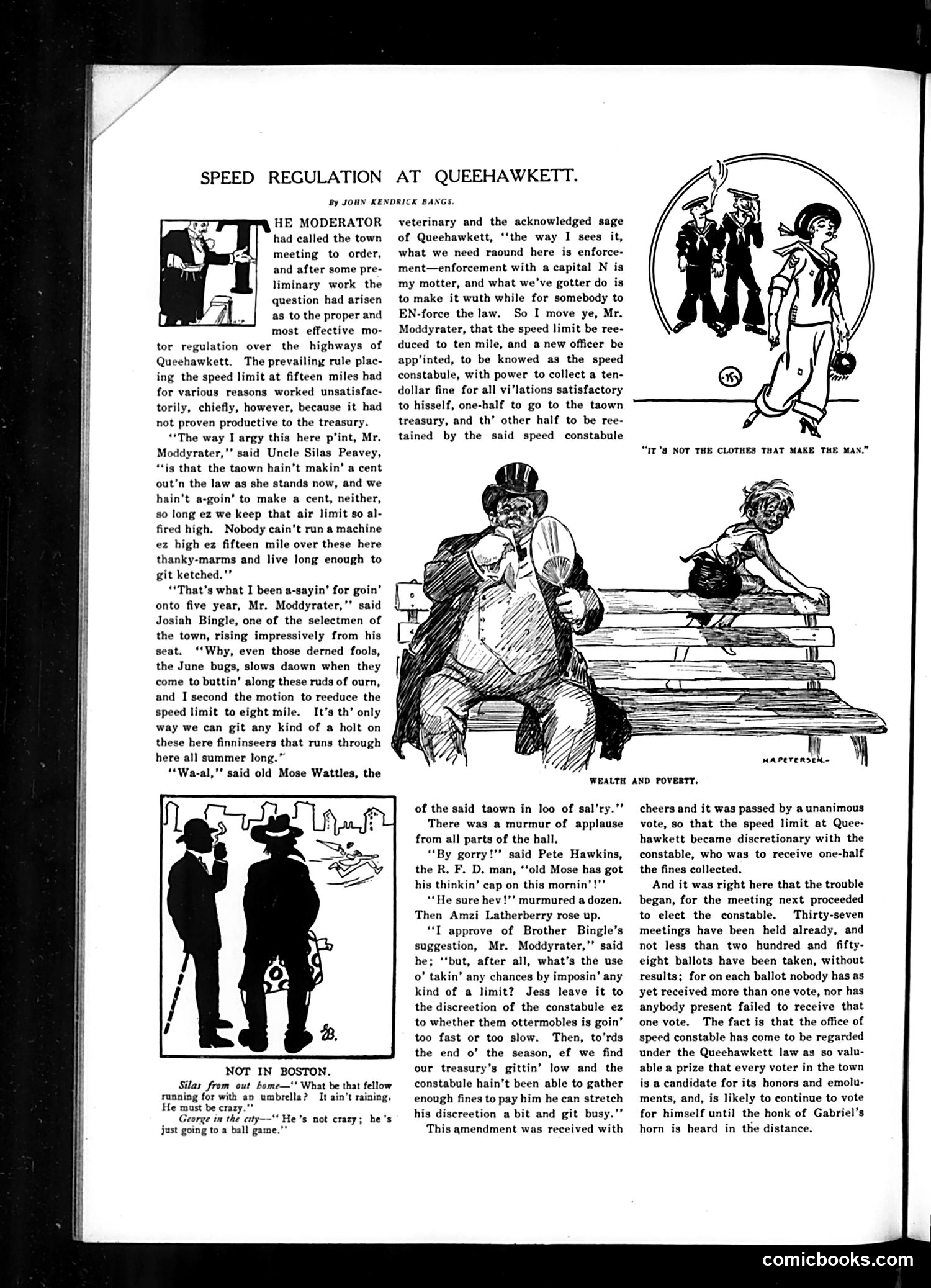
This is a satirical story by John Kendrick Bangs about a small-town New England meeting debating automobile speed limits. The humor targets municipal corruption and self-interest disguised as civic duty. The plot: A town sets a 15-mph speed limit but collects no fines, so it's ineffective. Various rustic characters propose reducing the limit to 8-10 mph and creating a "speed constable" position—one who keeps half the fines collected as salary rather than receiving wages. The satire: The townspeople gradually reveal the scheme's true purpose: not safety, but creating a profitable position for someone. The final joke—that 37 meetings and 258 ballots have failed to elect a constable because every voter wants the lucrative job for themselves—exposes how small-town graft operates: corruption masquerading as regulation, with everyone complicit. The dialect-heavy rural characters emphasize that such schemes were supposedly characteristic of rustic American towns.
📄 Transcribed text from this page (OCR, searchable)
Machine-transcribed from the original scan — historical spelling and the odd misread are preserved.
SPEED REGULATION AT QUEEHAWKETT. By JOHN KENDRICK BANGS. HE MODERATOR had called the town meeting to order, and after some pre- liminary work the question had arisen as to the proper and most effective mo- tor regulation over the highways of Queehawkett. The prevailing rule plac- ing the speed limit at fifteen miles had for various reasons worked unsatisfac- torily, chiefly, however, because it had not proven productive to the treasury. “The way I argy this here p’int, Mr. Moddyrater,”’ said Uncle Silas Peavey, “tis that the taown hain’t makin’ a cent out’n the law as she stands now, and we hain’t a-goin’ to make a cent, neither, so long ez we keep that air limit so al- fired high. Nobody cain’t run a machine ez high ez fifteen mile over these here thanky-marms and live long enough to git ketched.’” “That's what I been a-sayin’ for goin’ onto five year, Mr. Moddyrater,’’ said Josiah Bingle, one of the selectmen of the town, rising impressively from his seat. ‘‘Why, even those derned fools, the June bugs, slows daown when they come to buttin’ along these ruds of ourn, and I second the motion to reeduce the speed limit to eight mile. It’s th’ only way we can git any kind of a holt on these here finninseers that runs through here all summer long.” “‘Wa-al,’’ said old Mose Wattles, the NOT IN BOSTON. Silas from out bome—'' What be that fellow running for with an umbrella? It ain't raining. He must be crazy." George in the cty--"' He's not crazy; he's just going to a ball game." veterinary and the acknowledged sage of Queehawkett, ‘‘the way I sees what we need raound here is enforce- ment—enforcement with a capital N is my motter, and what we've gotter do is to make it wuth while for somebody to EN-force the law. So I move ye, Mr. Moddyrater, that the speed limit be ree- duced to ten mile, and a new officer be app’inted, to be knowed as the speed constabule, with power to collect a ten- dollar fine for all vi'lations satisfactory to hisself, one-half to go to the taown treasury, and th’ other half to be ree- tained by the said speed constabule HA rant. WEALTH AND POVERTY. of the said taown in loo of sal’ry.’’ There was a murmur of applause from all parts of the hall. “By gorry!’’ said Pete Hawkins, the R. F. D. man, ‘‘old Mose has got his thinkin’ cap on this mornin’!"’ **He sure hev!’’ murmured a dozen. Then Amzi Latherberry rose up. “I approve of Brother Bingle’s suggestion, Mr. Moddyrater,”’ said he; ‘‘but, after all, what’s the use o’ takin’ any chances by imposin’ any kind of a limit? Jess leave it to the discreetion of the constabule ez to whether them ottermobles is goin’ too fast or too slow. Then, to’rds the end o’ the season, ef we find our treasury’s gittin’ low and the constabule hain’t been able to gather enough fines to pay him he can stretch his discreetion a bit and git busy.’’ This amendment was received with cheers and it was passed by a unanimous vote, so that the speed limit at Quee- hawkett became discretionary with the constable, who was to receive one-half the fines collected. And it was right here that the trouble began, for the meeting next proceeded to elect the constable. Thirty-seven meetings have been held already, and not less than two hundred and fifty- eight ballots have been taken, without results; for on each ballot nobody has as yet received more than one vote, nor has anybody present failed to receive that one vote. The fact is that the office of speed constable has come to be regarded under the Queehawkett law as so valu- able a prize that every voter in the town is a candidate for its honors and emolu- ments, and, is likely to continue to vote for himself until the honk of Gabriel’s horn is heard in the distance. comicbooks.com