
Judge, 1911-08-12 · page 17 of 24
Judge — August 12, 1911 — page 17: what you’re looking at
What you’re looking at
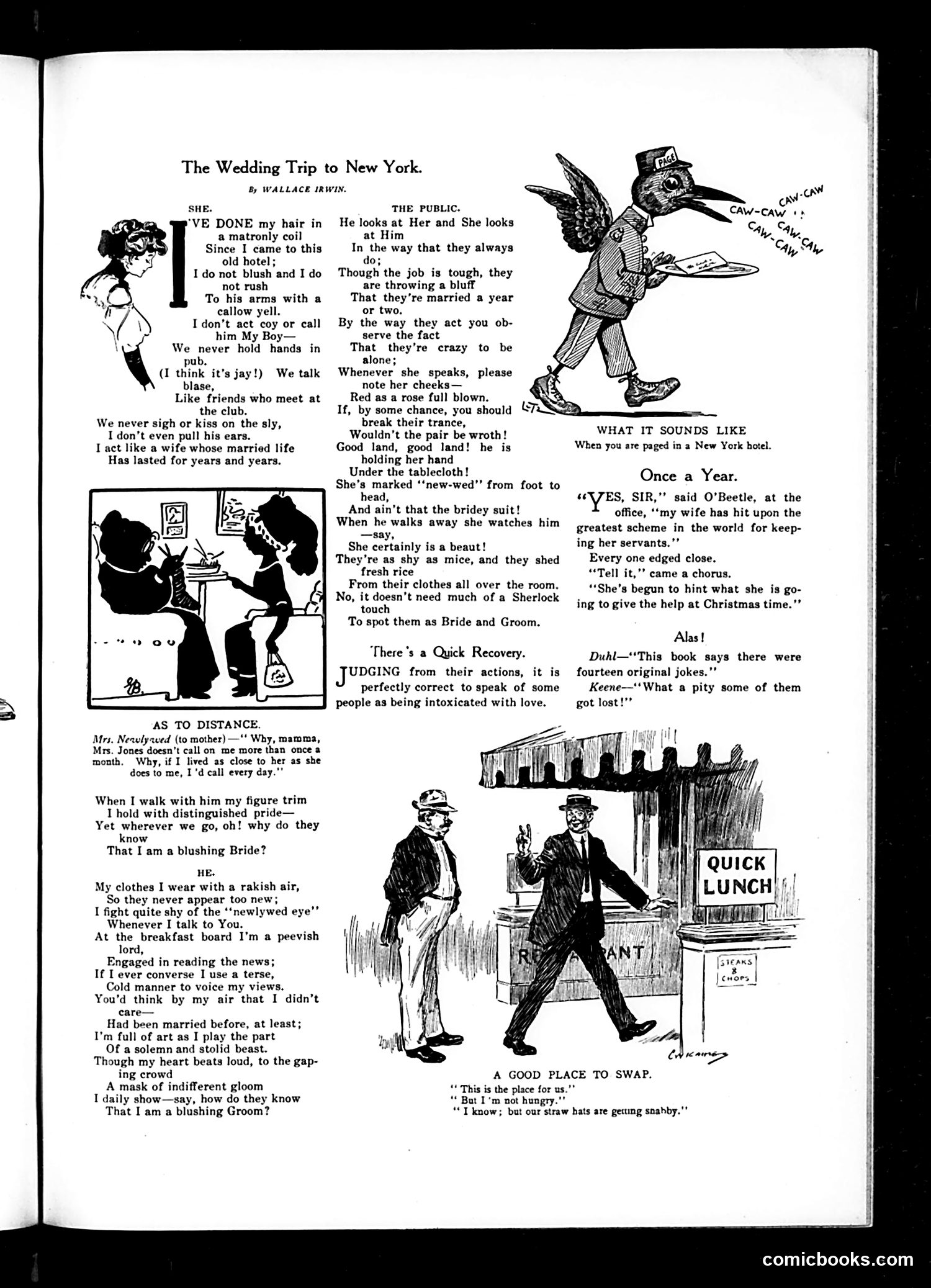
This page satirizes newlyweds' futile attempts to appear sophisticated and seasoned in public. The main piece contrasts three perspectives: the bride and groom each claim they're acting *blasé and indifferent* to disguise their newlywed status (no hand-holding, cold demeanor, reading newspapers). Yet "The Public" section reveals they're completely transparent—their blushing cheeks, hidden hand-holding under tablecloths, and scattered rice give them away instantly. The satire targets the social pretense of young married couples trying to seem worldly and experienced rather than naive and infatuated. Contemporary readers would recognize the universal awkwardness: newlyweds' self-consciousness about appearing too affectionate in public, contrasted with their obvious inability to hide their excitement. Additional vignettes mock honeymoon-related observations: servants' gift-giving schemes and couples visiting modest lunch counters while dressed in straw hats (casual wear).
📄 Transcribed text from this page (OCR, searchable)
Machine-transcribed from the original scan — historical spelling and the odd misread are preserved.
The Wedding Trip to New York. By WALLACE IRWIN. SHE. "VE DONE my hair in a matronly coil Since I came to this old hotel ; I do not blush and I do not rush To his arms with a callow yell. I don’t act coy or call him My Boy— We never hold hands in pub. (I think it's jay!) blase, Like friends who meet at the club. We never sigh or kiss on the sly, I don’t even pull his ears. I act like a wife whose married life Has lasted for years and years. We talk AS TO DISTANCE. Mrs, Neawlyqwed (to mother) —'' Why, mamma, Mrs. Jones doesn't call on me more than once a month. Why, if I lived as close to her as she does to me, I'd call every day."’ When I walk with him my figure trim I hold with distinguished pride— Yet wherever we go, oh! why do they know That I am a blushing Bride? HE. My clothes I wear with a rakish air, So they never appear too new; I fight quite shy of the ‘newlywed eye’’ Whenever I talk to You. At the breakfast board I’m a peevish lord, Engaged in reading the news; If L ever converse I use a terse, Cold manner to voice my views. You’d think by my air that I didn’t care— Had been married before, at least; I'm full of art as I play the part Of a solemn and stolid beast. Though my heart beats loud, to the gap- ing crowd A mask of indifferent gloom I daily show—say, how do they know That I am a blushing Groom? THE PUBLIC. He looks at Her and She looks at Him In the way that they always do; Though the job is tough, they are throwing a bluff That they’re married a year or two. By the way they act you ob- serve the fact That they’re crazy to be alone; Whenever she speaks, please note her cheeks— Red as a rose full blown. If, by some chance, you should break their trance, Wouldn’t the pair be wroth! Good land, good land! he is holding her hand Under the tablecloth! She’s marked ‘‘new-wed’’ from foot to head, And ain’t that the bridey suit! When he walks away she watches him —say, She certainly is a beaut! They’re as shy as mice, and they shed fresh rice From their clothes all over the room. No, it doesn’t need much of a Sherlock touch To spot them as Bride and Groom. There's a Quick Recovery. UDGING from their actions, it is perfectly correct to speak of some people as being intoxicated with love. WHAT IT SOUNDS LIKE When you are paged in a New York hotel. Once a Year. «VES, SIR," said O’Beetle, at the office, ‘‘my wife has hit upon the greatest scheme in the world for keep- ing her servants.’’ Every one edged close, “Tell it,’’ came a chorus. “‘She’s begun to hint what she is go- ing to give the help at Christmas time.” Alas! Duhl—'This book says there were fourteen original jokes.’’ Keene—‘‘What a pity some of them got lost!”” [steans Jewors | Mawes A GOOD PLACE TO SWAP. “* This is the place for us.’* “ But I'm not hungry.’ ““T know; but our straw hats are geting snahby."* comicbooks.com