
Judge, 1911-08-12 · page 13 of 24
Judge — August 12, 1911 — page 13: what you’re looking at
What you’re looking at
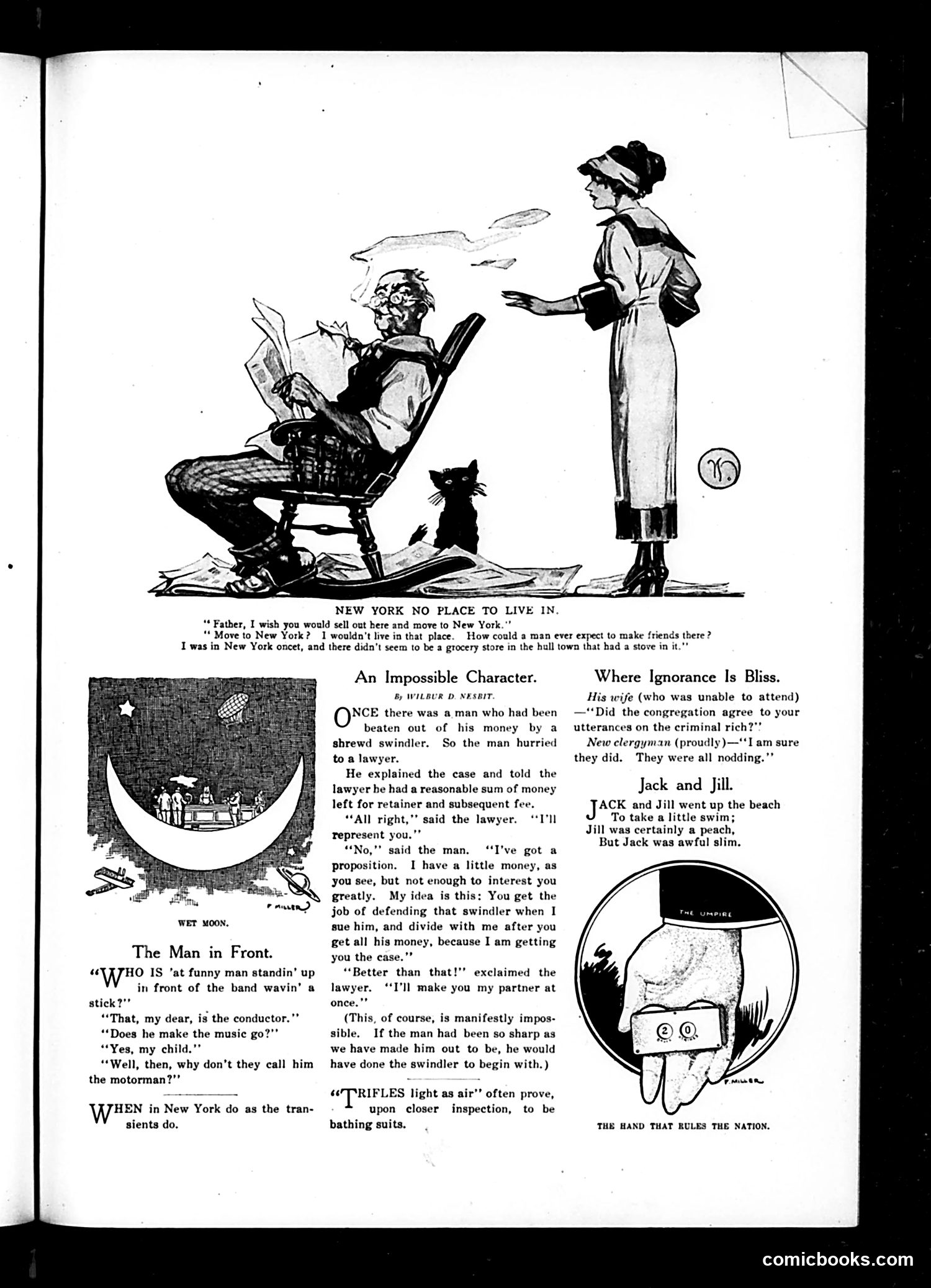
This page contains several satirical pieces targeting early 20th-century American social attitudes and New York City life. The top cartoon mocks rural skepticism about urban living—a country father dismisses New York as unfriendly and lacking basic amenities (grocery stores with stoves), reflecting period anxiety about big-city anonymity versus small-town community. "The Man in Front" makes a simple wordplay joke: a child mistakes the orchestra conductor for a "motorman" (streetcar operator), confusing the stick-waving authority figure with transit workers familiar to urban audiences. "An Impossible Character" satirizes a man attempting to propose an obviously corrupt legal scheme to a lawyer—the satire being that someone clever enough to devise such a con would have already swindled the lawyer directly. Minor pieces include jokes about bathing suits, a clergyman misreading parishioner nodding as agreement, and a "Jack and Jill" poem about beach swimming where one party is unattractive. "The Hand That Rules the Nation" (bottom right) appears to reference political/economic power, though context is unclear from this excerpt alone. The overall tone emphasizes social pretension and urban-versus-rural contrasts.
📄 Transcribed text from this page (OCR, searchable)
Machine-transcribed from the original scan — historical spelling and the odd misread are preserved.
NEW YORK NO PLACE TO LIVE IN. “* Father, I wish you would sell out here and move to New York."’ “* Move to New York? 1 wouldn't live in that place. How could a man ever expect to make friends there ? I was in New York oncet, and there didn't seem to be a grocery store in the hull town that had a stove in it,"’ The Man in Front. “YX 7HO IS ‘at funny man standin’ up in front of the band wavin’ a stick?" “That, my dear, is the conductor.” “*Does he make the music go?"’ “Yes, my child.’" “*Well, then, why don’t they call him the motorman?’’ HEN in New York do as the tran- sients do. An Impossible Character. By WILBUR D. NESBIT. NCE there was a man who had been beaten out of his money by a shrewd swindler. So the man hurried to a lawyer. He explained the case and told the lawyer he had a reasonable sum of money left for retainer and subsequent fee. “All right," said the lawyer. “I'll Tepresent you.’’ “‘No,’’ said the man. ‘‘I've got a proposition. I have a little money, as you see, but not enough to interest you greatly. My idea is this: You get the job of defending that swindler when I sue him, and divide with me after you get all his money, because I am getting you the case.’” “Better than that!’’ exclaimed the lawyer. ‘I'll make you my partner at once."” (This, of course, is manifestly impos- sible. If the man had been so sharp as we have made him out to be, he would have done the swindler to begin with.) «sTDRIFLES light as air’’ often prove, upon closer inspection, to be bathing suits. Where Ignorance Is Bliss. His wife (who was unable to attend) —‘‘Did the congregation agree to your utterances on the criminal rich?"’ New clergyman (proudly)—‘‘I am sure they did. They were all nodding.’’ Jack and Jill. ACK and Jill went up the beach To take a little swim; Jill was certainly a peach, But Jack was awful slim. THE HAND THAT RULES THE NATION. comicbooks.com