
A complete issue · 27 pages · 1911
Judge — August 5, 1911
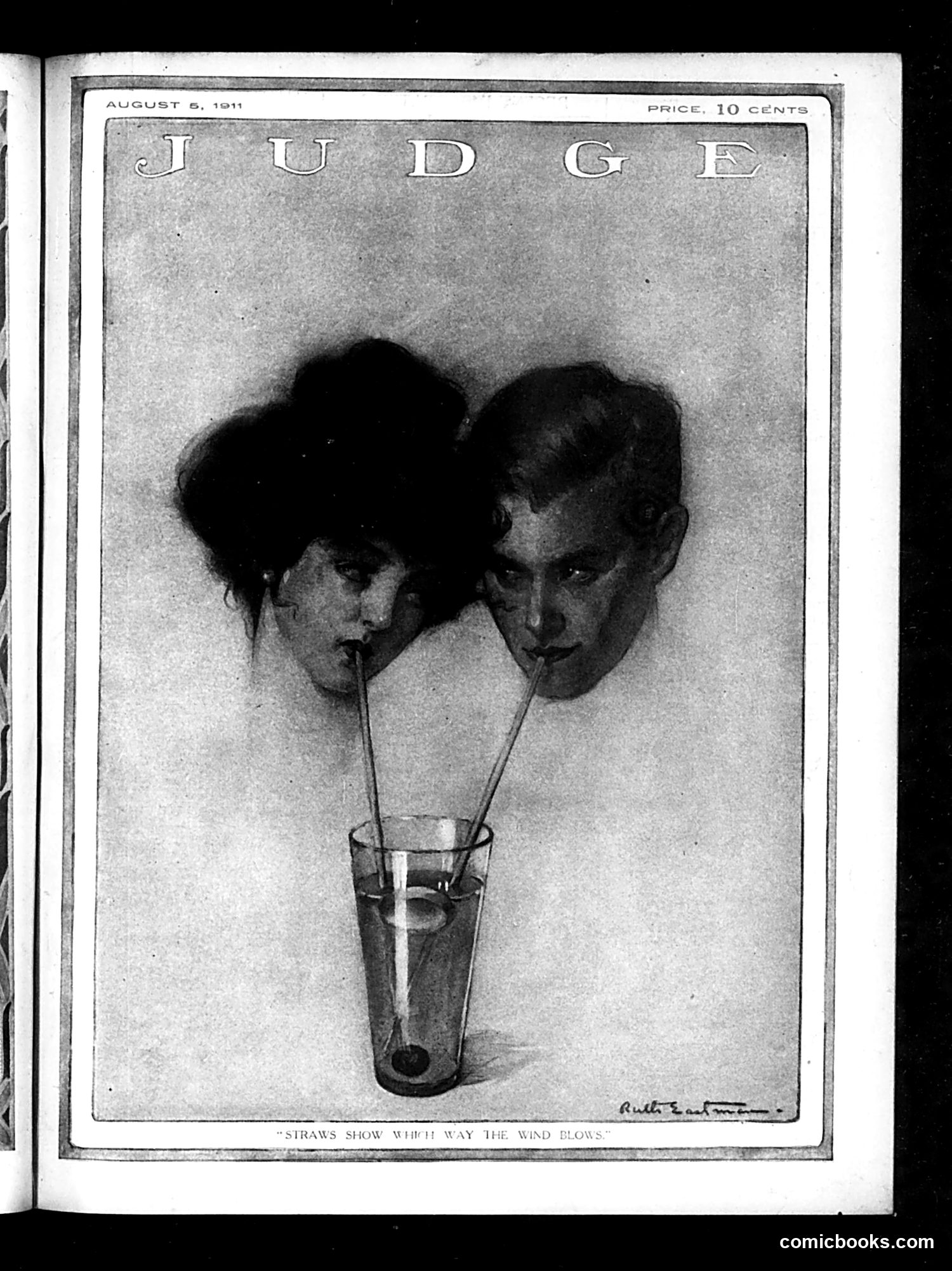
This satirical illustration shows two figures sharing a drinking straw in a glass, captioned "STRAWS SHOW WHICH WAY THE WIND BLOWS." The image appears to be social commentary, likely critiquing intimate or scandalous behavior between two individuals. Without additional context about specific public figures or events from August 1911, the exact targets of the satire are unclear. However, the caption suggests the cartoon exposes hidden truths or reveals character through seemingly innocent actions—a common Judge magazine approach. The intimate positioning and shared straw imply impropriety or secret relationships being made visible. The image quality and artistic style (signed by what appears to be "Ault" or similar) is typical of Judge's editorial cartoons from this era.
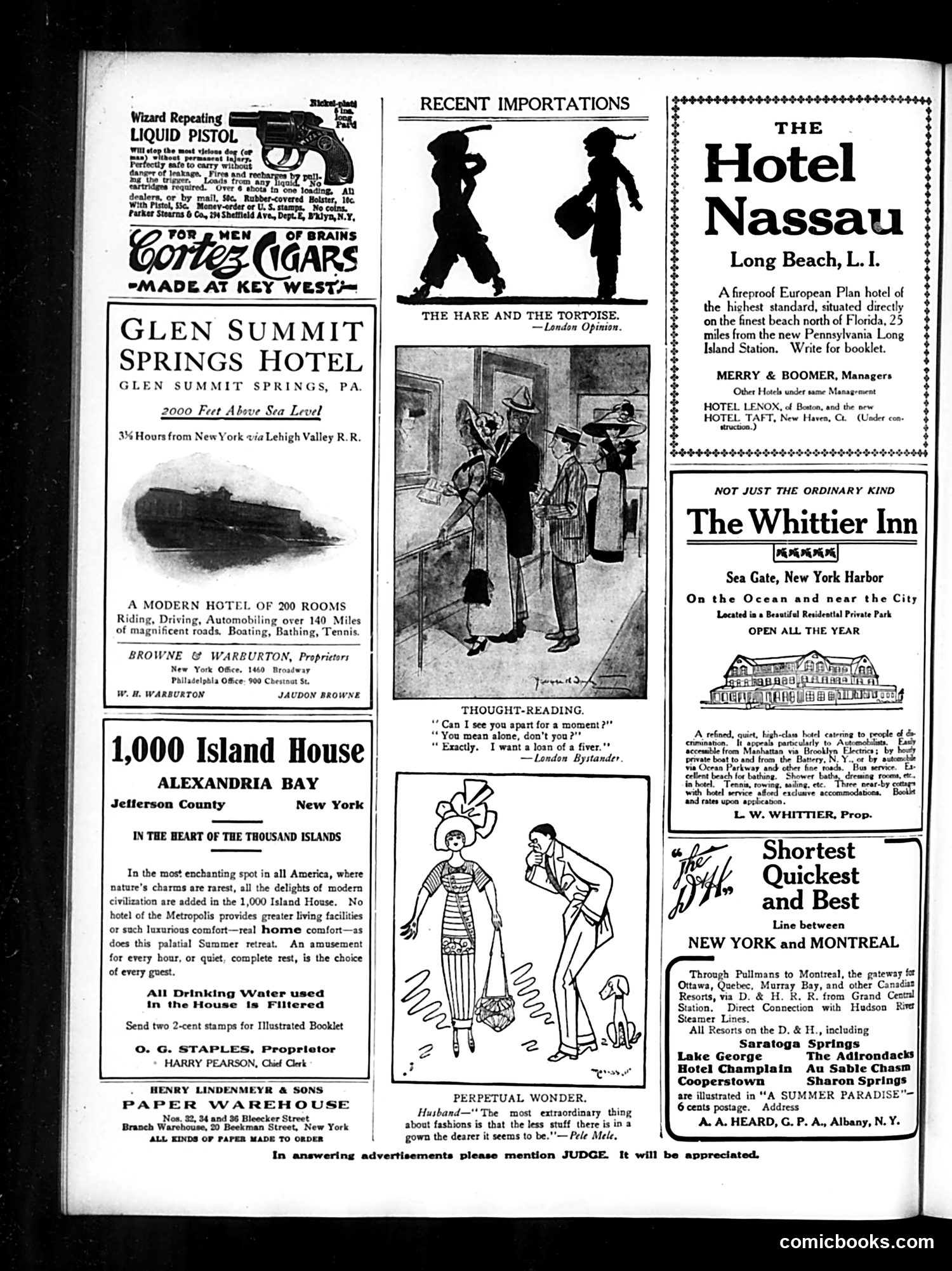
This page is primarily **advertising**, featuring hotels and travel services from the early 20th century (Glen Summit Springs Hotel, 1,000 Island House, Hotel Nassau, the Whittier Inn, and steamship lines). The two cartoons are humorous social commentary: 1. **"The Hare and the Tortoise"** silhouette depicts the classic Aesop's fable—likely satirizing speed versus patience, possibly referencing contemporary debates about modern fast-paced life. 2. **"Thought-Reading"** shows a woman alone asking "You mean alone, don't you?" The joke suggests mind-reading reveals social anxieties or unspoken thoughts about companionship—typical early-20th-century humor about romance and gender dynamics. 3. **"Perpetual Wonder"** quips that fashion's most extraordinary aspect is how less staff in department stores somehow manage adequately—satirizing retail labor practices or fashion industry inefficiency.
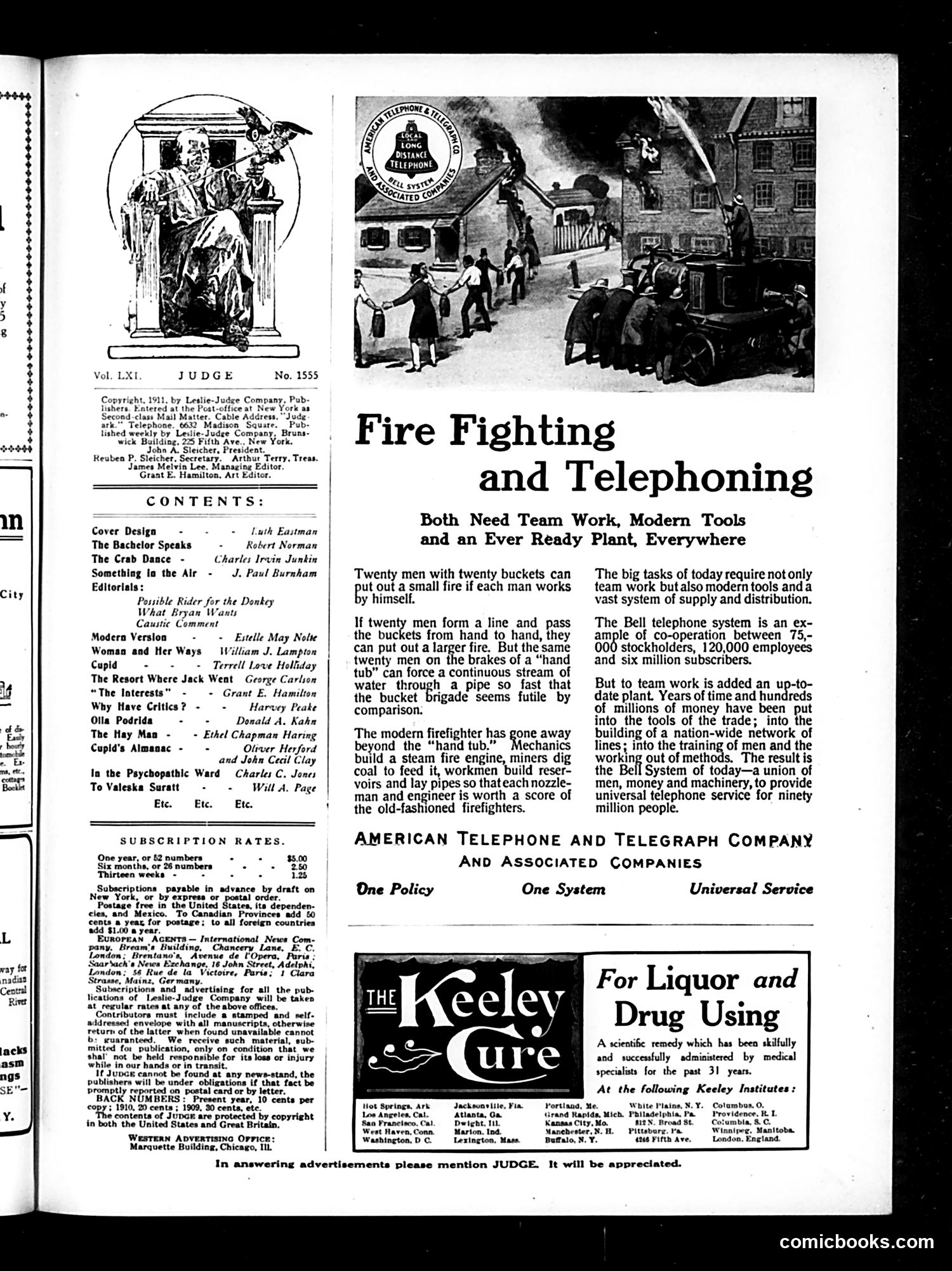
This page is primarily **advertising and editorial contents**, not satire. The left side shows the magazine's masthead and table of contents for Vol. LXI, No. 1555 (1903, per copyright notice). The main content is an **article on "Fire Fighting and Telephoning"** with an accompanying photograph. The piece argues both professions require "team work, modern tools and an ever ready plant." It contrasts outdated bucket-brigade methods with modern steam-powered fire engines and the telephone system's coordination capabilities. Below are advertisements for "The Keeley Cure" (an alcohol/drug treatment) and other products. There is **no political cartoon visible** on this page—it's a standard magazine spread combining editorial content with period advertising.
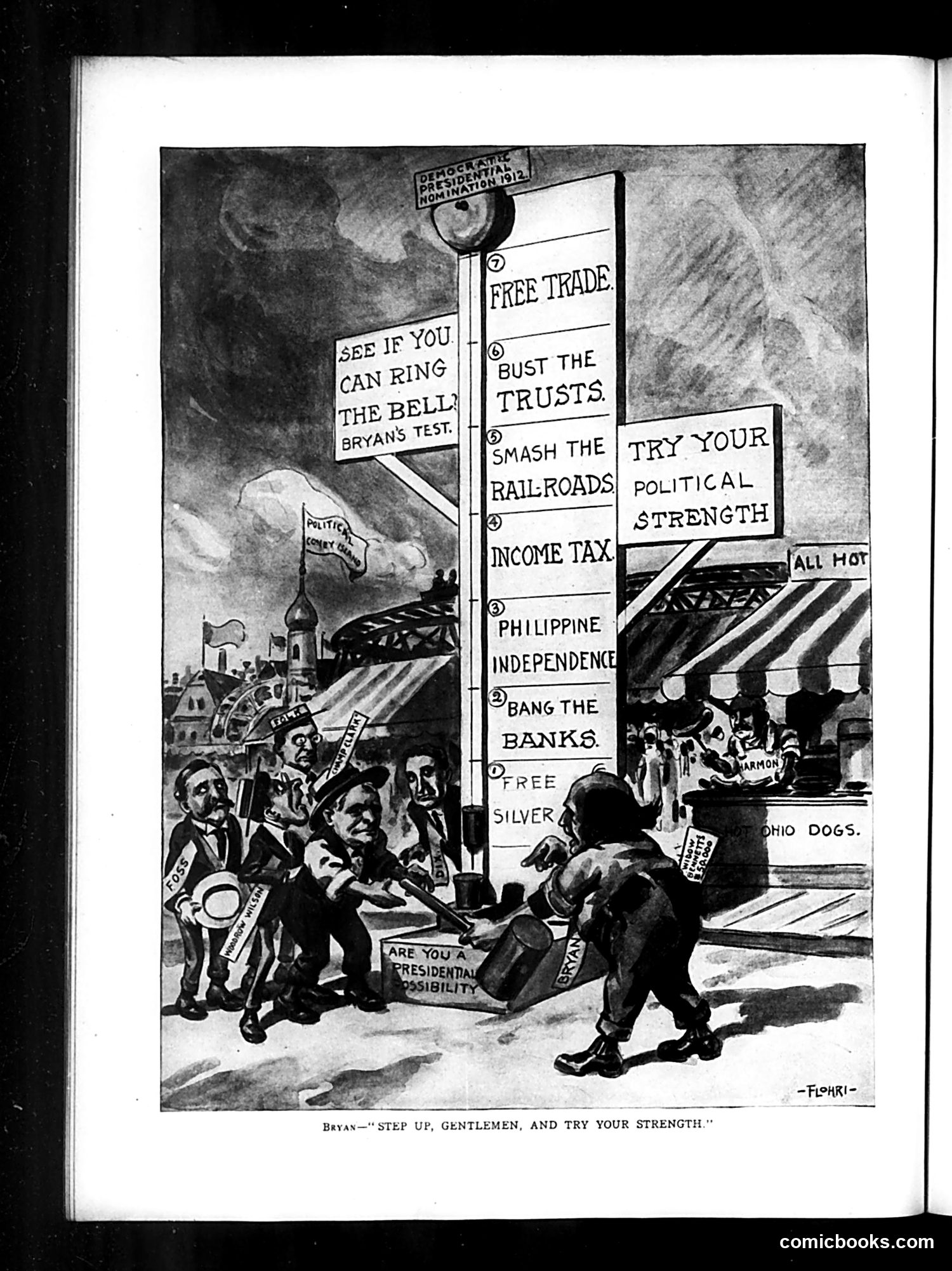
This cartoon satirizes William Jennings Bryan's 1912 presidential campaign. The "strength tester" machine references Bryan's famous "Cross of Gold" speech and his populist political positions. The numbered list of challenges—free trade, busting trusts, smashing railroads, income tax, Philippine independence, banking reform, and free silver—represents Bryan's core campaign promises. The crowd of working-class men being invited to "try your strength" mocks Bryan's rhetoric as a carnival-like spectacle. The illustration suggests these ambitious political goals are unrealistic, comparing them to an amusement park game. The figure running the booth and the onlookers represent the public's skepticism toward Bryan's radical reform agenda during the 1912 election.
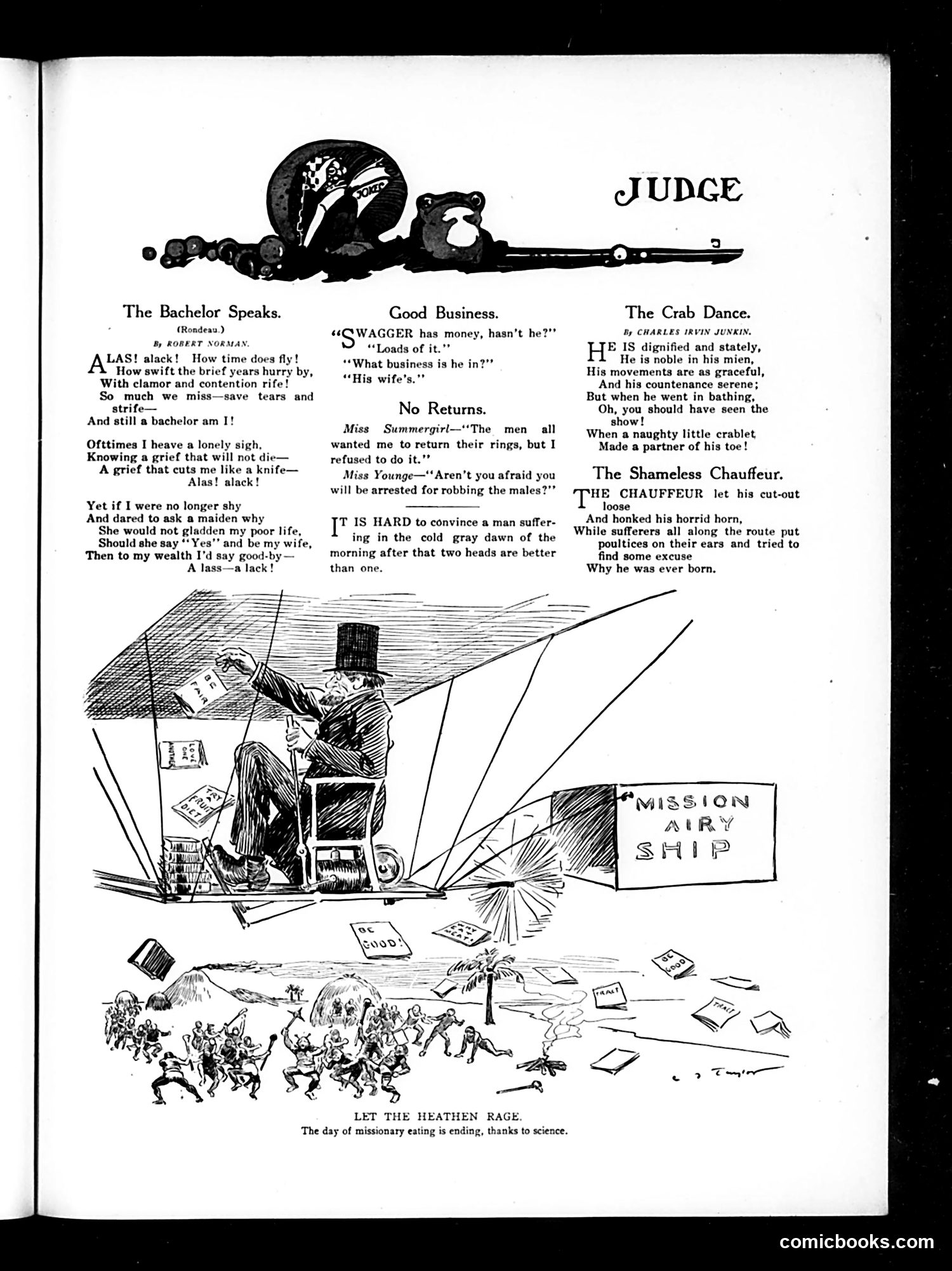
This page contains several satirical poems and a cartoon. "The Bachelor Speaks" mocks unmarried men's nostalgia. "Good Business" jokes about a man's wife's jewelry business. "The Crab Dance" humorously describes a dignified man's awkward dancing. The main cartoon depicts a "Mission Airy Ship" — likely satirizing missionary work or colonial ventures. A man sits above indigenous peoples, surrounded by papers and supplies, presumably "civilizing" or converting them. The caption "Let the Heathen Rage: The day of missionary eating is ending, thanks to science" suggests skepticism toward missionary efforts, implying that modern science renders such missions obsolete or ineffective. "The Shameless Chauffeur" satirizes an impertinent car driver. The overall tone is irreverent toward social institutions and progress claims.
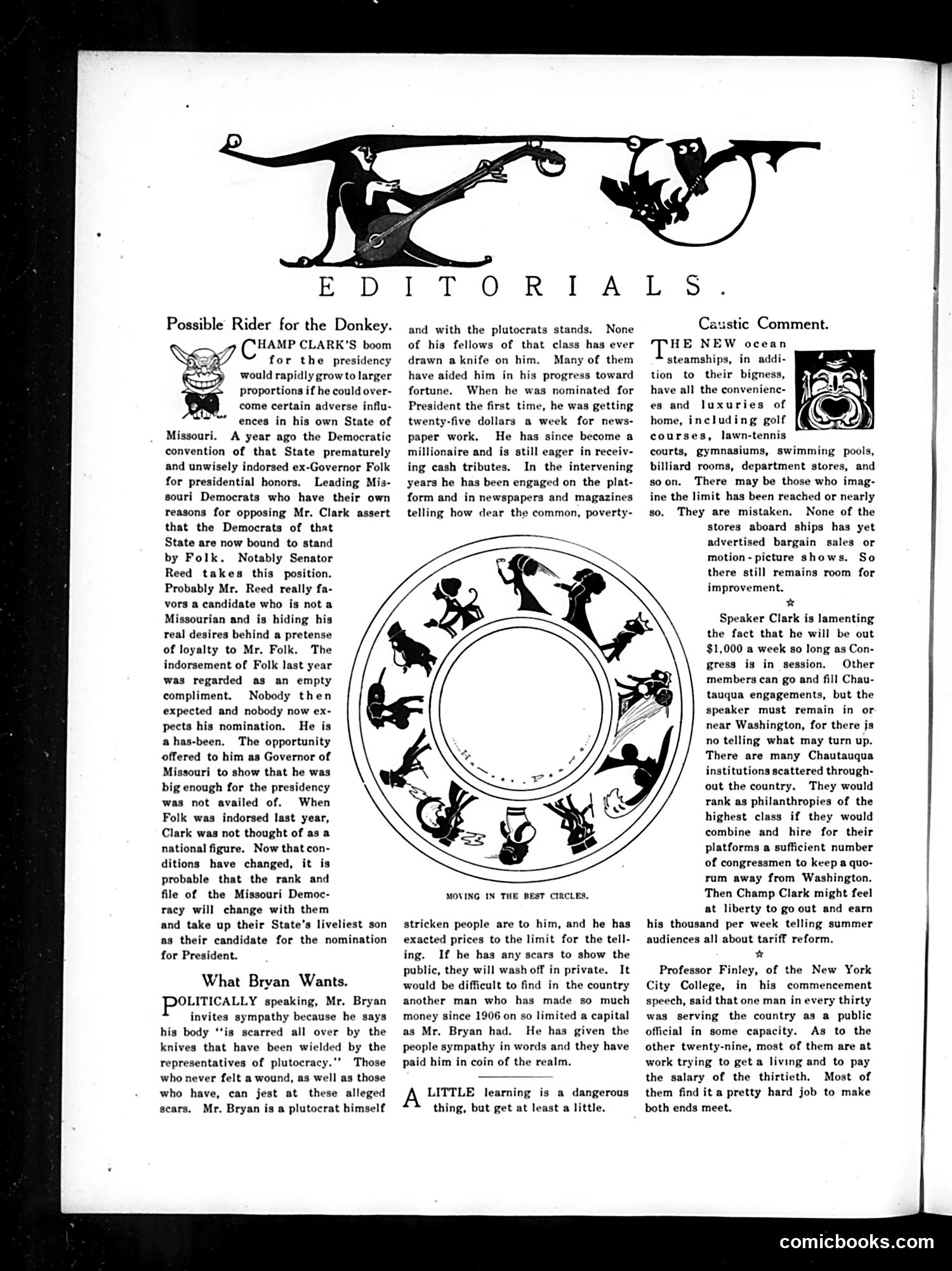
This page lampoons several 1910s Democratic figures and William Bryan's political hypocrisy. **Main targets:** - **Champ Clark** (Missouri politician): Editorial questions whether he can overcome factional opposition to secure the presidential nomination, noting ex-Governor Folk's prior endorsement complicates matters. - **William Jennings Bryan**: The central satire claims Bryan poses as a champion of "common, poverty-stricken people" while actually being a self-made millionaire who profits handsomely from lectures and appearances. Judge accuses him of having "scars" from plutocrats that "will wash off in private"—meaning his victimhood claims are performative. The circular illustration labeled "Moving in the Best Circles" likely visualizes him among the wealthy elite he publicly critiques. The "Possible Rider for the Donkey" title refers to the Democratic Party (symbolized as a donkey), with Clark as potential leader. **Sidebar quips** mock ocean liner luxury and Speaker Clark's lost income during Congressional sessions.
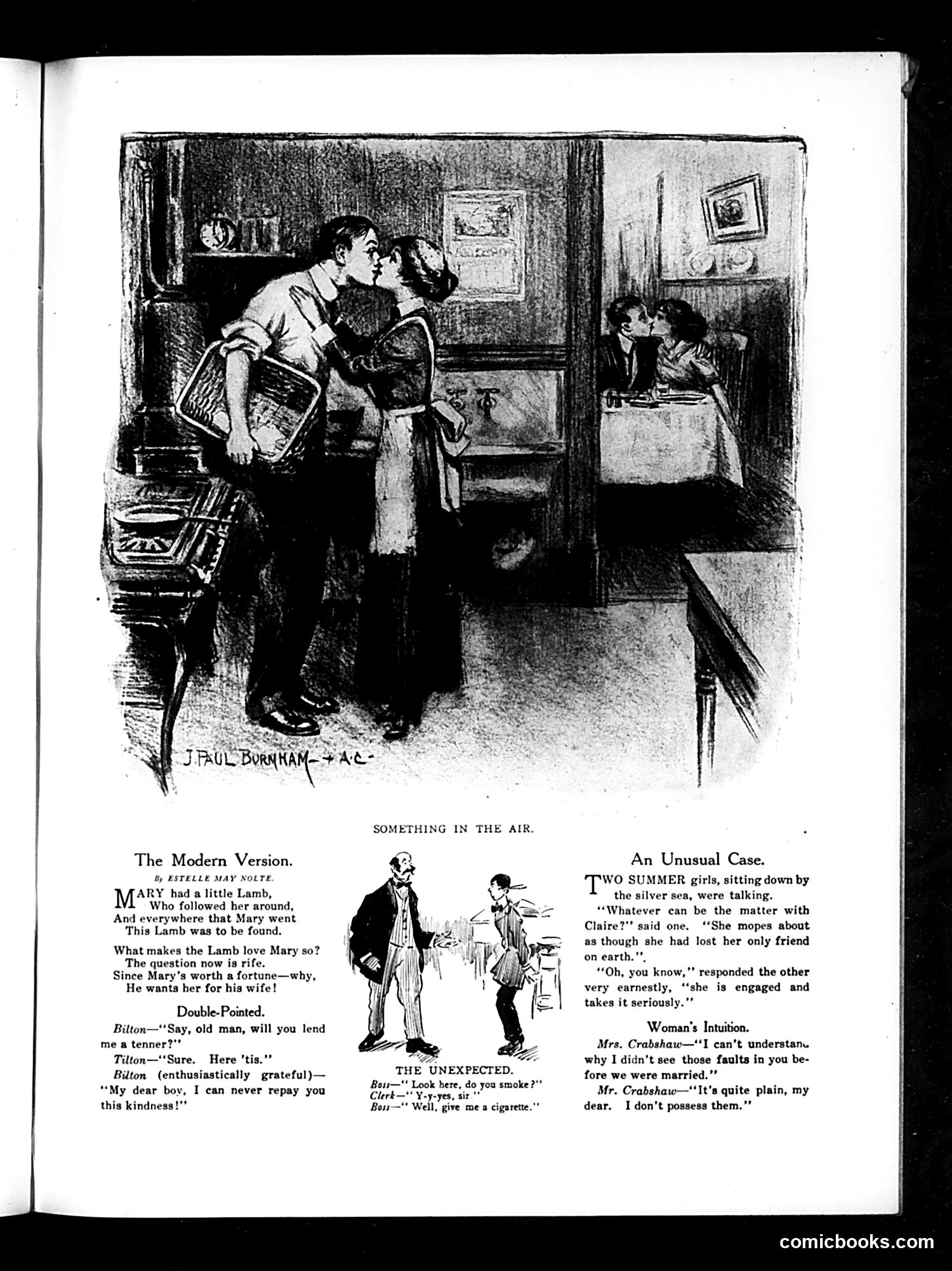
This page collects several short humorous pieces typical of early 20th-century American satirical humor: **"The Modern Version"** updates the nursery rhyme "Mary Had a Little Lamb" with cynical social commentary: the lamb now follows Mary because she's wealthy and wants to marry her for money—a jab at mercenary courtship. **"Double-Pointed"** presents wordplay: Bilton borrows money then claims he can never repay the kindness, a joke about someone being too grateful or pretending eternal debt for a small favor. **"The Unexpected"** shows a boss asking an employee for a cigarette after the employee admits smoking—subverting expected power dynamics where bosses would typically scold employees. **"An Unusual Case"** jokes that an engaged woman is miserable because she "takes it seriously"—implying most women don't—satirizing marriage anxieties. **"Woman's Intuition"** presents a husband's retort to his wife's complaint about not noticing his faults before marriage: he didn't have them then, implying he acquired them afterward—blaming marital change on the wife's influence. These are lighthearted domestic and social satire typical of Judge's era.
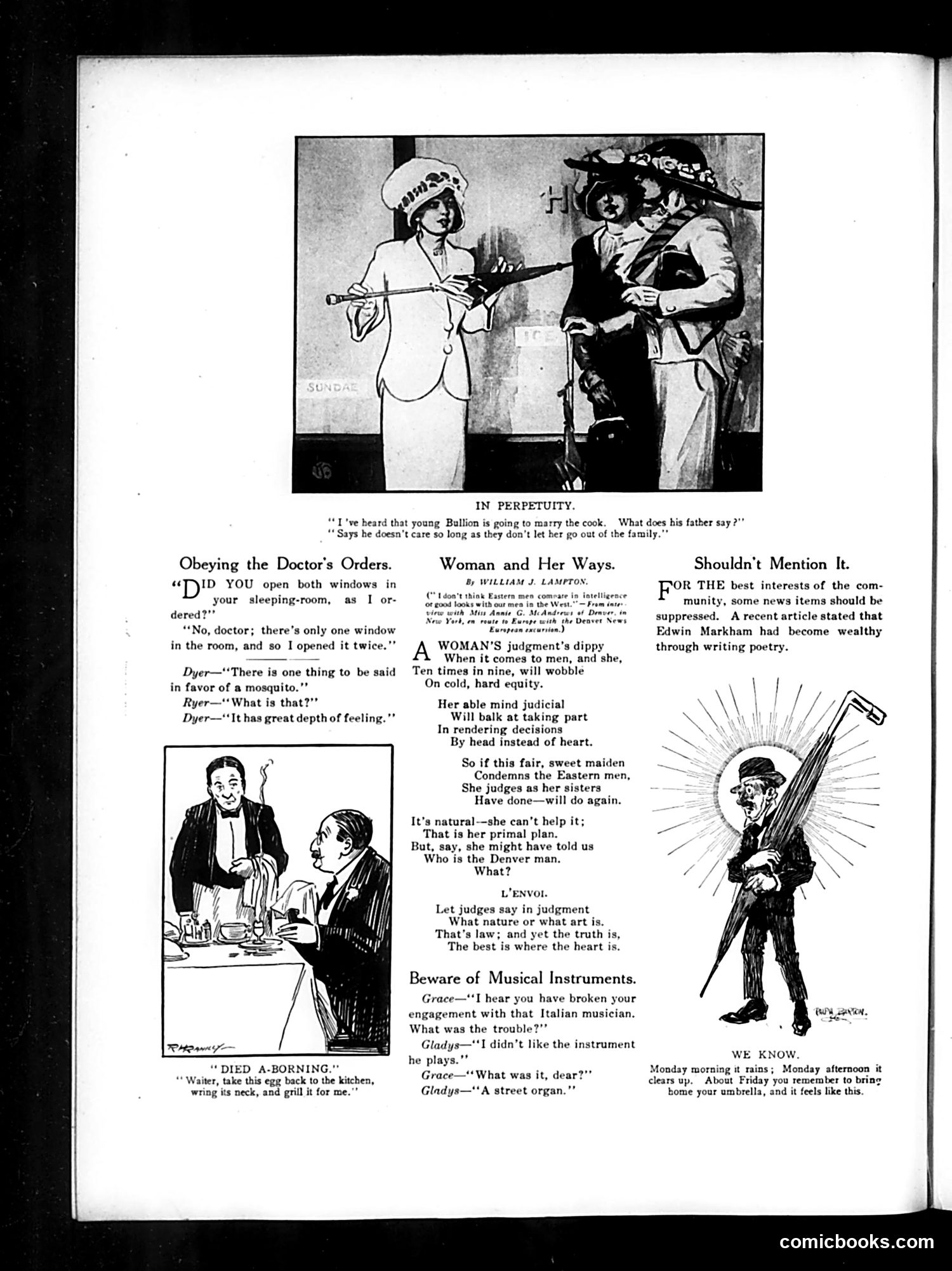
This page from *Judge* contains several short humorous pieces satirizing early 20th-century social conventions: **"In Perpetuity"**: A joke about class and marriage—a wealthy man (Bullion) marrying the family cook is scandalous, but the father accepts it only if she stays within the household, treating her as permanent property rather than a person. **"Obeying the Doctor's Orders"**: Absurdist humor about literal interpretation—a patient opens one window twice instead of opening two windows, showing foolish compliance. **"Woman and Her Ways"**: William Lampton's poem critiques women's supposed emotional irrationality in judgment, particularly regarding Eastern men versus a mysterious "Denver man," implying women judge by heart rather than intellect. **"Beware of Musical Instruments"**: A woman breaks her engagement with an Italian musician because she dislikes his instrument—a street organ—a play on expectations versus reality. The cartoons use exaggeration and wordplay typical of *Judge*'s satirical style, targeting gender stereotypes, class dynamics, and social pretension of the era.
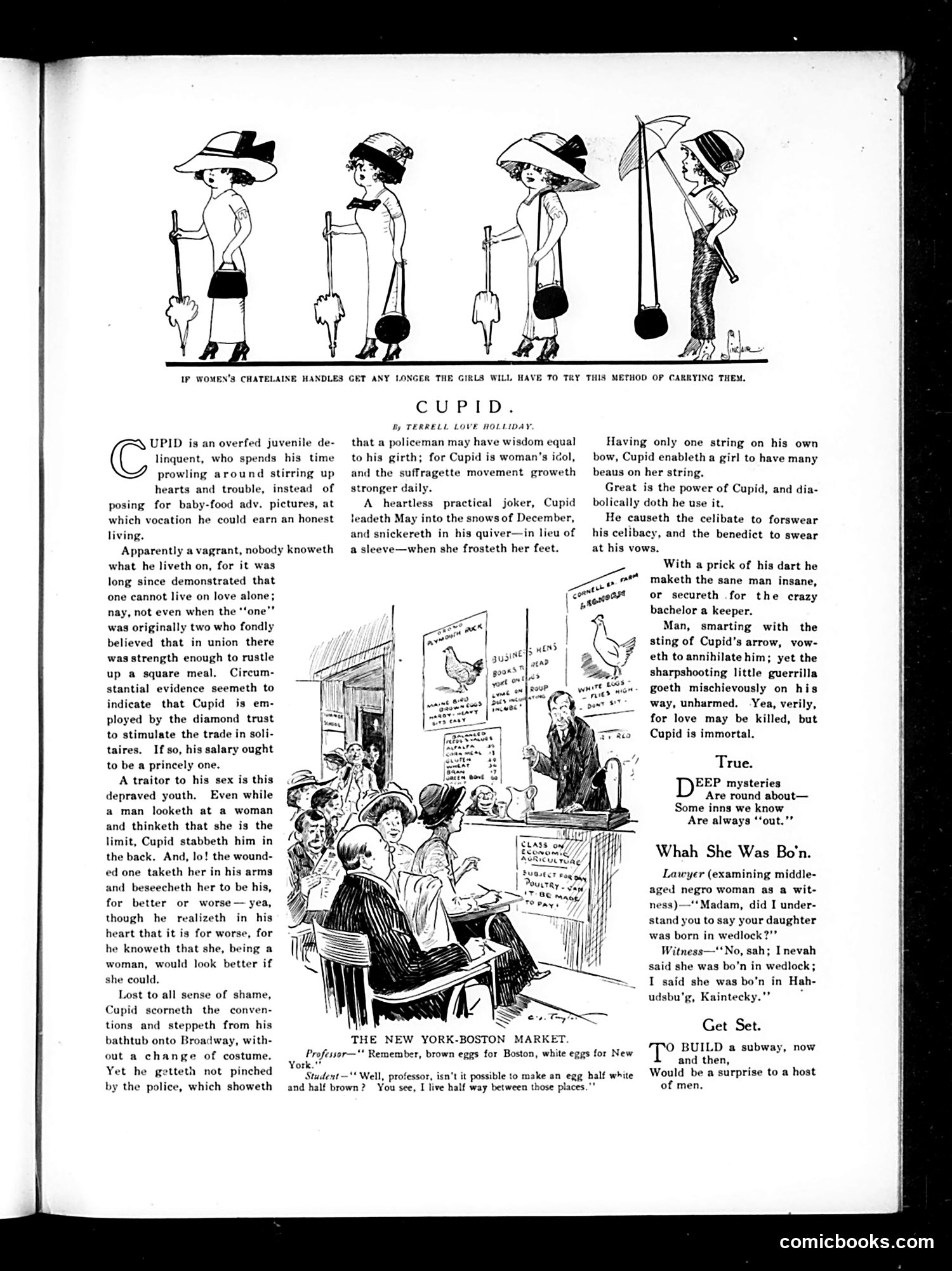
## Top Cartoon Four women demonstrate increasingly absurd methods of carrying elongated chatelaine handles (decorative chains worn at the waist holding keys, scissors, etc.). The satire mocks the growing length of these fashion accessories—a genuine trend of the era—suggesting women would soon need ridiculous implements to manage them. ## Main Article: "Cupid" This is a cynical essay personifying Cupid as an irresponsible vagrant who causes romantic chaos. The satire attacks romantic love itself: Cupid "stabs men in the back," tricks women from spring into winter marriages, and manipulates both the sane and insane. The piece mocks the gap between romantic idealization and marital reality, particularly how women "would look better if she could"—a dig at women's appearance. It's misogynistic social commentary disguised as witty skepticism about love and marriage. ## Supporting Cartoons "The New York-Boston Market" jokes about egg trading; "Whah She Was Bo'n" uses racist dialect humor; "Get Set" offers mundane subway commentary. These are typical Judge filler content of the period.
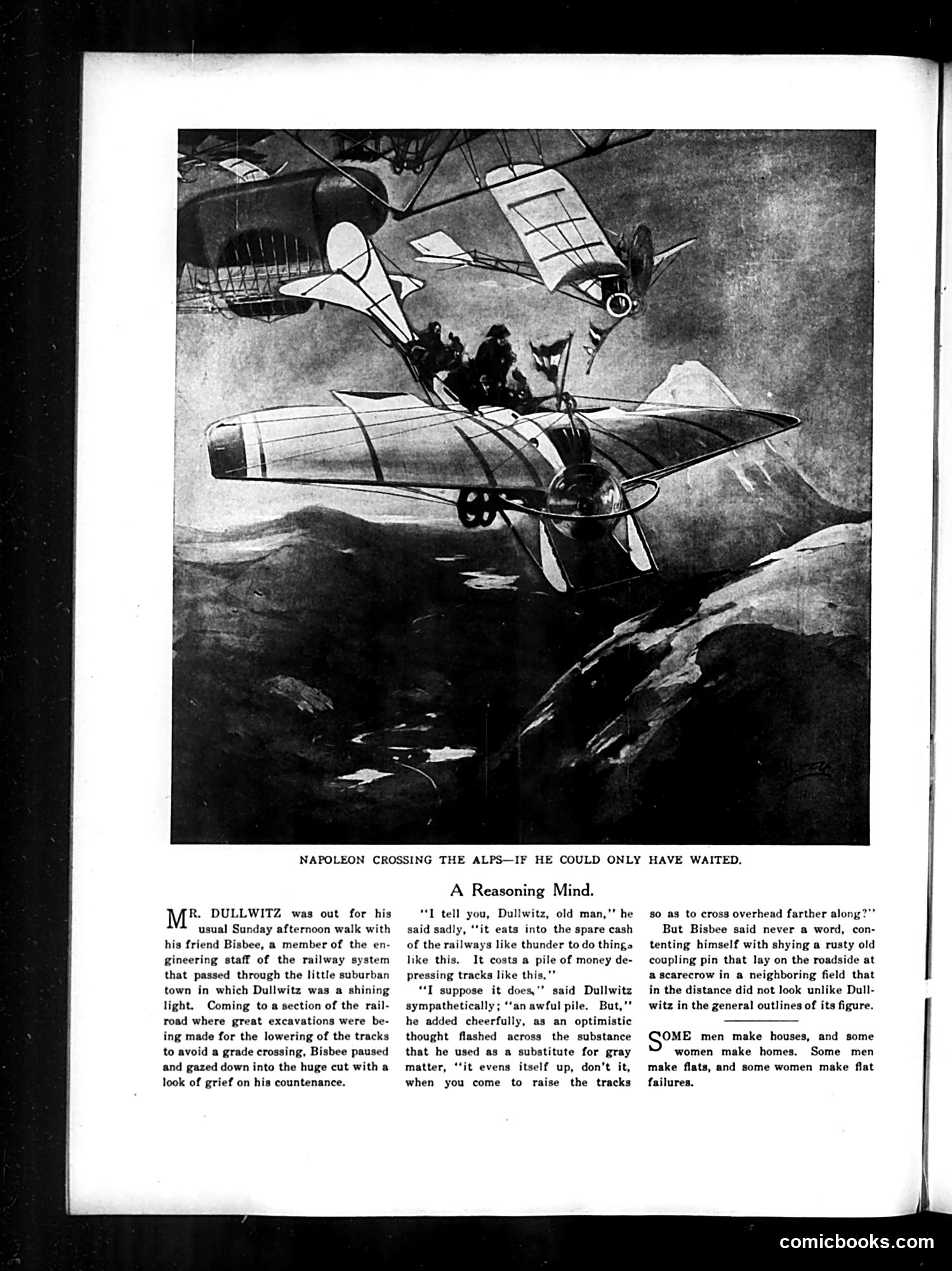
This is a humorous short story illustrated with a satirical cartoon showing airplanes crossing mountains (parodying famous Napoleon paintings). **The Joke:** Two men, Dullwitz and Bisbee, observe railroad excavations. Bisbee laments the enormous expense of lowering tracks to avoid a grade crossing. Dullwitz cheerfully suggests it "evens out" when they later raise the tracks elsewhere—displaying spectacularly flawed logic. The expense simply repeats; money isn't saved. **The Satire:** The piece mocks people who rationalize wasteful spending through circular reasoning. Bisbee's silent response—throwing a coupling pin at a scarecrow resembling Dullwitz—expresses exasperation at such obtuse thinking. **The Title Cartoon:** References Napoleon crossing the Alps, humorously reimagined with early aircraft, suggesting ambitious but impractical undertakings. **The Moral Couplet:** Concluding aphorisms about men/women and their abilities to build successfully or fail.
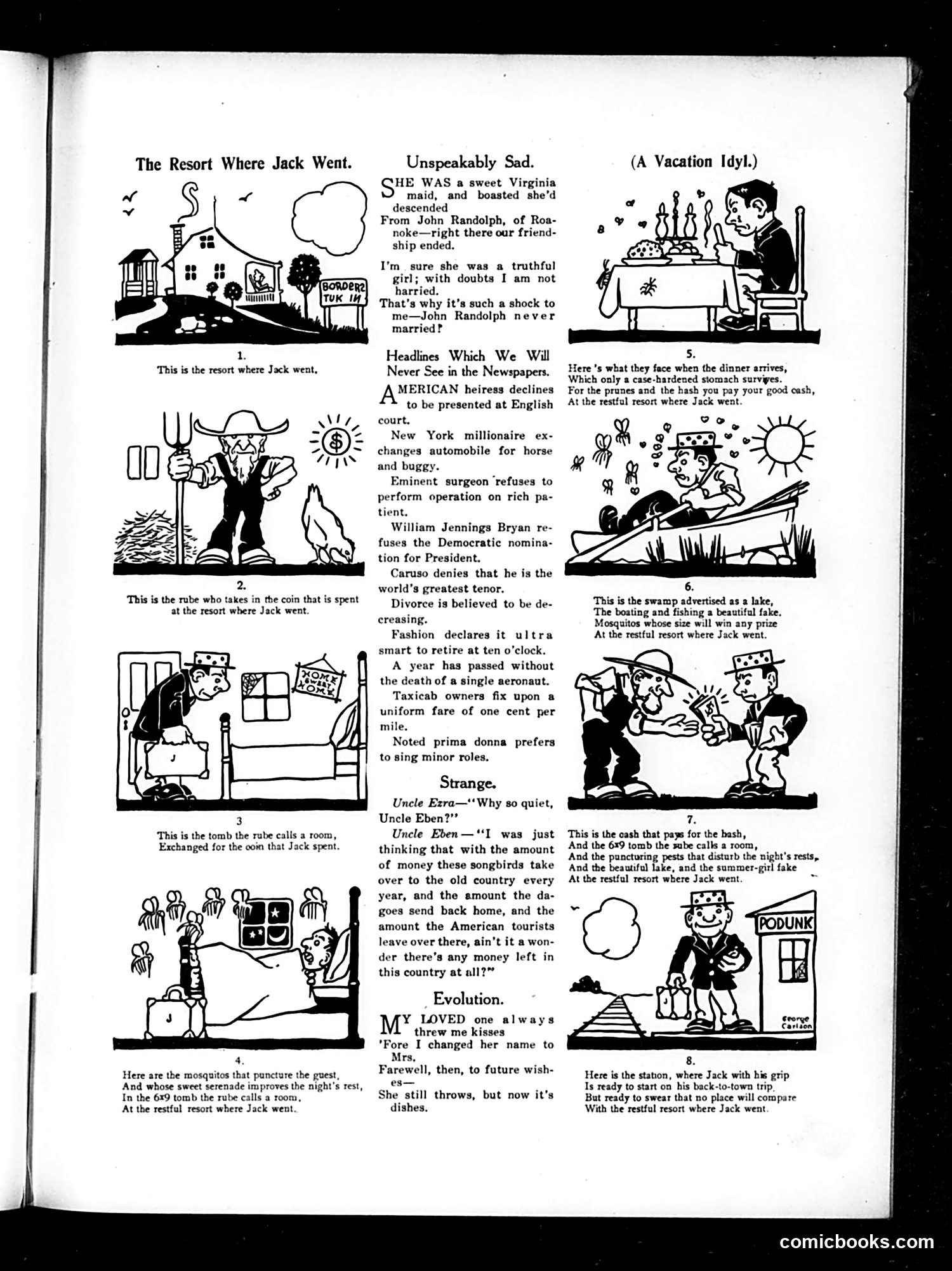
This multi-panel comic satirizes dishonest vacation resorts that fleece tourists. "Jack" visits a supposedly restful destination but encounters: shoddy accommodations ("69 tomb" rooms), disease-carrying mosquitoes, inedible food (prunes and hash), and a fake lake advertised for boating. The satire's bite comes from the final irony—despite these miserable conditions, Jack departs swearing it was wonderful, suggesting either gullibility or social pressure to pretend he enjoyed his costly vacation. The page also includes satirical "Headlines Which We Will Never See," mocking absurdities like millionaires rejecting automobiles or wealthy patients refusing surgery—these invert common American behaviors (wealth-seeking, status-chasing) to expose their ridiculousness. The "Evolution" and "Strange" sections use similar inverted logic to mock marital disappointment and wealth flowing overseas during this era.
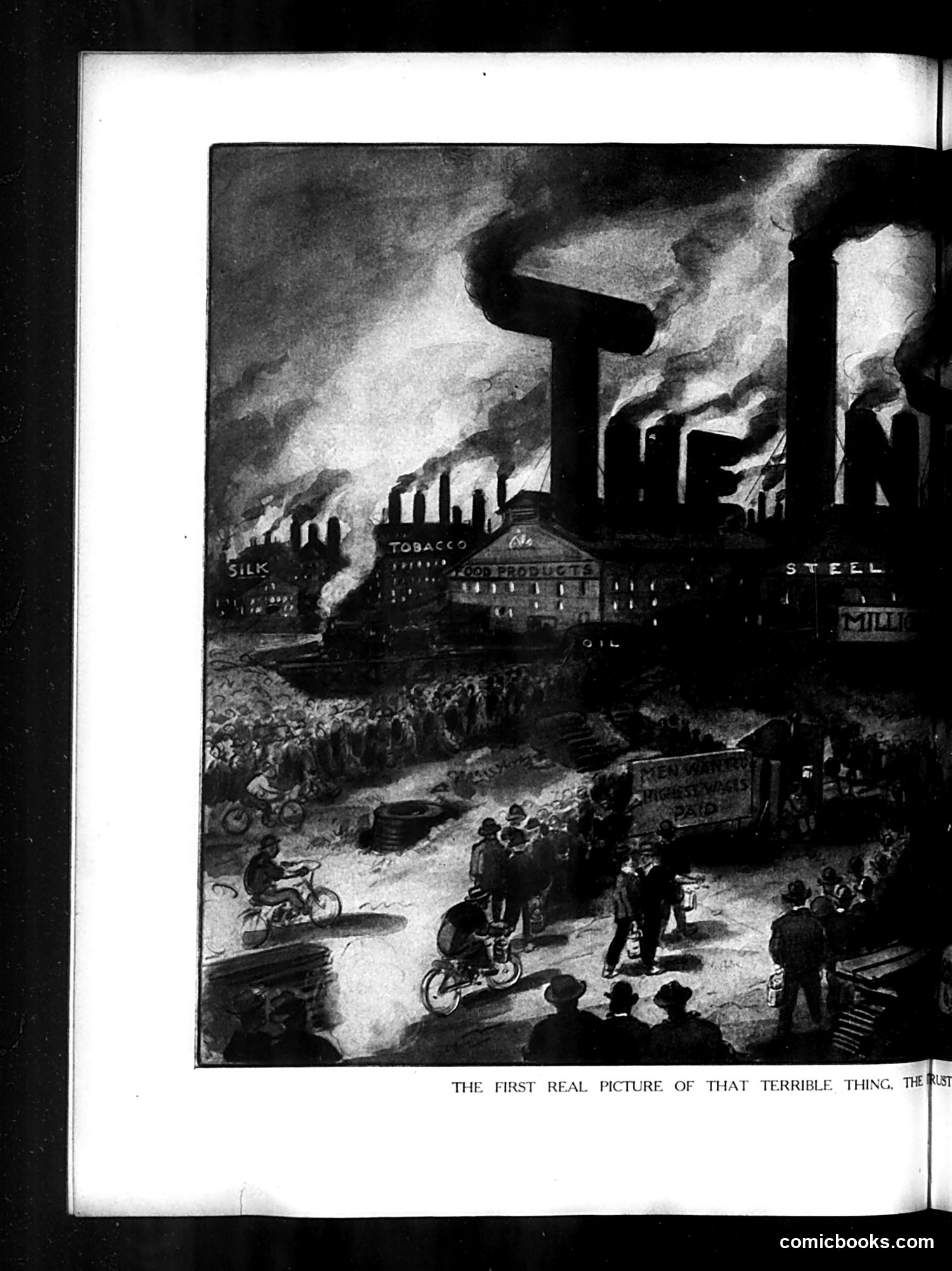
This satirical illustration depicts an industrial nightmare landscape dominated by massive factory smokestacks belching smoke. The factories are labeled "SILK," "TOBACCO," "OIL," and "STEEL," representing major American industries. In the foreground, crowds of workers and civilians mill about in apparent chaos or distress. The caption reads "THE FIRST REAL PICTURE OF THAT TERRIBLE THING," though it's cut off. The satire likely critiques industrial capitalism and its human costs—depicting factories as looming, polluting monsters that dwarf the people below them. The labeled industries suggest Judge magazine is commenting on specific corporate or industrial practices causing public concern, possibly regarding labor conditions, environmental pollution, or economic exploitation during the industrial era. Without the complete caption, the precise "terrible thing" referenced remains unclear.
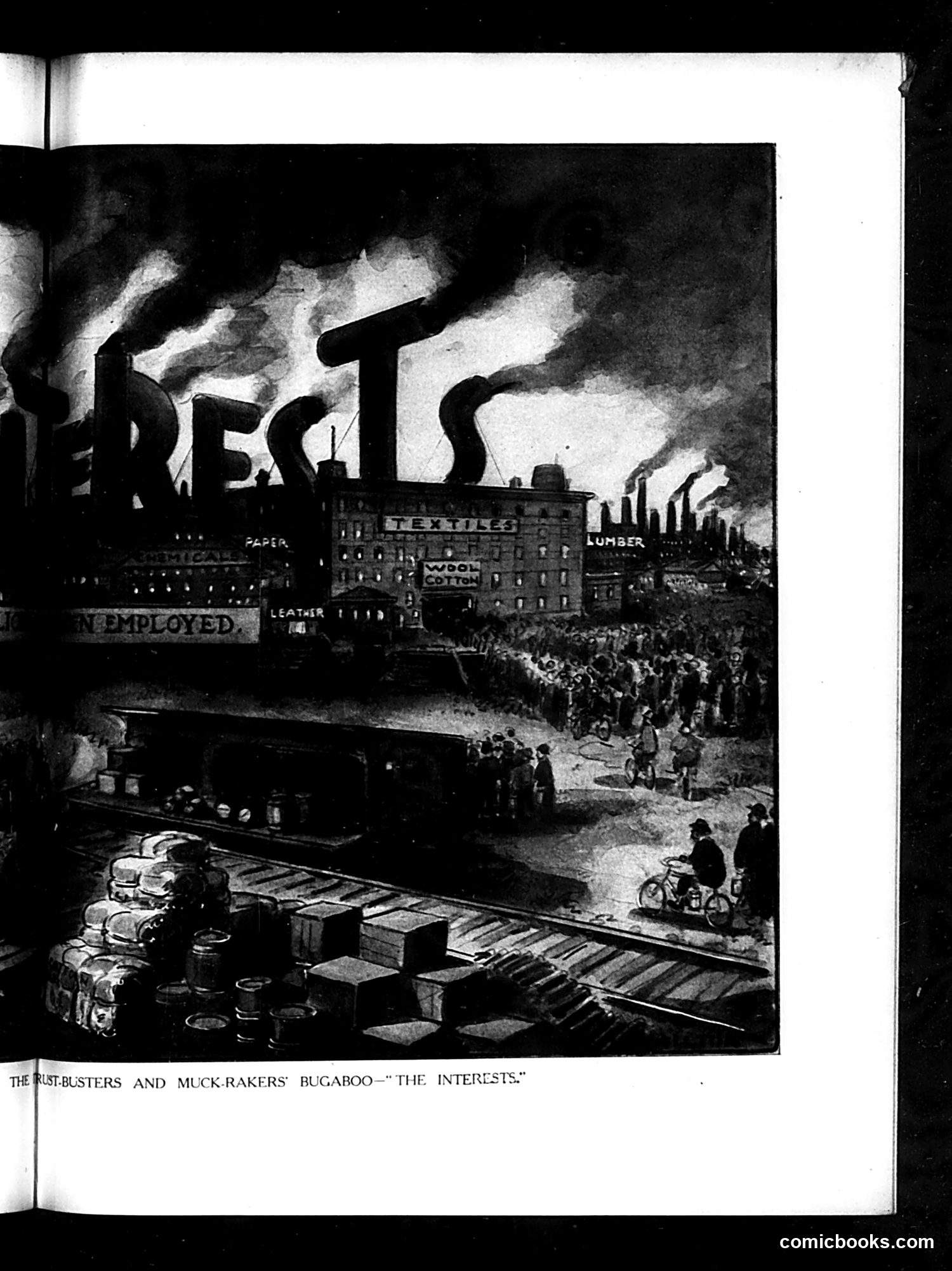
This satirical illustration depicts "The Interests"—a pejorative term for wealthy industrial and corporate powers that Progressive Era reformers opposed. The massive figure dominating the skyline represents consolidated business interests controlling various industries labeled on factory buildings: textiles, lumber, paper, wool, cotton, and leather. Below, crowds of ordinary people and a train suggest workers and the public dwarfed by corporate power. The cartoon mocks "rust-busters and muck-rakers" (reformers and investigative journalists) by presenting "The Interests" as their feared enemy or "bugaboo." This reflects early 20th-century anxieties about monopolies and corporate consolidation. The image criticizes how reformers focused on abstract corporate villainy rather than addressing concrete working-class concerns, suggesting their crusade was somewhat theatrical or exaggerated.
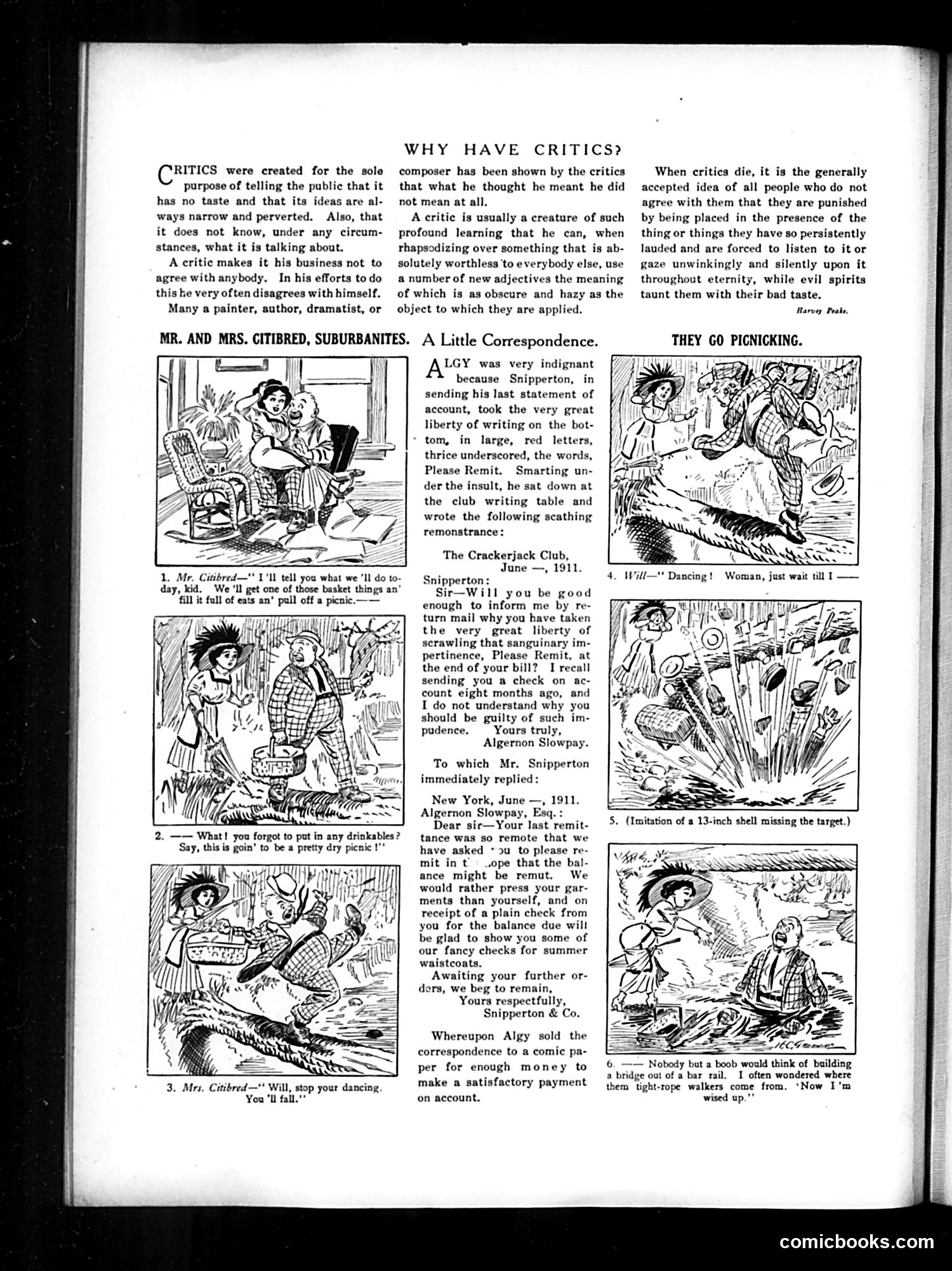
**Top Essay:** A satirical attack on professional critics, arguing they exist solely to contradict public opinion and obscure merit beneath pretentious vocabulary. The author (credited as Harve Prats) claims critics champion worthless work using incomprehensible language, and deserve eternal punishment for their bad taste. **Bottom Cartoons:** Two unrelated humor strips. "Mr. and Mrs. Citibred" depicts suburban domesticity—a couple planning a picnic but forgetting drinks, with slapstick consequences. "A Little Correspondence" shows a deadbeat customer (Algernon Slowpay) indignant at a bill collector's blunt "Please Remit" notation. The creditor (Snipperton) replies sardonically, offering to press clothes rather than pursue payment. Slowpay sells their exchange to a comic paper to settle the debt—meta-humor about publication itself. Both satirize social pretension and class friction through exaggerated characters and wordplay typical of 1911 Judge humor.
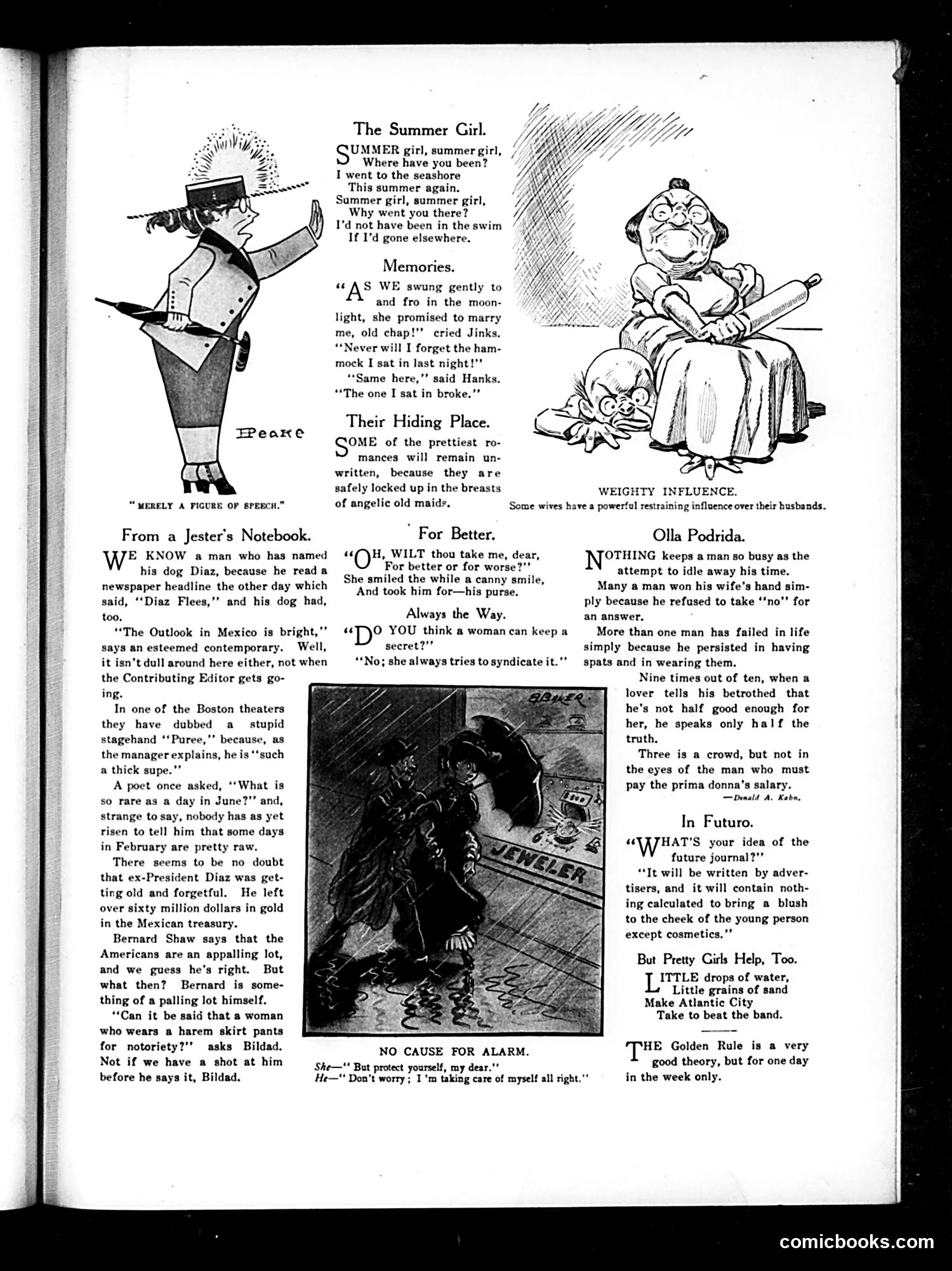
This is a humor/satire page mixing jokes, verse, and social commentary typical of early 20th-century Judge magazine. **Key References:** - **"Diaz" dog joke**: References ex-Mexican President Porfirio Díaz, who fled Mexico during the 1910 revolution. The joke plays on the headline "Diaz Flees"—the owner named his dog after this news event. - **"The Outlook in Mexico is bright"**: Satirizes optimistic newspaper coverage of Mexico's political instability during the revolution. - **Social satire sections** ("Memories," "For Better," "Always the Way"): Mock romantic relationships and marriages, with recurring themes about women being mercenary (marrying for money, keeping secrets) and marriages involving power imbalances. - **"Weighty Influence" cartoon**: Shows a large woman controlling her small husband—visual satire about wives dominating their husbands. The page's overall tone mocks contemporary social pretensions, gender relations, and current events through light verse and observational humor.
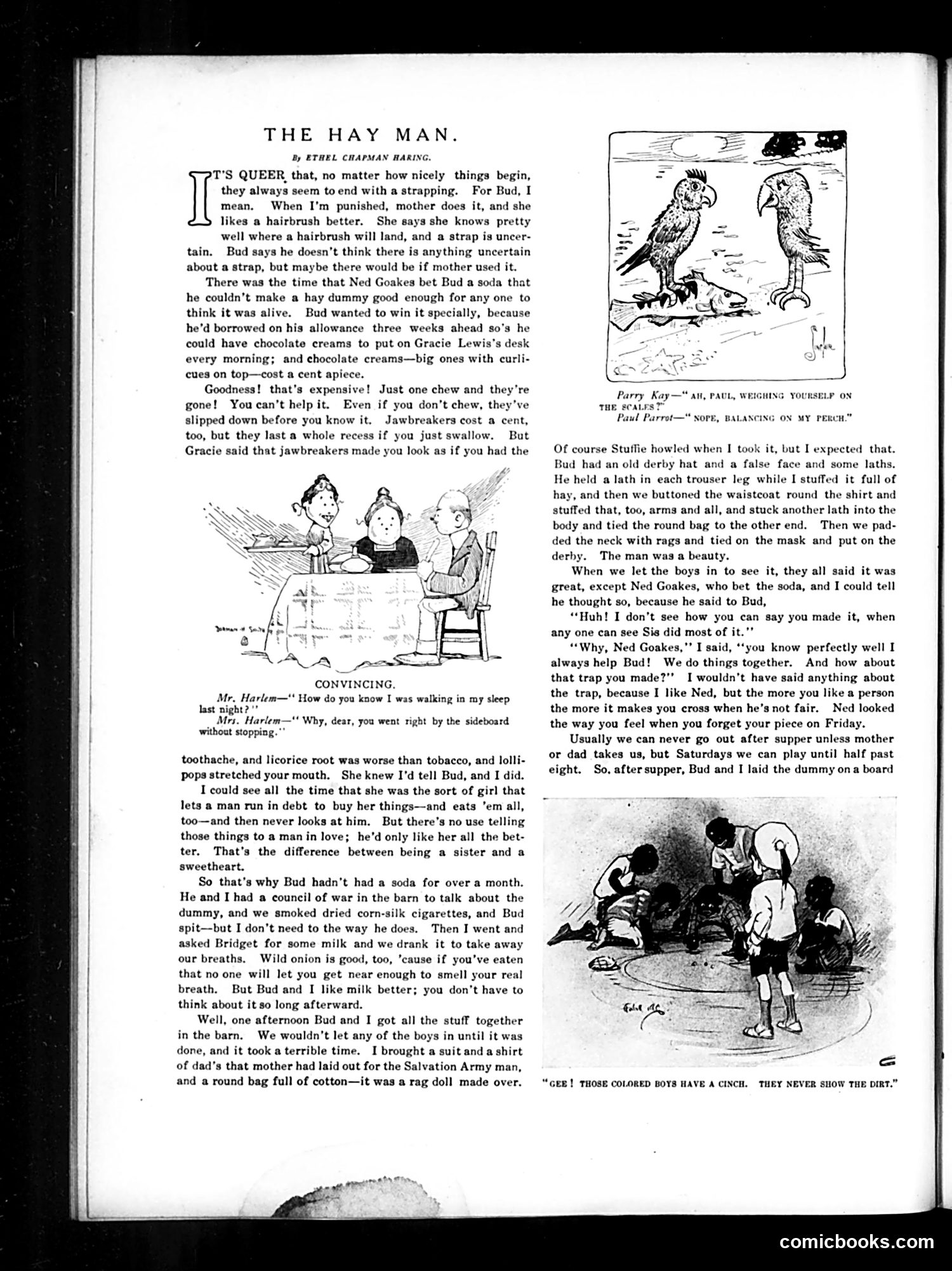
This is a short story by Ethel Chapman Haring, not primarily a political cartoon. The page features a narrative about two children, Bud and his sister (the narrator), who create a convincing scarecrow-like dummy from their father's old clothes stuffed with hay and cotton, intended to win a soda bet from a boy named Ned Goakes. The story explores childhood logic and relationships—Bud's romantic interest in Gracie Lewis (motivating the wager), sibling dynamics, and competitive honor among children. The small cartoon vignettes are humorous asides: one about a husband sleepwalking past food, another with anthropomorphic birds. The satire is gentle, poking fun at children's earnest schemes, their economic reasoning (counting penny candies), and social hierarchies. The implied ending—punishment awaits Bud—reflects early 20th-century attitudes toward mischief and parental discipline.
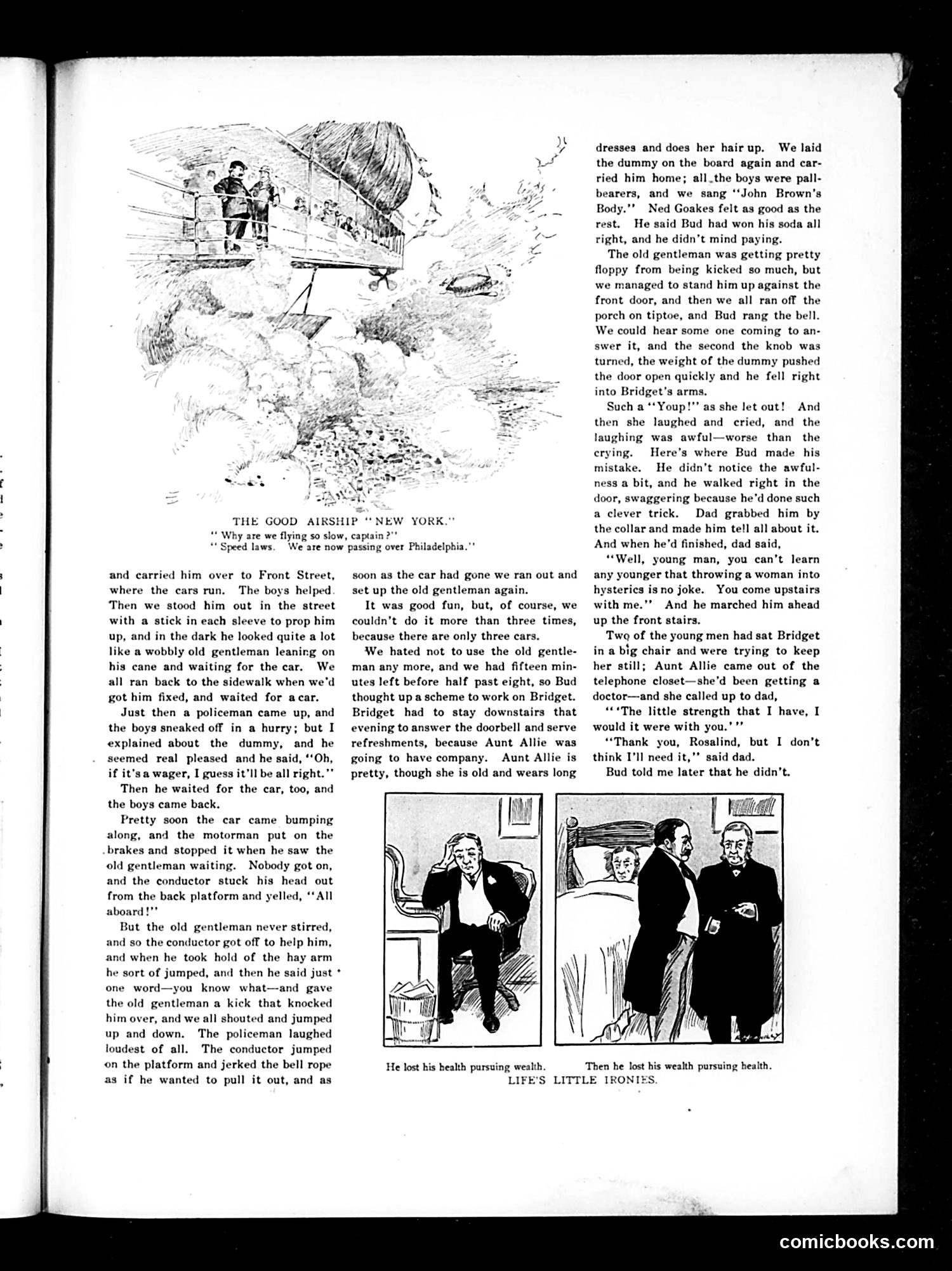
This page contains two separate pieces of satirical content: **Upper Section - "The Good Airship 'New York'":** A humorous story about boys playing pranks with a dummy dressed as an old man. They place it on streetcar tracks to trick conductors and motormen. The joke plays on the conductors' reactions—they brake suddenly, then kick the dummy in frustration upon discovering the deception. The final prank involves startling the servant "Bridget" by having the dummy fall into her arms, causing her hysterics. The father's punishment of his son emphasizes that frightening women is not a legitimate joke. **Lower Section - "Life's Little Ironies":** Two cartoon panels showing a wealthy man, captioned "He lost his health pursuing wealth" (left) and "Then he lost his wealth pursuing health" (right). This satirizes how wealthy men sacrifice their wellbeing chasing money, then waste their fortunes trying to regain health—a common turn-of-the-century critique of capitalist excess and vanity. Both pieces mock contemporary American social behavior: reckless youth mischief and the hypocritical priorities of the wealthy.
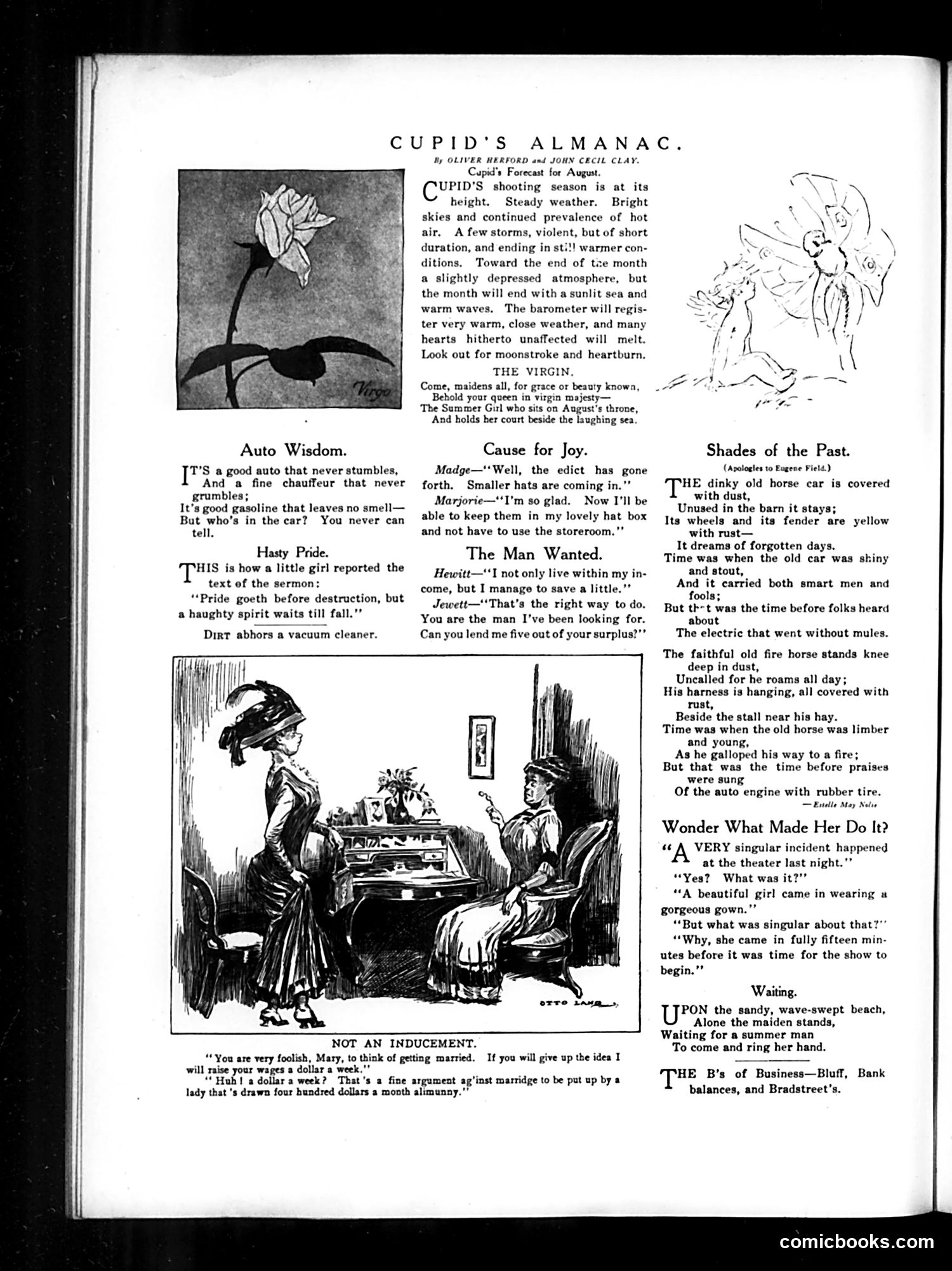
This page from *Judge* (a satirical magazine) contains several humorous commentaries on early 20th-century American life: **"Auto Wisdom"** jokes about the unpredictability of automobiles and their occupants—a new technology that was unreliable and socially disruptive. **"Hasty Pride"** mocks a child's misinterpretation of a Biblical sermon, finding humor in innocent misquotation. **The main cartoon** depicts a conversation between two women about marriage and money. The man claims to save money, but immediately asks to borrow from his "surplus"—satirizing male financial hypocrisy and the marriage market. **"Shades of the Past"** nostalgia piece elegizes outdated transportation (horse cars, fire horses) being replaced by automobiles and electric vehicles—reflecting rapid technological change and obsolescence anxiety. **"Wonder What Made Her Do It?"** presents absurdist humor: a woman's singular behavior is arriving *early* to a theater—mocking social conventions about punctuality. The overall theme: modernity disrupting tradition, whether through automobiles, gender relations, or changing social customs.
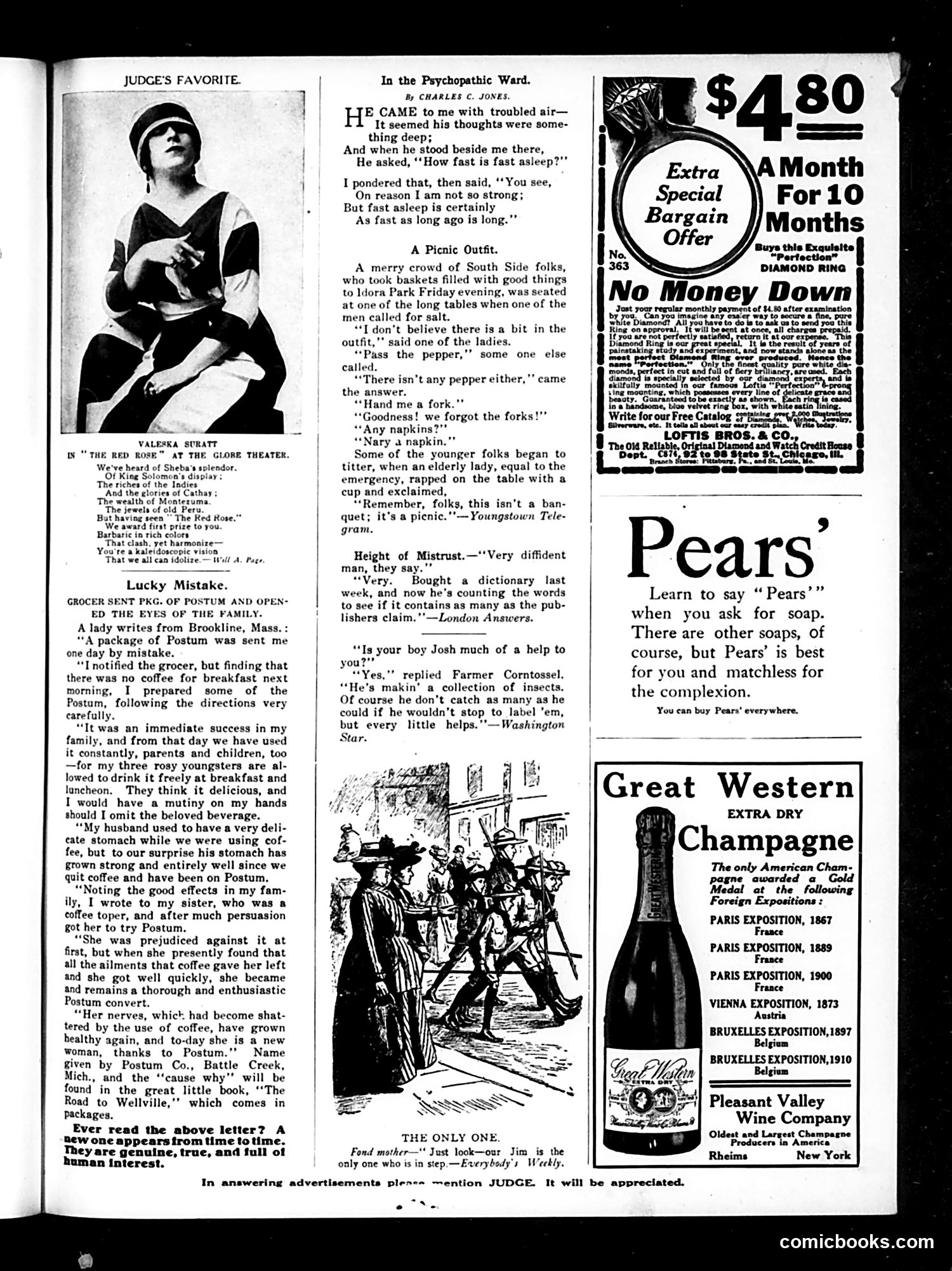
This page contains several light comedic pieces rather than political cartoons: **"In the Psychopathic Ward"** presents a philosophical joke about the meaning of "fast asleep"—absurdist wordplay typical of early-20th-century humor magazines. **"A Picnic Outfit"** satirizes poor planning: a South Side Chicago group arrives at a park with food but forgot salt, pepper, forks, and napkins—comedic commentary on disorganization and the humor found in everyday mishaps. **"Height of Mistrust"** jokes about a diffident man who bought a dictionary specifically to count words and verify the publisher's claims—poking fun at excessive skepticism. The page is primarily **advertising and filler content**: Postum coffee substitute testimonials, a Pears' soap ad, Great Western Champagne promotion, and jewelry store credit offers dominate. The theatrical photo features actress Valeska Suratt. This represents Judge's typical mix of light social humor, product advertising, and entertainment notices rather than sharp political satire.
This page from Judge magazine (likely early 1900s, given references to automobiles and electric streetcars) contains satirical humor about contemporary American life: **Main cartoons:** - **"Auto Wisdom"** jokes about unpredictable automobiles and their occupants—a commentary on the new, unreliable automobile technology - **"Not an Inducement"** depicts a conversation where an employer offers a woman a dollar raise to abandon marriage plans, but she dismissively reveals she receives four hundred dollars monthly in alimony—satirizing divorce, women's financial independence, and employer paternalism **Literary pieces** include nostalgic verses comparing obsolete horse-drawn streetcars and fire horses to modern electric vehicles, mocking technological progress. **Social satire** throughout targets: courtship rituals ("Waiting"), fashion trends (smaller hats), gender dynamics, and class attitudes. The humor relies on readers recognizing contemporary anxieties about rapid modernization, changing social roles (particularly women's), and shifting urban life—making this quintessentially early-20th-century American satire.
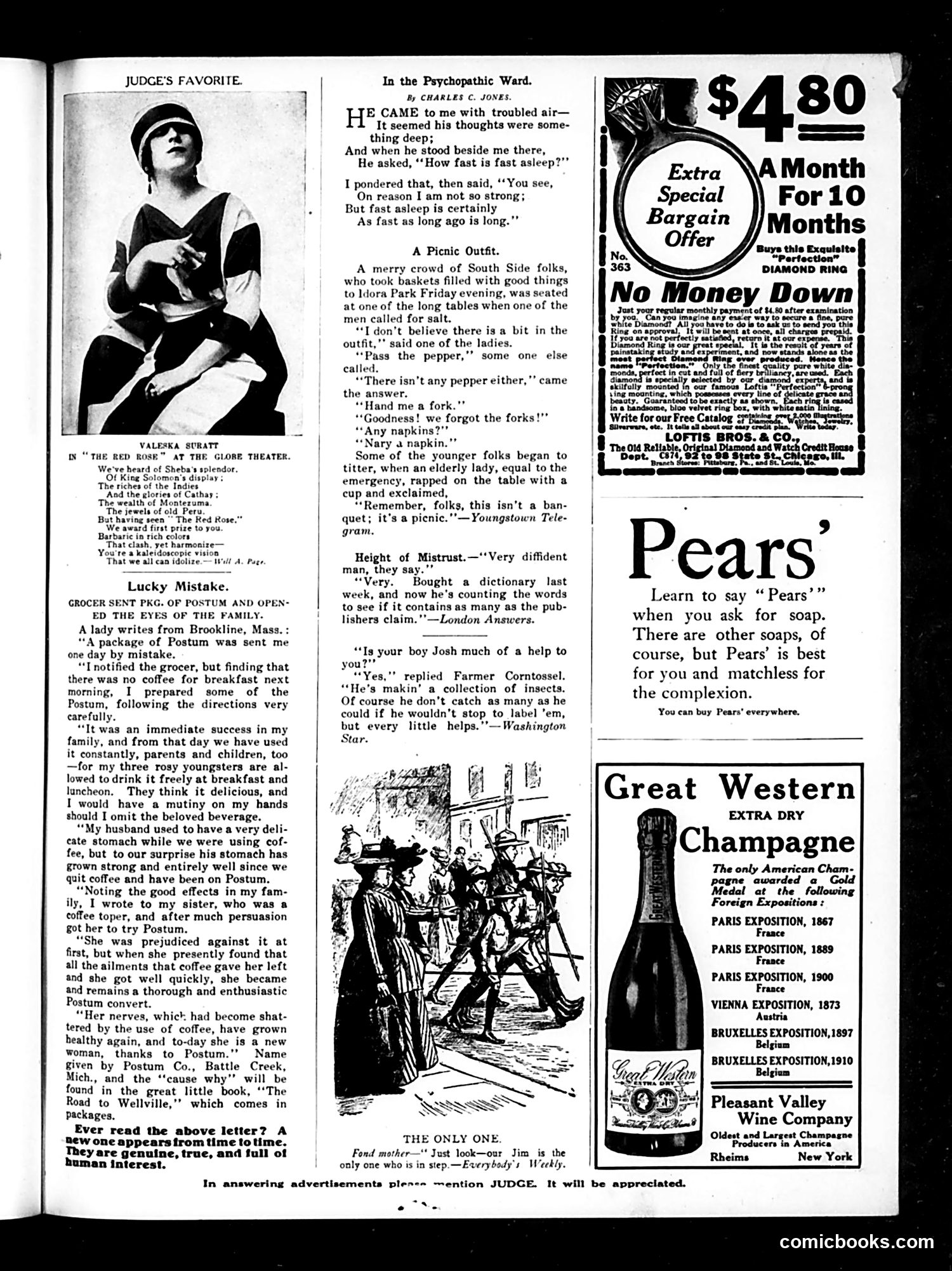
This is primarily an **advertising and humor page** from Judge magazine, not a political cartoon. **Content includes:** 1. **"Judge's Favorite"** — A theatrical advertisement featuring actress Valeska Suratt in "The Red Rose" at the Globe Theater, with poetic praise. 2. **"Lucky Mistake"** — A testimonial advertisement for Postum (a coffee substitute), presenting a Brookline woman's story about accidentally receiving Postum instead of coffee, discovering health benefits for her family and sister. 3. **Humorous short pieces** — Three brief satirical anecdotes: - A dialogue about the degrees of sleepiness - A picnic scene where diners forget all equipment except attitude - A farmer's son collecting insects laboriously 4. **Advertisements** — For diamond rings, Pears soap, and Great Western champagne. The page reflects early 1900s concerns: patent medicines/health products, theatrical entertainment, and gentle domestic humor. It's entertainment and commerce rather than political satire.
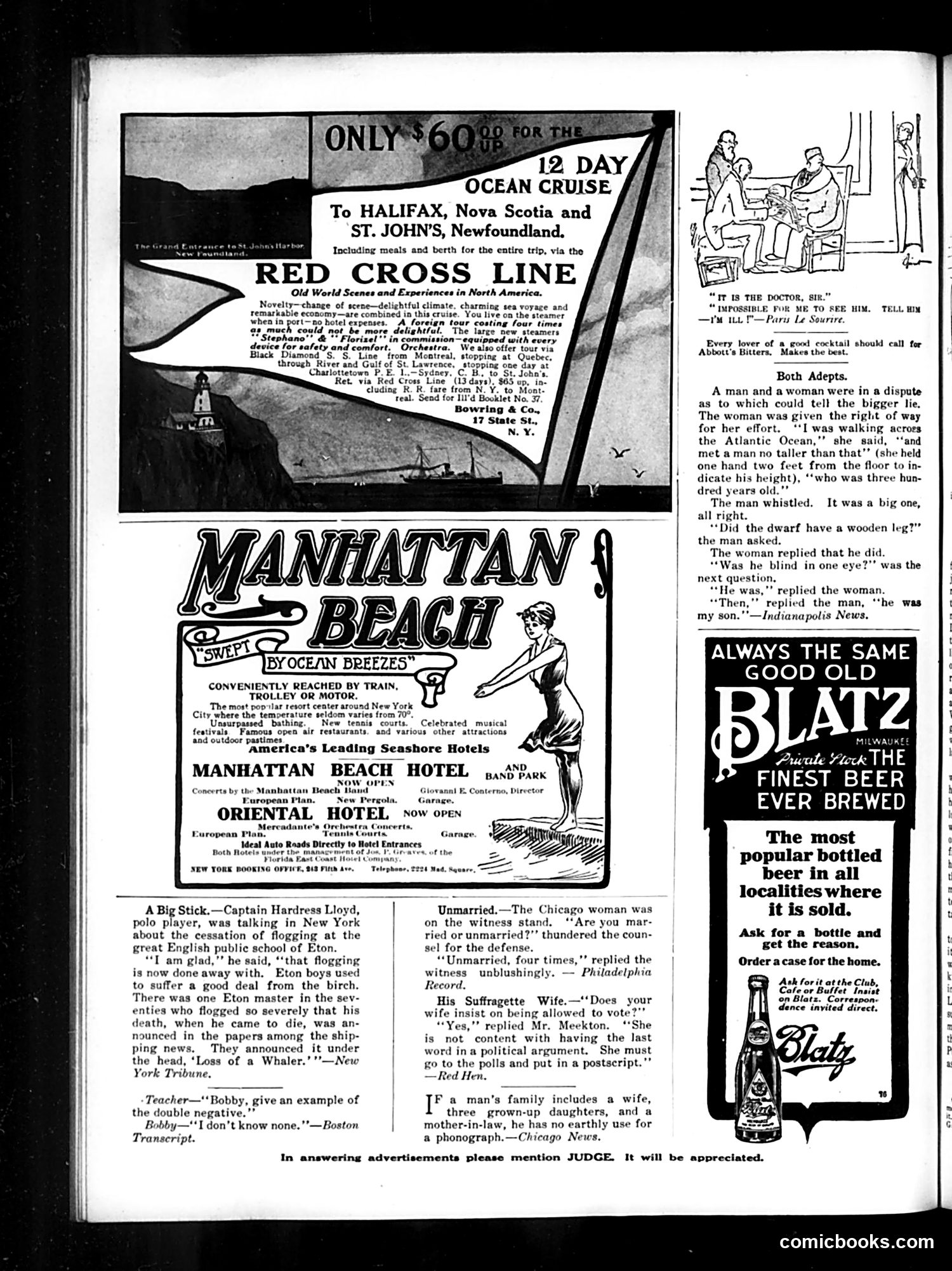
This page is primarily **advertisements and short humor items**, not political cartoons. The content reflects early 20th-century American leisure and domestic life. The largest ad promotes a **Red Cross Line ocean cruise** ($60 for 12 days to Halifax and Newfoundland)—targeting affluent travelers seeking "novelty" and "economy" combined. Below that, **Manhattan Beach** advertises itself as an accessible resort near New York City, emphasizing modern attractions (tennis, musical festivals, restaurants). The humor items are domestic jokes typical of the era: - A woman and man compete over who tells bigger lies (she claims meeting a 300-year-old dwarf; he identifies it as his son) - A captain's anecdote about discontinued flogging at Eton School - A suffragette wife who demands voting rights - A joke about phonographs being useless with a mother-in-law present The **Blatz beer advertisement** promotes Milwaukee beer as the "finest ever brewed," emphasizing its popularity. The page reflects pre-WWI American consumer culture: leisure travel, seaside resorts, and domestic gender tensions around emerging women's suffrage—all presented through lighthearted satire.
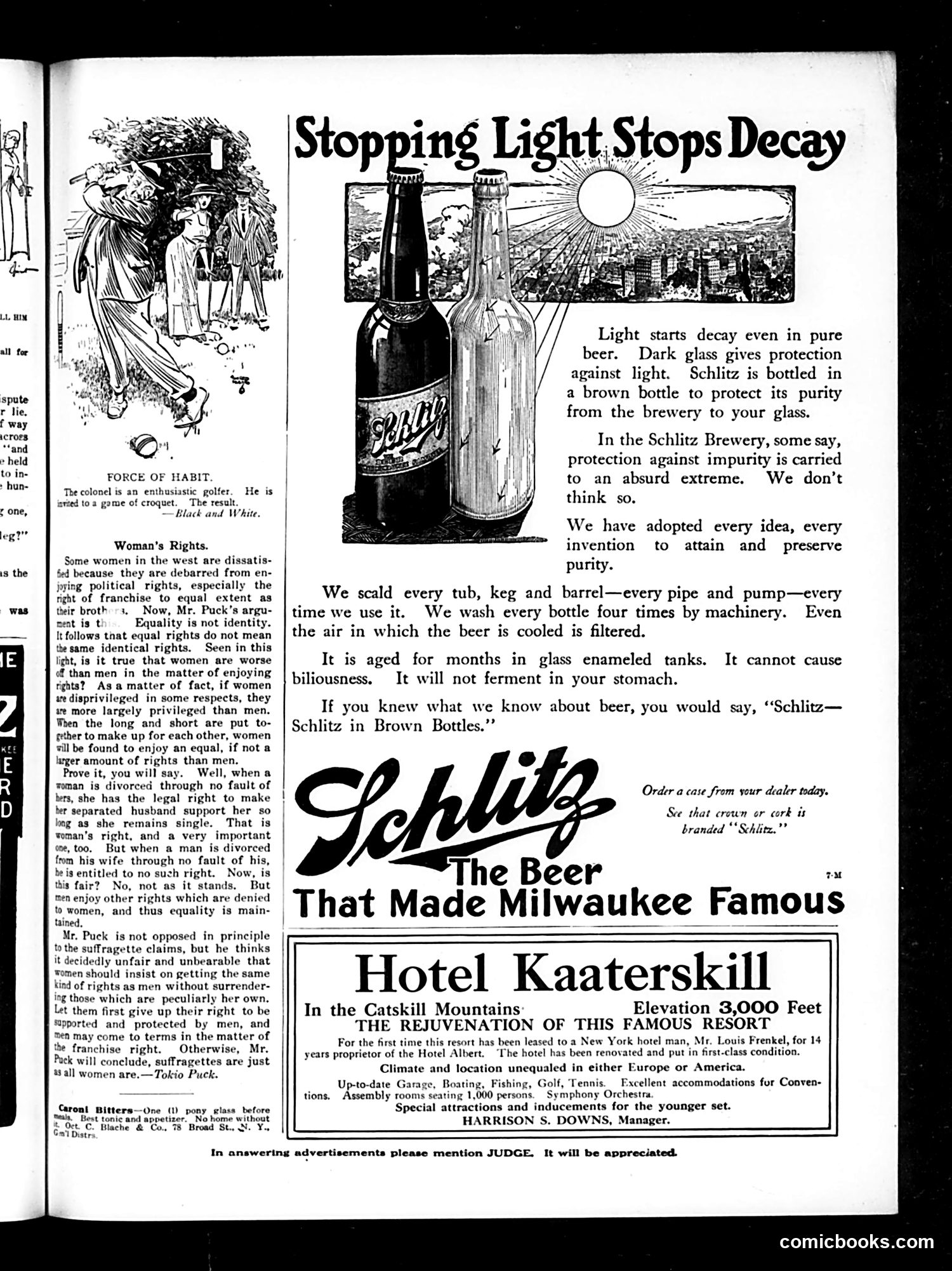
This page mixes satirical editorial content with period advertising. **The "Woman's Rights" cartoon** depicts a debate on suffrage. The text argues against women's franchise claims, using a counterintuitive logic: it contends women already enjoy "equal, if not larger" rights than men through legal protections (like spousal support rights in divorce). The piece sarcastically suggests women cannot demand voting rights without surrendering their existing legal privileges—a rhetorical dodge against the suffragette movement. The cartoon's angel figure likely represents an idealized conception of womanhood being invoked to oppose political equality. **"Force of Habit"** appears to be a small golf joke unrelated to women's rights. **The advertisements** for Schlitz beer and the Hotel Kaaterskill are standard period marketing, emphasizing purity and resort amenities respectively. The page reflects early 20th-century anti-suffrage arguments that framed women's legal protections as equivalent to voting rights—a position modern readers would recognize as fallacious.
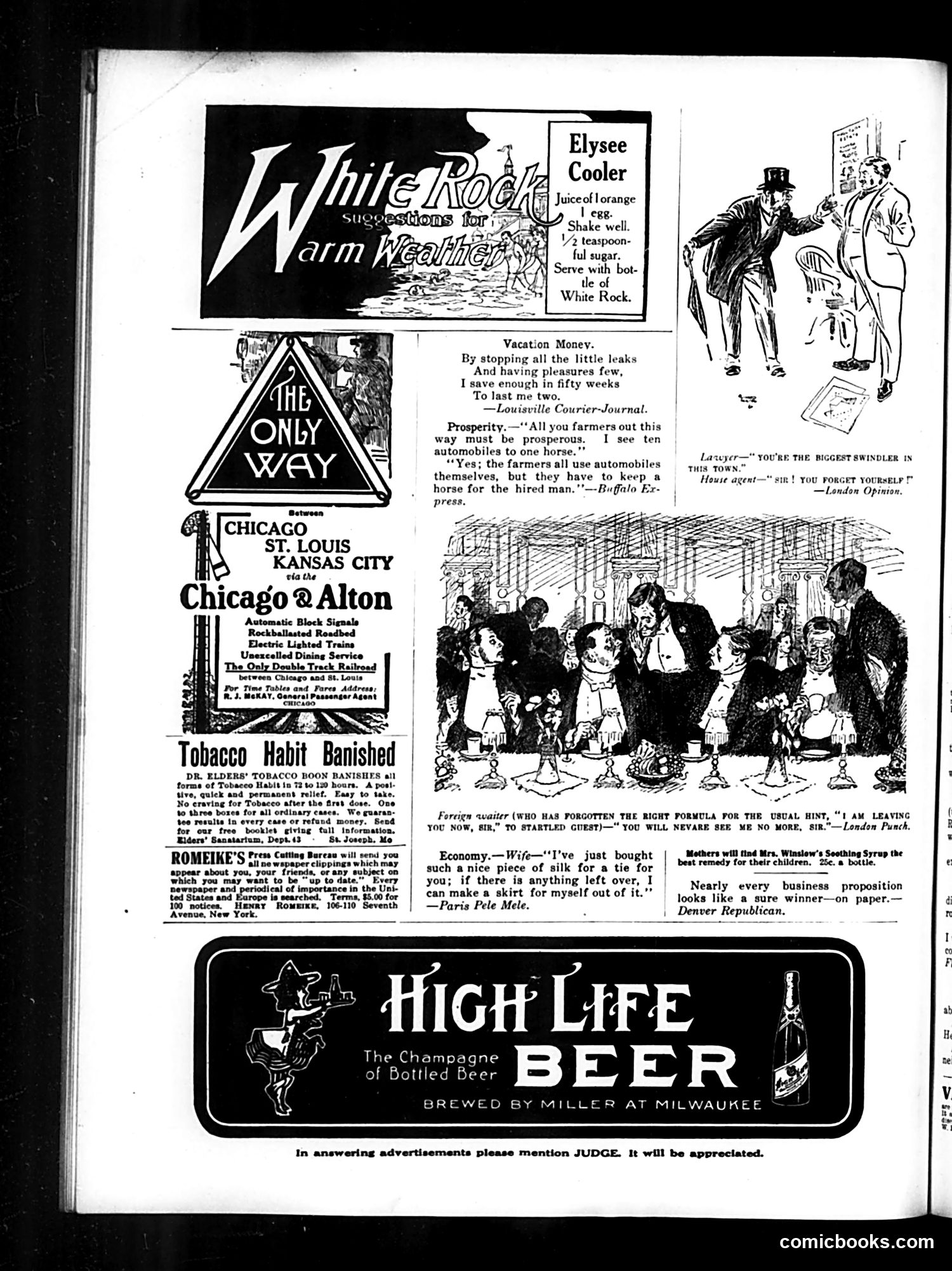
This is primarily an **advertising page** with several small satirical items interspersed. The main cartoons mock contemporary social attitudes: 1. **"Vacation Money"** jokes about working-class penny-pinching—saving for two weeks' vacation by eliminating small expenses. 2. **"Prosperity"** satirizes rural economic inequality: farmers buy automobiles but must keep horses for hired hands, suggesting farmers adopt new technology while maintaining exploitative labor practices. 3. **"Foreign Waiter"** (Punch cartoon) depicts a waiter abandoning his post, playing on class tensions and servant frustrations—likely referencing post-WWI social upheaval when traditional service roles faced disruption. 4. **"Economy"** shows a wife's pragmatic thriftiness: buying silk for her husband's necktie, then repurposing scraps into her own skirt. The page otherwise features period advertisements: White Rock beverages, railroad services, a tobacco-cessation product, and High Life beer. The ads and content reflect early 20th-century American concerns: transportation, health remedies, and consumer goods.
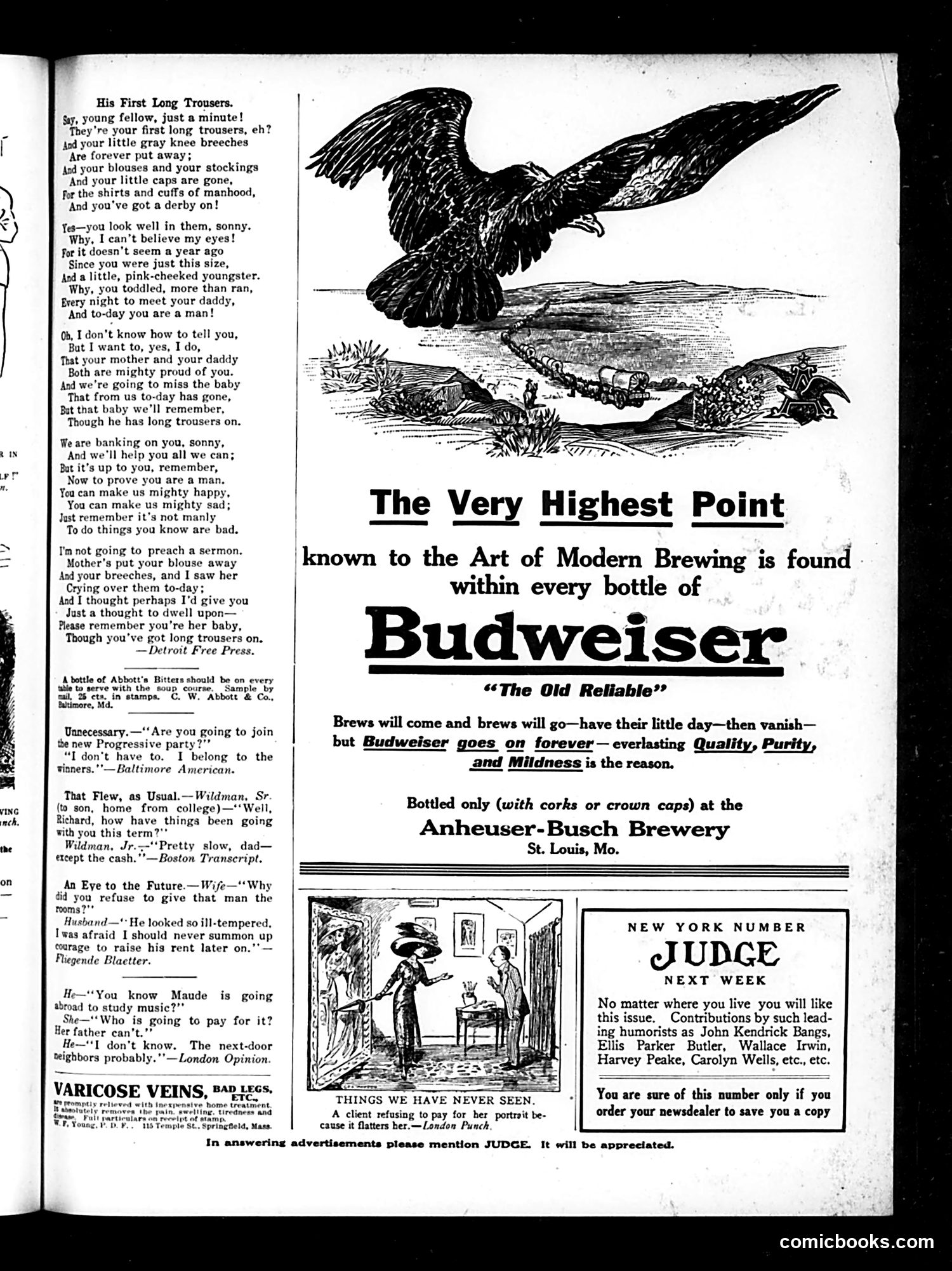
The main poem depicts a parent's bittersweet reflection as their son receives his first adult trousers, marking his transition from childhood to manhood. The speaker recalls the boy's infancy, noting the loss of "little gray knee breeches" and childhood garments, while expressing parental pride mixed with nostalgia. The sentiment is sentimental rather than satirical—common Victorian/early-20th-century fare celebrating coming-of-age. The parent offers gentle moral guidance, reminding the boy that his parents sacrificed for him and expect responsible behavior. The page also contains brief humorous quips typical of Judge's style (jokes about Progressive politics, a stingy landlord, adultery), plus a Budweiser advertisement emphasizing "Quality, Purity, and Mildness" and a preview of next week's Judge issue. The illustration shows a young figure in long trousers, consistent with the poem's theme.
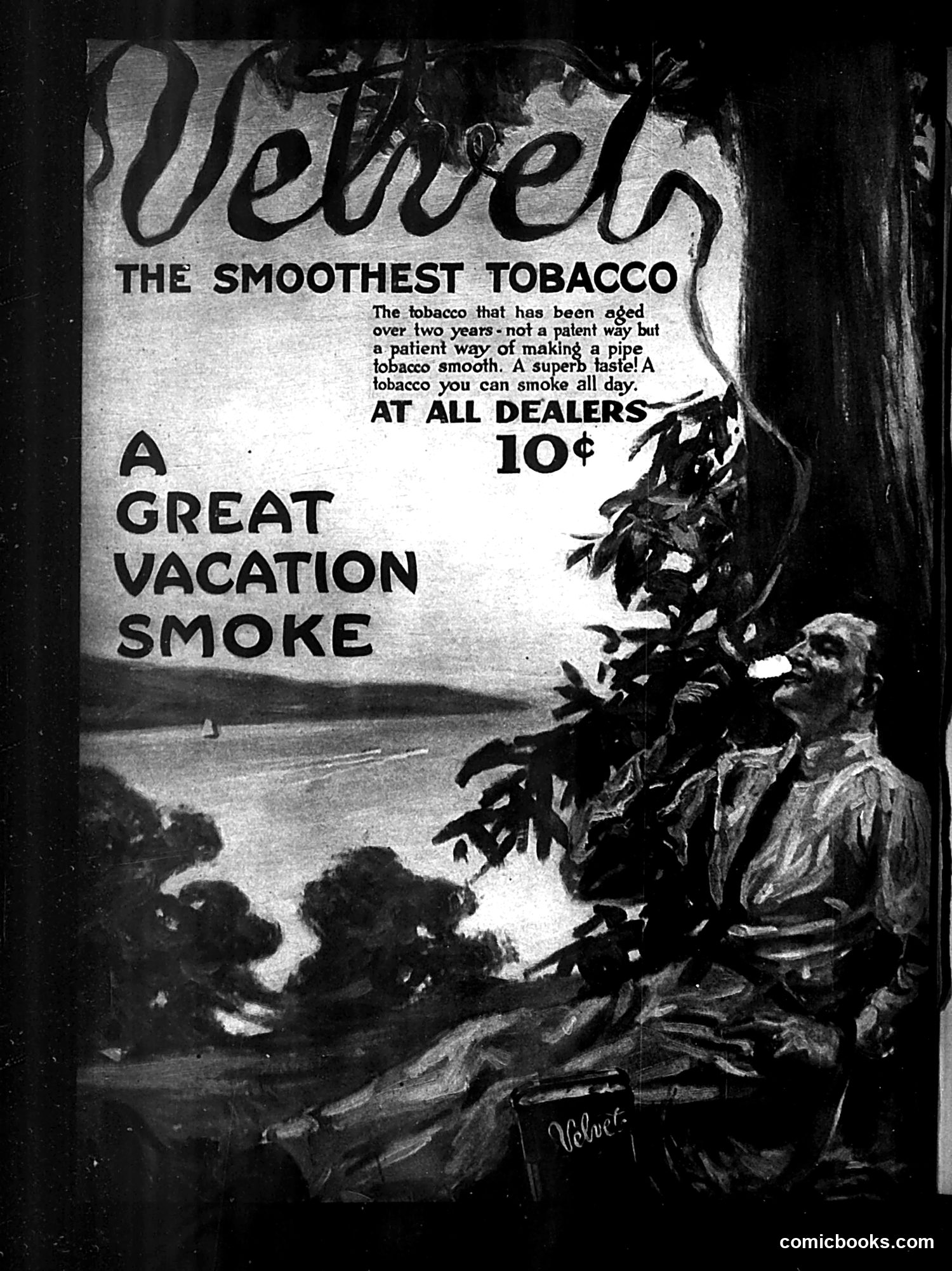
This is a **tobacco product advertisement**, not political satire. It promotes "Velvet" pipe tobacco at 10 cents, emphasizing its smoothness from two-year aging. The ad uses a picturesque vacation scene—a man relaxing by water with tropical foliage—to associate the product with leisure and pleasant experiences. The tagline "A Great Vacation Smoke" suggests the tobacco enhances relaxation. The imagery is typical early-20th-century advertising, romanticizing smoking as a desirable lifestyle activity. There is no political commentary or social satire present. This reflects the era when tobacco marketing was unrestricted and smoking was widely promoted without health warnings.
I can see this is a page from *Judge* magazine (as indicated by the watermark), but the image is almost entirely black with only faint white edges visible on the left and right sides. The OCR text provides only a website reference ("comicbooks.com") with no actual article or caption content. Without legible text or discernible cartoon imagery, I cannot identify specific figures, political references, or satirical points. The page appears to be either a title page, advertising page, or a heavily degraded scan that has rendered the content illegible. To provide accurate historical analysis, I would need a clearer image showing the actual cartoon(s) or article text.